
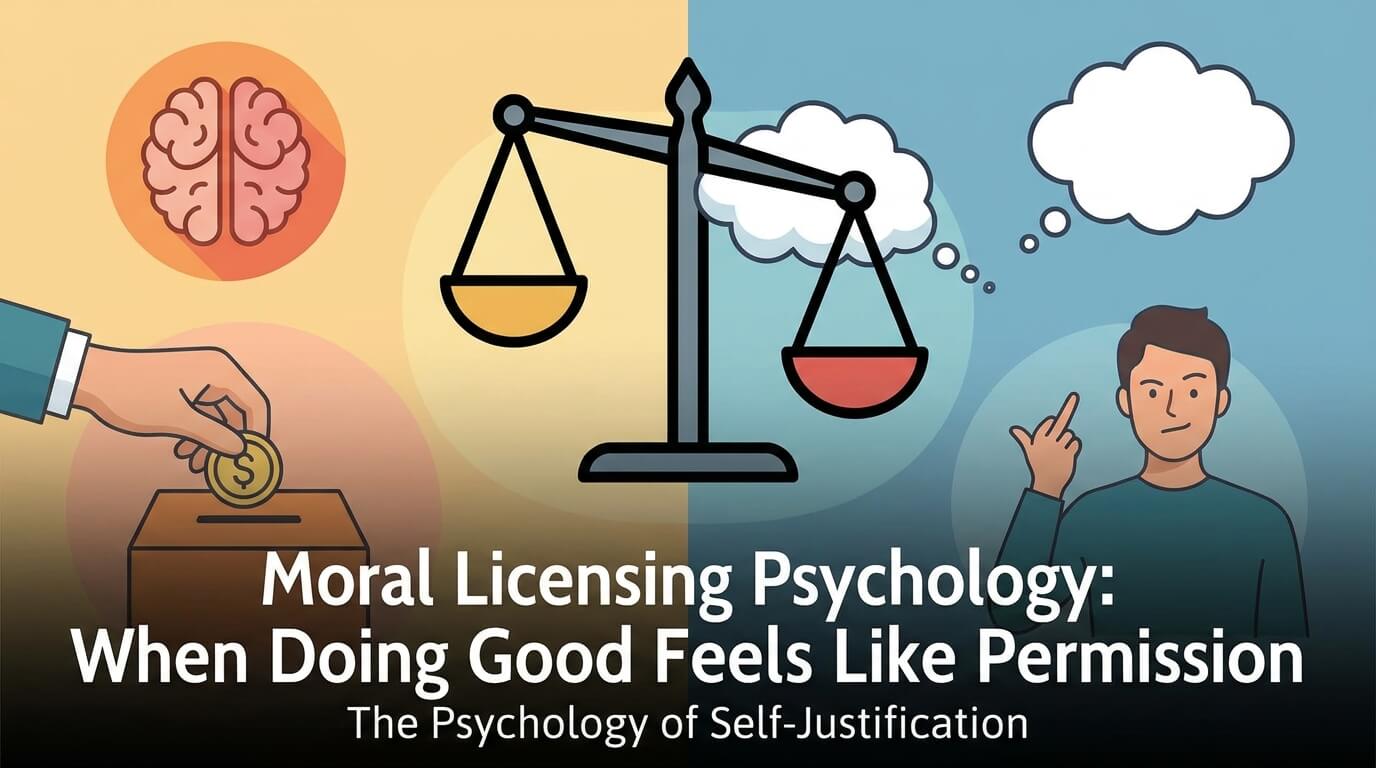
You donate to a cause, then feel less concerned about a selfish choice later. You apologize after hurting someone, then treat the apology as proof that the issue should be over. You remind yourself that you are usually generous, honest, or responsible, and the current exception begins to feel less serious.
This is the basic idea behind moral licensing: a good action, intention, identity, or reputation may sometimes make a later questionable choice feel more acceptable. The earlier behavior functions like moral credit. Instead of asking whether the present action fits the standard, the mind quietly asks whether enough goodness has already been accumulated to offset it.
The effect is not automatic, universal, or equally strong in every situation. Good behavior can also reinforce consistency. A person who acts honestly may become more committed to honesty rather than less. Moral licensing is most useful as a possible explanation for self-justification, not as a rule that predicts what every person will do.
Quick Answer
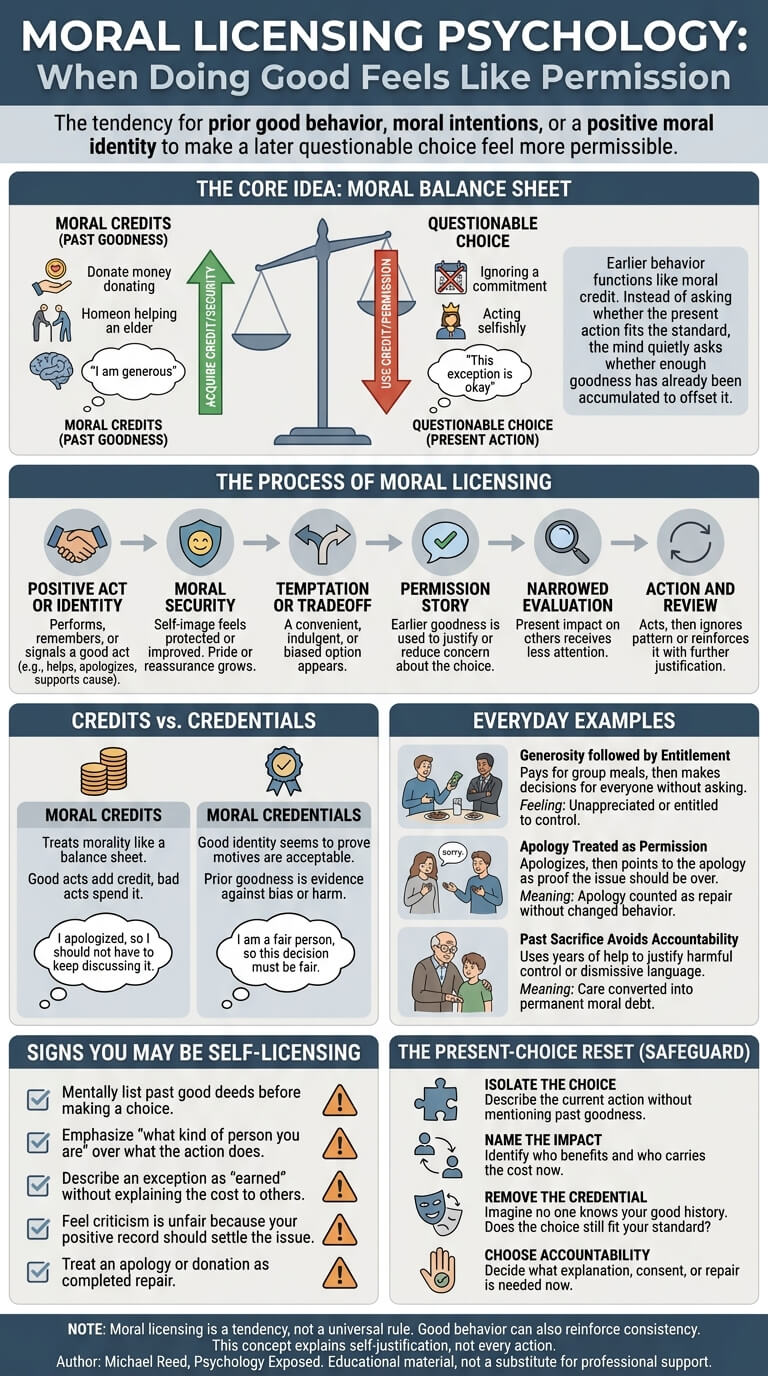
Moral licensing psychology describes the tendency for prior good behavior, moral intentions, or a positive moral identity to make a later questionable choice feel more permissible. The earlier act may function as a credit, credential, or proof of good character. A practical safeguard is to evaluate the present choice on its own impact, standard, and consequences rather than using past goodness as a moral balance sheet.
What Moral Licensing Means
Moral licensing is often described as a form of self-licensing. A person performs, remembers, plans, or displays something positive, then becomes more willing to accept conduct they would normally question. The licensing thought may be explicit, such as “I have earned this,” or subtle, such as feeling less need to examine the present decision carefully.
A discussion of moral licensing and instrumental apology describes how a good act can be used to justify, soften, or cover a questionable act. The important feature is not simply that good and bad behavior occur in sequence. It is that the good behavior becomes part of the justification.
Prior goodness changes how a later choice is interpreted
Imagine someone who has spent the morning helping a relative. Later, they ignore a commitment to another family member and think, “I have already done more than anyone else today.” The earlier help is real. The later choice may still need evaluation. Licensing occurs when the first act changes the moral interpretation of the second without changing its actual impact.
The person may not decide consciously to trade one act against another. The positive self-image created by helping can reduce discomfort, self-monitoring, or perceived need for consistency.
Moral credits: a good act seems to offset a bad one
The credits model treats morality like a balance sheet. A generous act adds credit. A selfish choice spends some of it. The person may believe that the total account remains positive, so the current exception is acceptable.
This logic appears in thoughts such as “I usually do more than my share,” “I already gave money,” or “I apologized, so I should not have to keep discussing it.” The problem is that the affected person experiences the present behavior, not the actor’s private total of past goodness.
Moral credentials: a good identity seems to prove motives are acceptable
Credentials work differently. Instead of offsetting a later act, prior goodness is treated as evidence that the later act cannot reflect bias, selfishness, or harmful intention. “I am a fair person, so this decision must be fair.” “I have always supported them, so my criticism cannot be dismissive.”
A positive history can provide relevant context, but it does not make present conduct immune from examination. Good character is not a substitute for checking impact.
Why licensing is a tendency, not a guaranteed sequence
The same good act may produce opposite outcomes. One person becomes more consistent because the action strengthens a valued identity. Another feels morally secure enough to permit an exception. Context, framing, identity, effort, social feedback, and the type of later choice may all matter.
This uncertainty is important because evidence for moral licensing is mixed. Some studies find licensing effects, while others find little or no effect in particular tasks. The concept should be applied cautiously and behavior should be examined directly.
The Moral Licensing Process
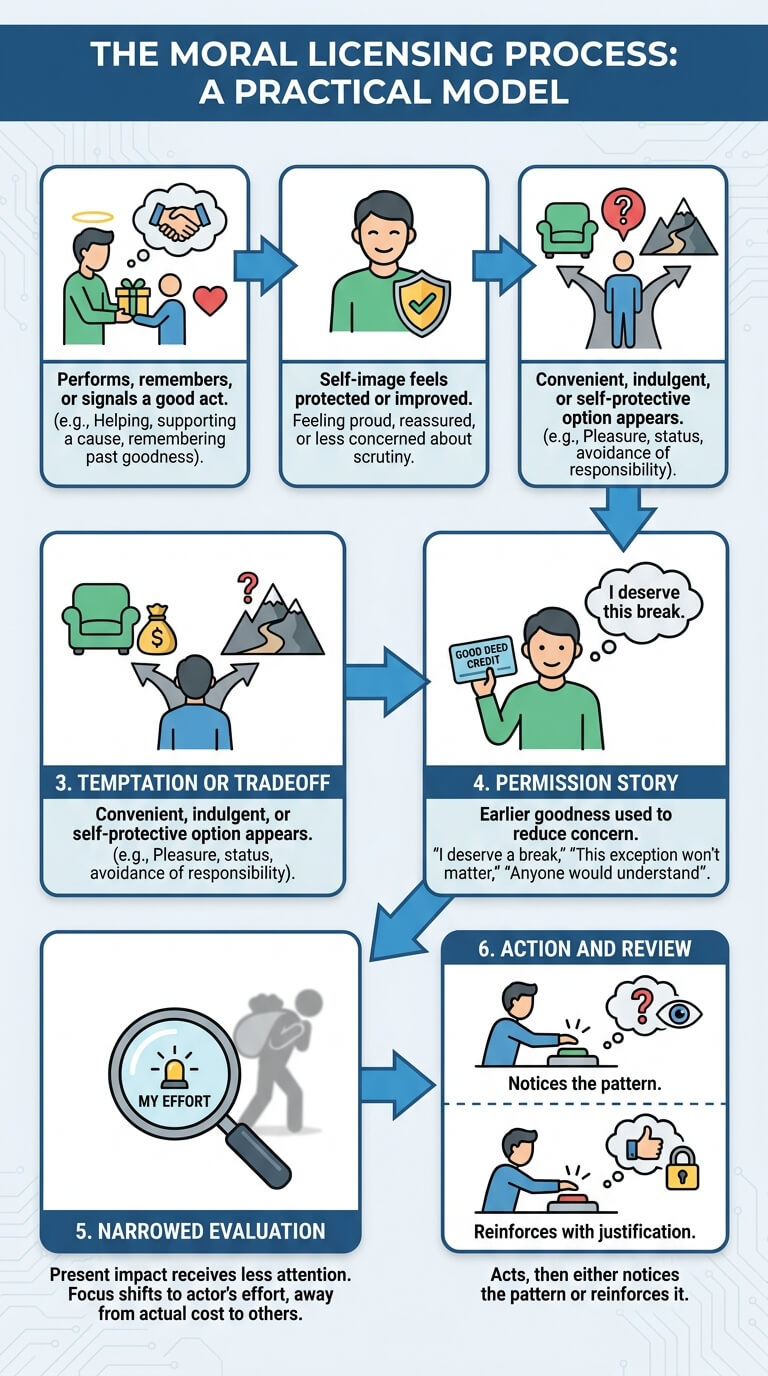
Moral licensing becomes easier to notice when it is broken into steps. The sequence below is not a diagnosis. It is a practical model for examining how an earlier positive act may influence a later choice.
- Positive act or identity: The person helps, sacrifices, apologizes, supports a cause, or remembers being a good person.
- Moral security: Their self-image feels protected or improved.
- Temptation or tradeoff: A convenient, indulgent, biased, or self-protective option appears.
- Permission story: The earlier goodness is used to reduce concern about the current choice.
- Narrowed evaluation: Present impact receives less attention.
- Action and review: The person acts, then either notices the pattern or reinforces it with further justification.
A person performs, remembers, or signals a good act
The first step does not require a dramatic sacrifice. It may be a small act of generosity, a statement of good intention, a public expression of support, or a memory of past responsibility. Even planning a future good act may sometimes create a sense of moral progress before the act occurs.
The positive behavior can be sincere. Licensing does not mean the good act was fake. It concerns how that act is later used.
Moral self-image feels secure
After behaving well, a person may feel proud, reassured, or less concerned about how others see them. That security can support continued consistency. It can also reduce the felt need to prove morality through the next decision.
The risky shift is from “I did something good” to “This proves that my next choice does not need the same scrutiny.”
A later temptation or tradeoff appears
The later choice often offers convenience, pleasure, status, relief, or avoidance of responsibility. It may involve spending, honesty, fairness, effort, bias, apology, environmental behavior, or treatment of another person.
Licensing is more likely to matter when the choice is ambiguous enough to support several interpretations. Clear wrongdoing is harder to justify than a decision that can be described as deserved, harmless, temporary, or exceptional.
The questionable choice is reframed as earned, harmless, or exceptional
The mind may say, “I deserve a break,” “This one exception will not matter,” or “Anyone who knows my record would understand.” These thoughts are not always licensing. Rest and legitimate exceptions can be reasonable. The concern is whether past goodness is being used to avoid evaluating the current cost.
Attention shifts away from the new action’s actual impact
Once permission is granted, attention may move toward the actor’s effort and away from the person who carries the burden. An apology becomes proof of goodness rather than a first step in repair. A donation becomes the central fact while a later harmful choice is minimized.
The present-action reset restores the missing question: what does this choice do now, regardless of what happened before?
Everyday Moral Licensing Examples
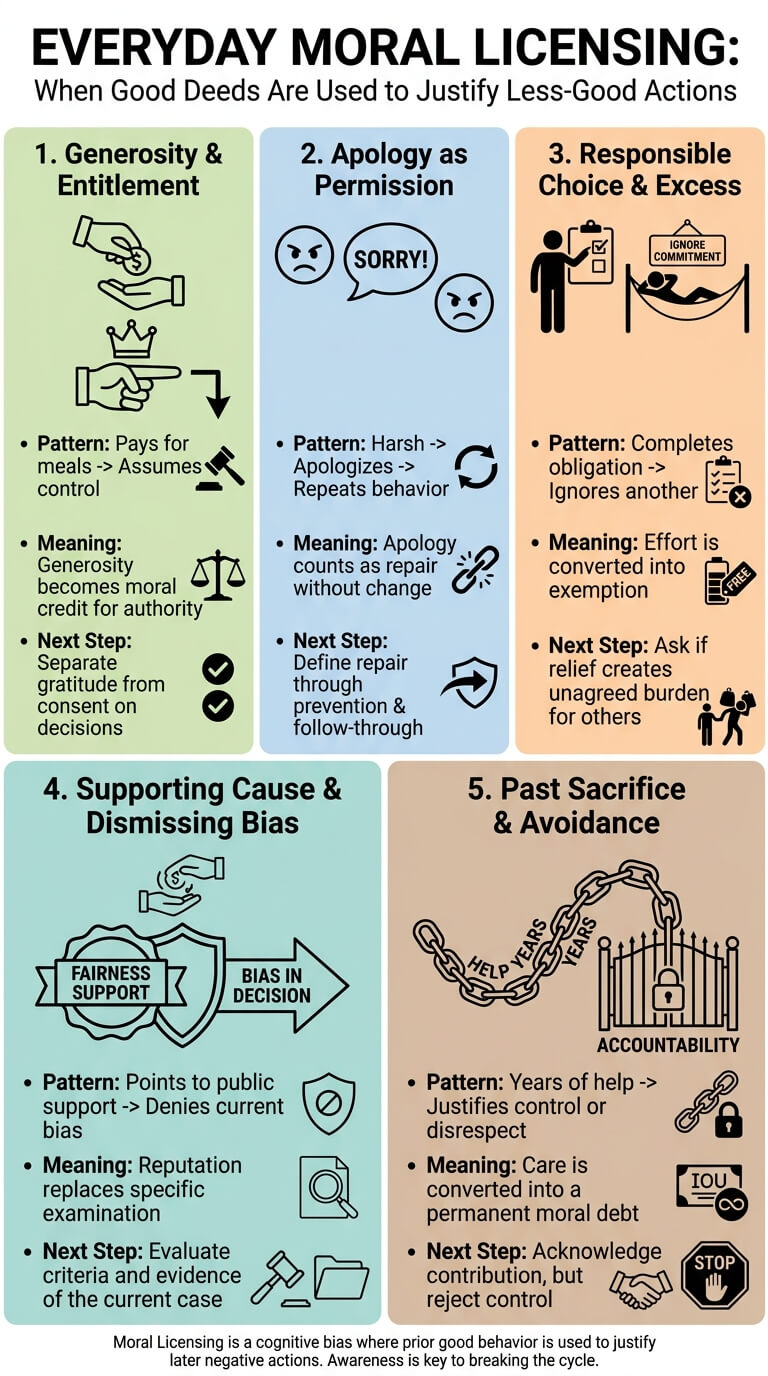
Generosity followed by entitlement
A person pays for several group meals, then begins making decisions for everyone without asking. They may feel that generosity has earned extra authority. The gift was real, but it did not purchase control.
What the person may feel: unappreciated or entitled to a return.
What it may mean: generosity has become a moral credit attached to unrelated power.
What to do next: separate gratitude for the gift from consent about the present decision.
An apology treated as permission to repeat the behavior
Someone speaks harshly, apologizes, and expects the apology to close the issue immediately. When the behavior happens again, they point to how quickly they apologize as evidence that they care.
What the person may feel: morally restored after saying sorry.
What it may mean: the apology is being counted as repair without changed behavior.
What to do next: define repair through prevention, follow-through, and reduced recurrence.
One responsible choice used to justify excess
A person completes an important obligation, then treats that success as permission to ignore another commitment. The later choice may be reasonable rest, or it may transfer the cost to someone else.
What the person may feel: deserving of relief.
What it may mean: effort is being converted into exemption.
What to do next: ask whether the relief is self-contained or creates an unagreed burden for another person.
Supporting a cause used to dismiss bias in another context
Someone points to public support for fairness as evidence that a separate biased decision cannot be biased. Their earlier position becomes a credential that protects the present choice.
What the person may feel: unfairly accused because their identity seems proven.
What it may mean: moral reputation is replacing examination of the specific decision.
What to do next: evaluate the criteria, evidence, and outcome of the current case.
Past sacrifice used to avoid present accountability
A family member has provided years of help and later uses that history to justify controlling choices, dismissive language, or refusal to respect boundaries. Past sacrifice may deserve recognition. It does not create unlimited permission.
What the person may feel: that their sacrifices have not been repaid.
What it may mean: care has been converted into a permanent moral debt.
What to do next: acknowledge the contribution while rejecting control, humiliation, threats, or retaliation.
Why Good Behavior Can Create Permission
Moral balance-sheet thinking
Balance-sheet thinking treats moral behavior as exchangeable units. Good actions add credit, questionable actions subtract it, and the person judges the total rather than the present impact.
This mental accounting can feel reasonable because people often evaluate patterns over time. The error is assuming that one person’s benefit can automatically cancel another person’s harm, or that an unrelated good act removes the need for present accountability.
Identity protection and reduced self-monitoring
People prefer to see themselves as decent and trustworthy. Once that identity feels secure, they may monitor later choices less closely. The question shifts from “Does this action fit my standard?” to “Would a good person like me really do something wrong?”
The second question favors self-protection because the answer is already built into the identity.
Effort, deprivation, and the feeling of having earned relief
Effort naturally creates a desire for recovery or reward. That is not inherently moral licensing. The distinction depends on what the reward costs and whether the earlier effort is being used to justify harm, dishonesty, unfairness, or an unagreed burden.
Rest after caregiving may be necessary. Expecting another person to absorb all responsibilities without discussion because you have “done enough” may be licensing or a fairness conflict. The current arrangement still needs consent and clarity.
Ambiguity allows a favorable interpretation
Licensing thrives where a choice can be framed in several ways. A person can call a self-serving decision practical, a broken promise unavoidable, or a biased choice merely intuitive. The earlier good act makes the favorable interpretation easier to accept.
Clear criteria established before the decision reduce this flexibility. It is harder to rewrite a standard after learning who benefits when the rule was stated in advance.
Social praise can strengthen a moral credential
Recognition from others can reinforce the belief that one’s character has been established. Praise may encourage future good conduct, but it can also make criticism feel incompatible with the approved identity.
Observer licensing can occur too. Research on moral observer-licensing in online settings found that people judged questionable conduct less harshly when the actor had a prior record of moral behavior. The audience, not only the actor, may use past goodness as permission.
Moral Licensing Versus Nearby Concepts
| Concept | Core pattern | Main question |
|---|---|---|
| Moral licensing | Past or planned goodness makes a later questionable choice feel permitted | Would this choice seem acceptable without the earlier good act? |
| Moral hypocrisy | Standards are applied unevenly to protect image or advantage | Would the same rule apply if roles changed? |
| Ordinary reward | Effort is followed by rest, pleasure, or compensation | Does the reward create unagreed harm or violate the claimed standard? |
| Moral cleansing | A good act follows wrongdoing to restore self-worth or repair | Does the later good act address impact or merely reduce guilt? |
| Depleted self-control | Fatigue or strain reduces careful regulation | Is the choice justified through goodness, or mainly linked to exhaustion? |
| Principled exception | A relevant difference justifies different treatment | Would the same exception apply in comparable cases? |
Moral licensing versus moral hypocrisy
Hypocrisy focuses on unequal standards across people, groups, or public and private behavior. Licensing focuses on permission across time. The two can overlap. A person may use past goodness to justify an exception for themselves while judging others more strictly.
Moral licensing versus ordinary reward
A reward is not automatically unethical. Taking a break, enjoying a meal, or celebrating progress may be appropriate. Licensing becomes relevant when the reward is used to excuse a separate harm, broken agreement, unfair burden, or dishonest choice.
Moral licensing versus moral cleansing
Moral cleansing usually describes good behavior after a transgression. It may support real repair, or it may simply help the person feel better. The key difference is whether the good act addresses the specific impact and whether accountability continues.
Moral licensing versus burnout or depleted self-control
Exhaustion can reduce patience, attention, and inhibition. A tired person may make a poor choice without using previous goodness as permission. Licensing includes a justificatory link: “Because I did something good, this exception is acceptable.”
Moral licensing versus a legitimate exception
Exceptions can be fair when they respond to relevant differences in urgency, capacity, risk, or responsibility. A principled exception can be stated in advance and applied to comparable cases. A license is more likely to appear after the desired outcome is known.
What Research Can and Cannot Tell Us
Evidence that licensing appears in some contexts
Experiments and observational studies have found situations where prior moral behavior or moral credentials influence later judgment and conduct. Observer studies also suggest that audiences may become more forgiving when an actor has an established positive record.
These findings support treating moral licensing as a possible process, especially when a good act appears directly in the justification for a later exception.
Replication, effect-size, and publication-bias cautions
The evidence is not uniformly strong. An analysis of publication bias in moral licensing research concluded that earlier estimates of the effect may have been inflated and recommended adequately powered, preregistered studies.
A registered replication has also revisited the moral credentials pathway, reflecting the field’s effort to test how robust and domain-specific the effect is. This is a reason for careful language, not a reason to dismiss the concept entirely.
Why identity, framing, and the type of behavior matter
Licensing may depend on whether the earlier act feels morally relevant, whether it reinforces consistency, whether the later choice is ambiguous, and whether the person is focused on identity or specific conduct. A good act framed as “this is who I am” may support consistency in one setting and credential-based permission in another.
Avoiding one-cause explanations for complex choices
People act for many reasons. Fatigue, incentives, social pressure, habit, fear, convenience, and missing information may explain a questionable decision better than moral licensing. One laboratory study reported no evidence of moral licensing in a bribe-taking task, illustrating that the effect does not appear reliably in every design.
Use the concept when the permission story is visible. Do not use it as a hidden motive assigned to someone without evidence.
Signs You May Be Self-Licensing
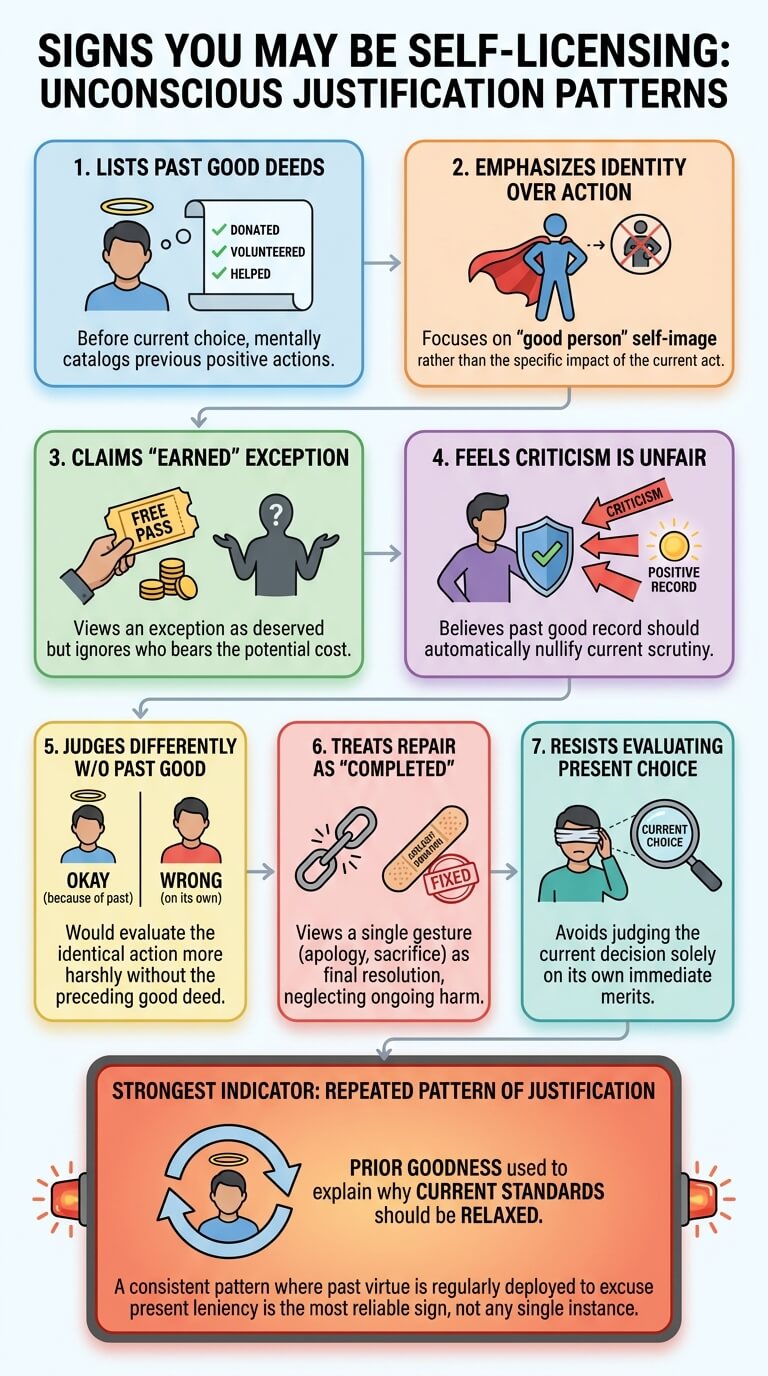
- You mentally list past good deeds before making the current choice.
- You emphasize what kind of person you are rather than what the action does.
- You describe an exception as earned but cannot explain who will carry its cost.
- You feel that criticism is unfair because your positive record should settle the issue.
- You would judge the same action differently without the earlier good deed.
- You treat an apology, donation, sacrifice, or public statement as completed repair.
- You resist evaluating the present choice on its own terms.
One sign is not proof. The strongest indicator is a repeated pattern in which prior goodness appears in the explanation for why current standards should be relaxed.
The Present-Choice Reset
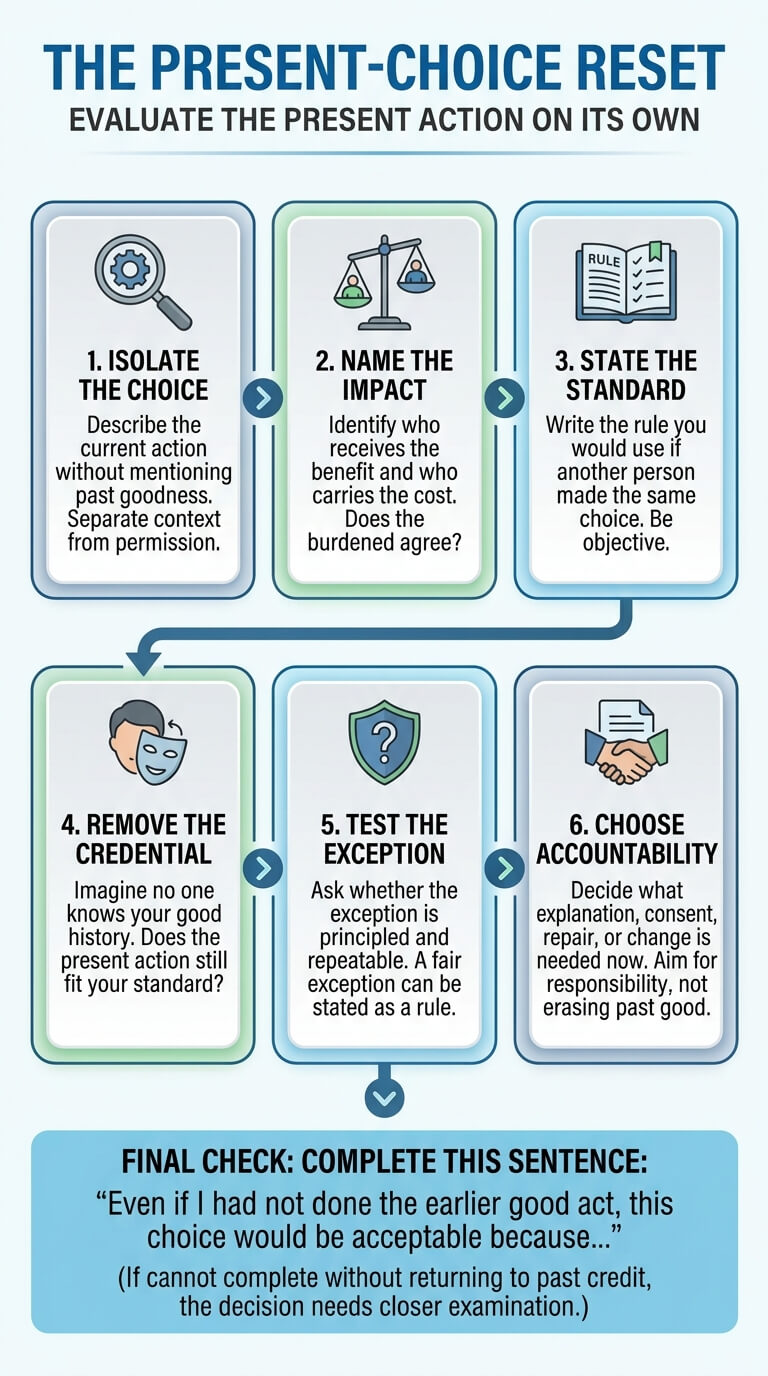
The Present-Choice Reset removes past moral credit from the decision long enough to examine the current action clearly.
For choices involving several competing harms or duties, a broader ethical decision-making process can supplement this reset by making stakeholders, rights, and tradeoffs explicit.
- Isolate the choice: Describe what you are considering without mentioning past goodness.
- Name the impact: Identify who receives the benefit and who carries the cost.
- State the standard: Write the rule you would use if another person made the same choice.
- Remove the credential: Imagine that no one knows your good history.
- Test the exception: Ask whether the same exception would apply in comparable conditions.
- Choose accountability: Decide what explanation, consent, repair, or change is needed now.
Evaluate the present action on its own
Complete this sentence: “Even if I had not done the earlier good act, this choice would be acceptable because…” If the sentence cannot be completed without returning to past credit, the decision needs closer examination.
Name who benefits and who carries the cost
Licensing often centers the actor’s effort and hides another person’s burden. List the benefit, the burden, and whether the person carrying the burden agreed to it.
Ask whether the exception is principled and repeatable
A fair exception can be stated as a rule. “Anyone who handled the emergency shift may rest the next morning after arranging coverage” is repeatable. “I deserve to disappear because I have done more good than everyone else” is not.
Imagine the choice without the earlier good act
Remove the donation, apology, sacrifice, public statement, or positive identity. Does the present action still fit your standard? This step separates context from permission.
Decide what accountability looks like now
Accountability may involve asking consent, changing the plan, acknowledging impact, returning a resource, correcting a statement, or preventing recurrence. The aim is not to erase past goodness. It is to stop past goodness from replacing present responsibility.
How to Interrupt Moral Licensing
Replace moral identity claims with behavior-specific standards
Instead of “I am a generous person,” use “I do not attach control or repayment to gifts.” Instead of “I am fair,” use “I state the criteria before knowing who benefits.” Specific standards are harder to protect through reputation alone.
Treat good actions as commitments rather than credits
A good act can reinforce what you want to continue. “Helping reminds me that I value responsibility” supports consistency. “Helping proves I have earned an exception” creates a credit.
Build decision rules before temptation or pressure appears
Decide in advance how shared responsibilities, exceptions, apologies, or conflicts of interest will be handled. Precommitment reduces the opportunity to rewrite the rule around the preferred outcome.
Use role reversal and future-pattern questions
Ask whether you would accept the same explanation from another person. Then ask, “What pattern would form if I made this exception every time I had recently done something good?” A choice that seems harmless once may look different as a repeated rule.
Repair impact without using repair as a new license
An apology or corrective act should address the specific harm. It should not become fresh credit that excuses the next repetition. Repair is demonstrated through changed behavior, not only renewed moral self-image.
An apology may reduce guilt or shame, but emotional relief should not become moral credit that replaces repair or changed behavior.
How Licensing Can Turn Into Hypocrisy or Distort Ethical Choices
When self-licensing becomes a repeated double standard
If a person repeatedly grants themselves permission based on past goodness while denying comparable exceptions to others, licensing begins to resemble hypocrisy. The temporal credit has become an unequal rule.
How pressure and conflict of interest make licensing easier
Pressure creates a strong desire for a favorable explanation. A positive moral identity supplies one. Conflicts of interest deserve extra structure because the person benefits from concluding that the exception is harmless.
Why current impact should remain visible
Moral accounting often compares the actor’s good history with the actor’s current choice. The missing perspective is the person affected now. Keeping present impact visible makes it harder for unrelated credit to dominate the decision.
When Moral Debt Becomes Control or Coercion
Past help, sacrifice, gifts, apologies, or loyalty do not create permission to control another person. Statements such as “After everything I have done for you” may express genuine hurt, but they can also be used to demand access, obedience, money, silence, or forgiveness.
If moral debt is enforced through threats, humiliation, stalking, isolation, financial control, intimidation, or retaliation, prioritize safety and qualified support. Do not rely on explaining moral licensing to someone who uses fear to maintain power.
Frequently Asked Questions About Moral Licensing
Does rewarding yourself after doing good count as moral licensing?
Not automatically. A reward may be healthy, planned, and self-contained. Moral licensing is more likely when the reward violates a standard, creates an unagreed burden, or is justified mainly by moral credit rather than its own reasonableness.
Can an apology create a licensing effect?
Yes, if the apology is treated as proof that accountability is complete or as permission to repeat the behavior. A sincere apology can also support repair. The difference appears in follow-through, reduced recurrence, and willingness to address impact.
Is moral licensing always unconscious?
No. Some permission thoughts are explicit, such as “I earned this exception.” Others are subtle and appear as reduced concern or more favorable interpretation. Conscious awareness is not required, but the process should not be assumed without evidence.
What is the difference between moral credits and moral credentials?
Credits offset a later questionable act, as if morality were a balance sheet. Credentials provide evidence that the person is good, so the later act is interpreted more favorably. Both can reduce scrutiny, but they do so through different stories.
How strong is the evidence for moral licensing?
Research has found licensing effects in some settings, but replication and publication-bias analyses suggest that earlier estimates may have overstated the size or reliability of the effect. It is best treated as a context-dependent possibility rather than a universal law of behavior.
Key Takeaways
- Moral licensing occurs when past, planned, remembered, or displayed goodness makes a later questionable choice feel more permissible.
- Moral credits offset behavior, while moral credentials protect identity and motives.
- Good behavior can also promote consistency, so licensing should not be treated as inevitable.
- Ordinary rewards, principled exceptions, moral cleansing, fatigue, hypocrisy, and licensing are related but distinct.
- The Present-Choice Reset evaluates current impact without using past goodness as a balance sheet.
- Apologies, gifts, sacrifice, and support do not create unlimited permission, control, or exemption from accountability.
Choose one recent decision in which you thought, “I have earned this.” Remove the earlier good act from the explanation and evaluate the present choice again. Keep the reward if it remains fair and self-contained. Change the plan if the justification depends on another person carrying a cost they did not choose.
Author note: Michael Reed is the Founder and Lead Writer at Psychology Exposed. He explains human behavior, emotional patterns, self-awareness, relationships, and everyday decisions in clear, research-aware language. This material is educational and is not a substitute for mental health, legal, safety, financial, or crisis support.

Michael Reed is the Founder and Lead Writer at Psychology Exposed. He writes about human behavior, relationships, emotional patterns, self-awareness, and practical psychology topics using research-informed, easy-to-understand content.
Read More About Michael Reed: https://psychologyexposed.com/michael-reed/