
You walk into a meeting and one person barely looks up. A friend answers your message with two words. Someone smiles while disagreeing with you. Within seconds, your mind begins building an explanation: distracted, annoyed, shy, dismissive, nervous, confident, interested, or something else.
This is social perception. It is the everyday process of noticing social information and using it to form an impression of another person. The process feels immediate, but it is not direct access to someone else’s mind. You receive fragments, such as words, tone, expressions, timing, behavior, context, and history, then combine them into a working interpretation.
That interpretation may be useful, incomplete, or mistaken. A more realistic skill is separating observation from inference and updating your view as later behavior adds context.
Quick Answer: Social Perception Builds a Person From Limited Cues

Social perception psychology examines how people form impressions, interpret behavior, infer emotions or intentions, and revise those judgments over time. According to the APA Dictionary definition of social perception, the process involves using another person’s behavior to form opinions or make inferences about motives, attitudes, or values. The key word is inference. What you notice is real input, but the meaning you assign is a conclusion rather than a direct reading of the person.
People combine behavior, context, and prior knowledge
A short reply can mean irritation, hurry, fatigue, uncertainty, or simply a concise communication style. Your mind does not evaluate each option from zero. It uses the situation, your relationship history, social expectations, and familiar patterns to choose a likely meaning.
Impressions can form quickly but remain revisable
Fast impressions help you navigate unfamiliar people and situations without lengthy analysis. They become risky when speed is confused with certainty. A first impression is best treated as an early hypothesis that may become stronger, weaker, or more complicated as new information appears.
A cue is not the same as a proven intention
A crossed arm, delayed response, flat tone, or brief frown may deserve attention. None of these cues proves a hidden motive by itself. The same visible behavior can come from many internal states, so confidence should rise only when multiple cues, context, and repeated behavior point in the same direction.
What Social Perception Includes
Social perception is broader than reading faces or body movements. It includes the full chain from noticing a cue to deciding what that cue may mean about a person in a particular situation.
Noticing social cues
Before you can interpret another person, something must attract attention. It may be a change in voice, a pause before answering, an unusual word choice, direct eye contact, or silence where you expected a response. Salient cues can feel more important simply because they stand out.
Organizing cues into an impression
The mind rarely stores each cue as an isolated fact. It groups them into a coherent picture, such as friendly, guarded, capable, uncertain, impatient, or trustworthy. This organization is efficient, but it can make scattered details seem overly consistent.
Inferring traits, emotions, goals, and intentions
You may infer a temporary emotion, such as embarrassment, or a stable trait, such as confidence. You may also infer a goal, such as wanting approval, or an intention, such as trying to exclude someone. These are different claims. A visible action can support several possibilities, and each requires a different level of evidence.
Updating an impression over time
A fair interpretation is not frozen at first contact. A quiet coworker may become animated in smaller groups. A warm acquaintance may repeatedly fail to follow through. Updating means allowing repeated behavior and changing context to reshape the original impression rather than forcing every new detail to fit it.
Social perception is one application of the broader process of selecting and interpreting information.
The Social Perception Process

A useful way to understand social perception is to see it as a sequence. The steps happen quickly and often overlap, yet separating them reveals where uncertainty enters.
Cue availability
You can interpret only the information available to you. In person, you may hear timing and tone while seeing movement and expression. In a text message, many of those channels disappear. A judgment based on fewer channels should usually be held more lightly.
Attention and salience
Some cues receive more weight because they are vivid, unexpected, emotionally charged, or personally relevant. A single awkward comment may dominate your impression even when the rest of the interaction was ordinary. What captures attention is not automatically what best represents the person.
Context and role expectations
The same behavior can carry different meanings across settings. Direct speech may sound efficient in an emergency, harsh in a personal conversation, or normal within a particular workplace. Roles also shape expectation. You may read silence differently from a manager, a close friend, a stranger, or someone who is still learning the language.
Trait or intention inference
After noticing behavior, the mind asks what caused it. It may attribute the action to the person, the situation, or both. A person who leaves early might seem uninterested, yet they may have childcare responsibilities, a migraine, or another commitment that you cannot see.
Feedback from later interaction
Your interpretation affects how you behave, and your behavior can change what happens next. If you assume someone is unfriendly, you may become brief and distant. They may then respond cautiously, which appears to confirm the original belief. Later interaction is useful evidence, but it is not independent of how you entered the exchange.
The Main Sources of Social Information

People usually build impressions from several channels at once. Accuracy improves when the channels are considered together and interpreted within the situation.
Words and content
Words provide the clearest record of what was explicitly communicated. Even so, literal content does not always reveal emphasis, uncertainty, humor, or emotional meaning. Listen for what was said, what was avoided, and whether the message remains consistent across time, without treating one phrase as a complete personality profile.
Tone, timing, and conversational pattern
Volume, pace, hesitation, interruption, and response timing can shape how words are received. A pause may signal thoughtfulness, discomfort, distraction, or difficulty finding language. Patterns across several exchanges usually tell you more than one pause or one change in tone.
Facial expression and gaze
Faces can communicate emotion and attention, but expressions are influenced by context, culture, habit, and deliberate control. A brief expression may be meaningful without explaining its cause. Seeing tension on someone’s face does not tell you whether they are upset with you, worried about something else, or physically uncomfortable.
Posture, movement, and distance
Movement and personal space provide information about engagement, readiness, comfort, and social norms. These cues are flexible rather than fixed. Folding the arms may reflect coldness, comfort, habit, self-protection, or simply being cold. The surrounding pattern matters more than a decoding rule.
Situation, role, and relationship history
Context often explains behavior better than appearance alone. A rushed nurse, cautious new employee, grieving friend, or exhausted parent may act differently from their usual baseline. Relationship history matters too. The meaning of a joke between old friends cannot be judged only from the words heard by an outsider.
Reputation and secondhand information
Other people’s descriptions can prepare you to notice certain traits before you meet someone. Reputation may contain useful warnings, but it can also filter the encounter. Treat secondhand information as context to verify, not as a substitute for direct evidence.
First Impressions
First impressions are a normal part of social navigation. The problem is not that they exist, but that they often feel more complete than the information behind them.
Why speed can be useful
Quick judgments help people decide where to direct attention, how formal to be, and whether a situation appears welcoming or uncertain. Research reviewed in First Impressions From Faces shows that observers readily form trait impressions from facial appearance. Speed can help organize a first response, but an immediate impression is not the same as an accurate description of character.
Why limited evidence creates uncertainty
A first meeting samples a narrow slice of behavior. The person may be tired, nervous, performing a role, adjusting to the setting, or responding to something you do not know about. The less representative the situation, the less confidently it should be used to predict how the person behaves elsewhere.
How later information can revise an impression
Revision requires more than collecting details that fit your opening view. Notice disconfirming moments as well. Someone who seemed distant may consistently help others. Someone who seemed highly confident may avoid responsibility when decisions become difficult. Repeated behavior across situations provides a stronger basis than charisma or awkwardness at first contact.
Warmth and Competence as an Impression Framework
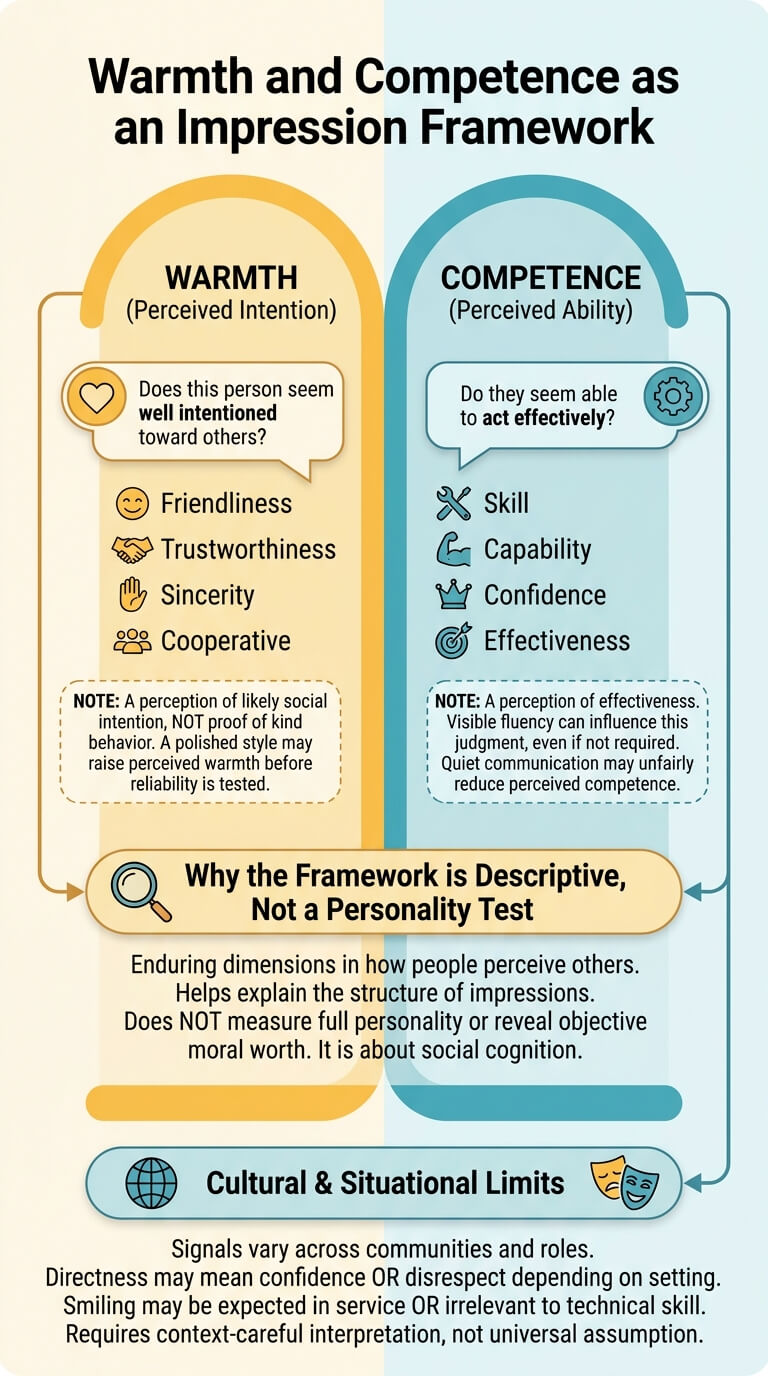
Many social impressions can be described partly through two broad questions: Does this person seem well intentioned toward others, and do they seem able to act effectively? Researchers often discuss these dimensions as warmth and competence.
Warmth as perceived intention or friendliness
Warmth includes impressions related to friendliness, trustworthiness, sincerity, and whether someone appears cooperative. It is a perception of likely social intention, not proof that the person will behave kindly. A polished friendly style may raise perceived warmth before reliability has been tested.
Competence as perceived ability or effectiveness
Competence includes impressions of skill, capability, confidence, and effectiveness. Visible fluency can influence this judgment, even when the task does not require public speaking. Quiet or hesitant communication may reduce perceived competence unfairly when the person’s actual work is strong.
Why the framework is descriptive, not a personality test
A major review of warmth and competence in social cognition describes these as enduring dimensions in how people perceive individuals and groups. They help explain the structure of impressions, but they do not measure a person’s full personality or reveal objective moral worth.
Cultural and situational limits
Signals of warmth and competence vary across communities and roles. Directness may communicate confidence in one setting and disrespect in another. Smiling may be expected in customer service but irrelevant to technical skill. A culturally careful interpretation asks what the behavior means in that context before treating it as universal.
How People Infer Intentions
Intentions are especially tempting to infer because they help behavior feel understandable. They are also difficult to observe directly.
Behavior does not explain itself
The action is visible, but its purpose is not. Someone changes the subject. That could be avoidance, politeness, confusion, embarrassment, time pressure, or an attempt to protect another person’s privacy. Naming the action accurately is easier than proving why it happened.
Context narrows possible motives
Situational information can make some explanations more plausible than others. Research on person and situation attributions illustrates how observers consider whether an event is better explained by the individual or by circumstances. Good social judgment keeps both possibilities available long enough to compare them.
Ambiguity invites prior expectations
When evidence is unclear, earlier experiences fill the gap. If a previous colleague repeatedly took credit for your work, a vague comment from a new colleague may feel suspicious. The past matters, yet similarity in feeling does not prove similarity in motive.
Role expectations and prior context may create a perceptual set before a person’s behavior is fully interpreted.
Confidence should remain proportional to evidence
Use language that matches what you know. “They paused after I asked” describes an observation. “They were uncomfortable” is an interpretation. “They are hiding something” is a stronger claim. Moving between these levels without noticing can turn a possibility into a certainty.
Social Perception and Emotion
Your emotional state changes what feels important, threatening, safe, or familiar. This influence does not make every interpretation wrong. It does mean that feeling certain and having strong evidence are separate things.
Anxiety can increase threat interpretation
When you feel socially anxious, ambiguous cues may be easier to read as rejection, criticism, or embarrassment. Research on interpretation in social anxiety discusses how negative beliefs can shape the meaning assigned to unclear social information. This is not a diagnosis, and anxiety may sometimes respond to a real problem. The practical step is to check evidence before treating ambiguity as confirmation.
Anger can increase hostile readings
Anger prepares attention for unfairness, obstruction, and disrespect. In that state, a neutral interruption may feel deliberate or contemptuous. Pause before assigning motive, especially when the visible action could have several causes. The emotion may identify an important boundary without accurately identifying the other person’s intention.
A positive mood can soften ambiguous cues
When you feel safe and connected, you may give others more benefit of the doubt. This can support patience, but it can also lead you to overlook repeated inconsistency. Positive interpretation is not automatically more accurate than negative interpretation. Both should remain open to behavior over time.
Emotion influences perception without proving it wrong
Emotions carry information about your needs, history, and current environment. Respect the feeling while examining the conclusion. “I feel uneasy” can be true even when “this person intends harm” is not yet established. If there are direct threats, coercion, stalking, or retaliation, prioritize safety and outside support rather than extended interpretation exercises.
Social Perception vs Body Language
Body language contributes to social perception, but the two concepts are not interchangeable.
| Concept | Main focus | Useful question | Important limit |
|---|---|---|---|
| Body language | Visible posture, movement, gaze, gesture, and distance | What nonverbal behavior is present? | A cue does not have one universal meaning |
| Social perception | The full interpretation of another person using many cue sources | What impression am I forming, and from what evidence? | The impression remains an inference |
| Intention judgment | A conclusion about what someone is trying to do | Which motives fit the behavior and context? | Intentions are rarely visible directly |
Body language is one input channel
Posture and expression can add meaning, especially when they change from a person’s usual behavior. They should be read alongside words, timing, context, relationship history, and later action. Nonverbal information is evidence, not a secret code.
Words, context, history, and roles also matter
A manager’s direct tone during a safety incident may reflect responsibility rather than hostility. A friend’s reduced eye contact may mean they are listening while concentrating. Context prevents a visible cue from being detached from the situation that produced it.
Single-cue decoding is unreliable
Claims such as “looking away means lying” or “crossed arms mean resistance” ignore alternative explanations and individual differences. A stronger approach looks for changes from baseline, several converging cues, and behavior that repeats across relevant situations.
Social Perception vs Social Cognition
The terms overlap, but social cognition covers a wider range of mental activity.
Perceiving people versus broader social thinking
The APA Dictionary entry on social cognition includes perceiving, interpreting, categorizing, remembering, and judging social behavior. Social perception is more specifically concerned with how impressions and interpretations of people are formed from available cues.
Memory and judgment extend beyond the immediate impression
You may first perceive a coworker as tense, later remember only the sharpest comment, compare it with earlier meetings, and decide whether to trust them with a task. Social perception contributes to that chain, while social cognition includes the broader thinking and memory processes around it.
Social Perception vs Perceptual Bias
Social perception is the task of interpreting another person. Perceptual bias is a systematic tilt within that task.
The task is different from the tilt
Forming an impression is unavoidable. A bias appears when certain information is repeatedly overweighted, ignored, or interpreted in a preferred direction. For example, status may make confidence seem more credible, while the same behavior from a lower-status person is judged as arrogance.
Expectancy and salience can distort person perception
If you expect someone to be difficult, their blunt comment may dominate your attention while cooperative actions fade into the background. The distortion occurs before a final judgment because the input itself is being selected and weighted unevenly.
Common Social Perception Errors
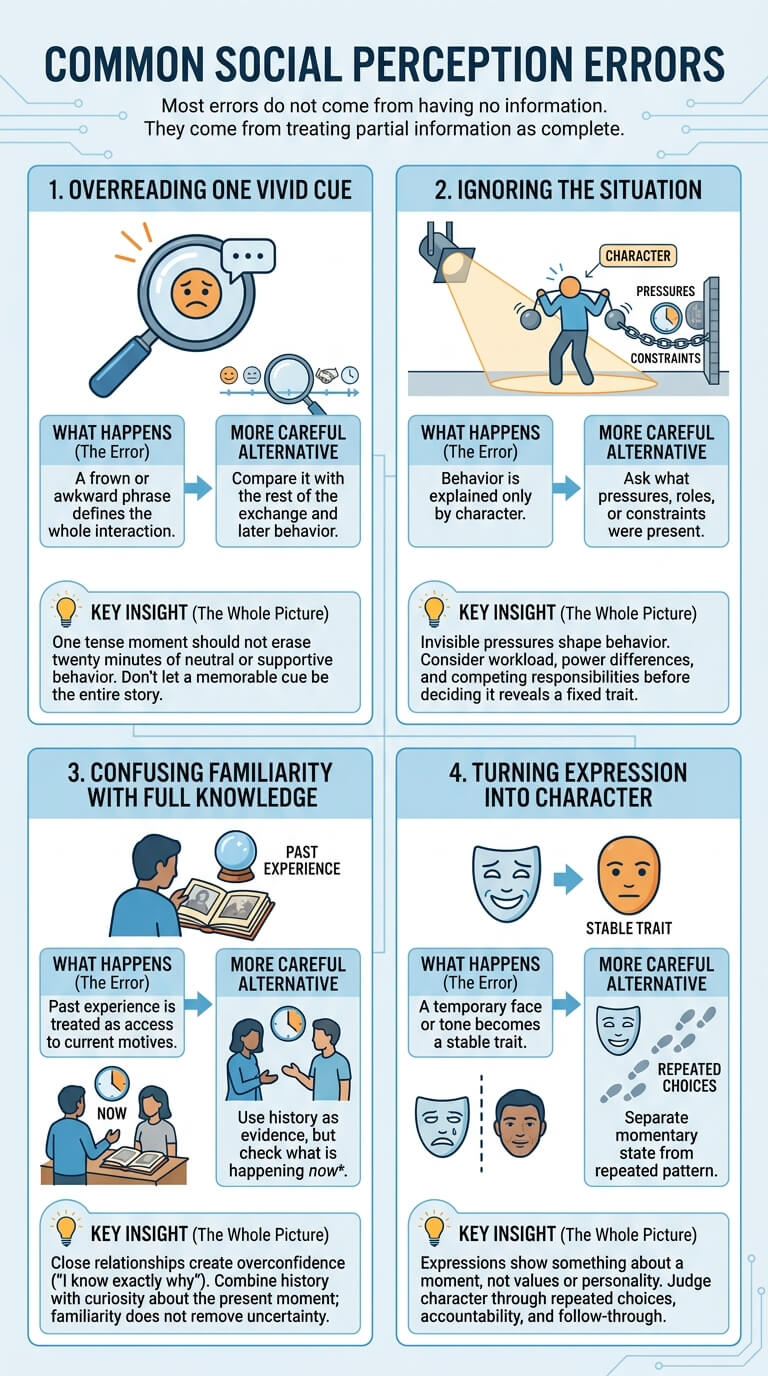
Most errors do not come from having no information. They come from treating partial information as complete.
| Error | What happens | More careful alternative |
|---|---|---|
| Overreading one vivid cue | A frown or awkward phrase defines the whole interaction | Compare it with the rest of the exchange and later behavior |
| Ignoring the situation | Behavior is explained only by character | Ask what pressures, roles, or constraints were present |
| Confusing familiarity with full knowledge | Past experience is treated as access to current motives | Use history as evidence, but check what is happening now |
| Turning expression into character | A temporary face or tone becomes a stable trait | Separate momentary state from repeated pattern |
Overreading one vivid cue
A memorable cue can become the center of the story because it is emotionally striking. Before concluding, ask how much of the interaction it represents. One tense moment may matter, but it should not erase twenty minutes of neutral or supportive behavior.
Ignoring situational explanations
People often appear more consistent than they are because observers cannot see all the pressures shaping their behavior. Consider workload, unfamiliarity, power differences, cultural rules, physical discomfort, and competing responsibilities before deciding the action reveals a fixed trait.
Treating familiarity as full knowledge
Knowing someone well improves context, but it does not remove uncertainty. Close relationships sometimes create overconfidence: “I know exactly why you did that.” A more accurate approach combines history with curiosity about the present moment.
Assuming expression reveals stable character
Expressions show something about a moment, yet they do not automatically reveal values, honesty, or personality. A nervous smile does not prove insincerity. A calm face does not prove indifference. Character is better judged through repeated choices, accountability, and follow-through.
How to Check a Social Interpretation
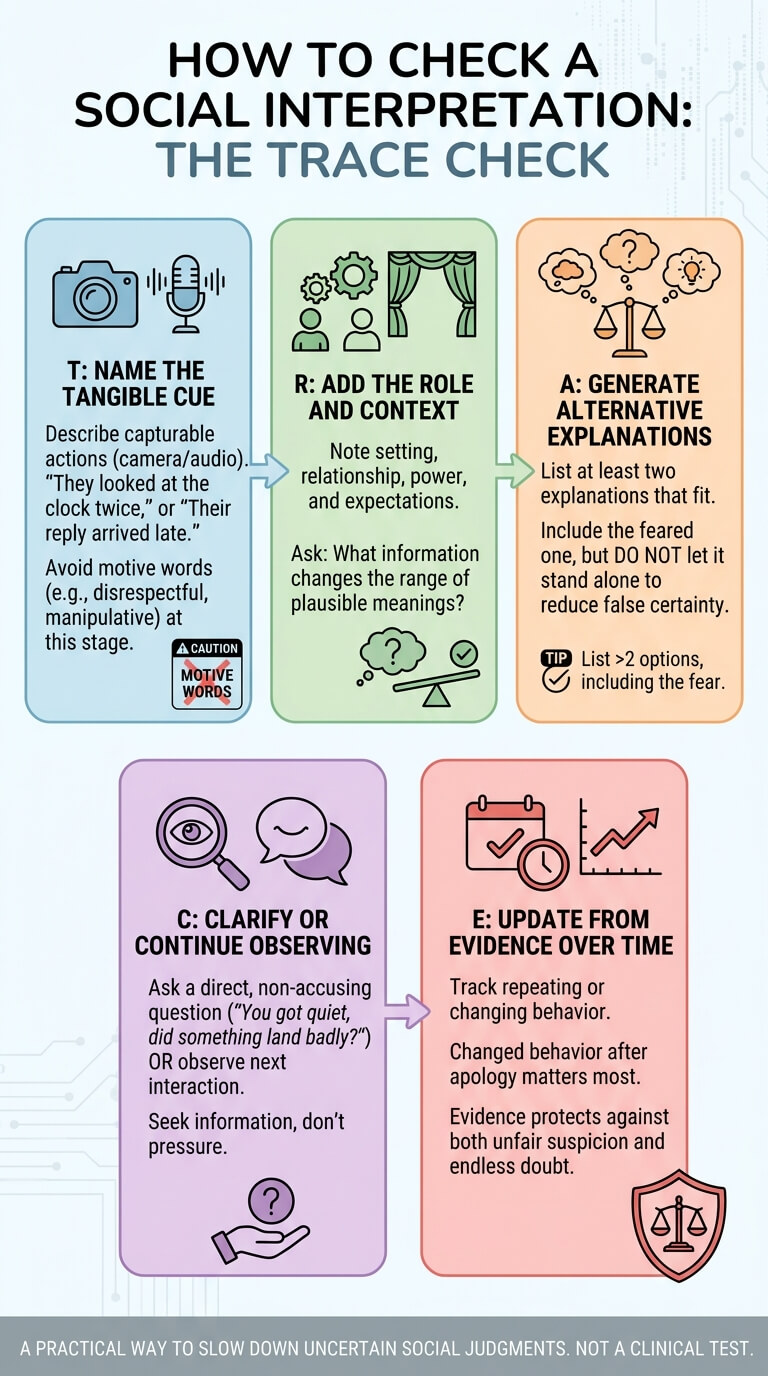
The TRACE check is a practical way to slow down an uncertain social judgment. It is not a clinical test. It simply separates the parts of an interpretation so that each part can be examined.
T: Name the tangible cue
Describe what a camera or audio recording could capture: “They looked at the clock twice,” “Their reply arrived the next day,” or “They interrupted before I finished.” Avoid motive words such as disrespectful, manipulative, jealous, or uncaring at this stage.
R: Add the role and context
Note the setting, relationship, expectations, time pressure, power difference, and any known circumstances.Ask what information changes the range of plausible meanings.
A: Generate alternative explanations
List at least two explanations that fit the cue. Include the interpretation you fear, but do not let it stand alone. Alternatives reduce false certainty and reveal which additional evidence would help distinguish among possibilities.
C: Clarify or continue observing
When appropriate, ask a direct, non-accusing question: “You got quiet after that point. Did something land badly?” In lower-stakes situations, you may simply observe the next interaction. Clarification should seek information, not pressure someone into confirming your preferred story.
E: Update from evidence over time
Track behavior that repeats, changes, or contradicts the original impression. An apology matters more when followed by changed behavior. A warm explanation matters less when the same harmful action continues. Evidence over time protects against both unfair suspicion and endless benefit of the doubt.
Everyday Examples
These examples show how the same cue can support several meanings.Match confidence to evidence and choose the next reasonable step.
A quiet coworker in a meeting
Situation: A coworker says little and avoids joining a debate. What you may feel: dismissed, unsupported, or unsure of their competence. What it may mean: they could be cautious, processing information, worried about status, or unfamiliar with the topic. What to do next: ask for their view after the meeting or invite specific input without putting them on the spot.
A delayed response from a friend
Situation: A friend reads your message and replies the next evening. What you may feel: unimportant or rejected. What it may mean: avoidance is possible, but so are overload, distraction, uncertainty about the reply, or different texting habits. What to do next: look at the wider pattern and ask plainly if the delay affects something time-sensitive.
A brief facial expression during feedback
Situation: Someone briefly tightens their face while you give feedback. What you may feel: judged, resisted, or worried you caused offense. What it may mean: surprise, concentration, discomfort, disagreement, or an unrelated physical sensation. What to do next: finish the point, then ask what they think rather than treating the expression as a verdict.
A confident speaker with uncertain evidence
Situation: A speaker talks smoothly and answers quickly. What you may feel: reassured by their competence. What it may mean: communication skill may be high, while the underlying claim may still be weak. What to do next: separate presentation from evidence by checking examples, reasoning, and follow-through.
How Other Perception Processes Shape Social Understanding
Interpreting people draws on the same broader processes used to organize sights, select information, and apply expectations. Seeing the overlap helps explain why a social impression can feel immediate even when several mental steps contributed to it.
Visual organization shapes facial and movement cues
You first have to detect and organize a face, gaze direction, movement, or distance before assigning social meaning. Lighting, angle, obstruction, and surrounding expressions can change what becomes visible. Social meaning therefore begins with visual perception but extends beyond it.
Perceptual bias can tilt the interpretation
Once a cue is noticed, expectations and emotional salience may influence its weight. A skeptical observer and a trusting observer can attend to different parts of the same interaction. Neither viewpoint should be accepted solely because it feels immediate.
Roles create different views of the same event
A manager may see a deadline discussion as necessary coordination, while an employee experiences it as pressure. A parent may see a question as concern, while a teenager experiences surveillance. The event is shared, but access, responsibility, history, and stakes differ.
Different roles and histories also help explain why people can interpret the same social situation differently.
Frequently Asked Questions About Social Perception
These answers address common questions about first impressions, social cues, and the limits of interpreting other people.
How quickly do first impressions form?
They can begin very quickly, sometimes from a brief view, voice sample, or opening behavior. Speed does not guarantee depth or accuracy. Early impressions are most useful as tentative guides that remain open to information from different settings and repeated interactions.
Can body language reveal true intentions?
Body language can show attention, arousal, comfort, readiness, or emotional expression, but it does not reliably reveal one hidden intention from a single cue. Interpretation improves when nonverbal behavior is combined with words, context, baseline behavior, and what the person does over time.
Why do different people perceive the same person differently?
Observers bring different histories, expectations, goals, moods, cultural norms, and relationships to the encounter. They may also receive different behavior from the person. A leader who seems supportive to one employee may seem distant to another because their access, needs, and interactions are not the same.
How do anxiety and mood affect social perception?
They can change which cues stand out and which explanations feel plausible. Anxiety may make threat or rejection interpretations more available, while a positive mood may encourage generous explanations. Emotional influence should invite a careful evidence check, not automatic dismissal of the feeling.
Can first impressions be changed?
Yes, especially when later behavior is clear, repeated, and relevant. Change may be slower when the first impression was emotionally strong or repeatedly rehearsed. Deliberately noticing contradictory evidence helps, but revision should follow real behavior rather than pressure to ignore valid concerns.
Key Takeaways
- Social perception turns limited cues into a working impression of another person.
- Words, tone, expression, context, roles, history, and later behavior all contribute to interpretation.
- First impressions are fast hypotheses, not direct access to personality or intention.
- Warmth and competence describe common dimensions of impressions, not a complete personality test.
- The TRACE check separates observable cues from context, alternatives, clarification, and evidence over time.
- When behavior involves threats, coercion, stalking, or retaliation, safety matters more than finding the perfect interpretation.
A useful next step is to take one recent social conclusion and write down the exact cue that produced it. Then add the context and one alternative explanation. You do not need to erase your first impression. You only need to give it the right level of confidence and let later evidence change it.

Michael Reed is the Founder and Lead Writer at Psychology Exposed. He writes about human behavior, relationships, emotional patterns, self-awareness, and practical psychology topics using research-informed, easy-to-understand content.
Read More About Michael Reed: https://psychologyexposed.com/michael-reed/