

A belief can be as ordinary as “this route is faster” or as personal as “people will leave if I disappoint them.” Some beliefs rest on careful evidence. Others grow from repetition, emotion, family stories, culture, or one powerful experience. Once familiar, a belief can feel like a fact built into the world.
Beliefs influence what you notice, how you interpret events, what you expect, and which actions feel sensible. A belief may support persistence or narrow your choices before you test what is possible. Understanding them means separating what feels true from what has been checked and placed in context.
Quick Answer
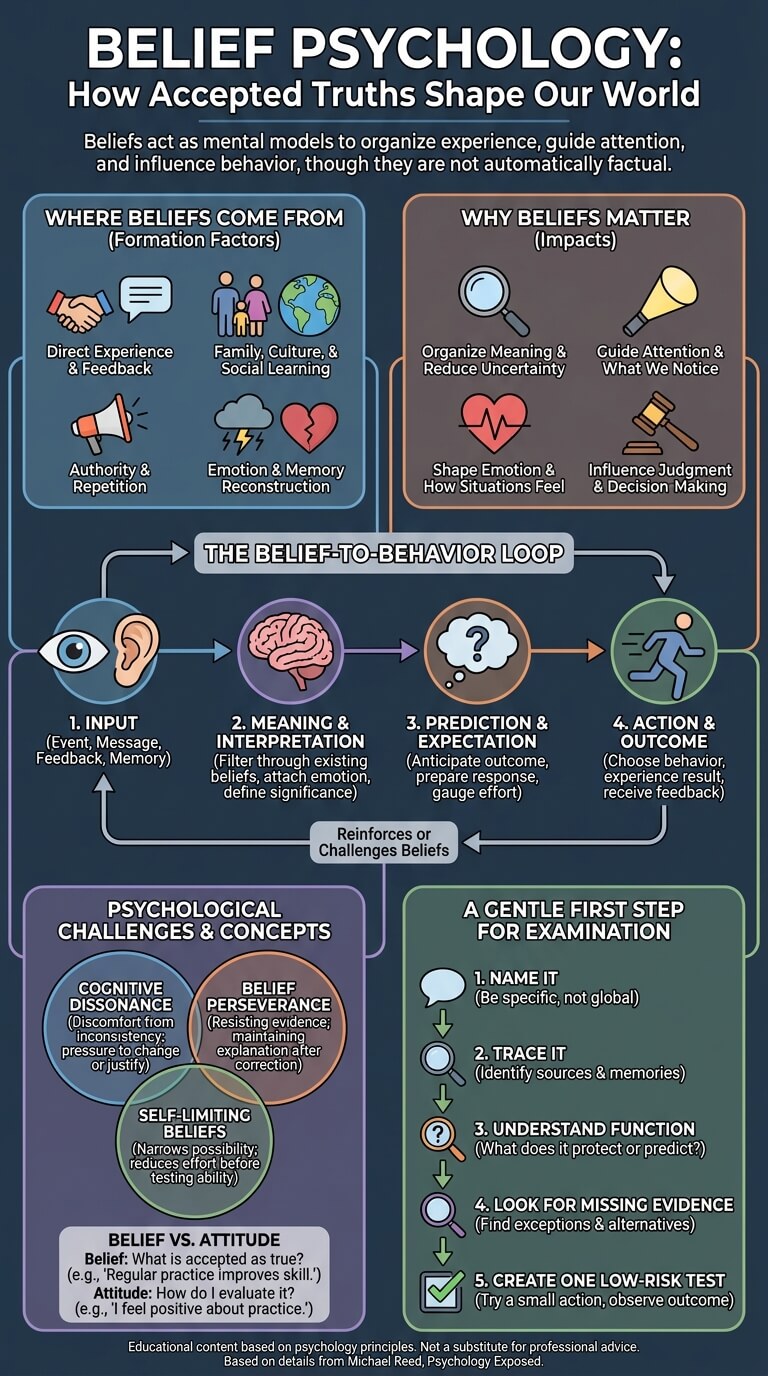
In psychology, a belief is something a person accepts as true, real, or valid. Beliefs help organize experience, but they are not automatically accurate. They can shape attention, memory, emotion, expectations, identity, and behavior. They also change through new evidence, direct experience, social feedback, reflection, and repeated action, although strongly held beliefs may resist revision.
What a Belief Means in Psychology
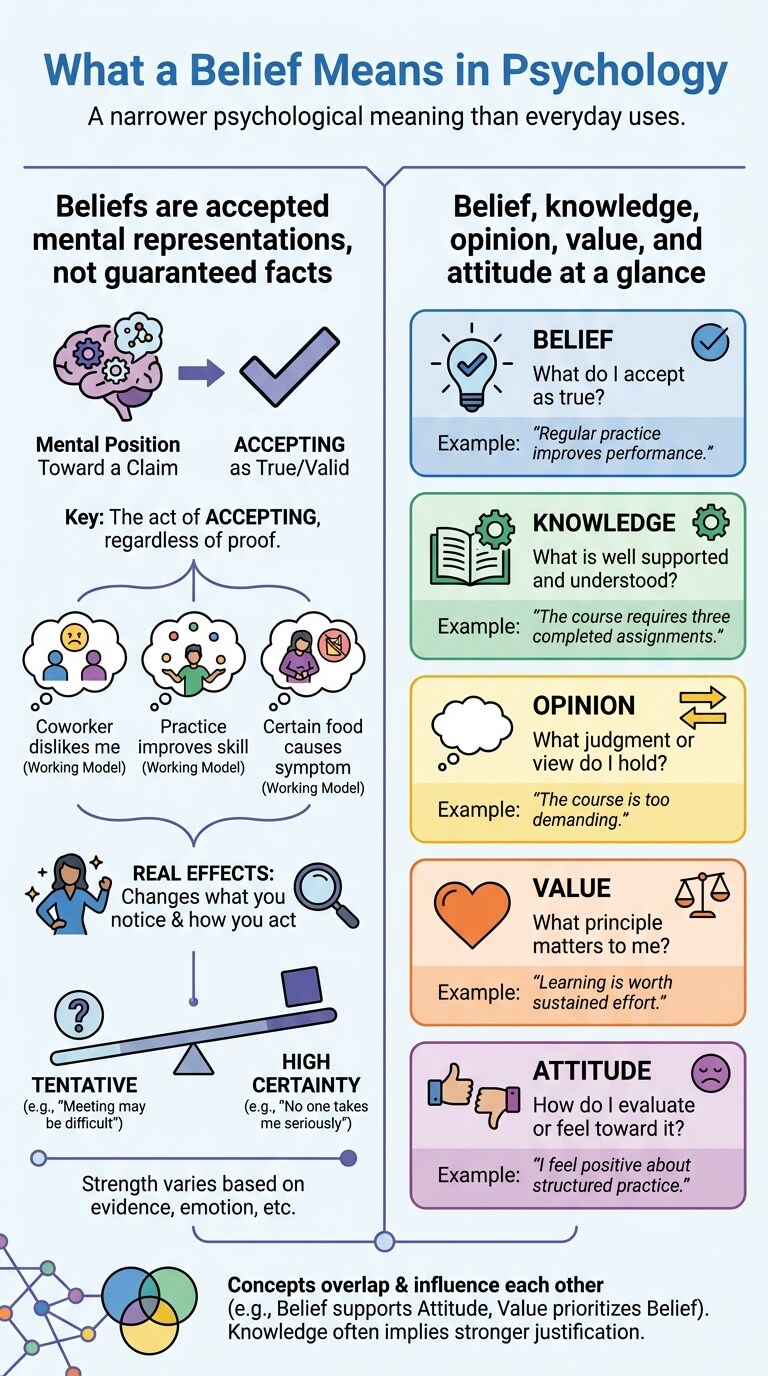
The word is familiar, but its psychological meaning is narrower than many everyday uses.
Beliefs are accepted mental representations, not guaranteed facts
The APA Dictionary of Psychology definition of belief includes accepting the truth, reality, or validity of something. The crucial word is accepting. A belief describes a person’s mental position toward a claim, not whether the claim has been proven.
You may believe a coworker dislikes you, that practice improves skill, or that a certain food causes a symptom. Each belief creates a working model. The model may be accurate, partly accurate, outdated, or based on too little information. Even a mistaken belief can have real effects if it changes what you notice and how you act.
Beliefs differ in strength. Some are tentative: “The meeting may be difficult.” Others carry high certainty: “No one takes me seriously.” Certainty can reflect evidence, familiarity, emotion, identity, or repeated group confirmation.
Belief, knowledge, opinion, value, and attitude at a glance
| Concept | Main question | Simple example |
|---|---|---|
| Belief | What do I accept as true? | “Regular practice improves performance.” |
| Knowledge | What is well supported and understood? | “The course requires three completed assignments.” |
| Opinion | What judgment or view do I hold? | “The course is too demanding.” |
| Value | What principle matters to me? | “Learning is worth sustained effort.” |
| Attitude | How do I evaluate or feel toward it? | “I feel positive about structured practice.” |
These concepts overlap, but they are not interchangeable. A belief can support an attitude. A value can make one belief more important than another. An opinion may combine beliefs, values, and preferences. Knowledge usually implies stronger justification than belief alone, although people do not always agree about what counts as sufficient evidence.
Why Beliefs Matter in Everyday Life
Beliefs matter because they help turn incomplete information into a usable interpretation.
Beliefs organize meaning and reduce uncertainty
Daily life produces more information than anyone can examine from the beginning each time. Beliefs act as shortcuts. They help answer questions such as: Is this person safe? Is this task worth the effort? What does silence mean? What usually happens when I speak up?
This function is useful, but an explanation may keep operating after circumstances change. A child who learned that mistakes bring ridicule may carry “mistakes are dangerous” into a supportive adult environment. The belief once predicted a real response but may now overgeneralize.
Beliefs influence attention, emotion, judgment, and action
Imagine receiving a short message that says, “We need to talk tomorrow.” Someone who believes conflict usually leads to rejection may notice the delay, feel dread, and mentally rehearse the worst outcome. Someone who believes difficult conversations can solve problems may still feel uneasy, but prepare questions instead of assuming abandonment.
The message is identical. The belief changes the meaning attached to it. That meaning affects emotion, which influences behavior. Neither person is simply choosing a mood. Their minds are using earlier learning to predict what the message signals.
The Belief-to-Behavior Loop
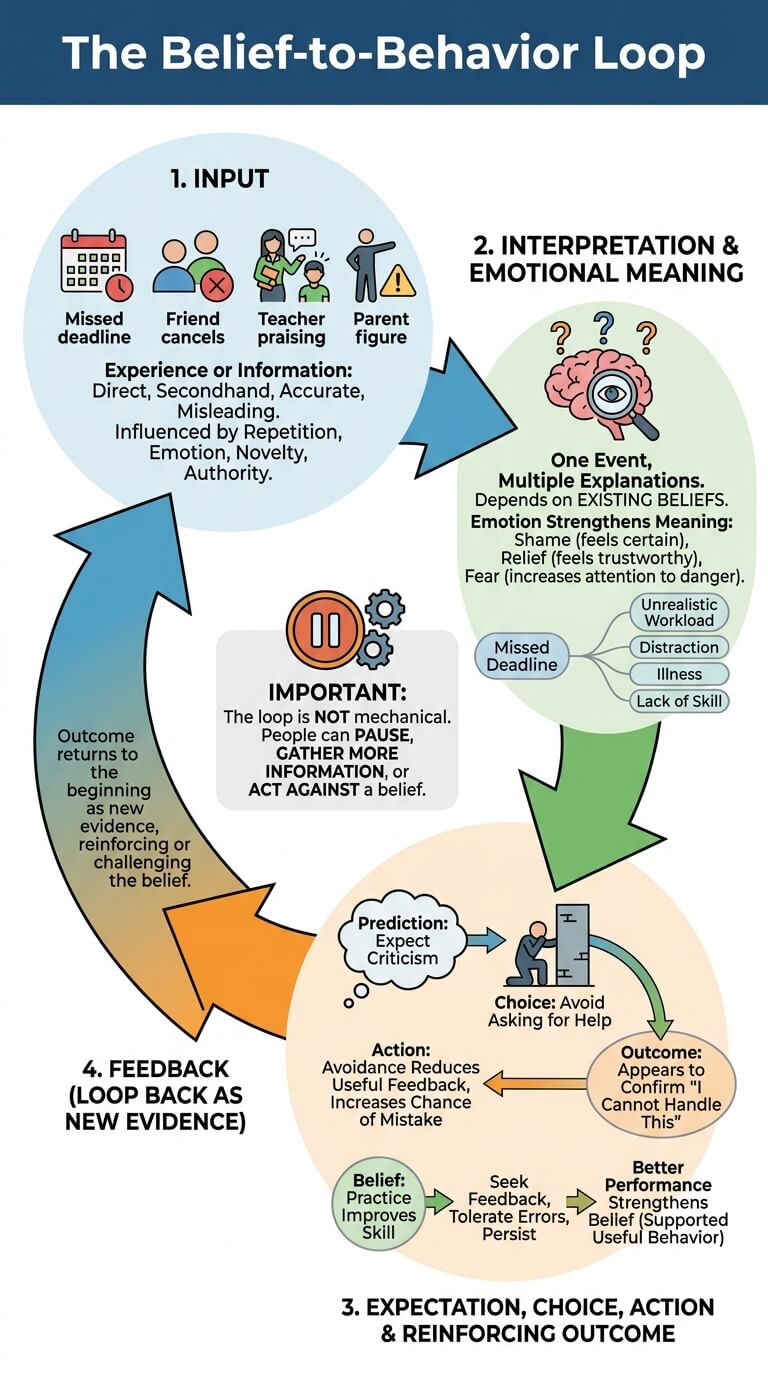
A useful way to understand beliefs is to follow a four-part loop: input, meaning, prediction, and feedback. The loop is not mechanical. People can pause, gather more information, or act against a belief. Still, it explains why a belief can become stronger through ordinary experience.
Experience or information
The loop begins with an event, message, observation, memory, or piece of feedback. You miss one deadline. A friend cancels twice. A teacher praises your preparation. A parent repeatedly warns that strangers cannot be trusted. The input may be direct or secondhand, accurate or misleading.
Repeated events usually carry more influence, but a single emotionally intense event can also become highly memorable. The mind does not weigh every experience equally. Novelty, fear, relief, authority, and personal relevance can increase the importance assigned to what happened.
Interpretation and emotional meaning
Events do not arrive with one fixed explanation. Missing a deadline could mean poor planning, an unrealistic workload, distraction, illness, or lack of skill. The interpretation selected often depends on existing beliefs. A person who already believes “I am unreliable” may treat one mistake as proof of identity rather than information about a specific situation.
Emotion strengthens meaning. Shame can make a self-critical explanation feel certain. Relief can make a comforting explanation feel trustworthy. Fear can increase attention to possible danger while reducing attention to neutral details. Emotion is important information about what matters to you, but it is not a direct accuracy test.
Expectation, choice, action, and reinforcing outcome
Interpretation creates a prediction. If you expect criticism, you may avoid asking for help. Avoidance can reduce useful feedback, increase the chance of another mistake, and appear to confirm “I cannot handle this.” The outcome then returns to the beginning of the loop as new evidence.
The loop can also help. A learner who believes structured practice improves skill may seek feedback, tolerate early errors, and persist. Better performance then strengthens the belief. It did not guarantee success, but it supported useful behavior.
Where Beliefs Come From

Most beliefs reflect several influences rather than one simple cause.
Direct experience and feedback
Personal experience is powerful because it feels concrete. If speaking honestly repeatedly leads to respectful discussion, you may develop trust in direct communication. If it repeatedly leads to mockery, you may learn to hide what you think. The belief is shaped not only by the event, but by how consistent it seems and whether alternative explanations are available.
Feedback also matters. Specific feedback, such as “your argument is clear, but the evidence needs work,” supports a different belief than a global label such as “you are bad at writing.” One points to an improvable part of a task. The other may be absorbed as a statement about identity.
Family, culture, authority, repetition, and social learning
Many beliefs are learned before a person can evaluate them. Families communicate assumptions about success, emotion, trust, money, conflict, and belonging. Culture supplies broader stories about what is normal, admirable, shameful, or possible.
Authority and repetition add weight. A claim repeated by a respected teacher, leader, expert, or close relative may feel credible because the source is trusted. A familiar claim may also become easier to process, and ease can be mistaken for truth. Social learning adds another layer: people watch what receives approval, punishment, attention, or silence.
Memory reconstruction and identity needs
Memory is not a perfect recording. Research on constructive memory describes remembering as an active process that can support useful meaning while also allowing omissions and distortions. Current beliefs can influence which details come to mind and how earlier events are organized into a story.
Identity adds stability. A belief such as “I am the responsible one” may guide useful behavior, yet it may also make rest feel selfish or asking for help feel like failure. Beliefs tied to belonging can be especially difficult to examine because revision may seem to threaten connection with a family, community, profession, or valued version of oneself.
How Beliefs Shape the Mind
Once established, beliefs help prioritize information and prepare a likely response.
What people notice and remember
Beliefs guide attention toward information that appears relevant. If you believe a colleague is dismissive, you may quickly notice interruptions and overlook moments when they invite your view. This does not mean the dismissiveness is imaginary. It means the belief influences which evidence receives priority.
Beliefs also shape recall. A difficult week may bring failures to mind, while a positive shift may make supportive memories easier to access. One vivid recollection is not always the full history.
How situations feel
Emotion often follows the meaning assigned to a situation. Believing that a delay signals rejection may create anxiety. Believing that the same delay reflects a busy schedule may create mild frustration. Believing that uncertainty can be tolerated may reduce the urge to demand immediate reassurance.
This does not mean you can simply choose a pleasant interpretation. A useful response is more careful: identify the belief shaping the feeling, compare it with available facts, and leave room for more than one explanation. Emotional regulation and reality checking can work together.
What people expect from themselves and others
Beliefs produce expectations about ability, trust, effort, fairness, and likely outcomes. Someone who believes “people only help when they want something” may refuse support and then experience relationships as less dependable. Someone who believes “I should understand immediately” may interpret normal confusion as proof of low ability.
Expectations affect preparation. They influence how much effort seems worthwhile, whether someone asks questions, and how quickly they give up. They can contribute to self-fulfilling patterns, but external reality still matters. Confidence cannot remove a real barrier, and pessimism does not cause every bad outcome.
How identity and belonging stabilize beliefs
A belief becomes harder to revise when it answers “who am I?” or “who are my people?” Evidence then carries more than factual meaning. It can feel like a demand to betray a group, admit weakness, or rewrite a personal history.
Respectful disagreement needs more than better information. People may need room to update without humiliation and a way to preserve dignity or belonging. This does not require accepting harmful claims. It explains why change may carry social and emotional costs.
Belief Formation Psychology: How New Beliefs Begin
Formation focuses on the path from first exposure to an accepted conclusion.
From first exposure to a working conclusion
Belief formation asks how an event or claim becomes something a person accepts as true. The process may include attention, interpretation, emotion, repetition, authority, social confirmation, and memory. A single source rarely explains every belief. For example, “I am bad at public speaking” might grow from one embarrassing moment, repeated self-comparison, a critical comment, and later avoidance that prevents corrective experience.
Tracing formation is useful because origin and accuracy are different questions. A belief may have had a reasonable protective purpose and still be too broad today. The practical task is to identify what happened, what meaning was assigned, who reinforced it, and what later experiences seemed to confirm it.
Attitude Psychology: How Evaluation Adds Feeling and Direction
Attitudes explain the positive, negative, or mixed evaluation attached to a subject.
Beliefs describe, while attitudes evaluate
An attitude is a relatively enduring evaluation of a person, object, group, idea, or issue, according to the APA definition of attitude. Beliefs often provide reasons for that evaluation. You might believe a class is well organized and demanding, then hold a positive attitude because you value structure and challenge.
Attitudes usually include what you think, how you feel, and how inclined you are to act. Those parts can disagree. You may believe exercise is beneficial, feel bored by it, and still maintain a routine. This is why an expressed attitude does not always predict behavior by itself.
Belief vs Attitude: Choosing the Right Concept
The distinction becomes clearer when truth claims and evaluations are separated.
A simple decision rule
Use belief when the main issue is what someone accepts as true: “My manager does not trust me.” Use attitude when the main issue is evaluation: “I dislike being closely supervised.” The belief may support the attitude, but they answer different questions.
For a direct side-by-side distinction, the difference between belief and attitude becomes clearest when truth claims and evaluations are examined separately.
When a statement includes both, separate them. “Feedback is usually an attack, so I hate performance reviews” contains a belief about feedback and a negative attitude toward reviews. That separation matters because the evidence needed to examine the belief may differ from the experience needed to change the attitude.
Cognitive Dissonance: When Belief and Action Collide
Important inconsistencies can create pressure to change, justify, or minimize something.
Why inconsistency creates pressure
Cognitive dissonance describes discomfort connected to important inconsistency among beliefs, attitudes, choices, or behavior. A person who sees themselves as honest may feel tension after hiding relevant information. Someone who values health may feel uncomfortable about a habit that conflicts with that value.
People may reduce the discomfort by changing behavior, revising a belief, minimizing the issue, or adding a justification. Dissonance can support honest change, but it can also strengthen rationalization. The important question is not only “How can I feel better?” It is “Which response creates better alignment with evidence and responsibility?”
Belief Perseverance: Why Some Beliefs Survive Contrary Evidence
Correction becomes harder when the belief has already grown into a wider explanation.
Removing evidence may not remove the explanation
Belief perseverance occurs when a belief continues after its original support has weakened or been disproved. The mind may have already built a wider explanation around the belief. Correcting one fact does not automatically replace that explanation.
A useful correction therefore does more than say “that is wrong.” It may need to show which part is unsupported, provide a more plausible account, and explain what evidence would distinguish the two. Research on belief updating in response to scientific evidence also highlights that trust in the information source can affect how people respond to new claims.
Why People Resist Changing Their Mind
A challenge may be heard as a threat to more than factual accuracy.
Changing a view can carry identity and social costs
Resistance during disagreement is not always the same as a belief simply persisting. A challenge can threaten autonomy, status, belonging, or self-respect. If someone feels cornered, mocked, or ordered to agree, they may defend the belief partly to defend their freedom or dignity.
Public commitment increases the cost. Changing a view may mean admitting an error publicly. Reconsideration becomes easier when the claim is specific, evidence can be considered without humiliation, and revision does not require an instant confession.
Self-Limiting Beliefs: When a Belief Narrows Possibility
Some beliefs reduce action before ability or opportunity has been fairly tested.
Capability, worthiness, permission, and safety
A self-limiting belief is a conclusion that unnecessarily reduces what someone attempts or considers possible. Common forms include “I am not creative,” “I always ruin close relationships,” or “people like me do not succeed in that field.” These beliefs can influence effort, attention, and the meaning assigned to setbacks.
The key is to separate a realistic constraint from a global conclusion. A skill gap, financial limit, disability, unsafe environment, or unfair system is not solved by mindset. A belief becomes more questionable when it is absolute, identity-based, resistant to exceptions, and used to predict failure before a specific test has occurred.
Expectation Psychology: How Predictions Shape Experience
Expectations carry beliefs forward into predictions about what comes next.
Expectations prepare attention, emotion, and behavior
An expectation is a prediction about what will happen. It can shape what you notice, how you prepare, and how you interpret an ambiguous result. Expecting rejection may lead to guarded communication that makes connection harder. Expecting useful feedback may make it easier to ask questions and apply what you hear.
This is a psychological pathway, not manifestation. Expectations do not directly control other people, chance, illness, or external systems. Their influence comes through attention, emotion, preparation, behavior, and interpretation. Flexible expectations use ranges and remain open to updating when reality differs.
Attitude Change Psychology: How Evaluations Shift Over Time
Evaluations can move in strength, certainty, direction, or emotional tone.
Change can come through more than argument
Attitudes may change through credible information, direct experience, emotion, repeated exposure, new behavior, trusted relationships, or changes in identity and social context. A person can learn favorable facts and still retain a negative attitude if the emotional experience remains unchanged.
Lasting change usually requires more than temporary agreement. The new evaluation needs enough support to remain accessible across situations. A change may also be partial: someone can become less certain, more ambivalent, or more open without reversing from strongly negative to strongly positive.
Persuasion Psychology: How Messages Influence Belief and Attitude
Messages work within an existing mind, relationship, and social setting.
Source, message, audience, and context all matter
Persuasion is communication intended to influence beliefs, attitudes, intentions, or choices. Its effects depend on who delivers the message, the quality and framing of the evidence, the audience’s prior beliefs and motivation, and the social setting in which the message appears.
Ethical persuasion preserves the ability to question, verify, delay, and refuse. Manipulation hides important information or exploits pressure in ways that reduce meaningful choice. No wording guarantees change. A credible message can still fail when it threatens identity, comes from a distrusted source, or ignores the experience supporting the current view.
Which Belief Topic Should You Read Next?
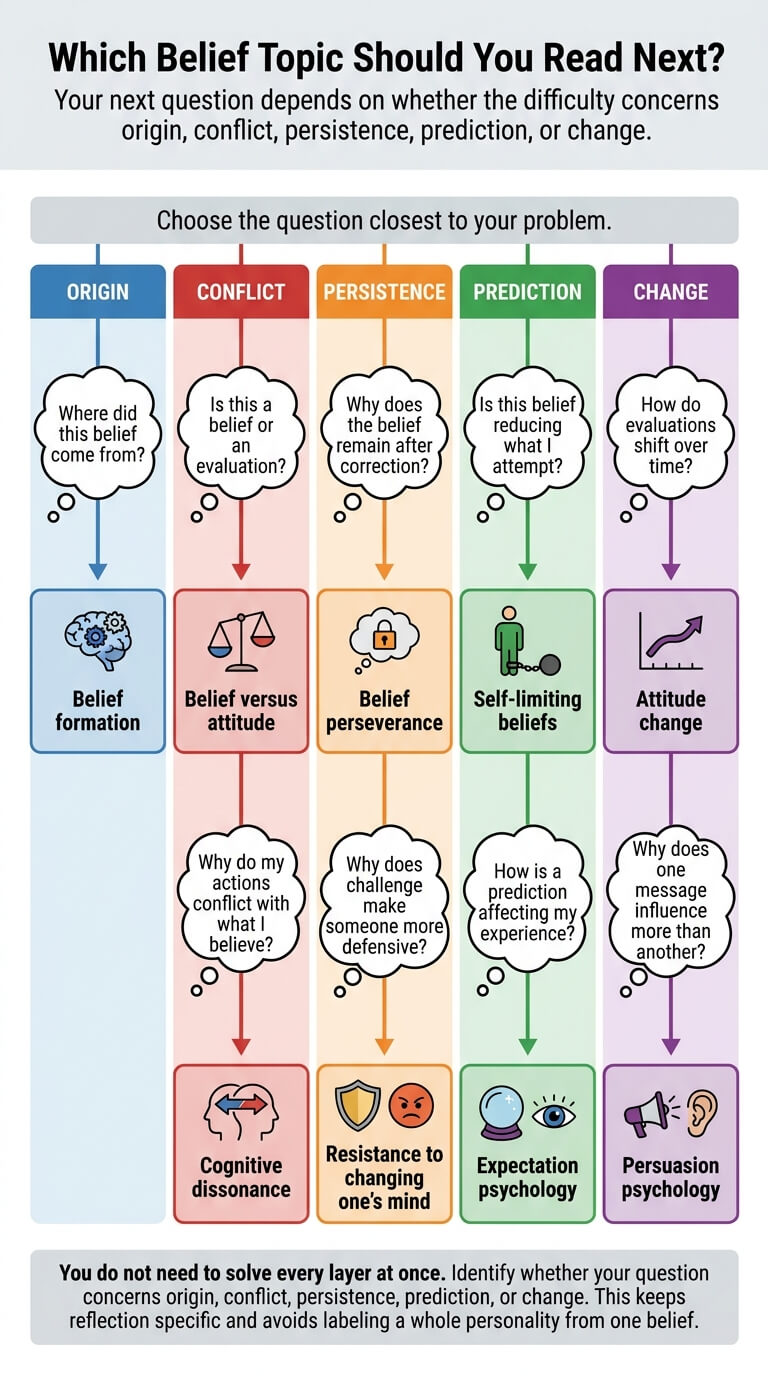
Your next question depends on whether the difficulty concerns origin, conflict, persistence, prediction, or change.
Choose the question closest to your problem
| If you are asking… | The most useful next topic is… |
|---|---|
| Where did this belief come from? | Belief formation |
| Is this a belief or an evaluation? | Belief versus attitude |
| Why do my actions conflict with what I believe? | Cognitive dissonance |
| Why does the belief remain after correction? | Belief perseverance |
| Why does challenge make someone more defensive? | Resistance to changing one’s mind |
| Is this belief reducing what I attempt? | Self-limiting beliefs |
| How is a prediction affecting my experience? | Expectation psychology |
| How do evaluations shift over time? | Attitude change |
| Why does one message influence more than another? | Persuasion psychology |
You do not need to solve every layer at once. Identify whether your question concerns origin, conflict, persistence, prediction, or change. This keeps reflection specific and avoids labeling a whole personality from one belief.
Common Misunderstandings About Beliefs
Several common assumptions make beliefs appear simpler and more controlling than they are.
Strong belief does not equal accurate belief
Confidence and accuracy are different qualities. A person may be highly certain because a claim is familiar, emotionally important, socially reinforced, or connected to identity. Another person may hold an accurate view with appropriate uncertainty because the evidence is incomplete.
A better test asks how the belief was formed, what evidence supports it, what evidence would count against it, and how broadly it is being applied. Strength of feeling deserves attention, but it should not replace evaluation.
Changing a belief is not always weakness or inconsistency
Updating can reflect intellectual honesty. New information, changed circumstances, or direct experience may justify a different conclusion. The ability to say “I no longer think that explanation fits” can be a sign of learning rather than unreliability.
At the same time, frequent changes are not automatically wise. Good updating considers source quality, alternative explanations, and the amount of evidence available. The goal is neither rigid certainty nor constant reversal. It is proportionate confidence.
Beliefs do not mechanically determine every action
Behavior also depends on habit, emotion, skills, incentives, social pressure, opportunity, fatigue, and competing goals. Someone may believe honesty matters but avoid a difficult truth out of fear. Someone may dislike exercise but continue because a routine and social commitment support it.
The gap shows that action has several causes. The full situation is more informative than assuming one behavior reveals a person’s deepest belief.
A Gentle First Step for Examining a Belief
Curiosity works better than forcing yourself to adopt the opposite conclusion.
Name it, trace it, understand its function, and test its limits
- Name the belief precisely. Replace “everything goes wrong” with a specific claim such as “when I ask for help at work, people think I am incompetent.”
- Trace the source. Note the experiences, messages, people, and memories that made the belief plausible.
- Notice its function. Ask what the belief helps you predict, avoid, protect, or preserve.
- Look for missing evidence. Identify exceptions, alternative explanations, and situations where the belief has not been tested.
- Create one low-risk test. Make a specific prediction, try a small action, and review what actually happened without forcing a positive conclusion.
This approach is not about talking yourself into the opposite belief. “Everyone will support me” may be as untested as “no one will.” A more useful update might be: “Some people respond poorly, but I can choose whom I ask, make the request specific, and judge the response from evidence.”
When Professional Support May Help
Most belief reflection is ordinary, but some situations deserve individualized care.
Rigid beliefs can sometimes be connected to serious distress
Consider speaking with a qualified mental health professional when beliefs are linked to severe anxiety, depression, shame, impaired daily functioning, intense fear, or behavior that places you or someone else at risk. Ordinary inaccurate beliefs should not be confused with clinical symptoms. Assessment requires context and professional judgment.
If you are struggling emotionally or need help finding care, the National Institute of Mental Health help page lists options for immediate support and finding a provider. In an urgent or life-threatening situation, use local emergency services.
FAQ About Belief Psychology
These questions address common points of confusion about awareness, emotion, disagreement, and change.
Are beliefs always conscious?
No. Some beliefs can be stated clearly, while others operate as quick assumptions. You may not notice a belief until a repeated reaction exposes it, such as assuming silence means anger or treating a small error as proof of incompetence. An automatic assumption is still open to examination, but it may take observation to put it into words.
Can emotions create beliefs?
Emotion can strongly influence belief formation because it marks an experience as important. Fear may support a broad danger belief, while relief may make a reassuring explanation feel trustworthy. Emotion alone does not prove or disprove a claim. It tells you that the event carries meaning and deserves careful context.
Why can two people interpret the same evidence differently?
They may begin with different prior beliefs, memories, goals, identities, levels of trust, and definitions of reliable evidence. They may also notice different details. Disagreement does not automatically mean both interpretations are equally supported, but understanding the starting assumptions helps explain where the conclusions diverge.
Can behavior change before belief changes?
Yes. People often try a new action while still feeling doubtful. Repeated experience can then provide information that changes the belief gradually. A person may practice speaking up before believing they are confident, or follow a study plan before believing they are capable. Behavior is not proof by itself, but it can create new evidence.
How long does belief change take?
There is no single timeline. A low-stakes belief may change after a clear correction, while one tied to identity, fear, or belonging may shift slowly. The first change may be reduced certainty rather than reversal. Durable updating often needs credible information, experience, and time.
Key Takeaways
- A belief is something accepted as true or valid, not proof that it is accurate.
- Beliefs guide attention, emotion, expectations, judgment, and choices.
- Experience, family, culture, authority, repetition, memory, and belonging all contribute to belief formation.
- Behavior can reinforce a belief by producing outcomes that seem to confirm it.
- Beliefs tied to identity or social belonging often require more than a factual correction to change.
- A useful first step is to make the belief specific, trace its source, examine its function, and test one prediction.
Educational note: Michael Reed is the Founder and Lead Writer at Psychology Exposed. This content is educational, not a diagnosis or a substitute for individualized mental health care.

Michael Reed is the Founder and Lead Writer at Psychology Exposed. He writes about human behavior, relationships, emotional patterns, self-awareness, and practical psychology topics using research-informed, easy-to-understand content.
Read More About Michael Reed: https://psychologyexposed.com/michael-reed/