

A disagreement can begin with facts and quickly become something else. One person offers evidence, the other becomes defensive, and both sides repeat themselves with greater certainty. The conversation no longer feels like a shared attempt to understand what is true. It feels like a contest over identity, respect, control, or belonging.
People do not resist changing their mind only because they lack information. A challenged belief may be connected to self-image, autonomy, public reputation, loyalty, past choices, or emotional safety. Admitting uncertainty can feel like losing status. Accepting a correction can seem like surrendering control. Reconsidering one idea may raise uncomfortable questions about an entire group or history.
Understanding these pressures does not require accepting false claims or tolerating harmful behavior. It helps explain why adding more facts sometimes fails and why respectful conditions can make genuine reconsideration more possible.
Quick Answer
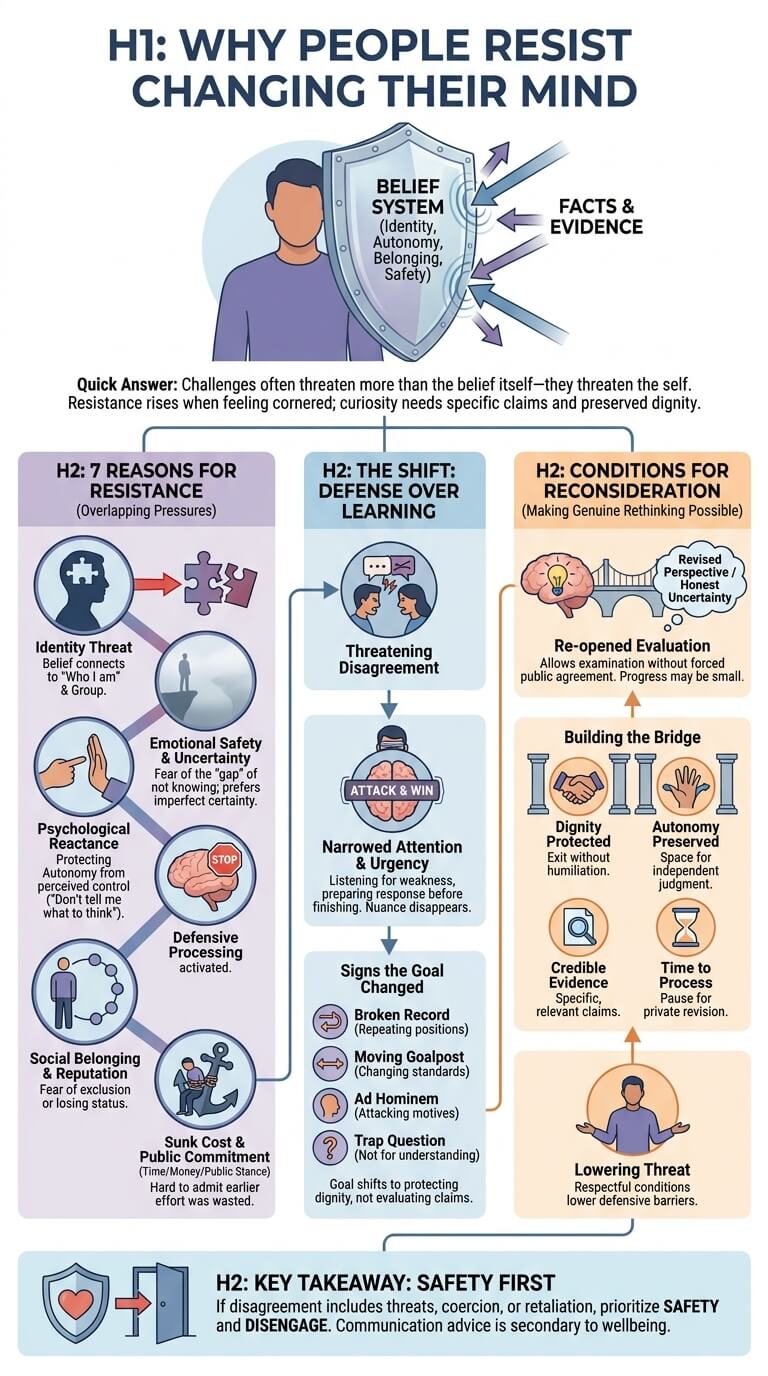
People often resist changing their mind because a challenge threatens more than the belief itself. It may threaten identity, autonomy, belonging, reputation, past investment, or trust in the person delivering the message. Resistance tends to rise when someone feels cornered or humiliated. Curiosity becomes more possible when the claim is specific, autonomy is preserved, evidence is credible, and the person has a dignified way to revise.
Resistance Is Often About More Than Facts
Facts matter, but they enter a social and emotional setting. A person evaluates not only the evidence but also what accepting it would mean. The same correction may feel manageable in private and humiliating in front of an audience. A question from a trusted friend may invite reflection, while the same question from a hostile coworker may trigger defense.
The stakes become clearer when the challenged idea is viewed within the broader psychology of beliefs, where identity, expectations, interpretation, and behavior can all become connected to what feels true.
A challenged belief can threaten identity, autonomy, belonging, or past choices
A belief may support a larger story: “I am a careful parent,” “I understand this field,” “My group can be trusted,” or “I did not waste years on the wrong path.” Changing the belief may feel like admitting incompetence, disloyalty, or poor judgment.
This helps explain why a narrow factual challenge can create a broad reaction. The spoken issue might be one claim, but the experienced issue is, “What kind of person will I be if I accept this?” Resistance is stronger when the answer feels socially or emotionally costly.
Seven Reasons People Resist Reconsidering
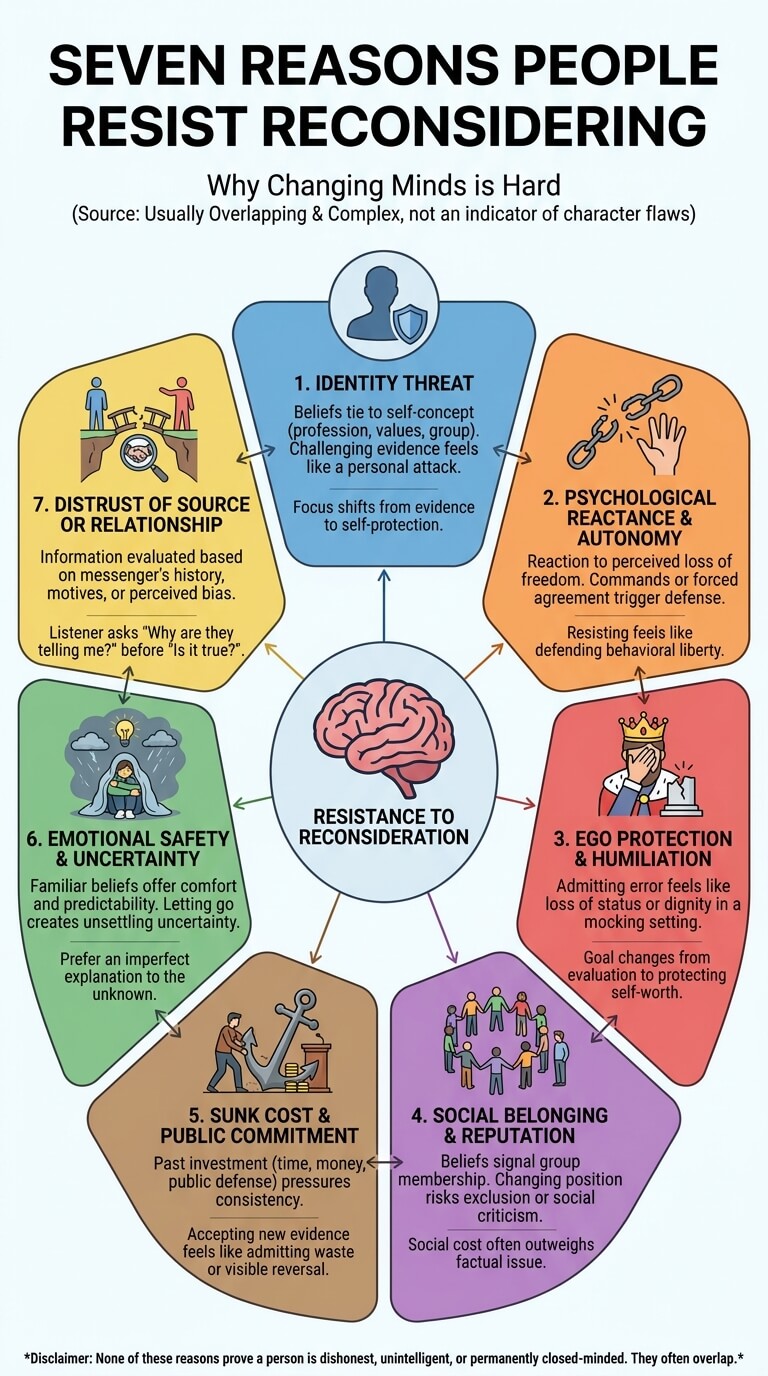
Resistance usually has more than one source. The seven reasons below often overlap, and none of them proves that a person is dishonest, unintelligent, or permanently closed-minded.
Identity threat
People use beliefs to organize who they are. A belief can connect to professional identity, family role, morality, competence, culture, or group membership. Evidence that challenges the belief may therefore feel like evidence against the self.
Research on social identity threat and science-discrediting responses illustrates how findings that threaten a valued group identity can motivate people to devalue the findings. The practical lesson is broader than any one topic: when a message is heard as “people like you are foolish,” attention may shift from evidence to self-protection.
If the challenge also exposes a mismatch between a valued belief, self-image, and past behavior, cognitive dissonance can add another source of psychological pressure.
Psychological reactance and loss of autonomy
Reactance is the motivation to restore freedom when it feels threatened. The APA Dictionary of Psychology describes psychological reactance as a reaction to perceived threats to behavioral freedom.
Commands such as “You must admit this,” “There is only one acceptable answer,” or “Stop thinking that way” can make the act of resisting feel like a defense of autonomy. A review of psychological reactance describes anger and negative thinking as common responses when freedom feels restricted.
Preserving autonomy does not mean treating evidence as optional. It means allowing the person to examine the evidence and reach a conclusion without being forced into a public performance of agreement.
Ego protection and fear of humiliation
Changing one’s mind may require admitting, “I was wrong,” “I misunderstood,” or “I repeated something unreliable.” In a respectful setting, this can be ordinary learning. In a mocking setting, it can feel like loss of status.
Humiliation changes the goal of the conversation. Instead of evaluating the claim, the person tries to protect dignity. They may attack the challenger, deny obvious points, or search for any inconsistency that restores balance.
Social belonging and reputation
Beliefs can signal membership. A person may know which views are praised, tolerated, or punished within a family, workplace, friendship group, or community. Changing position may risk criticism or exclusion.
Even private doubt can feel dangerous when the person imagines having to explain it publicly. The social cost may be larger than the factual issue. This does not make the belief correct, but it affects how much emotional risk accompanies revision.
Sunk cost and public commitment
Past investment creates pressure for consistency. Someone who defended a claim repeatedly, spent money based on it, or persuaded others to act may find revision especially difficult. Accepting new evidence can feel like admitting that earlier effort was wasted or harmful.
Public commitment increases the cost because other people witnessed the position. A quiet update becomes a visible reversal. The person may continue defending the belief partly to avoid embarrassment, apology, or loss of authority.
The investment may also be practical. A manager may have approved a project, a parent may have advised a child, or a friend may have encouraged others to follow the same path. Changing position could require correcting earlier guidance and accepting responsibility for its effects. The temptation is to keep searching for reasons the original choice will eventually be justified.
A useful distinction is between honoring past effort and protecting a past conclusion. Time and money already spent may deserve acknowledgment, but they do not determine what should happen next. A person can say, “I made the best decision I could with what I knew, and the evidence has changed.”
Emotional safety and uncertainty
A familiar belief can provide certainty even when it is incomplete. It tells the person what happened, who is responsible, and what to expect next. Letting go may create a temporary gap with no clear replacement.
Uncertainty can be especially difficult when the topic involves safety, health, family, work, or identity. The person may prefer an imperfect explanation to “I do not know.” Reconsideration becomes easier when the alternative account is understandable and uncertainty is treated as tolerable rather than shameful.
Distrust of the source or relationship
People evaluate information partly through the person delivering it. A history of contempt, dishonesty, control, or broken promises can make accurate information difficult to receive. The listener may ask, “Why are they telling me this?” before asking, “Is it true?”
Distrust can be reasonable. Expertise, incentives, and track record matter. Resistance becomes less informative when the source is evaluated by a standard that changes according to whether the conclusion feels comfortable.
What Happens During a Threatening Disagreement
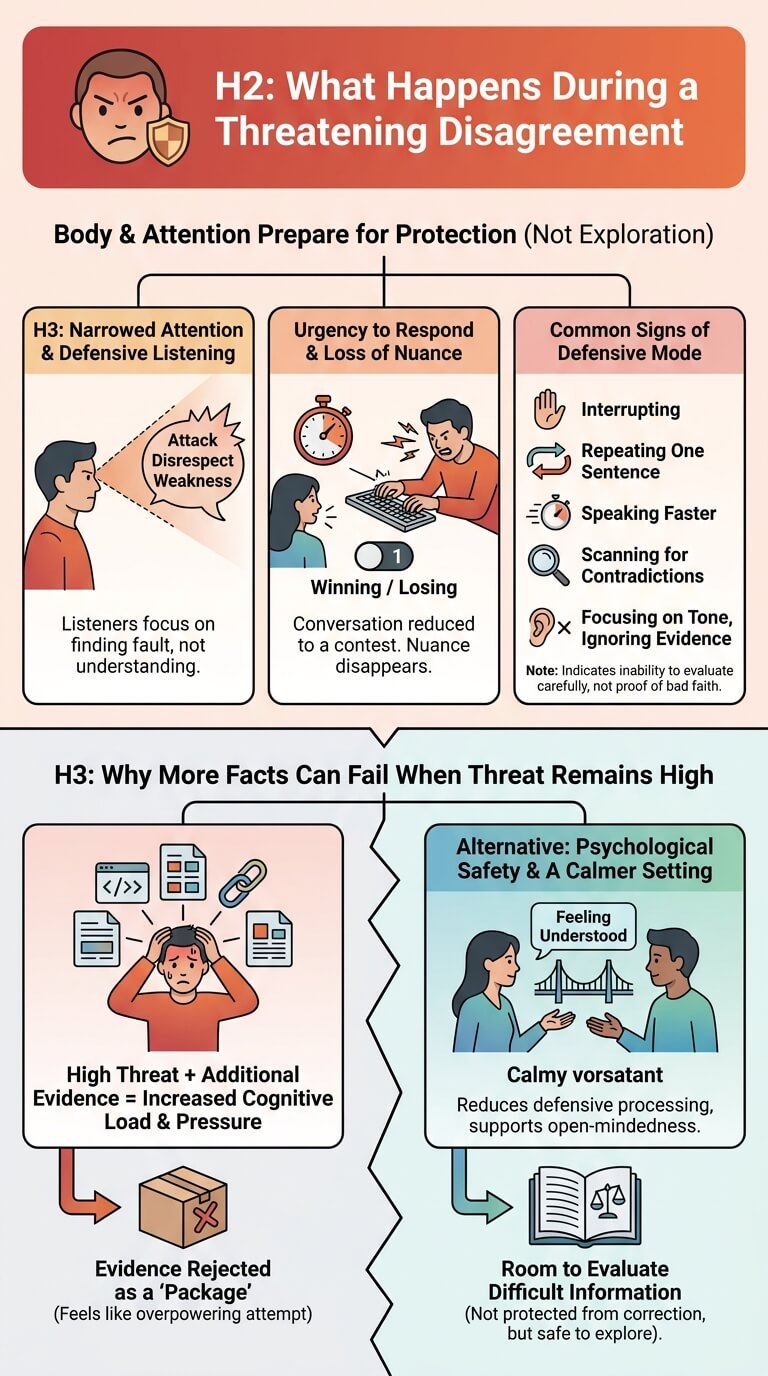
When disagreement feels threatening, the body and attention prepare for protection rather than exploration.
Narrowed attention, defensive listening, and urgency to respond
A person may listen mainly for attack, disrespect, or weakness in the other argument. They begin preparing a response before the speaker finishes. Nuance disappears, and the conversation is reduced to winning or losing.
Common signs include interrupting, repeating one sentence, speaking faster, scanning for contradictions, or focusing on tone while ignoring the central evidence. These reactions are not proof of bad faith. They indicate that the conversation may no longer support careful evaluation.
Why more facts can fail when threat remains high
Additional evidence increases cognitive load. If each new link feels like another attempt to overpower the person, the evidence itself becomes associated with pressure. The listener may reject the package without examining individual claims.
Feeling psychologically safe does not mean being protected from correction. Research on psychological safety in attitude conversations suggests that feeling understood can support open-mindedness and reduce defensive processing. A calmer setting creates more room to evaluate difficult information.
Resistance vs Belief Perseverance
These concepts interact, but they describe different parts of belief maintenance.
The social moment of challenge versus persistence after disconfirmation
Belief perseverance refers to a belief remaining influential after its original evidence has been weakened or withdrawn. Resistance to changing one’s mind focuses on what happens when reconsideration is demanded or invited in a social interaction.
A belief can persevere quietly without an argument. Resistance becomes visible when challenge activates identity, autonomy, reputation, or distrust. The same person may privately revise later even after resisting publicly in the moment.
Resistance vs Healthy Skepticism
Not every refusal to agree is defensive. Skepticism is necessary when evidence is weak, sources conflict, or consequences are serious.
Evidence standards, uncertainty, and willingness to update
Healthy skepticism uses standards that apply across preferred and disliked conclusions. It asks for relevant evidence, acknowledges uncertainty, and identifies what would change confidence. Resistance protects one conclusion by moving the standard whenever evidence arrives.
| Healthy skepticism | Self-protective resistance |
|---|---|
| Asks what evidence supports the claim | Attacks the person before examining the claim |
| Uses similar standards for both sides | Demands perfect proof only from unwanted conclusions |
| Can state what would change confidence | Treats every possible outcome as confirmation |
| Allows “uncertain” as an answer | Needs immediate certainty or victory |
| Updates gradually when evidence changes | Protects the same conclusion by changing reasons |
Signs a Conversation Has Shifted From Learning to Self-Protection
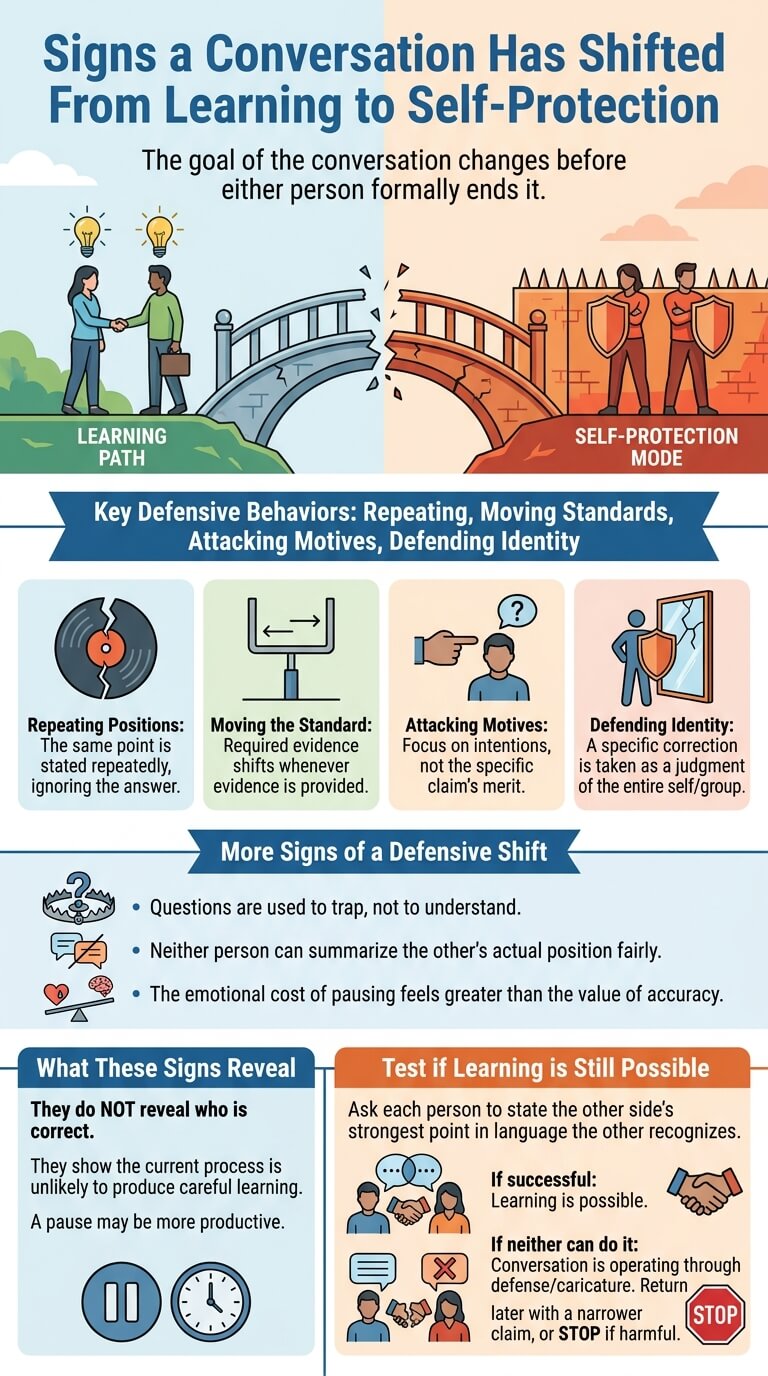
The goal of the conversation changes before either person formally ends it.
Repeating positions, moving the standard, attacking motives, and defending identity
- The same point is repeated without engaging with the answer.
- The required evidence changes each time evidence is provided.
- The person attacks motives instead of evaluating the specific claim.
- A narrow correction is heard as a judgment of the whole self or group.
- Questions are used to trap rather than understand.
- Neither person can summarize the other’s actual position fairly.
- The emotional cost of pausing feels greater than the value of accuracy.
These signs do not reveal who is correct. They reveal that the current process is unlikely to produce careful learning. A pause may be more productive than another round of argument.
You can test whether learning is still possible with one simple request: ask each person to state the other side’s strongest point in language the other recognizes. If neither can do it, the conversation is probably operating through defense and caricature. Return later with one narrower claim, or stop if the exchange has become harmful.
How Public Commitment Raises the Cost of Changing
People often find it easier to reconsider privately than in front of an audience.
Saving face, consistency pressure, and audience effects
A public position becomes connected to reputation. Reversal may require admitting that others were misled or that criticism was justified. The person may fear appearing weak, inconsistent, or unqualified.
Face-threatening communication can reduce willingness to keep contributing. Research on face-threatening feedback and psychological safety found that threatening feedback affected emotional responses and willingness to engage further. Although the study context is specific, the practical implication is useful: humiliation is not an efficient route to thoughtful revision.
Give people room to revise without requiring a dramatic confession. “I need to look at that again” is a meaningful step. Quiet changes in future behavior may appear before a public statement changes.
How to Talk Without Triggering More Resistance
No wording can control another person’s response. These approaches simply reduce avoidable threats and improve the conditions for honest evaluation.
Ask how the belief was formed
Try: “What led you to that conclusion?” or “Which part of the evidence feels strongest to you?” This reveals whether the belief rests on direct experience, one source, a group norm, or a broader fear.
Listen for the function of the belief as well as its content. It may provide certainty, loyalty, protection, or a sense of competence. Understanding the function does not require accepting the conclusion.
Preserve autonomy and avoid cornering
Use language that leaves space for independent judgment: “Here is the evidence I found,” “You can review it yourself,” or “We do not have to settle this immediately.” Avoid demanding instant agreement.
Autonomy also includes your own boundaries. You do not have to continue a conversation that is disrespectful, repetitive, or unsafe.
Find the specific claim rather than attacking the whole worldview
Replace “Everything you believe is wrong” with “This report does not support that particular conclusion.” A narrow claim can be checked. A total attack invites total defense.
Ask both sides to state the claim in observable language. “They never respect us” may become “They changed the schedule twice without consultation.” The second statement is easier to verify and discuss.
This is also why ethical persuasion works best when evidence can be examined without humiliation, hidden pressure, or loss of meaningful choice.
Offer an alternative explanation, not only a correction
Removing an explanation creates uncertainty. When possible, explain what better accounts for the event. “The delay was caused by a system outage” is more usable than “Your assumption was false.”
When the cause is unknown, say so. An honest gap is better than replacing one unsupported story with another.
Give time and a dignified exit
People may need time to process evidence after the social pressure ends. Try: “You do not need to answer now. We can revisit it later.” This makes private revision possible.
A dignified exit is not the same as pretending both claims are equally supported. It separates correction from humiliation.
What Not to Do
Some tactics increase pressure without improving understanding.
Humiliate, flood with links, demand instant admission, or treat disagreement as diagnosis
- Do not mock the person for having believed something.
- Do not send twenty links when one credible source addresses the claim.
- Do not demand a public confession as proof of learning.
- Do not call ordinary disagreement narcissism, delusion, trauma, or a personality disorder.
- Do not keep arguing after threats, intimidation, or retaliation appear.
- Do not confuse respecting autonomy with accepting falsehood or abandoning your boundary.
A Conversation Decision Tree
Before continuing, identify the kind of issue and the condition of the conversation.
Is the issue factual, moral, identity-based, or safety-related?
| Issue | Useful response |
|---|---|
| Factual | Define the claim, source, evidence standard, and uncertainty |
| Moral | Name the values, harms, duties, and tradeoffs involved |
| Identity-based | Separate dignity from accuracy and avoid group-level insults |
| Safety-related | Prioritize protection, documentation, support, and boundaries |
Is the person curious, defensive, coercive, or threatening?
A curious person asks questions and can summarize evidence. A defensive person may still engage but needs a pause or narrower focus. A coercive person tries to force agreement or punish dissent. A threatening person creates fear of harm or retaliation.
Do not confuse intensity with curiosity. Someone can ask many questions while refusing every answer or using questions to exhaust the other person. Genuine curiosity allows a response to matter. It can acknowledge a valid point, reduce confidence, or identify a remaining uncertainty without immediately moving the standard.
Continue, pause, set a boundary, or disengage
- Continue when both people can ask questions and revise details.
- Pause when attention has narrowed and repetition has begun.
- Set a boundary when the conversation becomes insulting, controlling, or intrusive.
- Disengage when there are threats, stalking, coercion, or credible fear.
How to Notice Resistance in Yourself
The same mechanisms are easier to see in other people than in ourselves.
What would changing this belief cost me socially or emotionally?
Ask what you would lose if the belief changed. Possible answers include status, certainty, group approval, a sense of competence, justification for a past decision, or a familiar explanation.
Naming the cost does not prove the belief is false. It reveals a pressure that may be influencing how evidence is judged.
Try completing two sentences: “If I changed my mind, I might lose…” and “If I kept this belief despite better evidence, I might lose…”. The first makes the emotional cost visible. The second prevents comfort from becoming the only factor in the decision.
What evidence would I accept before seeing it?
State in advance what source, observation, or outcome would lower your confidence. If no possible evidence counts, the belief is protected from testing.
Use calibrated change. You may not need to move from certainty to the opposite conclusion. “I am less confident than before” is genuine updating.
Also check whether you are asking the other side to meet a standard you would reject for your own view. Would one flawed source discredit your entire position? Would one emotional speaker make every supporting fact irrelevant? Symmetrical standards are a practical sign that accuracy still matters more than defense.
Conditions That Make Reconsideration More Possible

Reconsideration becomes easier when the conversation lowers unnecessary threat while keeping standards clear.
Accuracy, autonomy, dignity, trust, and time
People are more likely to reconsider when the evidence is relevant, the source is credible, autonomy is preserved, dignity is protected, and there is time to process. A usable alternative explanation also reduces the fear of being left with nothing.
These conditions do not guarantee agreement. They remove avoidable barriers. Attitude change may still require repeated experience, new social norms, or a shift in the beliefs supporting the evaluation.
Progress may look smaller than agreement. The person may ask a genuine question, stop repeating one claim, lower certainty, or agree to check a source independently. These are signs that evaluation has reopened. Pushing for a final declaration at that moment can restore the threat that had begun to decrease.
When to Disengage or Seek Support
Not every disagreement should be continued, especially when the cost includes fear or loss of safety.
Step back when disagreement includes threats, humiliation, coercion, stalking, or retaliation
Communication advice is not appropriate when another person uses fear, control, surveillance, threats, stalking, or retaliation. The priority is safety, not finding a more persuasive sentence.
The National Domestic Violence Hotline safety-planning resource explains that a safety plan is personal and practical. If you are in immediate danger, contact local emergency services. If the situation is not immediate but you feel unsafe, consider reaching a trusted person, local advocate, or qualified support service.
Educational note: Resistance to changing one’s mind is not a clinical diagnosis. This concept should not be used to label, control, or shame another person.
FAQ About Resistance to Changing One’s Mind
These questions address intelligence, reactance, face-saving, persuasion, and the point at which continuing is no longer useful.
Why do smart people resist evidence?
Intelligence does not remove identity, autonomy, emotion, social belonging, or past investment. Strong reasoning skills can support careful updating, but they can also be used to defend a preferred conclusion. The more useful question is whether the person applies fair evidence standards and can state what would change confidence.
Does arguing harder make someone more certain?
It can, especially when greater pressure increases reactance or humiliation. More evidence is not inherently harmful, but flooding, cornering, and ridicule can shift attention away from the claim. A specific source, clear question, and time to process are often more useful than intensity.
How can someone change their mind without losing face?
Allow gradual language such as “I am reconsidering,” “I need more information,” or “I was too certain.” Discuss the correction privately when possible and avoid demanding a dramatic admission. Preserving dignity makes it easier to revise without turning the update into a social defeat.
Is refusing to agree always psychological reactance?
No. The person may have valid evidence concerns, different values, distrust based on experience, or uncertainty that has not been resolved. Reactance is one possible response to threatened freedom, not a universal explanation for disagreement.
When should I stop trying to persuade someone?
Stop when the conversation is repetitive, disrespectful, coercive, or unsafe; when the decision belongs to the other person and you have stated your view clearly; or when continuing damages your wellbeing. You can set a boundary without securing agreement.
Key Takeaways
- Resistance often protects identity, autonomy, belonging, reputation, or past investment, not only a factual claim.
- Reactance can make pressure itself a reason to resist, even when the evidence deserves consideration.
- Healthy skepticism uses consistent standards and remains willing to update.
- Public humiliation and information flooding usually reduce the conditions for reflective thinking.
- Specific claims, credible evidence, autonomy, dignity, and time make reconsideration more possible.
- When disagreement includes threats, coercion, stalking, or retaliation, prioritize safety and disengagement over persuasion.
For a practical next step, choose one disagreement and write down four things: the specific claim, the evidence standard, the identity or autonomy threat, and the safest next action. That may be one focused question, a pause, a boundary, or a decision to stop trying to change the other person’s mind.

Michael Reed is the Founder and Lead Writer at Psychology Exposed. He writes about human behavior, relationships, emotional patterns, self-awareness, and practical psychology topics using research-informed, easy-to-understand content.
Read More About Michael Reed: https://psychologyexposed.com/michael-reed/