

You may believe honesty matters, then hide a mistake. You may know a purchase was unwise, yet keep defending it because admitting regret feels worse. You may value rest while repeatedly working past exhaustion. The discomfort that follows can feel like tension, irritation, embarrassment, urgency, or a strong need to explain yourself.
Cognitive dissonance is one way psychology describes this pressure for consistency. It appears when two personally important thoughts, attitudes, actions, choices, or identities do not fit together. The mind then tries to reduce the mismatch. Sometimes that leads to useful change, such as correcting behavior or updating a belief. Sometimes it leads to justification, avoidance, or selective interpretation.
Dissonance is not a diagnosis, proof of hypocrisy, or evidence that someone is secretly lying. People can feel guilty, uncertain, disappointed, or conflicted for other reasons. The concept is most useful when it helps identify what is colliding and whether the response improves alignment or merely protects comfort.
Quick Answer
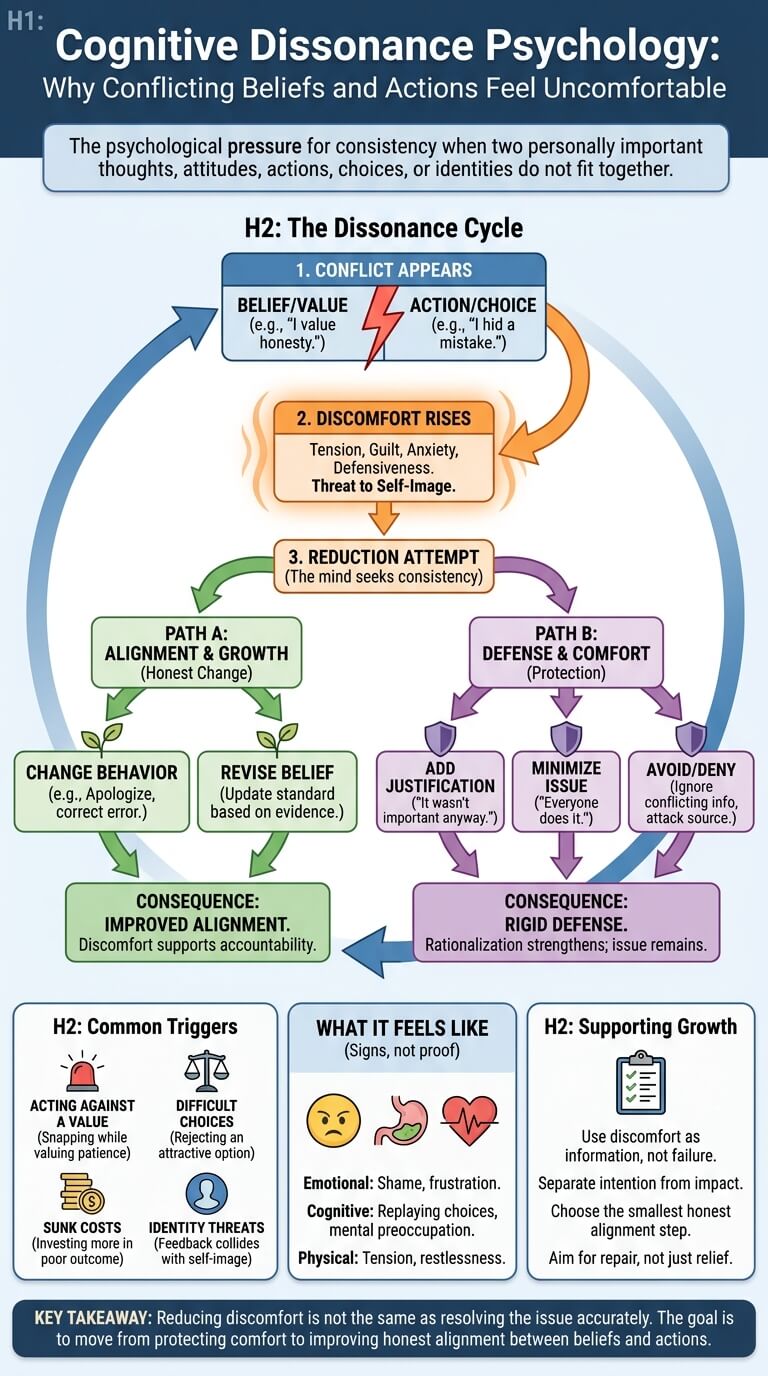
Cognitive dissonance is psychological discomfort caused by a meaningful inconsistency between beliefs, attitudes, actions, choices, or self-image. People often reduce it by changing behavior, revising a belief, adding a justification, minimizing the issue, or avoiding conflicting information. The discomfort can support growth when it leads to honest alignment, but it can also strengthen rationalization.
What Cognitive Dissonance Means
Cognitive dissonance theory proposes that inconsistency among important cognitions can create an aversive state that motivates reduction. A broad review of dissonance-reduction processes describes several ways people may restore consistency after choices, effort, or behavior create conflict.
The conflict becomes easier to understand when it is placed within the broader psychology of how beliefs shape interpretation and behavior.
The word cognitive can sound as if the experience is purely intellectual. In real life, the mismatch may involve emotion, bodily arousal, identity, social belonging, or fear of consequences. The central issue is not simply having two different thoughts. It is experiencing them as difficult to hold together.
The concept also has measurement limits. A methodological review of cognitive dissonance theory argues that the internal state has not always been defined and measured consistently across studies. That is a useful warning against treating every defensive reaction, changed preference, or uncomfortable feeling as proof of dissonance.
Inconsistency must feel personally important
Not every contradiction produces dissonance. You can prefer one restaurant today and another tomorrow without feeling threatened. You can change your mind about a minor fact with little discomfort. Pressure rises when the inconsistency touches something important: a moral standard, a public commitment, a major purchase, a valued relationship, professional competence, or the kind of person you believe yourself to be.
Consider two people who forget to recycle one bottle. One sees it as an ordinary lapse. The other strongly identifies as environmentally responsible and feels ashamed. The behavior is the same, but the second person experiences a sharper conflict with self-image.
Discomfort can be emotional, cognitive, and physical
Dissonance may feel like unease, guilt, frustration, defensiveness, embarrassment, anxiety, regret, or anger. It may also show up as mental preoccupation: replaying the choice, searching for supportive information, criticizing the alternative, or preparing explanations before anyone asks.
Some people notice bodily signs such as restlessness, tension, heat, or a racing heart. These reactions are not unique to cognitive dissonance, so they should not be treated as proof. They simply show that personally meaningful inconsistency can involve more than abstract reasoning.
The Dissonance Cycle

A practical model is: conflict, pressure, reduction attempt, and consequence. The last step matters because reducing discomfort is not the same as resolving the underlying issue.
Conflict appears
The cycle begins when two elements do not fit. You believe you are financially careful, but you make an impulsive purchase. You value kindness, but you speak harshly. You publicly support a plan, then learn that it has serious drawbacks. You choose one opportunity and lose access to another attractive option.
The mismatch may be obvious immediately or become visible later through feedback, consequences, or new evidence.
Discomfort rises
The inconsistency gains emotional force when it threatens identity, autonomy, status, belonging, or a valued goal. A person may think, “If this decision was poor, what does that say about my judgment?” The discomfort now concerns more than the original event.
Urgency can make the mind reach for the fastest available explanation. That is why the first response is not always the most accurate one.
The mind seeks consistency
People may gather more information, reinterpret what happened, change their behavior, compare themselves with others, blame circumstances, or reduce the importance of the conflict. Some responses are deliberate. Others happen quickly enough to feel like obvious truth.
The mind is not necessarily trying to deceive itself. It is trying to create a workable account of events. The problem begins when relief becomes the only standard for choosing that account.
Belief, attitude, behavior, or explanation changes
One part of the conflict usually shifts. The person returns the purchase, decides it was deserved, claims it was unavoidable, or stops identifying as financially careful. Each response reduces inconsistency in a different way.
The consequence may be greater alignment, temporary relief, or a more rigid defense. The same discomfort can therefore support accountability or rationalization.
| Stage | Example | Useful question |
|---|---|---|
| Conflict | “I value honesty, but I hid an error.” | What exactly does not fit? |
| Pressure | “Maybe I am not as responsible as I thought.” | What identity or consequence feels threatened? |
| Reduction attempt | “It was not important, and anyone would have done it.” | Am I learning or only seeking relief? |
| Consequence | The mistake stays hidden and may repeat. | Did the response improve alignment? |
Common Situations That Create Dissonance

Dissonance is especially likely when a choice or action carries personal meaning and cannot be undone easily.
Acting against a value
A person who values patience may snap at a child. Someone who values fairness may give a friend special treatment. The conflict is between behavior and a standard used to understand the self.
The next response matters. The person can acknowledge the impact and repair it, or protect identity by insisting the behavior did not count. The desire to remain “a good person” can motivate accountability, but it can also motivate denial.
Choosing between attractive options
Choosing one option means giving up another. After a difficult decision, people may emphasize the strengths of the chosen option and the weaknesses of the rejected one. Research on choice-induced preference change examines how past choices can influence later preferences.
This does not mean every post-choice preference is fake. New experience may genuinely reveal advantages. The useful question is whether the evaluation changed because of new evidence or because uncertainty became uncomfortable.
Investing heavily in a poor outcome
Time, money, effort, and public commitment make revision costly. A disappointing course may seem more valuable after an exhausting admission process. An underperforming project may receive more resources because stopping would make the earlier investment feel wasted.
The past cost cannot be recovered, but it can shape the need to justify continuing. This is where dissonance can interact with sunk-cost thinking without being identical to it.
Learning that a trusted person or group may be wrong
New information can threaten more than a factual belief. It may challenge loyalty, shared identity, or confidence in one’s judgment. A person may fear that reconsidering one claim means rejecting an entire community.
That wider meaning makes updating harder. The person is not only asking, “Is this evidence credible?” They may also be asking, “Where will I belong if I accept it?”
Receiving feedback that conflicts with identity
A capable employee may react strongly to criticism because the feedback collides with a professional self-image. A caring partner may hear concern about their behavior as an accusation that they are uncaring. When identity becomes the focus, specific information can be lost.
Separating action from identity can reduce this pressure: “I handled this conversation poorly” is easier to examine than “I am a terrible person.” The first statement allows accountability without requiring total self-rejection.
How People Reduce Cognitive Dissonance
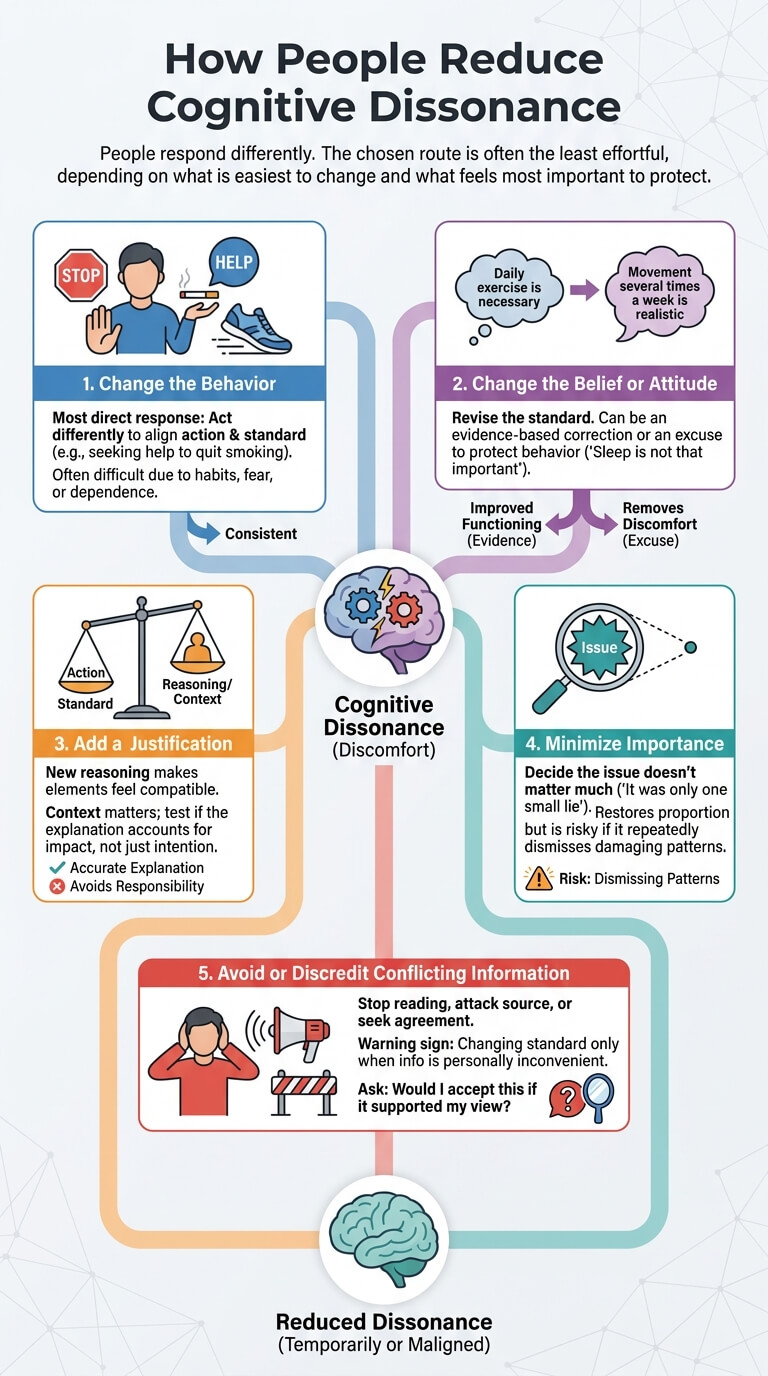
People do not all respond in the same way. The least effortful route often depends on what is easiest to change and what feels most important to protect.
Change the behavior
The most direct response is to act differently. A person who values health and notices heavy smoking may seek help to reduce or stop. Someone who treated a coworker unfairly may apologize and change how future decisions are made.
Behavior change can reduce dissonance because action and standard become more consistent. It is often difficult when habits, dependence, fear, social pressure, or limited resources are involved.
Change the belief or attitude
A person may revise the standard instead. “Daily exercise is necessary” becomes “Movement several times a week is a realistic goal.” That change may be an evidence-based correction rather than an excuse.
At other times, belief change protects an unchanged behavior: “Sleep is not that important for me.” The difference lies in the quality of evidence and whether the revision improves functioning or simply removes discomfort.
Add a justification
New reasoning can make the elements feel compatible. “I missed the deadline because an urgent family issue required attention” may be an accurate explanation. “Deadlines are arbitrary, so my delay does not matter” may avoid responsibility when others were affected.
Justification is not automatically dishonest. Context matters. The test is whether the explanation accounts for evidence and impact, not only intention.
Minimize importance
A person may decide the issue does not matter much: “It was only one small lie.” Sometimes this restores proportion. Not every inconsistency deserves intense shame.
Minimization becomes risky when it repeatedly dismisses consequences. If the same “small” behavior damages trust, the discomfort may be pointing toward a pattern that deserves attention.
Avoid or discredit conflicting information
Another route is to stop reading, attack the source, question motives, or surround oneself with agreement. Source criticism can be reasonable. Evidence should be evaluated. The warning sign is changing the standard only after information becomes personally inconvenient.
Ask whether you would accept the same source, method, or argument if it supported your preferred conclusion.
Everyday Examples
The following examples show that similar discomfort can lead to different forms of reduction.
Health habits
Situation: A person believes sleep matters but stays online until 2 a.m.
What they may feel: frustration, guilt, or irritation when reminded.
What it may mean: the behavior conflicts with a health belief, but habit, reward, stress, or avoidance is stronger in the moment.
What to do next: change one environmental cue, such as charging the phone outside the bedroom, rather than arguing about the importance of sleep again.
Spending and sunk costs
Situation: Someone pays for an expensive program that provides little value.
What they may feel: embarrassment and a strong need to defend the purchase.
What it may mean: admitting disappointment threatens confidence in their judgment.
What to do next: evaluate future costs and benefits separately from money already spent.
Work and achievement
Situation: An employee believes careful work defines them but submits a rushed report.
What they may feel: defensiveness when errors are identified.
What it may mean: feedback is being interpreted as an identity threat rather than information about one task.
What to do next: name the specific error, its impact, and one prevention step before explaining circumstances.
Relationships and loyalty
Situation: A person values loyalty but learns that a close friend has repeatedly harmed others.
What they may feel: tension between protecting the friendship and acknowledging the pattern.
What it may mean: evidence conflicts with both trust and social belonging.
What to do next: separate loyalty from automatic defense. A boundary or honest conversation may be more loyal to one’s values than denial.
Honesty and self-image
Situation: Someone describes themselves as honest but hides an important detail.
What they may feel: urgency to prove that the omission was not really deceptive.
What it may mean: self-image and behavior are colliding.
What to do next: ask what the other person would reasonably have understood if the detail had been disclosed.
Cognitive Dissonance vs Guilt, Regret, Hypocrisy, and Ambivalence
These concepts overlap, but they are not interchangeable.
A comparison framework based on the source of discomfort
| Concept | Main source | Typical question |
|---|---|---|
| Cognitive dissonance | Meaningful inconsistency among beliefs, actions, choices, or identity | How can these elements fit together? |
| Guilt | Belief that one’s action violated a moral standard or harmed someone | What did I do, and how can I repair it? |
| Regret | Comparison between a chosen outcome and a better imagined alternative | Would another choice have worked better? |
| Hypocrisy | Claiming or enforcing a standard that one’s behavior contradicts | Am I applying the same standard to myself? |
| Ambivalence | Simultaneous positive and negative evaluation of the same target | What do I both value and dislike here? |
A person can experience more than one at once. Someone may regret a choice, feel guilty about its impact, and experience dissonance because the action conflicts with self-image. Accurate labeling helps identify whether the next step is repair, better decision-making, tolerance of mixed feelings, or belief revision.
Why Dissonance Can Strengthen a Belief
Contradiction does not always produce reconsideration. Sometimes the effort spent defending a belief makes it more important.
Effort justification and identity protection
When people work hard, endure discomfort, or sacrifice for an outcome, admitting that the outcome has little value creates a painful mismatch. Research on effort and reward valuation discusses the idea that unpleasant effort can increase later valuation through dissonance-reduction processes.
This can appear in demanding groups, expensive training, difficult relationships, or long projects. “I suffered for this” can quietly become evidence that “this must be worthwhile.” Effort may genuinely create skill or meaning, but effort alone does not prove value.
When defending a choice feels easier than revising it
Revision may require admitting loss, explaining the change publicly, or grieving an identity. Defense provides faster emotional relief. The person may search for supportive examples, reinterpret criticism as hostility, or make the original claim broader.
A useful question is, “What would I have to feel or admit if I stopped defending this?” The answer may reveal shame, loss, loyalty, or fear that evidence alone cannot address.
When Dissonance Can Support Growth
Discomfort is not automatically harmful. It can signal that behavior and values need attention.
When the mismatch leads someone to revise an evaluation rather than only justify a behavior, it can become part of the broader process of attitude change.
Use discomfort as information rather than proof of failure
The presence of inconsistency does not mean your identity is false. People act under stress, limited information, habit, competing goals, and social pressure. A specific mismatch can be examined without turning it into a total judgment.
Replace “I am a fraud” with “My action did not match the standard I want to follow.” The second statement preserves responsibility while making repair possible.
Choose the smallest honest alignment step
Alignment may mean correcting a statement, returning a purchase, apologizing, revising a plan, changing one routine, or admitting uncertainty. The smallest useful step is concrete enough to alter future evidence.
Insight without action can become another explanation. A small behavior provides information about whether the value or belief can guide real choices.
A Dissonance Self-Check
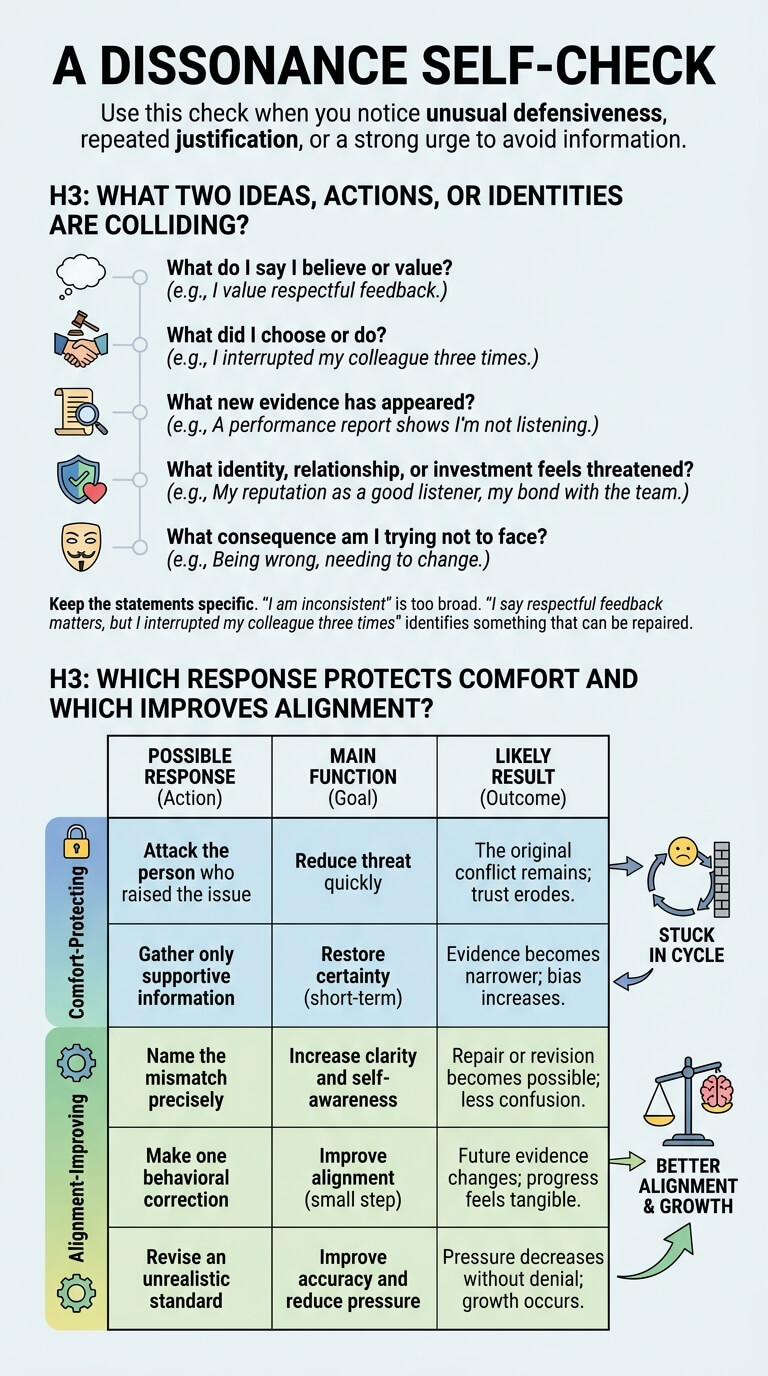
Use this check when you notice unusual defensiveness, repeated justification, or a strong urge to avoid information.
What two ideas, actions, or identities are colliding?
- What do I say I believe or value?
- What did I choose or do?
- What new evidence has appeared?
- What identity, relationship, or investment feels threatened?
- What consequence am I trying not to face?
Keep the statements specific. “I am inconsistent” is too broad. “I say respectful feedback matters, but I interrupted my colleague three times” identifies something that can be repaired.
Which response protects comfort and which improves alignment?
| Possible response | Main function | Likely result |
|---|---|---|
| Attack the person who raised the issue | Reduce threat quickly | The original conflict remains |
| Gather only supportive information | Restore certainty | Evidence becomes narrower |
| Name the mismatch precisely | Increase clarity | Repair or revision becomes possible |
| Make one behavioral correction | Improve alignment | Future evidence changes |
| Revise an unrealistic standard | Improve accuracy | Pressure decreases without denial |
How to Respond Without Rationalizing
The goal is not to eliminate every explanation. Explanations are necessary. The goal is to test whether the explanation accounts for evidence and impact.
Pause before explaining
When feedback feels threatening, delay the defense. Try: “I want to think about that before I answer.” A short pause gives the initial pressure time to settle and reduces the chance of committing publicly to an explanation you later need to protect.
Separate intention, impact, evidence, and identity
Use four lines:
- Intention: What was I trying to do?
- Impact: What happened for other people or the situation?
- Evidence: What facts support or weaken my explanation?
- Identity: What conclusion about myself am I afraid this implies?
Good intention can coexist with harmful impact. One mistake does not define an entire identity. Holding both ideas reduces the need to choose between total innocence and total self-condemnation.
Make one reversible behavioral test
If you believe criticism is unfair, ask for one concrete example and a clear standard. If you believe a purchase will become useful, set a date and measurable use target. If you believe a difficult habit is necessary, test a safer alternative for one week.
A reversible test generates evidence without requiring an immediate identity-level conversion.
How Dissonance Connects to Belief Persistence and Resistance
Dissonance, belief perseverance, and resistance to changing one’s mind can occur together, but they describe different parts of the process.
How discomfort can lead either to revision or defense
Dissonance is the pressure created by inconsistency. Belief perseverance is the continued belief after supporting evidence weakens or disappears. Resistance to changing one’s mind often emphasizes the social and emotional cost of being challenged.
A person may feel dissonance when evidence conflicts with a valued belief. To reduce it, they may revise the belief. They may instead discredit the evidence, protect identity, and strengthen the original explanation. The discomfort does not determine which route will be chosen.
This is also why respectful correction can help without guaranteeing change. Preserving dignity may reduce identity threat, but the person still needs credible evidence, an alternative explanation, and time to update.
When Professional Support May Help
Ordinary inconsistency is part of human life. Support becomes worth considering when the conflict contributes to severe shame, compulsive behavior, major avoidance, persistent distress, or unsafe relationships.
Seek support when conflict affects safety or daily functioning
A mental health professional may help when repeated rationalization is tied to addiction, disordered eating, compulsive checking, self-harm, trauma-related distress, or behavior that seriously harms relationships or work. The aim is not to diagnose “cognitive dissonance,” but to address the underlying behavior, emotion, and consequences.
If a relationship includes coercion, threats, stalking, humiliation, or retaliation, prioritize safety rather than trying to reason the other person out of inconsistency. In the United States, the National Institute of Mental Health help page provides options for finding care and crisis support. Elsewhere, use local mental health or emergency services.
Educational note: Cognitive dissonance is a psychological concept, not a clinical diagnosis. It should not be used to label another person or excuse harmful behavior.
FAQ About Cognitive Dissonance
These questions clarify what dissonance does, how conscious it is, and why reduction does not always produce accurate change.
Does cognitive dissonance always change beliefs?
No. People may change behavior, reinterpret the situation, add a justification, reduce the issue’s importance, or avoid conflicting information. Belief change is one possible response. The easiest element to alter often depends on identity, investment, available evidence, and social cost.
Can someone experience dissonance without realizing it?
Yes. A person may notice irritation, defensiveness, avoidance, or repeated explanation before recognizing the underlying inconsistency. However, those reactions have many possible causes. Dissonance is a useful hypothesis only when a specific meaningful conflict can be identified.
Why do people defend decisions they regret?
Admitting regret may threaten confidence, status, or a public commitment. Emphasizing the chosen option’s benefits can reduce uncertainty and protect self-image. Defense may also reflect genuine new experience, so changed preference should not automatically be dismissed as rationalization.
Is cognitive dissonance the same as lying to yourself?
No. Dissonance refers to discomfort from inconsistency and the motivation to reduce it. Some reduction strategies involve biased reasoning, but others involve honest behavior change, reasonable belief revision, or a more realistic standard. The process is broader than deliberate self-deception.
Can changing behavior reduce dissonance?
Yes. When action becomes more consistent with a valued belief or attitude, the mismatch can decrease. Behavior change is especially useful when the standard remains credible and the action is within the person’s control. If the standard is unrealistic, revising it may be healthier than chasing impossible consistency.
Key Takeaways
- Cognitive dissonance arises when a personally important belief, action, choice, attitude, or identity does not fit another.
- The discomfort may lead to behavior change, belief revision, justification, minimization, or avoidance.
- Reducing discomfort is not the same as resolving the issue accurately or responsibly.
- Dissonance differs from guilt, regret, hypocrisy, and ambivalence, although several may occur together.
- Effort, public commitment, and identity can make defending a poor choice feel easier than revising it.
- A useful response names the exact mismatch, separates intention from impact, and chooses one honest alignment step.
For a concrete next step, write one sentence beginning “I believe or value…” and a second beginning “But I chose or did…”. Then list the explanation that gives the fastest relief and the action that would create better alignment. The difference between those two responses is often where the most useful learning begins.

Michael Reed is the Founder and Lead Writer at Psychology Exposed. He writes about human behavior, relationships, emotional patterns, self-awareness, and practical psychology topics using research-informed, easy-to-understand content.
Read More About Michael Reed: https://psychologyexposed.com/michael-reed/