
Belief and attitude are often used as if they mean the same thing. They are related, but they answer different psychological questions. A belief concerns what you accept as true, likely, or real. An attitude concerns how you evaluate something, often as positive, negative, desirable, undesirable, safe, risky, appealing, or unpleasant.
That difference becomes clearer when the same topic produces both. You may believe that regular exercise improves health while feeling negatively toward gyms. You may believe a coworker is highly skilled while disliking their communication style. You may believe a policy will reduce costs while still feeling uneasy about its consequences.
Separating belief from attitude helps explain why two people can agree on facts but feel differently, why someone can hold a positive attitude without acting on it, and why changing one belief may not change the full evaluation. It also prevents a common mistake: assuming a person’s behavior reveals exactly what they believe or feel.
Quick Answer
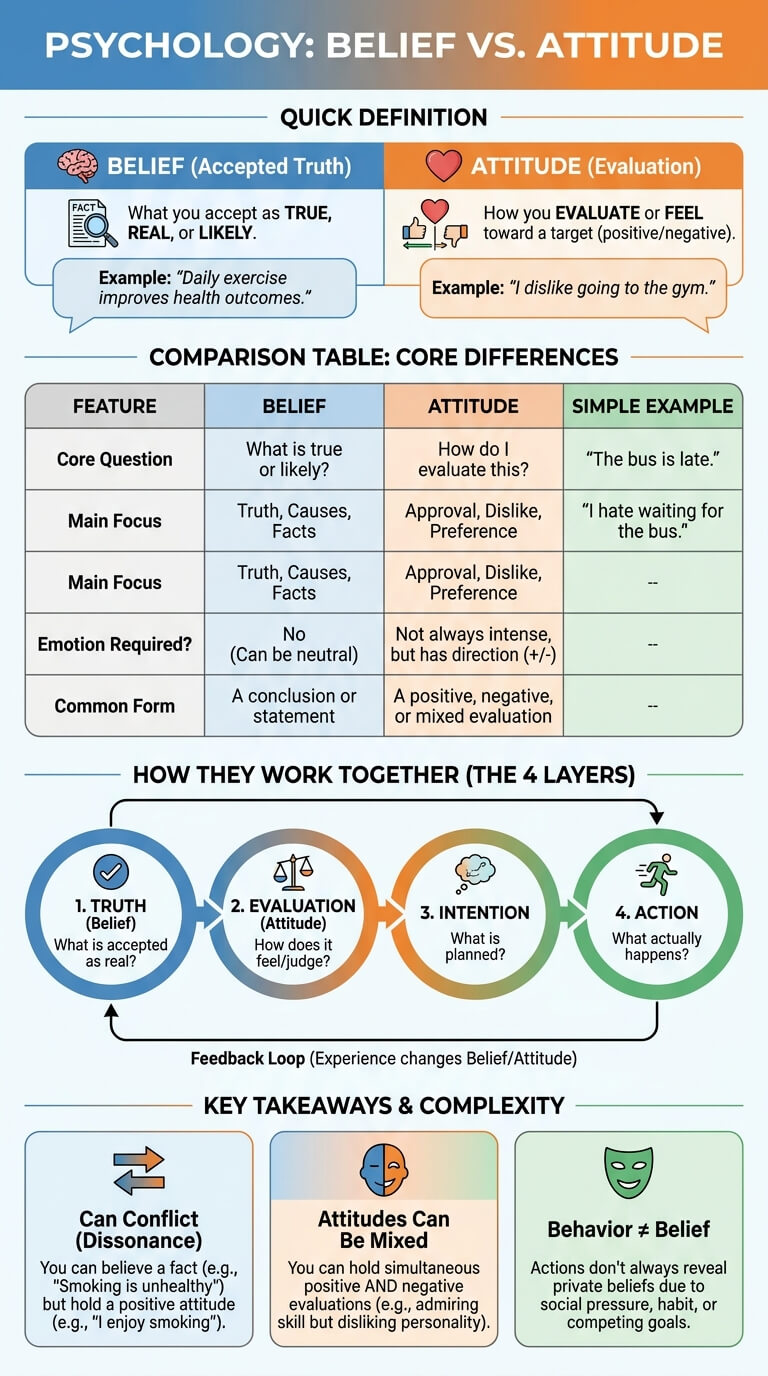
A belief is something a person accepts as true or likely, such as “This course requires weekly practice.” An attitude is the person’s positive, negative, or mixed evaluation of the target, such as “I like this course.” Beliefs often support attitudes, but the same belief can produce different evaluations, and attitudes can also include emotion, past experience, identity, and action tendencies.
The Simplest Difference

The most practical distinction is this: belief describes accepted truth, while attitude describes evaluation. The APA Dictionary of Psychology entry for belief focuses on accepting something as true, real, or valid.
The corresponding APA definition of attitude describes a relatively enduring evaluation of a target.
Belief asks, “What do I accept as true?”
A belief may concern facts, causes, abilities, intentions, probabilities, or relationships between events. Examples include:
- “The train is usually faster during rush hour.”
- “My manager values detailed preparation.”
- “Learning a language requires repeated practice.”
- “This person is likely to keep their promise.”
- “If I ask for help, people may see me as unprepared.”
Some beliefs are well supported. Others are incomplete, uncertain, or inaccurate. Psychology can examine how strongly a belief is held and how it influences behavior without assuming that the belief is objectively correct.
Attitude asks, “How do I evaluate or feel toward it?”
An attitude expresses approval, dislike, comfort, suspicion, attraction, support, or another evaluative direction. Examples include:
- “I like taking the train.”
- “I feel positive about detailed preparation.”
- “I enjoy language learning.”
- “I feel cautious around this person.”
- “I dislike asking for help.”
An attitude can include beliefs, feelings, and readiness to act. It is therefore broader than a single belief. It also may be mixed. Someone can admire a demanding teacher’s knowledge while disliking the pressure of the class.
Belief vs Attitude Comparison Table

The table below separates the concepts across meaning, emotional direction, behavior, certainty, and change.
| Feature | Belief | Attitude |
|---|---|---|
| Core question | What do I accept as true or likely? | How do I evaluate this target? |
| Typical form | A statement or conclusion | A positive, negative, neutral, or mixed evaluation |
| Main focus | Truth, probability, cause, meaning, or expectation | Approval, liking, dislike, comfort, concern, or preference |
| Emotion required? | No. A belief can feel emotionally neutral. | Not always intense, but evaluation has a positive, negative, or mixed direction. |
| Behavioral tendency? | May influence behavior through goals and interpretation. | Often includes an approach, avoidance, support, or opposition tendency. |
| Can be uncertain? | Yes. A person may hold a belief with low or high confidence. | Yes. An attitude may be weak, strong, or ambivalent. |
| Common change route | New evidence, explanation, experience, or prediction failure | New belief, emotion, experience, behavior, identity, or social context |
| Simple example | “The bus is often late.” | “I dislike taking the bus.” |
How Beliefs and Attitudes Work Together
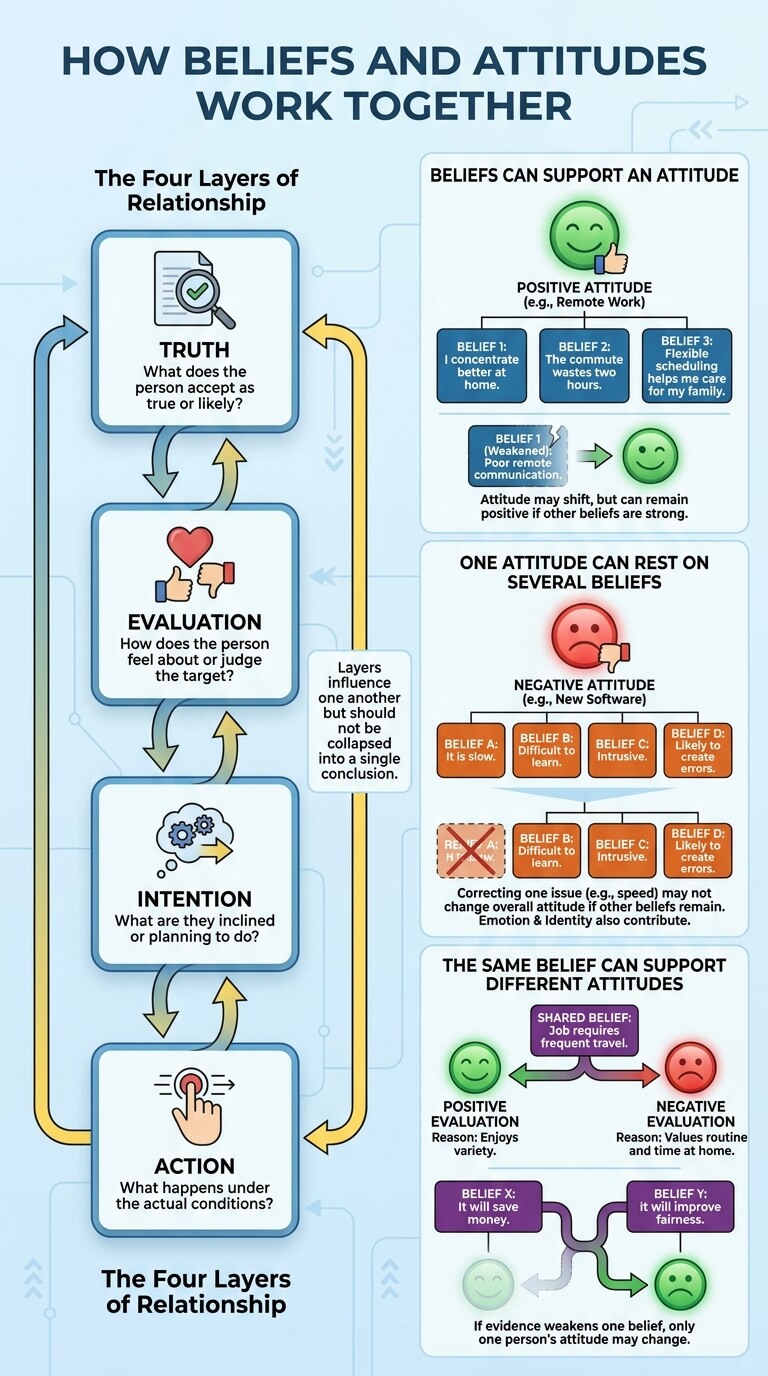
The relationship can be understood through four layers: truth, evaluation, intention, and action. The layers influence one another, but they should not be collapsed into a single conclusion.
- Truth: What does the person accept as true or likely?
- Evaluation: How does the person feel about or judge the target?
- Intention: What are they inclined or planning to do?
- Action: What happens under the actual conditions?
Beliefs can support an attitude
Suppose someone has a positive attitude toward remote work. Supporting beliefs may include “I concentrate better at home,” “The commute wastes two hours,” and “Flexible scheduling helps me care for my family.” These beliefs provide reasons for the evaluation.
If one belief changes, the attitude may shift. If the person joins a team with poor remote communication, the belief “I am more productive at home” may weaken. Yet the overall attitude could remain positive because flexibility and family time still matter.
One attitude can rest on several beliefs
An attitude usually has more than one basis. Someone may dislike a new software system because they believe it is slow, difficult to learn, intrusive, and likely to create errors. Correcting the speed issue may not change the overall attitude because the other beliefs remain.
This explains why a single fact sometimes has little effect. It addressed one support, while the evaluation was held up by several others. Emotion and identity may also contribute independently of the factual claim.
The same belief can support different attitudes
Two people may both believe that a job requires frequent travel. One evaluates that positively because they enjoy variety. The other evaluates it negatively because they value routine and time at home. Agreement about what is true does not guarantee agreement about whether it is desirable.
The reverse is also possible. Two people may share a positive attitude toward the same policy for different reasons. One believes it will save money; the other believes it will improve fairness. If later evidence weakens one belief, only one person’s attitude may change.
Paired Everyday Examples
Paired examples make the distinction more practical because they keep the target constant while separating truth claims from evaluation.
Learning and ability
Belief: “Improving at public speaking requires repeated practice.”
Attitude: “I dislike public-speaking practice because it makes me feel exposed.”
A person can accept the value of practice while feeling negatively toward the process. Their behavior may then depend on whether the expected benefit outweighs discomfort and whether practice can be made gradual or private.
Health behavior
Belief: “Preventive checkups can identify some problems earlier.”
Attitude: “I feel uneasy about medical appointments.”
The belief and attitude point in different directions. The person may intend to book an appointment but delay because of fear, cost, access, prior treatment, or uncertainty. Delay alone does not prove they reject the health information.
Relationships and trust
Belief: “My friend shared something private that I told them.”
Attitude: “I now feel cautious about confiding in them.”
The belief concerns what happened. The attitude is an evaluation of the person as a target for future disclosure. A broader belief such as “Nobody can be trusted” would go beyond the evidence in this one relationship.
Technology and risk
Belief: “This tool stores personal data on remote servers.”
Attitude: “I have a mixed attitude toward using it.”
The person may appreciate convenience while disliking privacy risk. Ambivalence is not confusion here. It reflects two relevant evaluations operating at the same time.
Social groups and institutions
Belief: “This organization made a decision without consulting affected members.”
Attitude: “I feel less supportive of the organization.”
The attitude may be based on beliefs about transparency, fairness, competence, or future behavior. Someone else may accept the same event as true but evaluate it less negatively because they prioritize speed or trust the decision makers.
Can a Belief Exist Without a Strong Attitude?
Yes. Many beliefs carry little emotional or evaluative weight.
Accepting a claim as true while feeling neutral
You may believe that a library closes at 8 p.m. without liking or disliking that fact. You may believe a distant city has a particular population without any meaningful evaluation of the city. The belief is informational rather than personally important.
Attitude becomes more likely when the information connects to goals, values, identity, pleasure, risk, or expected consequences. The closing time may become negative when you need the library at 9 p.m. The same belief now matters because it affects a goal.
This distinction also helps explain why correcting a minor belief may be easy. Little identity or emotion is invested. A person can update “The appointment is Tuesday” to “The appointment is Wednesday” without needing to protect a wider evaluation.
Can an Attitude Exist Without a Clear Belief?
Yes. A person can experience a fast evaluation without being able to state a clear reason.
Fast evaluation, familiarity, and poorly articulated reasons
You may like a familiar song before remembering where you heard it. You may feel uneasy about a design, tone of voice, or social setting without being able to identify the exact feature producing the response. The attitude is present, while its basis remains unclear.
That does not mean the evaluation appeared from nowhere. It may reflect learned association, past experience, sensory preference, cultural familiarity, or information that is difficult to retrieve consciously. It also does not prove that the evaluation is accurate.
A responsible response is curiosity rather than certainty. Ask what cues are present, when the reaction appears, whether it changes with context, and what evidence would support the interpretation. Avoid converting “I feel uneasy” directly into “This person is dangerous” without additional information.
It can also help to compare the reaction across similar targets. If the unease appears around every unfamiliar setting, the evaluation may reflect uncertainty more than a feature of this particular place. If it appears only after one specific behavior, the cue may deserve closer attention. Comparison makes the attitude more precise without dismissing the feeling.
When Beliefs and Attitudes Conflict
Belief and attitude can point in different directions. Someone may believe a difficult conversation is necessary while strongly disliking confrontation. A person may believe a product works well while disliking the company that makes it. Another may believe a family tradition is meaningful while feeling burdened by participating.
Mixed evidence, ambivalence, identity, and competing goals
Conflict may occur because the evaluation has several bases. A belief supports one side, while emotion, identity, or another belief supports the other. Research on cognitive and affective inconsistency shows why thoughts and feelings do not always align neatly.
Instead of asking, “Which side is my real attitude?” list the competing parts. For example:
- I believe the move would improve my career.
- I feel sad about leaving my community.
- I value stability and also value growth.
- I expect the first six months to be difficult.
- I intend to gather more information before deciding.
The conflict is not solved by labeling one part irrational. Each statement describes a different psychological layer.
Belief vs Opinion, Value, Preference, and Expectation
Belief and attitude are not the only concepts that get blended together. The following comparison adds four nearby terms.
| Concept | Main question | Example: working from home |
|---|---|---|
| Belief | What do I accept as true? | “I complete focused tasks faster at home.” |
| Attitude | How do I evaluate it? | “I like working from home.” |
| Opinion | What judgment or position do I express? | “Employees should be allowed two remote days.” |
| Value | What broad principle matters? | “Autonomy and family time are important.” |
| Preference | Which option do I favor? | “I prefer home on writing days.” |
| Expectation | What do I predict? | “I expect fewer interruptions tomorrow.” |
The APA entry for expectancy highlights the future-oriented nature of expecting a particular outcome. An expectation can be treated as a type of belief about what is likely to happen, but it is useful to name it separately because predictions shape preparation, attention, and disappointment.
Which Usually Changes First?
There is no universal order. Belief, attitude, behavior, and experience can influence one another in several directions.
Belief change can shift attitude
If someone learns that a feared technology uses stronger privacy protections than expected, the negative attitude may soften. The effect depends on whether privacy was the main basis of the evaluation and whether the new information is trusted.
A changed belief may have little effect when the attitude is mainly emotional or identity-based. Knowing that flying is statistically safe does not automatically remove fear of flying. The factual belief and emotional evaluation can change at different speeds.
Experience or emotion can shift attitude before explicit belief
A positive direct experience may improve an attitude before the person can explain why. Repeated respectful contact with a previously unfamiliar group may make the evaluation warmer even when the person has not consciously revised every prior belief.
Emotion can also move an attitude temporarily. A moving story may increase concern, while anger may make a policy seem less acceptable. Whether the change lasts depends on what is remembered, reinforced, and integrated afterward.
Behavior can create pressure for both to change
Voluntary action can provide new evidence. A person who joins a class reluctantly may discover that they enjoy it and are more capable than expected. The behavior supplies experience that changes both belief and attitude.
Coerced behavior is different. Acting under pressure may not produce internal agreement. People may comply publicly while retaining the original evaluation. This is another reason not to infer belief from behavior alone.
A Five-Question Decision Guide
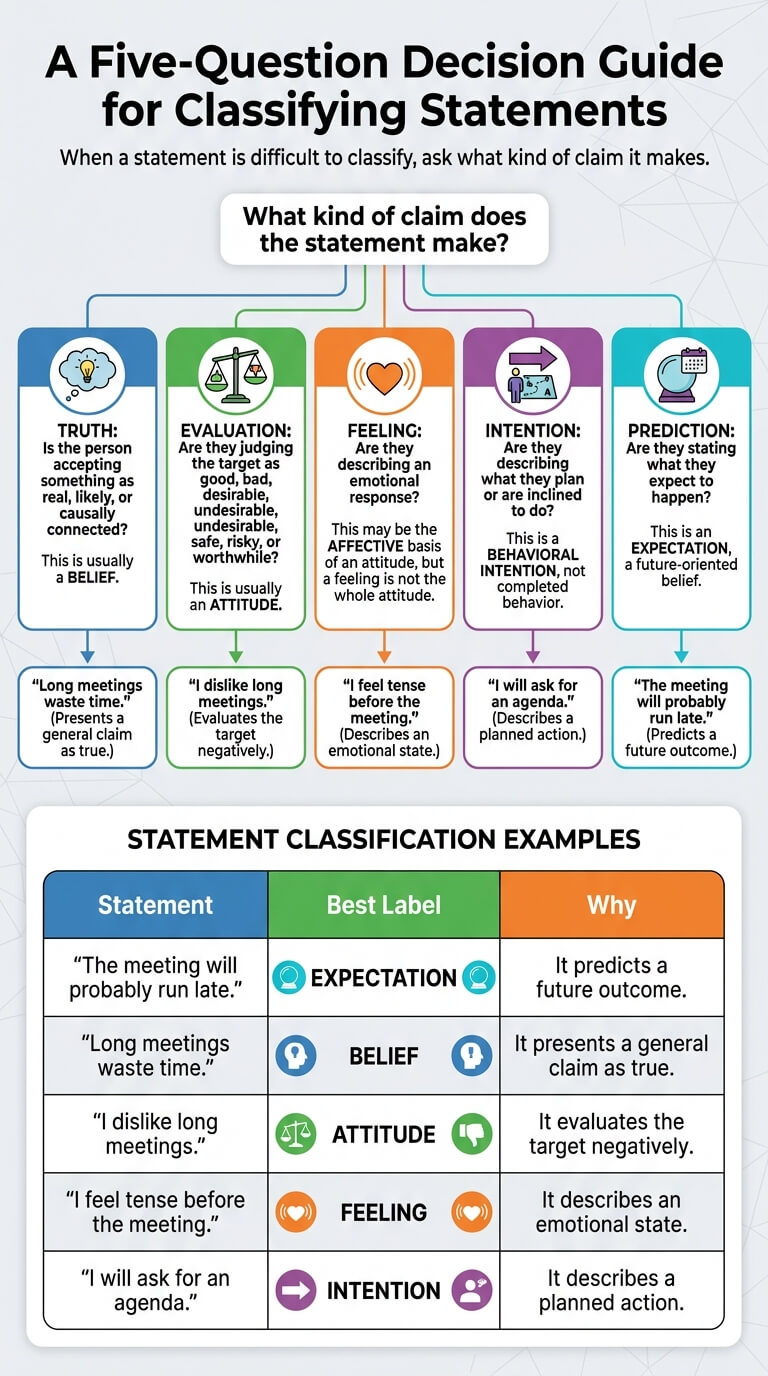
When a statement is difficult to classify, ask what kind of claim it makes.
Is the statement about truth, evaluation, feeling, intention, or prediction?
- Truth: Is the person accepting something as real, likely, or causally connected? This is usually a belief.
- Evaluation: Are they judging the target as good, bad, desirable, undesirable, safe, risky, or worthwhile? This is usually an attitude.
- Feeling: Are they describing an emotional response? This may be the affective basis of an attitude, but a feeling is not the whole attitude.
- Intention: Are they describing what they plan or are inclined to do? This is a behavioral intention, not completed behavior.
- Prediction: Are they stating what they expect to happen? This is an expectation, a future-oriented belief.
| Statement | Best label | Why |
|---|---|---|
| “The meeting will probably run late.” | Expectation | It predicts a future outcome. |
| “Long meetings waste time.” | Belief | It presents a general claim as true. |
| “I dislike long meetings.” | Attitude | It evaluates the target negatively. |
| “I feel tense before the meeting.” | Feeling | It describes an emotional state. |
| “I will ask for an agenda.” | Intention | It describes a planned action. |
Why the Difference Matters
Precise labels make reflection, disagreement, and behavior change more effective.
Better self-reflection, clearer communication, and more accurate interpretation
If you call an attitude a belief, you may argue about facts when the real issue is evaluation. A person may already accept that an event is safe but still feel negatively toward it. More evidence may not address the emotional basis.
If you call a belief an attitude, you may treat a factual disagreement as a matter of personal taste. “I do not like that conclusion” does not answer whether the evidence supports it. Evaluation and accuracy need separate discussion.
Clear labels also improve difficult conversations. One person may be debating whether an event happened, while the other is explaining how the event affected them. The first issue concerns evidence; the second concerns evaluation and emotion. Both can matter, but answering only one leaves the other person feeling ignored or the factual question unresolved.
The distinction also reduces mind reading. Research on the attitude-behavior relationship shows that factors such as accessibility, stability, certainty, direct experience, and consistency affect how strongly attitudes relate to later behavior. A single action should not be treated as a complete report of belief or attitude.
Where Cognitive Dissonance Appears
Belief, attitude, and behavior sometimes point in different directions without producing much discomfort. The mismatch becomes more relevant when it threatens an important self-image, value, commitment, or decision.
When belief, attitude, and behavior point in different directions
Imagine someone who believes honesty is important, has a negative attitude toward deception, and then hides a mistake. They may feel tension because behavior conflicts with a valued evaluation and self-concept. They could admit the mistake, change the belief about honesty, minimize the importance of the event, or create a justification.
Not every gap is cognitive dissonance. Someone may support exercise but miss one walk because of illness. The behavior differs from the attitude, but there may be no meaningful inconsistency to resolve. Importance and interpretation determine whether the mismatch creates pressure.
What to Do Next
When you want to understand or change a reaction, label the layers before trying to fix them.
Label the belief, attitude, intention, and behavior separately
Use four short statements:
- I believe: What do I accept as true or likely?
- I evaluate: What do I like, dislike, support, or oppose?
- I intend: What am I inclined or planning to do?
- I did: What happened under the actual conditions?
Then identify the first useful question. If the belief is weakly supported, gather better evidence. If the attitude is mixed, separate its positive and negative bases. If intention and action differ, examine opportunity, habit, skill, fear, incentives, and competing goals. If the behavior occurred under pressure, do not assume it reflects private agreement.
This sequence prevents an all-purpose solution from being applied to the wrong layer. Facts are useful when a truth claim is uncertain. Reflection is useful when an evaluation is mixed. Planning is useful when intention lacks a practical route. Accountability is useful when a chosen action caused harm. Precision makes the next step smaller and more relevant.
FAQ About Beliefs and Attitudes
These questions address the overlap between belief, evaluation, opinion, behavior, values, and change.
Is every attitude based on a belief?
Attitudes commonly involve beliefs, but a person may not be able to state the basis clearly. Fast affective reactions, familiarity, direct experience, and learned associations can contribute to evaluation. A later explanation may capture part of the basis without fully describing how the attitude developed.
Is an opinion a belief or an attitude?
An opinion is an expressed judgment or position. It can contain both beliefs and attitudes. “The city should add more buses” may reflect beliefs about demand and cost, plus a favorable evaluation of public transportation. The exact label depends on whether the statement emphasizes truth, evaluation, or a recommended position.
Can someone believe something but behave against it?
Yes. Behavior also depends on goals, opportunity, pressure, skill, habit, incentives, and competing beliefs. A person may believe sleep is important and still stay awake to finish urgent work. The behavior does not prove the belief was insincere, although repeated choices may reveal which goals dominate in practice.
Are values closer to beliefs or attitudes?
Values are broad principles about what is important or desirable. They often organize both beliefs and attitudes. Valuing fairness may influence what evidence a person notices, how they evaluate a policy, and what actions they support. A value is not identical to either one.
Which is harder to change, a belief or an attitude?
Either can be difficult when it is strong, identity-relevant, emotionally important, socially reinforced, or supported by repeated experience. A narrow factual belief may change quickly after clear correction. A broad attitude may persist because several beliefs and emotions support it. The structure matters more than the label alone.
Key Takeaways
- A belief describes what someone accepts as true or likely; an attitude describes how they evaluate a target.
- Several beliefs can support one attitude, and the same belief can produce different attitudes in different people.
- A belief can exist with little emotion, while an attitude can appear before its supporting reasons are easy to explain.
- Truth, evaluation, intention, and action are related layers, not interchangeable evidence about the mind.
- Behavior depends on context and should not be treated as a perfect measure of private belief or attitude.
- Separating the layers reveals whether the next step requires evidence, emotional understanding, practical support, or behavior change.
Choose one current decision and write four lines: what you believe, how you evaluate the option, what you intend to do, and what you actually do. The first mismatch often shows whether you need more information, a clearer value judgment, a practical plan, or a more realistic understanding of the situation.

Michael Reed is the Founder and Lead Writer at Psychology Exposed. He writes about human behavior, relationships, emotional patterns, self-awareness, and practical psychology topics using research-informed, easy-to-understand content.
Read More About Michael Reed: https://psychologyexposed.com/michael-reed/