
Before an interview, a person expects to freeze and begins scanning for signs that the interviewer is unimpressed. Before meeting a new group, someone expects rejection and speaks less than they normally would. Another person expects a difficult task to improve with practice and prepares long enough to notice progress.
Expectations are future-oriented predictions. They prepare attention, emotion, effort, and behavior before an outcome arrives. That preparation can change the experience and sometimes influence what happens next. It can also create a loop in which the result appears to confirm the original prediction.
This does not mean thoughts magically control external events. Other people, chance, resources, health, discrimination, skill, and real-world conditions remain important. Expectation psychology is most useful when it shows which parts of an experience are being shaped internally and which parts remain outside personal control.
Quick Answer

In psychology, an expectation is a belief or mental set about a future event, response, or outcome. Expectations can guide what people notice, how they interpret uncertainty, which emotions appear in advance, how they prepare, and what actions they take. Those actions may influence the outcome, but expectations do not guarantee success, failure, illness, rejection, or recovery.
What an Expectation Means in Psychology
The APA Dictionary of Psychology entry for expectancy describes the term differently across fields, including a mental set that shapes how a person approaches a situation and a belief that an action can produce a particular result. The common feature is orientation toward what is likely to happen next.
Many expectations do not appear from nowhere; earlier belief formation helps supply the assumptions that later become predictions about what will happen next.
A prediction about a future event, response, or outcome
An expectation can concern the world: “The meeting will probably run late.” It can concern another person: “They will react defensively.” It can concern the self: “I will forget what I planned to say.” It can also connect action with outcome: “If I practice this skill, I will become more accurate.”
Expectations vary in confidence. A person may see an outcome as possible, likely, almost certain, or unavoidable. Strong certainty is psychologically influential because it reduces the number of alternatives the person prepares for, but certainty does not establish accuracy.
Expectation versus hope, goal, belief, assumption, and standard
| Concept | Main question | Example |
|---|---|---|
| Expectation | What do I predict will happen? | “I expect the presentation to be difficult.” |
| Hope | What outcome do I want? | “I hope the audience responds well.” |
| Goal | What result am I trying to produce? | “My goal is to explain three ideas clearly.” |
| Belief | What do I accept as true? | “Preparation improves my delivery.” |
| Assumption | What am I taking for granted? | “The audience already understands the background.” |
| Standard | What level do I think should be met? | “A professional talk should finish on time.” |
One statement can contain several elements. “I expect to succeed because I prepared, and I will be disappointed if I do not” combines a prediction, supporting belief, desired outcome, and emotional standard.
The Expectation-to-Experience Pathway
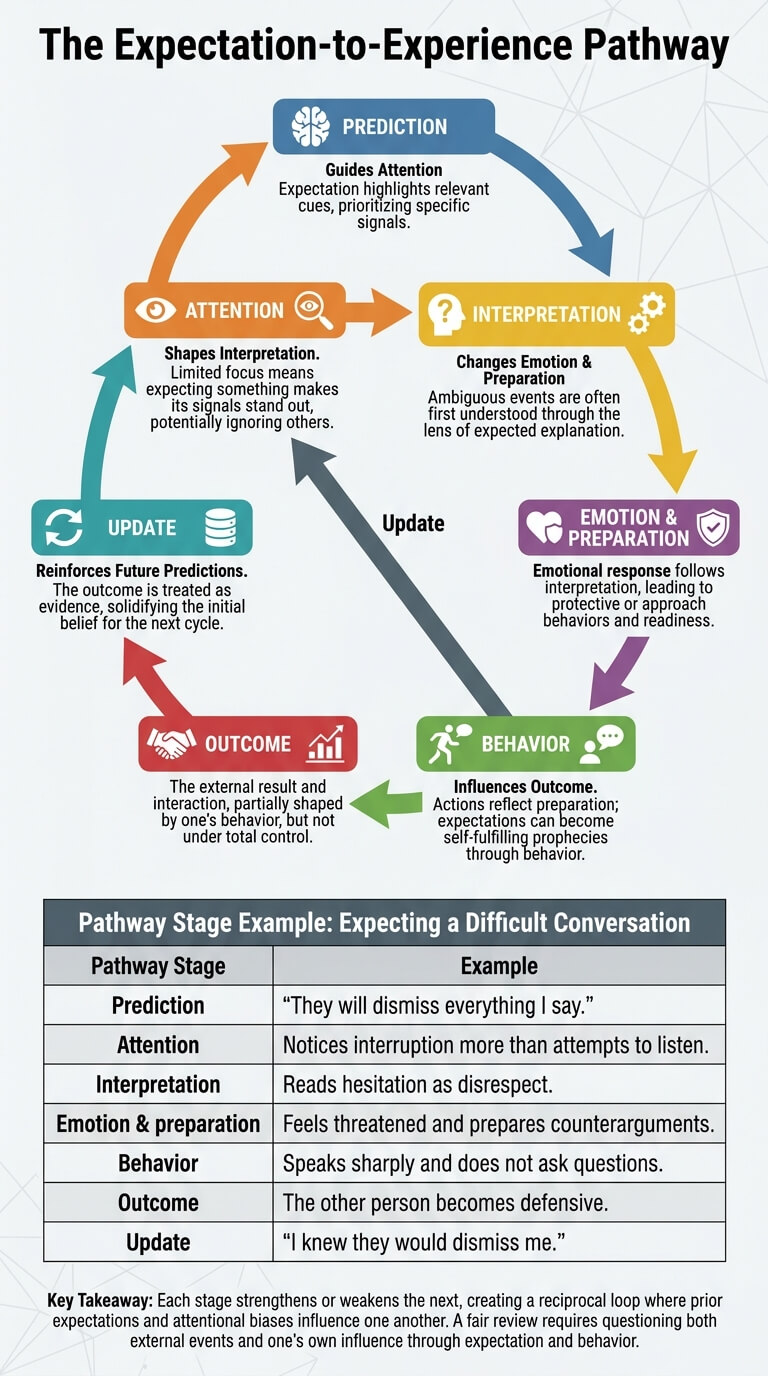
A useful pathway is: prediction, attention, interpretation, emotion and preparation, behavior, outcome, and update. Each stage can strengthen or weaken the next.
Prediction guides attention
When an outcome is expected, cues related to it become more relevant. A person expecting criticism notices pauses, frowns, and corrections quickly. Someone expecting support notices warmth, agreement, and invitations to continue.
Attention is limited, so prioritizing one kind of cue means other information may receive less processing. Expectation does not create every cue, but it affects which signals reach the foreground.
Attention shapes interpretation
Many situations are ambiguous. A delayed reply may mean rejection, distraction, illness, workload, or a lost phone. The expected explanation often becomes the first interpretation.
Research reviewing expectancies and attention toward threat describes a reciprocal relationship in which prior expectations and attentional bias can influence one another. The evidence is complex, but it supports caution about treating what is noticed first as a complete picture.
Interpretation changes emotion and preparation
If an ambiguous event is interpreted as danger, anxiety and protective preparation may rise. If it is interpreted as opportunity, excitement and approach behavior may become more likely. The emotional response then makes the interpretation feel more convincing.
Preparation follows the predicted future. Expecting difficulty may lead to careful rehearsal, which can help. It may also lead to avoidance, overchecking, or sleep loss, which can make performance harder.
Behavior influences the outcome and later belief
A person expecting rejection may speak less, avoid eye contact, or appear distant. Other people may then respond with less warmth. The outcome feels like evidence that rejection was inevitable, even though behavior helped shape the interaction.
The loop is not total control. The other person may have been unfriendly regardless. A fair review asks both, “What happened outside me?” and “How did my expectation change what I did?”
| Pathway stage | Example: expecting a difficult conversation |
|---|---|
| Prediction | “They will dismiss everything I say.” |
| Attention | Notices interruption more than attempts to listen. |
| Interpretation | Reads hesitation as disrespect. |
| Emotion and preparation | Feels threatened and prepares counterarguments. |
| Behavior | Speaks sharply and does not ask questions. |
| Outcome | The other person becomes defensive. |
| Update | “I knew they would dismiss me.” |
How Expectations Affect Attention and Perception
Expectations help the mind process a large amount of information efficiently. The cost is that expected signals may become easier to detect while unexpected information receives less weight.
Seeing expected signals sooner
A person waiting for an important message recognizes the notification sound immediately. Someone expecting a hostile response notices a change in tone before others do. This sensitivity can be useful when the expectation is well calibrated.
It becomes less useful when probability is confused with certainty. Detecting one expected cue does not prove the entire prediction. A frown may indicate disagreement, concentration, pain, or something unrelated to the conversation.
Missing information that does not fit the prediction
Unexpected information may be dismissed as an exception. Someone who expects to perform badly may remember one error and overlook five clear answers. A person expecting a partner to be unsupportive may discount practical help because it did not arrive in the preferred form.
The remedy is not to ignore intuition. It is to widen the sample. Ask what evidence fits, what does not fit, and what remains ambiguous.
How Expectations Shape Emotion
Emotions often begin before the event because the mind is already simulating a likely future.
Anticipatory anxiety, excitement, disappointment, and relief
Expecting threat can produce anticipatory anxiety. Expecting reward can produce excitement. Both prepare the body and behavior for what has not yet happened.
Afterward, emotion depends partly on the comparison between prediction and result. A neutral outcome can feel disappointing when a person expected something excellent. The same outcome can feel relieving when something worse was expected.
Why the gap between expectation and outcome matters
Disappointment is not produced only by a bad result. It is influenced by how the result compares with the expected or desired result. This explains why an objectively good outcome can still feel unsatisfying after unrealistic expectations.
Surprise signals that the prediction needs updating. The useful question is not only, “Did I like the outcome?” but also, “What did this reveal about the accuracy and certainty of my expectation?”
How Expectations Change Behavior
Predictions alter what seems worth doing and how much effort appears justified.
Effort, persistence, avoidance, communication, and risk-taking
Expecting that effort can improve performance may support practice and persistence. Expecting that nothing will help may reduce investment. Expecting rejection may reduce communication, while expecting acceptance may increase approach behavior.
High expectations can improve preparation when they are connected to controllable actions. They can reduce performance when they create perfectionism, overarousal, or a belief that anything short of the ideal is failure.
Risk-taking also changes. A person expecting success may take a reasonable opportunity or ignore important warning signs. Low expectations may prevent reckless action or block a valuable attempt. Accuracy and flexibility matter more than positivity alone.
Self-Fulfilling Prophecy

A self-fulfilling prophecy occurs when an expectation changes behavior in a way that contributes to the predicted outcome.
When expectations help produce the expected result
The pathway can involve the self or another person. A teacher expects a student to struggle, gives less challenging work and less detailed feedback, and the student learns less. A person expects not to be liked, behaves with distance, and receives a cooler response.
A longitudinal study of social expectations and later social functioning found that adolescents’ expectations were linked to behavior that helped shape later relationship outcomes. The result illustrates a behavioral pathway, not the magical creation of social reality.
Why not every fulfilled expectation is self-caused
An expectation can be correct because it was based on good information. Expecting rain after a reliable forecast does not cause rain. Expecting an unsafe person to retaliate may reflect observed risk, not a communication style that created the danger.
External systems, other people’s choices, chance, and structural conditions can determine outcomes. The self-fulfilling label should be used only when behavior plausibly helped produce the result.
Placebo and Nocebo Expectations
Health is one area where expectations can influence subjective experience and some physiological responses. It is also an area where overstatement can cause harm.
How expectation can influence symptoms and treatment experience
Positive and negative treatment expectations can contribute to placebo and nocebo effects. An umbrella review of placebo and nocebo mechanisms describes expectations and learning as important, interacting contributors to treatment-related responses.
Expectations may affect pain, perceived side effects, symptom attention, stress, and treatment engagement. These effects can involve real subjective and physiological processes. They are not evidence that illness is imaginary.
Limits, ethics, and why this is not imaginary illness
Expectancy effects do not mean positive thinking cures disease or negative thinking causes every symptom. Biological illness, injury, medication effects, and disease progression remain real. A critical review of patients’ treatment expectations notes that expectation concepts and measures vary, which limits simple conclusions.
Do not stop medication, delay evaluation, or dismiss symptoms because expectations may play a role. Ethical care combines accurate information, informed consent, supportive communication, and appropriate treatment.
Expectations in Everyday Life
The same future-oriented process appears across learning, motivation, relationships, health, and work.
Learning and performance
A student expecting confusion may avoid difficult practice or treat effort as evidence of low ability. Another student may expect improvement with structured repetition and continue long enough to receive useful feedback.
Performance expectations are most useful when tied to process: preparation time, practice quality, feedback, and recovery after error. A prediction such as “I will get the highest score” depends heavily on factors outside direct control.
Motivation and goals
A goal states a desired outcome. Expectation estimates what will happen. Motivation is affected by both value and expected possibility. A valuable goal may receive little effort when success seems impossible.
Expectations should not replace planning. “I expect improvement” becomes more useful when paired with a specific action and a way to measure progress.
Relationships and communication
Expecting rejection can make someone withhold needs, test loyalty indirectly, or interpret delay as abandonment. Expecting perfect understanding can create disappointment when another person needs clarification.
Flexible relationship expectations include standards and uncertainty: “I expect respectful discussion, but I do not expect immediate agreement.”
Health experiences
Expectations can shape symptom monitoring, treatment adherence, and interpretation of bodily sensations. Catastrophic expectation may increase vigilance, while unrealistic reassurance may delay care.
Use qualified medical guidance for personal health decisions. Psychological pathways can affect experience without replacing medical assessment.
Work and feedback
An employee expecting criticism may overprepare, avoid asking questions, or become defensive before feedback is complete. A manager’s expectations may influence which errors are noticed and which opportunities are offered.
Clear performance criteria reduce the role of vague expectation. Specific standards make it easier to distinguish a prediction from observed results.
Expectation vs Self-Limiting Belief
The concepts overlap, but their scope differs.
Temporary prediction versus broader conclusion about capability or identity
An expectation is usually situation-specific and future-facing: “I expect this presentation to be difficult.” A self-limiting belief is broader: “I am incapable of presenting.” The first predicts one event; the second defines capability across events.
A repeated negative expectation can gradually support a limiting belief. Avoidance reduces practice, difficult outcomes continue, and “this may go badly” becomes “I cannot do this.” Separating the two makes a smaller test possible.
Helpful, Flexible, and Rigid Expectations

The most useful expectation is not always positive. It is proportionate, revisable, and connected to appropriate preparation.
Accuracy, range, controllability, and response to new evidence
| Expectation type | Characteristics | Example |
|---|---|---|
| Helpful | Evidence-based and linked to controllable action | “This will be challenging, so I will rehearse twice.” |
| Flexible | Uses a range and updates with new information | “The response may be mixed, and I will listen for specifics.” |
| Rigid | Treats one outcome as certain and explains away alternatives | “They will reject me, and politeness will only hide it.” |
A flexible expectation can still be negative. Expecting a difficult recovery period may support planning when the prediction comes from qualified guidance. The problem is not negativity by itself. It is excessive certainty, poor evidence, or failure to update.
Controllability also matters. An expectation about personal preparation should be reviewed differently from an expectation about another person’s decision. You can change rehearsal, timing, questions, and support. You cannot guarantee an employer’s choice, another person’s mood, or a medical outcome. Flexible expectations direct effort toward the first group without claiming control over the second.
An Expectation Audit

Use the audit before a situation that creates strong anticipation.
What am I predicting?
Write one observable outcome with a time and context. Replace “Everything will go wrong” with “I predict that I will forget my main point during tomorrow’s meeting.”
What cues am I using?
List direct evidence, past experience, current conditions, and assumptions. Separate base-rate information from one vivid memory. Ask whether the present situation resembles the past in the ways that matter.
How is the prediction changing my behavior?
Notice preparation, avoidance, reassurance seeking, communication, checking, sleep, and risk-taking. The expectation may be helping you prepare or quietly making the outcome harder.
What outcome would update it?
State what would raise or lower confidence. If every outcome proves the prediction, the expectation is not being tested fairly.
Choose an update rule before the event. Decide whether one result is enough or whether the prediction should be reviewed across several similar situations. A single unusual interaction may deserve attention without becoming a universal rule. Repeated outcomes under comparable conditions provide stronger evidence.
| Audit field | Example |
|---|---|
| Prediction | “My question will be dismissed.” |
| Evidence | One previous interruption and a rushed agenda |
| Behavior effect | I wait until the last minute and speak too quickly. |
| Alternative outcomes | The answer may be brief, delayed, or discussed afterward. |
| Update rule | I will judge three meetings, not one moment. |
How to Make Expectations More Flexible
Flexibility means preparing realistically without treating one prediction as destiny.
Use ranges instead of certainties
Replace “This will fail” with “The result could range from limited interest to a useful conversation.” A range prompts preparation for more than one outcome.
Separate desired outcome from predicted outcome
You can hope for acceptance while predicting uncertainty. Confusing hope with expectation makes an ordinary outcome feel like betrayal. Naming both reduces that gap.
Plan for more than one plausible result
Prepare a response for success, difficulty, and ambiguity. Multiple plans reduce the need to control the result emotionally.
Review outcome without hindsight distortion
Afterward, record the original prediction before rewriting it as “I knew it all along.” Note what happened, what you influenced, what you could not control, and what should change next time.
Review both misses and correct predictions. If the expectation was accurate, ask whether it was based on reliable cues or whether the match occurred by chance. If it was inaccurate, identify which assumption failed. The aim is better calibration, not proving that optimism or pessimism is always superior.
Why Expectations Are Not Manifestation
Expectation psychology describes identifiable pathways through attention, interpretation, emotion, preparation, behavior, learning, and social interaction.
Psychological pathways versus claims of thought directly controlling external events
Expecting a productive meeting may encourage preparation and collaborative behavior. It does not control whether another person arrives, whether a system fails, or whether an employer makes an offer.
Positive expectation should not be used to blame people for illness, discrimination, loss, abuse, poverty, or events outside their control. Internal processes influence experience and action within real constraints. They do not make external reality obey thought.
Bridge: Beliefs, Perception, Motivation, and Attitude Change
Expectation sits at the future-facing edge of a broader belief system.
When repeated outcomes change how a person evaluates the target, the process can extend from expectation updating into attitude change.
Expectations as the future-facing part of a broader belief system
Beliefs supply assumptions about how the world works. Expectations apply those assumptions to what will happen next. Perception determines which incoming signals are prioritized. Motivation reflects the value and expected possibility of action. Attitudes evaluate the target and may shift when outcomes repeatedly differ from predictions.
This sequence explains why changing one expectation can have wider effects without replacing the entire belief system. A new experience may reduce certainty, create a more flexible prediction, and gradually alter behavior and evaluation.
The process can also run in the opposite direction. A stable attitude may shape which outcome is expected, motivation may determine how much evidence is gathered, and repeated perception may strengthen the underlying belief. These concepts interact, but naming expectation separately keeps the analysis focused on the predicted future.
When Professional Support May Help
Ordinary anticipation is part of life. Support may be useful when expectations become persistently catastrophic or severely restrictive.
Seek support when catastrophic expectations drive severe anxiety, avoidance, or impairment
A qualified mental health professional may help when feared predictions lead to panic, inability to work or study, major social withdrawal, compulsive reassurance seeking, persistent sleep disruption, or avoidance of necessary care. The goal is not to eliminate uncertainty but to reduce impairment and build safer ways to respond.
The National Institute of Mental Health help page provides options for finding care and crisis support in the United States. In immediate danger, contact local emergency services or an appropriate crisis service where you live.
Educational note: Expectations are not diagnoses. Catastrophic predictions can occur for many reasons, and this article cannot determine the cause for an individual.
FAQ About Expectation Psychology
These questions clarify physical symptoms, disappointment, performance, assumptions, and catastrophic predictions.
Can expectations change physical symptoms?
Expectations can influence pain, perceived side effects, symptom attention, stress, and some physiological responses through placebo and nocebo pathways. This does not mean symptoms are imaginary or that expectation is the only cause. Medical symptoms deserve appropriate evaluation.
Why do low expectations sometimes protect against disappointment?
A lower prediction can reduce the gap between expected and actual outcomes. However, very low expectations may also reduce preparation, engagement, and opportunity. Protection from disappointment can come at the cost of useful action.
Can high expectations improve performance?
They can when they increase preparation, persistence, feedback-seeking, and access to opportunity. They can hurt when they create perfectionism, excessive pressure, poor risk judgment, or denial of constraints. High expectation is not a substitute for skill and support.
What is the difference between expectation and assumption?
An expectation predicts what will happen. An assumption is something taken as true without being examined in the moment. An assumption may support an expectation, such as assuming the audience is hostile and therefore expecting rejection.
How can someone reduce catastrophic expectations?
Make the prediction specific, estimate a range rather than one certain disaster, identify current evidence, notice how the prediction changes behavior, and plan for more than one outcome. Seek professional support when catastrophic expectations cause severe distress, avoidance, or impairment.
Key Takeaways
- An expectation is a future-oriented belief or mental set about an event, response, or outcome.
- Expectations guide attention, interpretation, emotion, preparation, and behavior before the outcome arrives.
- A self-fulfilling prophecy requires a plausible behavioral pathway; not every accurate prediction is self-caused.
- Placebo and nocebo expectations can affect real experience without making illness imaginary or replacing medical care.
- Flexible expectations use ranges, respond to evidence, and separate desired outcomes from predicted outcomes.
- Psychological expectations influence action within reality; they do not manifest external events through thought alone.
Choose one strong expectation about an upcoming event. Write the prediction, the evidence supporting it, the behavior it is producing, and one outcome that would change your confidence. Then prepare for two plausible results instead of one. That small change turns expectation from a verdict into a testable guide.

Michael Reed is the Founder and Lead Writer at Psychology Exposed. He writes about human behavior, relationships, emotional patterns, self-awareness, and practical psychology topics using research-informed, easy-to-understand content.
Read More About Michael Reed: https://psychologyexposed.com/michael-reed/