
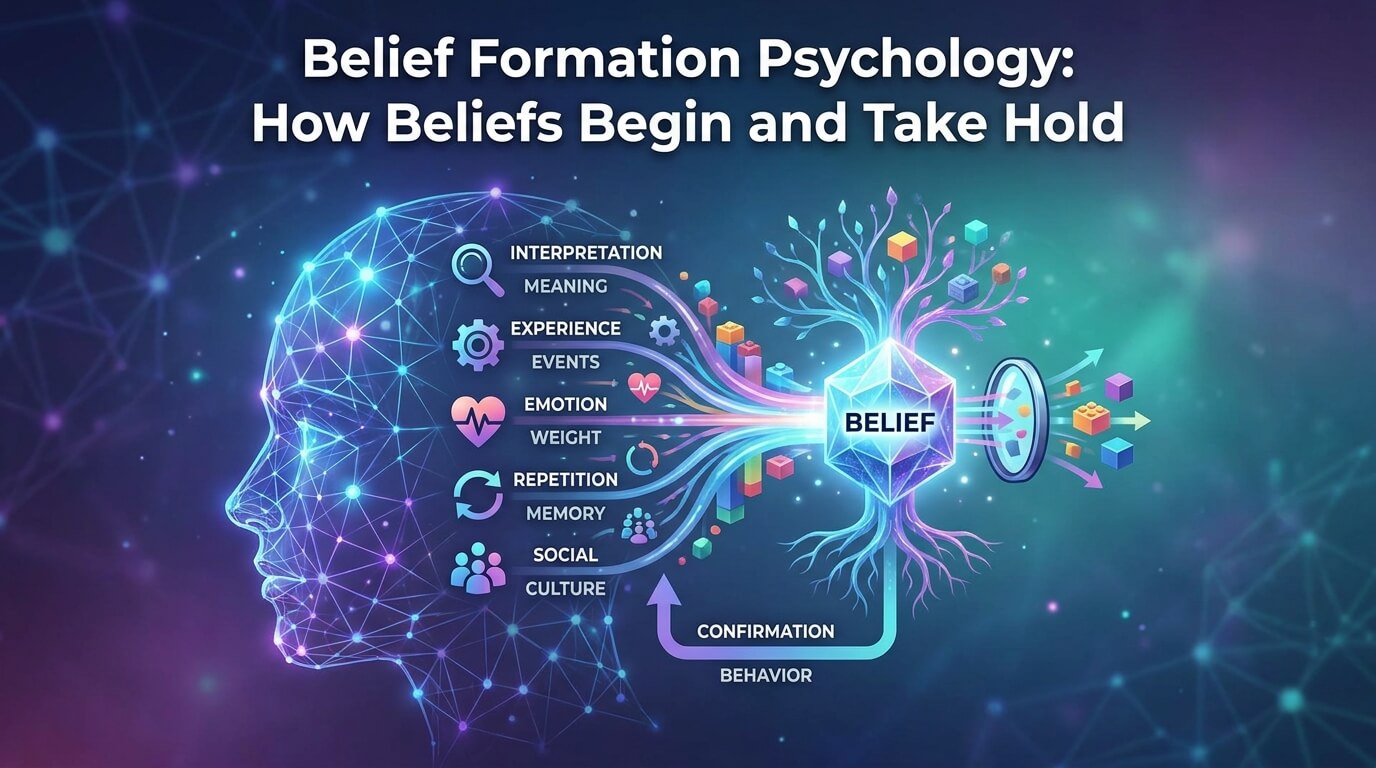
A belief rarely arrives as a carefully tested conclusion. More often, it develops from a mixture of experience, explanation, emotion, repetition, memory, and social feedback. A child hears that mistakes are embarrassing, notices adults reacting sharply to errors, and later concludes, “If I get something wrong, people will think less of me.” An adult has two disappointing relationships and begins to expect that closeness always ends in rejection. A repeated claim starts to feel familiar, then familiar begins to feel true.
Understanding belief formation does not mean blaming family, culture, or past experiences for every assumption you hold. It means separating where a belief came from, what purpose it served, and how well it fits the evidence available now. A conclusion may be understandable because of your history yet too broad for every setting.
The useful question is not only, “Do I believe this?” It is also, “What taught me to believe it, what keeps confirming it, and what would give me a fair reason to revise it?”
Quick Answer
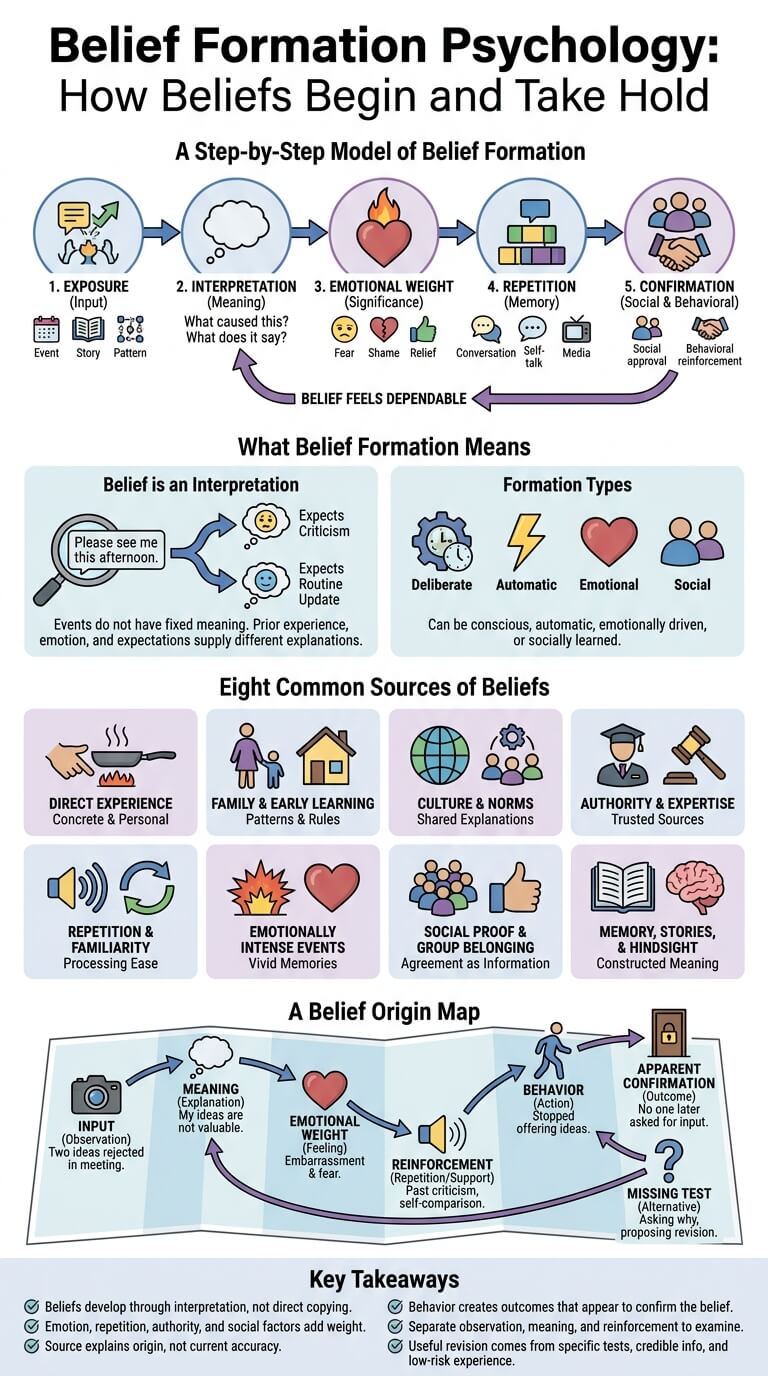
Beliefs form when the mind interprets events or information, gives them meaning, stores that meaning in memory, and receives enough repetition or reinforcement for the conclusion to feel dependable. Direct experience matters, but so do family messages, culture, authority, emotion, familiarity, social approval, and later behavior. Formation can be conscious or automatic, and a belief’s origin does not by itself prove whether the belief is true.
What Belief Formation Means
The APA Dictionary of Psychology describes belief as accepting something as true, real, or valid. Belief formation is the process through which a possible explanation becomes an accepted one. The mind moves from “this might be the case” toward “this is how things are,” often without a formal decision.
Once a conclusion has taken hold, the broader framework of belief psychology helps explain how it can shape attention, emotion, expectations, and later behavior.
A belief is built through interpretation, not copied directly from reality
Events do not enter the mind with one fixed meaning. Two employees may receive the same message, “Please see me this afternoon.” One expects criticism; the other expects a routine update. Prior experience, emotion, and expectations supply different explanations.
People often remember a conclusion as part of the event. “My manager was angry” may mean, “The message was brief, and I interpreted brevity as anger.” The interpretation may be correct, but it is not the same as the observation.
Formation can be deliberate, automatic, emotional, or social
Some beliefs are formed deliberately. You compare several explanations, review evidence, and choose the one that seems most credible. Other beliefs develop automatically through repeated pairings. A neighborhood repeatedly described as dangerous may begin to feel unsafe even when you have little direct knowledge of it.
Emotion can speed the process because an intense event feels important. Social learning can shape belief before personal evidence is available, especially when people rely on trusted adults, experts, peers, or group norms to interpret an unfamiliar topic.
A Step-by-Step Model of Belief Formation
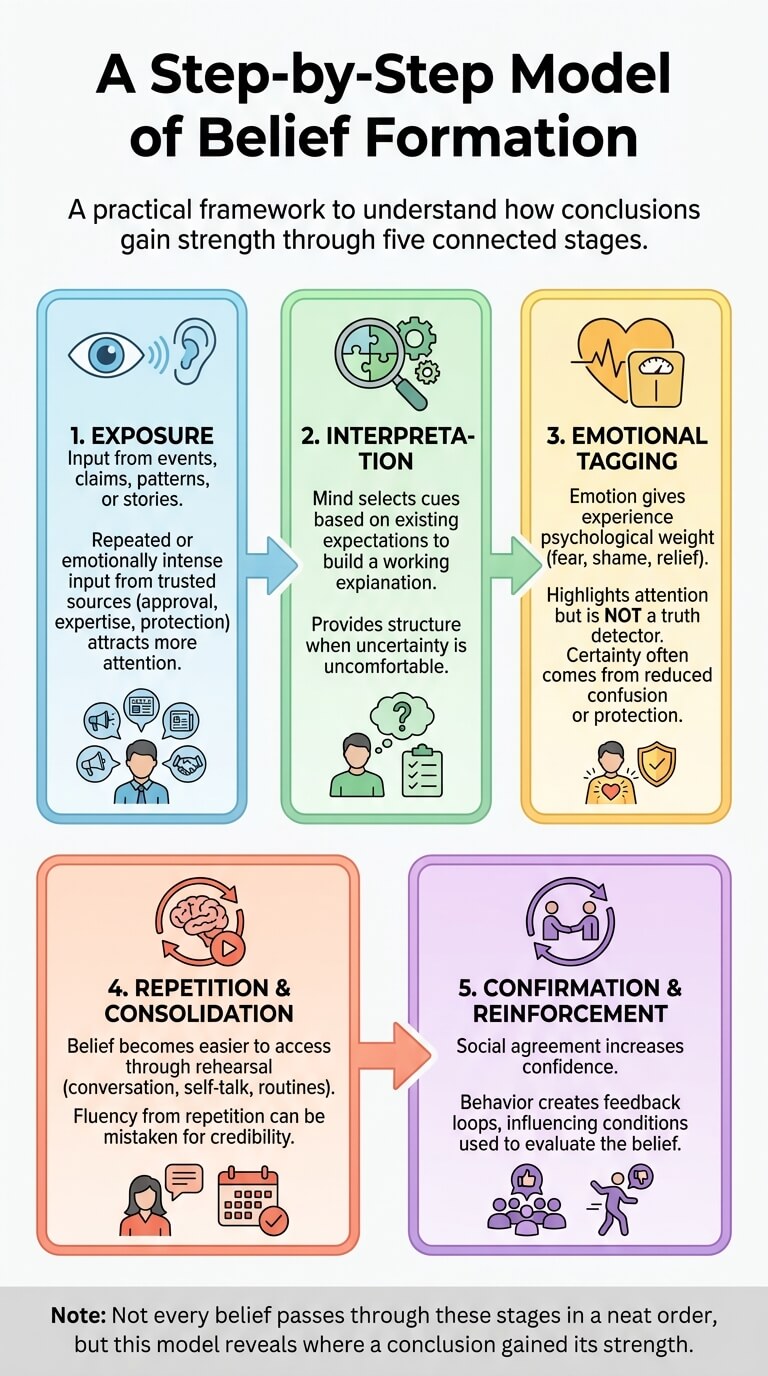
A practical way to understand the process is to follow five stages: exposure, interpretation, emotional weight, repetition, and confirmation. Not every belief passes through these stages in a neat order. Still, the model helps reveal where a conclusion gained its strength.
Exposure to an event, claim, or pattern
Formation begins with input: an event, story, instruction, expression, headline, repeated pattern, or missing response. A person might hear, “Creative work is not a real career,” notice practical jobs receiving more praise, and see relatives worry about financial risk.
A single exposure may matter, but repeated or emotionally intense input attracts more attention, especially when it comes from someone whose approval, expertise, or protection feels important.
Attention and interpretation
The mind cannot process every available detail equally. It selects some cues and builds a working explanation. Attention is influenced by existing expectations. Someone who already fears rejection may notice a delayed reply more strongly than several warm messages that came before it.
Interpretation then answers questions such as: What caused this? What does it say about me? Is this likely to happen again? Is the situation safe? The answers may be tentative at first, but they provide structure when uncertainty feels uncomfortable.
Emotional tagging and perceived significance
Emotion gives an experience psychological weight. Fear may mark an event as dangerous. Shame may turn criticism of one action into a conclusion about the whole self. Relief may strengthen a belief that a particular habit, person, or explanation kept something bad from happening.
Emotion is useful because it highlights what may require attention. It is not a truth detector. A conclusion can feel certain because it reduced confusion or offered protection, not because it was carefully verified.
Repetition, rehearsal, and memory consolidation
A belief becomes easier to access when it is repeated in conversation, internal self-talk, media, routines, or remembered stories. Rehearsal also makes the explanation more fluent. The more easily a statement comes to mind, the less effort it takes to process, which may be mistaken for credibility.
Repetition does not need to be verbal. A person who repeatedly avoids speaking in meetings may rehearse the behavioral message, “Staying quiet keeps me safe.” Each avoided meeting prevents a fuller test of what might happen if they contributed.
Social confirmation and behavioral reinforcement
People look to others for information about what is normal, believable, and safe to say. Agreement from a group can increase confidence, while disagreement may be dismissed when the social cost of reconsidering feels high. Research on public conformity and private acceptance also shows why outward agreement and inward belief should not always be treated as the same thing.
Behavior then adds another layer. If you expect people to judge you, you may become guarded. Others respond to the distance, and their response appears to confirm that people are unfriendly. The belief has influenced the conditions used to evaluate it.
Eight Common Sources of Beliefs
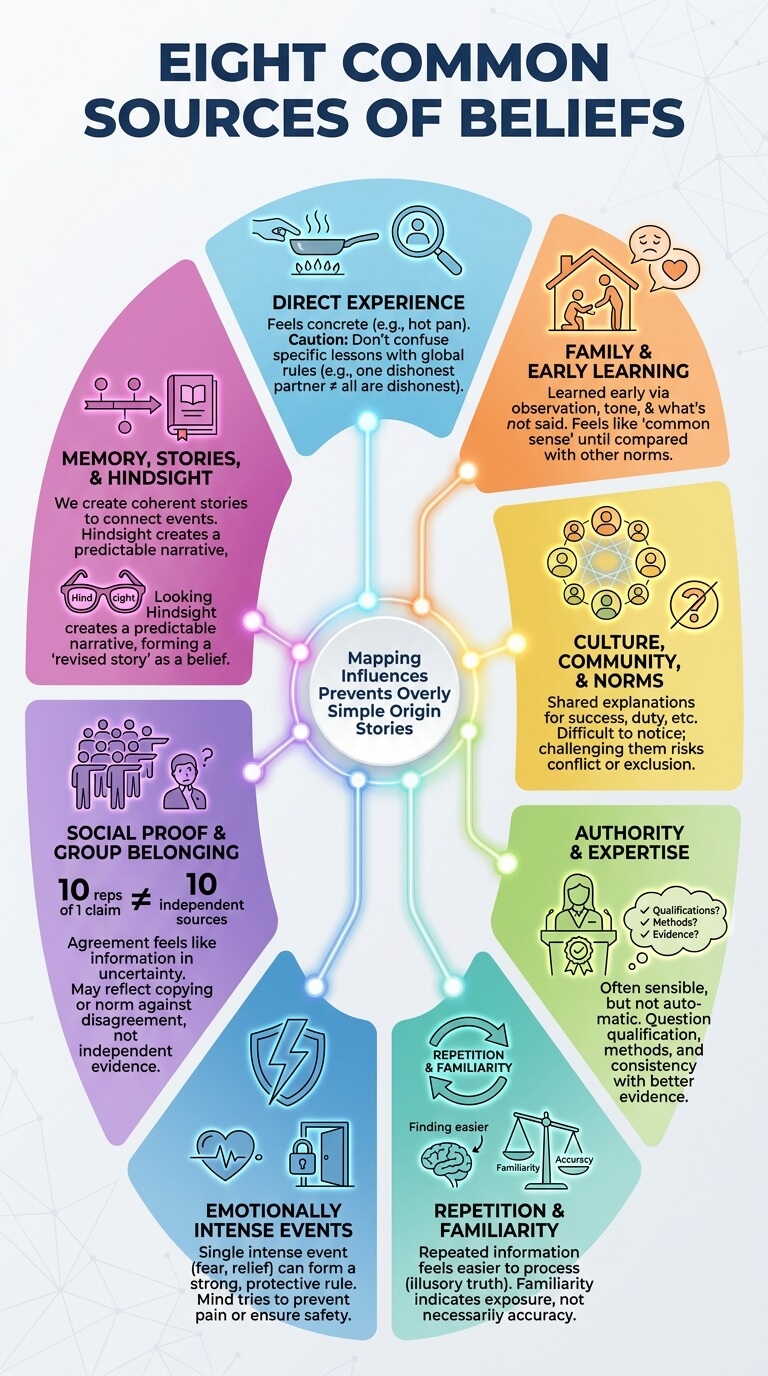
Most beliefs have more than one origin. A conclusion may begin with personal experience, gain strength through family interpretation, and later be maintained by selected memories. Mapping these influences prevents an overly simple origin story.
Direct experience
Personal experience is powerful because it feels concrete. Touching a hot pan creates a reliable belief about heat and pain. Yet experience can also be limited. One dishonest business partner does not establish that all business partners are dishonest.
The useful distinction is between a specific lesson and a global rule. “This person broke an agreement” is narrower than “No one can be trusted.” The broader statement requires broader evidence.
Family and early learning
Children learn from direct instruction, observation, reward, punishment, tone, and what adults repeatedly avoid discussing. A family may never say, “Feelings are unacceptable,” yet a child can reach that conclusion if sadness is mocked, anger is punished, and vulnerability is ignored.
Early learning often feels like common sense because it developed before comparison was possible. Later exposure to other families or cultures may reveal that a “normal rule” was actually one local way of organizing life.
Culture, community, and norms
Culture offers shared explanations about success, responsibility, respect, authority, family duty, and emotional expression. These ideas help people coordinate, but they are difficult to notice when everyone nearby shares them.
Community norms also define which questions feel acceptable. A belief may remain unexamined not because nobody could challenge it, but because challenging it would risk conflict, exclusion, or loss of identity.
Authority and expertise
Relying on expertise is often sensible because no individual can verify every technical claim. Problems arise when authority is treated as automatically correct, expertise is assumed to transfer across fields, or confidence is mistaken for evidence.
A stronger approach asks: What is this person qualified to know? How do they know it? Is the claim consistent with better evidence? Are uncertainty and limitations acknowledged?
Repetition and familiarity
Repeated information tends to feel easier to process. Research on the illusory truth effect has found that repeated statements are often judged as more truthful than new ones, even when repetition adds no meaningful evidence.
This does not mean people believe everything they hear repeatedly. Prior knowledge, attention, trust, and motivation still matter. It does mean that familiarity should not be used as a substitute for verification. “I have heard this many times” answers a question about exposure, not accuracy.
Emotionally intense events
A frightening, humiliating, joyful, or relieving event can produce a strong rule after only one experience. Someone embarrassed during a presentation may conclude that public speaking is dangerous. Someone who felt immediate relief after checking a locked door may conclude that repeated checking prevents harm.
Emotionally formed beliefs often have a protective logic. The mind is trying to prevent a repeat of pain or preserve a path to safety. Understanding that function can reduce self-criticism while still allowing the conclusion to be tested.
Social proof and group belonging
When many people appear to agree, agreement itself becomes information, especially when the situation is uncertain or belonging matters. It may reflect shared knowledge, but it can also reflect copying, conformity, or a norm against disagreement.
A useful question is, “Did each person reach this conclusion independently, or are people repeating one another?” Ten repetitions from one original claim are not the same as ten independent sources of evidence.
Memory, stories, and hindsight
People make sense of life through stories that connect events, motives, causes, and outcomes. A coherent story is useful, but it can become more stable than the details that originally supported it.
Hindsight can also make an outcome feel predictable after it occurs. Once a relationship ends, earlier disagreements may be remembered as obvious signs that it was always doomed. The revised story can then become a belief about future relationships.
Why Emotion Can Make a Belief Feel Certain
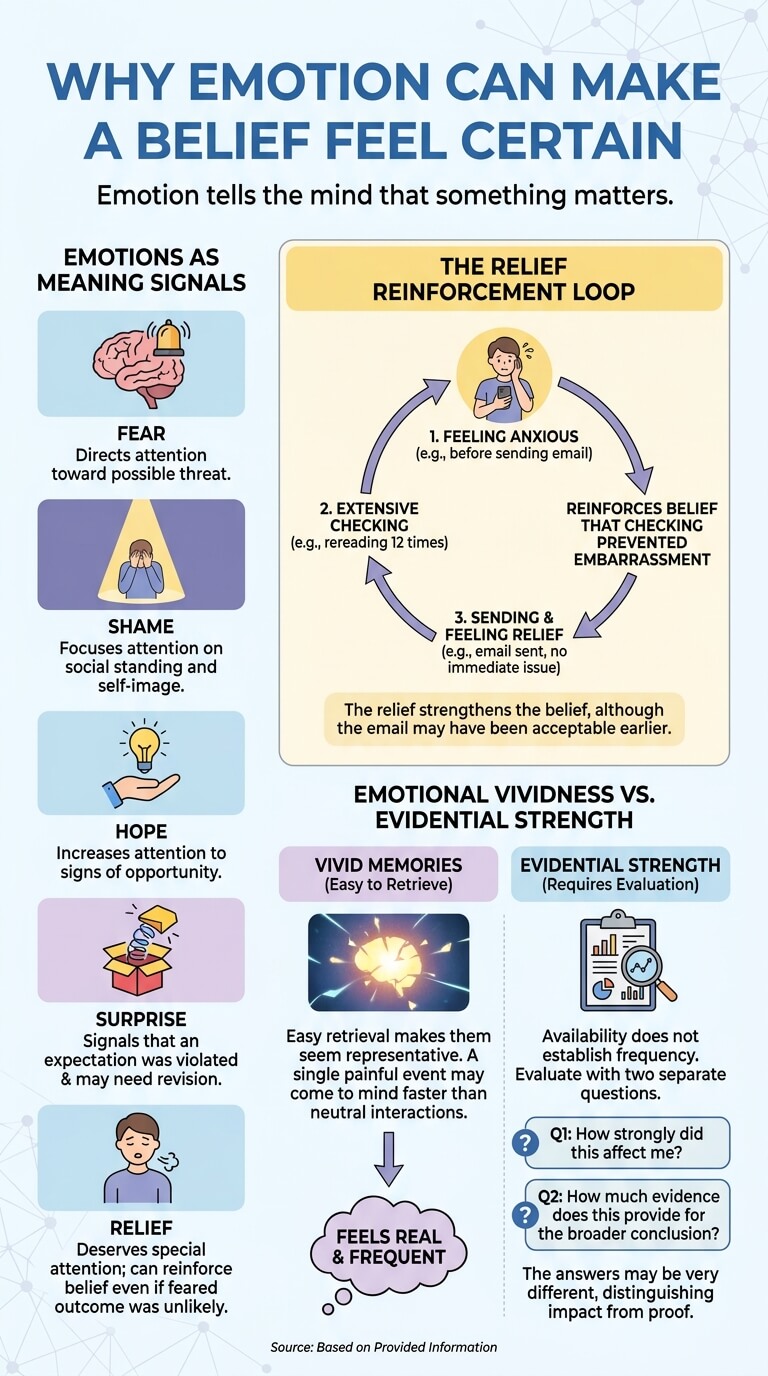
Emotion tells the mind that something matters.
Fear, relief, shame, hope, and surprise as meaning signals
Fear directs attention toward possible threat. Shame focuses attention on social standing and self-image. Hope increases attention to signs of opportunity. Surprise signals that an expectation was violated and may need revision.
Relief deserves special attention because it can reinforce a belief even when the feared outcome was unlikely. Imagine feeling anxious before sending an email, rereading it twelve times, then feeling relief after sending it. The relief may strengthen the belief that extensive checking prevented embarrassment, although the email may have been acceptable after the second review.
Emotional vividness versus evidential strength
Vivid memories are easy to retrieve, and easy retrieval can make them seem representative. A single painful rejection may come to mind faster than several neutral or positive interactions. The emotional event is real, but its availability does not establish how often the same outcome will occur.
When evaluating an emotionally powerful belief, ask two separate questions: “How strongly did this affect me?” and “How much evidence does this provide for the broader conclusion?” The answers may be very different.
How Repetition and Familiarity Influence Belief
Familiar language requires less mental effort.
Familiar claims can feel easier to process
A slogan, family saying, or repeated self-description can begin to feel natural simply because it has been rehearsed. “I am bad with money,” “People always leave,” or “Success requires constant stress” may become default explanations long before they are tested carefully.
Internal repetition can be as influential as external repetition. Each time a person interprets nervousness as proof of inability, the same conclusion is rehearsed. The belief becomes quicker to access during the next difficult moment.
Familiarity does not prove truth
A practical response is to label familiarity accurately: “This idea feels known to me.” That statement is more precise than “This idea must be true.” Then look for independent support, specific examples, exceptions, and the original source of the claim.
Corrections also need care. Repeating a false claim while trying to correct it may increase familiarity. It is often clearer to lead with the accurate information, explain it simply, and only mention the mistaken claim when necessary for understanding.
How Family and Culture Shape the Default Explanation
Young children depend on caregivers for both safety and interpretation.
Beliefs learned before they can be evaluated
They cannot easily compare family rules with multiple alternatives. If achievement receives warmth while rest receives criticism, a child may learn that productivity earns belonging. If conflict is followed by days of silence, they may learn that disagreement threatens connection.
These lessons are not always explicitly taught or intended. Children infer rules from patterns, and early rules may later feel like facts about life rather than conclusions learned in one environment.
Shared assumptions that remain invisible inside a group
A shared belief is difficult to notice when nobody needs to state it. A workplace may treat exhaustion as proof of commitment. A community may view asking for help as weakness. A family may equate disagreement with disrespect. The assumption becomes visible when someone acts differently.
Questioning a shared belief can therefore feel socially risky. The person is not only reconsidering an idea. They may be challenging a connection to family history, group loyalty, or a valued identity. This explains the emotional cost without deciding whether the belief is accurate.
The Role of Memory in Building Beliefs
Memory is not a perfect recording that is replayed unchanged.
Memory is reconstructed around meaning
Research on constructive memory describes remembering as an active process that can preserve useful meaning while also allowing omissions, blending, and distortion.
When people remember an event, they draw on stored details, current knowledge, later information, and the story they now use to understand what happened. This does not mean memory is generally false. It means confidence and completeness should not be assumed to be the same as accuracy.
Later beliefs can reshape how earlier experiences are recalled
Suppose someone develops the belief, “My coworkers never respect my ideas.” Earlier meetings may then be recalled mainly through interruptions and criticism, while moments of support become less accessible. The belief organizes memory, and the selected memories strengthen the belief.
To reduce this circular process, look for records created close to the event: messages, notes, dates, multiple perspectives, or concrete outcomes. These do not remove interpretation, but they provide additional material beyond the current story.
Why Two People Form Different Beliefs From the Same Event
Two people can experience the same situation and leave with different beliefs because they entered it with different histories.
Prior expectations, identity, emotion, and available explanations
A difficult exam may teach one student, “I need a different study method.” It may teach another, “I am not intelligent.” The first explanation focuses on strategy; the second turns the result into identity.
Available explanations matter. If a person knows that sleep loss affects concentration, they may interpret a poor performance as temporary. Without that explanation, they may make a broader conclusion about ability. Social feedback then strengthens one interpretation over another.
| Same event | Possible meaning | Belief that may form | Likely next behavior |
|---|---|---|---|
| A friend replies late | “They are busy” | Delays are not always personal | Wait and ask later |
| A friend replies late | “I am being rejected” | Closeness is unreliable | Withdraw or seek repeated reassurance |
| A project receives criticism | “The method needs work” | Feedback can improve performance | Revise and ask questions |
| A project receives criticism | “I have been exposed as incapable” | Mistakes reveal personal inadequacy | Avoid difficult projects |
Belief Formation vs Attitude Formation
A belief concerns what a person accepts as true or likely.
Accepting something as true versus evaluating it positively or negatively
An attitude concerns how a person evaluates a target, often along a positive to negative dimension. The APA definition of attitude emphasizes this evaluative quality.
For example, “Remote work reduces commuting time” is a belief. “I like remote work” is an attitude. The attitude may be supported by several beliefs, such as expecting more flexibility, fewer interruptions, or less social connection. A person can accept the same factual belief and still evaluate remote work differently.
| Process | Main question | Example |
|---|---|---|
| Belief formation | What do I accept as true? | “This course requires weekly practice.” |
| Attitude formation | How do I evaluate it? | “I feel positive about the course.” |
| Expectation formation | What do I predict will happen? | “Regular practice will improve my result.” |
Formation vs Belief Change
Formation happens when a person develops an initial working conclusion.
Building an initial model versus revising an established one
Belief change happens after that conclusion has acquired support from memory, emotion, identity, behavior, or a social group. Revising it may require more than presenting a new fact because the belief is now connected to other parts of life.
This distinction prevents two errors. First, the factor that formed a belief may not be the factor currently maintaining it. A childhood message may begin the belief, while adult avoidance now keeps it alive. Second, discovering an origin does not automatically create change. Insight is useful, but new evidence and new experience may still be needed.
A Belief Origin Map
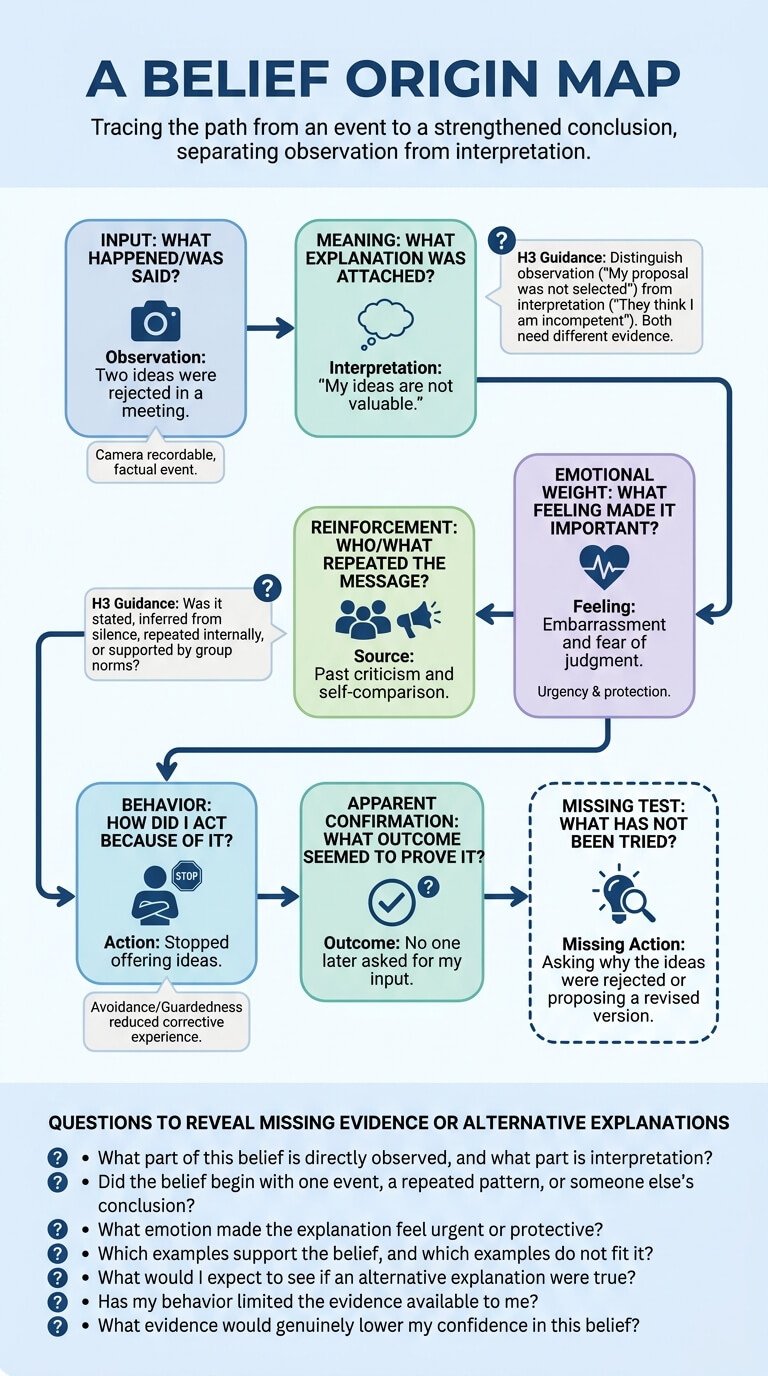
The following map separates the event from the explanation and traces how the conclusion gained strength. Use it for one specific belief rather than an entire worldview.
| Part of the map | Question | Example |
|---|---|---|
| Input | What happened or what was said? | Two ideas were rejected in a meeting. |
| Meaning | What explanation did I attach? | “My ideas are not valuable.” |
| Emotional weight | What feeling made it important? | Embarrassment and fear of judgment. |
| Reinforcement | Who or what repeated the message? | Past criticism and self-comparison. |
| Behavior | How did I act because of it? | Stopped offering ideas. |
| Apparent confirmation | What outcome seemed to prove it? | No one later asked for my input. |
| Missing test | What has not been tried? | Asking why the ideas were rejected or proposing a revised version. |
What happened, what meaning was assigned, who reinforced it, and what outcome seemed to confirm it
Write the observation in language a camera could record before adding interpretation. “My proposal was not selected” is an observation. “They think I am incompetent” is an interpretation. Both deserve attention, but they require different forms of evidence.
Next, identify who reinforced the meaning. Was it stated by another person, inferred from silence, repeated internally, or supported by group norms? Then examine how your behavior affected later outcomes. Avoidance, reassurance seeking, overpreparation, or guardedness may have reduced opportunities for corrective experience.
Questions that reveal missing evidence or alternative explanations
- What part of this belief is directly observed, and what part is interpretation?
- Did the belief begin with one event, a repeated pattern, or someone else’s conclusion?
- What emotion made the explanation feel urgent or protective?
- Which examples support the belief, and which examples do not fit it?
- What would I expect to see if an alternative explanation were true?
- Has my behavior limited the evidence available to me?
- What evidence would genuinely lower my confidence in this belief?
What to Do When You Discover a Belief Has a Weak Foundation
A painful origin does not automatically make a belief false, and a respected origin does not automatically make it true.
Separate origin from accuracy
“My father taught me this” explains transmission. “This helped me survive a difficult period” explains function. Neither statement completes the accuracy question.
Use three separate labels: source, function, and evidence. Source asks where the belief came from. Function asks what it helped you avoid, predict, preserve, or organize. Evidence asks how well the conclusion matches the broader facts now.
Test the belief with new information and low-risk experience
Turn a broad belief into a specific prediction. Instead of “People do not respect me,” try, “If I ask for uninterrupted time to explain one proposal, the group will dismiss it without consideration.” A specific prediction creates something observable.
Choose a low-risk test rather than an all-or-nothing challenge. Ask one clarifying question, request one piece of feedback, try one new behavior, or compare information from two independent credible sources. Record what happened before explaining it away. The aim is not to force a positive conclusion. It is to increase the quality of the evidence.
Why Formed Beliefs Can Become Difficult to Update
Once a belief has shaped memory, behavior, relationships, and identity, changing it can create secondary problems.
When new evidence conflicts with an important existing belief, the resulting tension may also involve cognitive dissonance, especially when identity, past choices, or behavior are implicated.
Belief perseverance, internal conflict, and identity threat
New evidence may conflict with past choices. Reconsideration may feel disloyal to a group. A different conclusion may remove a familiar explanation without immediately providing a replacement.
This is why a correction may be factually strong but psychologically incomplete. People often need an alternative model that explains the same experience, preserves dignity, and offers a workable next step. Persistence does not prove the original belief is correct, but it does show that belief change involves more than deleting a sentence from the mind.
When Professional Support May Help
Some beliefs are closely tied to severe anxiety, depression, traumatic experiences, compulsive behavior, or a deeply negative view of the self.
Fear, shame, or painful experiences can make self-examination harder
Exploring them alone may feel overwhelming or may intensify distress. A qualified mental health professional can help examine the belief without assuming that every remembered detail is exact or that the belief defines your identity.
Consider seeking support when a belief contributes to major avoidance, inability to function, persistent hopelessness, panic, self-harm thoughts, or fear for your safety. The National Institute of Mental Health help page lists options for finding care and immediate assistance in the United States. In an urgent safety situation, contact local emergency services or a crisis service available where you live.
Educational note: Understanding how beliefs form can support reflection, but it is not a diagnosis and does not replace individualized mental health care.
FAQ About Belief Formation
These questions address common misunderstandings about early beliefs, repetition, emotion, and awareness.
Are childhood beliefs permanent?
No. Early beliefs can feel deeply familiar because they developed before a person had many alternatives, but familiarity is not permanence. New relationships, education, feedback, and repeated experiences can provide material for revision. Change may take longer when the belief is tied to safety, belonging, or identity.
Can one emotional event create a lasting belief?
Yes, especially when the event is frightening, humiliating, relieving, or otherwise highly significant. A strong emotion can produce a broad rule from limited evidence. The lasting belief may be protective, but it still benefits from checking whether the rule applies to every situation or mainly to the original context.
Does repetition make people believe false information?
Repetition can increase familiarity, and familiarity can increase perceived truth. It does not guarantee belief, and people are influenced by prior knowledge, credibility, attention, and motivation. Repetition should therefore be treated as a reason to verify a claim, not as evidence that the claim is accurate.
Can beliefs form without conscious thought?
Yes. People can learn associations, expectations, and social rules without deliberately deciding to adopt them. You may notice the belief only when a situation triggers a strong reaction or automatic prediction. Bringing it into awareness makes examination possible, but awareness alone may not immediately change it.
How can someone identify the source of a belief?
Begin with a specific statement, then ask when it first felt familiar, what experiences seemed to support it, whose interpretation influenced it, what emotion gave it weight, and what behavior later reinforced it. Treat recalled origins as clues rather than perfect records. The current evidence matters as much as the earliest memory.
Key Takeaways
- Beliefs develop through interpretation, not through direct copying of reality.
- Emotion, repetition, authority, family, culture, memory, and group agreement can all add weight to a conclusion.
- A belief’s source explains how it began, but does not settle whether it is accurate now.
- Behavior can create outcomes that appear to confirm the belief that shaped the behavior.
- Separating observation, meaning, reinforcement, and missing evidence makes a belief easier to examine.
- Useful revision comes from specific predictions, credible information, and low-risk corrective experience, not forced positive thinking.
Choose one belief that affects a current decision and complete the origin map in writing. Keeping the event, interpretation, emotion, reinforcement, and behavior on separate lines can reveal where certainty came from and what evidence would be useful next.

Michael Reed is the Founder and Lead Writer at Psychology Exposed. He writes about human behavior, relationships, emotional patterns, self-awareness, and practical psychology topics using research-informed, easy-to-understand content.
Read More About Michael Reed: https://psychologyexposed.com/michael-reed/