

A correction can be clear, credible, and easy to understand, yet the original belief may still influence judgment. A manager learns that a negative report about an employee was inaccurate but continues to see the employee as unreliable. A person discovers that a health claim came from a weak source but still feels suspicious of the safer alternative. A first impression remains even after the event that created it has been explained differently.
This persistence is not always deliberate stubbornness. A belief can outlive its original evidence because the mind has already built explanations, predictions, memories, and behaviors around it. Removing one fact does not automatically remove the story that fact helped create.
Belief perseverance psychology examines that durability. The useful question is not only, “Why did the person ignore the correction?” It is also, “What remained after the correction, and what would help the mind build a more accurate replacement?”
Quick Answer
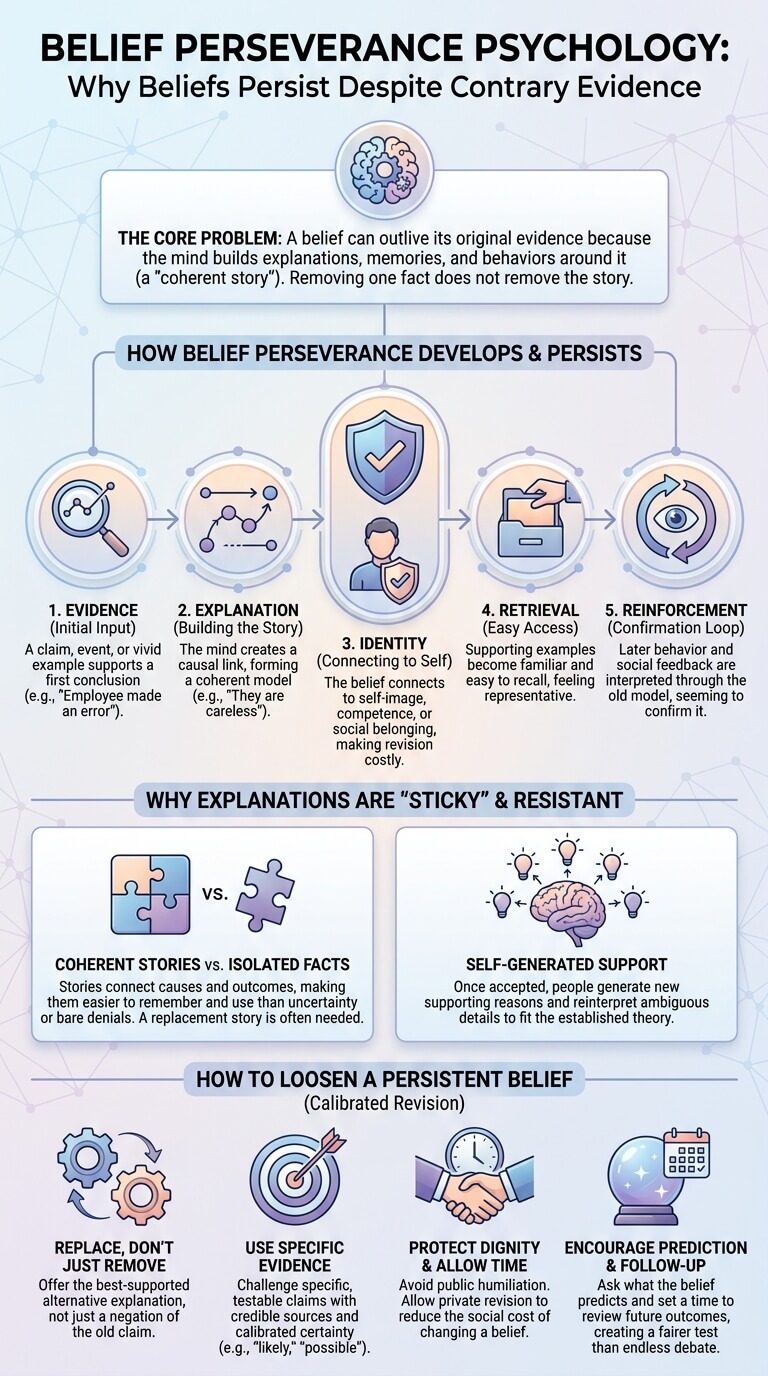
Belief perseverance is the tendency for a belief to continue after its original support has been weakened, withdrawn, or contradicted. The belief may persist because its explanation remains coherent, related memories are easy to retrieve, identity or belonging is involved, and later behavior seems to confirm it. Corrections usually help, but effective revision often requires a credible alternative explanation, clear evidence, and time to update.
What Belief Perseverance Means
The APA Dictionary of Psychology defines the perseverance effect as the persistence of beliefs about oneself or others despite a lack of supporting evidence or a contradiction of that evidence. The key feature is not simply holding a strong belief. It is continuing to rely on the belief after its original basis has lost credibility.
Belief perseverance is one part of a wider system, because beliefs can shape attention, memory, expectations, and behavior even after their original evidence changes.
The original evidence can disappear while the explanation remains
Imagine hearing that a coworker missed an important deadline because they were careless. You begin to interpret their short messages, quiet manner, and requests for clarification as signs of poor organization. Later, you learn that the deadline was changed without their knowledge.
The original accusation has been corrected, but the explanation “this person is careless” may remain available. Their ordinary behavior has already been fitted into that story. Unless the interpretation is revisited, the correction removes one event while leaving the larger model untouched.
Persistence is not proof of low intelligence or bad faith
Belief perseverance can affect thoughtful people because it grows from normal functions of cognition. Human beings build explanations, use past information to predict what will happen next, and prefer models that make events coherent. These abilities are useful. They also create inertia.
Bad faith is possible, but it should not be assumed. A person may sincerely accept that a source was wrong while failing to notice how much the old claim still guides memory and judgment. Another may understand the correction but distrust the person delivering it. A third may not know what explanation should replace the original one.
How Belief Perseverance Develops
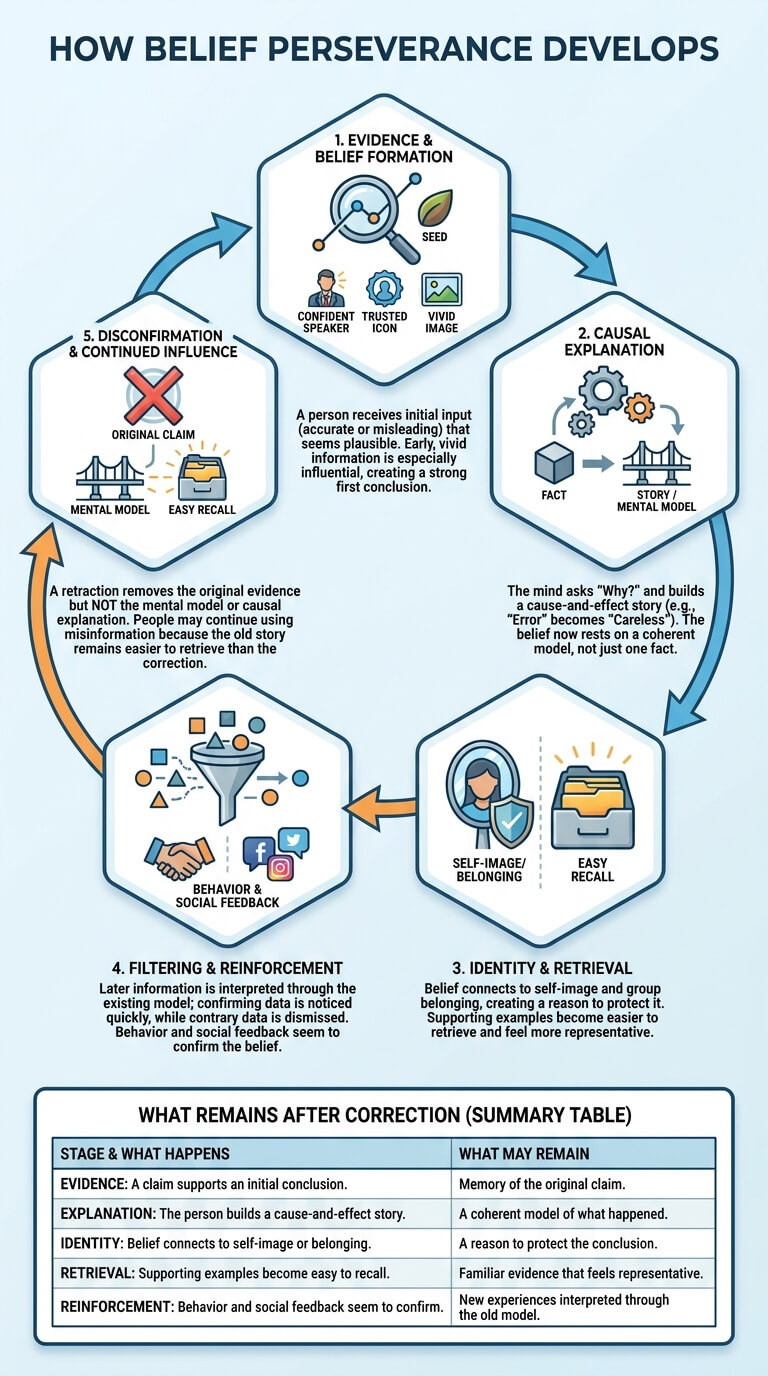
A practical model follows five elements: evidence, explanation, identity, retrieval, and reinforcement. The belief becomes more durable as each element adds support beyond the original claim.
A belief is formed
First, a person receives information or interprets an experience. The input may be accurate, incomplete, misleading, or false. It becomes a working belief because it seems plausible and helps explain something important.
The initial evidence does not need to be extensive. A vivid example, a confident accusation, or a trusted source can create a strong first conclusion. Early information is especially influential when the person has little prior knowledge.
The person builds a causal explanation
The mind does more than store the claim. It asks why the event happened. “The employee made an error” becomes “They are careless.” “My friend did not reply” becomes “They are losing interest.” “This treatment did not work once” becomes “This type of care never helps.”
Causal explanations connect separate details. Once built, they can generate new supporting reasons that were never part of the original evidence. The belief is no longer resting on one fact. It is resting on a story.
Later information is interpreted through that explanation
New events are filtered through the existing model. A delayed response looks like rejection. A question looks like incompetence. A neutral facial expression looks like disapproval. Information that fits the story is noticed quickly, while information that does not fit may seem unusual or irrelevant.
This does not require a conscious decision to ignore evidence. The explanation shapes what feels meaningful before deliberate evaluation begins.
Disconfirmation removes evidence but not the mental model
A retraction can remove the original claim without filling the gap it leaves. Research on the continued influence of corrected information shows that people can keep using misinformation in later reasoning even after receiving a retraction.
The old information may remain easier to retrieve than the correction, or the correction may not explain what actually happened. “The first report was wrong” tells the reader what to reject. It may not provide a usable account of the event.
| Stage | What happens | What may remain after correction |
|---|---|---|
| Evidence | A claim or event supports an initial conclusion | Memory of the original claim |
| Explanation | The person builds a cause-and-effect story | A coherent model of what happened |
| Identity | The belief connects to self-image or belonging | A reason to protect the conclusion |
| Retrieval | Supporting examples become easy to recall | Familiar evidence that feels representative |
| Reinforcement | Behavior and social feedback seem to confirm the belief | New experiences interpreted through the old model |
Why Explanations Are So Sticky
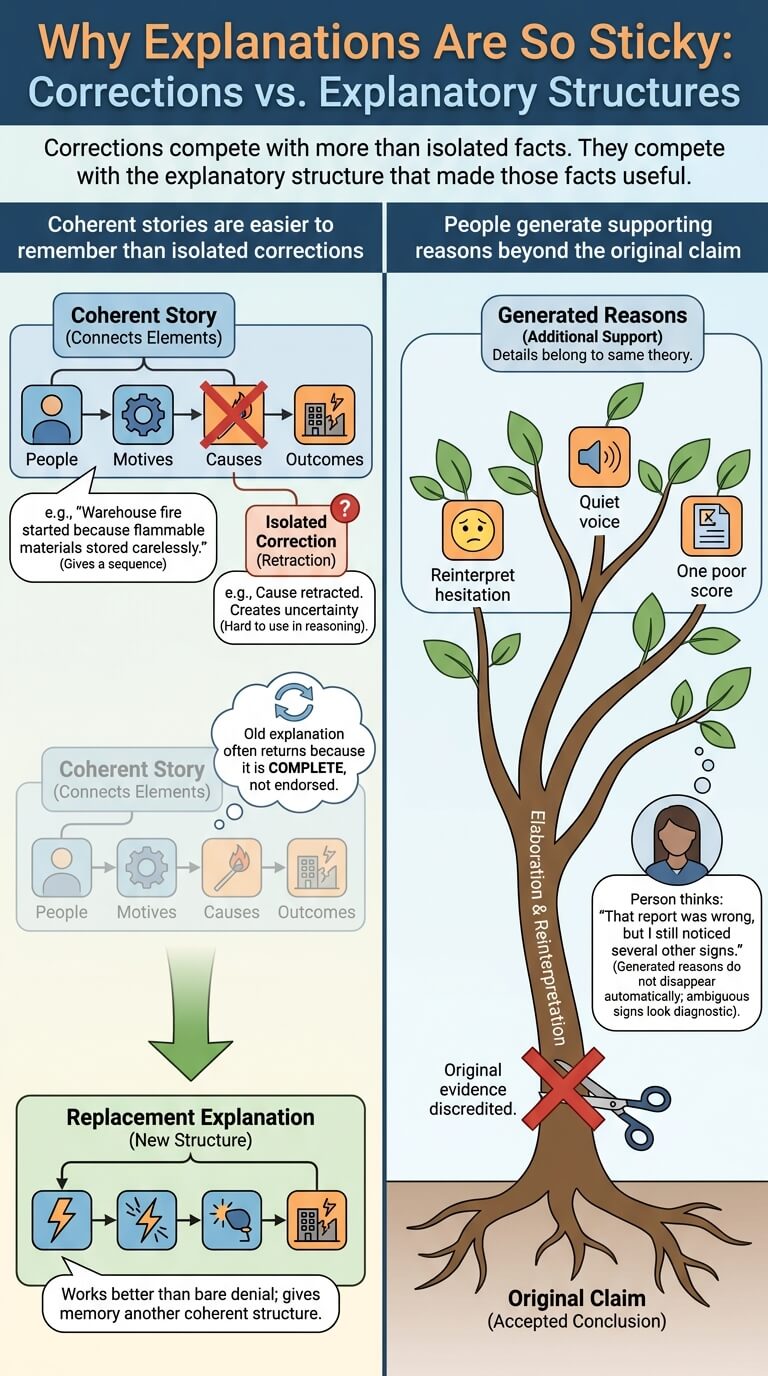
Corrections compete with more than isolated facts. They compete with the explanatory structure that made those facts useful.
Coherent stories are easier to remember than isolated corrections
A story connects people, motives, causes, and outcomes. “The warehouse fire started because flammable materials were stored carelessly” gives the mind a sequence. If that cause is later retracted, the person must remember both the correction and the absence of a confirmed cause.
Uncertainty is harder to use in reasoning. The old explanation may return because it is complete, not because it is still consciously endorsed. A replacement explanation often works better than a bare denial because it gives memory another coherent structure.
People generate supporting reasons beyond the original claim
Once a conclusion is accepted, people may elaborate it. If someone believes a student lacks ability, they may reinterpret hesitation, a quiet voice, and one poor score as additional support. Those details were not part of the first claim, but they now belong to the same theory.
When the first evidence is discredited, the generated reasons do not disappear automatically. The person may think, “That report was wrong, but I still noticed several other signs.” Some of those signs may be ambiguous observations that only looked diagnostic inside the original story.
Identity, Emotion, and Social Belonging
Some beliefs do more than explain events. They protect a sense of competence, loyalty, safety, or membership.
Some beliefs protect self-image, relationships, or group membership
A belief may support the idea that you make good decisions, understand people accurately, belong to a trustworthy group, or have not wasted years of effort. Revision can therefore feel like a judgment about the self rather than an ordinary update.
For example, changing a belief about a respected leader may create concern about past loyalty. Revising a belief about a career path may raise questions about time and identity. Correcting a belief about a close relationship may threaten connection with people who still hold it.
The cost of revision may feel larger than the factual issue
The factual question may be narrow, but the perceived consequences are broad: “If this was wrong, what else did I misunderstand?” or “Will people reject me if I change my position?” The mind may defend the belief partly to avoid shame, grief, uncertainty, or social loss.
This does not make the belief accurate. It explains why fact delivery alone may be insufficient. Revision becomes easier when a person can update without being humiliated, isolated, or required to reject their entire identity.
Belief Perseverance vs Confirmation Bias
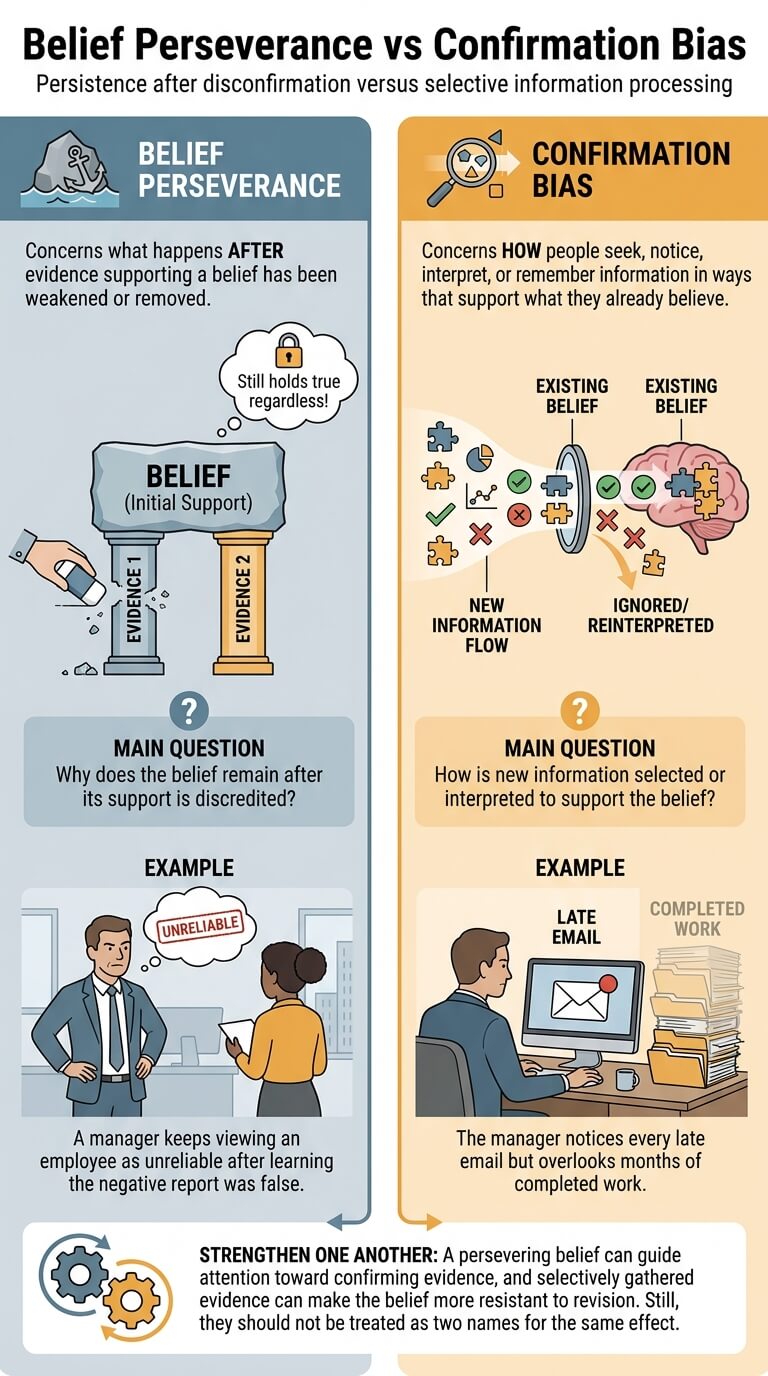
These concepts overlap, but they describe different problems.
Persistence after disconfirmation versus selective information processing
Belief perseverance concerns what happens after evidence supporting a belief has been weakened or removed. Confirmation bias concerns how people seek, notice, interpret, or remember information in ways that support what they already believe.
| Concept | Main question | Example |
|---|---|---|
| Belief perseverance | Why does the belief remain after its support is discredited? | A manager keeps viewing an employee as unreliable after learning the negative report was false. |
| Confirmation bias | How is new information selected or interpreted to support the belief? | The manager notices every late email but overlooks months of completed work. |
The processes can strengthen one another. A persevering belief can guide attention toward confirming evidence, and selectively gathered evidence can make the belief more resistant to revision. Still, they should not be treated as two names for the same effect.
Belief Perseverance vs Motivated Reasoning and Cognitive Dissonance
Three nearby concepts can be separated by their main focus: durability, desired conclusion, and inconsistency pressure.
A comparison of outcome, motive, and emotional pressure
| Concept | Primary focus | Useful question |
|---|---|---|
| Belief perseverance | The belief remains after supporting evidence changes | What part of the old model is still active? |
| Motivated reasoning | Reasoning is pulled toward a preferred conclusion | What outcome does the person want to protect? |
| Cognitive dissonance | Inconsistency creates psychological discomfort | What beliefs, actions, or identities do not fit together? |
A person can experience all three. New evidence threatens a valued belief, creating discomfort. The person evaluates the correction more critically because they prefer the old conclusion. The belief then persists. The overlap does not erase the distinctions.
What Research Says About the Backfire Effect
The idea that corrections routinely make false beliefs stronger has become more famous than the evidence supports.
Corrections do not always strengthen false beliefs
A backfire effect occurs when belief in a misconception becomes stronger after correction than it was before correction or in a no-correction condition. A review of backfire-effect evidence and measurement concluded that widely discussed worldview and familiarity backfire effects are not reliable enough to justify avoiding correction.
Later research has continued to find that corrections usually reduce belief in misinformation. Persistence is common, but persistence means the correction did not remove the entire influence. It does not mean the person necessarily became more convinced.
Context, trust, repetition, and identity still matter
Backfire can occur under some conditions. A large study found that stronger post-correction belief was closely associated with distrust of the correction rather than appearing as a general response to being challenged. The research on backfire and distrust in corrections supports a more specific interpretation: source credibility and reception conditions matter.
This nuance changes the practical lesson. Do not avoid accurate correction because you assume it will backfire. Instead, make the correction credible, understandable, specific, and respectful. Explain what is known, what is uncertain, and what should replace the old account.
Everyday Examples of Belief Perseverance
The following situations show how an old model can survive even when the initiating evidence changes.
First impressions
Situation: Someone hears before a meeting that a new colleague is arrogant. The claim later turns out to be based on mistaken identity.
What the observer may feel: continued distance or suspicion.
What it may mean: neutral confidence and brief answers were already interpreted through the arrogance story.
What to do next: reset the judgment and look for behavior across several situations rather than trying to defend the original impression.
Self-beliefs
Situation: A student fails one exam after being ill and concludes, “I am bad at science.” Later grades improve, but the label remains.
What the student may feel: anxiety and low confidence before each science task.
What it may mean: the original result became an identity explanation, and nervousness now feels like confirmation.
What to do next: replace the global label with a record of performance by topic, preparation, health, and study method.
Workplace judgments
Situation: A manager receives an inaccurate warning that an employee misses details.
What the manager may feel: heightened concern about every small correction.
What it may mean: ordinary edits are being coded as evidence of a stable trait.
What to do next: review objective performance over a defined period and compare it with team standards.
Health claims
Situation: A viral post links a common symptom to a specific food. The claim is corrected, but the reader still avoids the food.
What the reader may feel: unease when considering eating it.
What it may mean: the cause-and-effect story remains emotionally vivid, and avoidance prevents new experience.
What to do next: use reliable health guidance and speak with a qualified professional when a personal medical decision is involved.
Relationship narratives
Situation: A delayed reply is interpreted as rejection. The person later learns that the phone was lost.
What they may feel: lingering distrust despite accepting the explanation.
What it may mean: the delay activated an older belief that closeness is unreliable.
What to do next: separate the specific event from the broader relationship pattern and judge reliability across repeated behavior.
Why Repeating a Correction Can Still Fail
A correction may be accurate yet fail to become the information the person uses later.
Familiarity, source distrust, missing alternatives, and social threat
The original claim may be more vivid or familiar. The source of the correction may not be trusted. The correction may say only what did not happen, leaving no alternative cause. Public embarrassment may make acceptance feel costly.
Memory updating also matters. Research on the integration of corrections with earlier information suggests that continued influence is not only a simple failure to remember the correction. The mind must integrate the new information into the event model used for reasoning.
That is why “This is false” may be weaker than “This is false, here is why the source was mistaken, and here is the best-supported explanation.” The second correction helps rebuild the model.
An Evidence-and-Explanation Audit
This audit is designed for one specific belief. It separates the original evidence from the explanation that grew around it.
What was the original evidence?
Write the first event, claim, observation, or source that supported the belief. Keep it narrow. “One client rejected the proposal” is clearer than “Clients do not value my work.” Note whether the evidence was direct, reported by someone else, inferred, or remembered later.
What explanation survived after it changed?
Ask what story remained when the first support weakened. Did the belief become a trait judgment, a prediction, or a rule? “The report was false, but they still seem unreliable” reveals that the conclusion has detached from its original basis.
What finding would genuinely count against the belief?
A belief cannot be tested fairly if every possible outcome confirms it. If friendliness proves manipulation and distance proves hostility, no evidence can weaken the judgment. State in advance what observation would lower confidence.
| Audit question | Example response |
|---|---|
| What first supported the belief? | A colleague said the employee often missed deadlines. |
| What was later corrected? | The colleague had confused two employees. |
| What explanation remains? | The employee still seems careless. |
| Which observations were reinterpreted? | Short emails and requests for clarification. |
| What evidence would lower confidence? | Six weeks of accurate, on-time work under the same standards as peers. |
How to Loosen a Persistent Belief
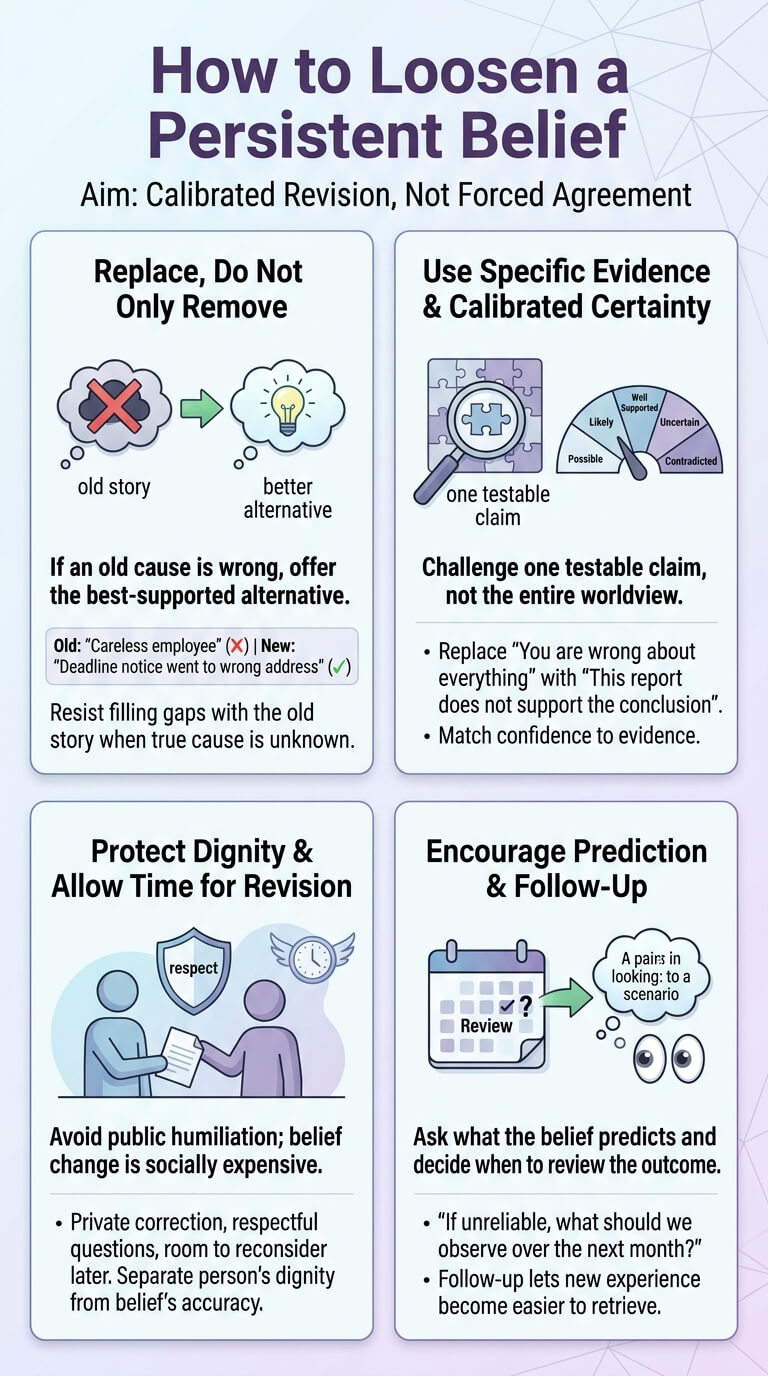
The aim is calibrated revision, not forced agreement or compulsory positivity.
Replace, do not only remove, the explanation
If an old cause is wrong, offer the best-supported alternative. “The employee was not careless; the deadline notice went to the wrong address” gives the mind a replacement account. When the true cause is unknown, say that clearly and resist filling the gap with the old story.
Use specific evidence and calibrated certainty
Challenge one testable claim rather than an entire worldview. Replace “You are wrong about everything” with “This report does not support the conclusion because the names were mixed up.” Use confidence that matches the evidence: possible, likely, well supported, uncertain, or contradicted.
Calibrated language allows updating without demanding a swing from absolute certainty to the opposite extreme.
Protect dignity and allow time for revision
Public humiliation makes belief change socially expensive. A person who feels cornered may defend the belief to defend status. Private correction, respectful questions, and room to reconsider later can reduce that cost.
Respect does not require treating every claim as equally valid. It means separating the person’s dignity from the accuracy of the belief.
Encourage prediction and follow-up rather than debate victory
Ask what the belief predicts and decide when to review the outcome. “If the employee is unreliable, what should we observe over the next month?” Prediction creates a fairer test than exchanging interpretations indefinitely.
Follow-up matters because one correction may reduce confidence without eliminating the old influence. New experience needs a chance to become easier to retrieve than the original story.
When Persistence Becomes Resistance in Conversation
A belief may persist quietly in memory, then become actively defended when another person challenges it.
How social threat can activate defensiveness and reactance
Being corrected can threaten autonomy, identity, or reputation. The person may focus on the challenger’s tone, motives, or status instead of the evidence. At that point, the conversation includes resistance as well as belief perseverance.
Reduce unnecessary threat by asking how the conclusion was reached, acknowledging any valid concern, and identifying the narrow claim under discussion. Do not demand instant public surrender. A person may need time to revise privately before expressing a new position.
If a conversation becomes coercive, threatening, or humiliating, disengagement and boundaries are more appropriate than trying to perfect the correction.
What to Do Next
Choose one belief with a clear factual component and one meaningful consequence.
Test one claim with one credible source and one observable prediction
Write the claim in specific language. Identify the original support, the correction, and the explanation that remains. Then consult a source with relevant expertise rather than collecting many low-quality opinions.
Finally, make one prediction. Decide what you would expect to observe if the belief is accurate and what would lower your confidence. Review the result at a set time. The purpose is not to win against yourself or another person. It is to make updating possible.
FAQ About Belief Perseverance
These questions address stubbornness, accurate beliefs, corrections, first impressions, and self-correction.
Is belief perseverance the same as being stubborn?
No. Stubbornness is an everyday judgment about unwillingness to change. Belief perseverance describes a more specific pattern in which a belief remains influential after its original evidence has been weakened or contradicted. A person may not realize the old explanation is still guiding them.
Can accurate beliefs also persevere?
Yes. Persistence alone does not show that a belief is false. An accurate belief may remain stable because the evidence continues to support it. The concern arises when confidence no longer responds appropriately to the quality of evidence.
Do corrections make false beliefs stronger?
Usually not. Corrections generally reduce belief, even when they do not eliminate the original influence. Backfire effects can occur in some circumstances, especially when the correction is distrusted, but they are not the normal result of presenting accurate information.
Why do first impressions persist?
First impressions organize later attention and interpretation. Once a trait explanation is formed, ambiguous behavior may be read as supporting it. Correcting the first report may not automatically reset all the later interpretations built around it.
Can people reduce belief perseverance in themselves?
Yes, although complete immunity is unrealistic. Helpful steps include separating evidence from explanation, naming what would count against the belief, seeking independent information, making observable predictions, and reviewing outcomes after enough time has passed.
Key Takeaways
- Belief perseverance occurs when a conclusion remains influential after its original support has been weakened or removed.
- The old explanation, related memories, identity needs, and later behavior can survive a correction.
- Belief perseverance differs from confirmation bias, motivated reasoning, and cognitive dissonance, although the processes can interact.
- Corrections usually help; the backfire effect is less common and less general than popular summaries suggest.
- A useful correction replaces the old explanation, uses credible evidence, preserves dignity, and allows time for updating.
- An Evidence-and-Explanation Audit reveals whether the belief still responds to possible disconfirming evidence.
Take one persistent belief and write three sentences: “The original evidence was…,” “The explanation that remains is…,” and “I would lower my confidence if…”. If the third sentence is impossible to complete, the most useful next step is not another argument. It is designing a fair test.

Michael Reed is the Founder and Lead Writer at Psychology Exposed. He writes about human behavior, relationships, emotional patterns, self-awareness, and practical psychology topics using research-informed, easy-to-understand content.
Read More About Michael Reed: https://psychologyexposed.com/michael-reed/