

People encounter persuasive communication every day: a doctor explains a treatment, a friend recommends a decision, a company promotes a product, a teacher argues for a method, or a public message asks people to change behavior. Some messages invite careful thought. Others rely heavily on confidence, emotion, repetition, familiarity, or social approval.
Persuasion is not automatically manipulation. Communication becomes persuasive when it is intended to influence belief, attitude, intention, or behavior. Whether it succeeds depends on more than the words. The source, evidence, framing, audience, timing, social context, and perceived freedom all shape how the message is processed.
No universal script can reliably change every mind. A message that helps one person reconsider may make another person suspicious or defensive. Ethical persuasion therefore aims to improve understanding and support voluntary choice, not bypass judgment or remove the ability to refuse.
Quick Answer
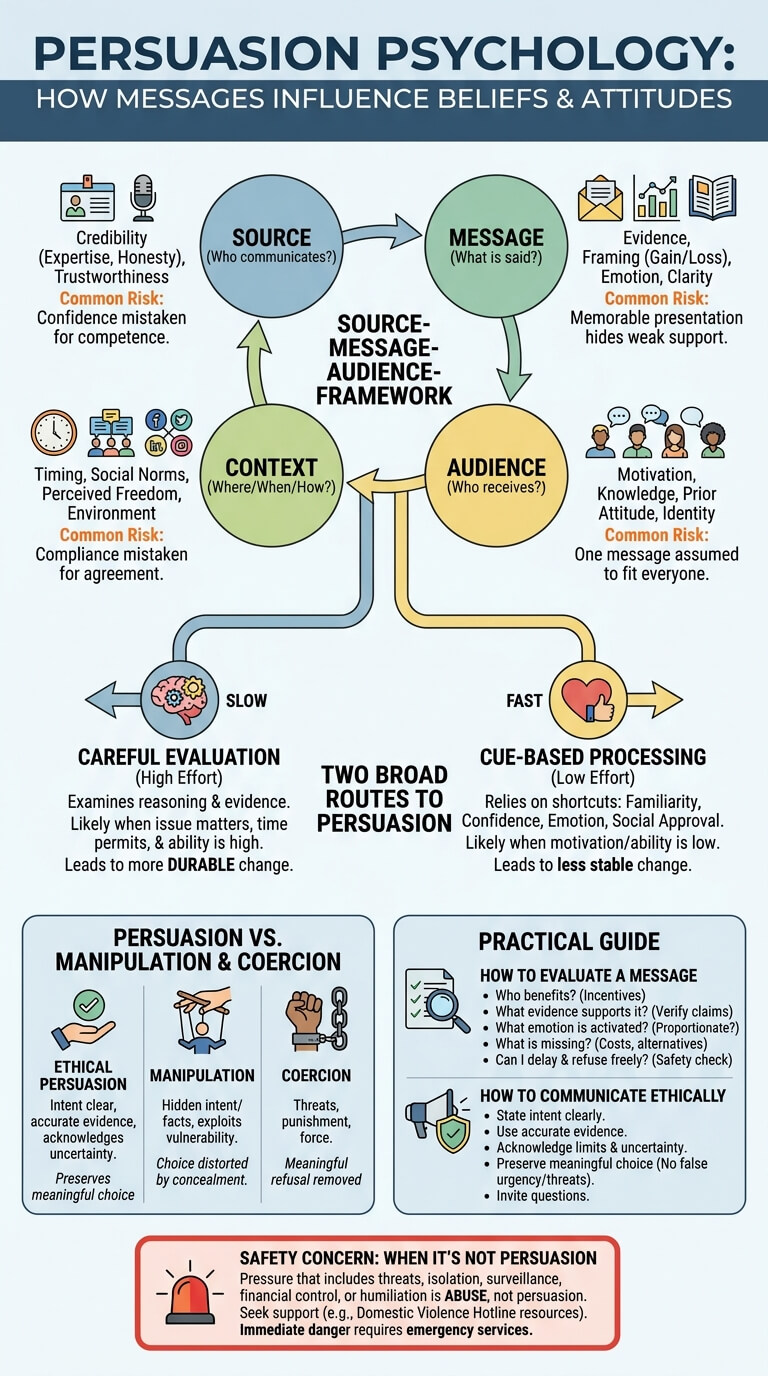
Persuasion psychology examines how communication influences beliefs, attitudes, intentions, and behavior. Four interacting elements matter: the source, the message, the audience, and the context. People may evaluate arguments carefully or rely more on cues such as credibility, confidence, familiarity, emotion, and social endorsement. Durable change is more likely when the evidence is strong, the issue matters, the audience can think carefully, and autonomy is preserved.
What Persuasion Means in Psychology
The APA Dictionary of Psychology entry for persuasion describes influence on attitudes or beliefs through communication. The key feature is a message directed toward some form of change.
Intentional communication aimed at changing belief, attitude, intention, or behavior
A persuasive message may aim to change what someone accepts as true, how they evaluate a target, what they intend to do, or what action they take. These outcomes are related but not identical.
A person may accept that a product has one useful feature without developing a favorable overall attitude. They may feel positively toward exercise without forming an intention to begin. They may intend to vote, attend, purchase, or seek care but fail to act because of time, cost, access, habit, or competing priorities.
Clear analysis therefore asks which outcome the communicator is trying to influence. “Did the message work?” is incomplete unless success has been defined.
Influence does not guarantee lasting internal change
A message may produce attention, agreement, compliance, intention, or behavior without creating a durable attitude. Someone may agree publicly to avoid conflict. A viewer may click because of urgency and regret the decision later. An employee may follow a rule while privately opposing it.
Lasting change is more likely when the person understands the reasoning, sees the evidence as relevant, integrates the new view with existing knowledge, and continues to endorse it after pressure or reward disappears.
The Source-Message-Audience-Context Framework
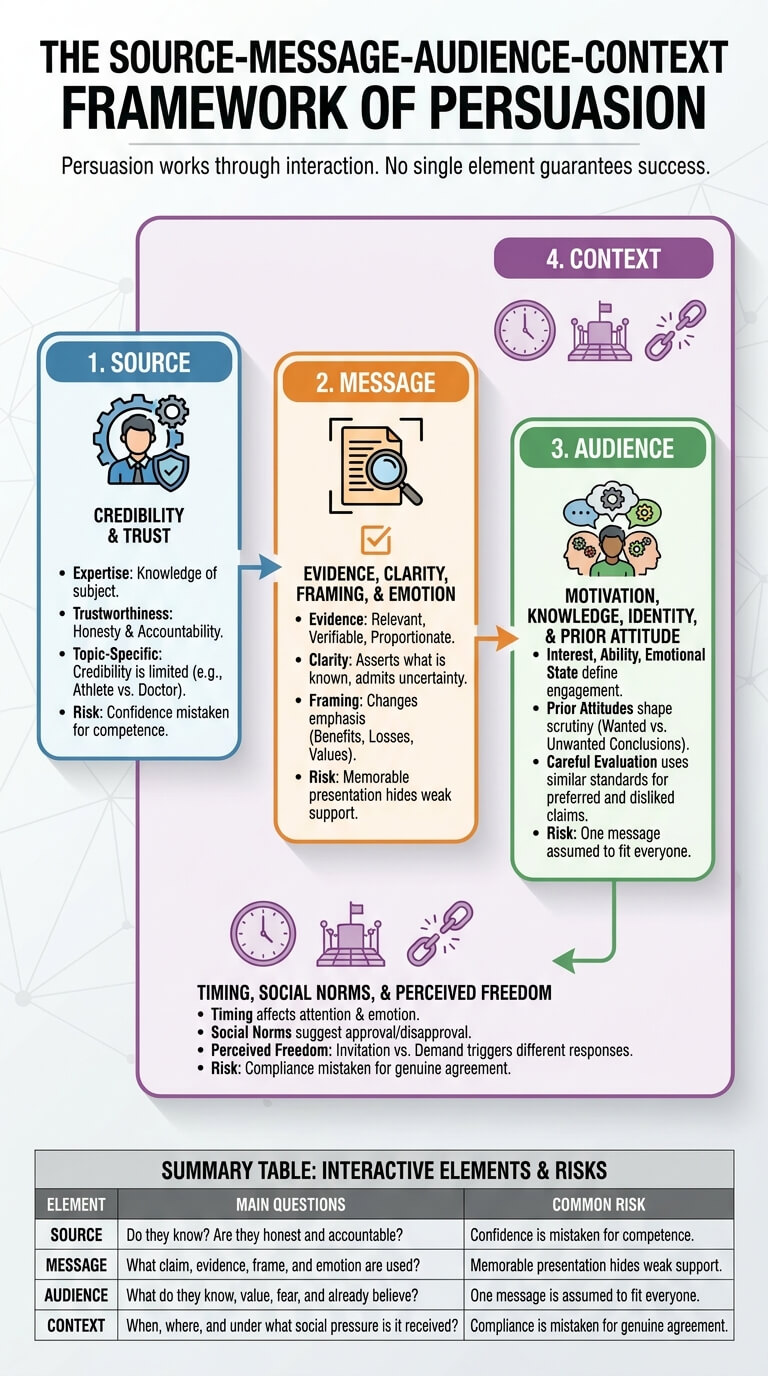
Persuasion works through interaction. A credible source cannot rescue a meaningless claim, and a strong message may fail when the audience lacks time, trust, or freedom to evaluate it.
Source credibility and trust
People ask whether the communicator knows the subject and whether they are likely to speak honestly. Expertise and trustworthiness are central dimensions of source credibility. Research on source credibility and prior attitudes shows that credibility can matter differently depending on whether people already hold a position and how carefully they process the message.
Credibility is partly topic-specific. A skilled athlete may be credible about training experience but not medication safety. A familiar friend may be trustworthy about personal events but lack relevant expertise for legal or medical advice.
Message evidence, clarity, framing, and emotion
The message supplies claims, reasons, examples, emotional meaning, and a requested conclusion. Strong evidence should be relevant, verifiable, and proportionate to the claim. Clarity helps the audience understand what is being asserted and what remains uncertain.
Framing changes which features become prominent. A message can emphasize benefits gained, losses avoided, fairness, safety, identity, cost, or responsibility. Framing does not create evidence. It changes the reference point used to interpret it.
Audience motivation, knowledge, identity, and prior attitude
Audience members differ in interest, knowledge, time, ability, emotional state, identity, and existing evaluation. Someone directly affected by a policy may inspect details that a casual observer ignores. An expert may notice weak reasoning that sounds convincing to a beginner.
Prior attitudes also shape scrutiny. A message that fits an existing view may be accepted quickly, while an unwanted conclusion receives more criticism. Careful evaluation requires using similar evidence standards for preferred and disliked claims.
Context, timing, social norms, and perceived freedom
The same message can work differently in private, in public, during a crisis, or after trust has been damaged. Timing affects attention and emotion. Social norms suggest what others do or approve. Public settings raise concerns about reputation and face-saving.
Perceived freedom is especially important. A message that feels like an invitation may be examined. The same information delivered as a demand may trigger resistance.
| Element | Main questions | Common risk |
|---|---|---|
| Source | Do they know? Are they honest and accountable? | Confidence is mistaken for competence. |
| Message | What claim, evidence, frame, and emotion are used? | Memorable presentation hides weak support. |
| Audience | What do they know, value, fear, and already believe? | One message is assumed to fit everyone. |
| Context | When, where, and under what social pressure is it received? | Compliance is mistaken for genuine agreement. |
Two Broad Routes to Persuasion
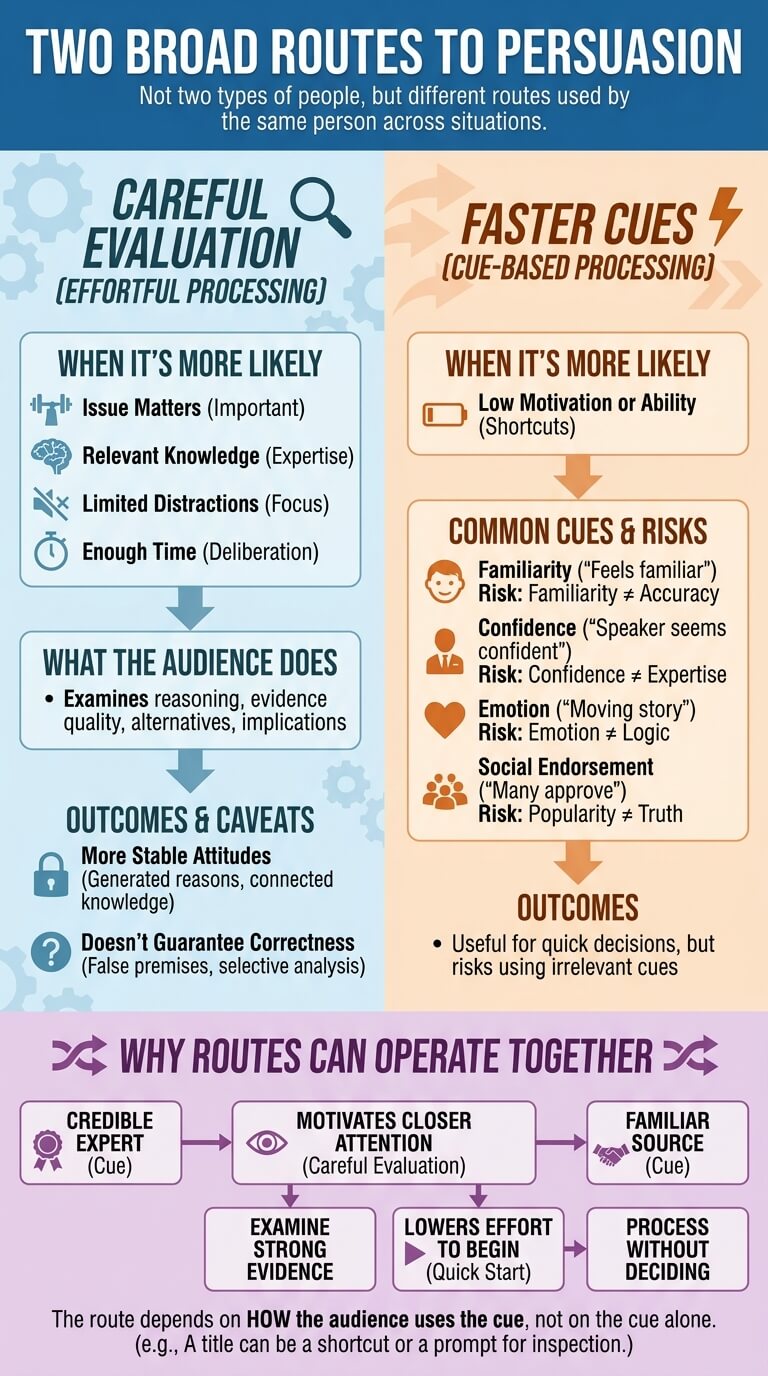
Persuasion theories often distinguish more effortful evaluation from faster cue-based processing. These are not two types of people. The same person can use different routes across situations.
Careful evaluation of arguments and evidence
Careful processing is more likely when the issue matters, the person has relevant knowledge, distractions are limited, and enough time is available. The audience examines reasoning, evidence quality, alternatives, and implications.
Attitudes formed through careful evaluation may be more stable because the person has generated reasons, connected the information with prior knowledge, and considered objections. Careful thought does not guarantee correctness. People can reason deeply from false premises or selectively analyze evidence.
Faster cues such as familiarity, confidence, emotion, and social endorsement
When motivation or ability is low, people may rely more on shortcuts: “Experts usually know,” “Many people approve,” “This feels familiar,” “The speaker seems confident,” or “The story feels authentic.” These cues can be useful because no one can investigate every claim fully.
The risk is using an irrelevant cue as if it proved the conclusion. Popularity does not establish truth. Confidence does not establish expertise. Familiarity does not establish accuracy.
Why routes can operate together
A credible expert may motivate closer attention to strong evidence. A moving story may make someone willing to examine statistics. A familiar source may lower the effort required to begin processing without deciding the final judgment.
The routes interact. Source credibility can be a quick cue, evidence about competence, or a reason to inspect the message more carefully.
The same feature can play different roles. A specialist’s title may act as a shortcut when the audience lacks time. In a high-stakes decision, the title may instead prompt closer examination of the specialist’s training, methods, and conflicts of interest. The route depends on how the audience uses the cue, not on the cue alone.
What Makes a Source Credible
Credibility is an audience judgment, not a permanent trait owned by the communicator.
Expertise, honesty, similarity, consistency, and transparency
Expertise concerns relevant knowledge or experience. Honesty concerns whether the source appears willing to communicate accurately rather than merely secure compliance. Consistency concerns whether claims, evidence standards, and behavior remain stable across situations.
Similarity can increase trust because the source appears to understand the audience’s experience. It should not replace expertise when the decision requires technical knowledge. Transparency strengthens credibility when sources disclose uncertainty, incentives, limitations, and conflicts of interest.
Why confidence can be mistaken for competence
Fluent speech, certainty, status, attractive presentation, and repeated exposure can create an impression of authority. A hesitant expert may appear less credible than a confident nonexpert even when the expert’s caution reflects better understanding.
Evaluate whether the person can explain evidence, acknowledge uncertainty, correct errors, and remain accountable. Confidence is one communication style, not proof of knowledge.
Evidence, Stories, and Emotion
Persuasive messages often combine data, explanation, narrative, and emotional meaning.
When evidence supports durable change
Evidence supports change when it addresses the actual claim, comes from an appropriate method, can be checked, and survives plausible alternative explanations. Strong evidence may still fail when the audience cannot understand it or sees no connection to the decision.
Durability improves when the person can explain the reasoning in their own words and apply it to a new case. Repeating a conclusion without understanding its support produces a more fragile change.
When stories make information memorable
Stories connect events, motives, characters, and consequences. An interdisciplinary review of narratives in judgment and persuasion explains how stories can increase engagement, comprehension, memory, and identification.
A vivid story can make an issue concrete, but one case cannot establish frequency or typicality. Ethical communication uses stories to illustrate evidence, not replace the broader evidence base.
When emotion helps attention or overwhelms reasoning
Emotion can signal importance, support empathy, and make information memorable. Fear may motivate preparation when the threat is credible and an effective response is available. Hope may support persistence when it is connected to realistic action.
Emotion becomes problematic when it creates panic, shame, disgust, or urgency that prevents verification and free choice. The question is not whether emotion is present. It is whether emotion helps the audience understand or pressures them to stop evaluating.
Framing and Language
Framing highlights some consequences, values, or comparisons while leaving others less visible.
Gain versus loss frames
A gain frame emphasizes benefits of taking an action. A loss frame emphasizes costs of not taking it. Neither frame is universally superior.
A large review of persuasive message design choices found that many commonly recommended message variations produce small and inconsistent differences. Audience, issue, setting, and execution matter more than a simple rule such as “loss always persuades better.”
Concrete versus abstract language
Concrete language explains what happened, what action is requested, and what result is expected. Abstract language can connect a message to values and identity but may hide missing details.
Compare “Support better service” with “Add two evening appointments each week and publish average waiting times.” The second claim is easier to evaluate because it identifies an action and outcome.
Questions, metaphors, and reference points
Questions can invite reflection or quietly assume a conclusion. “How much longer will you tolerate this?” presumes the situation should no longer be tolerated. Metaphors can clarify complexity but also import emotional associations that are not evidence.
Reference points affect evaluation. A price appears low compared with an inflated anchor. A moderate result appears disappointing after an unrealistic promise. Ask who selected the comparison and whether another reference point would change the judgment.
Framing can be informative when it reveals a consequence the audience might overlook. It becomes misleading when one frame hides a material cost or makes a relative change look larger than the underlying numbers justify. Whenever possible, compare both gains and losses, absolute numbers and percentages, and short-term and long-term effects.
Repetition, Familiarity, and Message Fluency
Repeated messages become easier to recognize and process. Ease can be mistaken for truth or quality.
Why repeated claims can feel true
A familiar statement may feel less surprising and require less effort to process. That fluency can increase subjective plausibility even when no new evidence has been added.
Repetition is not proof. Check whether each exposure provides independent support or merely repeats the same source. Ten accounts copying one claim are not ten separate confirmations.
When repetition creates reactance or distrust
Repetition can create irritation when the audience notices persuasive intent or feels surrounded by the same demand. Excessive frequency can signal desperation, commercial pressure, or an attempt to replace evidence with familiarity.
Ethical repetition improves comprehension, reminds people of relevant information, and varies explanation without hiding that the core claim is the same.
Social Context and Norms
People use groups to judge what is common, approved, safe, and identity-consistent.
Consensus cues, trusted groups, and identity
Consensus can provide useful information when other people have independent experience. It becomes less informative when the group copies the same source, fears dissent, or rewards visible conformity.
Trusted groups influence which messengers are accepted and which claims feel compatible with identity. Messages from an out-group may be judged as hostile before their content is considered.
Descriptive norms versus approval norms
Descriptive norms concern what people usually do. Approval norms concern what people believe should be done. “Most employees submit reports on Friday” is descriptive. “The team expects reports by Friday” communicates approval and possible social consequences.
Norm messages can backfire when they normalize the unwanted behavior. Saying “many people ignore this rule” may communicate that noncompliance is common, even when the message intends criticism.
A more careful norm message distinguishes prevalence from approval. “Most people support the rule, and compliance is increasing” communicates both what others approve and what behavior is becoming common. The figures should be accurate, current, and relevant to the audience rather than invented for motivational effect.
Psychological Reactance
Persuasion becomes harder when the audience experiences the message as a threat to freedom.
Why pressure can strengthen resistance
A review of psychological reactance describes anger and counterarguing as common responses to perceived restrictions on freedom. Forceful language can make resisting the message feel like restoring autonomy.
False urgency, limited-time pressure, humiliation, repeated demands, and refusal to allow questions can increase resistance. The person may reject a reasonable recommendation because the method of delivery feels controlling.
Autonomy-supportive communication
Autonomy-supportive messages state the concern, explain the evidence, acknowledge limits, and preserve meaningful choice. They may say, “Here are the risks and options,” rather than, “Only a foolish person would refuse.”
Preserving choice does not mean withholding a clear recommendation. It means the recommendation can be evaluated and declined without punishment or deception.
Persuasion vs Manipulation, Coercion, and Education
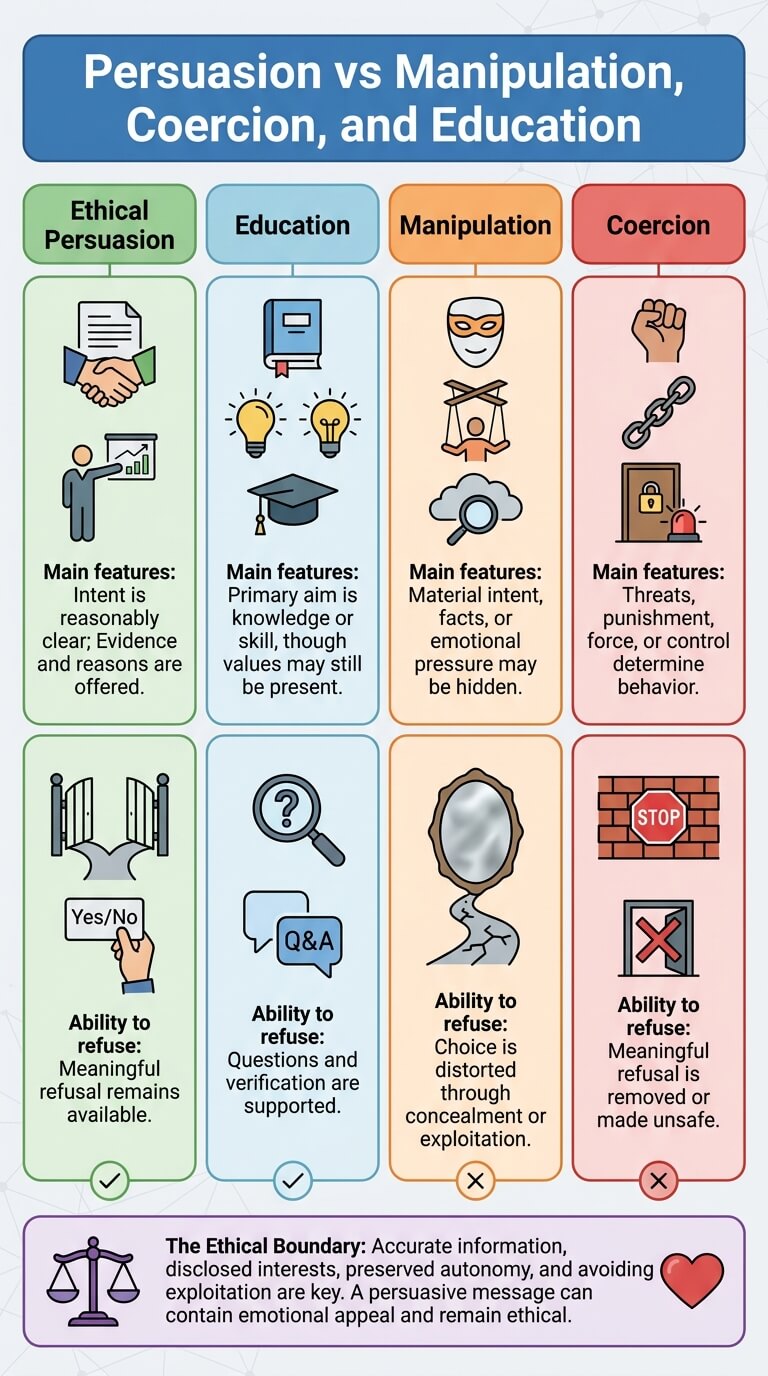
These concepts differ in transparency, freedom, pressure, and the audience’s ability to evaluate and refuse.
| Process | Main features | Ability to refuse |
|---|---|---|
| Ethical persuasion | Intent is reasonably clear; evidence and reasons are offered | Meaningful refusal remains available |
| Education | Primary aim is knowledge or skill, though values may still be present | Questions and verification are supported |
| Manipulation | Material intent, facts, or emotional pressure may be hidden | Choice is distorted through concealment or exploitation |
| Coercion | Threats, punishment, force, or control determine behavior | Meaningful refusal is removed or made unsafe |
A persuasive message can contain emotional appeal and remain ethical. The boundary is not emotion versus logic. It is whether the communicator uses accurate information, discloses relevant interests, preserves autonomy, and avoids exploiting vulnerability.
Persuasion vs Attitude Change
Persuasion is one communication pathway. Attitude change is the wider psychological process or outcome.
A communication pathway versus the broader change process
An attitude may change through direct experience, behavior, identity transition, emotion, or social context without anyone sending a persuasive message. A persuasive message may change one belief but leave the overall attitude unchanged.
Persuasion can also produce temporary compliance rather than internal change. The broader attitude-change process asks whether the evaluation persists, influences later behavior, and generalizes beyond the original situation.
How to Evaluate a Persuasive Message
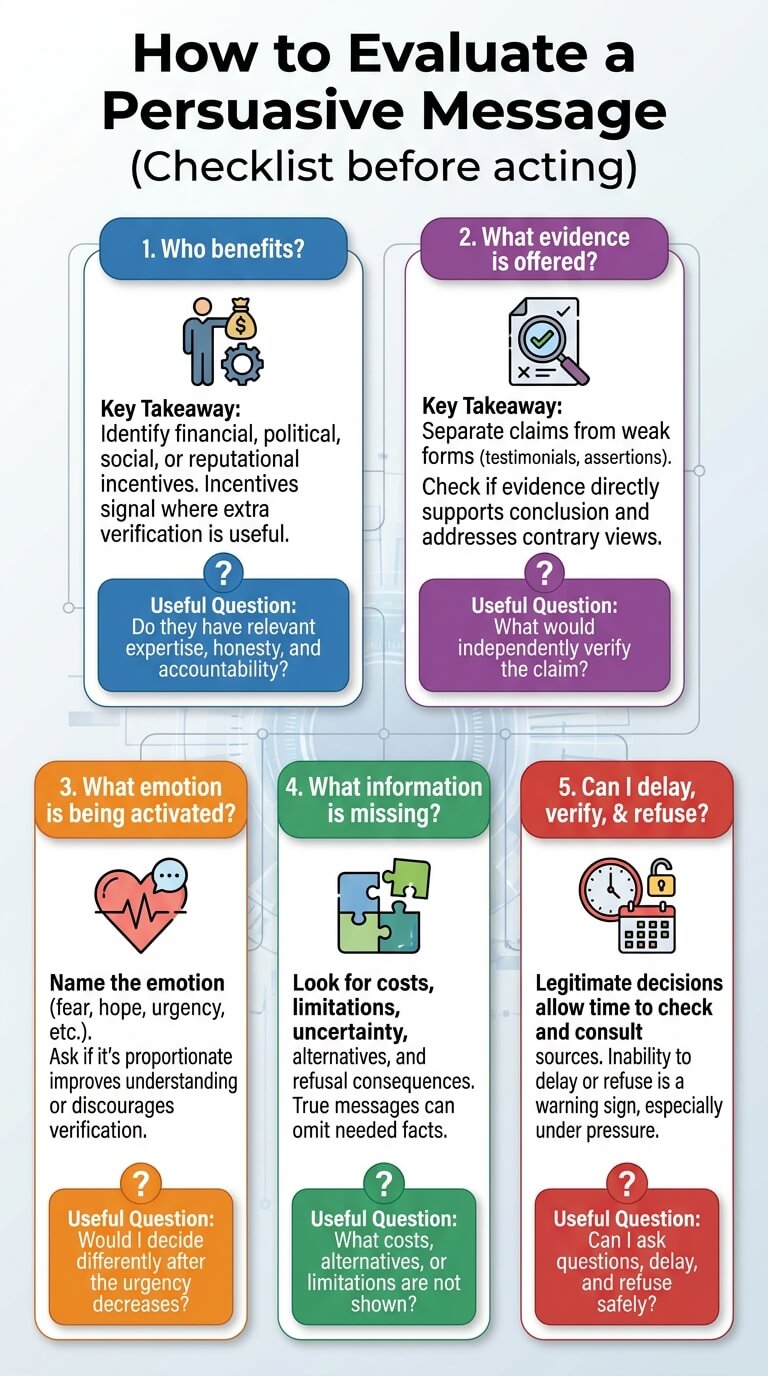
Use this checklist before accepting, sharing, purchasing, signing, or acting.
Who benefits?
Identify financial, political, social, or reputational incentives. A source can benefit and still tell the truth. The incentive signals where extra verification may be useful.
What evidence is offered?
Separate claims from testimonials, examples, and repeated assertions. Ask whether the evidence directly supports the conclusion and whether stronger contrary evidence has been addressed.
What emotion is being activated?
Name fear, hope, shame, anger, belonging, disgust, or urgency. Then ask whether the emotion is proportionate and whether it improves understanding or discourages verification.
What information or alternatives are missing?
Look for costs, limitations, uncertainty, base rates, comparison options, cancellation terms, and consequences of refusal. A message may be technically true while omitting information needed for a reasonable decision.
Can I delay, verify, and freely refuse?
Legitimate decisions often allow time to check the claim and consult independent sources. Inability to delay or refuse is a warning sign, especially when the pressure concerns money, health, sex, housing, work, or relationships.
| Evaluation area | Useful question |
|---|---|
| Source | Do they have relevant expertise, honesty, and accountability? |
| Evidence | What would independently verify the claim? |
| Emotion | Would I decide differently after the urgency decreases? |
| Missing information | What costs, alternatives, or limitations are not shown? |
| Freedom | Can I ask questions, delay, and refuse safely? |
How to Communicate Persuasively Without Manipulating
Ethical persuasion makes the reasoning easier to evaluate rather than harder to resist.
State intent, use accurate evidence, acknowledge uncertainty, preserve choice, and avoid false urgency
- State what you are asking the person to consider or do.
- Use evidence that matches the size and certainty of the claim.
- Disclose relevant interests, limitations, and uncertainty.
- Explain why the recommendation may matter to this audience.
- Invite questions and serious alternatives.
- Allow time for decisions when delay is reasonably possible.
- Avoid fabricated scarcity, humiliation, threats, deception, and punishment for refusal.
A clear recommendation can still be strong: “Based on these risks, I recommend option A.” Ethical strength comes from evidence and accountability, not from removing the other person’s agency.
When the communicator holds authority, additional care is needed. A manager, clinician, teacher, parent, or financial adviser may have legitimate reasons to recommend one option, but the audience can experience the recommendation as harder to refuse. Clarify which parts are required, which are optional, and what consequences genuinely follow from each choice.
Bridge: Belief Formation, Resistance, and Attitude Change
Persuasive communication enters a belief system that already contains experiences, explanations, identities, and social commitments.
How communication enters an existing belief system
A message may introduce a new belief, challenge an old explanation, increase ambivalence, or create a behavior intention. Existing attitudes determine what receives attention. Identity threat or reactance may create resistance. Repeated experience determines whether the change consolidates.
This is why one message rarely explains the entire outcome. Persuasion is an entry point. Belief formation, perseverance, resistance, expectation, behavior, and social context shape what happens afterward.
When Persuasion Becomes a Safety Concern
Persuasion should not be used as a neutral label for conduct that removes freedom through fear or control.
Seek support when influence includes threats, isolation, surveillance, humiliation, financial control, or retaliation
Pressure becomes a safety concern when another person monitors communication, isolates someone from support, controls money, threatens consequences, humiliates them, or retaliates for refusal. In these situations, the goal is not to become more persuasive or win an argument.
The National Domestic Violence Hotline safety-planning resources can help people think through personal and practical safety options in the United States. If there is immediate danger, contact local emergency services. Elsewhere, use an appropriate local domestic violence or crisis service.
Educational note: Ethical persuasion preserves meaningful choice. Threats, surveillance, isolation, financial control, and retaliation are not persuasion techniques.
FAQ About Persuasion Psychology
These questions clarify manipulation, emotion, credibility, repetition, and durable influence.
Is persuasion always manipulation?
No. Ethical persuasion presents reasons and evidence while preserving meaningful choice. Manipulation hides relevant intent or information, exploits vulnerability, or distorts choice. Coercion goes further by using threat, force, punishment, or control.
Are emotional messages less rational?
Not necessarily. Emotions can signal values, consequences, and human impact. An emotional message becomes less reliable when feeling replaces evidence, creates panic, or prevents verification. Rational evaluation can include emotion without being ruled by it.
Why does credibility matter?
People cannot investigate every claim from the beginning. Credibility helps allocate attention and trust. It is most useful when based on relevant expertise, honesty, transparency, accountability, and a record of correction rather than confidence alone.
Does repetition make a claim true?
No. Repetition can increase familiarity and processing fluency, which may make a claim feel more plausible. Truth still depends on evidence. Check whether repeated versions come from independent sources or trace back to one unsupported claim.
What makes persuasion last?
Durable change is more likely when the person thinks carefully, understands the arguments, integrates the new view with existing knowledge, gains supporting experience, and continues to endorse the conclusion without pressure. No single message feature guarantees persistence.
Key Takeaways
- Persuasion is communication intended to influence belief, attitude, intention, or behavior.
- Its effects depend on the interaction of source, message, audience, and context.
- People may evaluate arguments carefully or rely more on credibility, familiarity, emotion, and social cues.
- Stories and emotion can improve attention and meaning, but they do not replace evidence.
- Framing, repetition, and confidence do not provide universal persuasion formulas.
- Ethical persuasion is transparent, evidence-aware, autonomy-supportive, and safe to refuse.
For the next persuasive message you encounter, identify the source, the central claim, the evidence, the emotion, the missing information, and your freedom to delay or refuse. Then ask one final question: would the message remain convincing if the urgency, confidence, and social approval were removed? That answer helps separate strong reasoning from strong presentation.

Michael Reed is the Founder and Lead Writer at Psychology Exposed. He writes about human behavior, relationships, emotional patterns, self-awareness, and practical psychology topics using research-informed, easy-to-understand content.
Read More About Michael Reed: https://psychologyexposed.com/michael-reed/