
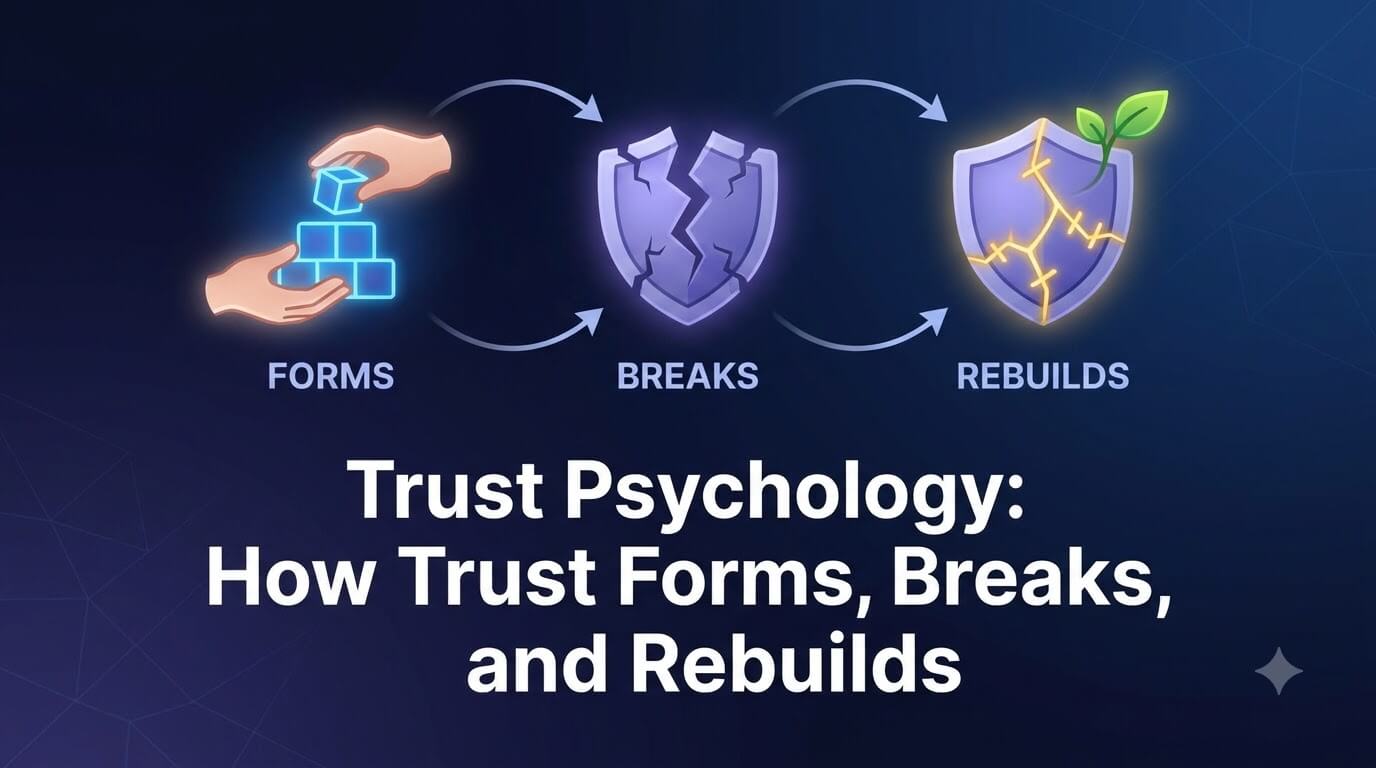
Trust affects far more than close relationships. It shapes whether you accept advice, delegate a task, share private information, follow a leader, believe an online claim, depend on an institution, or ask someone for help. Yet trust is often described as if it were a simple feeling that is either present or absent.
Psychologically, trust is better understood as a judgment made under uncertainty. You cannot know with complete certainty what another person, group, or system will do. Instead, you use past behavior, available evidence, perceived motives, and the stakes involved to estimate whether relying on them is reasonable. That estimate then influences how open, cautious, cooperative, or protective you become.
This broader view helps explain why trust may grow slowly, disappear after one serious violation, remain strong in one area but weak in another, or return only after repeated evidence of change. It also separates thoughtful trust from blind faith and reasonable caution from automatic suspicion.
Quick Answer
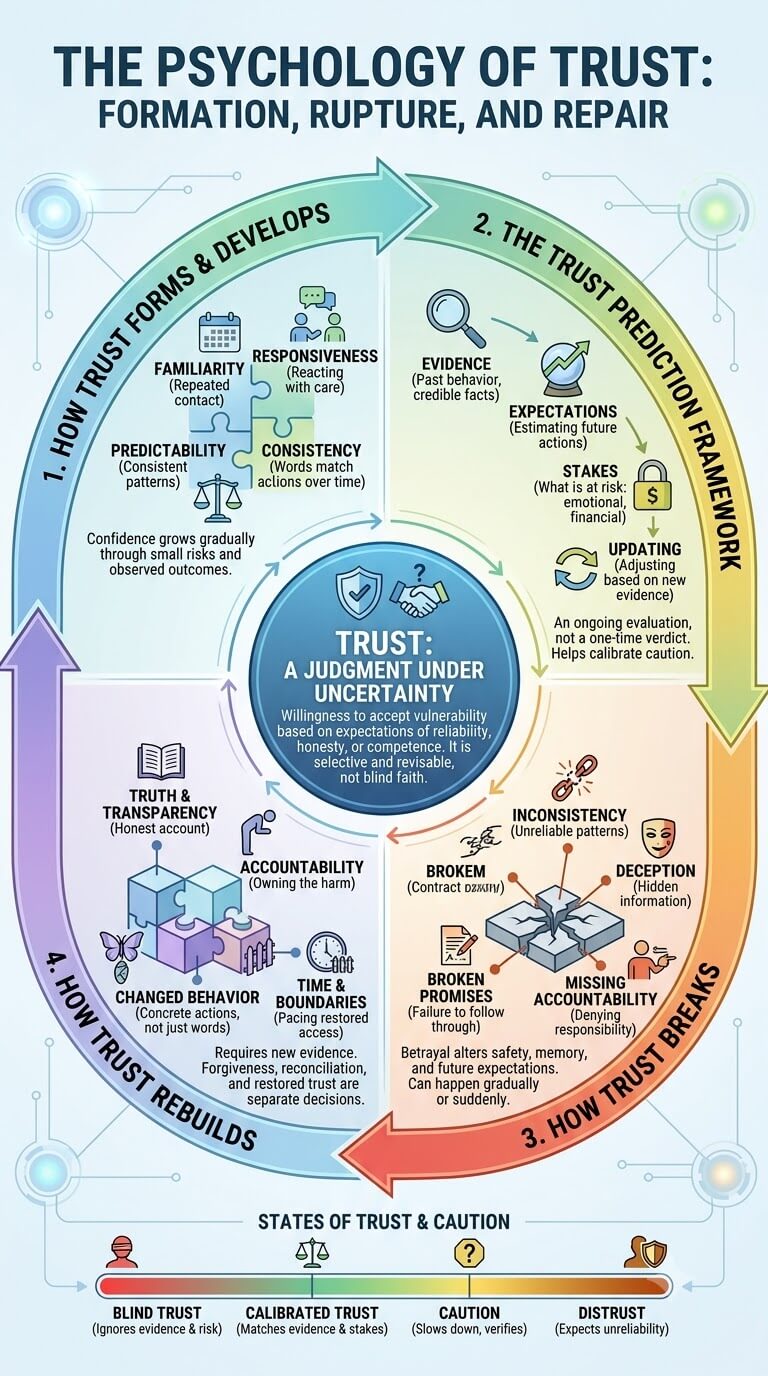
Trust is a willingness to accept uncertainty based on expectations of reliability, honesty, care, or competence
Trust means relying on a person, message, organization, or system when the outcome is not fully under your control. The APA Dictionary of Psychology definition of trust emphasizes confidence in dependability and predictability. In daily life, this may involve expecting someone to keep a promise, protect sensitive information, tell the truth, act competently, or consider your welfare.
Healthy trust is selective and revisable rather than blind
Healthy trust does not require you to ignore uncertainty. It allows confidence to differ by person, situation, and type of responsibility. You may trust a friend with emotional support but not financial advice, or trust a skilled colleague to complete technical work while remaining cautious about confidential information. As new evidence appears, reasonable trust can increase, narrow, pause, or decline.
What Trust Means in Psychology
Trust as an expectation about another person, source, group, or system
At its simplest, trust contains an expectation about what will happen next. You expect a friend to respond with care, a driver to follow traffic rules, a manager to apply standards fairly, or a news outlet to correct major errors. These expectations may be based on direct experience, reputation, social norms, institutional safeguards, or a combination of them.
Trust as behavior that accepts some vulnerability
A trust decision matters because something could be lost. Sharing a secret risks exposure. Delegating work risks disappointment. Following medical advice involves relying on expertise you may not personally possess. Letting someone borrow an important object gives them temporary control over something you value.
Research commonly describes trust as a willingness to accept vulnerability under uncertainty. A peer-reviewed study on trust between strangers at zero acquaintance also shows that trust behavior may be shaped by social expectations about respect, not only by calculations of likely reward. This helps explain why people sometimes extend limited trust before they have much personal evidence.
Trustworthiness as the qualities being evaluated
Trust and trustworthiness are related but distinct. Trust is the confidence or willingness of the person relying. Trustworthiness concerns the qualities of the person, organization, or system being evaluated. Those qualities may include honesty, consistency, competence, fairness, care, transparency, and willingness to take responsibility.
Why Trust Matters for Human Behavior
Trust reduces the cost of constant checking and self-protection
Daily life would be exhausting if every action required complete verification. Trust lets people act without checking every detail, monitoring every conversation, or preparing for every possible betrayal. It makes cooperation faster and reduces the mental effort involved in ordinary dependence.
Trust shapes cooperation, disclosure, learning, authority, and risk-taking
People usually cooperate more freely when they expect others to act fairly. They disclose more when they expect care and confidentiality. They accept guidance more readily when they believe the speaker is knowledgeable and honest. They take social or professional risks when they expect mistakes will be handled reasonably.
A large meta-analysis of human trust reviewed many factors that influence trust and its behavioral outcomes. The broad lesson is that trust does not come from one universal cue. It reflects characteristics of the person trusting, the party being trusted, the relationship between them, and the environment in which the decision occurs.
Distrust changes attention, interpretation, memory, and behavior
When distrust rises, people often look more closely for inconsistency, hidden costs, or signs of manipulation. Ambiguous behavior may receive a more threatening interpretation. A delayed reply may feel like avoidance, a policy change may seem deceptive, or an incomplete explanation may appear intentionally misleading.
The Trust Prediction Framework
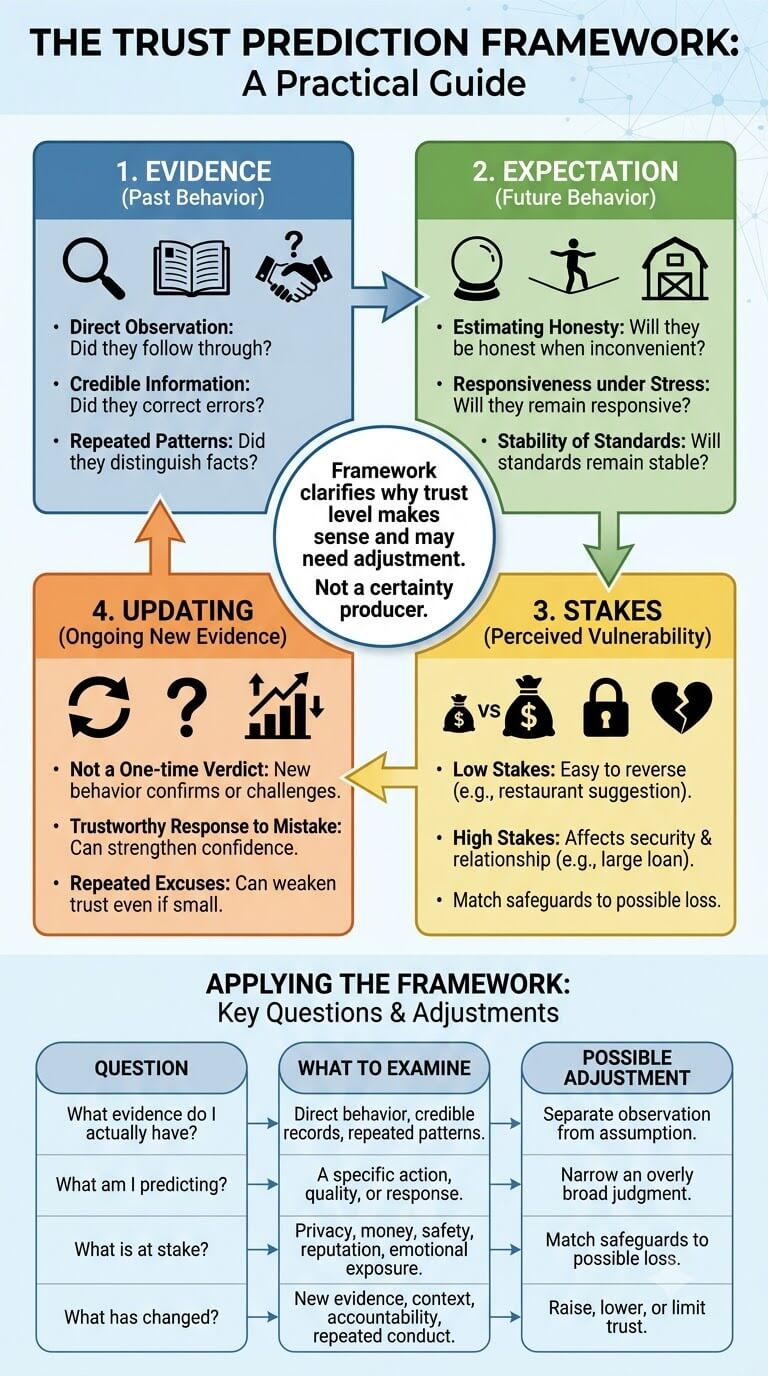
A practical way to understand trust is to view it as an ongoing prediction with four parts: evidence, expectation, stakes, and updating. The framework does not produce certainty. It helps clarify why your level of trust makes sense in one situation and may need adjustment in another.
Evidence from past behavior
Evidence includes what you have directly observed and what credible information suggests. Did the person follow through? Did the organization correct an error? Did the source distinguish facts from uncertainty? Did the team respond fairly when someone raised a concern?
Expectations about future behavior
Past evidence becomes trust when it informs a future expectation. You are not simply remembering that someone was honest before. You are estimating whether they are likely to be honest when honesty becomes inconvenient, whether they will remain responsive under stress, or whether their standards will remain stable when power shifts.
Perceived stakes and vulnerability
The same evidence may support different decisions depending on what is at risk. You might accept a restaurant suggestion from a new acquaintance but hesitate to lend them a large amount of money. The first decision has low stakes and is easy to reverse. The second may affect financial security and the relationship itself.
Ongoing updating when new evidence appears
Trust is not a one-time verdict. New behavior may confirm the current estimate, challenge it, or remain ambiguous. A trustworthy response to a mistake can strengthen confidence in accountability even though the mistake itself was disappointing. Repeated excuses can weaken trust even when each individual incident appears small.
| Question | What to examine | Possible adjustment |
|---|---|---|
| What evidence do I actually have? | Direct behavior, credible records, repeated patterns | Separate observation from assumption |
| What am I predicting? | A specific action, quality, or response | Narrow an overly broad judgment |
| What is at stake? | Privacy, money, safety, reputation, emotional exposure | Match safeguards to possible loss |
| What has changed? | New evidence, context, accountability, repeated conduct | Raise, lower, or limit trust |
How Trust Develops Over Time
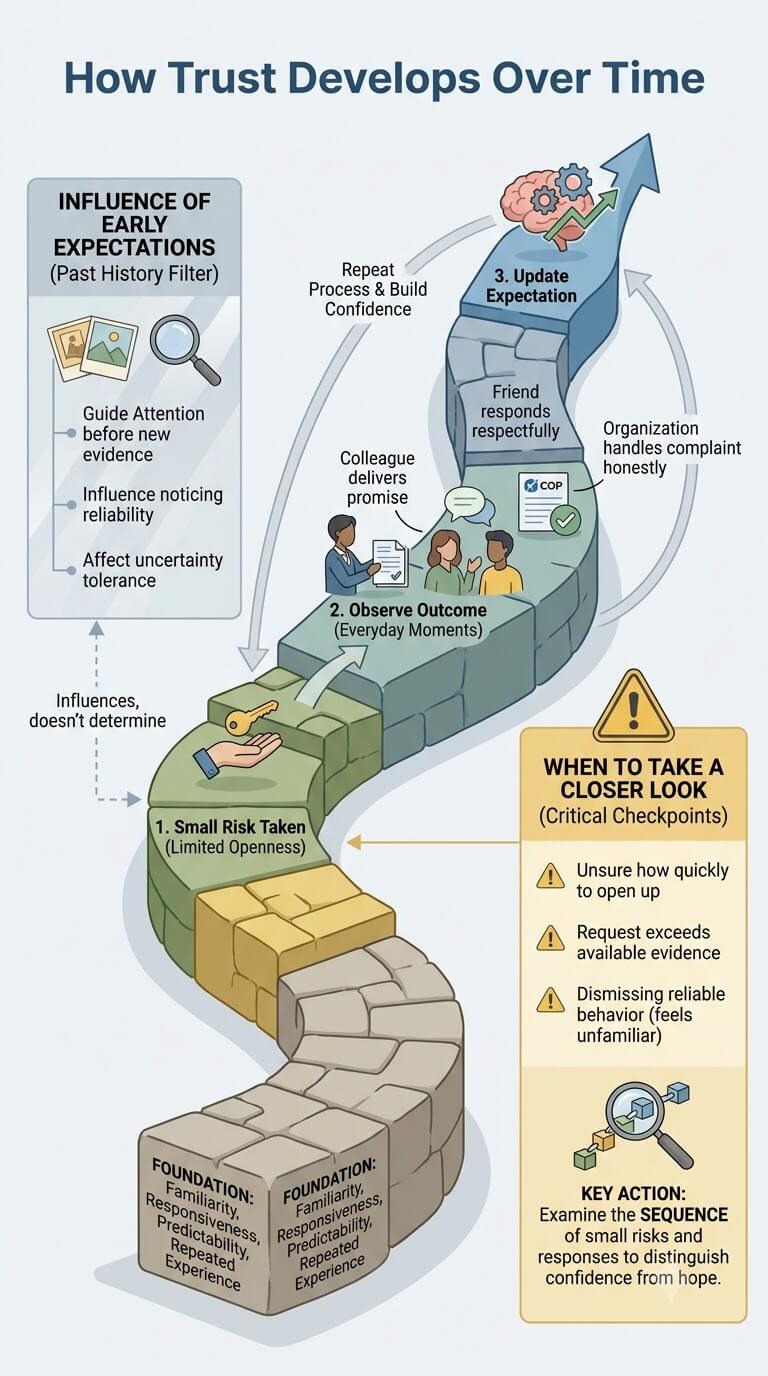
Familiarity, responsiveness, predictability, and repeated experience
Trust often begins with limited openness rather than complete confidence. A person accepts a small risk, observes what happens, and updates their expectation. The process repeats through everyday moments: a colleague delivers what they promised, a friend responds respectfully to disagreement, or an organization handles a complaint without hiding the problem.
Why early expectations can influence later trust without determining it
People do not enter every relationship with an empty history. Earlier experiences may influence how quickly they notice reliability, how much uncertainty they tolerate, and what they expect from closeness or authority. These expectations can guide attention before enough new evidence is available.
When you need a closer look at trust formation
Trust development deserves closer attention when you are unsure how quickly to open up, when someone is asking for access that exceeds the evidence available, or when you keep dismissing reliable behavior because it feels unfamiliar. Looking at the sequence of small risks and responses can reveal whether confidence is developing from experience or from hope alone.
Trust, Distrust, Caution, and Blind Trust
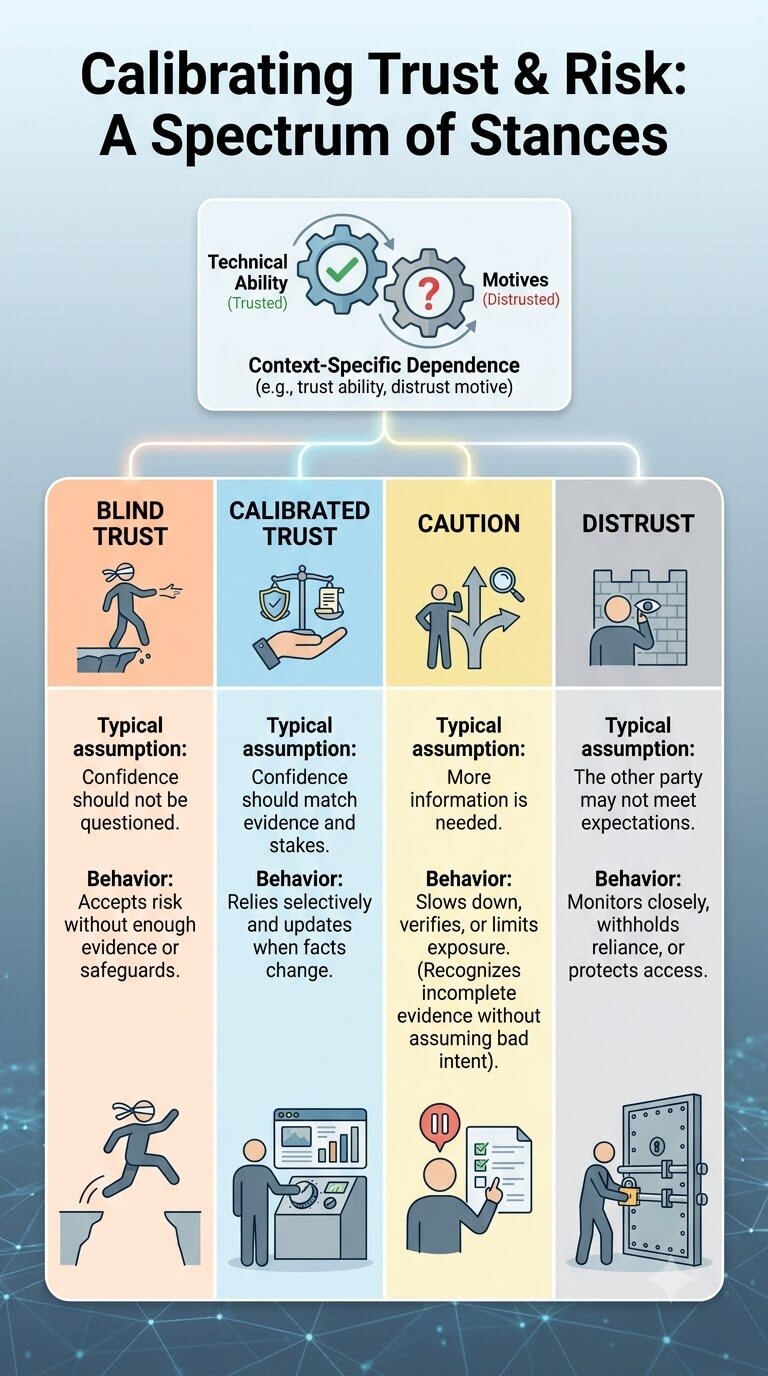
Trust and distrust are not simple opposites on every decision
You may trust someone’s technical ability while distrusting their motives. You may distrust a company’s privacy practices while trusting a specific employee’s honesty. You may have no reason to distrust a new neighbor yet still lack enough information to depend on them with something important.
Calibrated caution protects without assuming bad intent
Caution means recognizing that evidence is incomplete and adjusting the size of the risk. It may involve verifying a claim, sharing information gradually, asking for terms in writing, or waiting to see whether actions match words. None of these steps require accusing another person of deception.
It also helps to separate trust from distrust, caution, and blind trust because these reflect different judgments about uncertainty and risk.
| Position | Typical assumption | Behavior |
|---|---|---|
| Blind trust | Confidence should not be questioned | Accepts risk without enough evidence or safeguards |
| Calibrated trust | Confidence should match evidence and stakes | Relies selectively and updates when facts change |
| Caution | More information is needed | Slows down, verifies, or limits exposure |
| Distrust | The other party may not meet expectations | Monitors closely, withholds reliance, or protects access |
Why Consistency Builds Trust
Stable patterns make future behavior easier to predict
Consistency gives trust a track record. It shows how someone behaves not only when circumstances are easy, but also when they are tired, inconvenienced, corrected, or under pressure. Stable patterns reduce uncertainty because they make tomorrow less mysterious.
Words matter less when follow-through repeatedly contradicts them
Promises create expectations, but behavior confirms or weakens them. Reassurance loses value when deadlines are repeatedly missed, private information is repeatedly shared, or apologies are followed by the same conduct. In those cases, the issue is not that the words were insufficiently convincing. The behavioral evidence points in another direction.
When inconsistency needs context
Not every change signals deception. Illness, overload, unclear expectations, or a genuine change in circumstances may disrupt behavior. Context matters, but context should explain the change rather than erase its impact. A trustworthy response usually includes clear communication, ownership, and realistic adjustment.
How People Judge Credibility
Competence, honesty, evidence, motive, and track record
Credibility concerns whether a person or information source deserves belief. People often evaluate several questions at once: Does this person know what they are talking about? Are they being honest? Is the claim supported? What might they gain if I believe them? Have their past statements held up?
Why confidence and likability can be mistaken for credibility
The psychology of epistemic trust and vigilance examines how people decide whether communicated knowledge is relevant and dependable. Selective openness is different from accepting every message or rejecting every unfamiliar claim. It involves checking both the speaker and the content.
A simple credibility check
- Competence: Does the person have relevant knowledge or experience?
- Evidence: Can the claim be checked independently?
- Honesty: Do they acknowledge limits, uncertainty, and mistakes?
- Motive: What outcome do they want, and is that incentive disclosed?
- Record: How have similar claims or promises held up over time?
Vulnerability and the Choice to Trust
Openness creates possible connection and possible loss
Trust becomes meaningful when another party receives access to something that matters. Emotional disclosure gives someone knowledge that could be handled with care or used carelessly. Asking for support reveals a need. Delegating responsibility gives another person influence over an outcome.
Boundaries, pacing, and reciprocity keep vulnerability selective
A boundary defines what access is available and under what conditions. Pacing lets information develop before the risk expands. Reciprocity shows whether openness and responsibility move in both directions rather than one person repeatedly taking the larger risk.
Vulnerability is not a test of loyalty
Pressure to disclose secrets, share passwords, remove boundaries, or prove devotion is not the same as earning trust. Genuine trust allows choice. It does not require someone to surrender privacy or ignore discomfort to reassure another person.
Why Some People Struggle to Trust
Learned expectations, uncertainty, attachment patterns, and previous betrayal
Difficulty trusting may develop for many reasons. Some people have repeatedly experienced broken promises, unreliable care, deception, exclusion, or sudden changes in important relationships. Others may be dealing with current environments where rules are unclear and behavior is inconsistent. Some naturally require more evidence before accepting dependence.
Protection can remain active after the original context has changed
A protective expectation can outlast the situation that created it. Someone who learned that disclosure led to ridicule may withhold even with respectful people. A worker who was punished for raising concerns may stay silent under a fairer manager. The response makes sense in light of history, even when it no longer fits every present context.
Difficulty trusting is not proof of a disorder
Caution, slow trust, and selective disclosure are not diagnoses. They become more concerning when fear or vigilance is severe, persistent, disconnected from available evidence, or significantly limits daily functioning. A qualified mental health professional can help explore those concerns without assuming that every trust difficulty has the same cause.
How Trust Breaks

Inconsistency, deception, secrecy, broken promises, and missing accountability
Trust weakens when behavior makes future outcomes harder to predict or reveals that earlier expectations were inaccurate. Deception directly changes what the other person believed. Secrecy may show that important information was intentionally controlled. Broken promises show that stated commitments did not guide behavior.
Repeated small violations versus one high-impact violation
Some trust failures accumulate gradually. Constant lateness, selective honesty, dismissive reactions, and unreliable follow-through may each seem minor in isolation. Together, they create a stable expectation that dependence will be costly.
Other violations carry immediate weight because the stakes are high. Revealing private information, significant financial deception, serious professional misconduct, or a major betrayal may alter trust after one event. The speed of the change depends on impact, intent, context, prior history, and the possibility of repair.
The first useful question after a rupture
Instead of asking only, “Should I trust again?” first identify what specifically became unreliable. Was it honesty, judgment, confidentiality, loyalty, competence, or willingness to take responsibility? A specific answer makes the next decision clearer. Trust may need to be reduced in one area without making a total judgment about every aspect of the person.
The Psychological Impact of Betrayal
Betrayal changes safety, meaning, memory, and future expectations
Betrayal hurts not only because of what happened, but because it came from someone or something that had been granted trust. The mind may revisit earlier events, searching for missed signs. Memories that once felt secure may become uncertain. Future situations may be interpreted through the possibility of another hidden violation.
The injury is often about both the act and the story it rewrites
A betrayal can change the meaning of the past. Someone may wonder whether prior affection was genuine, whether shared decisions were based on false information, or whether they understood the relationship at all. That rewritten story can feel as destabilizing as the event itself.
Not every disappointment is betrayal
Betrayal usually involves a meaningful violation of an expectation tied to loyalty, honesty, protection, or responsibility. A mistake, disagreement, or inability to meet an unspoken expectation may still hurt, but labeling every disappointment as betrayal can hide the real issue. Clarifying what was promised, understood, and violated helps distinguish the two.
What Rebuilding Trust Requires
Truth, accountability, changed behavior, transparency, boundaries, and time
Trust cannot be restored by reassurance alone because the original expectation has already been disproved. Repair requires new evidence. That usually begins with a truthful account, clear ownership of the harm, and willingness to answer reasonable questions without manipulating the timeline.
After harm, rebuilding trust depends on new evidence, accountability, changed behavior, boundaries, and time rather than reassurance alone.
Forgiveness, reconciliation, and renewed trust are separate decisions
A person may release some anger without resuming the relationship. They may continue contact without restoring the same level of access. They may accept an apology while deciding that the risk remains too high. None of these choices is logically inconsistent.
What repair looks like in behavior
- The person answers the central issue rather than arguing over minor wording.
- They acknowledge impact without making the harmed person comfort them.
- They accept that access may return gradually or not at all.
- They make concrete changes connected to the violation.
- They remain accountable after the immediate emotion has passed.
Why the Mind Becomes Suspicious
Ambiguity and motive uncertainty invite hidden-meaning interpretations
Suspicion often appears when information is incomplete and the other party’s motives are uncertain. The mind tries to close the gap by constructing an explanation. A vague message may seem strategic, a change in tone may feel revealing, or a missing detail may appear intentionally concealed.
Suspicion can be protective but can also become self-reinforcing
Once someone expects deception, they may focus on confirming details and discount neutral or reassuring information. Protective behavior may also change the interaction. Repeated testing, indirect questions, or accusations can make another person defensive, which then appears to confirm the original concern.
Three questions before acting on suspicion
- What did I directly observe, without adding motive?
- What alternative explanations fit the same facts?
- What proportionate step could gather information without creating unnecessary harm?
Which Trust Topic Should You Explore Next?
Choose formation or consistency when trust is still developing
Look more closely at trust development when you are deciding how quickly to rely on a new person, group, or institution. Focus on consistency when the main question is whether repeated actions match promises. These two areas help distinguish a reasonable pace from pressure to offer confidence before a track record exists.
Choose distrust, credibility, or suspicion when evaluating uncertainty
Examine trust and distrust when your reaction feels more complex than simple confidence or doubt. Credibility is the better focus when you are judging a speaker, claim, expert, or information source. Suspicion deserves attention when ambiguous behavior keeps producing hidden-motive interpretations.
Choose trust struggle, break, betrayal, or rebuilding when trust has been harmed
Difficulty trusting focuses on barriers that affect the ability to place confidence, including learned expectations and uncertainty. Trust breakdown focuses on the behaviors that weaken an existing expectation. Betrayal focuses on the psychological impact of a serious violation. Rebuilding focuses on the evidence and conditions needed after harm has occurred.
Common Misunderstandings About Trust
Trust does not require certainty
If certainty were available, trust would be unnecessary. Trust exists because another person or system has some freedom to act differently from what you hope. The goal is not to eliminate uncertainty but to make a reasonable decision about it.
Boundaries do not automatically signal distrust
Boundaries can make trust more sustainable by defining responsibility and reducing avoidable ambiguity. Keeping separate financial accounts, asking before sharing a private story, or clarifying who has access to a document may support cooperation rather than undermine it.
Forgiveness does not automatically restore access
Emotional release and practical reliance answer different questions. Someone may no longer want to carry resentment while still deciding that confidential information, money, or close contact should remain limited.
One mistake and a repeated pattern should not be evaluated identically
A single mistake may call for clarification and repair. A repeated pattern offers stronger evidence about what to expect next. At the same time, one event can be enough to change trust when its impact is severe or when it reveals intentional deception.
When Trust Concerns Need More Support
Persistent fear, coercion, threats, humiliation, stalking, retaliation, or severe distress
Ordinary trust problems involve uncertainty, disappointment, or conflict. Safety concerns are different. If someone monitors your movements, threatens consequences for setting boundaries, humiliates you, controls access to money or communication, stalks you, or retaliates when you seek help, the priority is not finding better words to rebuild trust.
In those situations, consider reaching out privately to a trusted support person or a specialized service. The National Domestic Violence Hotline offers information on individualized safety planning. Use a safer device or communication method when you believe your activity may be monitored.
Why safety planning or professional support may come before communication or repair
Direct confrontation can increase risk when another person uses fear, coercion, violence, stalking, or retaliation. Advice that assumes equal freedom and good-faith discussion may not fit an unsafe situation. A trained advocate can help consider practical options based on your circumstances rather than pressuring you toward one decision.
Professional support may also be useful when mistrust or suspicion causes severe distress, disrupts sleep or daily functioning, or makes it difficult to maintain any supportive relationship. Seeking help does not mean your concerns are imaginary. It creates space to evaluate evidence, history, and present risk more carefully.
Frequently Asked Questions About Trust Psychology
Is trust a feeling, a belief, or a behavior?
Trust can involve all three. A person may feel safe, believe someone is dependable, and behave by accepting vulnerability. These parts do not always match. You may believe a person has changed while still feeling tense, or feel comfortable with someone without having enough evidence for a high-stakes decision.
Why does trust take longer to build than to lose?
Building trust often requires repeated evidence across different situations. A serious violation can reveal that an important expectation was wrong, so the estimate changes quickly. This is especially true when the violation involves deliberate deception, high stakes, or behavior that calls earlier experiences into question.
Can you trust someone in one area but not another?
Yes. Trust is often domain-specific. You might trust someone’s kindness but not their time management, or trust their technical skill but not their judgment about confidentiality. Naming the exact area prevents one strength or weakness from becoming an inaccurate total judgment.
Is distrust always caused by trauma?
No. Distrust may result from current evidence, repeated unreliability, conflicting incentives, institutional history, unclear information, or ordinary caution. Past harmful experiences can influence distrust, but it is inaccurate and potentially dismissive to assume that every concern comes from trauma.
Can trust return without forgetting what happened?
Yes, in some situations. Remembering a violation may help establish better boundaries and more accurate expectations. Trust returns, when it does, because new behavior supports a revised prediction, not because the past has been erased. In other situations, the evidence may not justify renewed reliance.
Key Takeaways
- Trust is a prediction about reliability under uncertainty, not a guarantee that nothing will go wrong.
- Reasonable trust considers evidence, the specific expectation, the stakes involved, and new information over time.
- Trust can differ by domain, so confidence in one quality does not require confidence in every quality.
- Consistency, accountability, competence, honesty, and transparent motives provide stronger evidence than reassurance alone.
- Caution can protect you without assuming bad intent, while blind trust ignores evidence and chronic suspicion may treat ambiguity as proof.
- After a serious rupture, forgiveness, reconciliation, restored access, and renewed trust remain separate choices.
Final Thoughts
The most useful next step is to replace the broad question “Do I trust them?” with a more precise one: “What am I relying on them to do, what evidence supports that expectation, and what is at stake if I am wrong?” Precision makes trust less mysterious. It helps you open gradually where evidence is growing, protect yourself where risk remains, and revise your judgment without treating either trust or distrust as a permanent identity.
Educational note: Michael Reed is the Founder and Lead Writer at Psychology Exposed. He writes about human behavior, relationships, emotional patterns, self-awareness, and everyday decisions in clear, research-aware language. This material is educational and is not a substitute for mental health, medical, legal, or crisis support.

Michael Reed is the Founder and Lead Writer at Psychology Exposed. He writes about human behavior, relationships, emotional patterns, self-awareness, and practical psychology topics using research-informed, easy-to-understand content.
Read More About Michael Reed: https://psychologyexposed.com/michael-reed/