
When trust has been damaged, the hardest question is often not “Do I still care?” It is “What would make relying on this person, team, family member, or institution feel reasonable again?” A sincere apology may matter. So may openness, remorse, explanations, and time. Yet none of those automatically restores trust. Trust changes when the evidence you use to predict future behavior changes.
That is why rebuilding trust is less like erasing a mistake and more like updating a judgment. The person who was hurt is deciding what level of reliance is now supported. The person who caused the rupture is showing, through repeated behavior, whether the conditions that produced the problem have actually changed. Sometimes that process leads to renewed closeness. Sometimes it leads to limited trust, stronger boundaries, a pause, or an ending.
Quick Answer
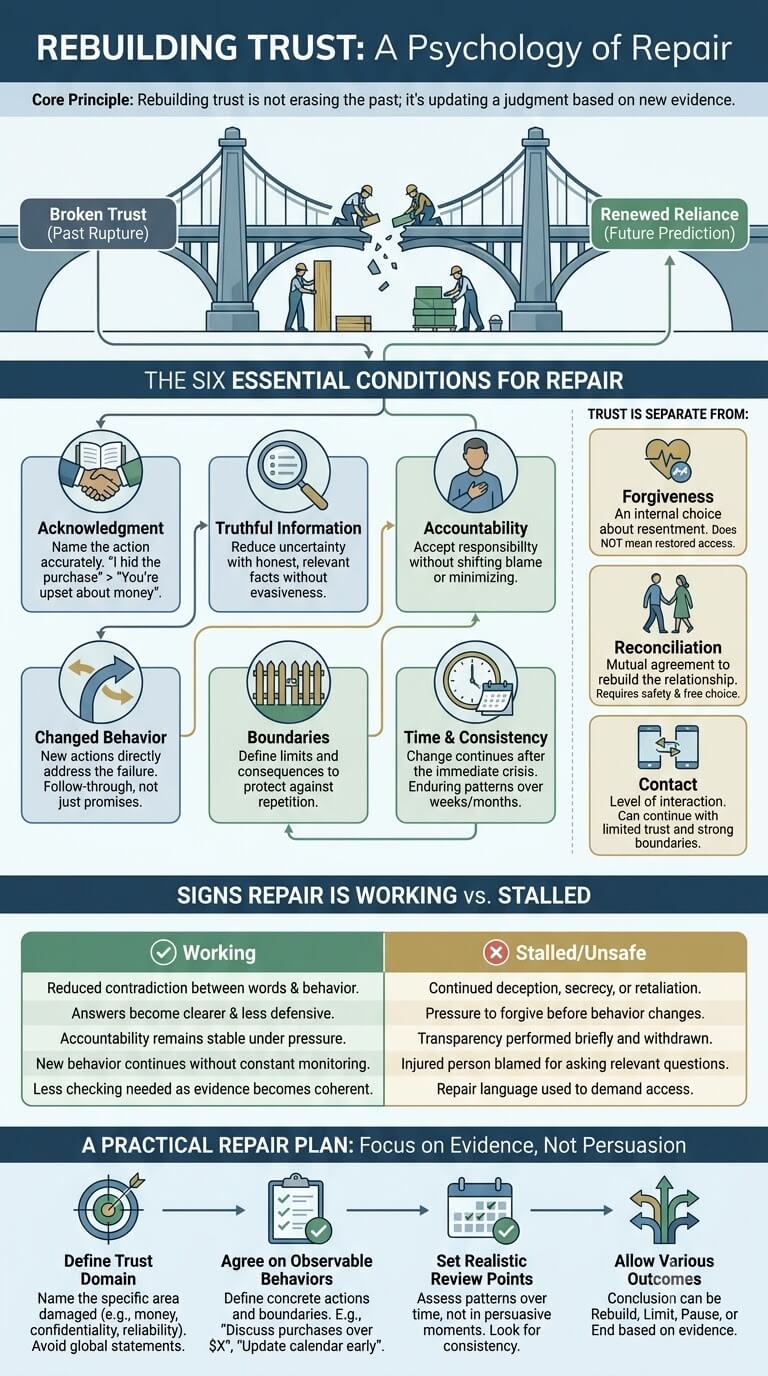
Rebuilding trust usually requires more than an apology. It depends on clear acknowledgment, truthful information, accountability, specific behavior change, workable boundaries, and enough time for those changes to become believable. Trust does not have to return to its old level, and forgiveness or reconciliation are not prerequisites. The question is whether new evidence supports safer, more realistic reliance.
Rebuilding Trust Is Not Returning to the Past
A rupture changes the information available to both people. Before the breach, one person may have assumed a promise would be kept, information would be shared honestly, money would be handled responsibly, or private material would stay private. After the breach, that assumption is no longer automatic. Repair starts from this changed reality.
The original assumption of safety has changed
Trust often works quietly. You do not inspect every promise because previous experience lets you predict what will probably happen. Once an important expectation is violated, uncertainty enters decisions that previously felt simple. A late arrival may now raise questions. A vague answer may feel more significant. A financial choice may require documentation that was never needed before.
This does not mean every concern is proof of danger. It means the old shortcut, “I can probably rely on this,” has been weakened. Repair has to give the mind something more solid than reassurance to work with.
Repair creates a new agreement with clearer evidence and boundaries
A better question than “How do we get back to normal?” is “What would responsible trust look like now?” That may require clearer agreements, specific follow-through, or a new response if the agreement is broken again.
After repeated missed deadlines, repair may mean shorter milestones and earlier updates. After hidden spending, it may mean agreed thresholds for discussing purchases. The point is to replace vague expectations with observable commitments.
Repair is one part of the broader psychology of trust, where expectations change as new evidence becomes available.
Some relationships stabilize without returning to the previous level of access
Trust is not all or nothing. You might keep ordinary contact with a friend but stop sharing highly private information, or continue working with someone while requiring written confirmation of important decisions.
As repair progresses, vulnerability and openness may return gradually rather than all at once, and boundaries can remain part of that process.
A reduced level of access can be a thoughtful conclusion rather than a failed repair. The relevant question is whether the current level of trust matches the current evidence.
The Six Conditions for Trust Repair
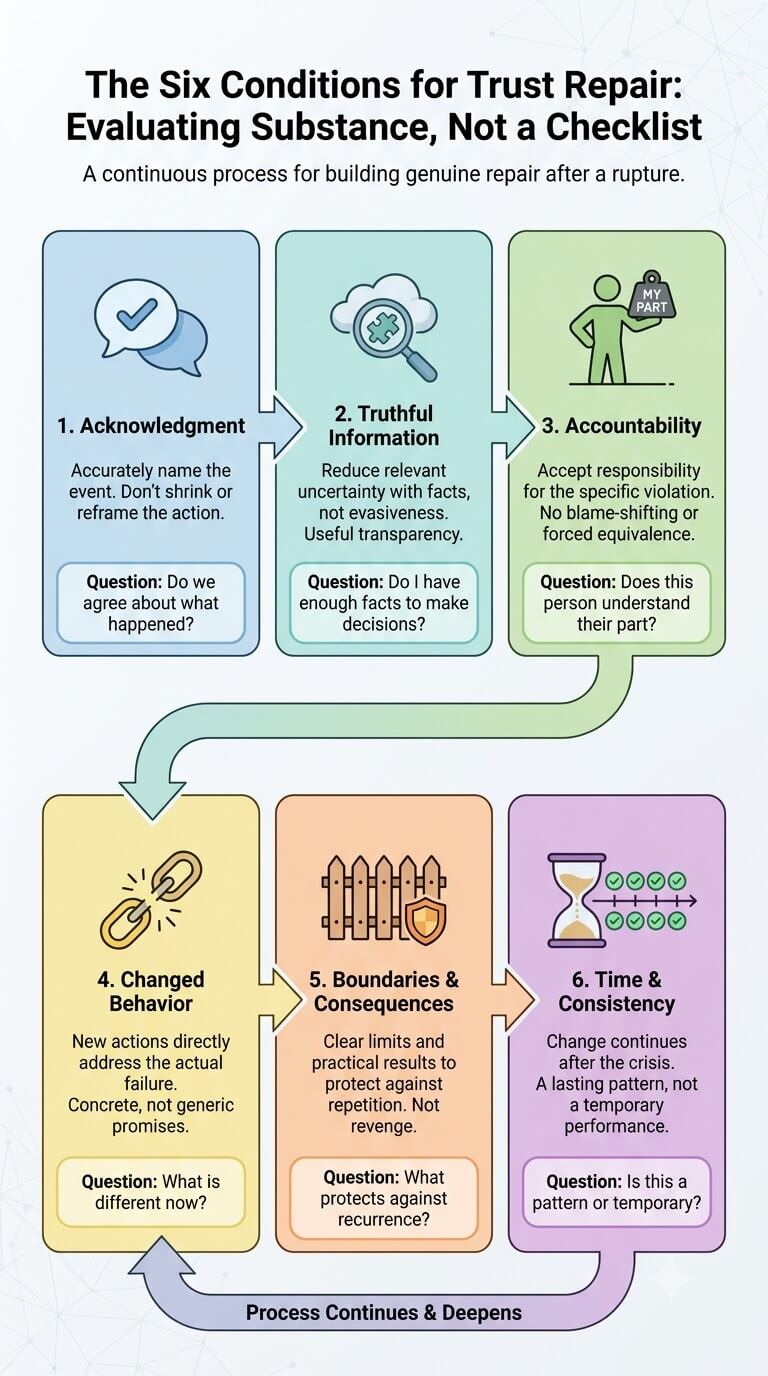
Different ruptures require different responses, but six conditions provide a useful way to evaluate whether repair has substance. Think of them as parts of one process rather than a checklist that guarantees an outcome.
| Condition | What it looks like | What it helps answer |
|---|---|---|
| Acknowledgment | The event is named accurately | Do we agree about what happened? |
| Truthful information | Relevant uncertainty is reduced without evasiveness | Do I have enough facts to make decisions? |
| Accountability | Responsibility is accepted without shifting blame | Does this person understand their part? |
| Changed behavior | New actions address the actual failure | What is different now? |
| Boundaries | Limits and consequences are clear | What protects against repetition? |
| Time | Change continues after the immediate crisis | Is this a pattern or a temporary performance? |
Clear acknowledgment of what happened
Acknowledgment means naming the action without shrinking it into something easier to defend. “I hid the purchase after we agreed to discuss expenses over that amount” is more useful than “You are upset about money again.”
The wording matters because accurate acknowledgment creates a shared starting point. It does not require agreement about every interpretation or emotional reaction.
Honest information that reduces avoidable uncertainty
Relevant information helps restore a coherent picture after a breach. Useful transparency is not unlimited interrogation. Details should serve understanding, safety, decision-making, or prevention.
Accountability without blame-shifting or forced equivalence
Two people can both have problems without being equally responsible for a specific violation. If one person lied, leaked confidential information, crossed an agreed boundary, or concealed a serious mistake, accountability for that action belongs with the person who did it.
Other issues can be discussed separately. Combining them too early can make responsibility disappear into “we both made mistakes,” even when the actions were not comparable.
Specific changed behavior connected to the violation
Change is most believable when it fits the failure. If the problem was repeated broken promises, the repair evidence is dependable follow-through. If the problem was secrecy, it may involve earlier disclosure of relevant information. If the problem was reckless decision-making, it may involve a new decision process rather than simply promising to “be better.”
Before deciding what repair requires, it helps to identify why trust broke and which specific area of reliability was damaged.
Boundaries and consequences that protect against repetition
Boundaries make the repair process concrete. A boundary might define what information must be shared, what behavior is unacceptable, what access is limited, or what the injured person will do if the problem recurs. A consequence is not necessarily revenge. It can be the practical result needed to protect someone from repeated exposure to the same risk.
Enough time and consistency for new evidence to accumulate
Trust is partly a prediction, so one good week cannot answer a long-term question. The important information is whether the new behavior survives boredom, stress, temptation, conflict, and reduced scrutiny. Consistency is especially informative after the urgency of the rupture has faded.
Why an Apology Is Only One Piece
An apology can be meaningful because it communicates recognition of harm and an intention to repair. Research using a trust game found that apologies were associated with greater subsequent trust partly through increased perceptions of the transgressor’s trustworthiness, although emotional context also mattered. The findings from research on apologies and repaired trust are useful for understanding one mechanism, not for assuming every apology repairs every real-world relationship.
An apology can signal understanding and intention
A strong apology usually answers several questions at once: Does the person know what they did? Do they understand why it mattered? Are they taking responsibility? Do they intend to behave differently? Those signals can reduce uncertainty, especially when they are specific rather than generic.
Trust depends on perceived trustworthiness and future behavior
The apology is a message about the present. Trust is a judgment about the future. That gap explains why someone may believe an apology is sincere and still not feel ready to rely on the person again. The next question becomes whether behavior supports the message.
Repeated apologies without change can deepen distrust
An apology followed by the same violation teaches a different lesson than the words intended. Over time, “I am sorry” may become evidence that the person knows the behavior causes harm but has not changed the conditions producing it. In that situation, requesting more reassurance may add words without adding useful evidence.
Accountability That Supports Repair

Accountability is often misunderstood as self-condemnation. It is more practical than that. It means being able to describe your role accurately, tolerate reasonable consequences, answer relevant questions, and change the process that allowed the problem to occur.
Naming the action and impact accurately
Useful accountability separates intent from impact. “I did not mean to scare you” may be true, but it does not answer whether the behavior was frightening. “I did not intend to mislead the team” does not settle whether information was withheld. Repair becomes clearer when the action is described before its motives are defended.
Answering reasonable questions without endless interrogation
The person who was hurt may need information about scope, timeline, risk, or whether more surprises are likely. Reasonable questions deserve honest answers, but the useful standard is whether the information clarifies decisions or helps prevent recurrence.
Accepting consequences without demanding immediate reassurance
Discomfort with distance or uncertainty does not entitle the person who caused the rupture to immediate forgiveness or restored access. An accountable response accepts that the injured person may need time and different boundaries.
Making a prevention plan that can be observed
Good intentions become more credible when attached to a process. Repeatedly missed commitments might lead to a shared calendar; concealed bad news might lead to earlier reporting; unpaid family loans might lead to no further lending.
Experimental work on spontaneous and strategic guilt communication in trust repair also suggests that how remorse is communicated can affect responses after a violation. Real-life accountability still requires more than an emotional display, because future behavior remains the stronger test.
Transparency, Privacy, and Surveillance
After secrecy or deception, people often ask whether total transparency is necessary. The answer depends on what information was hidden, what level of risk exists, and whether the proposed arrangement is freely agreed. Transparency can reduce uncertainty, but constant surveillance is not the same thing as trust.
Temporary transparency can reduce uncertainty when freely agreed and relevant
Temporary transparency may be useful when it directly addresses the breach. For example, a business partner might provide clearer transaction records after concealing expenses. A couple dealing with a specific form of secrecy might agree on a limited period of additional openness around the area that was affected.
The arrangement works best when its purpose and limits are explicit. “What information would actually help establish that the behavior changed?” is more useful than “Prove you have nothing to hide forever.”
Total surveillance can create control without creating trust
Access to every message, account, location, and private conversation may reduce uncertainty temporarily, but it can also create a system in which one person must constantly monitor the other. Monitoring can tell you what was visible. It cannot guarantee motive, honesty, or future behavior.
If surveillance is demanded through intimidation, threats, forced passwords, stalking, or retaliation, the problem is no longer simply trust repair. Safety and autonomy need to take priority.
Privacy can be renegotiated rather than permanently erased
Privacy is compatible with trust. People can have personal conversations, private thoughts, independent friendships, and individual accounts while still honoring shared agreements. After a rupture, some privacy boundaries may need temporary adjustment. The long-term aim should be a workable agreement, not permanent proof-on-demand.
The Trust Repair Timeline
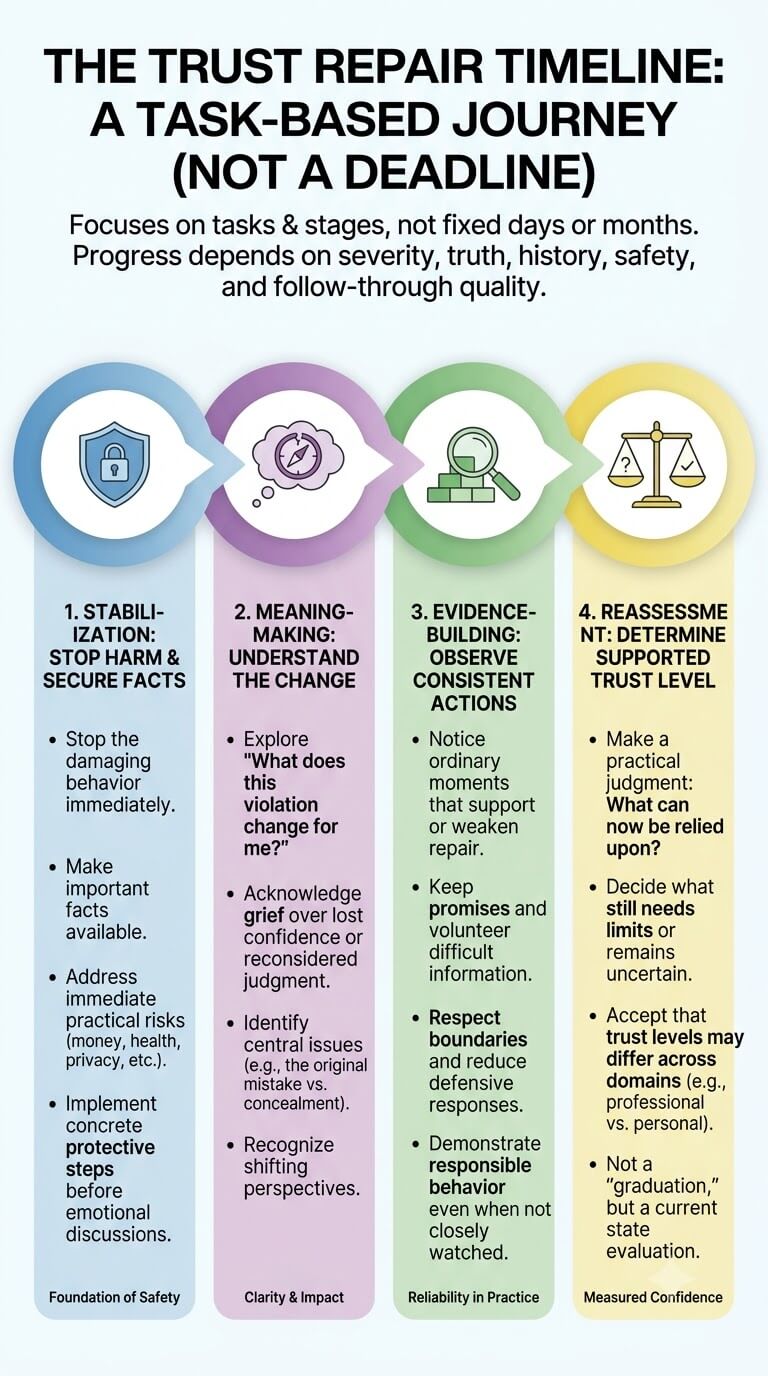
There is no universal number of days or months required to rebuild trust. The severity of the rupture, whether it was repeated, how quickly truth emerged, the relationship history, current safety, and the quality of follow-through all matter. A more useful timeline focuses on tasks rather than deadlines.
Stabilization: stop ongoing harm and secure facts
First, the behavior causing the rupture has to stop. Important facts need to become available, and immediate practical risks should be addressed. If the breach involves money, health, work, digital privacy, children, or another high-stakes area, stabilization may include concrete protective steps before emotional repair is discussed.
Meaning-making: understand what the violation changed
Next comes the question, “What does this change for me?” One person may be grieving lost confidence in the relationship. Another may be reconsidering a colleague’s judgment. Someone else may realize the central issue is not the original mistake but the months of concealment afterward.
Evidence-building: observe consistent new behavior
This phase is less dramatic. It consists of ordinary moments that either support or weaken the repair story. Promises are kept. Difficult information is volunteered. Boundaries are respected. Defensive responses become less frequent. The person behaves responsibly even when nobody is watching closely.
Reassessment: decide what level of trust is now supported
Reassessment is not a graduation ceremony. It is a practical judgment: What can I now rely on? What still needs limits? What remains uncertain? The answer may differ across domains. Emotional closeness could improve while financial trust remains restricted, or professional reliability could recover while personal closeness does not.
Signs Repair May Be Working
Repair usually becomes visible through reduced contradiction between words and behavior. One dramatic gesture matters less than a pattern that keeps making sense.
Questions receive clearer answers over time
Useful repair tends to reduce unnecessary mystery. Answers become more direct, timelines become more coherent, and new facts do not repeatedly overturn the previous story. The injured person may still have questions, but the information environment becomes less confusing.
Defensive reactions decrease and accountability remains stable
The person responsible may still feel shame, frustration, or fatigue. What matters is whether those feelings repeatedly become blame-shifting, minimization, or pressure to stop talking. Stable accountability means the basic ownership of the behavior does not disappear when the conversation becomes uncomfortable.
New behavior continues when pressure or attention fades
Early repair often happens under intense scrutiny. Later behavior is more revealing. Does the person still disclose relevant information when the crisis has cooled? Do they still honor the boundary when nobody praises them for it? Does follow-through survive an ordinary stressful week?
The injured person needs less checking because evidence is more coherent
A useful sign is not “never think about it again.” It is that less monitoring is needed to answer the same questions. Confidence grows because experiences are becoming more predictable, not because concern has been forbidden.
Signs Repair Is Stalled or Unsafe
Some situations contain the language of repair without the conditions of repair. Repeatedly asking someone to “trust again” does not create trust if the evidence continues to point in the opposite direction.
Continued deception, secrecy, retaliation, or intimidation
If new lies, hidden behavior, threats, or retaliation continue, the central problem is still active. Communication techniques cannot compensate for ongoing harm. In a coercive or frightening situation, focus on safety rather than proving commitment to the relationship.
Pressure to forgive before evidence changes
Forgiveness can be personally meaningful, but demanding it can become a way to close the discussion without doing the work. “If you loved me, you would let this go” shifts responsibility from the violation to the injured person’s reaction.
Transparency is performed briefly and then withdrawn without discussion
A short burst of openness may be sincere, but abrupt withdrawal can recreate the same uncertainty that damaged trust. If transparency needs to change, the change itself should be discussed rather than used as a test of whether the injured person is finally “over it.”
The harmed person is blamed for remembering or asking relevant questions
Repair does not require endless questioning, but reasonable questions about the breach should not be treated as proof that the injured person is the problem. The frequency and scope of discussion can be negotiated without denying why the questions exist.
Repair language is used to demand access or prevent boundaries
Statements such as “You cannot rebuild trust if you keep distance from me” can confuse repair with entitlement. The person who was harmed may need more distance, less access, financial separation, professional reporting, or another protective boundary while deciding what happens next.
Forgiveness, Reconciliation, and Trust Are Separate
These ideas are often bundled together, which creates pressure and confusion. Separating them gives the injured person more accurate choices.
| Decision | Main question | What it does not automatically mean |
|---|---|---|
| Forgiveness | What do I want to do with resentment or moral injury? | Restored access or renewed trust |
| Reconciliation | Do we both want and have enough safety to rebuild a relationship? | Returning to the old arrangement |
| Trust | What level of future reliance is supported now? | Approval of what happened |
| Contact | What level of interaction is workable? | Emotional closeness |
Forgiveness is an internal or relational choice
People define forgiveness differently, but it does not require renewed closeness. A person can forgive and still decide that restored access is not wise.
Reconciliation requires mutual participation and safety
Reconciliation requires participation, honesty, boundaries, and enough safety for choices to be freely made. A recent qualitative study of staying together after infidelity found themes including apology, rebuilding trust, support, and renegotiating boundaries. It reflects one specific romantic context, not a universal recovery path.
Trust is a current judgment about supported future reliance
You can care about someone and still decide they are not reliable in a certain area. You can also remain uncertain without making a permanent judgment about their character. Trust asks a narrower question: given what I know now, what is reasonable to rely on?
Contact can continue with limited trust and stronger boundaries
Practical obligations sometimes mean contact continues even when trust is low. In those cases, structure can matter more than closeness through written agreements, separate finances, defined responsibilities, or reduced disclosure.
A Practical Trust Repair Plan

A repair plan is most useful when it converts vague hopes into decisions that can be observed and reviewed. The following five steps keep attention on evidence rather than persuasive moments.
Define the exact trust domain that was damaged
Avoid global statements such as “I trust you” or “I do not trust you.” Name the area instead: money, confidentiality, professional competence, emotional reliability, digital privacy, or follow-through.
This reduces unnecessary global judgments and helps both people understand what evidence actually matters.
Agree on observable repair behaviors and boundaries
Define what change would look like in ordinary life. “Be honest” is vague. “Tell me before using shared savings above the agreed amount” is observable. So is telling a team early when a deadline will slip.
Set realistic review points instead of demanding instant certainty
Choose moments to reassess rather than constantly asking, “Do you trust me now?” Review after enough ordinary interactions or milestones to see whether the new pattern holds.
Evaluate patterns, not persuasive moments
Grand gestures and intense remorse can feel significant, but they should be interpreted alongside ordinary behavior. Reliable follow-through over time usually tells you more than one powerful promise.
Allow the conclusion to be rebuild, limit, pause, or end
A fair process does not predetermine the outcome. The evidence may support fuller trust, limited trust, more time, a pause, or an ending.
In romantic infidelity research, a narrative review notes that rebuilding trust can be difficult and slow in some couples, while outcomes vary widely. Love and Infidelity: Causes and Consequences is best read as context for one high-impact form of betrayal, not as a timeline for every kind of trust rupture.
Rebuilding Trust vs Nearby Topics
Trust repair becomes easier to think about when several commonly mixed concepts are separated.
Repair vs apology
An apology is one communication event. Repair is the wider process of clarifying what happened, accepting responsibility, changing behavior, respecting boundaries, and allowing time for evidence to accumulate.
Rebuilding vs forgetting
Trust does not require pretending the violation never happened. Memory can remain while the prediction of future risk changes. In fact, remembering accurately may help people keep the agreements that make future trust more realistic.
Rebuilding vs reassurance seeking
Reassurance can provide short-term comfort, but repeated reassurance cannot substitute for evidence. If the same question returns every hour despite consistent behavior, the next useful step may be helping the nervous system settle, clarifying what information is genuinely missing, or getting professional support for persistent distress.
Rebuilding vs returning to an unsafe dynamic
Repair requires free choice. If someone is using threats, stalking, financial control, humiliation, intimidation, violence, or retaliation, the goal should not be to become more trusting of that environment. The National Domestic Violence Hotline safety planning resources emphasize individualized safety when abuse or fear is present.
When Professional or Safety Support May Help
Some trust ruptures are manageable through direct conversation and behavioral change. Others create distress, conflict, or risk that is difficult to navigate alone. Support can be useful without implying that either person has a diagnosis.
Repeated betrayal, severe distress, trauma symptoms, or high-conflict cycles
Consider individual professional support if you are struggling with persistent sleep disruption, intrusive memories, intense fear, inability to function normally, or repeated cycles that you cannot interrupt. Couples or family work may be useful in some situations when both people can participate freely and safely.
Coercion, threats, stalking, financial control, humiliation, or retaliation
These behaviors change the decision. The priority is not better communication or faster forgiveness. It is reducing risk, preserving autonomy, documenting what is needed, and connecting with appropriate support. If you fear retaliation for setting a boundary, treat that fear as important information.
Why joint repair work is not appropriate when safety and free consent are absent
Joint conversations assume both people are free to disagree, leave, pause, and set limits. When one person controls the consequences of disagreement, that assumption is missing. Private, specialized support is often a safer starting point than asking the harmed person to disclose more in front of someone they fear.
For ordinary relationship repair where safety is present, practical guidance from The Gottman Institute on trust and betrayal also emphasizes responsibility, emotional attunement, and repeated trustworthy behavior. It is best used as practical relationship guidance rather than as proof that every damaged relationship should be preserved.
Frequently Asked Questions About Rebuilding Trust
The most common questions usually involve time, transparency, repeated violations, and how much trust has to return. None has a universal answer, but each can be made more concrete.
How long does it take to rebuild trust?
There is no standard timeline. A clearly acknowledged breach followed by immediate correction may be easier to update than years of deception. Look for stable phases instead: the harmful behavior stops, facts become clearer, accountability remains, new behavior persists, and reassessment happens without pressure.
Can trust return after repeated lying?
It can improve, but repeated lying raises the evidence threshold because new promises compete with a longer history. Ask whether the conditions supporting the lying have changed and whether honesty continues when truth is inconvenient. Ongoing deception means repair has not yet reached reliable evidence-building.
Is transparency required to rebuild trust?
Relevant transparency can help after secrecy, but total access is not a universal requirement. It should match the breach, be freely agreed, serve a clear purpose, and be reviewed over time. Permanent surveillance can create compliance without genuine confidence.
What if the apology seems sincere but behavior has not changed?
You can accept a sincere apology while withholding trust. Sincerity speaks to current emotion or intention; trust asks what is likely to happen next. If behavior has not changed, it is reasonable to wait for more evidence.
Can I rebuild some trust without fully reconciling?
Yes. Trust can be domain-specific and partial. You might trust a coworker to meet deadlines without restoring personal closeness, or trust a family member in one area while keeping other limits. Reconciliation and trust are separate decisions.
Key Takeaways
- Rebuilding trust means creating enough new evidence to support a revised prediction about future reliability, not pretending the rupture never happened.
- Acknowledgment, truthful information, accountability, behavior change, boundaries, and time are more informative together than any single apology or promise.
- Transparency should address the actual breach and remain freely agreed. Permanent surveillance is not the same as trust.
- Forgiveness, reconciliation, contact, and restored trust are separate decisions. One does not automatically require the others.
- Repair is more credible when new behavior continues after pressure, attention, and emotional intensity have faded.
- If coercion, threats, stalking, humiliation, financial control, violence, or retaliation are present, safety takes priority over joint repair.

Michael Reed is the Founder and Lead Writer at Psychology Exposed. He writes about human behavior, relationships, emotional patterns, self-awareness, and practical psychology topics using research-informed, easy-to-understand content.
Read More About Michael Reed: https://psychologyexposed.com/michael-reed/