

Trust rarely disappears because of one vague feeling. It usually changes when new evidence no longer matches what you thought you could rely on. A promise is not kept. Important information is hidden. A boundary is crossed. A person behaves one way in private and another in public. Or a concern is raised, only to be met with denial, blame, or another broken commitment.
That does not mean every mistake destroys trust. People forget, miscommunicate, make poor judgments, and sometimes disappoint each other without becoming fundamentally unsafe or unreliable. What matters is the combination of impact, repetition, concealment, context, and what happens after the problem is known.
Understanding why trust breaks helps you move beyond the question, “Do I trust them or not?” A more useful question is, “What changed in the evidence I was using to rely on this person, group, or institution?”
Quick Answer

Trust breaks when new experiences make someone or something seem less reliable, honest, safe, competent, or accountable than expected. A single serious violation can change trust quickly, while smaller inconsistencies can erode it over time. The response after harm also matters. Acknowledgment and changed behavior may limit further damage, while concealment, defensiveness, or repeated violations often deepen uncertainty.
Trust Usually Breaks Through an Evidence Mismatch
Trust involves accepting some uncertainty because you expect another person or system to behave within a range you consider dependable. A large meta-analysis of human trust research found that trust is shaped by many interacting factors, including reputation, relationship closeness, context, and perceptions of trustworthiness. That helps explain why the same behavior can carry different weight in different relationships. A broad meta-analysis of human trust describes trust as a judgment influenced by both the person being trusted and the surrounding context.
What was expected
Trust begins with an expectation, even when that expectation was never spoken aloud. You may expect a friend to keep private information private, a coworker to complete agreed work, a partner to be truthful about decisions that affect you, or an institution to apply its rules consistently.
When trust is damaged, identifying the violated expectation is often more useful than starting with a label such as “untrustworthy.” The specific expectation tells you what kind of reliability was lost.
What actually happened
The event itself matters. Missing one appointment after a family emergency is different from repeatedly disappearing without explanation. An accidental disclosure is different from sharing private information for status or revenge. A mistaken statement is different from knowingly presenting false information.
This is where impact and intent should be separated. Harm can be real even without bad intent, but intent can still influence what the event predicts about future risk.
A trust rupture is one stage within the broader psychology of trust, which also includes formation, calibration, vulnerability, and possible repair.
How the event was explained
Explanations help people update their expectations. A clear explanation can reduce uncertainty when it is specific, plausible, and consistent with the facts. A changing story does the opposite. It creates a second question: not only “Why did this happen?” but also “Can I trust the explanation?”
Research on honesty and later trust behavior supports the broader idea that honesty becomes part of how people form future expectations. In one experimental study, honesty-related information predicted later trust decisions. That does not mean one brain study can explain every real relationship, but it fits the everyday observation that truthfulness changes what people are willing to risk next.
What happened after the concern was raised
The response after a rupture is new evidence too. Someone may acknowledge what happened, answer reasonable questions, repair practical damage, and change the behavior that caused the problem. Or they may minimize the impact, attack the person who raised it, offer a vague apology, and repeat the same behavior.
Trust is therefore shaped by two events: the original violation and the response to it.
Seven Common Pathways That Break Trust
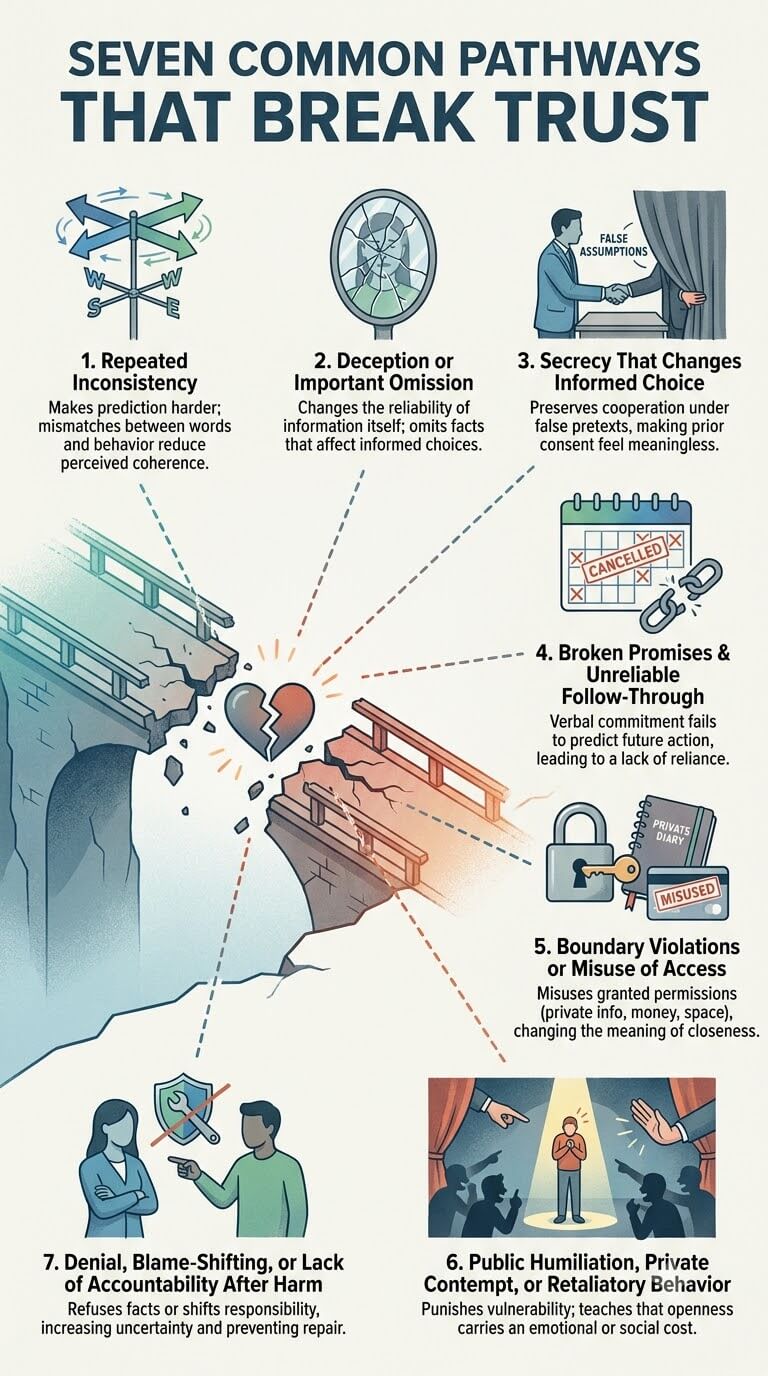
Different trust problems can feel similar emotionally, but the mechanism matters. The following pathways often reduce willingness to rely on someone.
Repeated inconsistency
Inconsistency makes prediction harder. If someone is supportive one week and contemptuous the next, follows through only when watched, or changes their standards depending on who benefits, the relationship becomes harder to navigate.
Experimental work has found that a sense of consistency can contribute to trust judgments. Research on subjective consistency and trust suggests that perceived fit and coherence can influence how trustworthy a person seems. In everyday life, repeated mismatches between words and behavior can have the opposite effect.
Deception or important omission
Direct lies can break trust because they change the reliability of information itself. Important omissions can do something similar when the missing information would reasonably have affected another person’s decision.
Not every unshared detail is deception. People are allowed privacy. The key question is whether the omitted fact changed another person’s ability to make an informed choice about something that affected them.
Secrecy that changes informed choice
Secrecy becomes especially damaging when it is used to preserve someone else’s cooperation under false assumptions. For example, hiding a financial risk from a business partner, concealing a major decision from a spouse who is materially affected by it, or withholding a known conflict of interest can make prior consent feel less meaningful.
The distress often comes from both the hidden fact and the realization that the decision environment was incomplete.
Broken promises and unreliable follow-through
A promise creates a future expectation. When promises are repeatedly broken, people learn that verbal commitment is not strong evidence of future behavior.
Small promises can matter because they serve as repeated samples. “I will call tonight,” “I will send it by Friday,” or “I will not share that” may look minor in isolation. When the same type of failure keeps occurring, the issue becomes less about one promise and more about whether commitment predicts action.
Boundary violations or misuse of access
Trust often includes permission: access to private information, money, physical space, accounts, responsibilities, emotions, or reputation. Misusing that access can change the meaning of closeness itself.
A boundary violation may be accidental, careless, entitled, or deliberate. The practical next step depends partly on which it is and whether the person respects the boundary once it is made clear.
Public humiliation, private contempt, or retaliatory behavior
Trust weakens when vulnerability is punished. Mocking someone publicly, using private disclosures against them, humiliating them during conflict, or retaliating after they raise a concern teaches a simple lesson: openness may carry a cost.
This can reduce emotional trust even if other forms of trust remain. You might still rely on a colleague’s technical skill while no longer trusting them with personal information.
Denial, blame-shifting, or lack of accountability after harm
The original event is often only part of the damage. When a person refuses obvious facts, makes the injured person responsible for the violation, or focuses entirely on defending intent, uncertainty increases.
Accountability does not require endless self-condemnation. It means accurately naming what happened, understanding the impact, taking reasonable responsibility, and showing what will be different next time.
One Major Rupture vs Repeated Small Violations

Trust can fall sharply after one consequential event, or decline gradually as smaller violations accumulate. The pattern of damage changes what deserves attention next.
High-impact events can rapidly change the meaning of the relationship
Some events carry enough weight that trust changes immediately. Examples include major financial deception, exposing highly private information, serious professional misconduct, a major concealed conflict of interest, or a deliberate act that places someone at substantial risk.
The reason is not simply that the event was upsetting. It may reveal information about values, judgment, honesty, or willingness to protect the other person that was previously unknown.
Small repeated incidents accumulate into a pattern
Other trust problems are cumulative. A person is ten minutes late once, then an hour late repeatedly. A manager gives one unclear instruction, then continually changes expectations and denies doing so. A family member occasionally forgets a request, then repeatedly ignores the same stated boundary.
No single moment seems large enough to “justify” the level of mistrust. Yet repeated experiences can create a stable prediction: “I cannot count on this changing.”
Both severity and repetition matter
| Pattern | What may matter most | Useful question |
|---|---|---|
| One low-impact mistake | Context and response afterward | Was this an exception or the start of a pattern? |
| Repeated small violations | Accumulation and predictability | What does the repetition now predict? |
| One serious rupture | Severity, concealment, and consequences | What new information did this reveal? |
| Serious rupture plus denial | Original harm plus failed accountability | Has the response increased uncertainty? |
Why Secrecy Damages Trust Even Before Every Fact Is Known
Secrecy creates a second problem beyond the hidden fact itself: uncertainty about whether earlier choices were made with enough information.
Hidden information removes informed choice
When someone discovers that relevant information was intentionally withheld, they may revisit earlier decisions. “Would I have agreed if I had known?” becomes central. This is why secrecy can feel different from ordinary privacy.
The concern is not a right to know everything. It is whether another person controlled a shared decision by controlling access to facts that materially affected it.
Discovery creates uncertainty about what else is missing
A hidden fact creates an information problem. If one important detail was concealed, the mind naturally asks whether other details are missing too. That uncertainty can increase checking, questioning, and reluctance to rely on reassurance alone.
This reaction can be temporary, or it can become entrenched if new contradictions continue appearing.
Privacy and secrecy are not identical
Privacy protects a person’s legitimate personal space. Secrecy, in the trust-breaking sense, hides information that another person reasonably needed for a shared choice, safety decision, agreement, or responsibility.
For example, keeping a private journal is not the same as concealing debt that affects shared finances. Not disclosing every conversation with a friend is different from hiding a professional conflict of interest while asking someone to rely on your recommendation.
Why the Response After Harm Matters
What happens after a violation helps people estimate whether the same risk is likely to continue, change, or become harder to understand.
Honest acknowledgment can limit further uncertainty
A clear acknowledgment gives the other person something stable to work with. It reduces the need to argue about whether the event happened and allows attention to shift toward impact, repair, and future expectations.
Acknowledgment alone does not restore trust, but it can prevent the rupture from expanding into a dispute about reality.
Defensive explanations can deepen the rupture
Defensiveness is understandable when someone feels ashamed, accused, or afraid of consequences. But explanations that erase impact can make the other person feel they now need to prove both the event and their reaction to it.
Compare “I was stressed, so it should not matter” with “I was stressed, but I still broke the agreement. I understand why that changed how reliable I seem.” The second statement does not guarantee repair, but it deals with the actual trust problem.
Apologies without changed behavior create a second mismatch
An apology creates another expectation: that the person understands what went wrong and intends to respond differently. If the same violation repeats, the apology itself may lose credibility.
Experimental research has found that apologies can improve trust under some conditions by affecting perceived trustworthiness and emotional responses. A study of apologies after trust violations also found that the effect was not automatic. Real-life trust is more complex, which is why behavior after the apology matters so much.
Accountability provides evidence about future risk
Useful accountability is observable. It may include correcting a false statement, returning money, changing access permissions, documenting a work process, respecting a newly stated boundary, or voluntarily providing information that was previously concealed.
The point is not punishment. The point is whether future risk is becoming more understandable and manageable.
How Broken Trust Changes Behavior

Reduced trust often shows up behaviorally before anyone has a perfect explanation for it. People change how much they verify, disclose, and depend.
More checking and less spontaneous cooperation
People often compensate for reduced trust by verifying more. A manager checks every deliverable. A partner asks more questions about a decision. A customer seeks written confirmation. A family member stops assuming a promise will happen.
Checking is not always evidence of irrational suspicion. Sometimes it is a practical response to a changed track record.
Reduced disclosure and dependence
If private information was mishandled, someone may share less. If practical commitments were unreliable, they may build backup plans. If financial agreements were broken, they may separate accounts or require documentation.
This is trust becoming more domain-specific. The person is changing how much vulnerability they are willing to accept in the area where evidence changed.
Increased sensitivity to inconsistency
After a rupture, small discrepancies may receive more attention than before. A changed detail, late response, or vague explanation can feel more significant because the person no longer gives ambiguity the same benefit of the doubt.
This can be adaptive for a period, but constant monitoring can also become exhausting. The long-term question is whether new evidence eventually becomes clear enough to reduce the need for vigilance.
Reinterpretation of earlier events and memories
New information can change the meaning of old events. A past excuse may suddenly look less convincing. A previously harmless inconsistency may seem connected to a larger pattern.
That reinterpretation is understandable, but certainty should still match evidence. New information can justify reviewing the past without proving that every ambiguous event had the same hidden cause.
Trust Breaks Differently Across Domains
Trust is not one single capacity. A rupture may affect emotional openness, confidentiality, practical reliability, money, professional judgment, or information credibility.
Emotional trust
Emotional trust involves believing that vulnerability will not be mocked, weaponized, or dismissed. It can break when private feelings are used during arguments, confidences are shared without permission, or emotional needs are repeatedly treated with contempt.
Confidentiality and privacy trust
This domain concerns who has access to information and how they use it. A person may remain friendly with someone while no longer trusting them with sensitive details.
Practical reliability
Practical trust concerns follow-through: arriving, completing work, handling responsibilities, keeping agreements, and communicating when plans change. The damage may be less emotionally dramatic but highly consequential.
Financial or professional trust
Money and work introduce measurable stakes. Hidden expenses, inaccurate reporting, misused access, undisclosed conflicts, or repeated missed responsibilities can quickly change the amount of oversight another person needs.
Trust in information, authority, or institutions
Trust can also decline when an organization, leader, or information provider appears inconsistent, misleading, opaque, or unwilling to correct errors. Here the question is not personal closeness. It is whether decisions, statements, and procedures remain dependable enough to justify reliance.
A Trust Breakdown Assessment

When emotions are high, a structured assessment can make the problem more specific.
What expectation was violated?
Name the domain: honesty, confidentiality, follow-through, fairness, money, competence, emotional safety, or something else. “I cannot trust anything” may be how the situation feels, but a narrower description usually leads to clearer decisions.
Was the event accidental, avoidable, concealed, or repeated?
These categories are not mutually exclusive. A mistake can be accidental but handled carelessly afterward. A preventable problem can be admitted quickly. A small violation can become serious through repetition and concealment.
What was the impact and what remains uncertain?
Separate what has already happened from what you fear might happen. For example: money was lost, private information was shared, a deadline was missed, or an agreement was broken. Then list what you still do not know.
This prevents uncertainty from quietly expanding until every possible concern feels equally certain.
Has accountability produced measurable change?
Look for behavior rather than intensity. Has the person corrected the practical problem? Have they stopped the behavior? Are agreements clearer? Are they answering relevant questions consistently? Are they respecting limits without demanding immediate forgiveness?
Is continued contact or dependence currently safe and necessary?
Trust decisions are constrained by reality. You may need to work with someone you no longer trust personally, coparent with firm boundaries, pause a financial arrangement, or reduce access while gathering facts.
The choice is not always “fully trust” or “cut off completely.” Sometimes the next step is narrower reliance with clearer safeguards.
What to Do First After Trust Is Damaged
The first response should reduce immediate exposure and improve clarity. It does not require deciding the entire future of the relationship at once.
Stabilize immediate safety, money, privacy, or work consequences
Deal with concrete exposure first. Change passwords if access was misused. Notify the relevant person if private or financial information may be compromised. Document a professional decision if accountability matters. Seek appropriate legal, financial, workplace, or safety assistance when the stakes exceed what an informal conversation can solve.
Separate known facts from feared possibilities
Create two mental columns. One is what you know. The other is what you suspect, fear, or still need to clarify. This protects you from two errors: minimizing a real problem and treating every possibility as established fact.
Name the specific trust domain that changed
“I still trust your intentions, but I do not currently trust your follow-through on money” is more actionable than “I trust you” or “I do not trust you.” Domain-specific language also makes it easier to decide what evidence would matter next.
Delay irreversible decisions when emotionally flooded unless safety requires action
Strong emotion can narrow attention. When there is no urgent risk, giving yourself enough time to understand the facts may improve decision quality. That does not require pretending the rupture is small.
If there are threats, stalking, coercion, retaliation, or immediate safety concerns, waiting for emotional calm before taking protective action may not be appropriate.
Why Trust Breaks vs Nearby Topics
Several experiences can involve mistrust without describing the same psychological problem. Keeping them separate makes the next question easier to identify.
Trust breaking vs struggling to trust
Struggling to trust concerns difficulty relying on others before or while trust is developing. Broken trust begins with an established expectation that was weakened by new evidence.
A current trust rupture should also be separated from a broader pattern in which someone struggles to trust others across many situations.
Trust breaking vs betrayal impact
A trust rupture describes what changed in reliability, honesty, safety, or accountability. Betrayal focuses more on the psychological impact of discovering that someone important acted against expectations, loyalties, or shared meaning.
Trust breaking vs rebuilding trust
Understanding the breakdown identifies the damaged domain and the evidence that changed. Rebuilding is a later question: whether enough new, repeated evidence can make reliance reasonable again.
Once the source of the rupture is clearer, rebuilding trust becomes a separate question about whether new behavior can support reliance again.
Broken trust vs ordinary conflict or disappointment
Not every argument or unmet preference is a trust rupture. You can strongly disagree with someone and still believe they are honest, reliable, and respectful of your boundaries.
Trust becomes the central issue when the event changes what you believe you can safely or reasonably rely on.
When Safety Comes Before Repair
Ordinary disappointment and unsafe control are not interchangeable. When fear or retaliation shapes what you can safely say or do, protection takes priority.
Coercion, threats, stalking, retaliation, financial control, humiliation, or repeated boundary violations
Some behaviors are not simply communication problems. Patterns involving fear, coercion, stalking, intimidation, financial control, retaliation, or deliberate isolation require a different lens. The National Domestic Violence Hotline describes emotional and financial abuse in terms of behaviors used to control, isolate, or frighten a partner, and it treats stalking as a safety issue rather than a relationship misunderstanding.
If those dynamics are present, the goal does not need to be restoring trust. Protecting access to money, devices, documents, transportation, housing, supportive people, and professional help may matter more.
Why confrontation or transparency requests may be unsafe in controlling situations
A direct confrontation is not automatically the safest next step. In stalking or controlling situations, attempts to block access, leave, or challenge the person can sometimes increase retaliation. The National Domestic Violence Hotline’s stalking safety guidance emphasizes individualized safety planning and notes that responses should consider the possibility of escalation.
If you feel afraid of what someone may do when challenged, consider confidential support from an appropriate local service or trusted professional rather than relying only on communication advice.
Frequently Asked Questions About Why Trust Breaks
These questions address common gray areas, especially where intent, privacy, repetition, and temporary anger can make the situation difficult to interpret.
Can one lie destroy trust?
Yes, one lie can significantly damage trust when the stakes are high, the lie changes an important decision, or it reveals a major mismatch in values or safety. But not every lie has the same meaning. Context, motive, consequences, concealment, and the response afterward all affect what the event predicts about future reliability.
Why do small broken promises matter?
Small promises become evidence through repetition. One forgotten task may say little. Repeated commitments followed by repeated nonperformance can teach the other person that verbal promises do not reliably predict action. Over time, they may stop planning around those promises.
Is keeping something private the same as secrecy?
No. Privacy is a legitimate boundary around personal information. Secrecy becomes a trust issue when relevant information is intentionally withheld in a way that changes another person’s informed choice, safety, shared responsibility, or agreement. The distinction depends on context, not on whether every detail was disclosed.
Can trust break even when there was no bad intention?
Yes. Intent and impact are different. A careless mistake, poor judgment, or avoidable failure can reduce trust even without malicious intent, especially when the consequences are serious. Good intent may influence how repair is approached, but it does not erase what the event revealed about reliability or judgment.
How do I know whether trust is damaged or I am temporarily upset?
Ask whether your willingness to rely on the person has changed after the emotion settles. Are you now checking more, sharing less, creating backup plans, or avoiding dependence in a specific area? If so, the issue may involve trust rather than only temporary anger. The next question is what evidence caused that change and whether new behavior is addressing it.
Key Takeaways
- Trust usually breaks when new evidence no longer matches an established expectation of reliability, honesty, safety, competence, or accountability.
- A single severe rupture can change trust quickly, while smaller inconsistencies can accumulate into a stable pattern.
- Secrecy is especially damaging when hidden information prevents someone from making an informed shared decision.
- The response after harm becomes new evidence. Clear acknowledgment and changed behavior differ from denial, blame-shifting, or repeated violations.
- Broken trust is often domain-specific. You may still trust someone in one area while reducing reliance in another.
- When fear, coercion, stalking, retaliation, or controlling behavior is present, safety planning matters more than trying to force a repair conversation.
Final Thoughts
When trust breaks, the most useful first step is not deciding whether another person is permanently trustworthy or untrustworthy. Identify the exact expectation that changed, the evidence that changed it, and the area of reliance that now feels different.
Then watch what happens next. Does uncertainty become clearer? Does accountability produce observable change? Or does the response create another mismatch? Trust is not restored by pressure to “move on,” and it is not always lost forever after one mistake. It becomes more or less reasonable as the evidence changes.

Michael Reed is the Founder and Lead Writer at Psychology Exposed. He writes about human behavior, relationships, emotional patterns, self-awareness, and practical psychology topics using research-informed, easy-to-understand content.
Read More About Michael Reed: https://psychologyexposed.com/michael-reed/