

Wanting closeness and finding it hard to trust can exist at the same time. You may like someone, respect them, and still feel pulled to check their story, hold back personal information, prepare for disappointment, or wait for certainty that never quite arrives. That tension does not automatically mean you are irrational, and it does not prove the other person is trustworthy either. It often means your mind is trying to predict what will happen if you rely on someone.
Trust becomes difficult when earlier experiences, current uncertainty, and protective habits all point in the same direction: dependence feels costly. The useful question is not simply, “Why am I like this?” A better question is, “What evidence is my mind using, what is happening now, and is my response helping me learn anything new?” That shift makes room for caution without turning caution into a permanent conclusion.
Quick Answer
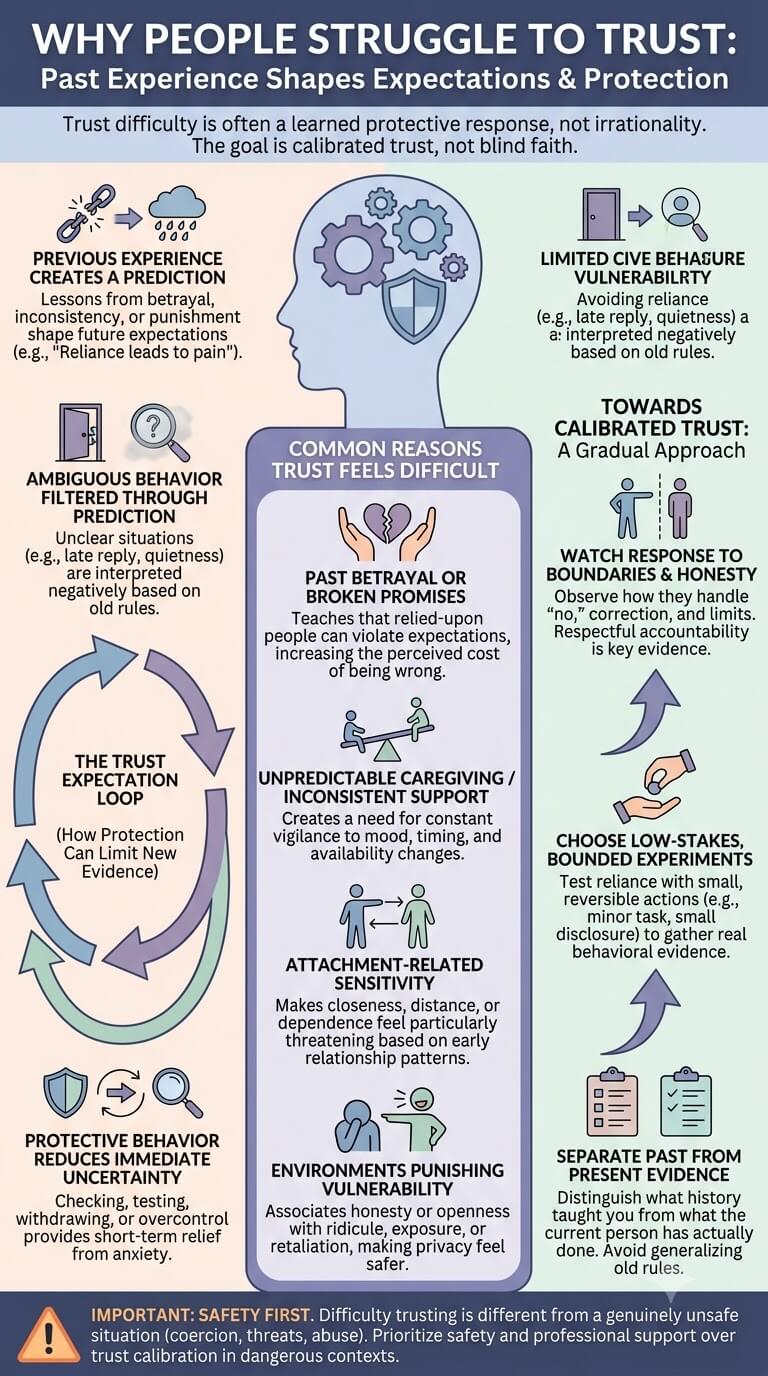
People may struggle to trust others when past experiences teach them that reliance can lead to disappointment, exposure, loss of control, or betrayal. Those expectations can shape how ambiguous behavior is interpreted. Trust usually becomes easier through specific, repeated evidence, not pressure to “just trust.” The aim is calibrated trust: staying responsive to real warning signs while allowing trustworthy behavior to update old predictions.
Difficulty Trusting Is Often Protective
A reluctance to trust often makes more sense when viewed as protection rather than stubbornness. If relying on people has repeatedly produced pain, unpredictability, embarrassment, or abandonment, caution may have reduced risk at one point. The problem comes when the protective rule becomes broader than the evidence that created it.
Protection can remain active after the original threat has passed
Human learning is built to carry information forward. If someone important was unpredictable, your mind may learn that uncertainty deserves close attention. Research on attachment describes how repeated caregiving experiences can contribute to expectations about whether others will be available and responsive. A broad review of attachment theory and research discusses these expectation-based “working models” and how earlier relationships may shape later social functioning.
That does not mean childhood determines adulthood. It means old predictions can stay influential until enough relevant experience challenges them. A person may leave an unreliable environment yet continue to behave as if closeness always requires vigilance. The reaction may feel automatic because the mind is trying to avoid an error it already learned was expensive.
The goal is not to remove caution but to improve calibration
Trust is not the opposite of caution. Mature trust includes discrimination: who is reliable, about what, under which conditions, and with what level of access? Someone can be excellent with practical commitments and poor with confidential information. Another person may be emotionally warm but inconsistent with deadlines. Calibration means matching trust to evidence and stakes instead of using one global rule for everyone.
Difficulty relying on others is one part of the broader psychology of trust, which also includes present evidence, uncertainty, vulnerability, and changing expectations.
A trust difficulty is not proof that the current person is safe or unsafe
Strong feelings provide information about your internal state, not a complete verdict on someone else. Feeling uneasy may reflect a real pattern, an old expectation, a mismatch in communication, or several of these at once. Treating the feeling as meaningless can be unsafe. Treating it as unquestionable proof can also prevent you from evaluating what is actually happening.
The Trust Expectation Loop
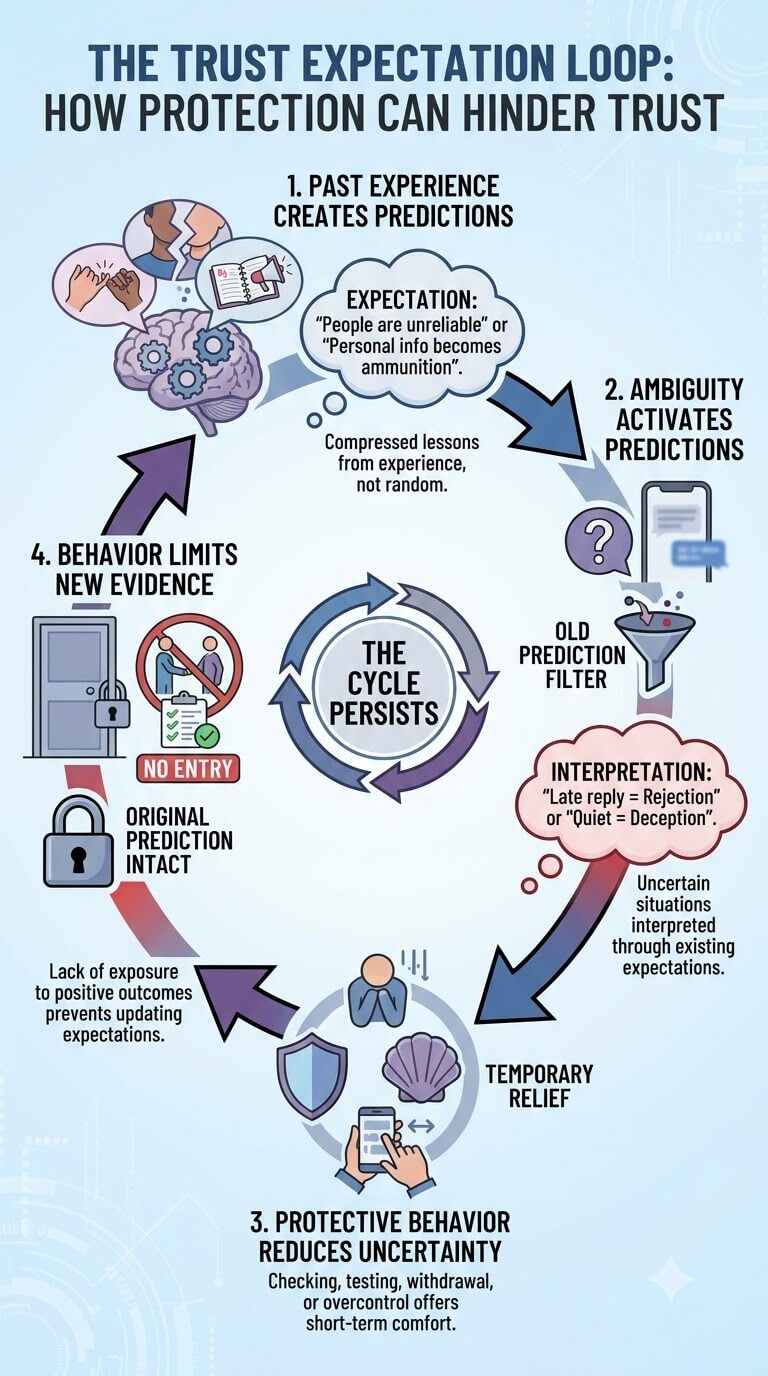
One reason trust struggles persist is that protection can reduce the very evidence needed to update expectations. The cycle often looks like this: a previous experience creates a prediction, ambiguity activates the prediction, protective behavior lowers immediate uncertainty, and reduced exposure to new evidence leaves the original prediction mostly intact.
Previous experience creates a prediction
Suppose several people promised help and failed to show up. “People do not follow through” may become a practical expectation. Or perhaps a private disclosure was later used during an argument. “Personal information becomes ammunition” may begin to feel safer than “some people handle vulnerability respectfully.” Predictions like these are not random. They are compressed lessons from experience.
Experimental work on trust development supports the idea that trust can emerge through learning about whether support is actually effective. In one set of studies, trust developed as an expectancy-learning process as participants learned whether help from a caregiver-like figure led to useful outcomes. Real relationships are more complex, but the core point is useful: expectations change through experience.
Ambiguous behavior is filtered through that prediction
Many social situations do not come with clear explanations. A friend replies late. A partner seems quieter. A coworker changes a meeting time. If your current expectation is “distance means rejection” or “changes mean deception,” ambiguity is more likely to be interpreted in that direction. The interpretation can arrive before you consciously compare alternatives.
Checking, testing, withdrawal, or overcontrol reduces immediate uncertainty
Protective behaviors often work in the short term. Rechecking a message may briefly reduce doubt. Asking the same reassurance question in several ways may produce temporary relief. Withholding may reduce the risk of being exposed. Pulling away after a close moment can restore a sense of control.
The behavior can limit new evidence and keep the prediction unchanged
If you never rely on someone even in a small, reversible way, you cannot observe how they handle that reliance. If every reassurance is followed by another check, reassurance may never become evidence that feels settled. If you withdraw without explaining what felt uncertain, the other person may respond to the withdrawal rather than to the original concern, creating even more ambiguity.
Common Reasons Trust Feels Difficult
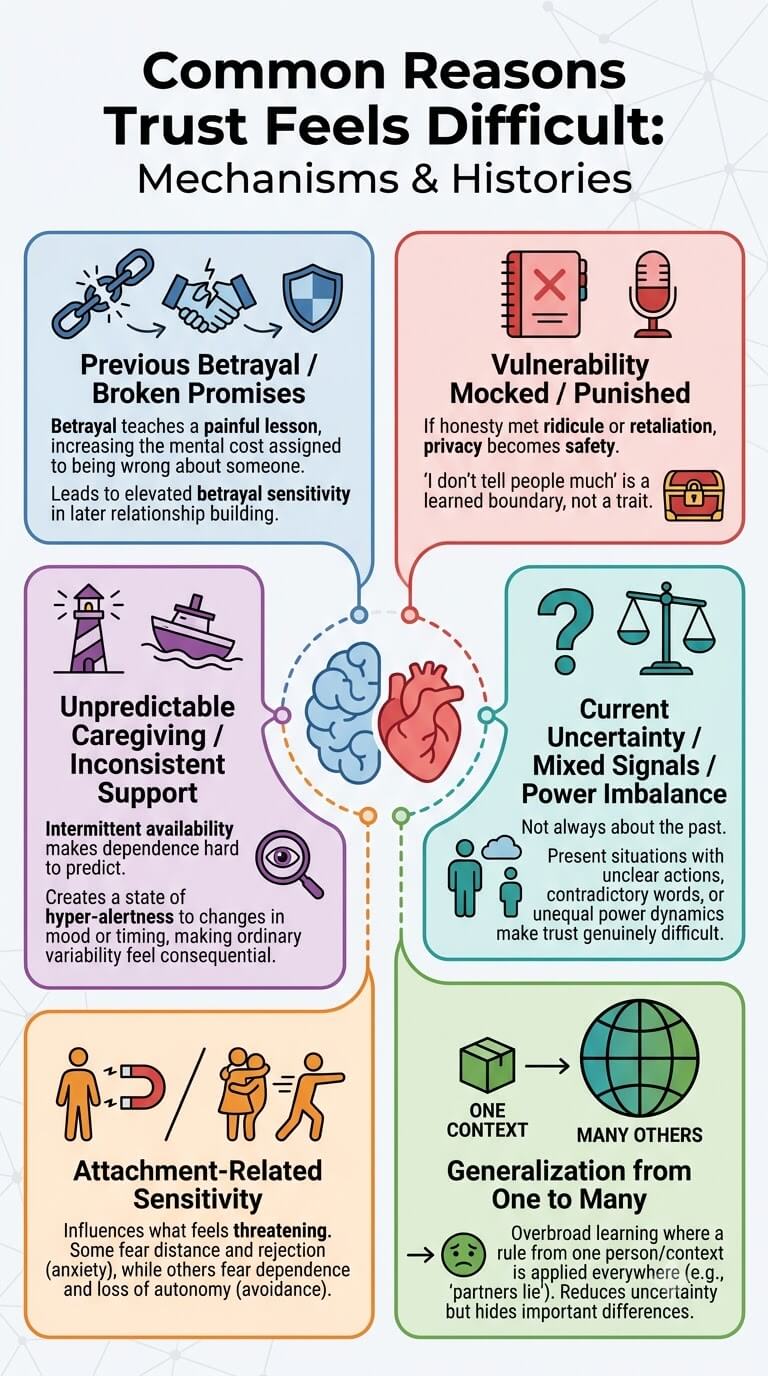
There is rarely one universal cause. Several histories and current conditions can produce similar outward behavior, which is why it is useful to understand the mechanism rather than attach a label too quickly.
Previous betrayal or repeated broken promises
Betrayal teaches a particularly painful lesson because the person being relied on is also the person who violates the expectation. Afterward, the mind may increase the cost assigned to being wrong about someone. A recent study of women who had survived intimate partner violence found elevated betrayal sensitivity compared with a comparison group, although its specific sample and cross-sectional design mean the findings should not be generalized to everyone who struggles with trust. The research is still useful for illustrating how betrayal sensitivity can remain relevant in later relationship building.
Unpredictable caregiving or inconsistent support
If support was available sometimes but not others, dependence may become difficult to predict. The person may learn to stay alert to changes in mood, timing, or availability because those details once mattered. Later, even ordinary variability can feel more consequential than it does to someone with a history of steadier support.
Attachment-related sensitivity to closeness, distance, or dependence
Attachment patterns can influence what feels threatening in close relationships. Some people become especially alert to distance and signs of rejection. Others may feel more threatened by dependence, loss of autonomy, or emotional exposure. These tendencies can make trust harder in different ways.
Environments where vulnerability was mocked, exposed, or punished
If honesty was met with ridicule, gossip, retaliation, or public embarrassment, privacy may become strongly associated with safety. In that context, “I do not tell people much” can be a learned boundary rather than a personality trait. The same can happen in families, schools, workplaces, friendships, or online communities.
Current uncertainty, mixed signals, or real power imbalance
Not every trust problem belongs to the past. Sometimes the present situation is genuinely unclear. Someone may say one thing and do another. A manager may control access to opportunities. A partner may demand transparency while protecting their own privacy. A friend may repeatedly change stories.
Generalization from one person or context to many others
Learning becomes overbroad when a rule created in one context is applied everywhere. “My former partner lied” can gradually become “partners lie.” “My family shared my private information” can become “nobody keeps confidence.” Generalization is understandable because it reduces uncertainty, but it may also hide important differences between people.
How Trust Struggles Can Show Up
Difficulty trusting does not always look like obvious suspicion. It can appear as perfectionistic standards for certainty, indirect tests, emotional distance, or attempts to control information. The behavior often makes more sense when you ask what risk it is trying to prevent.
| What it may look like | What it may be trying to prevent | A more informative next step |
|---|---|---|
| Waiting until you feel completely certain | Being wrong about someone | Define what evidence would be enough for one low-stakes decision |
| Repeated reassurance seeking | Surprise, rejection, or hidden change | Ask one specific question, then observe follow-through |
| Indirect loyalty tests | Feeling foolish for trusting | Make the need direct instead of creating a secret test |
| Withholding while expecting the other person to know | Exposure or rejection after asking | Share a bounded need that does not require total disclosure |
| Pulling away after closeness | Dependence becoming too risky | Slow the pace without disappearing |
| Treating a small inconsistency as a global verdict | Missing an early warning sign | Check whether the inconsistency repeats and whether accountability follows |
Delaying reliance until certainty is impossible
No relationship provides complete certainty. If the threshold for trust is “I must know this person will never disappoint me,” the threshold can never be reached. A better threshold is proportional: what do I know, how costly would an error be, and what level of reliance fits that evidence?
Repeated reassurance seeking or checking
Checking can include rereading messages, asking several people for interpretations, monitoring online activity, or repeatedly asking whether something is wrong. One check may provide useful information. A cycle of checking may instead teach the mind that uncertainty is intolerable unless another check is performed.
Indirect loyalty tests
A loyalty test creates a situation where the other person is expected to prove something without knowing the real question. Examples include withholding contact to see who reaches out first or presenting false information to see whether it is repeated. These tests often generate confusing evidence because the person is responding to the setup, not to a transparent request.
Withholding important information while expecting mind-reading
Sometimes the fear of asking directly leads to silence, while the need remains strong. “If they cared, they would know” protects against the vulnerability of making a request, but it also makes accurate response less likely. A small direct request usually produces more useful evidence than an unspoken test.
Pulling away after moments of closeness
A good conversation, increased intimacy, or receiving help can unexpectedly raise the stakes. Once another person matters more, there is more to lose. Pulling back may restore a sense of independence, even when nothing bad has happened. Slowing down can be reasonable; disappearing solely to reduce vulnerability may prevent you from learning whether the connection can tolerate honest pacing.
Reading small inconsistencies as proof of a global pattern
Reliability matters, but people also make ordinary mistakes. The useful distinction is between an error followed by ownership and repair, versus repeated inconsistency accompanied by denial, excuses, or shifting stories. A single late reply and a chronic pattern of secrecy should not receive the same weight.
Reasonable Caution vs a Self-Reinforcing Trust Struggle
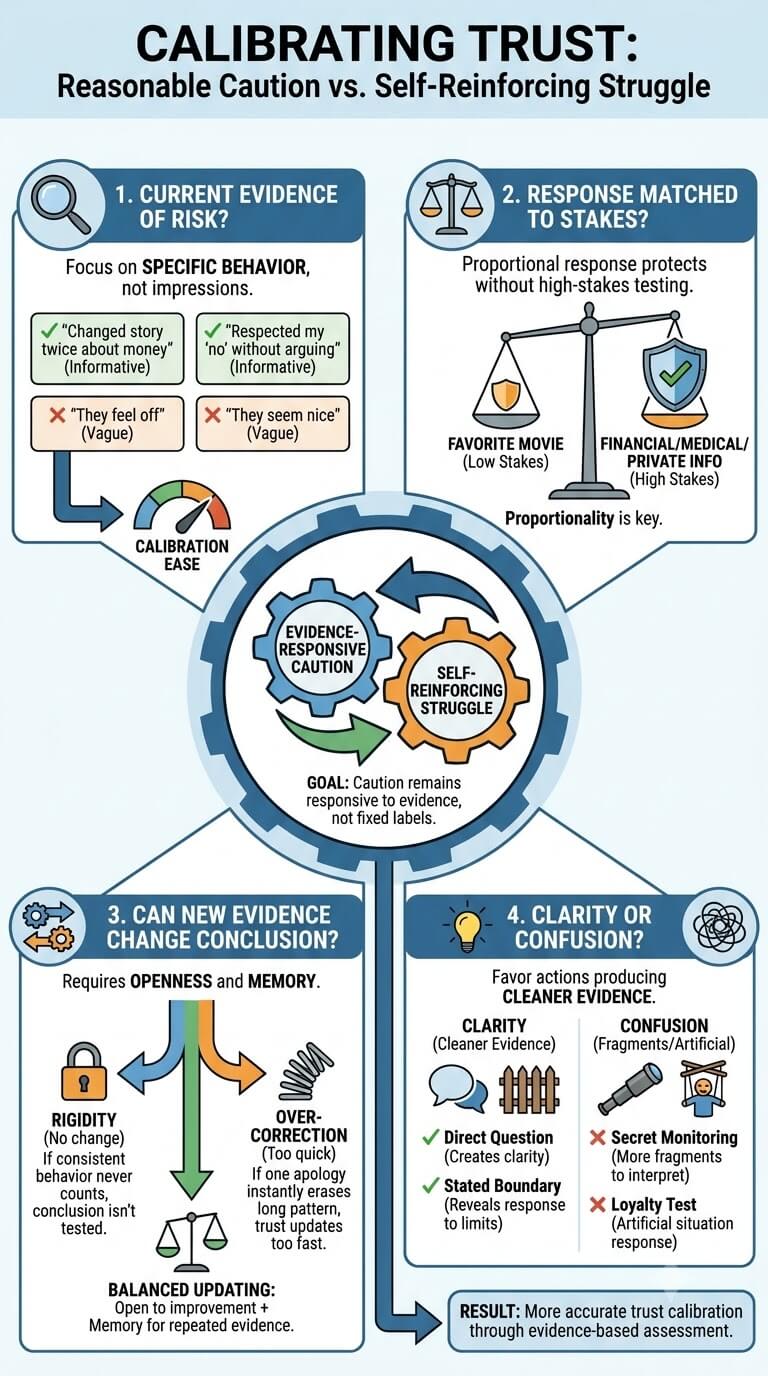
The goal is not to decide whether you are “too trusting” or “too suspicious.” A better test is whether your caution remains responsive to evidence. The following questions can help.
Is there current evidence of risk?
Name behavior rather than impressions when possible. “They changed their story twice about money” is more informative than “they feel off.” “They respected my no without arguing” is more informative than “they seem nice.” Specific evidence makes trust easier to calibrate.
Is the response matched to the actual stakes?
You do not need the same confidence to share a favorite movie as you do to share financial access, medical information, or a deeply private experience. A proportional response protects you without turning every interaction into a high-stakes test.
Can new evidence change the conclusion?
If no amount of consistent behavior can ever count, the conclusion is no longer being tested. On the other hand, if one apology instantly erases a long pattern of deception, trust may be updating too quickly. Calibration requires both openness to improvement and memory for repeated evidence.
Does the protective behavior create more clarity or more confusion?
A direct question may create clarity. Secret monitoring may create more fragments to interpret. A stated boundary reveals how someone responds to limits. A loyalty test may reveal only how they respond to an artificial situation. Favor actions that produce cleaner evidence.
Why Reassurance Alone Often Does Not Fix Trust
Reassurance feels relevant because trust involves uncertainty. Yet words often have limited power when the underlying expectation was learned through repeated experience. A promise can matter, but trust usually becomes more stable when the promise is followed by behavior.
Words may not update expectations without repeated behavior
A promise can express good intention, but it cannot substitute for what happens next. When trust has been shaped by repeated disappointment, ordinary follow-through often carries more weight than a strong statement made once.
Reassurance can become part of a checking cycle
When reassurance is used mainly to remove anxiety immediately, relief may last only until the next ambiguous cue. Then another question feels necessary. Instead of asking for a global promise, ask for one piece of observable clarity: “Can you tell me by Friday whether you can do this?” or “If plans change, please tell me directly rather than disappearing.”
Trust grows more reliably through bounded experiments and follow-through
A bounded experiment is small enough that a disappointing outcome is manageable and clear enough that you can observe what happened. You might delegate a minor task, share a moderately personal concern, or set a simple boundary. The point is not to secretly test someone. It is to allow real behavior to provide new information.
A Gradual Trust Recalibration Plan
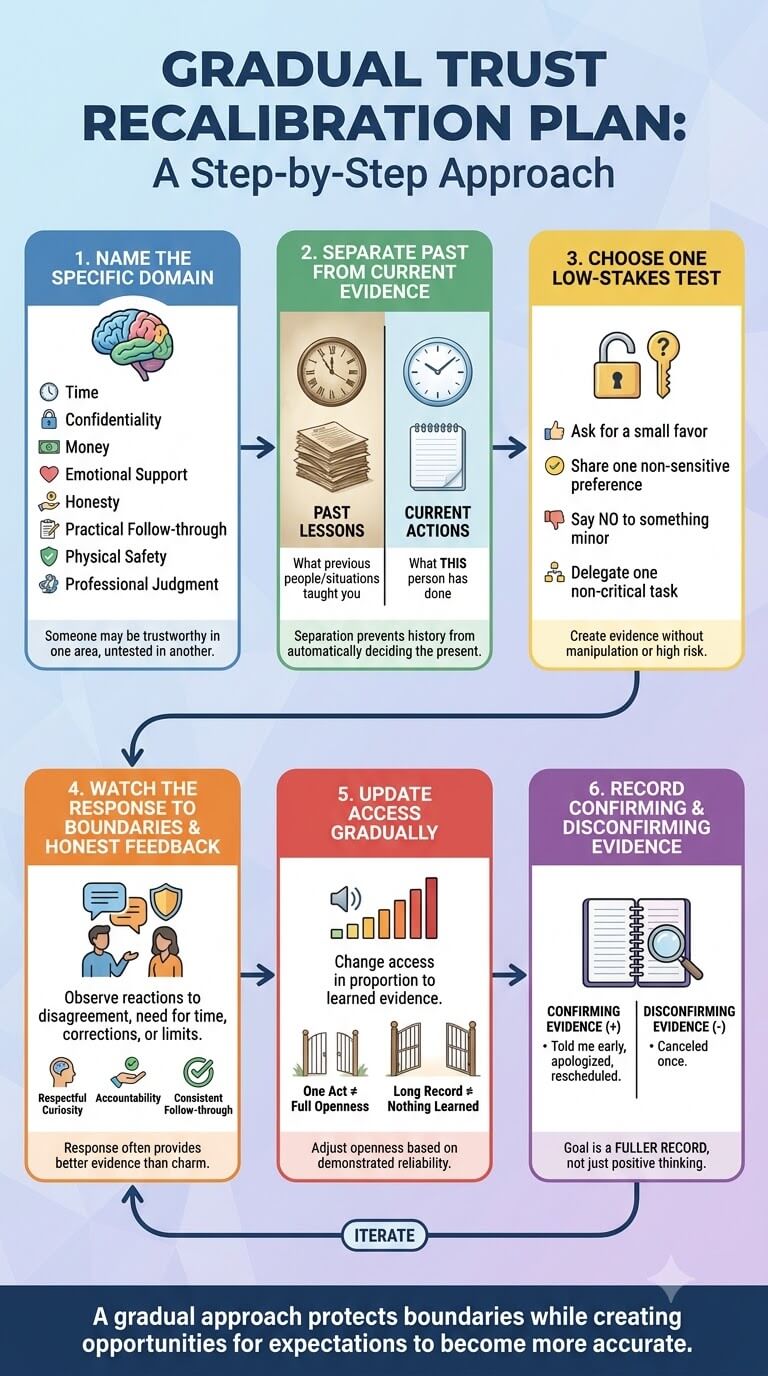
When trust feels difficult, all-or-nothing advice is rarely useful. A gradual approach protects meaningful boundaries while creating opportunities for expectations to become more accurate.
Name the specific domain of trust
Ask what you are actually considering trusting this person with: time, confidentiality, money, emotional support, honesty, practical follow-through, physical safety, or professional judgment. Someone may be trustworthy in one area and untested in another.
Separate past evidence from current evidence
Make two short lists. One is what previous people or situations taught you. The other is what this person has actually done. Both matter, but combining them into one list can make old evidence look current. The separation helps you notice when history is informing caution without automatically deciding the present.
Choose one low-stakes test that does not manipulate the other person
Ask for a small favor with a clear deadline. Share one non-sensitive preference. Say no to something minor and observe the response. Let the other person handle one piece of information that would be inconvenient, but not devastating, if handled poorly. These steps create evidence without turning the relationship into an exam.
Watch the response to boundaries and honest feedback
Trust is not only about whether people give you what you want. It is also about how they respond when you disagree, need time, correct them, or set a limit. Respectful curiosity, accountability, and consistent follow-through often provide better evidence than charm or intensity.
Update access gradually rather than all at once
Let access change in proportion to what you have learned. One reliable act does not require full openness, and a long record of reliability does not need to be treated as if nothing has been learned.
Record both confirming and disconfirming evidence
If you already expect betrayal, your attention may naturally notice cues that fit the expectation. Deliberately record evidence on both sides. “They canceled once” belongs on the list. So does “they told me early, apologized, and rescheduled.” The goal is not positive thinking. It is a fuller record.
Trust Difficulty vs Nearby Topics
Several experiences can look similar from the outside. Distinguishing them helps you choose a response that fits the actual problem.
| Experience | Main question | What deserves attention |
|---|---|---|
| Difficulty trusting | Can I safely increase reliance? | Old expectations, present evidence, protective habits |
| Trust already breaking | Why is established confidence declining? | Current inconsistency, secrecy, deception, broken agreements |
| Suspicion | Is there a hidden motive or missing explanation? | How uncertainty is interpreted and what evidence exists |
| Attachment pattern | What closeness or distance cues feel especially threatening? | Recurring relational expectations, without treating labels as destiny |
| Unsafe situation | Could relying on this person expose me to harm or retaliation? | Threats, coercion, stalking, monitoring, intimidation, power and safety |
Struggling to trust vs trust already breaking
Difficulty trusting often appears before there is clear evidence that a current person has violated trust. Trust breaking is different: confidence existed and is now being damaged by current behavior. The first calls for careful updating. The second calls for evaluating the violation, accountability, and whether continued reliance is reasonable.
It is also useful to distinguish an older difficulty trusting from a situation in which trust is currently breaking because of secrecy, deception, inconsistency, or broken agreements.
Trust difficulty vs suspicion
Trust difficulty is broad reluctance to rely. Suspicion is more specifically the thought that a hidden motive, concealed fact, or deceptive explanation may exist. You can struggle to trust without believing anyone is secretly doing something wrong. You can also become suspicious in one situation while generally trusting the person.
Trust difficulty vs attachment style
Attachment concepts can help explain sensitivity to closeness or dependence, but “I have trust issues because of my attachment style” can become too simple. Current behavior, culture, power, past betrayal, stress, and the specific domain of trust all matter. A label should not replace observation.
Trust difficulty vs a genuinely unsafe situation
Do not use self-reflection to talk yourself out of concrete safety concerns. Threats, stalking, intimidation, forced access to devices, retaliation for saying no, humiliation, or coercive control deserve a different response from ordinary uncertainty. The National Domestic Violence Hotline’s information on recognizing abuse can help people learn about warning signs and safety resources. If communication itself may increase danger, prioritize confidential support and safety planning over proving that you can trust.
How to Talk About Trust Without Accusing
You can name uncertainty without declaring someone guilty. The aim is to describe the situation, identify what would help, and leave room for behavior to answer the question.
Describe the specific situation and uncertainty
Try: “When the plan changed and I did not hear from you until much later, I noticed I started filling in the blanks. Can you tell me what happened?” This is more useful than “You are hiding something.” It gives the other person something concrete to respond to.
Ask for observable follow-through rather than total reassurance
Try: “I do not need a promise that nothing will ever go wrong. What would help is letting me know if you cannot make the plan.” Or: “I am not ready to share all of that yet. I can tell you a little more if we keep this private.” These requests create behavior you can actually evaluate.
State a boundary without demanding proof of loyalty
Try: “I am not comfortable sharing my password. I am happy to talk about what is making you worried.” A boundary is information about what you will and will not participate in. It does not require the other person to pass a secret test or surrender their own autonomy.
When More Support May Help
Trust difficulties exist on a wide spectrum. Some are manageable through reflection, clearer boundaries, and better evidence. Others become exhausting enough that additional support is worth considering.
Persistent fear, severe checking, sleep disruption, panic, or inability to function
If threat-scanning feels constant, interferes with sleep, work, school, or daily relationships, or creates intense physical arousal, a mental health professional can help you examine what is maintaining the distress without assuming a diagnosis. Cleveland Clinic describes hypervigilance as a heightened state of awareness that can become exhausting and may warrant professional support when it disrupts life.
A history of coercion, stalking, threats, humiliation, or repeated betrayal
When trust difficulty developed in an environment where there were real consequences for being open, cautious behavior may have been highly adaptive. You do not need to rush exposure to prove recovery or maturity. Confidential support can help you distinguish present choices from past pressure while keeping safety central.
Why professional support can help separate protection from current evidence
A qualified professional can provide a setting for examining predictions, checking cycles, avoidance, attachment-related sensitivities, and current relationship evidence without asking you to abandon caution. Research on epistemic trust also suggests that adversity, attachment, and openness to socially communicated information are linked in complex ways. A comprehensive review of epistemic trust research found associations among adversity, insecure attachment, mistrust, and credulity, while also emphasizing limits and inconsistencies in the evidence.
This is educational information, not a diagnosis. If distress is severe or safety is uncertain, individualized professional or specialist support may be more useful than trying to solve the problem through self-analysis alone.
Frequently Asked Questions About Struggling to Trust
These questions focus on the difference between understandable protection and conclusions that may need more current evidence.
Why do I distrust kind people?
Kind behavior today may not immediately outweigh experiences that taught you kindness could change, disappear, or hide another motive. Your mind may require more repeated evidence before it updates. Pay attention to whether the person remains respectful when disappointed, honors boundaries, admits mistakes, and behaves consistently over time. Kindness is one cue, not the entire case.
Can attachment patterns make trust harder?
They may influence which parts of trust feel most difficult. Sensitivity to distance can make uncertainty about availability feel urgent, while sensitivity to dependence can make closeness itself feel risky. Attachment concepts are most useful as patterns to observe, not as fixed identities or proof that a reaction is caused by one thing.
Are trust issues always caused by betrayal?
No. Repeated inconsistency, emotional unpredictability, ridicule, confidentiality breaches, power imbalance, social exclusion, or simply having little experience with reliable dependence can all shape trust. Current mixed signals can also make caution reasonable even without a dramatic past event.
Should I tell someone I have difficulty trusting?
You can, but you do not have to disclose your entire history. A bounded statement is often enough: “I tend to take trust slowly, so consistency helps me more than big promises.” That gives useful information without making the other person responsible for eliminating all of your uncertainty.
How can I build trust without ignoring red flags?
Keep trust specific, gradual, and evidence-based. Increase reliance when behavior supports it. Slow down when stories do not match actions, boundaries are pressured, accountability is missing, or the stakes exceed what you know. The goal is not maximum trust. It is trust that changes when the evidence changes.
Key Takeaways
For a practical next step, choose one relationship and one domain of trust. Compare the prediction you carry with the behavior you can observe now, then choose one small, reversible action that could give you clearer evidence.
- Difficulty trusting often reflects learned protection, not a simple refusal to connect.
- Past experience can shape how ambiguous present-day behavior is interpreted, but old expectations are not automatic proof about a new person.
- Checking, testing, withdrawal, and overcontrol may reduce uncertainty briefly while limiting opportunities to gather clearer evidence.
- Reasonable caution stays responsive to current behavior, actual stakes, boundaries, and new information.
- Small, transparent, low-stakes steps usually provide better evidence than secret loyalty tests or demands for total reassurance.
- When there are threats, coercion, stalking, humiliation, retaliation, or severe distress, safety and individualized support matter more than pushing yourself to trust.

Michael Reed is the Founder and Lead Writer at Psychology Exposed. He writes about human behavior, relationships, emotional patterns, self-awareness, and practical psychology topics using research-informed, easy-to-understand content.
Read More About Michael Reed: https://psychologyexposed.com/michael-reed/