
Trust rarely arrives as a clear decision. More often, it grows through dozens of small observations: whether someone keeps a simple promise, notices discomfort, tells the truth when the truth is inconvenient, or stays respectful when you disagree. A person may seem warm on the first meeting, yet warmth alone does not tell you how they will handle responsibility, privacy, pressure, or a boundary.
Quick Answer

Trust develops when repeated evidence makes another person or source more predictable under meaningful conditions
Trust grows when experience supports the expectation that someone will act with enough honesty, care, reliability, or competence for a particular situation. It usually begins with low-stakes contact, then expands as the person handles needs, limits, mistakes, and responsibility. Healthy trust is not instant certainty. It is a revisable judgment based on what has actually happened.
Trust Is Learned, Not Simply Chosen
Expectations begin before certainty is possible
Every new connection begins with incomplete information. You may know a person’s role, reputation, tone, appearance, shared contacts, or stated values, but you do not yet know how those qualities translate into behavior. The mind still has to decide how open or guarded to be. It uses prior experience, social cues, context, and the possible cost of being wrong.
Research on trust between people with no prior acquaintance shows that people sometimes accept vulnerability before they have strong evidence about another person’s likely behavior. This does not mean initial trust is irrational. It means early cooperation may also reflect social norms, respect, and a willingness to give someone a limited opportunity to act well.
Every interaction provides confirming, disconfirming, or ambiguous evidence
Once contact begins, expectations are tested. A friend remembers something important, a manager explains a changed deadline, or an online community enforces its rules fairly. These experiences confirm some expectations. A broken commitment, hidden condition, or dismissive response can disconfirm them. Other events remain ambiguous, such as a delayed reply with no explanation.
The Trust Development Cycle
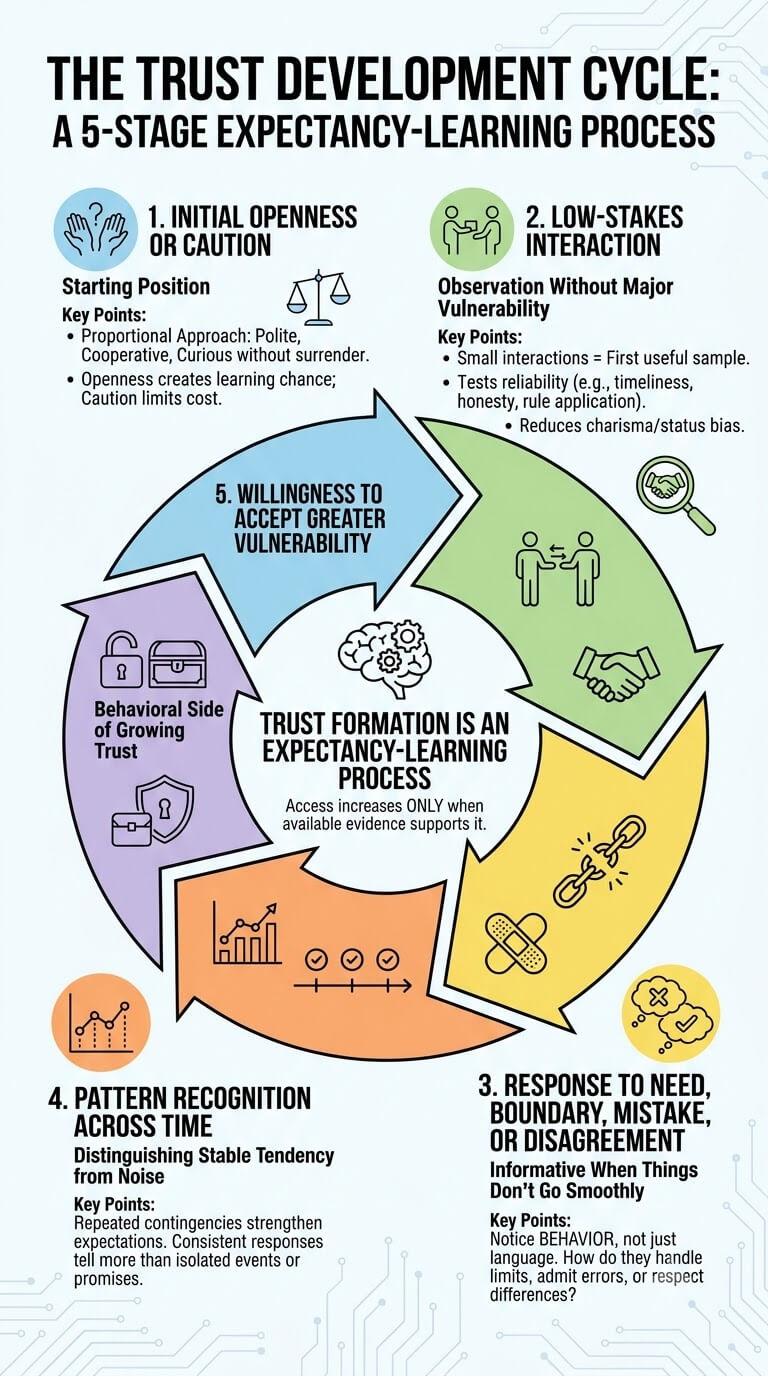
A practical way to understand trust formation is as a five-stage cycle. The stages are not rigid, and people may move forward, pause, or step back. What matters is that access increases only when the available evidence supports it.
Initial openness or caution
You begin with a starting position. Some people offer basic goodwill until given a reason not to. Others begin more carefully, especially when the stakes are high or past experiences make uncertainty feel costly. Neither starting point proves that someone is wise, damaged, naïve, or cold.
This learning process fits within the broader psychology of trust, where evidence, expectations, stakes, and new information shape willingness to rely.
The healthiest starting position is usually proportional. You can be polite without sharing private information, cooperative without surrendering control, and curious without treating first impressions as proof. Initial openness creates a chance to learn. Initial caution limits the cost if the situation is not what it seems.
The distinction between trust and distrust also matters because reasonable caution can remain present while confidence is still developing.
Low-stakes interaction
Small interactions produce the first useful sample of behavior. Does the person arrive when they said they would? Do they return borrowed items? Do they correct a misunderstanding rather than quietly benefiting from it? Does a group apply the same rule to popular and unpopular members?
Low-stakes moments matter because they allow observation without requiring major vulnerability. They also reduce the temptation to judge trustworthiness from charisma, similarity, status, or one emotional conversation. A person may be impressive in a planned setting and less reliable when no one is watching.
Response to a need, boundary, mistake, or disagreement
Trust becomes more informative when something does not go smoothly. A need requires responsiveness. A boundary limits access. A mistake creates a chance for honesty. A disagreement tests whether respect survives when interests differ.
Notice behavior rather than polished language. Someone who says, “I understand your boundary,” but repeatedly pressures you has provided different evidence from someone who accepts the limit without punishment. A colleague who admits an error early gives you more reliable information than one who protects their image until the facts become undeniable.
Pattern recognition across time
Repeated experiences help the mind distinguish a stable tendency from noise. Three fulfilled commitments in similar conditions usually tell you more than one dramatic promise. Several respectful disagreements tell you more than agreement during the easy stage of a friendship or partnership.
A study describing trust development as an expectancy-learning process tested the idea that people learn whether support is likely to help through repeated contingencies. The broader lesson is useful beyond caregiving: expectations become stronger when a response reliably follows a meaningful cue, and they weaken when outcomes are inconsistent or repeatedly unhelpful.
Willingness to accept greater vulnerability
As evidence accumulates, people may share more, delegate more, depend more, or reduce monitoring. This is the behavioral side of growing trust. You might ask a colleague to manage an important task, tell a friend something more personal, rely on a leader’s forecast, or accept information from a community without checking every minor detail.
Greater vulnerability should remain domain-specific. Trusting someone with a personal story does not automatically mean trusting them with money. Trusting a skilled technician’s repair does not require accepting their opinion on health or politics. Growth is healthiest when each new level of reliance matches the evidence available in that area.
Four Experiences That Commonly Build Trust

Consistency makes behavior easier to predict
Consistency turns isolated actions into an understandable pattern. It does not require perfect performance or identical behavior in every situation. It means commitments, values, and responses are stable enough that other people do not have to constantly guess which version of the person will appear.
Predictability lowers uncertainty. A team member who communicates early when delayed may be more trustworthy than someone who always promises perfect delivery but occasionally disappears. The first person makes reality visible. The second creates confidence through words, then transfers the cost of surprise to everyone else.
Responsiveness shows that signals and needs register
Responsiveness is not the same as immediate agreement or unlimited availability. It means another person’s signal is noticed and receives a relevant response. A parent responds to distress, a friend acknowledges a concern, a manager addresses a reported problem, or a moderator explains why a complaint was handled in a certain way.
Developmental research on predictability and safety cues in caregiving describes how predictable, appropriate responses can help shape expectations of availability and safety. Adult trust is more complex, but the everyday principle remains recognizable: people learn from whether their signals repeatedly lead to clear, appropriate responses.
Honesty allows expectations to match reality
Honesty supports trust because accurate information lets people make informed choices. This includes telling the truth, correcting false impressions, naming uncertainty, and disclosing relevant limits. Someone can be honest without revealing every private detail, but they should not create a misleading picture in order to secure access, approval, money, or loyalty.
Honesty is especially informative when it has a cost. Saying “I forgot,” “I cannot meet that deadline,” or “I benefit from this recommendation” may reduce immediate approval, yet it makes future expectations more accurate. Selective truth that protects a desired image can feel reassuring for a while, but it weakens the basis for reasonable reliance.
Competence shows that good intentions can become reliable action
A person may care deeply and still be unable to perform a particular responsibility. Trust therefore involves both motive and ability. You might trust a friend’s goodwill while not trusting their financial planning, or trust a leader’s technical knowledge while remaining uncertain about their people management.
A broad meta-analysis of human trust organizes trust around characteristics of the person trusting, the person or system being trusted, and the surrounding situation. This helps explain why competence matters more in some decisions than others. The qualities needed for emotional support are not identical to those needed for surgery, cybersecurity, childcare, or managing payroll.
Why Small Moments Often Matter More Than Grand Gestures
Ordinary follow-through creates a larger evidence sample
Grand gestures are vivid, but ordinary behavior is frequent. A costly gift, emotional declaration, public apology, or ambitious promise may be sincere. It is still one event. Daily follow-through reveals whether the person manages inconvenience, competing priorities, and moments when recognition is absent.
High-intensity promises can feel convincing before they are tested
Strong emotion can make the future feel settled. New partners may speak as if closeness is already proven. Leaders may describe a culture of transparency before anyone has challenged a decision. Online groups may demand immediate loyalty by presenting doubt as betrayal.
Intensity is not automatically manipulation, and enthusiasm is not a warning sign by itself. The key question is whether the pace allows verification. Trust-building becomes less healthy when someone pressures you to disclose, commit, invest, isolate from other viewpoints, or ignore discomfort before their behavior has been tested across time.
Repair after small mistakes reveals more than perfection
No relationship, team, or system produces flawless behavior. Small mistakes show what happens when reality conflicts with self-image. Does the person acknowledge impact, provide accurate context, make a reasonable correction, and change the relevant behavior? Or do they deny, blame, minimize, and repeat?
Repair provides a different kind of evidence from success. Success shows what a person does when things work. Repair shows whether accountability survives embarrassment and whether the other person’s experience still matters when accepting it is uncomfortable. This is not yet the same as rebuilding after major betrayal. It is normal trust development under ordinary strain.
How Early Experience Shapes Starting Expectations
Familiar patterns influence what feels safe, risky, or believable
People do not enter new situations as blank slates. Earlier relationships teach informal rules about what attention means, whether promises matter, how conflict ends, and whether asking for help leads to support, rejection, or unpredictability. These expectations can influence what feels familiar long before a person consciously explains it.
Familiarity is not the same as safety. Someone raised around unreliable promises may find inconsistency normal and overlook it. Another person may interpret a minor delay as a sign of abandonment because similar cues once preceded real loss. Both reactions make sense as learned expectations, but neither should be treated as final proof about the present situation.
Attachment-related expectations can shape openness without fixing destiny
Attachment research examines how repeated experiences with important caregivers can contribute to expectations about availability, comfort, and support. A major review of attachment theory and research also emphasizes complexity, development, and the need to avoid simple deterministic conclusions.
An attachment tendency is not a permanent identity or a diagnosis. Behavior varies by context, and dependable new relationships can revise earlier expectations.
New repeated experiences can revise old predictions
Change usually requires more than one reassuring conversation. If an old expectation says that expressing a need leads to ridicule, a single kind response may feel surprising but not yet believable. Repeated respectful responses create a larger body of evidence. Over time, the person can begin to predict a different outcome.
Revision is also possible in the other direction. Someone who begins with high trust may become more cautious after repeated exceptions, unexplained secrecy, or pressure around boundaries. Updating is not failure. It is part of keeping trust connected to current reality rather than protecting an old impression.
Trust Develops by Domain
Emotional trust is not the same as practical reliability
Trust is easier to judge when you name the domain. Emotional trust asks whether your feelings or private experiences will be handled with care. Practical trust asks whether a person completes responsibilities. Informational trust asks whether their claims are accurate. Moral trust concerns whether they will act fairly when interests conflict.
| Domain | What you are learning | Useful evidence |
|---|---|---|
| Emotional | Will openness be met with care rather than ridicule or exposure? | Confidentiality, respectful listening, response to vulnerability |
| Practical | Will responsibilities be handled as agreed? | Follow-through, early communication, correction of errors |
| Informational | Are claims accurate and uncertainty disclosed? | Evidence, corrections, transparent limits, track record |
| Boundary | Will a limit be accepted without punishment? | Response to no, pacing, respect for privacy and consent |
| Decision-making | Will power be used fairly when interests differ? | Consistent rules, accountability, reasons given for choices |
Competence in one role does not prove honesty in every area
People often generalize from one strong quality. A confident expert may be assumed to be honest. A caring relative may be assumed to be financially responsible. A popular creator may be assumed to check every claim. These conclusions may be correct, but the original evidence does not prove them.
Keep the inference narrow. “She has delivered three complex projects on time” supports trust in her project execution. It does not automatically answer whether she protects confidential information or admits conflicts of interest. Domain-specific trust is not cynical. It is more accurate and often kinder than placing someone in a role they have not shown they can handle.
Trust can grow at different speeds across money, privacy, work, and closeness
The cost of error changes the pace. You may quickly trust a colleague to recommend a restaurant but take longer to share access to financial data. You may enjoy a new friend’s company before trusting them with family information. You may accept a community’s basic advice while independently checking high-stakes health or legal claims.
Different speeds are normal. A reasonable boundary might be, “I am comfortable trying a small task first,” or “I share private details gradually.” Trust grows better when pacing is respected.
A Healthy Trust-Building Ladder

Start with observable low-stakes commitments
Choose something specific and realistic: a meeting time, a small task, a modest loan of an item, or an agreement about privacy. Vague promises such as “You can always count on me” are difficult to evaluate. Observable commitments make expectations clear for both people.
Increase access or disclosure gradually
When early commitments are handled well, increase the stakes slightly. Share a moderately personal concern, delegate a more important task, or rely on the person in a situation that requires judgment. Avoid leaps from minimal contact to total dependence. Gradual steps protect both people from unrealistic expectations.
Watch how the person handles limits and feedback
A boundary often reveals more than agreement. Notice whether a no is accepted, whether feedback becomes a personal attack, and whether the person can discuss impact without demanding immediate reassurance. Respectful handling of limits supports trust because it shows that connection does not depend on unlimited access.
Update trust when behavior changes
Trust should respond to recent evidence. Reliable behavior can justify greater reliance. Repeated problems can justify slowing down, reducing access, asking for clarification, or checking important information independently. Updating does not require a dramatic confrontation. Sometimes the appropriate response is simply to change what you rely on the person for.
| Step | Example | Question to ask |
|---|---|---|
| 1. Observe | A small promise or clear rule | Did behavior match the stated expectation? |
| 2. Test gently | A modest need, boundary, or responsibility | How did the person respond when something mattered? |
| 3. Compare | Several interactions across different conditions | Is there a stable pattern or only one vivid event? |
| 4. Expand | Slightly more disclosure, access, or dependence | Does the new level match the evidence? |
| 5. Revise | More trust, narrower trust, or a pause | What does current behavior support now? |
What Slows Trust Development

Mixed signals and unpredictable follow-through
Mixed signals force people to keep recalculating. Warmth followed by unexplained withdrawal, generous promises followed by silence, or strict rules applied only to certain people make future behavior harder to predict. The uncertainty itself can become tiring even when no single event looks severe.
Context matters. Illness, workload, cultural differences, disability, and changing responsibilities can affect behavior. Clear explanation and realistic renegotiation often protect trust better than pretending nothing changed. The central question is whether the person helps create an accurate picture or leaves others to absorb repeated surprise.
Pressure for fast intimacy or immediate loyalty
Trust needs enough time for evidence. Pressure may look like repeated demands for disclosure, anger when you consult other people, insistence that doubt is disrespectful, or requests for serious commitment before ordinary behavior has been observed. These actions do not automatically prove harmful intent, but they remove the conditions needed for informed choice.
You are allowed to slow the pace. A direct response can be simple: “I do not make that level of commitment this quickly,” or “I need more time and experience before I decide.” If saying no brings threats, humiliation, surveillance, retaliation, or fear, prioritize outside support and practical safety rather than trying to prove trust through more openness.
Unclear motives, hidden information, or repeated exceptions
People do not need perfect knowledge of another person’s motives, but relevant interests should be visible. A reviewer should disclose a paid relationship. A leader should explain who benefits from a policy. A friend asking for money should be honest about the situation and the terms.
Repeated exceptions are especially informative. One unusual circumstance may be reasonable. A different explanation every time can prevent expectations from stabilizing. Ask for concrete clarification and observe whether the answer becomes clearer or merely more complicated.
Environments where mistakes are denied rather than repaired
A culture that punishes admission of error encourages concealment. Team members hide problems until they grow. Family members protect appearances. Community leaders redefine criticism as disloyalty. In these environments, trust develops slowly because people cannot rely on accurate feedback when something goes wrong.
Trust-friendly environments make correction possible. They distinguish a mistake from a pattern, accountability from humiliation, and explanation from excuse. People are more likely to reveal useful information when honesty leads to proportionate consequences and a workable path forward.
How Trust Development Differs From Nearby Topics
Trust development vs consistency and trust
Consistency is one major input into trust, but trust development includes more than repetition. It also includes initial expectations, responsiveness, honesty, competence, boundaries, mistakes, interpretation, and the gradual decision to accept greater vulnerability. Someone can behave consistently and still be consistently dismissive, misleading, or unskilled.
Trust development vs credibility judgments
Credibility asks whether a person, claim, or information channel deserves belief. Trust development asks whether repeated experience supports relying on someone in a particular way. The two overlap, but they are not identical. You may find a scientist credible on a technical question without knowing them personally, or trust a friend’s intentions while checking their factual claim.
Trust development vs rebuilding damaged trust
Normal development begins with uncertainty and gradually adds evidence. Rebuilding begins after meaningful evidence has damaged an established expectation. It usually requires direct accountability, a clearer account of what happened, changed behavior, and enough time to see whether the change lasts. Early trust-building should not be used as a shortcut around an unresolved rupture.
First Steps for Building Trust Without Forcing It
Make one realistic commitment and follow through
Choose accuracy over impressiveness. “I will send the notes by Friday afternoon” is more useful than “I will take care of everything.” If circumstances change, communicate before the missed commitment when possible. Reliability includes honest renegotiation, not only flawless execution.
Respond clearly when expectations cannot be met
A clear response protects the other person’s ability to plan. Try: “I agreed too quickly, and I cannot complete this by Friday. I can deliver the first part Monday, or we can assign it elsewhere.” This shows respect for reality and gives the other person a choice.
Respect a no without punishing the boundary
If someone declines an invitation, limits disclosure, or requests a slower pace, accept the answer without sulking, mockery, repeated persuasion, or withdrawal designed to make them reconsider. A calm response such as “Understood, thanks for telling me” provides strong evidence that their autonomy is safe with you.
Let trust grow from evidence rather than pressure
Avoid asking, “Why do you not trust me?” as a demand for immediate access. A better question is, “What would help make expectations clearer?” Then listen for a request you can realistically meet. The answer may involve time, consistency, more information, or a boundary that remains in place even when trust grows.
How Consistency, Vulnerability, and Doubt Shape the Process
Consistency turns repeated actions into predictability
Repeated behavior gives the mind enough information to form a working expectation. The useful focus is not perfection but pattern quality: how often commitments are met, how exceptions are explained, and whether the person’s values remain visible when circumstances become inconvenient.
Vulnerability increases only when evidence supports it
Trust becomes meaningful when something could be lost, such as privacy, time, status, money, emotional security, or control over a decision. Gradual vulnerability lets connection deepen without turning openness into proof of loyalty. You can be sincere and still keep a reasonable pace.
Distrust and suspicion influence how ambiguous evidence is interpreted
When starting expectations are negative, ambiguous events may be read as proof of hidden motives. When starting expectations are overly positive, the same events may be dismissed too quickly. A balanced response separates what happened from the story attached to it, then waits for additional evidence when the immediate stakes allow.
Frequently Asked Questions About How Trust Develops
How long does it take to develop trust?
There is no universal timeline because frequency of contact, stakes, context, and the type of trust all matter. Ten routine interactions may reveal less than one situation involving a clear boundary or meaningful responsibility. A better measure is whether you have seen behavior across enough relevant conditions to form a reasonable expectation.
Can trust form without personal closeness?
Yes. You can develop practical or informational trust in a colleague, professional, institution, or system without emotional intimacy. The evidence may involve competence, transparent procedures, consistent performance, or correction of mistakes. Closeness is one context for trust, not a requirement for every form of it.
Does sharing personal information automatically build trust?
No. Disclosure can create a feeling of closeness, but trust depends on how the information is handled and whether openness is voluntary. Rapid mutual disclosure may feel bonding while leaving important qualities untested. Look for confidentiality, respect, pacing, and behavior after the emotional moment has passed.
Can one reliable action create trust?
One action can improve an initial impression or justify a small next step. It rarely supports broad trust across many domains. The more serious the possible loss, the more useful it is to observe repeated behavior, especially under inconvenience, disagreement, or responsibility.
Why do people trust familiar people even when evidence is mixed?
Familiarity reduces uncertainty and can feel easier to process than the unknown. Shared identity, repeated exposure, and old expectations may also influence judgment. Familiarity can be relevant evidence, but it should not override current behavior. Ask what the person has actually shown in the domain that matters now.
Key Takeaways
- Trust develops through repeated learning, not through one promise, one intense conversation, or a demand for loyalty.
- The most informative moments often involve a need, boundary, mistake, disagreement, or meaningful responsibility.
- Consistency, responsiveness, honesty, and competence contribute different kinds of evidence.
- Trust should grow by domain and at a pace that matches the possible cost of being wrong.
- Early expectations influence openness, but new repeated experiences can revise old predictions.
- Pressure, punishment for boundaries, hidden interests, and repeated unexplained exceptions interfere with informed trust.
A practical next step: choose one area where you are deciding whether to rely on a person, group, or information channel. Name the exact domain, the possible cost, and three pieces of recent behavioral evidence. Then decide whether the evidence supports a small increase in trust, the current level, or a slower pace.
Educational note: This material explains general psychological ideas and is not a diagnosis or a substitute for individual professional support. When trust concerns involve fear, coercion, threats, stalking, humiliation, or retaliation, communication exercises may not be the safest first response.
About the author: Michael Reed is the Founder and Lead Writer at Psychology Exposed. He writes about human behavior, relationships, emotional patterns, self-awareness, and everyday decisions in clear, research-aware language.

Michael Reed is the Founder and Lead Writer at Psychology Exposed. He writes about human behavior, relationships, emotional patterns, self-awareness, and practical psychology topics using research-informed, easy-to-understand content.
Read More About Michael Reed: https://psychologyexposed.com/michael-reed/