
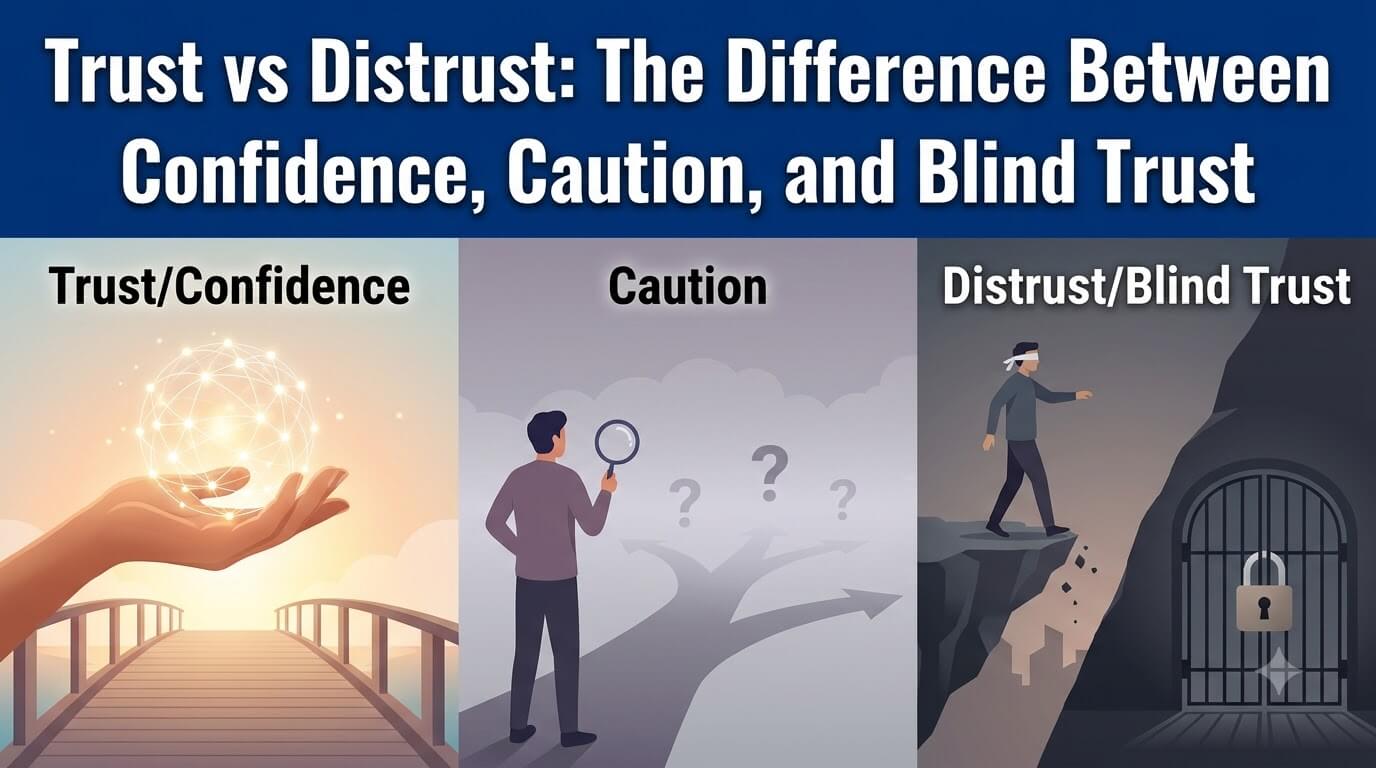
You may trust a coworker to finish a report but not to keep a personal confidence. You may believe a friend means well while still refusing to lend them money. You may also feel uneasy around someone without having enough evidence to conclude that they are unsafe. These are not contradictions. They show that trust is usually specific, conditional, and tied to consequences.
Looking at how trust develops helps explain why confidence often begins with small, reversible risks instead of complete reliance.
The difference between trust and distrust becomes confusing when people treat trust as total access and distrust as a personal attack. That framing leaves little room for caution, verification, or changing your mind. A more useful approach is to ask what you are relying on, what evidence supports that reliance, and what would happen if your judgment were wrong.
This distinction matters anywhere another person or system affects your choices. It helps you avoid giving confidence faster than evidence justifies or treating uncertainty as proof of harmful intent.
Quick Answer

Trust accepts some vulnerability because evidence supports reliance, while distrust expects meaningful risk or unreliability
Trust means you are willing to rely on someone or something within a particular area because the available evidence suggests reasonable dependability. Distrust means you expect that reliance may expose you to deception, neglect, harm, or serious cost. Caution sits between them. It delays reliance while information is incomplete. Healthy judgment stays open to revision rather than demanding unquestioned faith or permanent suspicion.
Trust and Distrust Are More Than Opposites
The APA Dictionary of Psychology defines trust as reliance on or confidence in someone or something, with predictability playing a central role in interpersonal trust. That definition points to an important detail: trust is not simply liking a person, admiring them, or believing they are morally good. It is an expectation about whether they are likely to act in a dependable way.
People can trust one person in one domain and distrust them in another
Trust is often divided by domain. A manager may be technically skilled but unreliable with confidential information. A family member may be emotionally caring but poor at handling money. An online creator may be entertaining while offering claims that require independent checking.
Global labels such as “I trust her” or “I do not trust him” can hide these differences. A better question is, “Trust them with what?” That question turns an emotional label into a more precise judgment. It also allows a relationship to contain both confidence and limits without forcing either total closeness or total rejection.
Low trust can reflect missing evidence rather than negative evidence
When you meet a new person, start a new job, or encounter an unfamiliar institution, you may have little evidence either way. Low trust in that situation does not necessarily mean you expect wrongdoing. It may simply mean that the prediction has not been tested.
This is why caution can be neutral. You can remain polite, curious, and open while limiting disclosure or checking important details. You are not accusing anyone. You are matching your level of reliance to the amount of information available.
Distrust can involve active protective expectations
Distrust is more than the absence of confidence. It often includes a negative expectation, such as believing that a promise is unlikely to be kept, that information may be withheld, or that access could be misused. Research reviews note that low trust, mistrust, and distrust are related but not always identical concepts. One useful distinction is that distrust involves expecting harmful or unreliable behavior, while low trust may simply involve limited willingness to become vulnerable.
That distinction matters because the response is different. Missing evidence may call for patience and small tests. Negative evidence may call for stronger boundaries, documentation, reduced access, or withdrawal from the situation.
The Five-Position Trust Map

Trust decisions rarely fit a yes-or-no box. These five positions describe responses to uncertainty, not personality types. People may move between them as evidence and stakes change.
Blind trust: reliance without sufficient checking or limits
Blind trust gives access, influence, or authority faster than evidence supports. It may be driven by loyalty, attraction, familiarity, status, urgency, or the wish to avoid conflict. The trusting person may ignore contradictions because questioning feels disloyal or uncomfortable.
Blind trust is not the same as warmth. The issue is whether reliance matches evidence and consequences. Sharing a minor preference carries little risk; giving a new acquaintance financial control carries much more.
Open trust: reasonable initial willingness under low stakes
Open trust allows ordinary cooperation before complete certainty is possible. You accept a small amount of vulnerability because the cost of being wrong is manageable. Examples include accepting a routine invitation, assigning a low-risk task, or believing a simple statement that has no major consequence.
Open trust makes ordinary cooperation possible. It works best with clear limits and a willingness to update when behavior changes.
Calibrated trust: reliance matched to evidence and consequences
Calibrated trust is selective. It considers track record, context, stakes, and the specific ability or quality being relied on. The amount of access increases when evidence becomes stronger, and it can decrease when new information changes the prediction.
You might trust a colleague with routine client communication yet request review before a high-stakes legal statement. The extra check reflects the consequence of error, not an absence of trust.
Caution: delayed reliance while information is incomplete
Caution says, “I do not know enough yet.” It may involve asking questions, moving slowly, verifying details, or keeping a boundary until more evidence appears. Caution does not require a negative story about the other person’s motives.
Caution is especially reasonable when stakes are high, the situation is new, or information is difficult to verify. It protects the decision without making an accusation.
Distrust: expectation that reliance may be unsafe, misleading, or costly
Distrust becomes appropriate when available evidence points toward a meaningful risk. Repeated dishonesty, retaliation after boundaries, unexplained secrecy, manipulated records, or a pattern of broken commitments may justify reducing reliance.
Distrust need not involve hostility. It can mean limiting access, confirming agreements in writing, independently checking claims, refusing pressure, or leaving when accountability is absent.
Trust vs Distrust Comparison
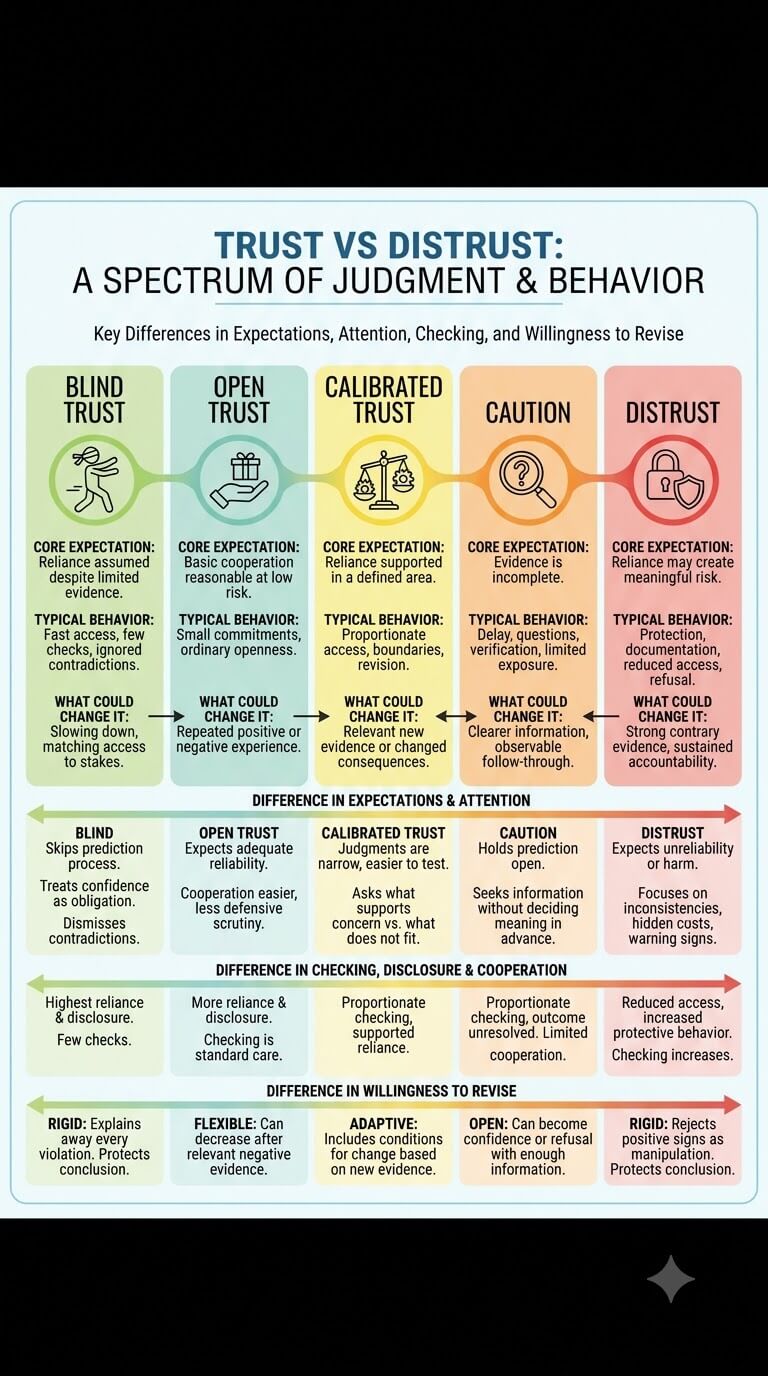
| Position | Core expectation | Typical behavior | What could change it |
|---|---|---|---|
| Blind trust | Reliance is assumed despite limited evidence | Fast access, few checks, ignored contradictions | Slowing down and matching access to stakes |
| Open trust | Basic cooperation is reasonable at low risk | Small commitments and ordinary openness | Repeated positive or negative experience |
| Calibrated trust | Reliance is supported in a defined area | Proportionate access, boundaries, revision | Relevant new evidence or changed consequences |
| Caution | Evidence is incomplete | Delay, questions, verification, limited exposure | Clearer information and observable follow-through |
| Distrust | Reliance may create meaningful risk | Protection, documentation, reduced access, refusal | Strong contrary evidence and sustained accountability |
Difference in expectations
Trust expects adequate reliability. Caution holds the prediction open. Distrust expects a meaningful chance of unreliability or harm. Blind trust often skips the prediction process and treats confidence as an obligation.
The expectation may be narrow or broad. “I do not trust this estimate because the data are incomplete” is narrower than “No expert can ever be trusted.” Narrow judgments are usually easier to test and revise.
These distinctions fit within the broader psychology of trust, where reliance is evaluated under uncertainty rather than treated as an all-or-nothing feeling.
Difference in attention and interpretation
Trust tends to make cooperation easier because every detail does not require defensive scrutiny. Distrust directs attention toward inconsistencies, hidden costs, and possible warning signs. Caution seeks information without deciding in advance what that information must mean.
Expectations influence attention. Confidence may make a contradiction easier to dismiss, while distrust may turn ambiguity into confirmation. Calibrated judgment asks what supports the concern and what does not fit it.
Difference in checking, disclosure, and cooperation
Trust generally allows more reliance, disclosure, and cooperation. Distrust reduces access and increases protective behavior. Caution uses proportionate checking while keeping the outcome unresolved.
Checking is not automatically distrust. Reviewing a contract, confirming a medical instruction, or asking who can view your data may be standard care. The meaning depends on the stakes, the context, and whether the checking can actually resolve uncertainty.
Difference in willingness to revise the judgment
A flexible trust judgment includes conditions for change. Trust can decrease after relevant negative evidence. Distrust can soften after sustained, observable change. Caution can become confidence or refusal once enough information arrives.
A rigid stance refuses updating. Blind trust explains away every violation. Blanket distrust rejects every positive sign as manipulation. Both positions protect a conclusion rather than testing it.
Caution Is Not the Same as Distrust
Caution says more evidence is needed
Caution is an information position. You may not know whether a new service protects personal data, whether a new colleague keeps commitments, or whether an unfamiliar health claim is accurate. Waiting, asking, and checking are reasonable responses to incomplete knowledge.
The APA definition of skepticism emphasizes questioning or doubt. In everyday decisions, healthy skepticism is useful when it remains connected to evidence and allows a claim to become more or less believable after examination.
Distrust says available evidence points toward meaningful risk
Distrust has a stronger basis. You may have seen altered records, conflicting explanations, repeated boundary violations, or promises followed by the same harmful result. The judgment is not merely “I need more time.” It is “What I have seen gives me a reason not to rely on this.”
The response should fit the evidence. One missed message may call for clarification; repeated lies about money may justify separate accounts or independent advice.
Boundaries can exist in both trusting and cautious relationships
A boundary does not prove a lack of affection or trust. You can trust a close friend and still keep passwords private. You can trust your team and still use approval procedures for large expenses. You can trust a partner and still expect consent, privacy, and freedom from intimidation.
The amount of vulnerability involved in trusting also matters because higher-stakes reliance usually deserves stronger evidence.
Boundaries define what access is appropriate. Trust affects how much reliance feels reasonable within those limits. Removing every boundary is not evidence of closeness. It may simply remove protection and accountability.
Distrust Is Not Always Irrational
Repeated inconsistency and deception are valid evidence
Trust should respond to reality. If explanations repeatedly conflict with records, commitments disappear when inconvenient, or honesty appears only after discovery, distrust may be a reasonable update. The purpose of noticing a pattern is not to punish someone forever. It is to avoid relying on a prediction that the evidence no longer supports.
A useful review on trust, mistrust, and distrust also emphasizes that these concepts are shaped by social and historical context. This is especially relevant when people evaluate institutions that have not treated all groups fairly.
Power imbalances and high stakes justify stronger verification
The amount of checking should rise with the possible cost of error. A charming claim about a minor preference does not require the same verification as a request involving money, health, employment, housing, legal rights, or personal safety.
Power matters because one side may control information, consequences, or access to help. In those settings, asking for documentation, consulting an independent professional, or delaying consent can be sound judgment rather than excessive suspicion.
Historical and institutional experiences can make mistrust contextually understandable
People do not evaluate institutions in a vacuum. Personal mistreatment, community history, discrimination, corruption, or opaque decision-making can affect the starting level of confidence. Telling people to “just trust” without addressing trustworthiness ignores the evidence behind their caution.
The constructive question is not only why people mistrust. It is also what the person or institution has done to become more transparent, accountable, consistent, and open to correction. Trust cannot be demanded as a substitute for trustworthy conduct.
When Trust Becomes Blind Trust
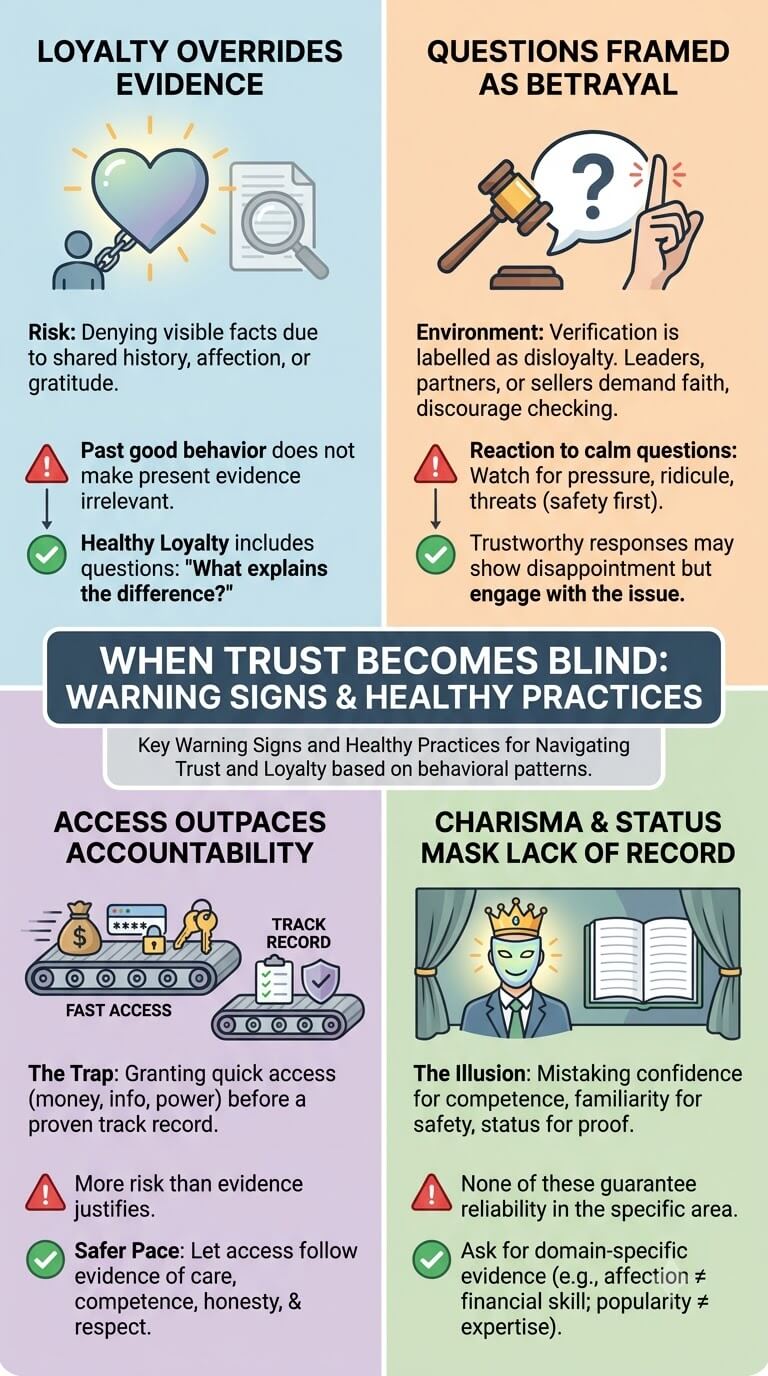
Loyalty replaces evidence
Loyalty becomes risky when it requires you to deny what you can see. You may feel pressure to defend a person because of shared history, group membership, affection, or gratitude. Past good behavior matters, but it does not make present evidence irrelevant.
Loyalty can still include questions: “This does not match what I was told. What explains the difference?” Trust that cannot tolerate a sincere question resembles obedience more than confidence.
Questions are treated as betrayal
Blind trust often grows in environments where verification is framed as disloyal. A leader may demand faith instead of providing records. A partner may call a reasonable boundary proof that you do not care. A seller may create urgency and discourage independent checking.
Watch the response to a calm question. Trustworthy people may feel disappointed or inconvenienced, but they can usually engage with the issue. Pressure, ridicule, threats, or retaliation are reasons to prioritize safety and outside support rather than attempting more direct confrontation.
Access increases faster than accountability
Fast access can include money, private information, decision power, passwords, living arrangements, or emotional dependence. When access grows before there is a track record, the trusting person carries more risk than the evidence justifies.
A safer pace lets access follow evidence of care, competence, honesty, and respect for limits.
Charisma, familiarity, or status substitutes for track record
Confidence can feel like competence. Familiarity can feel like safety. Status can feel like proof. None of these qualities guarantees reliability in the area that matters.
Ask for domain-specific evidence. Popularity does not prove health expertise, affection does not prove financial skill, and professional training does not remove conflicts of interest.
When Distrust Becomes Too Broad
One violation becomes a rule about everyone
A painful experience can teach a protective lesson. The lesson may begin as “This person hid important information” and expand into “People always hide the truth.” The broader rule feels safer because it removes uncertainty, but it may also block evidence that different people behave differently.
You do not need immediate openness. Keep the conclusion specific: who did what, in which context, and what evidence would matter with someone new?
Neutral ambiguity is consistently read as proof of bad intent
Delayed replies, changes in tone, incomplete explanations, and mistakes can have many meanings. Sometimes they signal a real problem. Sometimes they reflect distraction, poor planning, stress, or a misunderstanding.
The difference is whether the interpretation remains a hypothesis. “I noticed the details do not match, so I need clarification” preserves investigation. “The mismatch proves manipulation” closes the question before enough evidence is available.
No amount of new evidence is allowed to update the conclusion
Distrust may become rigid when every positive behavior is dismissed as fake and every negative behavior is treated as proof. A conclusion that cannot possibly change is no longer being evaluated.
One apology need not erase a serious history. The standard for updating should match the harm, and some decisions do not need to be reversed.
Protective checking creates more uncertainty instead of resolving it
Some checking produces useful information. Other checking creates an endless loop: rereading messages, searching for hidden meanings, testing people indirectly, or asking the same question without accepting any answer. The action promises certainty but keeps attention fixed on doubt.
A useful check has a purpose and stopping point. Decide what information you need and what decision follows. If repeated checking causes significant distress or disrupts daily life, a qualified mental health professional may help you examine the process without dismissing the concern.
A Calibrated Trust Decision Guide

Use the following questions when you need to decide how much confidence, access, or verification fits a situation. The aim is not perfect certainty. It is a proportionate decision that can be revised.
What exactly am I being asked to rely on?
Name the domain. Are you relying on honesty, competence, confidentiality, follow-through, emotional care, financial judgment, or respect for a boundary? A person may be dependable in one area and unreliable in another.
Example: “I trust my friend to care about me, but I do not rely on them to arrive on time.” That statement is clearer and more useful than assigning a global label.
What evidence is direct, repeated, and relevant?
Direct evidence comes from what you observed or verified, not only what someone else implied. Repeated evidence shows whether the behavior is a pattern. Relevant evidence matches the decision. Kindness does not prove technical competence, and confidence does not prove honesty.
A comprehensive review of epistemic trust describes how people selectively decide whether communicated knowledge is relevant and reliable. In practical terms, believing information responsibly involves evaluating both the message and the conditions under which it is offered.
What is the cost if I am wrong?
Low-cost mistakes allow more openness. High-cost mistakes justify stronger protection. The consequence may involve money, privacy, reputation, health, employment, housing, or physical safety.
Do not confuse anxiety with probability, but do not ignore consequence. Even a risk that seems unlikely may deserve verification when the possible harm is severe.
What boundary or verification fits the stakes?
Choose the smallest protection that adequately addresses the risk. That may be a written agreement, a second opinion, limited access, a trial period, separate accounts, a public meeting place, or refusing a request.
Useful language can be simple:
- “I am open to this, but I need the details in writing first.”
- “I trust your intention. I still want a second opinion because the decision is important.”
- “I am not comfortable sharing that information yet.”
- “The explanation does not match what I observed, so I am going to pause.”
What new evidence would make me update my judgment?
Identify the update rule. What would increase or reduce trust, and how long would a pattern need to continue? This keeps a strong feeling from becoming a permanent conclusion without review.
Updating need not be equal in both directions. Trust may fall after one severe violation and return only after sustained evidence.
Trust vs Nearby Concepts
Distrust vs suspicion
Distrust is a judgment about whether reliance is safe or wise. Suspicion is a hypothesis that something hidden may explain what you see. You can distrust a service because its record is poor without imagining a hidden motive. You can also feel suspicious while still lacking enough evidence to make a final trust decision.
Caution vs avoidance
Caution gathers information or limits exposure while a decision remains open. Avoidance moves away from the decision, conversation, person, or feeling. Avoidance may sometimes be necessary for safety, but it can also prevent useful evidence from becoming available.
Credibility vs interpersonal trust
Credibility concerns whether a person, statement, or information channel seems believable and competent. Interpersonal trust includes a wider willingness to rely on someone’s behavior. You may believe a mechanic’s technical explanation while not trusting the business to price the work fairly.
Forgiveness vs renewed trust
Forgiveness, reconciliation, and renewed trust are separate choices. A person may release some resentment without restoring access. They may remain civil without resuming closeness. Trust requires current evidence about future reliability, not only a decision about how to relate to the past.
What to Do Next
Name the domain and level of trust instead of making a global label
Replace “I trust them” with a precise sentence: “I rely on them for this task,” “I am cautious about sharing private information,” or “I do not trust them with financial decisions because of repeated evidence.”
Match access to evidence and consequences
Do not make closeness prove itself through unlimited access. Increase reliance in steps that fit the track record. When the consequences are serious, use verification even with people you generally trust.
This also applies to institutions and information. Trust supports cooperation but does not remove accountability. A large meta-analysis of trust and well-being found broad associations between trust and subjective well-being across the lifespan, while where trust is placed still matters.
Review whether your conclusion can still be updated
Ask yourself what would change your mind. If the answer is “nothing,” consider whether you are protecting a necessary boundary or protecting a belief from examination. Both trust and distrust work better when their scope, evidence, and revision conditions are clear.
If fear, coercion, stalking, threats, humiliation, or retaliation are present, do not use direct testing as the main strategy. Prioritize distance, documentation where safe, and confidential help from an appropriate local service or qualified professional.
Frequently Asked Questions About Trust vs Distrust
Can you care about someone and still distrust them?
Yes. Care describes emotional attachment or concern. Trust describes willingness to rely on someone in a particular area. You may care deeply about a relative while not trusting them with money, confidential information, or access to your home. Acknowledging that difference can protect both honesty and boundaries.
Is checking information a sign of distrust?
Not necessarily. Checking may be a normal response to high stakes, incomplete information, professional responsibility, or a new situation. It is more closely linked to distrust when you already expect deception or unreliability. The most useful question is whether the check is proportionate and capable of resolving the uncertainty.
Can distrust protect a person from harm?
Yes. Distrust may reduce exposure when there is relevant evidence of deception, broken commitments, unsafe behavior, or misuse of power. Protection becomes less useful when the judgment spreads to unrelated people or cannot be revised by any new evidence. The goal is not maximum trust. It is accurate, context-sensitive reliance.
What is the difference between mistrust and skepticism?
Skepticism is an attitude of questioning or doubt, often directed toward a claim. Mistrust is commonly used for unease or reduced confidence in a person, group, or system, although definitions vary across research areas. Both can be reasonable when they remain connected to evidence rather than automatic rejection.
Is unconditional trust psychologically healthy?
Unconditional care is possible, but unlimited trust is risky because people, roles, and circumstances change. Mature trust usually has a domain, a boundary, and a way to update. It does not require constant suspicion, yet it also does not demand that a person ignore deception, coercion, or repeated harm.
Key Takeaways
- Trust is usually domain-specific. Confidence in one ability does not prove reliability in every area.
- Low trust may mean evidence is missing, while distrust usually includes an expectation of meaningful risk or unreliability.
- Caution protects decision quality without assuming bad intent.
- Blind trust gives access or authority faster than the evidence and consequences justify.
- Calibrated trust matches reliance, boundaries, and verification to the stakes.
- A useful trust judgment can change when relevant new evidence appears.
Your next step is to choose one current trust decision and make it specific. Name what you are being asked to rely on, the evidence you actually have, the cost of being wrong, and the boundary that fits. That small shift from a global feeling to a defined decision often makes both confidence and caution easier to use wisely.
Author note: Michael Reed is the Founder and Lead Writer at Psychology Exposed. He writes about human behavior, relationships, emotional patterns, self-awareness, and everyday decisions in clear, research-aware language. This article is educational and is not a diagnosis or a substitute for individualized professional support.

Michael Reed is the Founder and Lead Writer at Psychology Exposed. He writes about human behavior, relationships, emotional patterns, self-awareness, and practical psychology topics using research-informed, easy-to-understand content.
Read More About Michael Reed: https://psychologyexposed.com/michael-reed/