

Opening up to another person involves uncertainty. You may tell a friend that you feel left out, admit a mistake at work, ask a partner for reassurance, or share something personal with a new friend. In each case, you give someone access to something that matters without controlling how they will respond.
That is why vulnerability and trust are closely connected. Vulnerability creates exposure, while trust affects whether that exposure feels reasonable. Trust does not require total disclosure, and vulnerability is not a test you pass by revealing more than you want to share.
Past experiences with ridicule, exposure, or unreliable responses can help explain why trusting others feels difficult even when closeness is genuinely wanted.
A useful approach is gradual. You can be honest while choosing the timing, depth, person, and setting, and you can reduce openness when someone handles information carelessly or ignores a limit.
Quick Answer

Vulnerability means allowing something meaningful about you to be known, requested, or depended on while accepting that the response is not fully under your control. Trust makes vulnerability easier when past behavior suggests your openness will be handled with care. Safer openness usually develops gradually, with attention to boundaries, consequences, reciprocity, and how the other person responds over time.
Vulnerability involves meaningful exposure, not uncontrolled disclosure
You are vulnerable whenever another person’s response could affect something you value. That may involve feelings, reputation, privacy, belonging, work, money, a relationship, or your sense of dignity. Disclosure is one form of vulnerability, but it is not the only one.
Asking for help can be vulnerable because the person may say no. Setting a boundary can be vulnerable because someone may be disappointed. Depending on a coworker can be vulnerable because their follow-through affects your work. Even saying, “I don’t know,” can feel exposing when you care about how competent others think you are.
Why Vulnerability Requires Trust
Trust does not remove the possibility of a disappointing response. It changes your estimate of the risk. When someone has been respectful, predictable, and careful with smaller moments of openness, sharing something more personal may feel less like a leap into the unknown.
Openness creates both connection and the possibility of hurt
Personal information can help people understand one another more accurately. Hidden needs are harder to respond to, concealed mistakes are harder to repair, and unnamed concerns leave more room for guessing.
Disclosure also creates a cost if the response is dismissive, mocking, careless, or exploitative. The openness that makes understanding possible also gives another person information that could matter later.
Openness is easier to understand within the broader psychology of trust, because vulnerability changes both the stakes and the possible cost of being wrong.
A systematic review of self-disclosure and relationship quality found that disclosure can contribute to relationship-building, while also showing that context matters. The practical lesson is not “share more.” It is that disclosure can support closeness when the setting and response make that openness meaningful rather than costly.
Trust lowers expected risk enough for openness to feel possible
Trust is partly a willingness to accept uncertainty because you expect another person to act in a reasonably dependable way. Early in a relationship, that expectation may be based on limited evidence. Later, it can become more grounded in repeated experience.
Research on trust at zero acquaintance shows that people can make trust judgments even with very little history. That helps explain why first impressions sometimes influence how quickly we open up. But an initial feeling of safety is not the same as a long record of careful behavior.
The stakes change with privacy, power, and consequences
Not every disclosure carries the same risk. Telling a close friend that you are nervous about a presentation is different from telling a supervisor something that could affect your employment. Sharing a childhood memory with a trusted sibling is different from posting it publicly where strangers can copy or redistribute it.
Power matters too. If another person controls money, employment, housing, grades, social belonging, or other important resources, refusing disclosure may carry a cost. In those situations, the consequences matter more than an ideal of openness.
Vulnerability Is More Than Sharing Secrets
Vulnerability is not limited to revealing painful secrets. It also appears when another person sees a need, limitation, preference, uncertainty, or dependence that matters to you.
Naming a need
Saying, “I need more notice before plans change,” reveals that something affects you. The other person may respond with care, defensiveness, indifference, or negotiation. You cannot guarantee which response you will receive, so the statement carries emotional risk.
Admitting uncertainty or a mistake
“I may have misunderstood that,” or “I missed the deadline” can feel vulnerable because your self-image or reputation is involved. Yet honesty about uncertainty often gives other people clearer information than pretending certainty you do not have.
Asking for help or depending on follow-through
Dependence is a practical form of vulnerability. If you ask a sibling to pick up your child, rely on a teammate to finish part of a project, or ask a friend to drive you home, their behavior affects an outcome you care about.
Setting a boundary that may disappoint someone
Boundaries can be vulnerable because they reveal where your limits are. Saying, “I don’t want to discuss that yet,” risks disapproval, but it also gives the other person a chance to show whether they can respect your autonomy.
Allowing another person to influence a meaningful decision
Listening seriously to someone else’s advice can be vulnerable because their view may shape your choices. Trust does not mean surrendering judgment. It means deciding that their perspective deserves some weight while you remain responsible for your own decision.
The Vulnerability Calibration Framework

Before increasing exposure, evaluate five questions. The aim is not to eliminate uncertainty, but to match openness to the evidence and the stakes.
| Question | What to consider | Possible warning sign |
|---|---|---|
| Relevance | Why does this person need to know this now? | You feel pushed to reveal something that is not needed for the relationship or task. |
| Readiness | Can you tolerate several possible responses? | You feel that only one exact response will make the disclosure feel bearable. |
| Evidence | How have they handled smaller disclosures, limits, and mistakes? | Their promises are warm, but their behavior is careless or inconsistent. |
| Stakes | What could happen if the information is misunderstood, repeated, or used badly? | The consequences are high and difficult to reverse. |
| Boundaries | What are you sharing, and what access are you not granting? | The other person treats one disclosure as permission to ask for everything. |
Relevance: why does this need to be shared?
Not every true fact about you needs to be disclosed to every trustworthy person. Relevance helps separate meaningful openness from disclosure driven mainly by pressure, guilt, or the belief that privacy is suspicious.
For example, a close friend may reasonably need to know that you are overwhelmed if it affects plans you made together. They do not automatically need every detail about why you are overwhelmed.
Readiness: can you tolerate a range of possible responses?
Before sharing something important, consider whether you can receive a caring but imperfect response. Someone may need a moment, ask a clumsy question, or misunderstand part of what you mean.
If any hesitation would feel like rejection, reduce the stakes or choose a more supportive setting. Readiness means recognizing how much uncertainty you can reasonably carry in that moment.
Evidence: what has this person done with smaller disclosures?
Look at behavior rather than relying only on warmth or promises. Do they keep private information private? Can they hear “no” without punishing you? Do they apologize when they overstep? Do they remember what matters to you without using it to control later conversations?
Small moments are useful because they reveal how the person handles access before the consequences become larger.
Stakes: what could happen if the information is mishandled?
Some disclosures are easy to recover from. Others can affect work, family, finances, reputation, or safety. Higher stakes justify slower pacing and stronger evidence.
This is especially important online. A private message can be copied, a photo can be saved, and a personal story can be shared beyond the audience you intended. The potential for closeness does not erase those practical realities.
Boundaries: what access is not being granted?
Every disclosure has a boundary around it. Saying that you are having a difficult week does not mean you have agreed to explain your medical history. Admitting a mistake does not mean you accept insults. Sharing a password once does not create permanent entitlement to your devices.
Clear limits help vulnerability stay voluntary. Without that distinction, openness can gradually turn into access that you never meant to give.
Gradual Disclosure and the Trust Ladder

Openness usually develops in smaller steps. You share something with manageable stakes, observe the response, and decide whether another step makes sense.
Looking at how trust develops helps explain why meaningful openness usually grows through smaller tests of responsiveness rather than one large disclosure.
Longitudinal research on vulnerable self-disclosure in supportive interactions suggests that disclosure and supportive responses can develop together over time. That fits everyday experience: people often become more open when prior openness has been met with care.
Begin with lower-stakes truthful information
You do not have to begin with the most private part of your life. A lower-stakes statement can still be honest: “I get nervous in large groups,” “I care about keeping plans,” or “I need time before I talk about family history.”
The purpose is not to test someone secretly. It is to let normal interaction provide information about how they respond to real, bounded openness.
Notice curiosity, respect, confidentiality, and follow-through
A trustworthy response does not have to be perfect. It often includes ordinary behaviors: listening, not pushing for more, keeping the information private, checking what would be helpful, and behaving consistently afterward.
Notice what happens days or weeks later too. A person may respond beautifully in the moment but later repeat your story to others. Long-term handling matters more than one polished conversation.
Increase depth only when behavior supports it
If someone repeatedly treats your openness with care, you may share more. The next step is still your choice. Reciprocity can support closeness, but equal disclosure is not a debt.
One person may be naturally more private, have different cultural norms, or need more time. The useful question is whether both people can be honest about their level of openness without coercion.
Pause or reduce access when the response becomes pressuring or careless
Trust does not require ever-increasing access. If someone gossips, mocks a disclosure, ignores a limit, or pressures you for more, reducing openness is a reasonable response to new evidence.
You do not need to prove that the person is “bad” before changing what you share. Calibration is about fit between evidence and access, not delivering a moral verdict.
What a Trustworthy Response to Vulnerability Looks Like
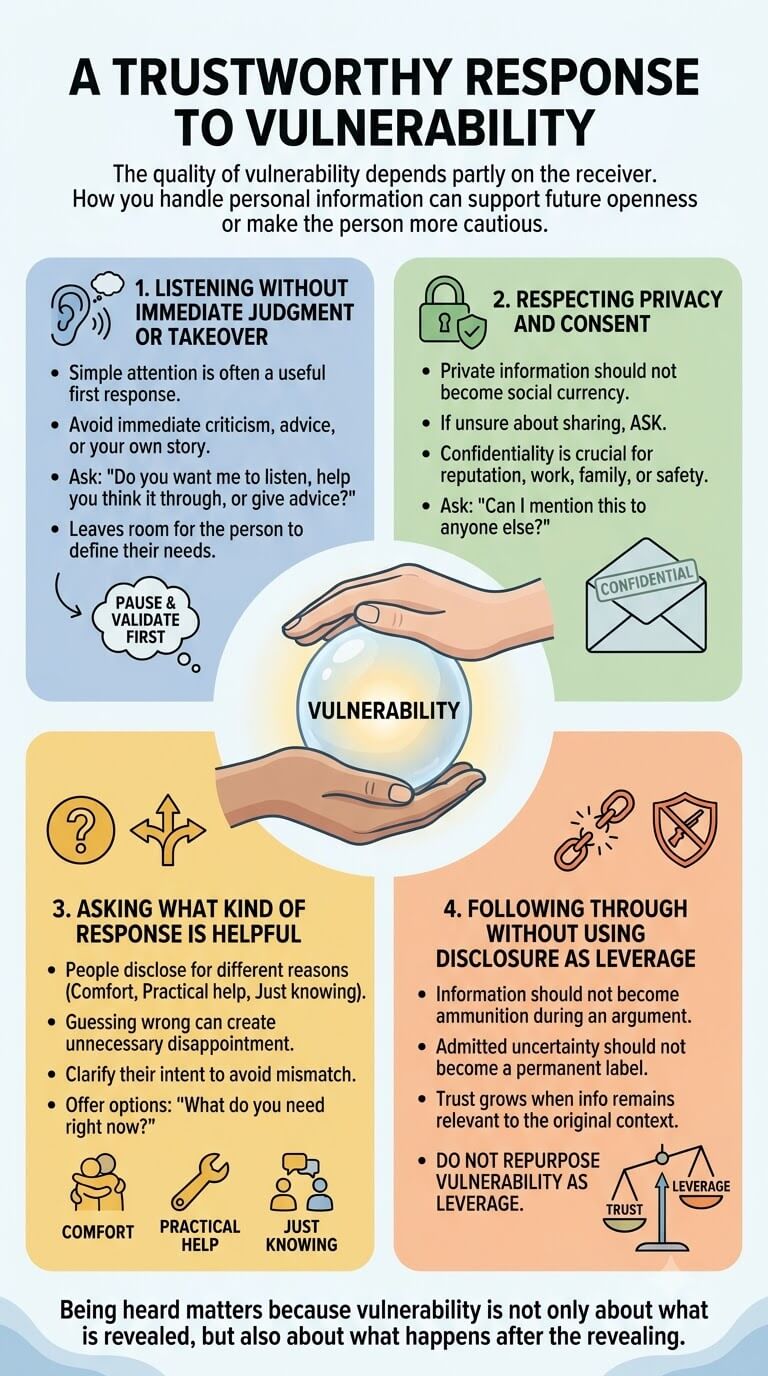
The quality of vulnerability depends partly on the receiver. How you handle personal information can support future openness or make the person more cautious.
Listening without immediate judgment or takeover
A useful first response is often simple attention. If a friend says they are embarrassed about a mistake, jumping immediately into criticism, advice, or your own similar story can make them feel that the disclosure was not actually received.
You can ask, “Do you want me to listen, help you think it through, or give advice?” That leaves room for the person to define what they need.
Respecting privacy and consent
Private information should not become social currency. If you are unsure whether you can mention something to another person, ask. Confidentiality is especially important when the disclosure could affect reputation, work, family relationships, or safety.
Asking what kind of response is helpful
People disclose for different reasons. Sometimes they want comfort. Sometimes they want practical help. Sometimes they simply want another person to know what is happening. Guessing wrong can create unnecessary disappointment.
Following through without using the disclosure as leverage
If someone tells you they fear abandonment, that information should not become ammunition during an argument. If an employee admits uncertainty, it should not automatically become a permanent label of incompetence. Trust grows when personal information remains relevant to the original context rather than being repurposed as leverage.
Research on the relational and emotional effects of self-disclosure also highlights that disclosure is shaped by the interaction that follows it. Being heard matters because vulnerability is not only about what is revealed, but also about what happens after the revealing.
Vulnerability Does Not Mean No Boundaries
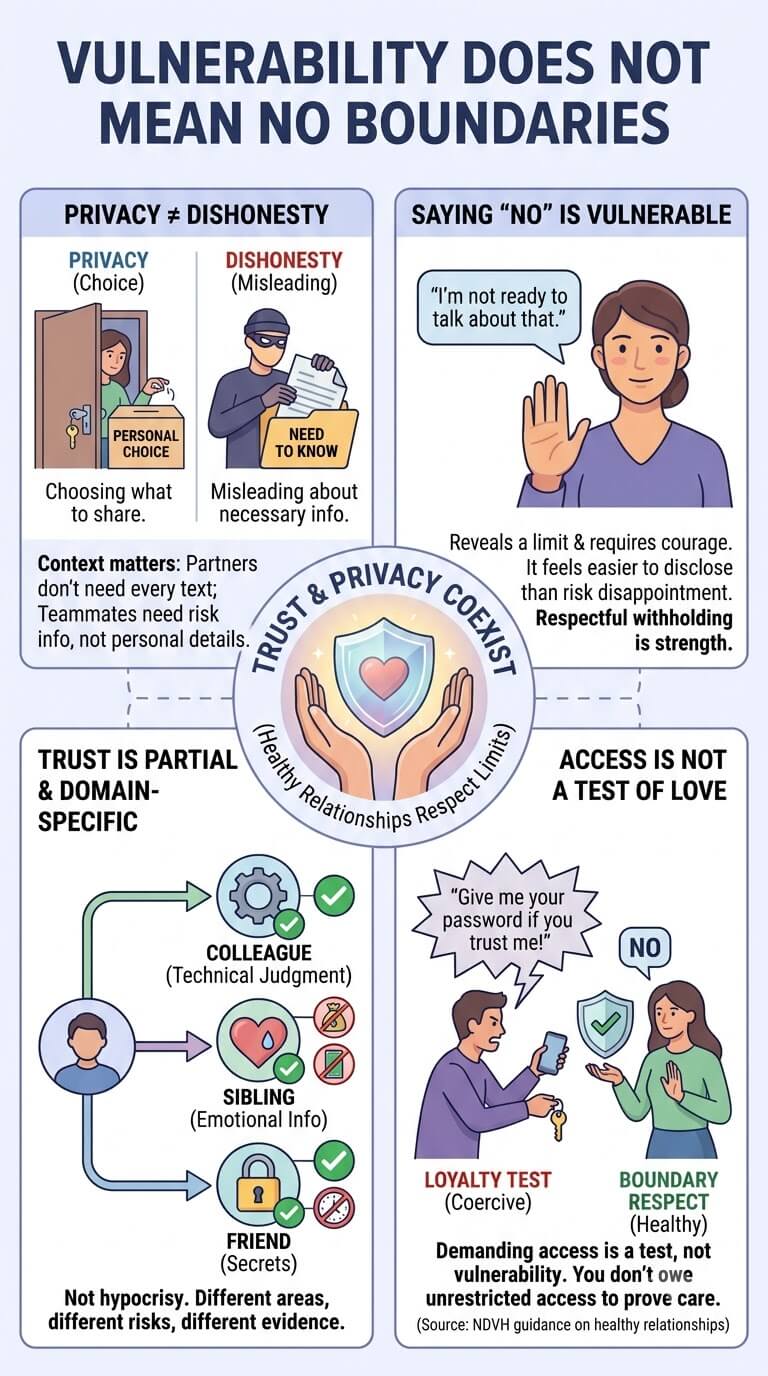
A common misunderstanding is that trust should eventually remove privacy. People can be close, honest, and committed while still keeping some areas personal.
Privacy is not dishonesty
Privacy means choosing what is yours to share. Dishonesty involves misleading someone about something they reasonably need to know. The difference depends on context.
A partner does not automatically need access to every private conversation on your phone. A teammate may need to know that a deadline is at risk, but not the personal family details behind it. Trust can coexist with appropriate privacy.
Saying no can be a vulnerable act
It may feel easier to disclose than to disappoint someone. “I’m not ready to talk about that” reveals a limit and creates the possibility that the other person will react badly. In that sense, withholding information respectfully can require its own form of courage.
Trust can be partial and domain-specific
You may trust a colleague’s technical judgment but not share personal problems with them. You may trust a sibling with emotional information but not with money. You may trust a friend to keep a secret but not to arrive on time.
This is not hypocrisy. Different areas of life create different risks and require different evidence.
Access should not be demanded as proof of love, loyalty, or honesty
Requests such as “If you trusted me, you’d give me your password” turn vulnerability into a loyalty test because the choice is no longer fully voluntary.
The National Domestic Violence Hotline’s guidance on healthy relationships explicitly distinguishes honesty from the right to privacy and identifies boundary respect and equality as important features of safer relationships. You do not owe unrestricted access to prove that you care.
When Vulnerability Becomes Unsafe or One-Sided
Not every uncomfortable response is a safety problem. People can be awkward, emotionally limited, or simply not the right person for a certain conversation. But some behaviors go beyond imperfect support and deserve a more protective response.
| What happens | Why it matters | What to consider next |
|---|---|---|
| You are pressured to disclose quickly | Your pace and consent are being overridden. | Slow down, restate your limit, or stop sharing. |
| Your information is mocked or exposed | Private material is being handled without care. | Reduce access and consider who else needs to know for support. |
| Your disclosure is used to threaten or punish you | The information has become leverage. | Prioritize safety rather than deeper conversation. |
| Only one person is expected to be transparent | The relationship may be operating with unequal rules. | Look at whether accountability and choice are mutual. |
| Refusing disclosure carries serious consequences | Power may be limiting genuine consent. | Consider confidential support outside the relationship or setting. |
Rapid pressure for disclosure
Intense early sharing can sometimes feel exciting and mutual. It is not automatically a problem. The concern is pressure: repeated questioning after you decline, guilt for being private, or claims that your caution proves disloyalty.
You are allowed to let closeness develop at a pace that fits the evidence you have.
Information is mocked, exposed, threatened, or reused during conflict
If someone shares private information after promising confidentiality, threatens exposure, or uses it to humiliate you, the issue is no longer simply how to communicate better. The information may be part of a control dynamic.
When there is fear, retaliation, stalking, threats, monitoring, or coercion, prioritize practical safety and confidential support. More disclosure may increase risk rather than improve understanding.
One person discloses while the other avoids accountability
Reciprocity does not require matching secrets detail for detail. However, a relationship can become unbalanced if one person is expected to explain every feeling and mistake while the other refuses basic accountability for behavior that affects both people.
Ask whether openness is creating mutual understanding or simply giving one person more information and influence.
Power differences make refusal costly
Workplaces, schools, families, caregiving relationships, and financial dependence can all create unequal power. A person may technically be able to say no but still fear losing opportunities, approval, income, or stability.
In higher-power situations, choose disclosure based on necessity and consequences, not on the assumption that openness is always emotionally healthier.
Vulnerability vs Nearby Concepts
Several behaviors can look similar from the outside while serving very different functions. Separating them helps you decide what kind of response is actually useful.
Vulnerability vs oversharing
Vulnerability is not defined by how much you reveal. A short sentence can be deeply vulnerable if the stakes are high. Oversharing usually refers to disclosure that exceeds what fits the context, audience, timing, or your own later comfort.
A practical self-check is: “Am I choosing this disclosure because it is relevant and I want to be known, or because I feel compelled to create immediate closeness?” Neither answer proves something is wrong, but the distinction can improve pacing.
Vulnerability vs emotional dependence
You can rely on another person without making them responsible for regulating every difficult feeling. Vulnerability may include asking for comfort, but it can also include accepting that the person cannot provide exactly what you want every time.
Vulnerability vs blind trust
Blind trust ignores or discounts meaningful evidence of risk. Vulnerability with calibrated trust does the opposite. It acknowledges uncertainty and still chooses a level of exposure that seems proportionate to the evidence.
Vulnerability and attachment without turning style labels into destiny
Attachment-related expectations can influence how safe closeness feels, but a label should not be used as a fixed explanation for every disclosure choice. Someone may be private because of temperament, culture, role boundaries, current stress, past experience, or simply preference.
The more useful question is what happens in the present interaction: Is openness voluntary? Are limits respected? Does behavior support greater trust over time?
Practical First Steps for Safer Openness
If you want more connection but feel uncertain about sharing, you do not need to choose between complete silence and complete exposure. A small, specific step can give you information without putting everything at stake.
Choose one honest but bounded statement
Try a sentence that is true and limited: “I’ve been stressed lately, but I’m not ready to explain all of it.” Or, “I care about this friendship, and I felt hurt when the plan changed without telling me.”
The boundary is part of the honesty. You are saying what is available for discussion and what is not.
Make one clear request instead of testing the person indirectly
Indirect tests create confusing evidence. Instead of withdrawing to see whether someone chases you, say, “Could you check in with me tomorrow?” Instead of hinting at confidentiality, say, “I’m telling you this privately, and I don’t want it shared.”
A direct request gives the other person a fair chance to respond and gives you clearer information about their reliability.
Notice the response over time rather than chasing immediate reassurance
One warm response can feel powerful, especially when a disclosure was difficult. Still, the stronger evidence appears later. Do they remember your limit? Do they behave differently when frustrated? Do they keep the information private when there is social pressure to share it?
Trustworthy handling is a pattern, not a single emotional moment.
Keep a boundary available if the evidence changes
You are allowed to revise your level of openness. A relationship that once felt safe may change. A person who mishandles one disclosure may repair well, or they may show a broader pattern of disregard.
Changing access is not necessarily punishment. It can simply be an update based on what you now know.
How Vulnerability Changes as Trust Changes
Vulnerability sits inside a larger process. The amount of openness that feels reasonable often changes as reliability, consistency, and prior experience accumulate.
Trust development determines when vulnerability can increase
Early openness often depends on small signals. Deeper openness is usually better supported by a longer history of respectful responses. If you are unsure whether to share more, look at what the relationship has already shown rather than what you hope it will become.
Consistency shows whether disclosed information will be handled reliably
A person who is kind only when things are easy may not yet have demonstrated how they handle vulnerability under stress. Consistency across disagreement, inconvenience, and time gives more useful evidence than a single supportive conversation.
Betrayal can make future vulnerability feel more costly
When private information has previously been exposed or used against you, future openness may carry extra meaning. You may need more evidence, more control over pacing, or more explicit agreements about privacy. Caution after betrayal does not have to mean permanent closure.
Frequently Asked Questions About Vulnerability and Trust
These questions focus on common decisions about pacing, privacy, pressure, and the difference between openness and unrestricted access.
Do I need to be vulnerable to build trust?
Some vulnerability is usually involved in deeper trust because trust requires accepting uncertainty. However, vulnerability can be small and practical, such as relying on someone to follow through or stating a preference honestly. You do not need to disclose your most private experiences in order to prove that trust is developing.
How do I know whether I am oversharing?
Consider the context, audience, stakes, and how you expect to feel afterward. If you are sharing mainly because you feel pressured, desperate for instant closeness, or unable to tolerate any other response, slowing down may help. Oversharing is not defined by a universal amount of information, because the same disclosure can fit one relationship and feel out of place in another.
Can I trust someone and still keep information private?
Yes. Trust does not require complete access. People can be honest about matters that affect the relationship while still keeping personal thoughts, conversations, passwords, memories, or experiences private. The key distinction is whether privacy is being used to protect appropriate autonomy or to conceal information the other person reasonably needs to make informed decisions.
What if someone demands vulnerability from me?
You can decline or limit the disclosure. A simple response might be, “I’m not ready to share that,” or “I can tell you the part that affects you, but I want to keep the rest private.” If refusal leads to threats, punishment, humiliation, monitoring, or fear, treat that as a safety concern rather than a normal disagreement about closeness.
Why does opening up feel dangerous even with a kind person?
Your expectations are shaped by more than the present person. Past experiences, uncertainty, the importance of the relationship, cultural norms, and the specific topic can all change the felt risk of disclosure. You do not need to force yourself to share faster. A gradual pace can let present-day evidence become more influential over time.
Key Takeaways
- Vulnerability means meaningful exposure to another person’s response, not unlimited disclosure.
- Trust helps openness feel reasonable when behavior provides evidence of care, reliability, and respect.
- Privacy can coexist with honesty, closeness, and commitment.
- A useful decision checks relevance, readiness, evidence, stakes, and boundaries before increasing exposure.
- Trustworthy responses respect consent, confidentiality, limits, and the original context of a disclosure.
- If personal information is threatened, exposed, monitored, or used for retaliation, prioritize safety rather than deeper openness.
Final Thoughts
You do not have to choose between being fully guarded and fully exposed. Pick one area where you want more honesty, decide what level of sharing fits the current evidence, and watch how the other person handles that access. Deeper vulnerability is safer when it is earned through behavior rather than demanded through pressure.
Educational note: Psychology Exposed provides general educational information, not diagnosis, therapy, legal advice, or crisis care. If disclosure is connected to threats, stalking, coercion, retaliation, or immediate safety concerns, seek confidential support appropriate to your situation.

Michael Reed is the Founder and Lead Writer at Psychology Exposed. He writes about human behavior, relationships, emotional patterns, self-awareness, and practical psychology topics using research-informed, easy-to-understand content.
Read More About Michael Reed: https://psychologyexposed.com/michael-reed/