

A confident voice can feel convincing before you have examined what it is saying. A familiar creator may seem more believable than an unfamiliar specialist. A person you dislike may give accurate information, while someone warm and sincere may be mistaken. These situations are difficult because the mind must judge both a message and the person delivering it, often with limited time and incomplete evidence.
Credibility psychology examines how people decide whether a speaker, expert, leader, institution, or everyday claim deserves belief. The judgment is not a direct test of truth. It is an estimate built from cues such as relevant competence, honesty, evidence, motive, and track record. Separating those cues helps you stay open without mistaking confidence, popularity, or credentials for certainty.
Quick Answer
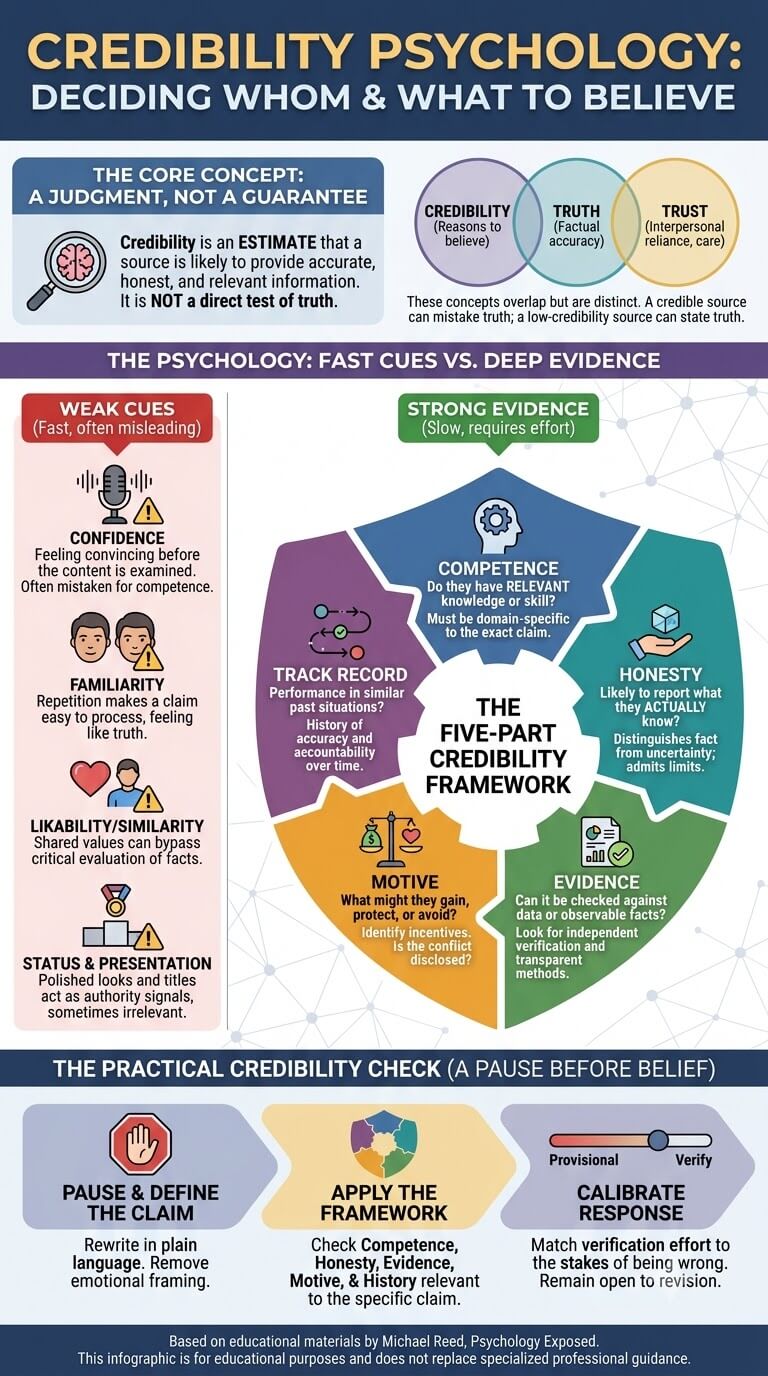
Credibility is a judgment that a person or information source is likely to provide accurate, honest, and relevant information. People estimate it from expertise, transparency, evidence, incentives, and past performance, but they also react to weaker cues such as confidence, familiarity, status, and likability. A careful judgment stays specific to the claim, compares available evidence, and remains open to revision.
Credibility, Trust, and Truth Are Different
These judgments overlap, but they do not answer the same question.
A credible source can still make a mistake
Credibility describes the quality of the reasons you have for taking a source seriously. It does not make that source infallible. A skilled physician may misread an unusual presentation. An experienced mechanic may overlook a rare fault. A careful friend may remember one detail incorrectly. The possibility of error is not evidence that expertise is useless; it is a reason to match confidence to the strength of the evidence.
Credible people often make uncertainty visible. They distinguish knowledge from inference, identify missing information, and update when better evidence appears. This may sound less impressive than certainty, but it gives a more accurate picture.
A true claim can come from a low-credibility source
A person with a poor record may occasionally say something true. A rumor may contain an accurate detail. An anonymous post may correctly report an event before established outlets confirm it. Truth does not become false because the messenger is weak, but a weak messenger gives you less reason to accept the statement without independent support.
This prevents rejecting a claim solely because you dislike the speaker. Separate the proposition from the person, then check stronger evidence, direct records, independent observers, or relevant expertise.
Interpersonal trust includes more than believing information
You may believe that a coworker is technically accurate while not trusting them with confidential information. You may trust a sibling’s intentions while not relying on their financial advice. Credibility concerns whether communication deserves belief. Interpersonal trust can also include care, loyalty, discretion, reliability, fairness, and willingness to protect another person’s interests.
Keeping these judgments separate makes reliance more precise. Believing an explanation, sharing a private fear, delegating a task, and granting access to money require different evidence.
Credibility is one part of the broader psychology of trust, but believing a claim and relying on a person are not always the same decision.
The Five-Part Credibility Framework

A useful credibility judgment considers five questions together. Their weight depends on the claim: technical statements lean on competence and evidence, while personal accounts may depend more on honesty, access, and verifiable details.
Competence: does the source have relevant knowledge or skill?
Competence asks whether the person has the ability needed for this particular question. Training, experience, direct observation, and demonstrated skill can all matter, but they are not interchangeable. A researcher may understand broad findings while a practitioner understands implementation problems. A patient may describe lived experience accurately without being able to generalize it to everyone.
A systematic review of leader credibility research found that credibility has been described through overlapping qualities such as competence, expertise, character, believability, and dependability. Credibility is rarely one trait. Ability matters, but so does how it is used and communicated.
Honesty: is the source likely to report what they actually know?
A competent person can still mislead. Honesty concerns whether the speaker is presenting their real knowledge, uncertainty, and intention rather than hiding inconvenient facts or claiming more certainty than they possess. Signs of honesty include correcting errors, distinguishing observation from interpretation, and acknowledging information that weakens one’s preferred conclusion.
Research on honesty and future trust behavior supports the central role honesty plays in impressions of trustworthiness. In everyday evaluation, however, you usually cannot see another person’s inner intention directly. You infer it from disclosure, accuracy, correction, and whether their account changes strategically when the audience or stakes change.
Evidence: can the claim be checked against reasons, data, or observable facts?
Evidence gives a claim support that does not depend entirely on the speaker’s presentation. It may include records, measurements, direct observations, transparent methods, documented outcomes, or several independent reports. Strong evidence does not always mean a large study. The right form depends on the question.
For example, a receipt may be better evidence of a payment than a general reputation for honesty. A pattern across controlled studies may be better evidence for a broad health claim than one dramatic testimonial. The key question is whether the evidence is relevant to the exact conclusion, not whether it looks impressive.
Motive: what might the source gain, protect, or avoid?
Motive affects what a person notices, emphasizes, withholds, or interprets. A seller benefits from your purchase. An employee may fear punishment for reporting a problem. A friend may soften information to protect your feelings. An activist may focus on evidence that advances an urgent cause. These incentives matter, but they do not automatically make the message false.
The useful approach is neither innocence nor cynicism. Identify the incentive, then look for safeguards. Is the conflict disclosed? Can the evidence be checked independently? Does the source present limitations or opposing evidence? Would the person benefit even if the claim were wrong?
Track record: how has the source performed in similar situations?
A track record turns a general impression into observable history. Has the person made accurate predictions in this domain? Do they correct public mistakes? Does their advice produce the outcomes they claimed? Have their explanations remained compatible with later facts?
Past performance is useful only when situations are comparable. Someone may meet routine deadlines yet estimate unfamiliar projects poorly. Match the track record to the current decision.
| Credibility factor | Useful question | Warning sign |
|---|---|---|
| Competence | What knowledge or access is relevant here? | Status in an unrelated field is treated as universal expertise |
| Honesty | Does the person separate facts, uncertainty, and opinion? | Confidence increases while important limitations disappear |
| Evidence | Can the conclusion be checked beyond the speaker’s assurance? | Anecdotes or presentation replace verifiable support |
| Motive | What does the source gain, protect, or avoid? | Conflicts are hidden or questions about incentives are punished |
| Track record | How accurate and accountable has the source been in similar cases? | Past failures are erased, reframed, or blamed entirely on others |
Why Confidence Feels Like Credibility

Fast social cues can persuade us before accuracy is checked.
Fluency and certainty reduce mental effort
Clear, smooth language is easier to process than hesitant or complicated language. That ease can be mistaken for truth. A short explanation with a strong conclusion may feel more credible than a careful explanation containing conditions, exceptions, and uncertainty, even when the careful explanation is better supported.
Fluency is not useless. A knowledgeable person should often be able to explain an idea clearly. The error is treating ease of understanding as proof that the conclusion is correct. Ask whether the simplicity comes from genuine clarity or from leaving out the parts that would make the claim less certain.
Status and presentation create authority cues
Titles, professional settings, polished graphics, expensive equipment, and institutional logos can signal expertise. They can also be borrowed, exaggerated, or irrelevant to the specific claim. Presentation may guide an initial impression, but it should not end the evaluation.
Initial judgments often form before detailed evidence is available. Research on trust at zero acquaintance illustrates that people may extend trust to strangers even when they have little information about likely behavior. The same general problem appears in credibility judgments: people must begin somewhere, so social cues fill the gap until stronger evidence arrives.
Familiarity can make a claim feel more believable
Repeated exposure makes a voice, phrase, or explanation easier to recognize. Recognition can feel like knowledge. When the same claim appears across several accounts, people may assume that several independent sources agree, even when all of them copied one original post.
Familiarity should therefore trigger a question: have I encountered independent support, or only repeated wording? A claim can become mentally comfortable without becoming better evidenced.
Likability and similarity can spill over into truth judgments
People often listen more openly to someone who shares their values, humor, identity, or frustrations. That openness can be useful because communication requires attention. It becomes a credibility error when “this person understands people like me” turns into “this person must be accurate about everything.”
The reverse error also occurs. Disliking a speaker’s tone, politics, or personality can make accurate information feel less credible. A disciplined evaluation asks whether the emotional reaction belongs to the claim, the messenger, or both.
Competence Is Domain-Specific
Expertise becomes useful only when it fits the question.
Expertise in one field does not transfer automatically to another
Expertise is usually narrow. A successful entrepreneur may understand product development but not nutrition. A therapist may understand emotional processes but not provide legal advice. A scientist may be highly qualified within one specialty and unfamiliar with another branch of the same field.
Before using credentials as evidence, name the domain precisely. What problem was the person trained to solve? What methods do they use? Does the current question fall inside that area? This avoids both overvaluing impressive titles and dismissing genuine expertise because it is specialized.
Firsthand experience and formal expertise answer different questions
Firsthand experience can reveal what an event felt like, what barriers appeared, and what consequences were overlooked by outsiders. Formal expertise may provide comparison across many cases, methods for testing explanations, and awareness of less visible alternatives. Neither automatically replaces the other.
A person describing their own experience is usually the primary authority on what they observed and felt. They may not be able to conclude that everyone with a similar experience will respond the same way. A professional can explain general patterns while still needing to listen to the individual case.
Relevant uncertainty can be a sign of honest expertise
Experts often know where the evidence is weak, which variables matter, and why a conclusion may change. Their language may include probability, ranges, conditions, or competing explanations. To a listener seeking certainty, this can sound less confident than an oversimplified answer.
Do not assume that uncertainty means ignorance. Ask whether the uncertainty is specific and informative. “I do not know” is weak when it avoids responsibility, but credible when the person explains what is unknown, what is known, and what information would reduce the uncertainty.
Research distinguishing competence and character in the development of trust also shows why ability should not be judged in isolation. A capable person may not be dependable or well-intentioned, while good character does not create technical skill. Credibility improves when the relevant qualities support one another.
How Honesty and Motive Affect Credibility
Incentives and disclosure shape what a speaker reports or leaves out.
Transparency about limits and conflicts of interest
Transparency gives the listener information needed to interpret the message. A reviewer who received a product, a researcher funded by an interested organization, or a manager defending a decision all have incentives worth knowing. Disclosure does not settle whether the conclusion is right, but it helps you judge where extra checking is appropriate.
Honest limits also include access. A person might say, “I saw the argument, but I did not hear what happened beforehand,” or “I understand the general policy, but I was not involved in this case.” Such statements reduce the scope of the claim instead of extending authority beyond the available information.
Incentives that create pressure to exaggerate or omit
Some incentives reward accuracy over time, while others reward attention now. A professional whose reputation depends on repeatable results may face costs for false claims. A creator paid per click may benefit from urgency, outrage, or certainty even when the evidence is mixed. An employee may omit risks when a leader punishes bad news.
Look at the system around the speaker, not only their personality. Are mistakes corrected publicly? Are predictions archived? Can users compare outcomes with promises? Does the organization protect people who raise concerns? Credibility becomes stronger when incentives and accountability make accuracy easier to maintain.
Why mixed motives do not automatically make a claim false
Most people have mixed motives. A teacher may care about learning and evaluations; a friend may tell the truth while hoping you choose a preferred option.
The question is whether the motive distorts the information. Does the person hide alternatives, misstate uncertainty, pressure you to decide before checking, or make disagreement personally costly? When possible, compare the claim with evidence that does not depend on the same incentive.
Evidence Quality for Everyday Readers

Evidence differs in relevance, independence, and strength.
Direct evidence vs anecdotes and testimonials
Anecdotes are useful for showing what can happen. They are weak for showing how often it happens, what caused it, or whether the same result will apply elsewhere. Testimonials add emotional detail but are usually selected rather than representative.
Direct evidence is not always a scientific paper. For an everyday promise, it may be a completed task, record, or observable behavior. Broader and more consequential conclusions require stronger support.
Independent agreement vs repeated copying
Several reports are more reassuring when they reached the conclusion separately. Ten posts repeating the same unsourced statement are not ten pieces of evidence. Look for different methods, records, observers, or institutions that converge without relying on one another.
Independence is especially important online, where content is quickly summarized and reposted. Trace an impressive statement back to its earliest accessible support. You may discover that a confident headline came from a tentative sentence, or that many accounts refer to the same unverified example.
Specific, testable claims vs vague claims that cannot fail
“This approach may improve some outcomes under these conditions” can be examined. “This changes everything” is harder to test because any result can be reinterpreted as success. Credible claims define what happened, for whom, compared with what, and over what period.
In personal situations, specificity also matters. “I will communicate better” provides little basis for evaluation. “I will send an update by noon when the deadline is at risk” identifies an action you can observe.
Updated conclusions when stronger evidence appears
Credibility is not proved by never changing one’s mind. A person who updates responsibly may be more credible than one who protects an old statement after the evidence changes. Look for an explanation of what changed, why it matters, and how the new conclusion differs from the previous one.
A broad review of epistemic trust describes the importance of selectively treating communicated information as reliable, relevant, and useful. Selectivity is the key. The aim is not to accept everything or reject everything, but to remain responsive to the quality of both the information and the communicator.
A Credibility Check Before You Believe or Share
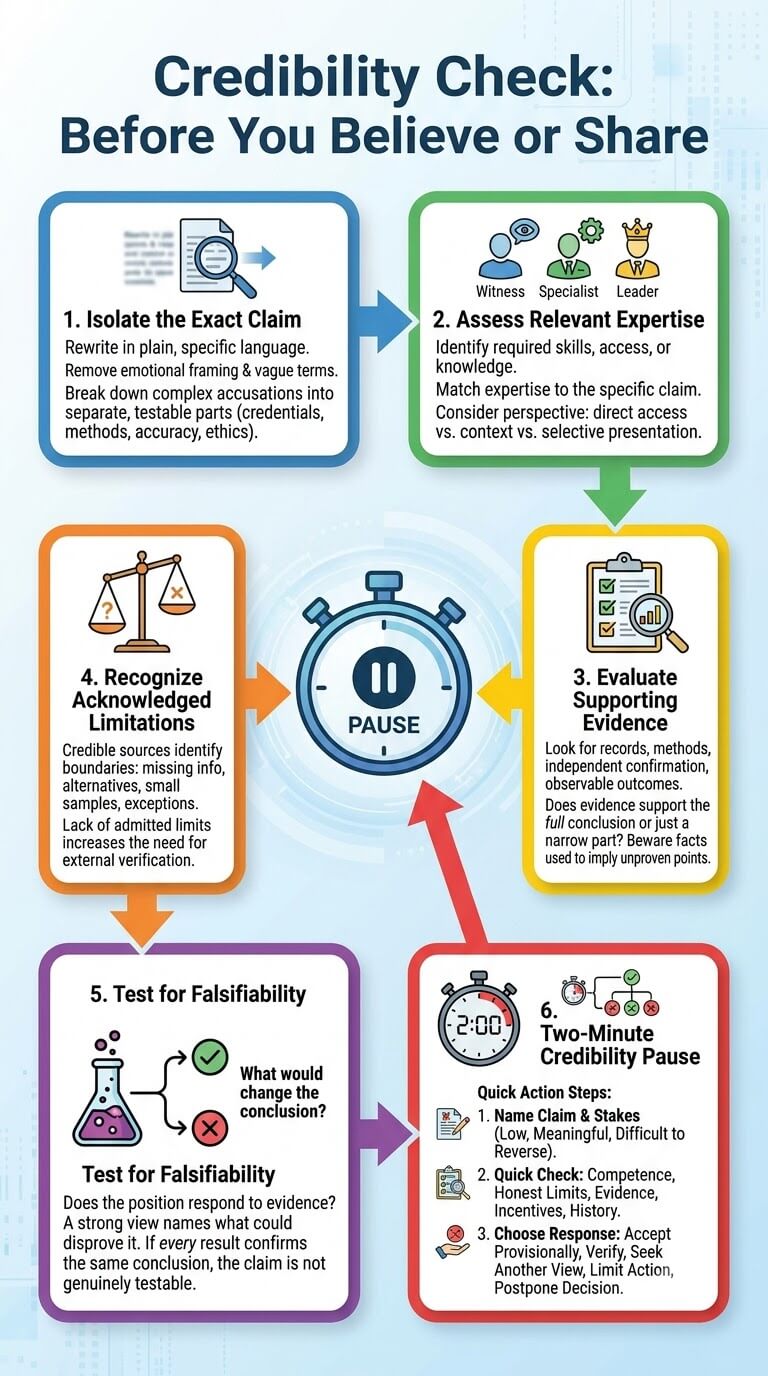
A brief pause can keep an appealing message from becoming automatic belief.
What exactly is being claimed?
Rewrite the statement in plain, specific language. Remove emotional framing, personal attacks, and impressive but vague terms. “This expert is a fraud” may contain several separate claims about credentials, methods, accuracy, or ethics. Each requires different evidence.
What expertise is relevant to that claim?
Identify the skill, access, or knowledge needed to know. A witness may have direct access but limited context. A specialist may understand the context but not the private event. A leader may know the decision but have reasons to present it selectively.
What evidence supports it?
Look for records, methods, observable outcomes, independent confirmation, or specific reasons. Ask whether the evidence supports the full conclusion or only a narrower part. A real fact can be used to imply something it does not establish.
What uncertainty or limitation is acknowledged?
Credible communication usually has boundaries. Notice whether the source identifies missing information, alternative explanations, small samples, exceptions, or conditions. A lack of limitations is not proof of dishonesty, but it raises the value of checking elsewhere.
What would change the source’s conclusion?
This tests whether the position responds to evidence. A strong view can still name what would change it. If every result confirms the same conclusion, the claim is not genuinely testable.
A two-minute credibility pause:
- Name the exact claim and the decision it could affect.
- Rate the stakes: low, meaningful, or difficult to reverse.
- Check relevant competence, honest limits, supporting evidence, incentives, and comparable history.
- Choose a proportional response: accept provisionally, verify, seek another view, limit action, or postpone the decision.
Common Credibility Errors
Most mistakes give one attractive cue too much weight.
Equating popularity with accuracy
Large audiences may reflect entertainment, timing, visibility, or emotional resonance. Reach shows influence, not factual accuracy.
Rejecting accurate information because the source is disliked
Negative feelings can narrow attention toward flaws while positive evidence is ignored. Separate moral, interpersonal, and factual judgments. You may reasonably oppose someone’s behavior and still verify whether a particular statement is accurate.
Believing a familiar claim because it is repeated
Repetition makes retrieval easier, and easy retrieval can feel like confirmation. Pause when a claim feels “obviously true” but you cannot remember where the evidence came from. Familiarity should prompt tracing, not automatic acceptance.
Treating one mistake as proof that every claim is false
Some errors reveal serious dishonesty or incompetence. Others are limited and corrected. Evaluate the type of mistake, whether it falls inside the relevant domain, how the person responds, and whether the failure repeats. Total rejection may be justified in a narrow area without extending to every statement the person makes.
Treating credentials as a substitute for current evidence
Credentials indicate training or qualification, not permanent accuracy. Good evaluation considers both expertise and the support offered for the present claim. This is especially important when experts speak outside their field, rely on outdated knowledge, or make recommendations with major medical, legal, or financial consequences.
Credibility vs Nearby Trust Concepts
Each concept answers a different question about reliance or belief.
Credibility vs interpersonal trust
Credibility asks whether information deserves belief. Interpersonal trust asks whether reliance feels reasonable across a wider set of behaviors and interests. You might believe a person’s technical report while not trusting their discretion, or trust their care while seeking a second opinion on a specialized question.
A useful distinction between trust and distrust is that credibility can sometimes be judged narrowly, claim by claim, without making a total judgment about the source.
Credibility vs consistency
Consistency shows whether behavior or messaging follows a recognizable pattern. It can strengthen credibility when explanations remain compatible with evidence and predictions perform well. Yet a false statement can be repeated consistently, and a truthful source may update its position when new facts appear.
Healthy skepticism vs suspicion of hidden motives
Healthy skepticism asks for proportionate evidence and remains open to revision. Suspicion focuses more strongly on the possibility that something concealed is driving the message. Motive can be relevant, but searching for hidden intention should not replace checking the visible claim and available evidence.
Credulity vs open-mindedness
Open-mindedness allows a new idea to be considered without requiring immediate acceptance. Credulity lowers discrimination and accepts information too readily. A person can listen respectfully, understand an argument, and still withhold belief until the support is adequate.
What to Do When Credible Sources Disagree
Disagreement requires comparison, not simply choosing the firmer voice.
Compare the exact scope of disagreement
Two credible people may agree on most facts but disagree about one estimate, method, or recommendation. Write down the precise point of conflict. Are they using different definitions, time frames, populations, or risk tolerances? Broad summaries often make a narrow disagreement look total.
Separate evidence disputes from value judgments
People may agree about likely outcomes and still choose differently because they value speed, cost, fairness, autonomy, or caution differently. Evidence can inform these choices without deciding every value question. Naming the value conflict reduces the temptation to label one side ignorant or dishonest.
Hold a provisional conclusion when evidence is incomplete
You do not always need immediate certainty. A provisional view can guide a reversible step while preserving room to update. For high-stakes medical, legal, or financial decisions, consult qualified professionals and verify the advice through appropriate records or independent opinions rather than relying only on a general credibility checklist.
A practical sentence is: “Based on the evidence available, this explanation seems more likely, but I would change my view if these missing facts turn out differently.” That is not indecision. It is confidence calibrated to what is currently known.
Frequently Asked Questions About Credibility Psychology
These answers address common difficulties in evaluating people and claims.
Does confidence make someone more credible?
Confidence can be one cue that a person understands familiar material, but it is not reliable by itself. People may sound certain because they are rehearsed, socially dominant, rewarded for strong opinions, or unaware of what they do not know. Compare confidence with relevant expertise, evidence, acknowledged limits, and past accuracy.
Is honesty more important than expertise?
It depends on the decision. Honesty is essential because expertise used deceptively can mislead effectively. Expertise is also essential when the question requires specialized knowledge. A sincere person may report their experience accurately and still give a weak technical conclusion. Strong credibility usually requires both truthful communication and competence relevant to the claim.
Can a biased source still provide accurate information?
Yes. Bias or self-interest may influence selection and framing without making every detail false. Identify what the source has reason to emphasize, then verify important claims independently. A disclosed bias is easier to account for than a hidden one, but disclosure alone does not guarantee accuracy.
Why do people trust familiar voices?
Familiar voices are easier to process and may feel socially safer. Repeated exposure also creates a sense that the message is widely known. These feelings can increase receptivity even when the evidence has not improved. Familiarity is a reason to notice your reaction, not a reason to dismiss or accept the speaker automatically.
How can I judge credibility without becoming distrustful of everyone?
Use proportional standards. Low-stakes, reversible claims may only need a quick check. High-stakes or difficult-to-reverse decisions deserve stronger evidence and independent confirmation. Keep judgments specific by domain and claim, and allow people to correct mistakes. Selective trust is more workable than either automatic belief or universal suspicion.
Key Takeaways
- Credibility is an estimate of whether a person or source is likely to provide accurate, honest, and relevant information, not a guarantee of truth.
- Competence, honesty, evidence, motive, and track record should be evaluated together and matched to the exact claim.
- Confidence, familiarity, status, likability, and repetition can influence belief even when they add little factual support.
- Expertise is domain-specific, and responsible uncertainty may be more credible than unsupported certainty.
- Mixed motives do not automatically make information false, but hidden incentives increase the need for independent checking.
- A useful next step is to state the claim precisely, rate the stakes, and choose a level of verification proportional to the possible cost of being wrong.
Educational note: Michael Reed is the Founder and Lead Writer at Psychology Exposed. He explains human behavior, relationships, emotional patterns, self-awareness, and everyday decisions in clear, research-aware language. This article is educational and does not replace individualized medical, legal, financial, mental health, or safety guidance.

Michael Reed is the Founder and Lead Writer at Psychology Exposed. He writes about human behavior, relationships, emotional patterns, self-awareness, and practical psychology topics using research-informed, easy-to-understand content.
Read More About Michael Reed: https://psychologyexposed.com/michael-reed/