

Trust is often discussed as if it depends on finding the right words. Someone promises they will change, explains why they disappeared, says they care, or makes a dramatic gesture that feels convincing in the moment. Yet the question that usually matters most is simpler: what happens next, and does it keep happening?
Looking at how trust develops shows why repeated reliable moments can gradually carry more weight than one impressive gesture.
Consistency gives people something they can use. It turns intentions into a pattern, helps the mind estimate what is likely to happen, and makes cooperation less dependent on constant checking. This does not mean a trustworthy person must be perfectly predictable. It means their commitments, explanations, responses, and values are reasonably aligned across time, including when keeping that alignment is inconvenient.
Quick Answer

Consistency builds trust because repeated behavior makes another person easier to predict. Trust grows when words, actions, communication, and responses align often enough that reliance feels reasonable. One mistake does not automatically make someone untrustworthy, and consistent behavior does not prove that someone is kind or safe. The useful question is whether the pattern is relevant, transparent, accountable, and sustained over time.
Why the Mind Uses Consistency as Evidence
Repeated patterns reduce uncertainty
Every act of trust includes some uncertainty. You cannot fully know whether a friend will keep a confidence, whether a coworker will finish their part, or whether an organization will apply its rules fairly. The mind therefore looks for patterns that make the future less difficult to estimate.
Research on subjective consistency and trust judgments suggests that people tend to trust others more when their behavior appears internally consistent. Consistency is useful because it creates a coherent expectation. Even when the outcome is not ideal, knowing what usually happens can reduce the need to prepare for several incompatible possibilities at once.
Stable responses help people plan and cooperate
Dependability matters most when another person must organize their behavior around yours. If you regularly arrive when agreed, communicate delays, respect limits, and complete what you accept, other people can plan without building several backup plans. Their attention is free for the task or relationship itself rather than for managing uncertainty.
Inconsistency increases monitoring and protective behavior
When behavior changes without explanation, people often begin monitoring details that previously felt unimportant. They may check messages repeatedly, ask for reassurance, confirm plans several times, document conversations, or avoid depending on the person altogether. These responses do not always mean the observer is controlling or anxious. They may be attempts to manage an environment that has become hard to predict.
The mind also learns from consequences. Research describing trust development as an expectancy-learning process shows why repeated experiences matter: expectations are updated when outcomes support or contradict what a person anticipated. A promise may create hope, but the outcome teaches the stronger lesson.
Consistency is one part of the broader psychology of trust, alongside credibility, vulnerability, expectations, stakes, and accountability.
The Four Layers of Trust-Building Consistency

Consistency is not one single behavior. A person can be punctual but emotionally unpredictable, honest about facts but unreliable with commitments, or warm in private while applying different values in public. A fuller judgment looks across four layers.
Commitment consistency: doing what was agreed
This is the most visible layer. It includes keeping appointments, completing accepted responsibilities, paying back money, respecting confidentiality, and following through on agreed changes. Commitment consistency does not require saying yes to every request. In fact, a clear no is often more trustworthy than an enthusiastic yes that will not be honored.
A useful sign is whether the person makes commitments in proportion to their actual capacity. Someone who says, “I can do the first part by Thursday, but not the whole project,” gives you information you can plan around. Someone who repeatedly promises everything and delivers unpredictably may create more emotional intensity, but less usable trust.
Communication consistency: keeping explanations clear and compatible
Reliable communication means that explanations do not constantly shift according to the audience or the immediate pressure. Details may be corrected as new information appears, but the central account remains understandable. When plans change, the person communicates rather than leaving others to discover the change after it causes a problem.
Emotional consistency: responding without unpredictable punishment or withdrawal
No one has the same mood every day. Emotional consistency is not permanent calmness or constant warmth. It is a reasonable stability in how another person treats you when they are disappointed, stressed, embarrassed, or told no.
For example, a manager can be frustrated and still avoid public humiliation. A partner can need space and still state when they will return to the conversation. A parent can disagree without withdrawing affection as punishment. The relevant evidence is not whether difficult emotion appears, but whether the person’s basic respect and responsibility disappear whenever emotion becomes uncomfortable.
Values consistency: applying stated principles when they become costly
Values become informative when following them requires effort, sacrifice, or fairness toward someone with less power. It is easy to claim honesty when the truth is convenient, or fairness when your preferred person benefits. Trust grows when stated principles continue to guide behavior after the cost rises.
| Layer | What consistency looks like | What weakens trust |
|---|---|---|
| Commitments | Realistic promises, dependable completion, early renegotiation | Repeated overpromising, unexplained misses, selective follow-through |
| Communication | Compatible explanations, clear intentions, timely updates | Changing stories, hidden changes, mixed verbal and nonverbal messages |
| Emotional response | Basic respect remains during stress, conflict, or disappointment | Unpredictable punishment, contempt, disappearance, or retaliation |
| Values | Principles still apply when inconvenient or costly | Rules change to protect status, image, or personal advantage |
Words, Actions, and Follow-Through

Why believable language cannot replace repeated evidence
Language matters. Clear explanations, sincere apologies, and thoughtful promises can reveal intention and make coordination possible. The problem begins when words are treated as the final evidence rather than the beginning of a test.
A compelling explanation may temporarily reduce discomfort because it gives the situation a coherent story. However, coherence is not the same as reliability. The stronger question is whether the explanation predicts later conduct. If someone says they understand why lateness caused a problem, do they begin leaving earlier, warning you sooner, or making fewer unrealistic plans?
How realistic promises strengthen credibility
Trustworthy commitments are usually specific enough to evaluate and modest enough to keep. “I will be more supportive” is emotionally appealing but vague. “I will not share this with the team, and I will ask before discussing it with anyone else” defines the expected behavior.
Realistic promises also include limits. A dependable person may say that they cannot guarantee an outcome, but can guarantee an action: they will call by Friday, tell you if the deadline changes, or document the decision. This kind of accuracy may sound less impressive than certainty, yet it gives trust a stronger foundation.
Why early communication protects trust better than excuses afterward
Sometimes a commitment cannot be kept. A child becomes sick, a workload changes, money is delayed, or new information makes the original plan unwise. The trust question then shifts from “Was the plan completed?” to “How was the exception handled?”
Early communication allows the affected person to adjust. It also shows that their time and exposure were considered before the failure became unavoidable. By contrast, an explanation offered only after discovery may be true, but it does not undo the cost of being left without usable information.
A practical relationship resource from The Gottman Institute on everyday trust similarly emphasizes matching words with actions, communicating intentions, admitting mistakes, and being accountable. These principles apply beyond romantic relationships because all of them make another person’s expectations more accurate.
Consistency Does Not Mean Perfection
Reliable people still forget, fail, and change plans
A perfect record is not a realistic requirement for trust. People misjudge time, lose focus, become ill, misunderstand instructions, and make choices they later regret. Treating every deviation as proof of untrustworthiness can create rigidity and make honest correction harder.
One useful distinction is between a lapse and a pattern. A lapse is limited, acknowledged, and followed by correction. A pattern repeats despite clear feedback, often with similar costs transferred to other people. The number of incidents matters, but so do their seriousness, similarity, explanation, and response.
The pattern after a mistake matters
Mistakes provide information that easy moments cannot. After a problem, does the person deny what happened, argue about your right to care, blame circumstances entirely, or pressure you to move on? Or do they name the impact, answer reasonable questions, make repair where possible, and alter the condition that produced the mistake?
After a rupture, rebuilding trust requires consistency to become new evidence over time rather than a short burst of improved behavior.
An apology is most credible when it changes the next decision. That change may be small: setting a reminder, declining an extra responsibility, adding a review step, sharing information earlier, or asking before crossing a boundary. The new behavior tells you whether accountability has moved beyond emotion.
Flexibility can be trustworthy when reasons are transparent
Consistency should not force people to repeat an outdated choice. A friend may revise a belief after learning more. A leader may change a policy when evidence shows harm. A partner may need to renegotiate how responsibilities are divided after a job change.
Transparent flexibility usually includes three elements: the person names what changed, explains why the old expectation no longer fits, and considers the effect on others. This preserves continuity at the level that matters. The exact action changes, but the values of honesty, fairness, and responsibility remain stable.
Healthy Consistency vs Rigid Predictability
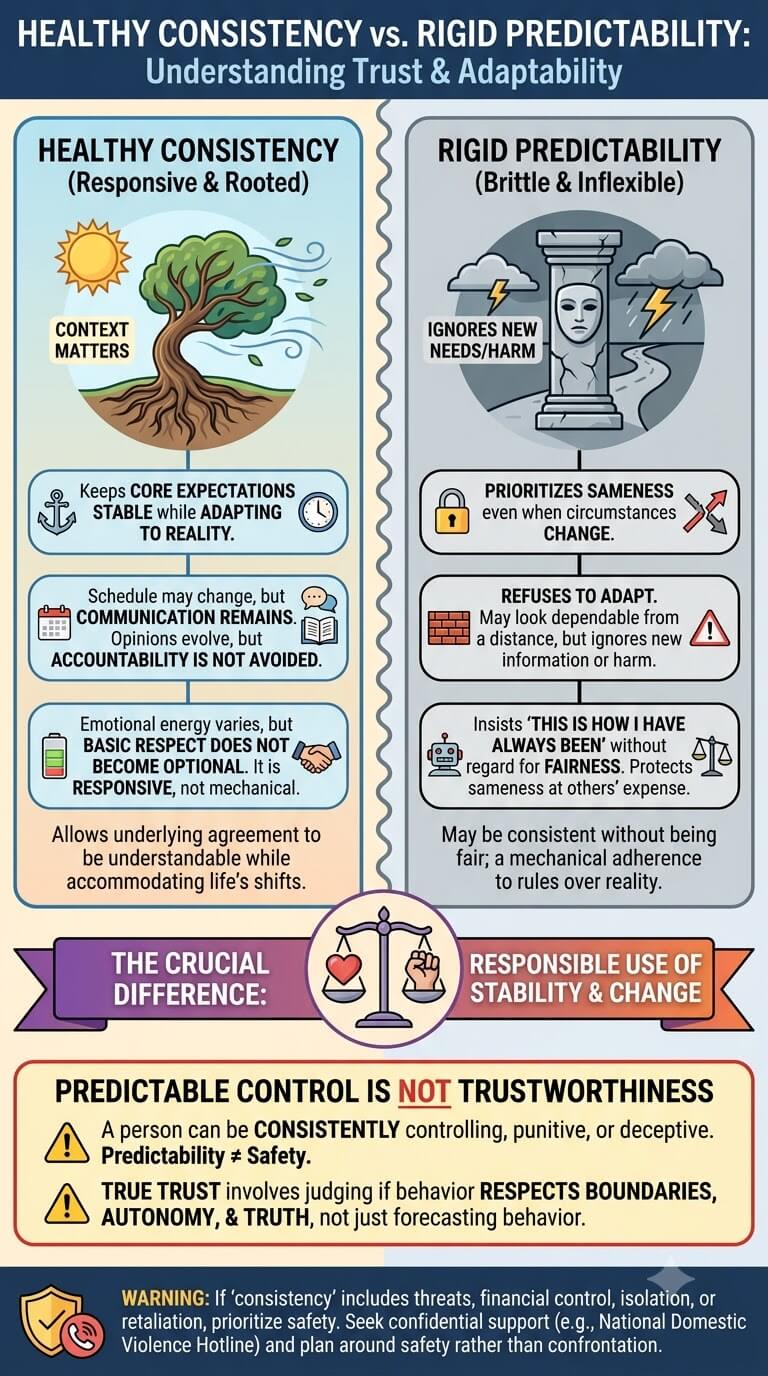
Healthy consistency keeps core expectations stable while adapting to reality
Healthy consistency makes key expectations dependable without demanding identical behavior in every setting. The person’s schedule may change, but they still communicate. Their opinion may evolve, but they do not rewrite what they previously said to avoid accountability. Their emotional energy may vary, but basic respect does not become optional.
This kind of consistency is responsive rather than mechanical. It allows context to matter while keeping the underlying agreement understandable.
Rigidity prioritizes sameness even when circumstances change
Rigid predictability can look dependable from a distance because it produces the same answer every time. Yet refusing to adapt may ignore new needs, information, or harm. A family rule that never changes, a workplace process that cannot accommodate disability, or a person who insists that “this is how I have always been” may be consistent without being fair.
The issue is not change itself. The issue is whether change and stability are used responsibly. Trustworthy flexibility responds to reality. Rigidity protects sameness, sometimes at other people’s expense.
Predictable control or cruelty is not trustworthiness
A person can be consistently controlling, punitive, deceptive, or humiliating. Predictability may help you anticipate them, but it does not make them safe. Trust requires more than the ability to forecast behavior. It also involves judging whether the behavior respects boundaries, autonomy, truth, and relevant responsibilities.
If “consistency” includes threats, intimidation, stalking, financial control, isolation, humiliation, or retaliation, communication tips should not be the first priority. The National Domestic Violence Hotline’s explanation of power and control can help distinguish ordinary unreliability from a broader pattern used to limit another person’s choices. Consider seeking confidential support and planning around safety rather than confronting the person in a way that could increase danger.
How Inconsistency Affects the Other Person
Increased checking and reassurance seeking
When previous assurances have not predicted outcomes, a person may stop treating reassurance as sufficient. They ask again, request proof, confirm details, or watch for small contradictions. This can frustrate both people. One feels monitored, while the other feels they are doing the work required to make the situation predictable.
More reassurance is not always the solution. If the problem is unreliable behavior, repeated comforting statements may briefly settle emotion while preserving the cause. A better response is to identify what evidence would reduce the need to check.
Difficulty planning or relaxing
Inconsistency forces people to hold more possibilities in mind. Will the person arrive? Will they complete the task? Will the mood change when a limit is stated? Will private information remain private? Even if each uncertainty seems small, the combined demand can make relaxation difficult.
Overattention to tone, timing, and small changes
When the large pattern is unclear, small cues gain importance. A delayed reply, unusual wording, altered expression, or slight change in routine may be treated as a possible warning. Some of these interpretations will be inaccurate, but they do not arise in a vacuum when earlier surprises carried real costs.
Restoring steadiness requires more than telling the person not to overthink. It requires reducing unnecessary ambiguity and allowing enough time for new evidence to become believable.
Lower willingness to disclose or depend
Trust affects access. People share less, ask for less, delegate less, and reveal fewer needs when they are unsure how information or dependence will be handled. This withdrawal may look like coldness, secrecy, or lack of commitment. It may also be a proportionate response to unreliable conditions.
Demanding greater openness before improving consistency reverses the order. Access should increase because evidence supports it, not because someone is pressured to prove loyalty.
A Consistency Evidence Check

The following questions help separate a real pattern from a strong reaction to one event. They are not a scoring test, and the seriousness of a single incident may still matter greatly.
Is the pattern repeated across time rather than selected from one moment?
Look for several relevant examples in different circumstances. One excellent act does not erase repeated failures, and one disappointing act does not erase a long record of dependability. Ask what happens most often, especially in situations similar to the decision you are making now.
Does behavior stay similar when no reward or audience is present?
Public behavior can be shaped by reputation, status, or immediate reward. Private behavior often reveals whether the action is part of a stable value or a performance. This does not mean private mistakes are more “real” than public strengths. It means both settings belong in the evidence sample.
Are exceptions explained before they become surprises?
Exceptions are inevitable. Trust depends partly on whether the person gives timely, relevant information and acknowledges the cost of the change. Repeated surprises followed by persuasive explanations still leave the other person unable to plan.
Does accountability change future behavior?
Accountability is not only accepting blame. It includes understanding the mechanism of the failure and changing it. If the same event keeps happening after the same apology, the apology may be sincere while the reliability problem remains unresolved.
Is the behavior relevant to the trust decision being made?
Someone can be consistent in one area and unreliable in another. A coworker may meet deadlines but gossip. A relative may be emotionally supportive but poor with money. A source may report one subject accurately and speak beyond its competence elsewhere.
A broad review of how and why humans trust highlights that trust depends on characteristics of the person who trusts, the person or system being trusted, and the surrounding context. This supports a domain-specific judgment rather than a single global label.
Common Mistakes When Judging Consistency
Confusing intensity with reliability
Intensity attracts attention. A dramatic apology, urgent declaration, expensive gift, or emotional confession can feel more meaningful than a month of ordinary follow-through. Yet intensity tells you how strong the moment feels, not how stable future behavior will be.
When evaluating change, give more weight to repeated low-drama actions. They are easier to overlook precisely because they do not demand attention.
Ignoring a pattern because each incident seems small
A five-minute delay, one unanswered message, or one forgotten errand may not matter much by itself. Repeatedly minimizing each event in isolation can hide the cumulative pattern. The practical harm often comes from the expectation that the next small agreement may also fail.
Instead of arguing over whether each incident is “serious enough,” examine the repeated effect. Are you doing extra checking, planning, emotional labor, or repair because the same category of commitment remains unstable?
Demanding impossible sameness from a human being
Consistency is not identical energy, availability, or performance every day. Illness, grief, disability, caregiving, work demands, and changing capacity affect behavior. A fair judgment considers whether the person communicates their limits and renegotiates responsibilities rather than treating variation itself as a betrayal.
The goal is dependable orientation, not robotic repetition. You should be able to understand what changed and what you can reasonably expect now.
Treating one improved week as proof of lasting change
Early improvement is encouraging, but it may reflect urgency, fear of consequences, or short-term focus. Sustainable change appears across ordinary days, stressful periods, competing demands, and moments when praise is no longer immediate.
You do not need to dismiss improvement. You can acknowledge it while keeping access and dependence proportional to the amount of evidence available.
Consistency and Nearby Trust Questions
Consistency vs credibility
Consistency helps answer, “Does this person or source behave in a stable, compatible way?” Credibility asks a narrower question about whether a claim, speaker, or source deserves belief. Consistency can support credibility, but a consistently repeated statement can still be false. Evidence, expertise, honesty, and motive also matter.
Consistency within the broader development of trust
Trust develops through more than repetition. Responsiveness, competence, honesty, boundaries, and context also shape what a person learns. Consistency is one mechanism that turns separate events into a recognizable expectation. It does not by itself determine what kind of expectation is being learned.
Inconsistency as one pathway through which trust breaks
Trust can break through deception, secrecy, exploitation, betrayal, or a serious single violation. It can also erode gradually when small commitments become unreliable and explanations stop predicting behavior. This article focuses on that gradual evidence problem, not every way trust can be damaged.
Sustained consistency as evidence during trust rebuilding
After trust is harmed, consistent action becomes one part of repair. It cannot erase the impact or force forgiveness, and the affected person may need boundaries even while change is occurring. What consistency can do is provide new evidence that the conditions behind the harm are being addressed.
How to Become More Trustworthy Through Consistency
Make smaller commitments that can actually be kept
Before agreeing, check your time, energy, authority, and competing responsibilities. A smaller promise kept is more useful than a generous promise that transfers the cost of failure to someone else. You can still be caring without pretending to have unlimited capacity.
Try language such as, “I cannot finish all of it today, but I can complete these two parts by six,” or “I am not ready to promise a decision, but I can give you an update Friday.”
Communicate changes early
Do not wait until the other person has already built plans around an expectation. As soon as a meaningful risk appears, share what you know, what remains uncertain, and when you will know more. Early communication is not an admission of failure. It is a way of sharing reality before the consequences widen.
Match apologies with a visible adjustment
After a repeated problem, ask what concrete condition needs to change. Will you reduce your commitments, use a reminder, stop making decisions while emotional, clarify ownership, ask permission, or create a check before sharing information?
A useful apology may sound like: “I said I would update you and did not. That left you unable to plan. I have added the deadline to our shared calendar, and I will tell you by noon if it changes.” The adjustment is modest, but it makes the next event testable.
Let repeated behavior carry the message
When someone has doubts, it is tempting to explain harder or ask them to recognize your effort immediately. Trust may lag behind improvement because the old expectation was learned through repetition. Allow the new behavior to accumulate without demanding instant access, closeness, or confidence as a reward.
You can name what you are doing, but avoid turning every improvement into a request for reassurance. Quiet dependability often communicates more clearly than repeated claims that you are now dependable.
When Additional Support May Help
Support may be useful when inconsistency is tied to severe stress, substance use, attention difficulties, depression, unresolved conflict, or responsibilities that consistently exceed capacity. A qualified professional can help identify what is interfering with follow-through without reducing the issue to laziness or bad character.
In relationships or workplaces, structured mediation may help when both sides can participate safely and there is genuine willingness to share information and accept limits. It is not appropriate to rely on joint communication when there are threats, coercion, stalking, intimidation, humiliation, financial control, or fear of retaliation. In those circumstances, seek confidential safety guidance suited to your location and situation.
Frequently Asked Questions About Consistency and Trust
How much consistency is enough to trust someone?
There is no universal number of days or successful actions. The needed evidence depends on what is at stake, how serious previous failures were, whether the behavior appears across relevant situations, and how easily harm could be reversed. Low-stakes trust can grow from a modest record. Access to money, private information, safety, or major decisions usually deserves stronger evidence and clearer safeguards.
Can an inconsistent person still be honest?
Yes. A person may tell the truth but struggle with planning, capacity, attention, avoidance, or follow-through. Honesty matters because it allows the problem to be understood accurately, but honesty alone does not make dependence workable. Trust can be calibrated by domain: you may believe the person’s account while limiting responsibilities that require dependable execution.
Does changing your mind damage trust?
Not necessarily. Changing your mind can show learning, reflection, or respect for new evidence. Trust is more likely to be damaged when the change is hidden, denied, repeatedly delayed, or imposed after others have carried the cost. Explain what changed, communicate early, and address the practical effect on people who relied on the earlier decision.
Why do broken small promises matter so much?
Small promises often form the majority of a person’s evidence about everyday reliability. Each incident may have a minor cost, but repetition teaches that agreements require monitoring or backup plans. The emotional reaction may therefore be about the accumulated expectation, not only the latest forgotten task.
Can someone act consistently for manipulative reasons?
Yes. Consistency shows predictability, not moral intent. Someone may behave reliably to gain access, protect an image, create dependence, or maintain control. Evaluate whether the behavior respects boundaries, remains fair when there is no reward, tolerates your independence, and aligns with verifiable evidence. Consistency should be considered alongside honesty, motive, competence, and safety.
Key Takeaways
- Consistency supports trust by making future behavior easier to estimate.
- Commitments, communication, emotional responses, and values can each be consistent or inconsistent in different ways.
- Reliable people still make mistakes; accountability becomes meaningful when it changes later behavior.
- Flexibility can strengthen trust when the reasons are transparent and the effect on others is addressed.
- Predictable control, cruelty, or deception is not trustworthiness.
- Judge the pattern that is relevant to the decision, then match access and dependence to the evidence available.
Final Thoughts
The next useful step is not to decide whether someone is “a trustworthy person” in the abstract. Choose one area of reliance and examine the evidence that belongs to it. What was agreed? What usually happens? How are exceptions communicated? Does accountability change the next outcome?
If you are evaluating someone else, let repeated behavior carry more weight than intensity. If you are trying to become more dependable, make one realistic commitment, communicate changes before they become surprises, and keep the adjustment long enough for others to learn from it. Trust rarely needs a grand performance. It needs evidence that remains usable after the moment has passed.
Educational note: Michael Reed is the Founder and Lead Writer at Psychology Exposed. He writes about human behavior, relationships, emotional patterns, self-awareness, and everyday decisions in clear, research-aware language. This article is educational and does not replace individualized mental health, safety, medical, or legal support.

Michael Reed is the Founder and Lead Writer at Psychology Exposed. He writes about human behavior, relationships, emotional patterns, self-awareness, and practical psychology topics using research-informed, easy-to-understand content.
Read More About Michael Reed: https://psychologyexposed.com/michael-reed/