

Betrayal can feel strangely larger than the event that caused it. A lie may take seconds to tell. A private message may take minutes to discover. A promise may be broken in a single decision. Yet the emotional impact can spread backward into old memories and forward into situations that have not happened yet.
That is because betrayal is rarely only about one action. It can change what you thought was safe, what you believed a relationship or agreement meant, how much you trust your own judgment, and what you expect from people in the future. The result may be anger, grief, numbness, confusion, repeated mental replay, or a sudden urge to check every detail. These reactions do not automatically mean a mental health disorder. They often reflect a mind trying to make sense of a serious mismatch between what was trusted and what actually happened.
This article explains the psychology of betrayal across romantic relationships, friendships, families, workplaces, communities, and institutions. It focuses on understanding the impact, not on telling you whether to forgive, stay, leave, reconcile, confront, or cut contact. Those are separate decisions, and safety matters more than conversation when there are threats, stalking, coercion, retaliation, or control.
Quick Answer

Betrayal hurts because an important expectation is violated by a person, group, or institution you relied on. The mind then has to update more than one belief at once: who is safe, what the past meant, whether your judgment can be trusted, and what may happen next. That combination helps explain why betrayal can produce both strong emotion and persistent uncertainty.
What Counts as Betrayal in Psychology?
Not every disappointment is betrayal. The word becomes most useful when there was meaningful trust, dependence, duty, loyalty, or a shared understanding that mattered to the person who was affected.
There was meaningful trust or dependence
Betrayal usually requires some form of reliance. You expected a partner to honor an agreement, a friend to protect something private, a manager to represent your work accurately, a family member to keep an important promise, or an institution to act according to duties it publicly accepted.
The level of dependence matters because the violation may affect money, reputation, belonging, work, family relationships, or the ability to make informed decisions.
An important expectation, duty, boundary, or shared reality was violated
The violation may involve deception, secrecy, divided loyalty, exposure of private information, misuse of power, failure to protect, or a serious broken agreement. In some cases, the person knew the rule clearly. In others, both people assumed the same rule without ever stating it explicitly.
Two people can disagree about whether something was a betrayal when an expectation was assumed rather than stated. Clarifying what each person reasonably understood can help distinguish a genuine trust violation from a painful mismatch in expectations.
Betrayal makes particular sense within the broader psychology of trust because the injury depends partly on an earlier expectation of reliability, loyalty, or care.
Betrayal is different from disappointment, conflict, and ordinary mistakes
| Experience | What usually makes it different |
|---|---|
| Disappointment | Something important did not go as hoped, but trust or duty may not have been violated. |
| Conflict | Two people have incompatible needs, interpretations, or goals. Conflict can happen without deception or broken loyalty. |
| Ordinary mistake | A person causes harm through error, poor judgment, or forgetfulness without necessarily concealing it or violating a core agreement. |
| Betrayal | A trusted person, group, or institution violates an expectation, duty, boundary, or shared reality that carried meaningful reliance. |
Intent matters, but it is not the only factor. Betrayal may be deliberate or may involve carelessness, concealed consequences, or failure of duty. The psychological impact depends on reliance, violation, consequences, and what happens after discovery.
Why Betrayal Can Feel Bigger Than the Event
The intensity often comes from the number of assumptions that must be revised at once, not only from the visible act.
The act can change what the past seems to mean
Imagine learning that a close friend shared private conversations for months. The new fact does not stay in the present. Earlier lunches, messages, reassurances, and moments of vulnerability may suddenly look different. You may wonder which moments were genuine and which were shaped by information you did not have.
This backward revision is disorienting because one new fact can change how many older moments are interpreted.
You may lose confidence in your own judgment
A common question after betrayal is not only, “Why did they do this?” It is, “How did I not know?” That second question can turn the violation inward. People may criticize themselves for trusting, missing a clue, accepting an explanation, or defending someone to others.
Hindsight makes earlier clues look more obvious than they were. Trust also requires some reliance without constant surveillance, so failing to predict concealed information does not prove that your judgment is generally poor.
Future situations become harder to predict
Before the betrayal, you may have had a working model of how the person or system behaved. Afterward, that model no longer feels dependable. A late reply, changed plan, closed door, unexplained expense, or private conversation may carry more uncertainty than it did before.
The mind may be trying to answer a more basic question: which signals still mean what I thought they meant?
The violation may affect identity, belonging, status, money, or safety
Betrayal can be deeply personal even when it is not romantic. A coworker taking credit for your work may affect professional identity and status. A family secret may change how you understand your history. A community leader hiding serious misconduct may damage belonging. An institution failing to protect people who depend on it can alter trust far beyond one individual interaction.
Research on institutional betrayal and trust in health care organizations illustrates this broader point: harmful institutional responses were associated with lower trust and greater disengagement. The context is health care, so the findings should not be generalized to every institution, but they show how a violation by a system can affect later willingness to rely on that system.
The Betrayal Impact Map
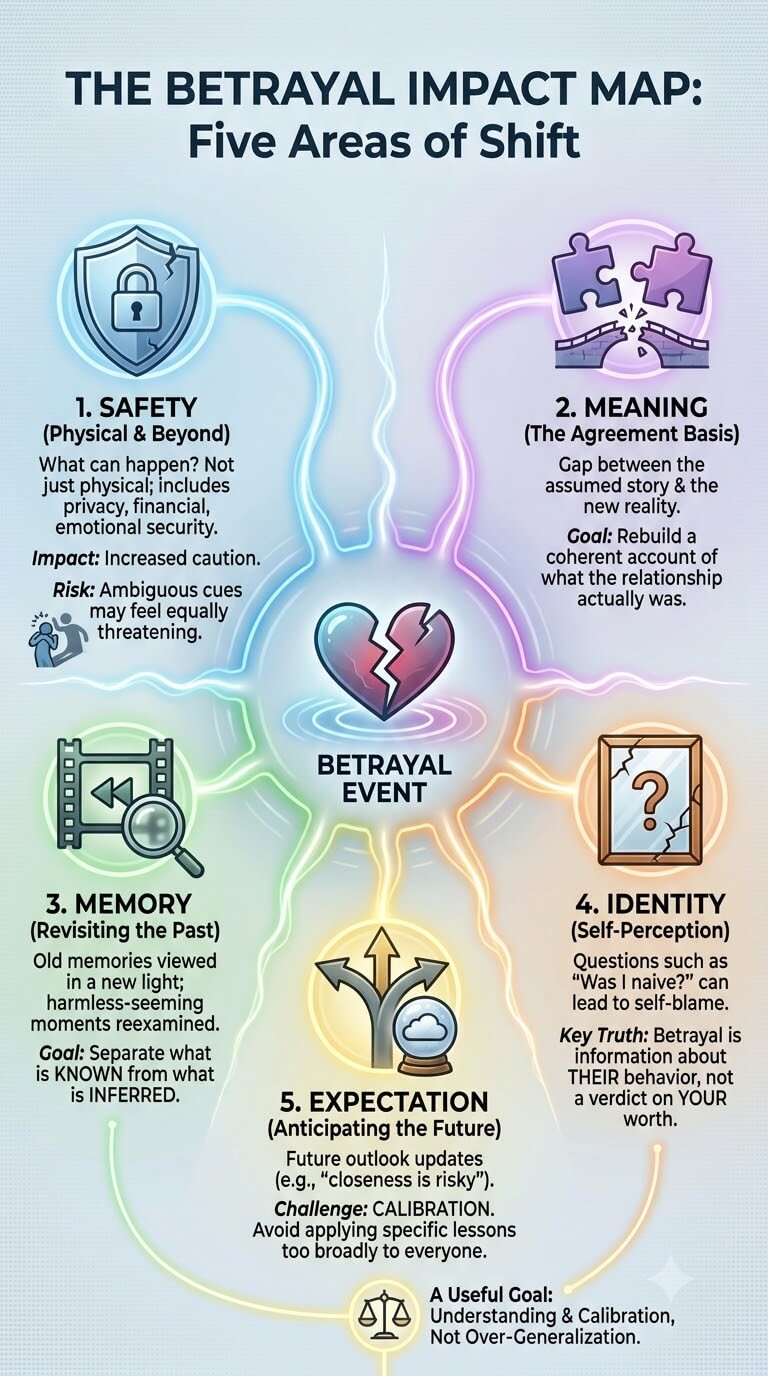
A useful way to understand betrayal is to separate five areas that often shift at the same time: safety, meaning, memory, identity, and expectation. One event can affect all five, or only two or three.
Safety: What can happen, and who can protect me?
Safety does not always mean physical safety. It may mean privacy, financial stability, emotional predictability, professional security, social belonging, or confidence that your boundaries will be respected.
After betrayal, cues connected with the original violation may receive more attention. That caution can help when risk is still present, but it becomes costly when every ambiguous cue feels equally threatening.
Meaning: What was the relationship or agreement actually based on?
Betrayal can create a gap between the story you thought you were living and the one you now have to consider. Secret debt can overturn an assumption of financial honesty; private undermining can overturn an assumption of professional support.
That is why people often search for a complete explanation: they are trying to rebuild a coherent account of what the relationship or agreement actually was.
Memory: Which earlier moments now look different?
New information can cause old memories to be reviewed in a different light. A harmless-seeming comment may now appear suspicious. A trip, meeting, promise, or period of distance may be reexamined for clues.
Not every revised interpretation is correct. A useful goal is to separate what is known from what is inferred rather than forcing certainty about every past moment.
Identity: What does this say about me, us, or my judgment?
Betrayal can threaten identity when trust was tied to seeing yourself as a good judge of character, respected colleague, valued family member, or protected member of a community.
Questions such as “Was I naive?” or “Did I matter?” can turn the event into self-blame. Another person’s deception, disloyalty, or failure of duty is information about their behavior and the situation, not a verdict on your worth.
Expectation: What should I anticipate from others now?
After betrayal, future expectations may update quickly: people hide things, closeness is risky, promises are unreliable, or sharing information creates danger.
A betrayal may also influence difficulty trusting other people later, but the broader trust struggle should not be treated as identical to the original event.
Some updating is sensible. The challenge is calibration. A lesson that accurately describes one person or environment may become too broad if it is applied to everyone.
Common Reactions After Betrayal
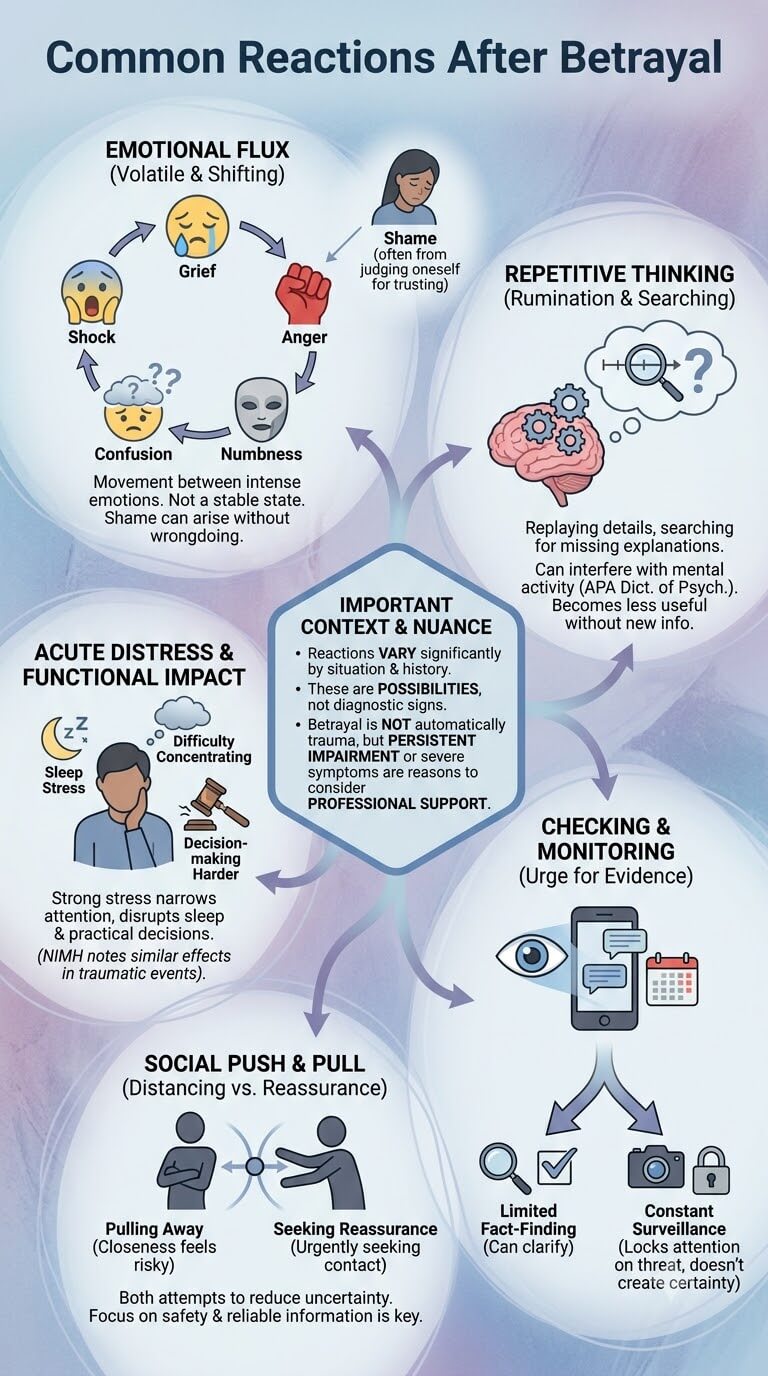
Reactions vary with the stakes, relationship, previous experiences, support, and whether the problem is over or continuing. These are common possibilities, not diagnostic signs.
Shock, numbness, anger, grief, shame, or confusion
A person may move between emotions rather than feel one stable reaction. Anger may appear first and grief later. Numbness may alternate with intense distress. Shame may arise even when the person who was betrayed did nothing wrong, especially if the event involves public embarrassment or a fear of being judged for trusting.
Research reviewing the consequences of romantic infidelity describes substantial emotional distress in many affected partners. The review Love and Infidelity: Causes and Consequences focuses on romantic infidelity, so it should not be treated as evidence for every kind of betrayal, but it helps illustrate why a trust violation in a highly dependent relationship can have effects beyond ordinary disappointment.
Replaying details and searching for the missing explanation
The mind may repeatedly return to a conversation, timeline, record, or disclosure while asking what was missed and what explains the contradiction.
The APA Dictionary of Psychology definition of rumination describes repetitive thinking that can interfere with other mental activity. Repetitive thought after betrayal may begin as an attempt to solve uncertainty, but it can become less useful when the same questions are revisited without new information.
Checking, comparing stories, or monitoring for more evidence
After discovering hidden information, checking may feel like the fastest way to prevent another surprise. Someone may review old messages, compare timelines, ask repeated questions, watch behavior closely, or seek confirmation from other people.
A limited fact-finding period can clarify what happened. Constant monitoring can keep attention locked onto threat without creating certainty. Do not treat surveillance or unauthorized access as a required path to clarity.
Pulling away or urgently seeking reassurance
One person may become distant because closeness feels risky, while another urgently seeks contact or reassurance. Both reactions can be attempts to reduce uncertainty.
Neither response determines what you should do. More useful questions concern safety, reliable information, and whether responsibility is taken without pressure or retaliation.
Difficulty concentrating, sleeping, or making decisions during acute distress
Strong stress can narrow attention, disrupt sleep, and make ordinary decisions harder, especially when practical consequences are still unfolding.
The National Institute of Mental Health notes that genuinely traumatic events can involve sleep problems, concentration difficulties, and repeated thoughts about what happened. Its guidance on coping with traumatic events is useful here as a boundary for severe distress. Betrayal should not automatically be labeled trauma, but persistent impairment or severe symptoms are reasons to consider professional support.
Why the Mind Rechecks the Past
Looking backward is often an effort to fit new information into an older story that no longer feels coherent.
New information triggers reinterpretation
Suppose you learn that a business partner had been negotiating against your interests while reassuring you that the agreement was secure. Earlier delays, vague explanations, and unusual requests may now be reconsidered. This is a normal attempt to integrate new evidence with an older model.
The danger is assuming that every ambiguous past event must now have had a hidden meaning. Some old events may genuinely fit the new information. Others may still be ordinary coincidences or unrelated mistakes.
Memory search attempts to restore a coherent story
Human beings generally prefer stories that make sense. Betrayal creates discontinuity: “I trusted this person” and “this person violated something important” now have to coexist. Searching memory is one way the mind tries to connect those two facts.
A practical approach is to separate confirmed facts, reasonable interpretations, and unanswered questions. This helps prevent repeated possibilities from being mistaken for certainty.
Rumination can feel like problem-solving while keeping threat active
Useful reflection usually produces something new: a clearer timeline, a decision, a question to ask, a boundary, or acceptance that an answer is unavailable. Rumination often circles back to the same point without changing what you know.
If you notice the same mental loop repeating, write down the exact unanswered question. Then ask whether there is a safe and realistic way to obtain new information. If not, the next task may be tolerating uncertainty rather than solving it through more thought.
Betrayal and Future Trust
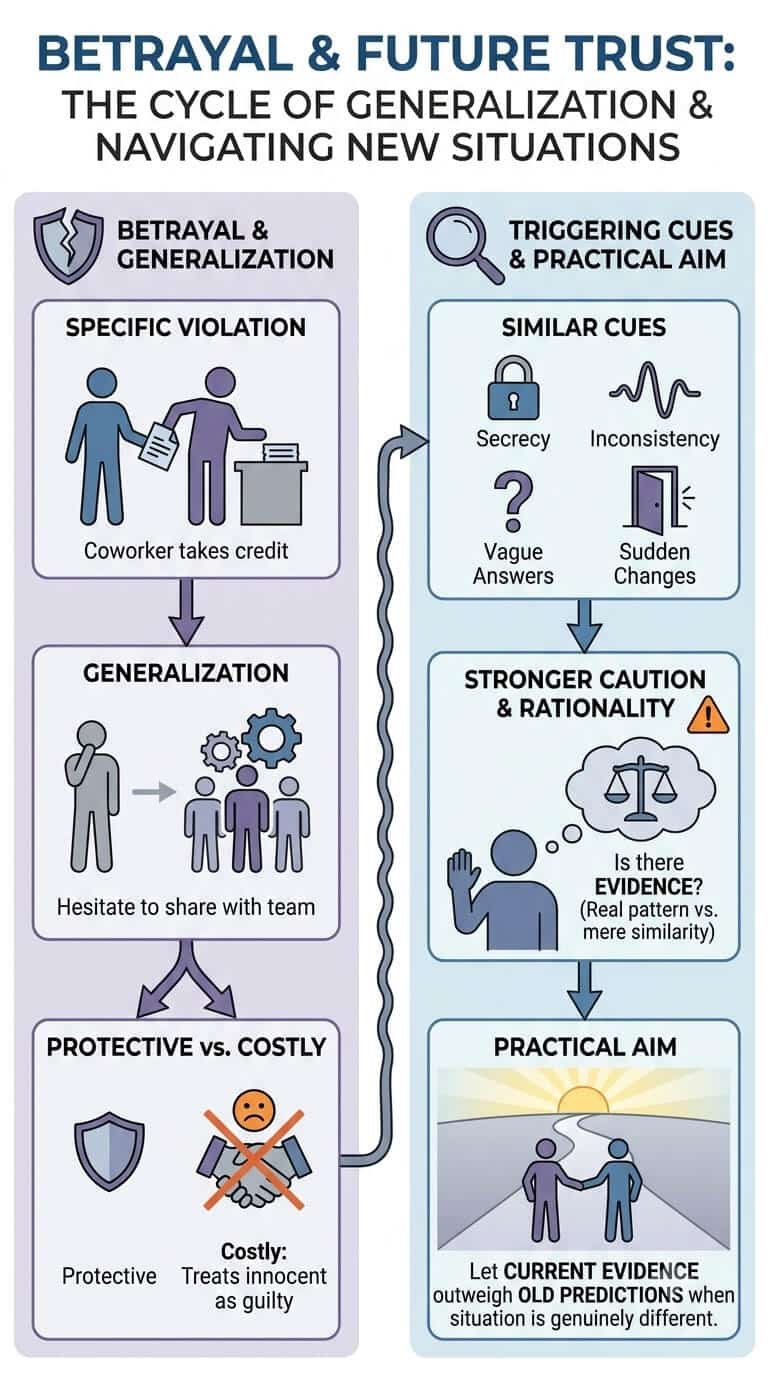
Important violations can influence later expectations, especially when new situations contain cues that resemble the original event.
A specific violation can generalize to other people or contexts
After one coworker secretly takes credit for your work, you may hesitate to share ideas with the whole team. After a partner hides major financial information, you may become more alert to financial secrecy in later relationships. After a community fails to respond to harm, you may distrust similar organizations.
Generalization can protect you, but it becomes costly when people who have not violated your trust are treated as if they already have.
Similar cues may trigger stronger caution later
Cues that resemble the original violation, such as secrecy, inconsistency, vague answers, or sudden changes in access, may carry more weight than before.
This is not automatically irrational. The better question is whether the cue has enough evidence behind it. Caution based on a real pattern is different from treating every similarity as proof.
Betrayal sensitivity can protect and also overpredict risk
A 2025 study on sensitivity to betrayal and new intimate relationship building examined survivors of intimate partner violence. The findings belong to that specific population and should not be generalized to ordinary betrayal, but they support a useful idea: past interpersonal harm can shape how future betrayal risk is perceived and how new closeness is approached.
The practical aim is not to become less cautious on command. It is to let current evidence gradually earn more influence than old predictions when the present situation is genuinely different.
Betrayal Across Different Contexts
The same basic psychology can appear in close relationships, families, workplaces, communities, institutions, and digital spaces.
Romantic relationships and friendships
Betrayal may involve infidelity, secret financial behavior, private information being shared, repeated lying, hidden relationships, or a friend choosing social advantage over an important confidence. What makes these events painful is often the gap between the expected loyalty and the revealed behavior.
Family secrecy or broken loyalty
Family betrayal can involve concealed information about money, caregiving, identity, inheritance, major decisions, or alliances during conflict. Because family relationships often carry long histories and strong assumptions about loyalty, the violation may change how earlier family experiences are understood.
Workplace, leadership, or professional betrayal
A supervisor may promise support and then shift blame. A colleague may use confidential information for advantage. A leader may publicly state one standard while privately rewarding the opposite behavior. These events can affect not only trust in one person but willingness to speak openly, collaborate, or take professional risks.
Institutional betrayal and loss of belonging
People also depend on schools, health systems, workplaces, religious organizations, clubs, public agencies, and other institutions. Betrayal can occur when an institution fails to prevent foreseeable harm, dismisses reports, protects status over people, or punishes someone for raising concerns.
The emotional impact may include a loss of belonging because the institution was part of the person’s identity or community. It may also affect future willingness to seek help from similar systems.
Digital betrayal involving privacy, exposure, or impersonation
Digital environments add forms of betrayal that can spread quickly: sharing private images or messages, accessing accounts without permission, exposing personal information, impersonating someone, or using private conversations publicly.
When the risk includes stalking, monitoring, coercion, threats, or control, treat it as more than a communication problem. The National Domestic Violence Hotline overview of abuse types explains forms of power and control that can include financial, emotional, digital, and other abusive behavior. Safety planning may be more appropriate than direct confrontation if retaliation is a concern.
What Helps in the Early Stage
Early priorities are usually clarity and stabilization, not forcing a final decision while distress and uncertainty are still high.
Stabilize practical basics first
If betrayal affects money, privacy, work, housing, health, or physical safety, practical stabilization may matter more than a perfect explanation. Protect essential accounts where you have the right to do so, preserve important records, and identify one reliable person who can help you think clearly.
When there is fear, coercion, stalking, threats, retaliation, or financial control, get specialized support and consider safety before disclosure or confrontation.
Separate facts, unanswered questions, and feared possibilities
Use three short lists:
- Known: information you can verify.
- Unknown: questions that remain unanswered.
- Feared: possibilities your mind is generating because the situation feels uncertain.
This does not eliminate emotion. It reduces the risk that fear quietly becomes treated as fact.
Limit repeated exposure to details when it becomes destabilizing
Collecting information may be necessary for a time. Once a fact is established, repeatedly reviewing the same upsetting material may add distress without improving understanding.
A useful question is, “What decision will this additional detail help me make?” If there is no answer, stepping away for a period may protect concentration and sleep.
Choose support that does not pressure an immediate decision
Other people may quickly tell you to leave, forgive, expose, reconcile, or forget. Your decision may involve safety, children, money, employment, culture, housing, or information they do not have.
Helpful support gives you room to understand the facts and decide at a pace that fits the actual situation.
Betrayal vs Nearby Trust Problems
| Question | Main focus |
|---|---|
| Why did trust break? | The behaviors and mismatches that weakened an established expectation. |
| Why does betrayal feel so intense? | The effects on safety, meaning, memory, identity, and future expectation. |
| Why do I struggle to trust people? | The broader learning history and expectations that make reliance difficult. |
| Can trust be rebuilt? | Evidence, accountability, changed behavior, boundaries, and time after damage. |
Betrayal is not the same as ordinary disappointment
A disappointing choice can hurt without changing the basic story of who someone is or what the relationship means. Betrayal more often produces a deeper revision because a meaningful expectation, loyalty, duty, or shared reality has been violated.
Examining why trust broke focuses on the behavior or evidence that damaged reliance, while betrayal psychology focuses more on what that discovery does to the person affected.
Betrayal impact is not the same as rebuilding trust
Understanding why you feel disoriented is one task. Deciding whether another person should regain access, influence, closeness, or responsibility is another. You can understand the emotional impact before you know whether repair is possible.
Understanding the impact does not answer whether trust can be rebuilt, because repair requires a separate evaluation of accountability and changed behavior.
Four Decisions That Do Not Need to Be Combined
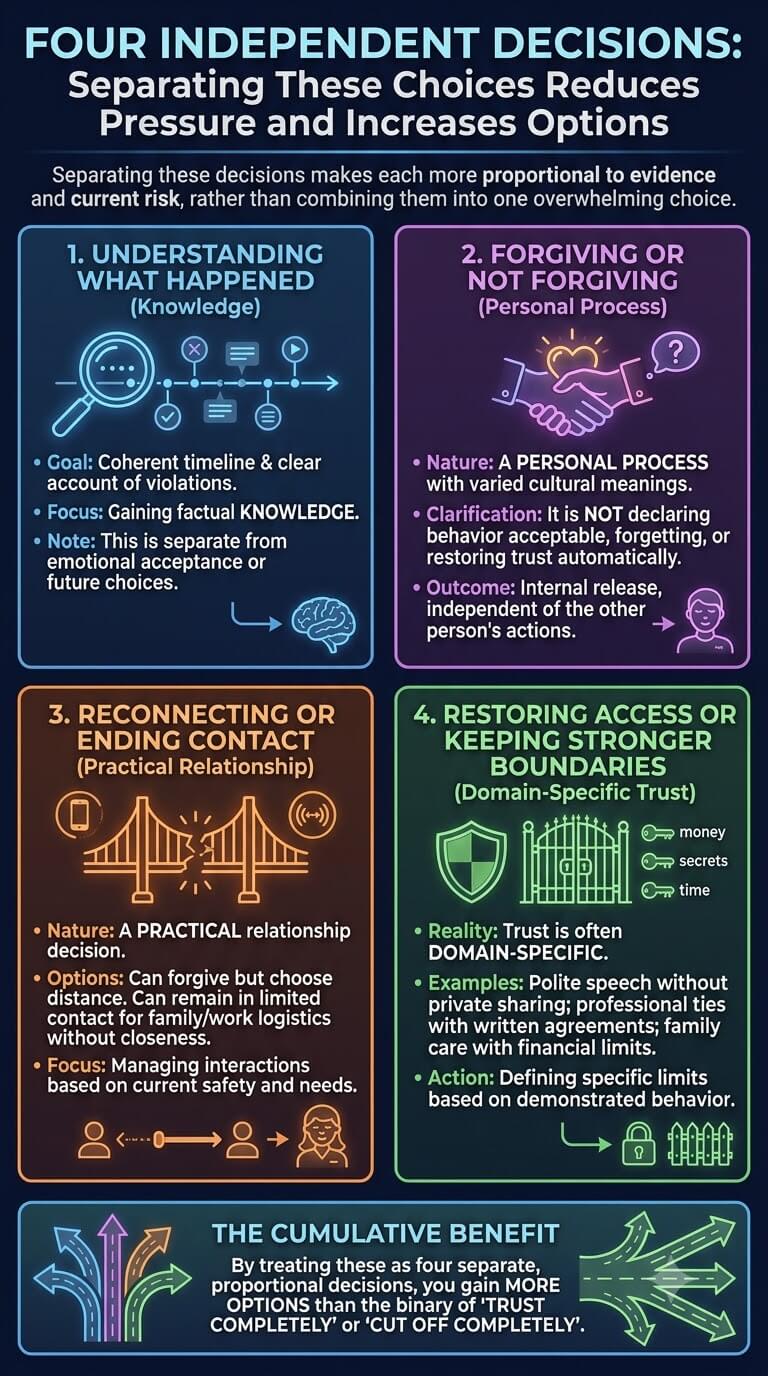
Separating these choices can reduce pressure and make each decision more proportional to the evidence and current risk.
Understanding what happened
You may want a coherent timeline and a clear account of what was violated. That is about knowledge.
Forgiving or not forgiving
Forgiveness is a personal process with different meanings across people and cultures. It is not the same as declaring the behavior acceptable, forgetting it, or restoring trust.
Reconnecting or ending contact
Contact is a practical relationship decision. Someone may forgive and still choose distance. Someone may remain in contact for family, work, or logistical reasons without returning to the previous level of closeness.
Restoring access or keeping stronger boundaries
Trust is often domain-specific. You might speak politely with someone but no longer share private information. You might continue a professional relationship while requiring written agreements. You might care about a family member while limiting their access to money or personal decisions.
Separating these decisions gives you more options than “trust completely” or “cut off completely.”
When to Seek More Support
Extra support is worth considering when distress is severe, functioning is impaired, or the situation includes ongoing danger or control.
Severe distress or difficulty functioning
Consider professional support if distress remains intense, sleep is severely disrupted, panic is frequent, you cannot function at work or home, or thoughts about the event dominate most of the day. A clinician can help assess what is happening without assuming that every betrayal meets criteria for a trauma-related disorder.
Self-harm thoughts or immediate danger
If you are having thoughts of harming yourself, feel unable to stay safe, or are in immediate danger, seek urgent local crisis or emergency support. Do not rely on an article to manage an acute safety situation.
Coercion, threats, stalking, retaliation, financial control, or fear
If the person involved uses fear, monitoring, threats, humiliation, stalking, financial control, or retaliation, do not treat a difficult conversation as the primary solution. Specialized safety support can help you think through options with the risk context in mind.
Frequently Asked Questions About Betrayal Psychology
These questions address common uncertainties about mental replay, self-doubt, future trust, intention, and forgiveness.
Why do I keep replaying the betrayal?
Your mind may be trying to resolve the contradiction between what you believed and what you learned. Replaying feels useful when it seems to uncover missing context, but it becomes less useful when no new evidence appears. Separating confirmed facts from unanswered questions can clarify whether there is still a problem to solve.
Why do I doubt my own judgment after betrayal?
Betrayal creates hindsight, so earlier clues can look obvious even when they were ambiguous at the time. Trusting someone does not require predicting every concealed action. Judge your earlier decision by what you reasonably knew then.
Can betrayal affect trust in people who did nothing wrong?
Yes. Important experiences can shape expectations beyond the original relationship. Similar cues may receive more attention, and caution may spread to new people or settings. That response can be protective, but it is worth checking whether current evidence supports the same level of concern. New people should not have to prove that the past never happened, but trust can still be earned gradually.
Is betrayal always intentional?
No. Some betrayals are deliberate, while others involve negligence, failure of duty, concealed consequences, or conflicting expectations. Intent affects accountability, but impact also matters. A useful assessment considers what was expected, what the person knew, what they did, whether they hid relevant information, and how they responded after the harm became clear.
Do I need to forgive to move forward?
Moving forward may involve grieving, boundaries, accountability, changed contact, selected forms of trust, or no reconnection at all. Forgiveness may matter to some people and not to others, and it should not be used as pressure to restore access or ignore risk.
Key Takeaways
- Betrayal is usually more than disappointment because it violates meaningful trust, dependence, duty, loyalty, or a shared understanding.
- The impact often spreads across five areas: safety, meaning, memory, identity, and expectations about the future.
- Rechecking the past is an attempt to create a coherent story, but repeated mental replay is not always the same as useful problem-solving.
- A betrayal can make similar cues feel more threatening later, so future trust works best when caution is updated with present evidence.
- Understanding, forgiving, reconnecting, and restoring access are separate decisions. You do not have to make them all at once.
- When betrayal occurs alongside coercion, threats, stalking, retaliation, financial control, or fear, safety should take priority over confrontation or reconciliation.
Final Thoughts
After betrayal, the mind often wants one answer that will make the entire story stable again. That answer may not exist immediately. A more useful first step is smaller: identify what you know, name what changed, protect what needs protecting, and separate today’s decision from decisions that can wait.
You do not need to decide the entire future of a relationship, role, or community while you are still trying to understand the rupture. Clarity can develop in stages. The next question is not necessarily, “Can I trust again?” It may simply be, “What evidence do I have now, and what level of access or reliance makes sense today?”
Educational note: Michael Reed is Founder & Lead Writer at Psychology Exposed. This article is educational and is not a diagnosis, treatment plan, crisis service, or substitute for individualized professional care.

Michael Reed is the Founder and Lead Writer at Psychology Exposed. He writes about human behavior, relationships, emotional patterns, self-awareness, and practical psychology topics using research-informed, easy-to-understand content.
Read More About Michael Reed: https://psychologyexposed.com/michael-reed/