
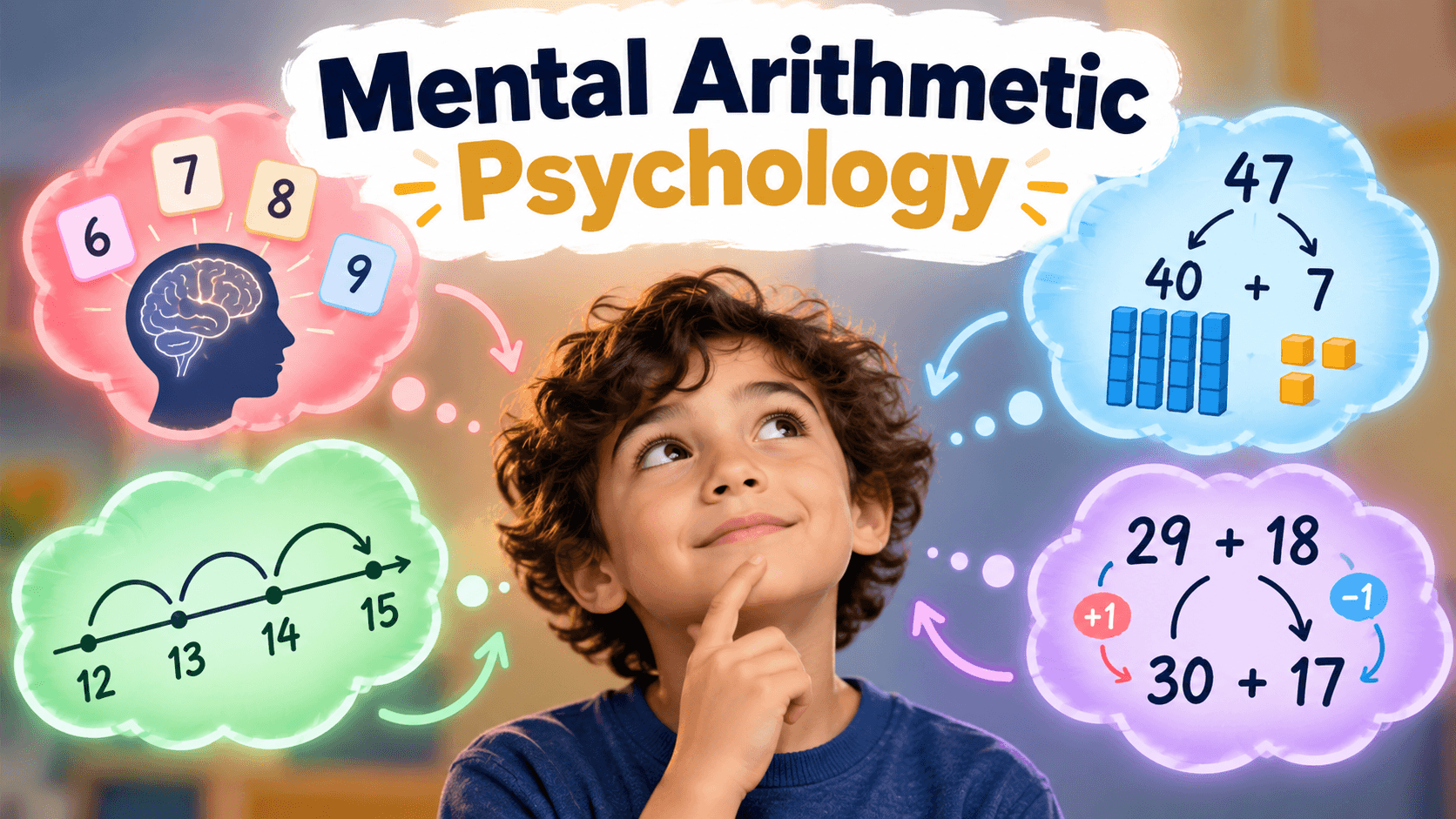
What happens when you solve 8 + 7 in your head? You might simply know that the answer is 15. You might think “8 + 2 = 10, then +5 = 15.” Someone else might count upward from eight. For 19 + 6, you might transform the problem into “20 + 5.” For 12 × 4, you might retrieve 48, double 12 twice, or break the problem into 10 × 4 plus 2 × 4.
These examples show why mental arithmetic is not one single cognitive mechanism. It is a family of strategies for performing numerical operations without relying entirely on a written algorithm or external calculator. The same person can retrieve one answer from long-term memory, use a stepwise procedure for another, decompose a difficult problem into easier parts, count for a small addition, or compensate after rounding a number to a convenient value.
The psychology of mental arithmetic therefore focuses on strategy selection, execution, intermediate values, and answer production. It also examines why problem size, familiarity, operation, and task demands can change the strategy used from one calculation to the next.
Quick Answer
Mental arithmetic is the cognitive processing used to solve arithmetic problems without relying entirely on written procedures or a calculator. It can involve direct fact retrieval, counting, decomposition, compensation, transformation, or other stepwise procedures. Strategy choice varies with the problem and the person. Retrieval can be efficient for familiar facts, but it is not always superior, and weak mental-arithmetic performance does not by itself indicate low intelligence or a learning disorder.
What Mental Arithmetic Means
Numerical calculation without relying entirely on an external calculator or written algorithm
Mental arithmetic means carrying out an arithmetic operation primarily through internal processing. The operation may be addition, subtraction, multiplication, or division. A person may still use a spoken number word, finger movement, imagined notation, or a brief external cue, but the central calculation is not delegated to a calculator or a fully written step-by-step algorithm.
The phrase “mental” does not imply that the process is invisible, effortless, or purely memory-based. People may move their eyes, whisper intermediate values, use their fingers, or visualize written numbers while calculating. These behaviors can support the calculation without changing its basic status as mental arithmetic.
A broad meta-analysis of retrieval and procedural mental arithmetic emphasizes that arithmetic problems can be solved through multiple strategies, particularly fact retrieval and procedural calculation. This diversity is central to modern cognitive arithmetic research.
Why mental arithmetic is not one single mechanism
Consider the difference between 2 + 2 and 47 + 38. Many adults can answer 2 + 2 directly from memory. The second problem is more likely to require a sequence of operations, such as adding tens and units, decomposing one operand, or compensating around a round number.
The same person can therefore move between qualitatively different routes. Mental arithmetic is better described as a strategy system than as one fixed process.
This matters because reaction time alone does not reveal the route. A fast answer might come from retrieval, a highly practiced transformation, or an efficient decomposition. A slower answer might reflect a careful procedure rather than poor numerical ability.
The Core Strategy-Selection Model
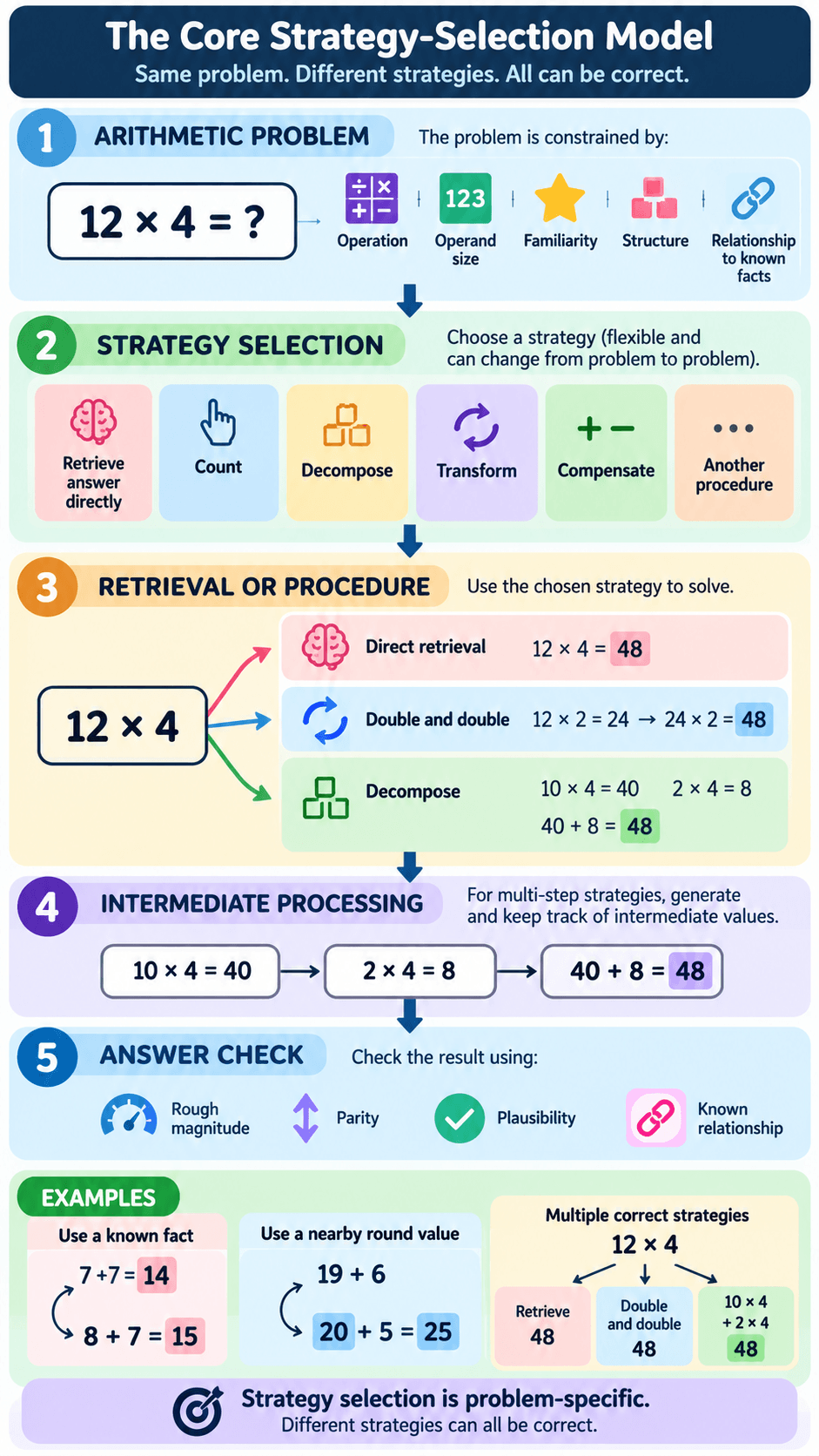
ARITHMETIC PROBLEM → STRATEGY SELECTION → RETRIEVAL OR PROCEDURE → INTERMEDIATE PROCESSING → ANSWER CHECK
A useful model is:
ARITHMETIC PROBLEM → STRATEGY SELECTION → RETRIEVAL OR PROCEDURE → INTERMEDIATE PROCESSING → ANSWER CHECK
The first stage is the problem itself. Its operation, operand size, familiarity, structure, and relationship to known facts all constrain which strategies are useful.
Next comes strategy selection. The solver may retrieve an answer directly, count, decompose, transform, compensate, or use another procedure. If a multi-step strategy is chosen, intermediate values must be generated and maintained. Finally, the result may be checked against rough magnitude, parity, plausibility, or a known relationship.
Research on strategy choice shows that people can switch flexibly between strategies from problem to problem. An open-access study of arithmetic strategy selection describes this adaptability as a core feature of strategic cognition rather than an exception.
Why strategy can change from problem to problem
Suppose you know 7 + 7 = 14 instantly. For 8 + 7, that known fact can support a transformation: 7 + 7 is 14, so 8 + 7 is 15. For 19 + 6, a different structure is more convenient because 19 sits next to the round value 20.
Now consider 12 × 4. One person may retrieve 48 directly. Another may double 12 to 24 and double again. Another may calculate 10 × 4 plus 2 × 4. All three routes can be correct.
Strategy selection is therefore problem-specific. Familiarity, convenient numerical structure, current attention, individual habits, and the need for speed or certainty can all influence the route used.
Fact Retrieval

Arithmetic facts and familiarity
Fact retrieval occurs when the answer becomes available from long-term memory without consciously recomputing the operation step by step. Familiar examples include small addition facts and multiplication facts that have been encountered repeatedly.
Retrieval is often fast because the solver does not need to maintain several intermediate values. The problem itself activates an associated answer strongly enough for a response to be produced.
However, retrieval is not an all-or-nothing property of a person. Someone may retrieve 6 × 7 instantly but calculate 7 × 8 through another route. Familiarity is attached to particular facts and relationships, not simply to a general personality type called “a retriever.”
When a result may be retrieved rather than recomputed
Small, familiar, frequently encountered problems are more likely to support retrieval. Repeated experience strengthens associations between problem forms and answers.
Problem structure matters too. Some facts are easier to retrieve because they participate in highly familiar patterns, such as doubles, multiplication-table relationships, or identities involving zero and one.
A retrieved answer can also serve as a building block for a nearby problem. Knowing 8 + 8 = 16 may help solve 8 + 7 without requiring a completely separate stored fact.
Procedural Calculation
Stepwise operations
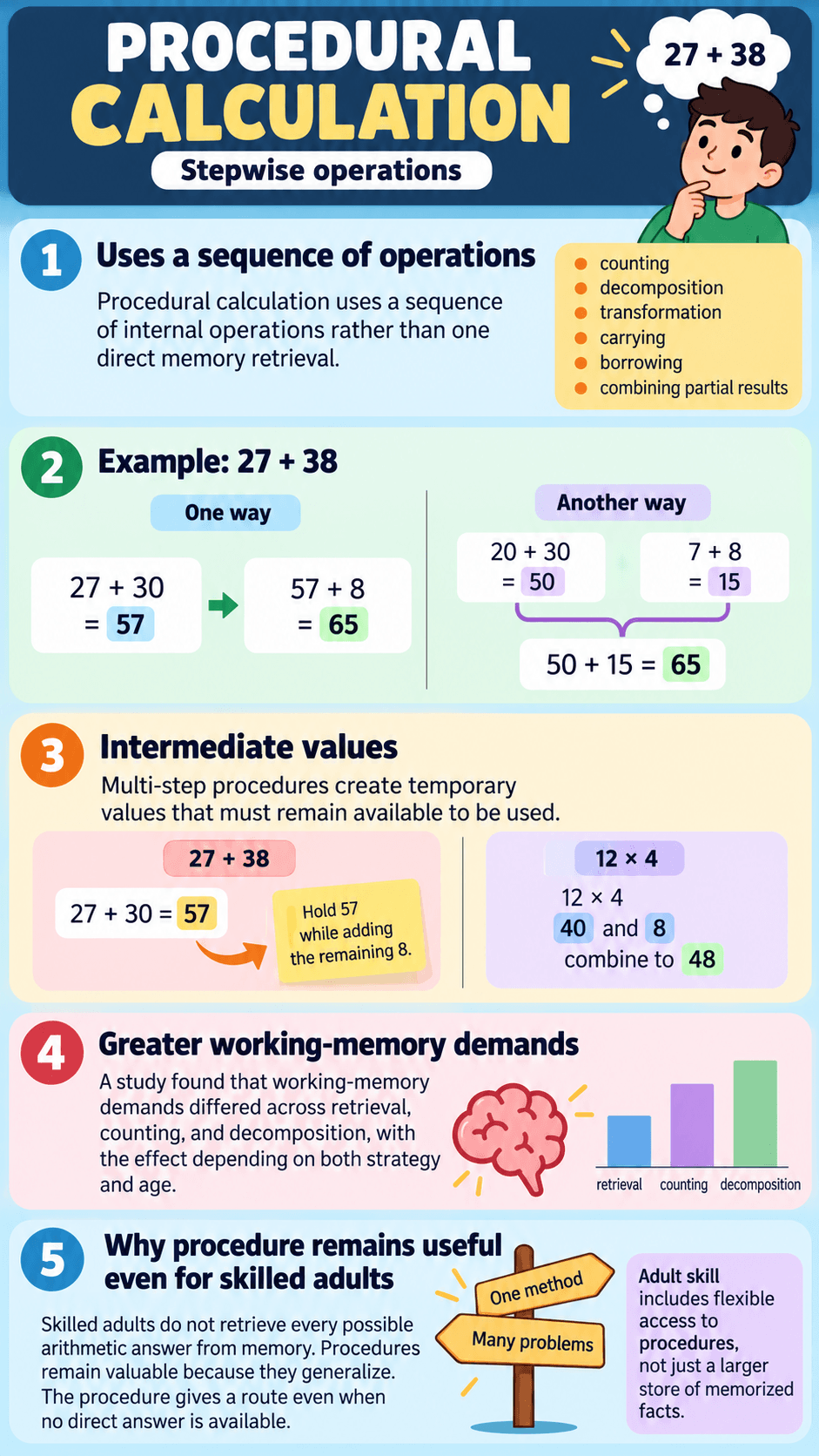
Procedural calculation uses a sequence of internal operations rather than one direct memory retrieval. The procedure may involve counting, decomposition, transformation, carrying, borrowing, or combining partial results.
For example, 27 + 38 might be solved as 27 + 30 = 57, then 57 + 8 = 65. Another person might compute 20 + 30 = 50, 7 + 8 = 15, then combine 50 + 15.
These are not merely slower versions of retrieval. They are structured computational routes that allow a person to solve problems whose answers are not readily available from memory.
Intermediate values
Multi-step procedures create temporary values that must remain available long enough to be used. In 27 + 38, a solver might hold 57 while adding the remaining 8. In a decomposition of 12 × 4, the values 40 and 8 may need to be combined into 48.
This temporary handling is one reason procedural calculation can place greater demands on active maintenance than simple retrieval. A study comparing arithmetic strategies found that working-memory demands differed across retrieval, counting, and decomposition, with the effect depending on both strategy and age. That pattern is summarized in an open-access study of strategy and working-memory demands in arithmetic.
Why procedure can remain useful even for skilled adults
Skilled adults do not retrieve every possible arithmetic answer from memory. That would require storing an enormous number of exact problem-answer associations.
Procedures remain valuable because they generalize. A person who knows how to decompose around tens can apply the method to many unfamiliar problems. The procedure gives a route even when no direct answer is available.
Adult skill therefore includes flexible access to procedures, not just a larger store of memorized facts.
Decomposition, Transformation, and Compensation

8 + 7 → 8 + 2 + 5
Decomposition breaks a problem into parts that are easier to handle. For 8 + 7, one route is:
8 + 7 → 8 + 2 + 5 → 10 + 5 → 15
The original addend 7 is decomposed into 2 and 5 because adding 2 creates the convenient landmark 10. The problem is not being solved by retrieval alone, even if the sub-facts are familiar.
19 + 6 → 20 + 5
Compensation changes a value to make the calculation easier, then corrects for the change. For 19 + 6:
19 + 6 → 20 + 6 → 26 → 25
A more compact version is to shift one unit from 6 to 19:
19 + 6 → 20 + 5 → 25
The arithmetic relationship is preserved even though the visible form of the problem changes.
Transforming a problem into an easier equivalent form
Transformation is a broader idea: preserve the answer while changing the problem into a form that is easier to calculate.
Examples include using doubles, near-doubles, round numbers, distributive structure, or inverse relationships. For 12 × 4, a solver might transform the problem into 10 × 4 plus 2 × 4, or into 12 × 2 × 2.
Recent work on mental addition also shows that adults use a surprising variety of strategies, including rounding and compensation. An open-access study of strategy variation in mental addition describes how retrieval, counting, decomposition, rounding, and compensation can all appear even in elementary arithmetic.
| Strategy | Example | Core move |
|---|---|---|
| Retrieval | 6 × 7 → 42 | Answer accessed directly from memory |
| Counting | 8 + 3 → 9, 10, 11 | Advance through a number sequence |
| Decomposition | 8 + 7 → 8 + 2 + 5 | Break a value into easier parts |
| Compensation | 19 + 6 → 20 + 5 | Adjust values while preserving the total |
| Multiplicative decomposition | 12 × 4 → 10 × 4 + 2 × 4 | Break the operation into known partial products |
Counting Strategies as One Option
When counting can contribute to arithmetic
Counting can serve as an arithmetic strategy when the operation is small enough to be represented as sequential movement through a number series. For 8 + 3, a person may count on: 9, 10, 11.
Counting on is different from recounting all items from one. It starts from a known operand and advances the remaining number of steps.
This strategy uses counting knowledge inside an arithmetic operation. The purpose is no longer merely to determine the numerosity of one visible set. It is to transform a known value according to an operation.
Why counting is not the whole arithmetic system
Counting becomes inefficient for large operands. Solving 47 + 38 by advancing 38 individual steps would be slow and vulnerable to tracking errors.
Arithmetic therefore benefits from multiple representations and transformations. Retrieval handles familiar facts. Decomposition reduces a large problem to smaller ones. Place-value structure supports tens and units. Compensation creates convenient landmarks.
Counting is one legitimate strategy among several, not an inferior behavior and not a complete model of arithmetic cognition.
Operation and Problem Differences
Addition and subtraction
Addition and subtraction can often be approached through counting, decomposition, compensation, or retrieval. The preferred route depends strongly on the problem.
For 9 + 1, retrieval may be immediate. For 38 + 27, decomposition or compensation may be more useful. For 52 – 49, a person may count the small difference upward from 49 rather than execute a full subtraction procedure.
This flexibility shows why arithmetic strategy should be studied at the level of individual problems rather than assumed from the operation label alone.
Multiplication and division at overview level
Multiplication facts are often associated strongly with retrieval because many small products are repeatedly practiced. Yet multiplication can also be reconstructed procedurally.
For 12 × 4, a solver might retrieve 48, use repeated doubling, or decompose 12 into 10 + 2. Division likewise can draw on remembered multiplication relationships, repeated subtraction, decomposition, or factor knowledge.
The aim here is not to catalog every arithmetic algorithm. The psychological point is that each operation offers several possible routes, and familiarity changes which route is easiest to access.
Problem-size effects where appropriate
A widely observed finding is the problem-size effect: larger arithmetic problems often take longer and produce more errors than smaller ones. For multiplication, 9 × 8 is typically harder than 2 × 3.
The effect has several possible sources. Larger facts may be less familiar, retrieval competition may be greater, procedures may require more steps, and strategy selection may change as problem size increases.
An open-access study of the multiplication problem-size effect describes the effect as robust while also noting that its source remains debated. The effect therefore should not be treated as proof of one single mechanism.
Retrieval vs Procedure Is Not a Personality Type
Familiarity and task demands
People are sometimes described casually as “memory people” or “method people,” but arithmetic strategy is more flexible than those labels suggest.
A person may retrieve 5 + 5, decompose 8 + 7, compensate 19 + 6, and use partial products for 12 × 4 within the same minute. The variation is not inconsistency. It is adaptation to problem structure.
Task demands also matter. Under severe time pressure, a person may attempt retrieval more often. When accuracy is emphasized, a solver may choose a slower procedure or verify a retrieved answer.
Individual and problem-specific strategy variation
Two people can choose different efficient strategies for the same problem. One may see 19 + 6 as 20 + 5. Another may retrieve 19 + 1 = 20, then add the remaining 5. A third may add 6 directly in smaller steps.
Research comparing objective problem features with self-reported strategies has found that the strategy used can explain substantial performance variation beyond problem size alone. An open-access study of individual arithmetic strategy ratings found strategy reports to be highly informative about task difficulty and reaction time.
This reinforces an important point: the arithmetic problem does not determine one inevitable route.
Supporting Processes Without Turning Them Into the Main Topic
Working-memory demands and intermediate values
Multi-step mental arithmetic requires temporary access to partial results. If you calculate 47 + 38 as 47 + 30 = 77, then +8, the value 77 must remain available while the next operation is performed.
Working memory helps maintain and manipulate those intermediate values. It may also support strategy execution, tracking, and coordination among steps.
But mental arithmetic is not the same thing as working memory. Working memory is a general cognitive system used across language, reasoning, planning, and many other tasks. In arithmetic, it is one supporting resource whose importance changes with strategy.
Language involvement where relevant
Arithmetic facts can be encoded partly through verbal associations, especially when they were learned through repeated spoken sequences. Number words also participate when a solver internally rehearses intermediate values.
Other strategies may rely more heavily on visual-spatial layouts or magnitude relationships. The balance can vary with operation, notation, experience, and individual preference.
Language therefore contributes to some arithmetic processing without defining the entire system.
Practice and expertise at overview level only
Experience changes which strategies are available and how efficiently they can be executed. Repeated exposure can strengthen fact retrieval, while practice with numerical structure can make decomposition and compensation easier to recognize.
However, describing those effects does not require turning mental arithmetic into a training guide. The psychological question here is how performance can shift with familiarity, not how to teach mathematics or prescribe practice.
Mental Arithmetic vs Working Memory, Problem Solving, and Learning

Numerical operation processing
Mental arithmetic focuses on carrying out numerical operations. The central object is the calculation itself: selecting and executing a route from operands and operator to an answer.
Active maintenance and manipulation
Working memory is broader. It concerns the temporary maintenance and manipulation of information across many cognitive domains. Arithmetic uses working memory when intermediate values or steps must be held active.
General solution search
Problem solving concerns how people define goals, search through possible solutions, overcome impasses, and evaluate strategies across many kinds of problems. Mental arithmetic can involve strategic choice, but its domain is specifically numerical operation processing.
Skill acquisition through experience
Learning psychology asks how performance changes through practice, feedback, memory formation, and transfer. Mental arithmetic research can observe effects of familiarity and expertise without becoming a general account of how arithmetic skill is taught or learned over time.
| Topic | Main focus |
|---|---|
| Mental arithmetic | Executing numerical operations in the head |
| Working memory | Temporarily maintaining and manipulating active information |
| Problem solving | Searching for and evaluating solutions across general tasks |
| Learning | Acquiring and changing skills through experience |
What Mental Arithmetic Performance Does Not Prove
Retrieval is not always superior
Retrieval can be fast for familiar facts, but speed alone does not make it the ideal route for every problem. A direct answer that is weakly associated may be less reliable than an efficient decomposition.
Procedures also provide flexibility. They allow unfamiliar problems to be solved without memorizing every possible fact.
The useful question is not “Did the person retrieve?” but “Was the selected strategy effective for this problem under these conditions?”
Weak performance is not an IQ or diagnostic marker
Mental-arithmetic performance can be affected by familiarity, strategy choice, temporary memory load, attention, notation, time pressure, operation, problem size, and previous experience.
A slow answer on one calculation does not reveal general intelligence. Nor can a few difficult mental calculations diagnose dyscalculia, ADHD, a memory disorder, or another condition.
Persistent difficulties with numerical skills that substantially interfere with education or everyday functioning may warrant professional assessment, but mental-arithmetic speed or strategy choice alone cannot identify a diagnosis.
FAQ
Is mental arithmetic mostly memory retrieval?
No. Retrieval is important for familiar arithmetic facts, but mental arithmetic also uses counting, decomposition, compensation, transformation, and other procedures. Strategy use changes across problems and individuals, so the same person may retrieve one answer and calculate the next.
Why might I use different strategies for 8 + 7 and 19 + 6?
The numerical structure is different. Eight plus seven can be decomposed around 10, such as 8 + 2 + 5. Nineteen plus six sits next to a round value, making compensation such as 20 + 5 especially convenient. Strategy selection is sensitive to landmarks, familiar facts, and problem structure.
Is counting a mental-arithmetic strategy?
Yes. Counting on can solve small additions or subtractions by advancing from a known value. However, counting is only one option. Larger or structurally convenient problems are often handled more efficiently through retrieval, decomposition, compensation, or other procedures.
How does working memory support calculation without being the same topic?
Working memory can keep intermediate values active, coordinate steps, and support procedural calculation. Mental arithmetic is the numerical operation being performed, while working memory is a general supporting system used in many other cognitive tasks as well.
Does weak mental arithmetic mean low intelligence or dyscalculia?
No. Mental-arithmetic performance depends on many task and strategy factors and cannot serve as a standalone intelligence or diagnostic test. A proper assessment of persistent numerical difficulty requires a broader history and multiple measures rather than one mental-calculation task.
Key Takeaways
- Mental arithmetic is not one mechanism. It can use fact retrieval, counting, decomposition, compensation, transformation, and other procedures.
- Strategy selection can change from problem to problem depending on familiarity, numerical structure, operation, problem size, and task demands.
- Retrieval can be efficient for familiar facts, while procedures remain essential for unfamiliar or structurally complex calculations.
- Intermediate values make active maintenance especially important during multi-step procedures, but mental arithmetic is not the same thing as working memory.
- Counting can contribute to arithmetic, but arithmetic also relies on transformations and relationships that go beyond sequential enumeration.
- Retrieval is not always superior, and mental-arithmetic speed or strategy choice should not be used to infer intelligence or diagnose a learning disorder.

Michael Reed is the Founder and Lead Writer at Psychology Exposed. He writes about human behavior, relationships, emotional patterns, self-awareness, and practical psychology topics using research-informed, easy-to-understand content.
Read More About Michael Reed: https://psychologyexposed.com/michael-reed/