
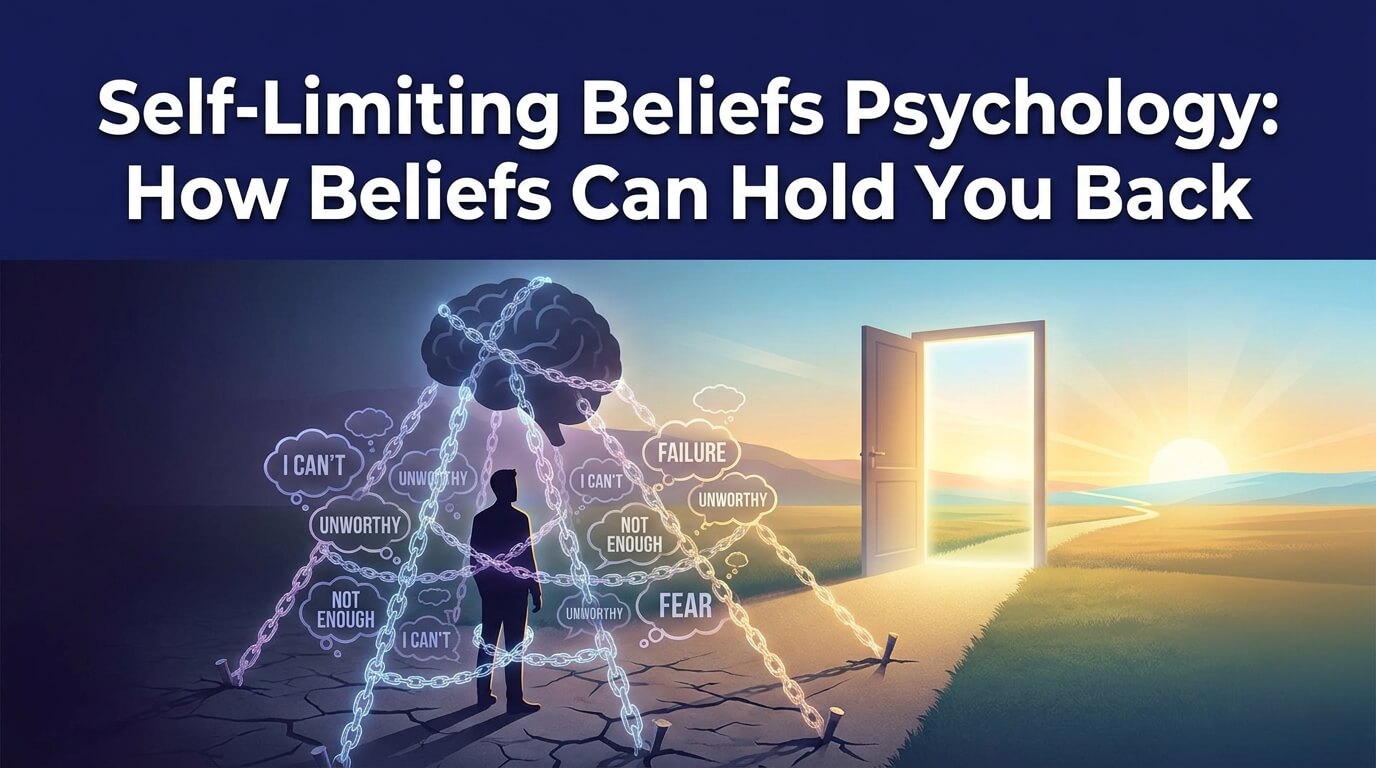
“I am not confident enough.” “People like me do not succeed at this.” “If I try and fail, everyone will know I was never capable.” Statements like these can feel less like opinions and more like descriptions of reality. They influence which opportunities seem available before any decision is made.
A self-limiting belief is a conclusion that narrows perceived capability, worthiness, permission, safety, or possibility. It may prevent someone from applying, speaking, learning, setting a boundary, showing creative work, or asking for support. The belief then reduces the experience that could test it, so the lack of evidence begins to look like proof.
Not every limit is created by mindset. Skills, money, health, discrimination, caregiving demands, unsafe relationships, and unequal access are real constraints. A useful psychological approach does not deny them. It separates what is currently restricted from what has been assumed to be universally or permanently impossible.
Quick Answer
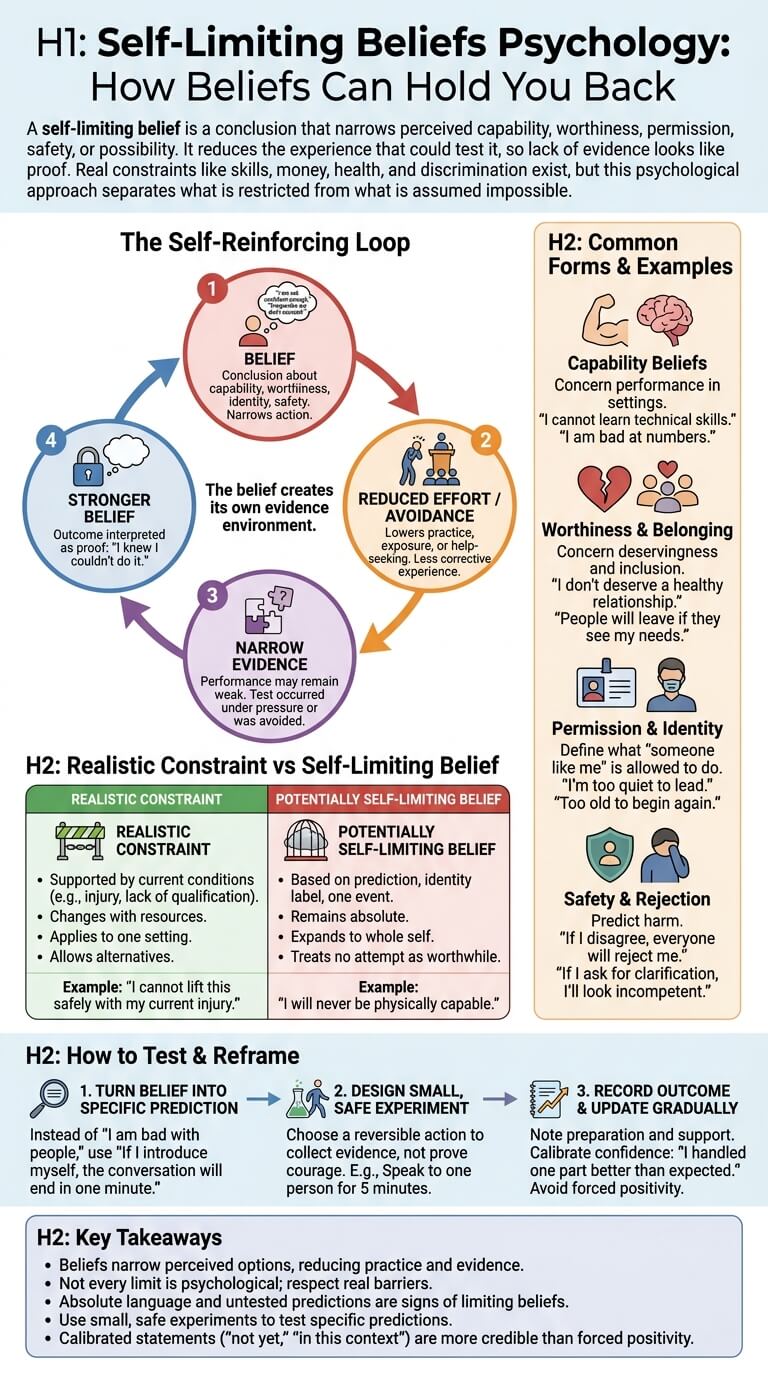
Self-limiting beliefs are conclusions about capability, worthiness, identity, safety, or possibility that unnecessarily narrow action. They often become self-reinforcing because the belief reduces effort, practice, exposure, or help-seeking, leaving little corrective evidence. The goal is not forced positivity. It is to make the belief specific, compare it with real constraints, test a small prediction, and update confidence gradually.
What a Self-Limiting Belief Is
A self-limiting belief is not an official diagnosis. It is a practical description of a belief that restricts perceived options more broadly than the available evidence justifies.
Self-limiting beliefs are easier to examine when they are placed within the wider framework of how beliefs shape thoughts and behavior.
A conclusion that narrows perceived options, effort, or permission
The belief may concern ability: “I cannot learn technical skills.” It may concern worthiness: “I do not deserve a healthy relationship.” It may concern permission: “I am not the kind of person who speaks publicly.” It may concern safety: “If I disagree, everyone will reject me.”
These beliefs affect behavior before the outcome is known. A person may not apply for the job, ask the question, attend the class, or set the boundary. The belief functions like a rule about which actions are available.
Why not every limit is self-imposed
A realistic constraint is supported by current conditions. Someone may lack a required qualification, have limited mobility, face financial barriers, live in an unsafe environment, or experience discrimination. Calling these problems “limiting beliefs” can shift responsibility away from institutions, resources, or other people’s behavior.
The psychological question is narrower: has the person turned a specific constraint into a global identity conclusion? “I cannot afford this course now” is different from “I will never be able to learn this.” “This workplace punishes disagreement” is different from “My opinions never matter anywhere.”
Common Forms of Self-Limiting Beliefs

Limiting beliefs often sound different on the surface but organize themselves around a few recurring themes.
Capability beliefs
Capability beliefs concern what a person thinks they can perform in a particular setting. The APA Dictionary of Psychology defines self-efficacy as a person’s perception of their capability to perform in a setting or reach a desired result.
Low self-efficacy may sound like “I cannot handle difficult feedback,” “I am bad at numbers,” or “I cannot learn this at my age.” These claims may contain a real skill gap, but they turn current performance into a prediction about future learning.
Worthiness and belonging beliefs
These beliefs concern deservingness and social inclusion: “I have to prove my value before I can ask for support,” “People will leave if they see what I need,” or “Success would make me selfish.”
Because belonging is important, these conclusions can feel protective. Staying quiet may reduce immediate risk of criticism. Over time, it also prevents the person from discovering which relationships can tolerate honesty and mutual care.
Permission and identity beliefs
Identity beliefs define what “someone like me” is allowed to do. A person may think they are too quiet to lead, too practical to create, too old to begin again, or too inexperienced to contribute.
Identity can provide continuity, but a narrow identity becomes restrictive when it treats preferences or past roles as fixed rules. “I have usually been the listener” does not prove “I cannot lead a discussion.”
Safety and rejection beliefs
Safety beliefs predict harm: “If I say no, the relationship will end,” “If I publish my work, ridicule is inevitable,” or “If I ask for clarification, I will look incompetent.”
Some danger predictions are realistic, especially in coercive or hostile settings. The task is not to ignore risk. It is to distinguish evidence-based caution from a rule that applies the worst past outcome to every future situation.
Permanence beliefs about personality or ability
Permanence beliefs turn a difficulty into an unchangeable trait: “I am simply not disciplined,” “I have no creative ability,” or “I will always panic under pressure.”
Research on growth and fixed mindsets suggests that beliefs about whether abilities can develop may influence challenge-seeking and responses to failure, but the evidence is more nuanced than popular slogans imply. A review of growth-mindset controversies emphasizes that effects vary by context and implementation. Believing improvement is possible does not make improvement automatic.
How Self-Limiting Beliefs Form

These beliefs usually emerge from understandable attempts to explain experience, predict outcomes, and avoid repeated pain.
The wider process of belief formation helps explain how repeated feedback, emotion, interpretation, and social learning can turn one experience into a broader conclusion about the self.
Repeated feedback, comparison, failure, criticism, culture, and protective learning
A child repeatedly told they are careless may begin treating mistakes as evidence of identity. An adult who compares early attempts with someone else’s polished work may conclude they lack talent. A person criticized whenever they expressed a need may learn that silence protects connection.
Culture and social roles also matter. Messages about age, gender, class, disability, family duty, or acceptable ambition can define which futures seem available. These messages are not simply private thoughts. They may reflect real social rewards and penalties.
How one event can become a broad rule
A painful event can produce an efficient rule: “Do not try that again.” After one humiliating presentation, “I performed poorly once” becomes “I cannot speak publicly.” After one rejection, “This person did not choose me” becomes “I am not desirable.”
The rule reduces uncertainty and may prevent immediate pain. Its weakness is scope. One event provides evidence about one event, not every future context, skill level, audience, or relationship.
The Self-Reinforcing Loop
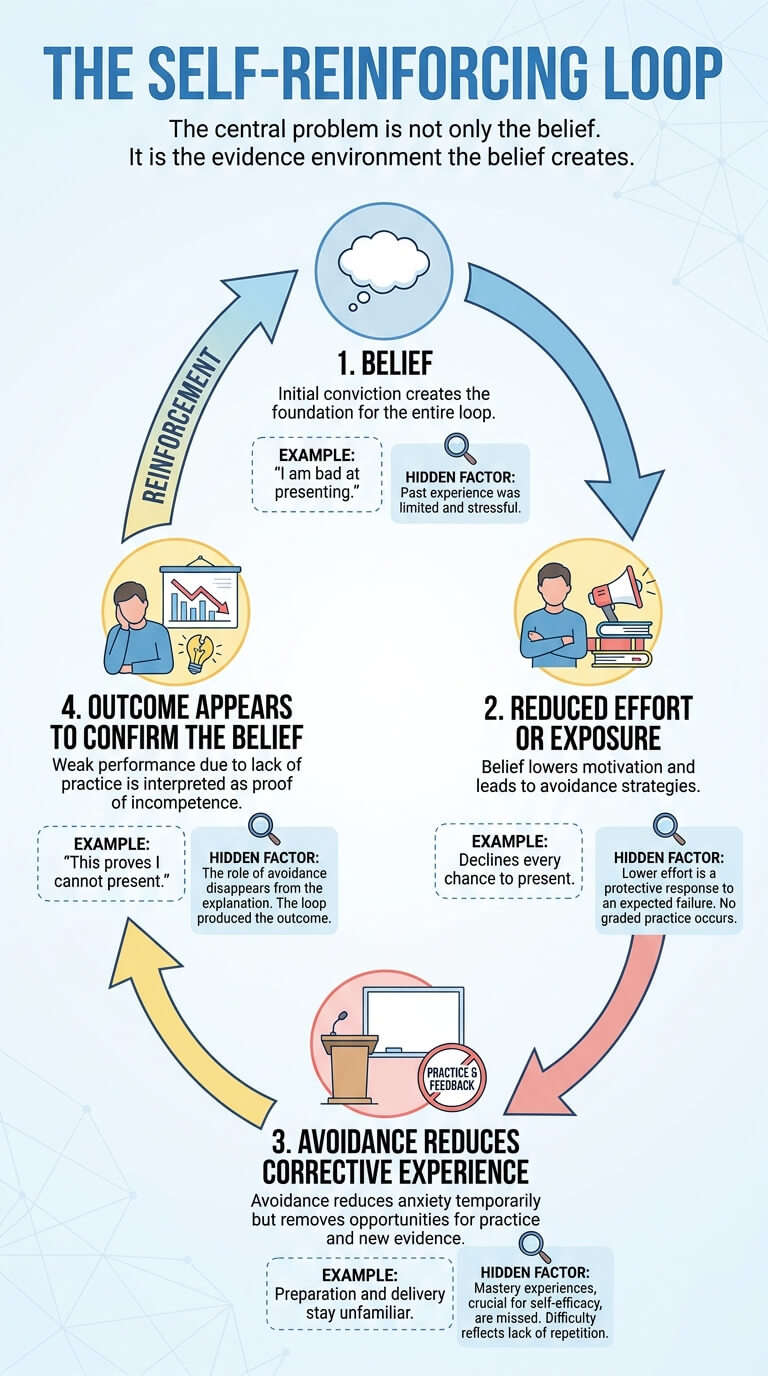
The central problem is not only the belief. It is the evidence environment the belief creates.
Belief lowers effort or exposure
If someone believes they cannot learn, they may stop earlier, choose only easy tasks, avoid feedback, or decline instruction. If they believe rejection is certain, they may not initiate contact or may communicate so cautiously that connection becomes difficult.
Lower effort is not always laziness. It can be a protective response to an expected outcome. Why invest energy when failure already feels decided?
Avoidance reduces corrective experience
Avoidance can reduce anxiety in the moment, which makes it more likely to be repeated. It also removes opportunities for practice, support, and new evidence. The person never sees what would happen after a smaller attempt, better preparation, or a different context.
Mastery experiences are an important source of self-efficacy. A review of the self-efficacy construct and its sources discusses mastery experience, observing others, verbal persuasion, and emotional or physical states as influences on efficacy beliefs.
Outcome appears to confirm the original belief
Because the person has less practice and fewer opportunities, performance may remain weak. The result is interpreted as proof: “I knew I could not do it.” The role of avoidance disappears from the explanation.
| Loop stage | Example | What is hidden |
|---|---|---|
| Belief | “I am bad at presenting.” | Past experience was limited and stressful. |
| Reduced exposure | Declines every chance to present. | No graded practice occurs. |
| Missing skill development | Preparation and delivery stay unfamiliar. | Difficulty partly reflects lack of repetition. |
| Narrow evidence | One unavoidable presentation feels difficult. | The test occurred under maximum pressure. |
| Stronger belief | “This proves I cannot present.” | The loop helped produce the outcome. |
Signs a Belief May Be Limiting Rather Than Descriptive
No single phrase proves a belief is inaccurate. These signs indicate that the claim deserves closer testing.
Absolute language, prediction without testing, identity labels, and selective evidence
- The belief uses words such as always, never, everyone, nobody, or impossible.
- A prediction is treated as fact before the situation occurs.
- A behavior or skill is converted into an identity label.
- Evidence from one context is applied to every context.
- Success is dismissed as luck while difficulty is treated as proof.
- The belief cannot state what evidence would lower confidence.
- The rule protects against discomfort but also blocks valued action.
The strongest sign is often inflexibility. An accurate belief should be able to respond to context, new skills, support, and changing evidence.
Another useful sign is whether the belief predicts the same result no matter what happens. If preparation is interpreted as “needing help proves I am incapable,” while lack of preparation is interpreted as “failure proves I am incapable,” the conclusion is protected from testing. A workable belief must allow at least one possible outcome to lower confidence.
Realistic Constraint vs Self-Limiting Belief
A grounded self-check respects both reality and possibility.
A comparison using evidence, flexibility, scope, and available options
| Question | Realistic constraint | Potentially self-limiting belief |
|---|---|---|
| Evidence | Supported by current, specific conditions | Based mainly on prediction, one event, or an identity label |
| Flexibility | Changes when resources or conditions change | Remains absolute despite new conditions |
| Scope | Applies to one setting or period | Expands to all settings and the whole self |
| Options | Allows alternatives, adaptation, or support | Treats no attempt as worthwhile |
| Testability | Can state what would change the conclusion | Explains away every possible result |
“I cannot lift this safely with my current injury” is a realistic limit. “I will never be physically capable” is broader. The first may require medical guidance and adaptation. The second turns a current condition into a permanent identity.
Some situations contain both types of limit. A person may face a real barrier and also underestimate the options that remain. For example, a workplace may genuinely restrict promotion, while the conclusion “there is no point developing any skill anywhere” extends beyond that workplace. Separating the external barrier from the internal generalization protects accuracy without blaming the person for the barrier.
Self-Limiting Beliefs vs Low Motivation and Self-Sabotage
These layers can interact, but they are not interchangeable.
Belief layer, energy or value layer, and behavior pattern
| Layer | Main question | Example |
|---|---|---|
| Self-limiting belief | What do I assume about my capability or permission? | “I could never run a meeting.” |
| Low motivation | How much value or energy do I have for this action? | “I can do it, but it does not feel worth the effort today.” |
| Self-sabotaging pattern | What repeated behavior interferes with my stated goal? | Delays preparation until success becomes unlikely. |
A person may experience all three, but the useful intervention differs. A belief needs evidence and testing. Low energy may require rest, health support, or a goal review. A repeated behavior pattern may require environmental or habit changes.
The layers can also form a sequence. “I am not capable” lowers motivation, which increases delay, which creates a poor result, which then strengthens the belief. Breaking the sequence does not require solving everything at once. A small skill-building action may create enough new evidence to weaken the belief even before motivation becomes strong.
If a person repeatedly acts in ways that conflict with an important self-belief or value, the discomfort may also involve cognitive dissonance rather than the limiting belief alone.
Everyday Examples
The following examples separate the belief from real conditions and identify one fair test.
Learning a skill
Belief: “I am too old to learn a language.”
Possible evidence: learning feels slower than it did at school.
Overreach: slower is converted into impossible.
Fair test: complete ten short lessons and compare recall with the starting point rather than with a fluent speaker.
Speaking up
Belief: “If I share an idea, people will think it is foolish.”
Possible evidence: one past idea was dismissed abruptly.
Overreach: one audience becomes every audience.
Fair test: share one prepared question with a supportive colleague before raising it in a larger meeting.
Career decisions
Belief: “I am not qualified enough to apply.”
Possible evidence: several preferred qualifications are missing.
Overreach: preferred is treated as mandatory, and the employer’s judgment is made in advance.
Fair test: separate required from preferred criteria and request feedback from someone familiar with the role.
Relationships and boundaries
Belief: “If I set a boundary, people will leave.”
Possible evidence: a past relationship punished disagreement.
Overreach: an unsafe pattern is assumed to define every relationship.
Fair test: begin with one low-stakes preference in a relationship that has shown respect. Do not use behavioral testing in a coercive or unsafe relationship.
Creativity and public work
Belief: “My work is not original enough to share.”
Possible evidence: the person notices influences and imperfections.
Overreach: being influenced is treated as having no contribution.
Fair test: share one finished piece with a defined audience and ask for feedback on one specific feature.
A Belief Evidence Audit

Use the audit on one sentence, not your entire identity.
What supports the belief?
List direct observations, feedback, results, and current constraints. Separate events from interpretations. “I received two rejections” is an observation. “Nobody will choose me” is a prediction.
What weakens it?
Look for exceptions, partial successes, different contexts, new resources, and evidence that the trait is not universal. Do not dismiss a success merely because it required help. Support is part of real-world capability.
Also examine the standard used to judge success. A person may call a presentation a failure because they felt nervous, even though the audience understood the message. They may dismiss progress because it was not effortless. Feeling discomfort and performing adequately can occur together, so emotional ease should not be the only measure.
Is it universal, permanent, and identity-based?
Ask whether the claim applies everywhere, forever, and to the whole self. Statements with all three qualities usually exceed the available evidence.
| Audit field | Example |
|---|---|
| Belief | “I cannot lead.” |
| Direct evidence | I became flustered leading one unplanned meeting. |
| Missing context | I had no agenda, preparation, or role clarity. |
| Evidence against universality | I coordinate small projects well. |
| More precise statement | I need structure and practice for larger meetings. |
How to Test a Self-Limiting Belief
A useful test is specific, small, safe, and capable of producing information.
Turn the belief into a specific prediction
Replace “I am bad with people” with “If I introduce myself to one new person at the event, the conversation will end within one minute because I will have nothing to say.” The prediction identifies an action and observable outcome.
Design a small, safe behavioral experiment
Choose an experiment that is reversible and proportionate. Prepare two questions, speak to one person, practice with a trusted friend, or attend for twenty minutes. The goal is not to prove courage. It is to collect better evidence.
Do not test beliefs by entering dangerous situations, confronting an abusive person, stopping treatment, ignoring disability needs, or risking essential income. Real safety and structural constraints are not experiments in positive thinking.
Record outcome, context, and alternative explanations
Write what happened before interpreting it. Note preparation, support, difficulty, and unexpected factors. A poor outcome may show that the belief was partly accurate in this context, that the task was too large, or that a skill needs development.
Update confidence gradually rather than forcing certainty
You do not need to replace “I cannot” with “I definitely can.” A calibrated update might be, “I handled one part better than expected,” “I need more practice,” or “This belief is less universal than I thought.”
Small experiences can build efficacy more credibly than affirmation alone. Research on academic self-efficacy and mastery experience emphasizes practical success, modeling, and feedback as ways efficacy beliefs can develop.
Design the next test so that the result can teach you something. If the task is so large that failure is almost guaranteed, it mainly measures overwhelm. If it is so easy that success feels irrelevant, it adds little evidence. The best experiment is challenging enough to matter and small enough to repeat.
Reframing Without False Positivity
Reframing should increase accuracy and flexibility, not deny difficulty.
From impossible claims to flexible, testable statements
| Rigid statement | Calibrated statement |
|---|---|
| “I cannot do this.” | “I cannot do this yet with my current skill and support.” |
| “I always fail.” | “I have struggled in these conditions, and I need a different test.” |
| “Nobody respects my boundaries.” | “Some people have reacted poorly, and I need to identify safer relationships.” |
| “I am not creative.” | “I have little practice finishing and sharing creative work.” |
| “I am not confident enough.” | “Confidence may follow smaller successful actions.” |
Words such as yet, in this context, with current skills, and under these conditions do not guarantee success. They prevent a temporary or local difficulty from becoming a permanent identity verdict.
A good reframe should remain believable. “I will definitely succeed” may create an argument inside the mind when the evidence is uncertain. “I can test one part and learn from the result” is often more useful because it supports action without pretending risk has disappeared.
Expectations, Motivation, and Learning
Self-beliefs influence what people notice, how long they persist, and how they interpret feedback.
How self-beliefs alter attention, persistence, and interpretation of feedback
Someone expecting failure may notice hesitation more than progress, treat effort as evidence of low ability, and stop before useful feedback arrives. Someone with unrealistically high confidence may ignore preparation. Calibrated self-efficacy supports effort while remaining responsive to evidence.
Self-limiting beliefs can also resemble learned helplessness when past uncontrollability produces the expectation that effort will not matter. A neuroscience review of learned helplessness and controllability notes that the original theory has been revised, which is another reason to avoid casually diagnosing passivity as “learned helplessness.”
When Professional Support May Help
Self-reflection is not always enough when beliefs are tied to severe distress or painful experiences.
Seek support when beliefs are tied to trauma, severe shame, depression, anxiety, or major impairment
A qualified mental health professional may help when negative self-beliefs contribute to persistent hopelessness, panic, major avoidance, self-harm thoughts, inability to function, or a deeply negative view of worth. Support can also be useful when a belief developed in abuse, discrimination, trauma, or chronic criticism and testing it alone feels unsafe.
The National Institute of Mental Health help page lists ways to find mental health care and crisis support in the United States. In immediate danger, contact local emergency services or an appropriate crisis service where you live.
Educational note: “Self-limiting belief” is not a clinical diagnosis. It should not be used to dismiss disability, structural barriers, unsafe conditions, or the effects of abuse.
FAQ About Self-Limiting Beliefs
These questions clarify accuracy, protection, confidence, and the relationship between action and belief.
Are limiting beliefs always false?
No. A limiting belief may contain a real concern, skill gap, or history of difficulty. It becomes unnecessarily restrictive when it is broader, more permanent, or more identity-based than the evidence supports. The aim is accurate scope, not automatic optimism.
Can a protective belief become outdated?
Yes. A belief that reduced harm in one environment may continue after conditions change. Silence may have protected someone in a punitive family or workplace, then limit honest communication in a safer relationship. Updating should occur carefully and with attention to current risk.
Why does evidence of success sometimes fail to change self-belief?
The person may dismiss success as luck, help, or an exception while treating difficulty as diagnostic. The old belief may also be tied to identity, shame, or a long history of selective memories. Repeated specific evidence is often more persuasive than one large success.
When a self-belief continues despite repeated evidence that should weaken it, belief perseverance can help explain why the older explanation remains influential.
How is a limiting belief different from low confidence?
Confidence is a level of certainty about performance. A limiting belief is the conclusion that organizes perceived options. Someone can feel nervous and still believe learning is possible. Another person may feel calm because they have already decided not to try.
Can action change belief before confidence appears?
Yes. Small, supported action can create mastery evidence before the person feels confident. Confidence is not always the entry requirement. The action should be safe, proportionate, and small enough to produce useful information rather than overwhelm.
Key Takeaways
- Self-limiting beliefs narrow perceived capability, worthiness, permission, safety, or possibility.
- Not every limit is psychological; real barriers, disability, discrimination, resources, and unsafe conditions must be respected.
- A belief can reinforce itself by reducing exposure, practice, support, and corrective evidence.
- Absolute language, identity labels, and untested predictions are signs that a belief may be broader than the evidence.
- A useful test turns the belief into one observable prediction and uses a small, safe, reversible experiment.
- Calibrated statements such as “not yet,” “in this context,” and “with current skills” are more credible than forced positivity.
Choose one belief that limits a valued action. Write the direct evidence for it, the context that may be missing, one fact that weakens its universality, and one small test you can conduct safely. The goal is not to prove that every limit is imaginary. It is to discover whether this particular conclusion still deserves the authority it has.

Michael Reed is the Founder and Lead Writer at Psychology Exposed. He writes about human behavior, relationships, emotional patterns, self-awareness, and practical psychology topics using research-informed, easy-to-understand content.
Read More About Michael Reed: https://psychologyexposed.com/michael-reed/