

Speaking feels immediate, but the mind has to solve several problems before a sentence reaches the outside world. You may know what you want to communicate, yet still need to choose the right words, arrange them into a workable structure, prepare their sound forms, and keep track of what you are actually saying. Most of this happens quickly enough that it feels effortless.
Language production psychology studies those hidden steps. It asks how an intended message becomes a sequence of words, how competing words are selected, how grammar and sound patterns are prepared, why ordinary speech contains pauses and corrections, and how speakers notice some of their own errors. The process is often described in stages, but researchers do not agree that every part operates as a rigid one-way pipeline. Within language psychology, production is the complementary problem to comprehension: how an intended message becomes linguistic form.
This topic is broader than word retrieval alone. It is also different from public-speaking skill, writing advice, or the metacognitive feeling of having a word “on the tip of your tongue.” The focus here is the cognitive machinery that turns an intention into spoken or written language.
Quick Answer
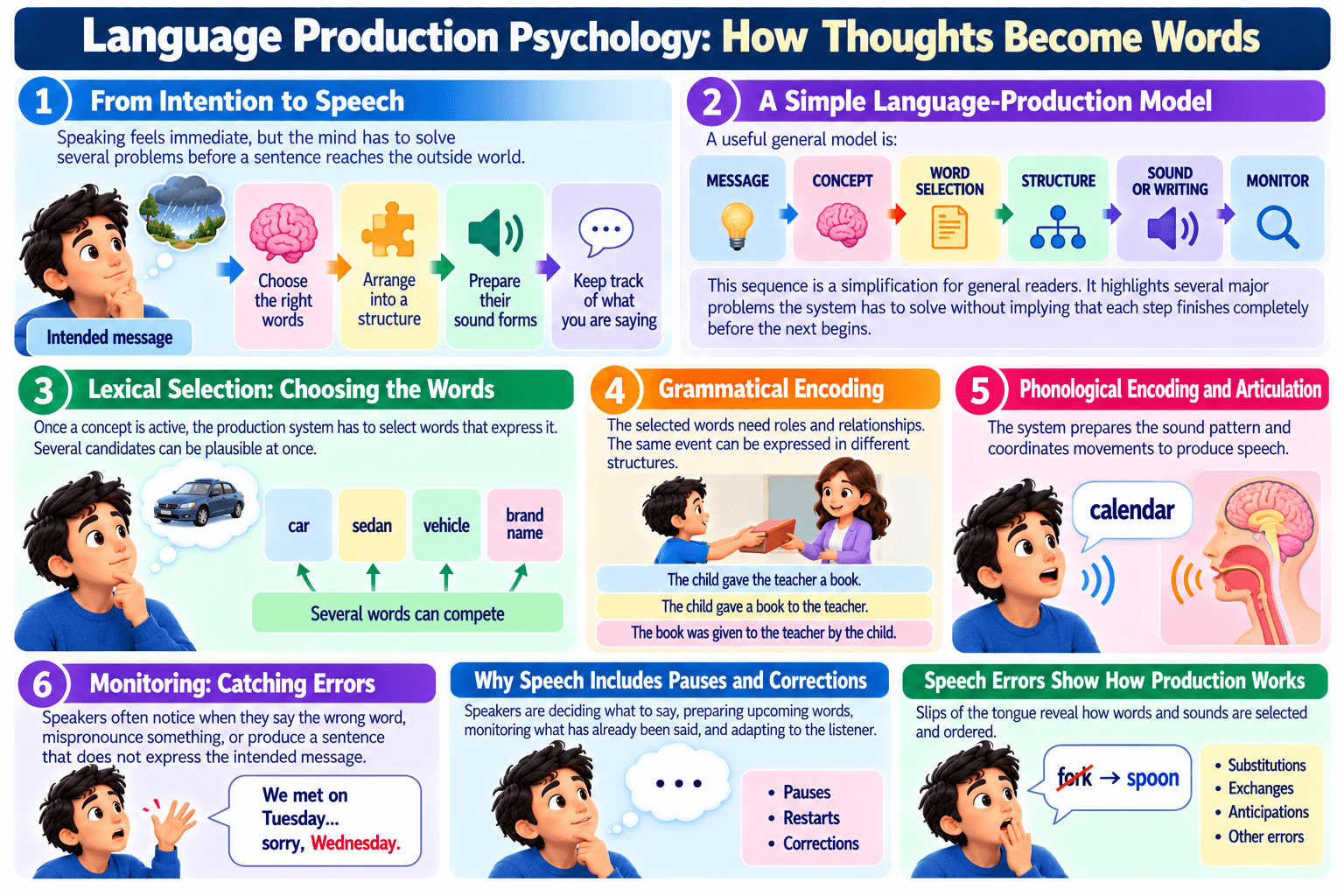
Language production is the set of mental processes that turns an intended message into words and sentences. A speaker must form a communicative idea, select lexical items, organize grammatical relationships, prepare word forms and sounds, coordinate articulation, and monitor the result. These processes interact, and competing theories disagree about exactly how information flows between them.
Language Production Begins With an Intended Message
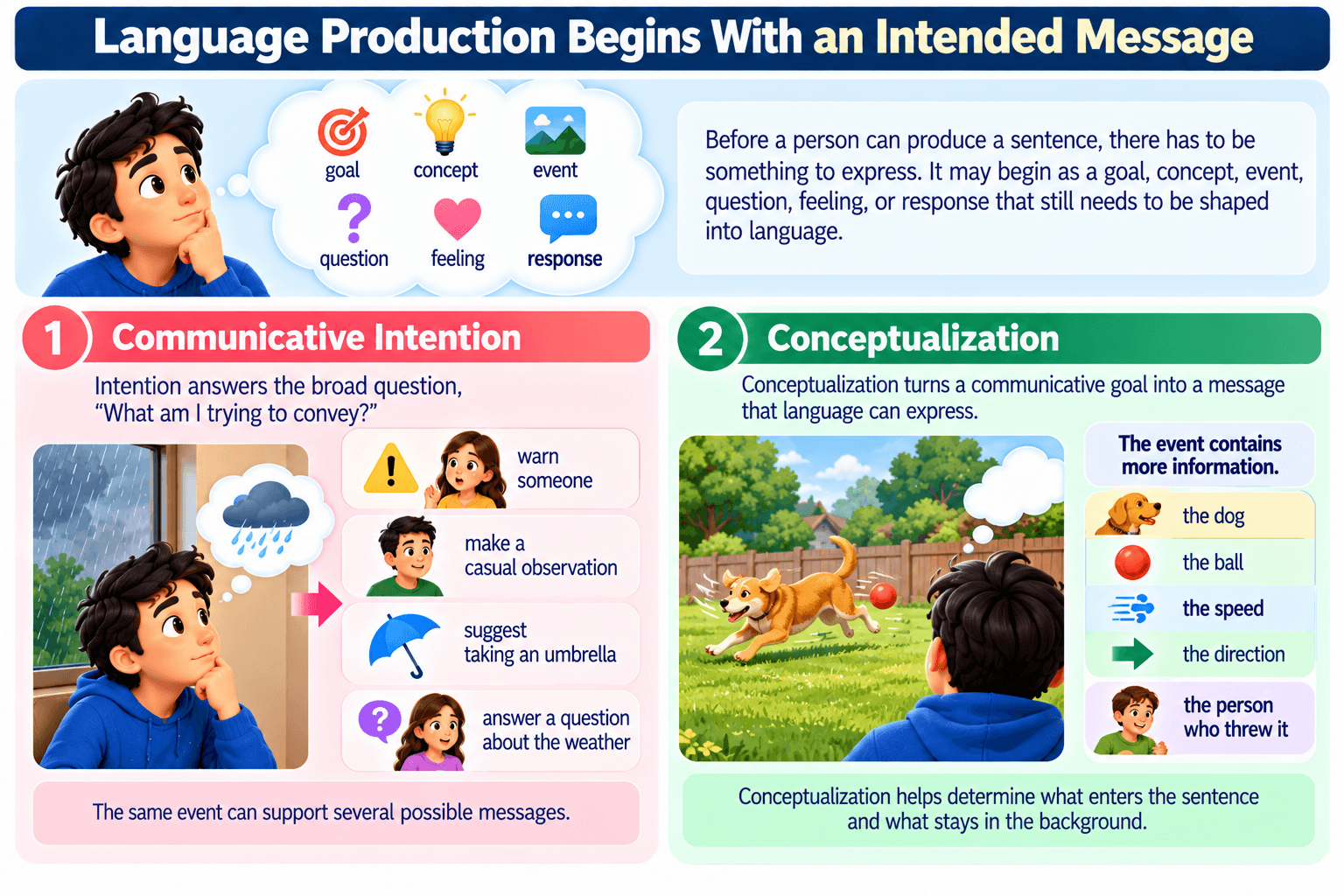
Before a person can produce a sentence, there has to be something to express. That “something” does not have to be a perfectly formed sentence in the mind. It may begin as a goal, concept, event, question, feeling, or response that still needs to be shaped into language.
A classic review of spoken word production and lexical access describes production as beginning with conceptual information and progressing toward lexical and phonological preparation before articulation. That general outline remains influential, although modern accounts differ on how sharply the stages are separated.
Communicative intention
Intention answers the broad question, “What am I trying to convey?” If you notice rain starting outside, you might intend to warn someone, make a casual observation, suggest taking an umbrella, or answer a question about the weather. The same event can support several possible messages.
The production system therefore does more than translate a ready-made thought word for word. It selects which part of a larger idea will be expressed, what level of detail matters, and what perspective the sentence will take.
Conceptualization
Conceptualization turns a communicative goal into a message that language can express. Suppose you watched a dog chase a ball across a yard. You might describe the dog, the ball, the speed, the direction, or the person who threw it. The event contains more information than any one sentence needs.
Conceptualization helps determine what enters the sentence and what stays in the background. That decision affects which words and grammatical structures become relevant later.
A Simple Language-Production Model
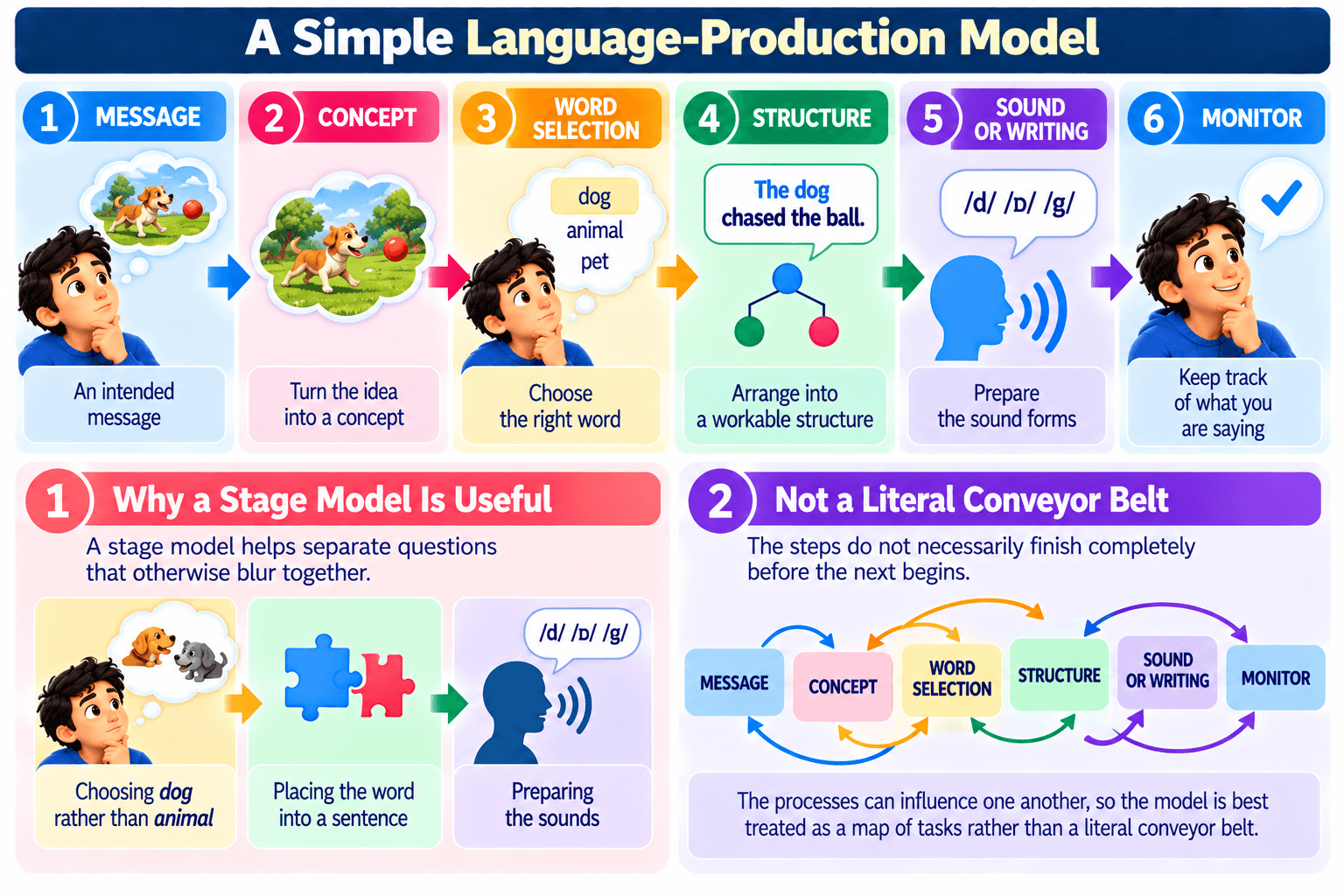
A useful general model is:
MESSAGE → CONCEPT → WORD SELECTION → STRUCTURE → SOUND OR WRITING → MONITOR
This sequence is a simplification for general readers. It highlights several major problems the system has to solve without implying that each step finishes completely before the next begins. Research on language production includes serial, interactive, cascading, and other accounts of how information may move among levels.
Why a stage model is useful without being literal
A stage model helps separate questions that otherwise blur together. Choosing dog rather than animal is not the same problem as placing the word into a sentence. Preparing the sounds /d/, /ɒ/, and /g/ is not the same as deciding that dog is the intended lexical item.
At the same time, the processes can influence one another. Research on lexical selection, speech errors, and monitoring has produced evidence for feedback and interaction in some circumstances. The model is therefore best treated as a map of tasks rather than a literal conveyor belt.
Lexical Selection: Choosing the Words That Fit the Message
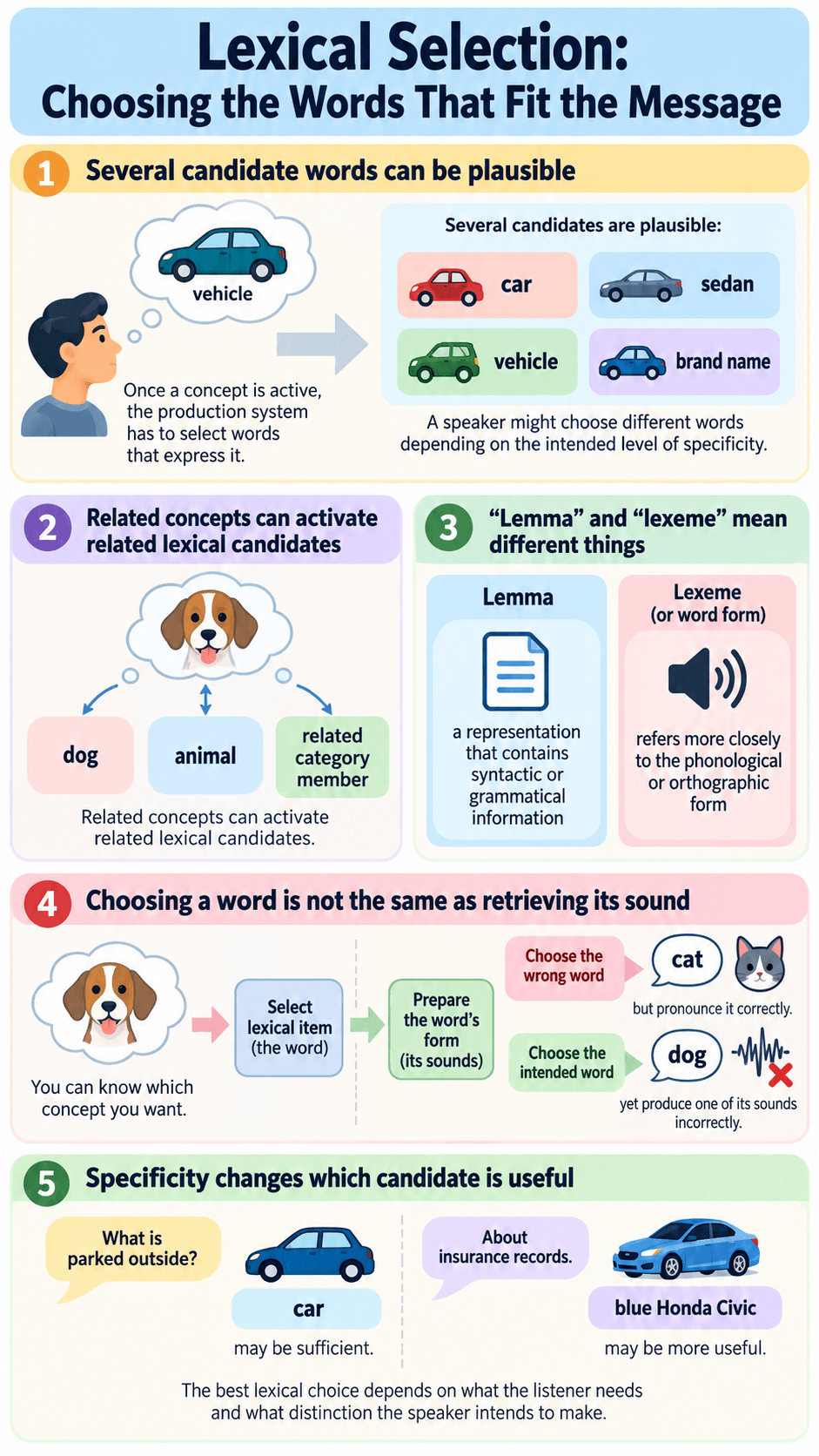
Once a concept is active, the production system has to select words that express it. This sounds simple until several candidates are plausible at once. A speaker describing a vehicle might choose car, sedan, vehicle, or a brand name depending on the intended level of specificity.
Why several words can compete
Related concepts can activate related lexical candidates. If you are naming a picture of a dog, words such as dog, animal, or even a related category member may become relevant to different degrees. Experimental tasks often reveal slower or less accurate selection when competing lexical information is strongly activated.
A critical review of the time course of lexical selection summarizes evidence that lexical access begins rapidly after conceptual processing starts, while also noting that precise timing estimates vary across methods and models.
What “lemma” and “lexeme” mean in plain language
Some theories distinguish between an abstract lexical representation and the word’s sound or written form. The term lemma is often used for a representation that contains syntactic or grammatical information, while lexeme or word form refers more closely to the phonological or orthographic form.
This vocabulary is useful when it clarifies a model, but it should not be mistaken for universally accepted mental boxes. Some theories make this distinction strongly, while others organize lexical information differently.
Why choosing a word is not the same as retrieving its sound
You can know which concept you want and still need to prepare the word’s form. In many production models, selecting the lexical item and preparing its sounds are related but separable operations.
This distinction helps explain why speech errors can occur at different levels. A person may choose the wrong word but pronounce it correctly, or choose the intended word yet produce one of its sounds incorrectly.
Specificity changes which candidate is useful
Production also involves choosing the right level of detail. If someone asks what is parked outside, car may be sufficient. If the conversation is about insurance records, blue Honda Civic may be more useful. The best lexical choice depends not only on what concept is active, but also on what the listener needs and what distinction the speaker intends to make.
This is one reason lexical selection should not be imagined as retrieving a single permanent label attached to a concept. Many concepts can be described at different levels of specificity, and the surrounding message helps determine which word is appropriate now.
Grammatical Encoding: Turning Selected Words Into a Sentence
Speaking requires more than collecting the right words. The words need roles and relationships. Who did what? Which noun belongs with which verb? Which information is the subject, object, modifier, or background detail?
From message structure to sentence structure
Suppose the intended event is a child giving a book to a teacher. English allows several ways to package that message: “The child gave the teacher a book,” “The child gave a book to the teacher,” or, in a different discourse context, “The book was given to the teacher by the child.”
The underlying event is similar, but the grammatical structure changes how information is organized. The production system must map conceptual roles onto a form that the language permits.
Structural choices are influenced by recent language experience
One well-studied phenomenon is structural priming, in which speakers become more likely to reuse a recently encountered syntactic structure. A critical review of structural priming shows how this effect has been used to study grammatical encoding and the representations involved in sentence production.
Structural priming does not mean speakers mechanically copy the previous sentence. It shows that recently activated structures can influence which grammatical option becomes easier to produce.
Planning a sentence does not require planning every word in advance
Speakers often begin talking before the entire sentence is fully prepared. The amount planned ahead depends on the task, sentence, speaker, and context. In spontaneous speech, planning and speaking overlap.
This overlap helps explain why people pause, restart, or revise a phrase midway. Production is often a moving process in which the next portion of the utterance is being prepared while the current portion is already being spoken.
Planning scope changes with the utterance
Speakers do not always prepare the same amount of language before they begin. A short routine answer such as “Yes, at three” may require very little advance planning. Explaining a complicated event may require more conceptual organization before the first clause is spoken, followed by additional planning while speech continues.
The amount of advance preparation can also change within one conversation. Naming a familiar object may be quick, while choosing a precise technical term or describing an unfamiliar relationship can require more time. This variability helps explain why fluency is not a simple measure of whether someone “knows what they mean.” A person may have a clear overall idea while still constructing the linguistic form step by step.
Phonological Encoding: Preparing the Sound Form
After lexical and grammatical information becomes available, spoken production requires preparation of the sound pattern. The system has to retrieve the relevant phonological form, organize its segments and syllables, and prepare it for motor execution.
From a selected word to a pronounceable form
If the intended word is calendar, the production system needs more than the concept and grammatical category. It has to prepare the sequence of sounds and syllables that make the word pronounceable in the speaker’s language.
Research on verbal ordering and language production describes a widely used distinction among message-level, grammatical, phonological, and articulatory encoding processes.
Why sound planning can produce systematic errors
Speech sounds are not always prepared perfectly. A sound may appear too early, persist from an earlier word, exchange position with another sound, or be omitted. Importantly, these errors are not completely random.
The patterns have historically been useful because they reveal something about how sounds are organized during production. Even an error can preserve properties of the language’s phonological system.
Articulation: Turning a Prepared Form Into Speech
Articulation is the motor execution stage in which prepared speech plans become coordinated movements of the respiratory system, larynx, tongue, lips, jaw, and other structures involved in speaking.
Articulation is only one part of speaking
Because articulation is visible and audible, it can seem like the whole process. Psychologically, however, much of the work has already occurred before the first sound is produced. The message, lexical choices, sentence structure, and phonological plan all contribute to what the articulatory system receives.
This is why a speech error cannot automatically be treated as an articulation problem. An incorrect output may originate at the conceptual, lexical, phonological, or motor level, and ordinary conversation does not provide enough information to determine the exact cause of a single error.
Why fluent speech still contains variability
Even fluent speakers do not produce identical acoustic patterns every time they say a word. Rate, surrounding sounds, emphasis, fatigue, conversational context, and motor variation all affect the signal. Successful production therefore does not mean perfect repetition.
The goal of the system is effective language output, not machine-like sameness.
Speech Errors Reveal the Architecture of Production
Slips of the tongue are useful because they expose parts of the production system that are usually hidden. Researchers have long analyzed substitutions, exchanges, anticipations, perseverations, and other errors to test theories about how words and sounds are selected and ordered.
Word substitutions
A speaker might intend fork but say spoon. If the substitute is semantically related, the error may reflect competition among lexical candidates. Other substitutions may be phonologically related, revealing a different source of interference.
One error does not identify a single mechanism with certainty, but patterns across many errors can constrain theories.
Sound exchanges and ordering errors
Classic slips include anticipations, in which a later sound appears too early, or exchanges, in which two sounds trade positions. Large-scale work on speech errors and production architecture shows how systematic error patterns can provide evidence about both planning and articulation.
These errors matter scientifically because they suggest that speech is organized into structured units rather than generated as an undifferentiated stream.
Why an error does not automatically signal a disorder
Healthy speakers pause, substitute words, repeat phrases, and occasionally produce the wrong sound. A rare slip during ordinary conversation is not enough to identify a language, memory, or neurological condition.
Sudden or marked changes in speaking or understanding, especially when accompanied by other neurological symptoms, are a different situation and may require urgent medical evaluation. General educational material cannot determine the cause of such a change.
Why Normal Speech Contains Pauses, Restarts, and Corrections
Spontaneous speech is produced under time pressure. The speaker is deciding what to say, preparing upcoming words, monitoring what has already been said, and adapting to the listener at the same time. Small disruptions are therefore expected.
Filled and silent pauses
A pause may occur while a speaker prepares the next phrase, searches among lexical alternatives, changes the planned structure, or decides what level of detail to include. A pause does not map neatly onto one single cognitive event.
Sometimes silence simply reflects the complexity of what the person is trying to express. In other cases it may reflect conversation management, emphasis, uncertainty, or a deliberate attempt to avoid speaking too quickly.
Restarts and reformulations
A speaker may begin “The meeting is on Thurs…” and then restart with “Actually, it was moved to Friday.” The revision can occur because the message changed, a factual error was noticed, or a clearer formulation became available.
Reformulation is evidence that production remains adjustable after speech has already started.
Monitoring: How Speakers Catch Some of Their Own Errors
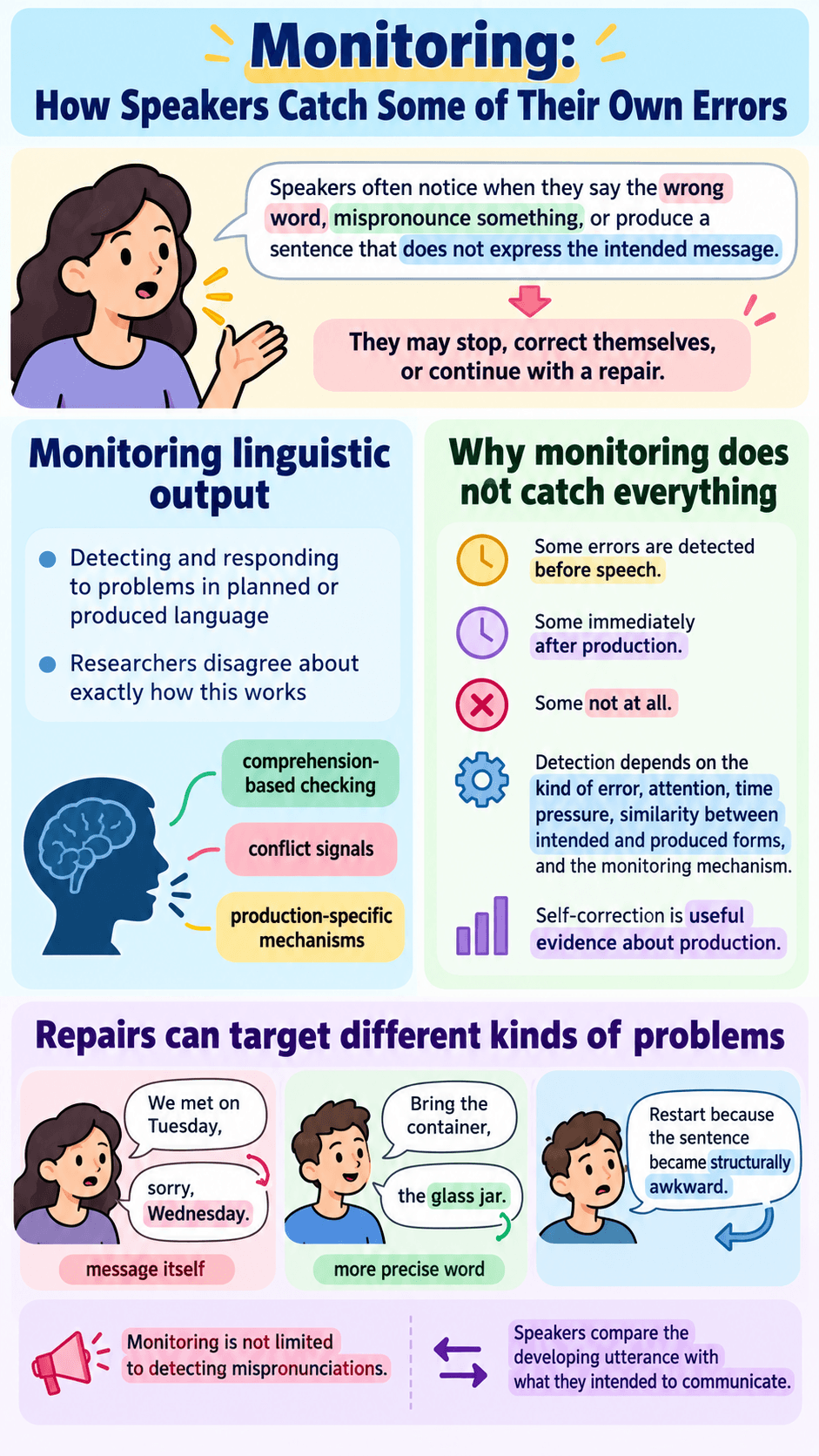
Speakers often notice when they say the wrong word, mispronounce something, or produce a sentence that does not express the intended message. They may stop, correct themselves, or continue with a repair.
Monitoring linguistic output
Monitoring in language production refers to detecting and responding to problems in planned or produced language. Researchers disagree about exactly how this works. Some theories emphasize comprehension-based checking, others emphasize conflict signals or production-specific mechanisms.
A review of self-monitoring in speech production highlights these competing accounts and shows that error detection cannot be reduced to one universally accepted mechanism.
Why monitoring does not catch everything
If monitoring were perfect, slips of the tongue would rarely reach the listener. In reality, some errors are detected before speech, some immediately after production, and some not at all.
Detection depends on the kind of error, attention, time pressure, the similarity between intended and produced forms, and the monitoring mechanism proposed by a given theory. Ordinary self-correction is therefore useful evidence about production, not proof that speakers continuously inspect every word consciously.
Repairs can target different kinds of problems
A self-repair may fix factual content, lexical choice, pronunciation, or sentence structure. Someone might say, “We met on Tuesday, sorry, Wednesday,” correcting the message itself. Another speaker might replace a broad word with a more precise one: “Bring the container, the glass jar.” A third might restart because the sentence has become structurally awkward.
These repairs show that monitoring is not limited to detecting mispronunciations. Speakers can compare the developing utterance with several kinds of expectations, including what they intended to communicate and whether the chosen form is working well enough to continue.
Spoken and Written Language Production
Speaking and writing share important planning problems: both require a message, lexical selection, sentence construction, and monitoring. Their output systems, however, are not identical. When language is experienced internally without audible or written output, the question shifts to inner speech rather than overt production.
Shared planning problems
Whether speaking or writing, a person still has to decide what to express and select words that fit the intended meaning. Both modes also require organizing words into a coherent sentence or larger discourse.
This shared foundation explains why some psycholinguistic concepts apply to both spoken and written production.
Different output demands
Speech unfolds rapidly and is difficult to retract once heard. Writing usually permits more time to pause, review, reorder, and edit before the reader sees the final version. Written production also relies on orthographic forms and motor actions such as handwriting or typing rather than speech articulation.
This article focuses mainly on the cognitive architecture of language production, not on techniques for becoming a better writer or public speaker.
Language Production vs Tip-of-the-Tongue Experiences
Word retrieval difficulty can appear during production, but the familiar tip-of-the-tongue experience belongs to a narrower metacognitive question.
Production asks how words are selected and prepared
Language production studies the larger mechanism that takes a message toward lexical selection, structure, sound or written form, and output. Temporary retrieval difficulty can occur within that broader process.
Tip-of-the-tongue asks what it feels like to know but not retrieve
A tip-of-the-tongue state includes the subjective sense that the word is known and may soon become accessible. That “feeling of knowing” is a metacognitive experience, not the whole production system.
The published Metacognition and Memory topic is the better place for the experience of judging what you know or can retrieve. Language production should mention that experience only to mark the boundary.
Language Production vs General Self-Monitoring
Speech monitoring is also narrower than metacognitive self-monitoring in general.
Production monitoring
Here the question is whether the speaker detects a linguistic problem: a wrong word, an unintended sound, a sentence that fails to express the message, or an error that needs repair.
Broader metacognitive monitoring
General self-monitoring includes tracking understanding, confidence, performance, strategy use, or errors across many kinds of thinking and behavior. Language-production monitoring is one specialized case within that wider territory.
Keeping the scopes separate prevents an article about speech production from becoming a general guide to metacognition.
A Practical Way to Observe Language Production
You do not need a laboratory to notice the stages involved in speaking, although everyday observation cannot identify mechanisms with experimental precision.
Notice a reformulation
The next time you change “I need the blue one” to “I mean the darker blue folder,” notice what changed. The concept became more specific, a new lexical choice was selected, and the sentence was reformulated to reduce ambiguity.
Notice a harmless slip
If you accidentally swap two sounds or say a related word, treat it as a reminder that production involves selection and ordering under time pressure. A single slip is usually more informative about the complexity of speaking than about a person’s health.
Notice planning ahead
Longer or unfamiliar explanations often produce more pauses than routine phrases. That difference reflects the extra planning required to choose content, structure it, and prepare the next stretch of language while speaking continues.
FAQ
These questions address common misunderstandings about how thoughts become spoken or written language.
What is language production in psychology?
Language production is the cognitive process of turning an intended message into linguistic output. It includes conceptualization, lexical selection, grammatical encoding, phonological or written-form preparation, articulation or writing, and monitoring. Researchers debate how strongly these stages are separated and how much information flows between them.
Why do people sometimes say the wrong word even when they know the right one?
Several lexical candidates may be active at the same time, and selection is not perfectly error free. A semantically or phonologically related competitor can occasionally be produced instead of the intended word. A single substitution does not reveal exactly which mechanism caused it and is not enough to diagnose a problem.
Are slips of the tongue random?
Not completely. Speech-error research shows recurring patterns in substitutions, exchanges, anticipations, and sound ordering. Those patterns have helped researchers test theories of lexical and phonological planning. Individual slips still have many possible causes, so the scientific value comes mainly from patterns across many observations.
Why do people pause even when they know what they want to say?
Knowing the general message does not mean every word and structure is already prepared. A speaker may still be choosing vocabulary, planning a clause, changing the level of detail, or monitoring the previous phrase. Pauses can therefore occur during normal fluent speech for several different reasons.
Is language-production monitoring the same as general self-awareness?
No. Production monitoring concerns detecting problems in planned or spoken language and correcting them when possible. General self-awareness and metacognitive monitoring cover much broader questions about thoughts, confidence, understanding, behavior, and performance.
Key Takeaways
- Language production begins with an intended message and requires several kinds of planning before speech or writing appears.
- Lexical selection, grammatical encoding, sound-form preparation, articulation, and monitoring solve different but interacting problems.
- Classic stage models are useful maps, but they should not be treated as one universally accepted literal pipeline.
- Speech errors are scientifically valuable because their patterns reveal how words and sounds are selected and ordered.
- Pauses, restarts, and occasional corrections are normal features of spontaneous production and do not by themselves indicate a disorder.
- Tip-of-the-tongue experiences and broad self-monitoring overlap with production but belong to separate metacognitive questions.

Michael Reed is the Founder and Lead Writer at Psychology Exposed. He writes about human behavior, relationships, emotional patterns, self-awareness, and practical psychology topics using research-informed, easy-to-understand content.
Read More About Michael Reed: https://psychologyexposed.com/michael-reed/