

You can hear a sentence in a fraction of a second and feel as if its meaning simply arrived. You can read a familiar word almost instantly, notice that a sentence sounds wrong before you can explain why, or begin speaking while you are still deciding exactly how the sentence will end. These everyday experiences hide a remarkable amount of mental work.
Language psychology examines that work. It looks at how the mind recognizes speech and written forms, identifies familiar words, activates meaning, combines words into sentences, uses context to infer what someone intends, and turns ideas into spoken or written language. It also asks broader questions about inner speech, the relationship between language and thought, and how people manage more than one language.
The goal here is not to teach grammar, improve vocabulary, or explain how to communicate better with another person. It is to show how language functions as a cognitive system. The most useful way to understand the topic is to separate several processes that work together so smoothly that we usually experience them as one act: understanding or producing language.
Quick Answer
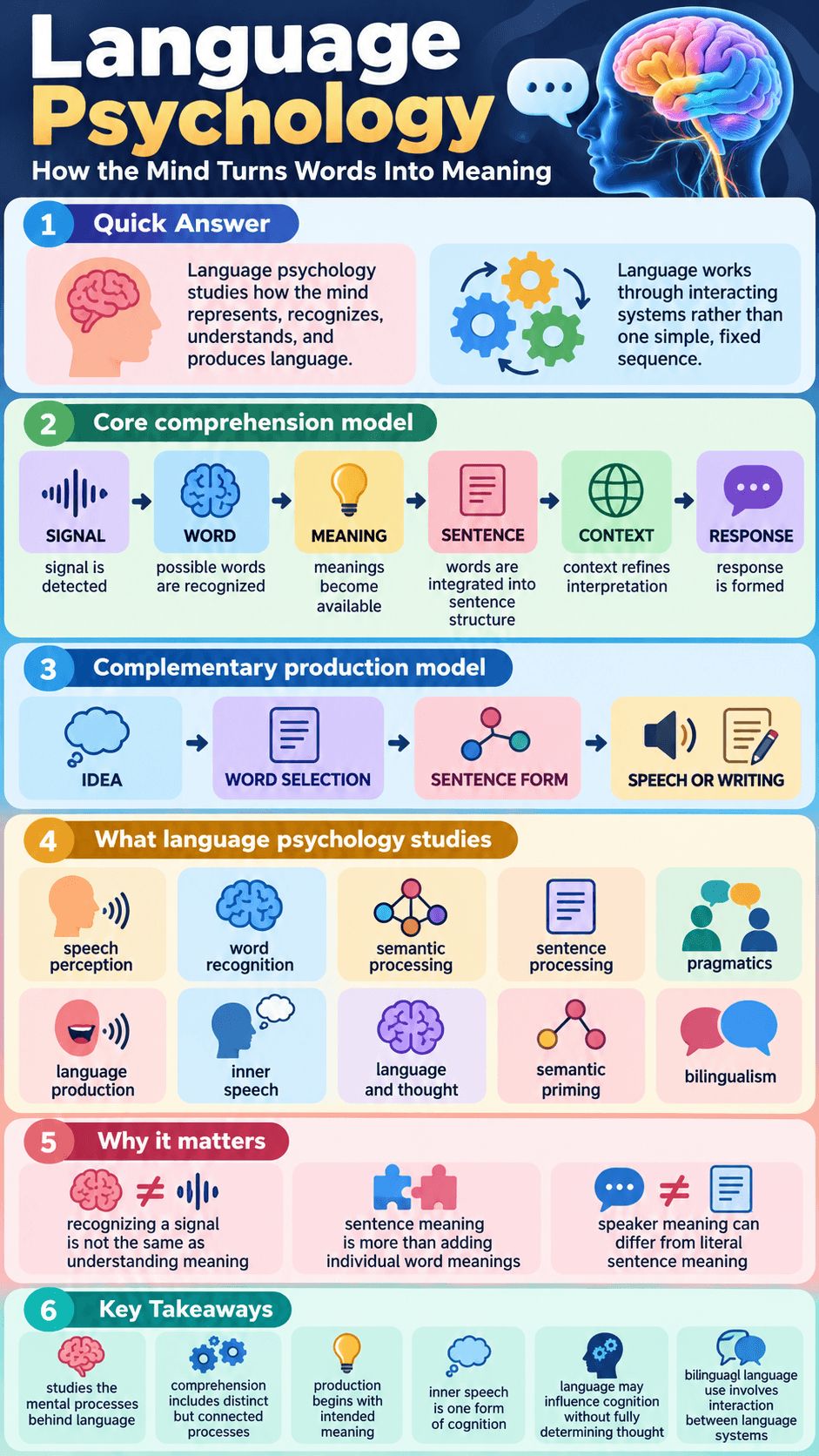
Language psychology studies how the mind represents, recognizes, understands, and produces language. It includes processes such as speech perception, word recognition, access to meaning, sentence comprehension, contextual inference, word selection, inner speech, and bilingual language use. Psycholinguistics is the scientific field that investigates many of these processes experimentally. Language works through interacting systems rather than one simple, fixed sequence.
What Language Psychology Studies
Language psychology as cognitive processing
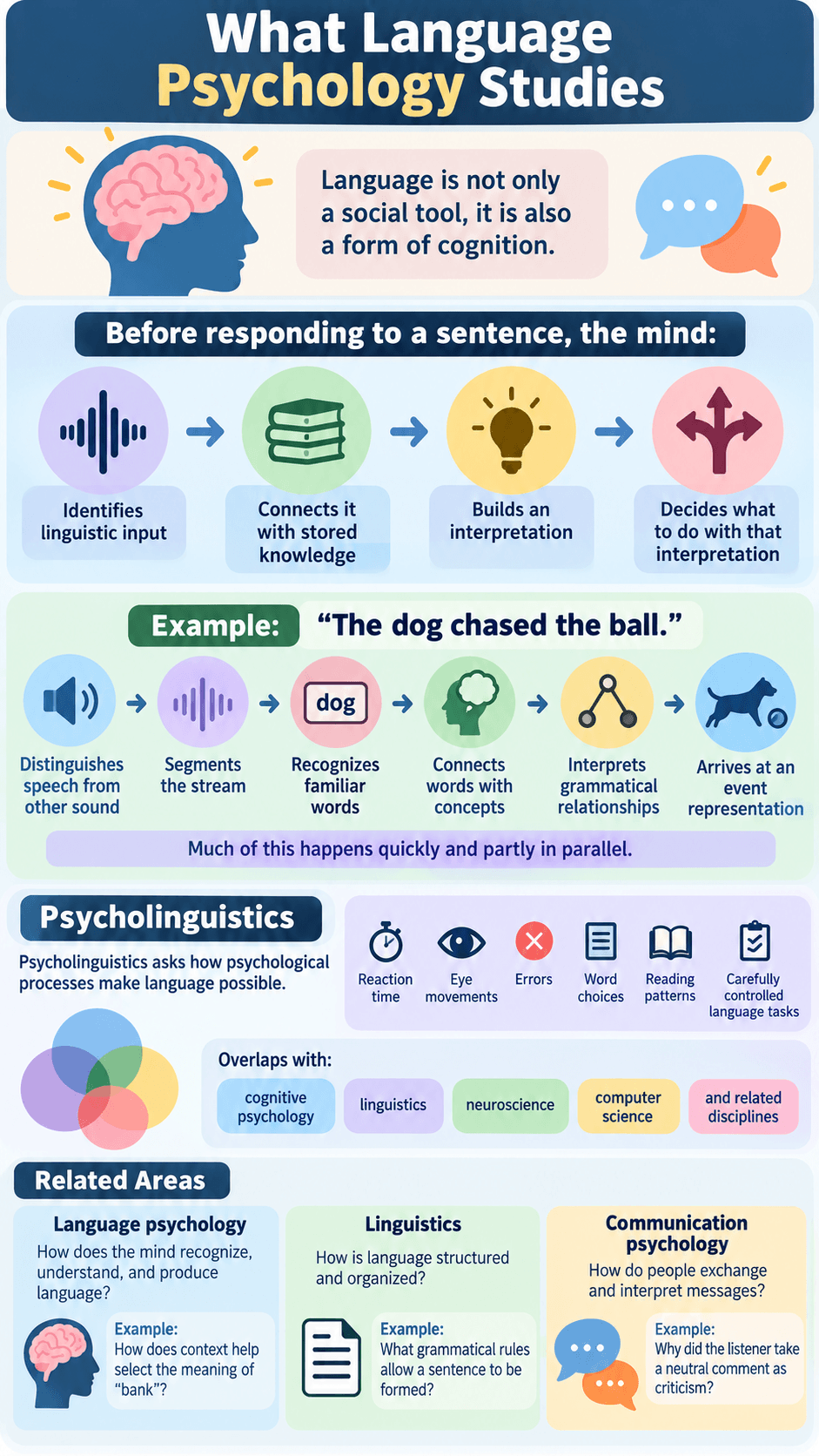
Language is not only a social tool. It is also a form of cognition. Before a person can respond to a sentence, the mind has to identify linguistic input, connect it with stored knowledge, build an interpretation, and decide what to do with that interpretation.
Consider the spoken sentence, “The dog chased the ball.” The listener must distinguish speech from other sound, segment the stream into useful units, recognize familiar words, connect those words with concepts, interpret the grammatical relationships, and arrive at an event representation. Much of this happens quickly and partly in parallel.
Psycholinguistics as the scientific field behind the topic
Psycholinguistics is the research tradition that asks how psychological processes make language possible. Researchers may measure reaction time, eye movements, errors, word choices, reading patterns, or responses to carefully controlled language tasks. The field overlaps with cognitive psychology, linguistics, neuroscience, computer science, and related disciplines.
The APA Dictionary of Psychology describes linguistics as the scientific study of the physical, structural, functional, psychological, and social characteristics of language. Psycholinguistics narrows the question toward the mental processes involved in understanding, producing, and representing language.
Language Psychology vs Communication Psychology vs Linguistics
These areas overlap, but they ask different questions. Linguistics examines the structure and properties of language, including sound systems, word structure, syntax, semantics, and pragmatics. Language psychology asks how the mind processes and uses those structures.
Communication psychology is more concerned with the exchange of messages between people. For example, recognizing that the word “bank” could refer to a financial institution or the side of a river is a language-processing question. Deciding why a partner interpreted a short text message as dismissive is more clearly a communication question.
| Area | Main question | Example |
|---|---|---|
| Language psychology | How does the mind recognize, understand, and produce language? | How does context help select the meaning of “bank”? |
| Linguistics | How is language structured and organized? | What grammatical rules allow a sentence to be formed? |
| Communication psychology | How do people exchange and interpret messages? | Why did the listener take a neutral comment as criticism? |
Why Language Is More Than Hearing or Reading Words
Recognizing a signal is not the same as understanding meaning
A sound can be heard without being understood as language. A printed string can be seen without being recognized as a familiar word. Language comprehension begins with perceptual information, but it depends on learned linguistic representations and context.
This is why an unfamiliar language can sound like a continuous stream even when a fluent speaker hears clear word boundaries. The physical signal does not arrive with neat spaces between spoken words. The listener uses experience with sound patterns, likely word forms, and context to make the stream more interpretable.
Sentence meaning is more than adding individual word meanings
Knowing every word in a sentence does not guarantee that the sentence will be understood. Word order and grammatical relationships matter. Compare “The dog chased the cat” with “The cat chased the dog.” The same words are present, but their relationships change the event.
Longer sentences also create expectations that can be revised as new words arrive. The mind often begins building an interpretation before the sentence is complete, which is efficient but sometimes leads to temporary misunderstanding and rereading.
Speaker meaning can differ from literal sentence meaning
If someone says, “It is cold in here,” they may simply be describing temperature. In another situation, the same sentence may function as an indirect request to close a window. Literal sentence meaning is one part of interpretation, not the whole of it.
Listeners also use shared knowledge, reference, recent conversation, setting, and assumptions about what the speaker is trying to accomplish. This contextual layer is central to pragmatic interpretation.
A Reader-Friendly Model of Language Comprehension
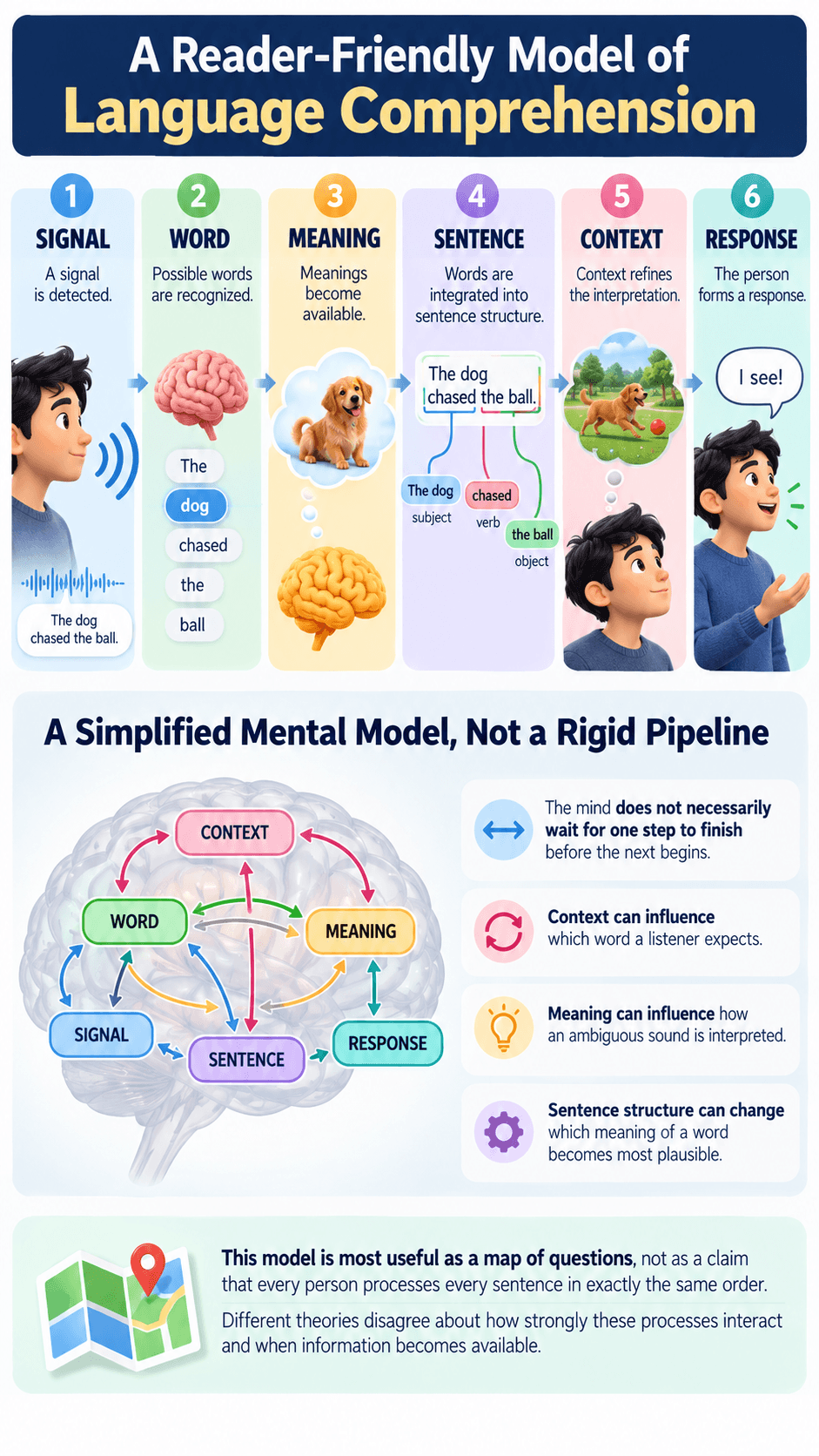
SIGNAL → WORD → MEANING → SENTENCE → CONTEXT → RESPONSE
A useful way to organize language comprehension is to imagine six broad steps: a signal is detected, possible words are recognized, meanings become available, words are integrated into sentence structure, context refines the interpretation, and the person forms a response.
This model helps separate questions that otherwise blur together. Speech perception concerns how sound becomes recognizable linguistic input. Word recognition concerns which familiar word the input matches. Semantic processing concerns what meanings are activated. Sentence processing concerns how multiple words and grammatical relationships are integrated. Pragmatics concerns how wider context shapes intended meaning.
Why this is a simplified mental model rather than a rigid universal pipeline
The arrows make the process easy to visualize, but the mind does not necessarily wait for one box to finish before the next begins. Context can influence which word a listener expects. Meaning can influence how an ambiguous sound is interpreted. Sentence structure can change which meaning of a word becomes most plausible.
Different theories disagree about how strongly these processes interact and when information becomes available. A general model is most useful as a map of questions, not as a claim that every person processes every sentence in exactly the same order.
A Complementary Model of Language Production
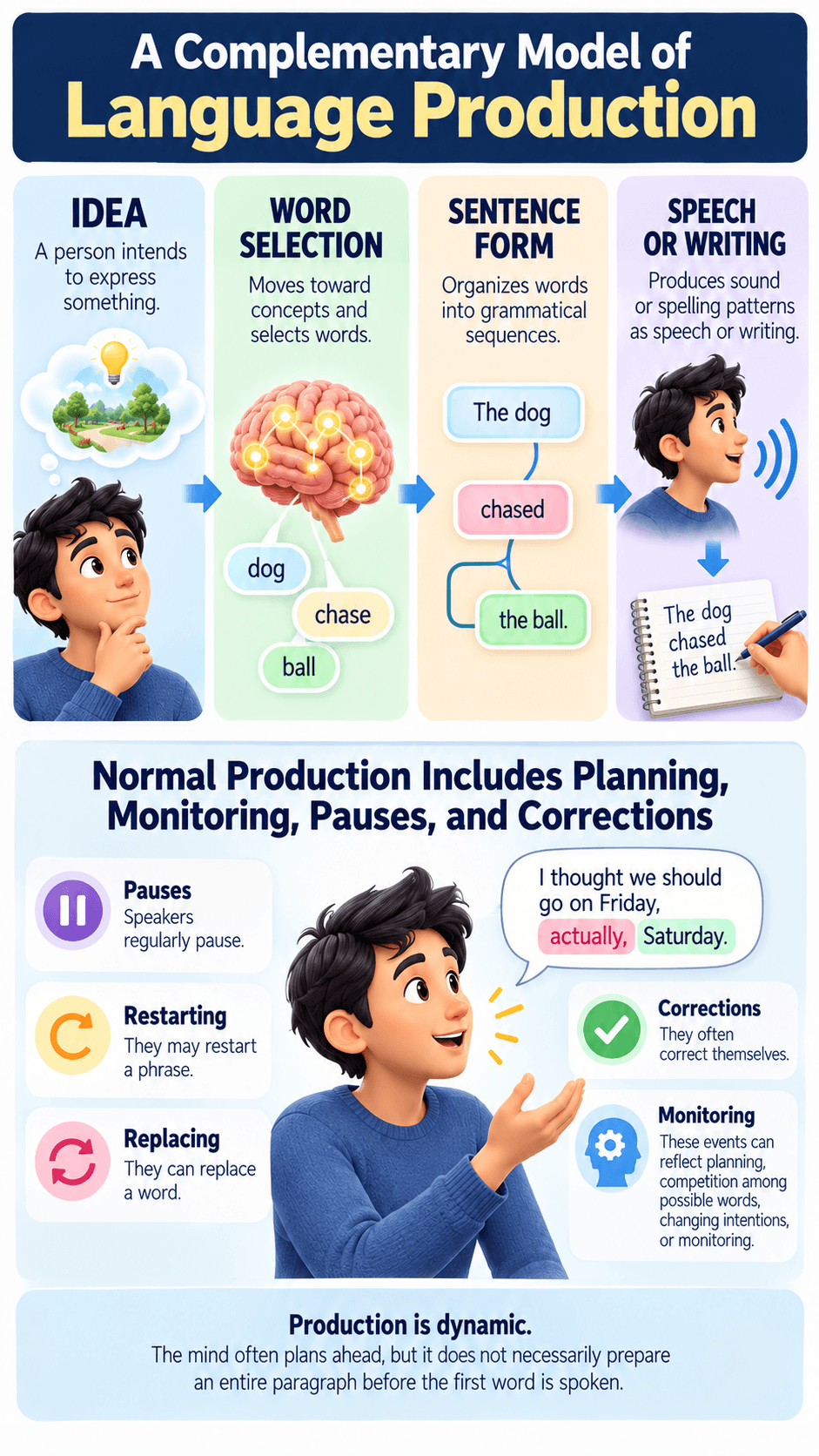
IDEA → WORD SELECTION → SENTENCE FORM → SPEECH OR WRITING
Understanding language starts with input. Producing language starts with something a person intends to express. A broad production model moves from an idea or communicative intention toward concepts, word selection, grammatical organization, sound or spelling patterns, and finally speech or writing.
Research reviews of language production processes describe production as involving multiple levels, including forming a message, selecting lexical representations, and configuring words into sequences. The exact architecture remains a matter of theory, so it is better to think in terms of coordinated operations than a single universally accepted diagram.
Why normal production includes planning, monitoring, pauses, and corrections
Fluent speaking can feel automatic, yet speakers regularly pause, restart a phrase, replace a word, or correct themselves. These events do not automatically signal a problem. They can reflect ordinary planning demands, competition among possible words, changing intentions, or monitoring of what is being said.
A person may begin, “I thought we should go on Friday, actually, Saturday,” because the intended message changed while speech was already underway. Production is dynamic. The mind often plans ahead, but it does not necessarily prepare an entire paragraph before the first word is spoken.
Area 1: Recognizing Linguistic Input
Speech perception in brief
Speech perception asks how rapidly changing acoustic information becomes recognizable speech. The challenge is greater than matching each sound to a fixed letter. Speech sounds vary with speaker, accent, speaking rate, surrounding sounds, and coarticulation, which means the production of one sound is influenced by neighboring sounds.
Listeners nevertheless achieve impressive stability. Familiarity with a language helps them use acoustic cues, learned categories, probable word forms, and context. Visual information from a speaker’s face can also influence perception in some situations. These effects show that recognizing speech is an active interpretation problem, not simple audio transcription.
Word recognition in brief
Once the input resembles familiar linguistic material, the mind must identify which word is present. Recognition can be influenced by frequency, familiarity, similarity to other words, and context. A common conceptual metaphor is a mental lexicon, but it should not be imagined as a tiny dictionary stored in one spot.
Instead, the term refers to organized knowledge about familiar words and their properties. Competing candidates may become active as a spoken word unfolds. With written words, letter patterns, sound information, and prior context can all influence recognition speed.
Area 2: Building Meaning
Semantic processing in brief
Recognizing a familiar word answers something like, “What word is this?” Semantic processing asks, “What meaning becomes active here?” Many words have multiple senses, and their interpretation depends on context. “Light” may refer to illumination, low weight, or something not serious.
Meaning also involves relationships among concepts. “Doctor” may make “nurse” more accessible because the concepts are related. “Robin” and “bird” have a category relationship. These connections help explain why meaning is flexible and context sensitive rather than a one-to-one lookup table.
Sentence processing in brief
Sentence processing combines word meaning with word order, syntax, plausibility, and prior context. Comprehension is often incremental, meaning interpretation develops as the sentence unfolds.
That strategy is fast, but it can create garden-path effects. A reader may initially adopt one grammatical interpretation and then revise it when later words no longer fit. The need to revise is a useful reminder that comprehension involves prediction and updating, not passive collection of words.
Pragmatic interpretation in brief
Pragmatics concerns what language means in context. A listener may need to determine what “she,” “there,” or “tomorrow” refers to, infer an indirect request, understand irony, or use shared knowledge to interpret a statement.
Pragmatic inference is not mind reading. It is an interpretation based on available linguistic and contextual information. The same words can reasonably support different interpretations in different settings, especially when speakers do not share the same assumptions or background knowledge.
Area 3: Producing Language
Language production in brief
Language production turns intended meaning into linguistic form. It involves choosing concepts to express, selecting words, organizing grammatical relationships, retrieving sound or written forms, and carrying out speech or writing.
Different theoretical models disagree about how strictly these operations are separated. Still, the distinction is useful because it explains why knowing what you want to say is not identical to having the exact sentence ready.
Why choosing a message is not the same as selecting words
You may know the point you want to make before you know the sentence you will use. For example, you may intend to decline an invitation politely, then consider several possible forms: “I cannot make it,” “I already have plans,” or “Thank you, but I will have to pass.”
The intention is broader than any one wording. Word selection and sentence formulation convert that intention into a linguistic expression. This distinction matters because language production is not simply retrieving a stored sentence from memory.
Area 4: Language, Thought, and Multiple Language Systems
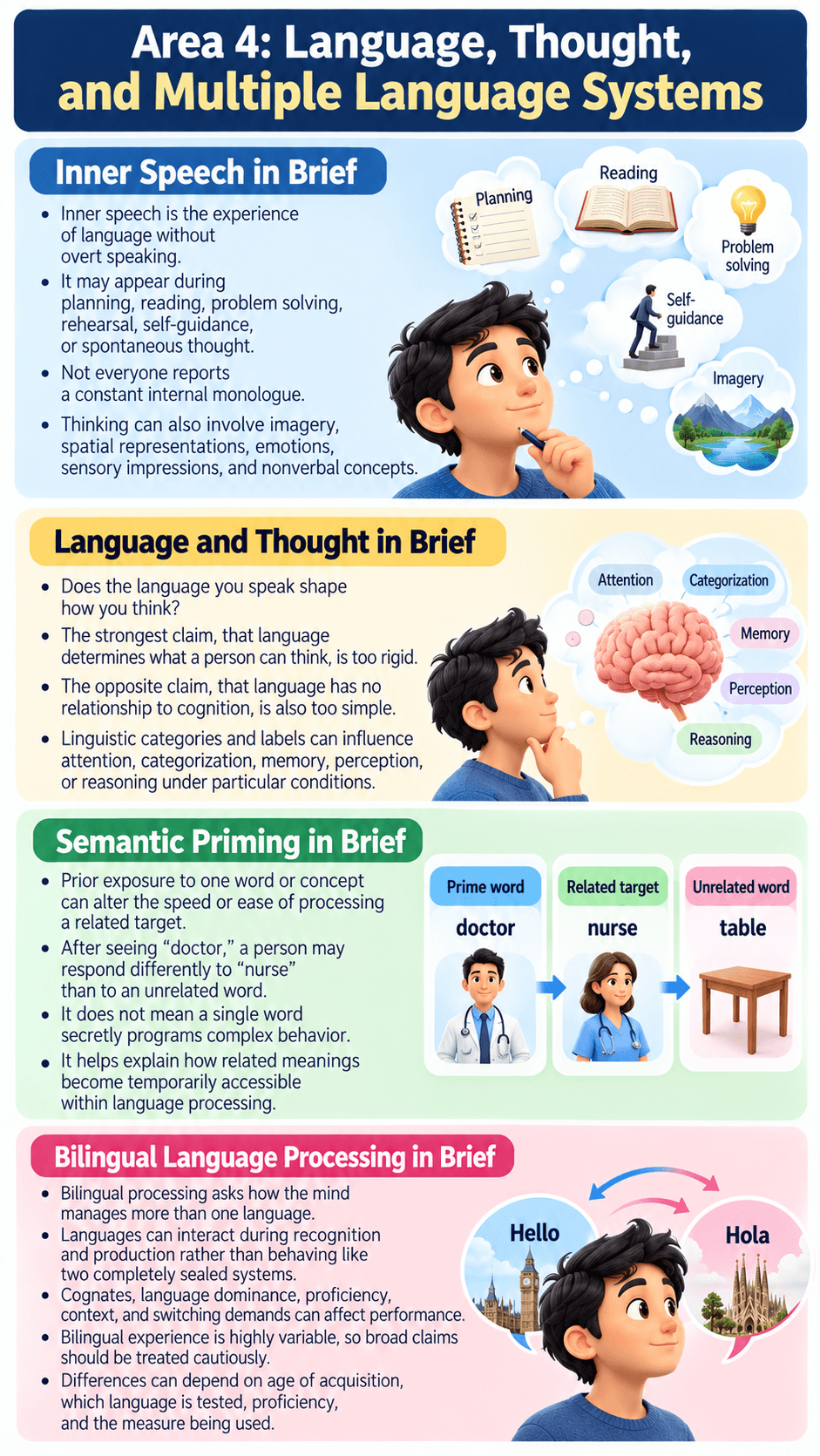
Inner speech in brief
Inner speech is the experience of language without overt speaking. It may appear during planning, reading, problem solving, rehearsal, self-guidance, or spontaneous thought. A major review of inner speech research emphasizes that internal verbal experience varies in form and function across people and situations.
Not everyone reports a constant internal monologue. Thinking can also involve imagery, spatial representations, emotions, sensory impressions, and nonverbal concepts. Inner speech is one possible form of cognition, not a requirement for all thought.
Language and thought in brief
Does the language you speak shape how you think? The strongest claim, that language determines what a person can think, is too rigid. Yet the opposite claim, that language has no relationship to cognition, is also too simple.
Research on linguistic relativity asks whether linguistic categories and labels can influence attention, categorization, memory, perception, or reasoning under particular conditions. Reviews of the language and thought debate treat influence as an empirical question rather than evidence that words imprison the mind.
Semantic priming in brief
Semantic priming is a specific experimental effect in which prior exposure to one word or concept can alter the speed or ease of processing a related target. After seeing “doctor,” for example, a person may respond differently to “nurse” than to an unrelated word.
The effect is usually studied across many trials and participants. It does not mean a single word secretly programs complex behavior. Semantic priming is most useful for understanding how related meanings become temporarily accessible within language processing.
Bilingual language processing in brief
Bilingual processing asks how the mind manages more than one language. Research suggests that languages can interact during recognition and production rather than behaving like two completely sealed systems. Cognates, language dominance, proficiency, context, and switching demands can all affect performance.
Bilingual experience is highly variable, so broad claims should be treated cautiously. A recent meta-analysis of bilingual lexical performance illustrates why simple claims about universal costs or advantages can be misleading. Differences can depend on age of acquisition, which language is tested, proficiency, and the measure being used.
Decision Guide: Which Language Psychology Article Should You Read Next?
If your question starts with how sound becomes speech
Speech perception is the best next topic. It focuses on acoustic cues, segmentation, phonetic categories, speaker variability, accent familiarity, and the way context helps stabilize recognition.
If your question starts with how a familiar word is identified
Word recognition is the narrower question. It examines how spoken or written forms activate candidate words and how frequency, familiarity, and competition influence recognition.
If your question starts with how a word activates meaning
Semantic processing focuses on meaning access. It is especially useful for understanding ambiguity, category relationships, associations, and the way context makes one interpretation more relevant than another.
If your question starts with how a sentence is built word by word
Sentence processing looks at incremental comprehension, syntax, word order, plausibility, prediction, ambiguity, and reanalysis. It explains why difficult sentences may require rereading even when every individual word is familiar.
If your question starts with how context changes intended meaning
Pragmatics is the next step. It examines how listeners use common ground, reference, implication, indirectness, irony, and other contextual cues to move beyond literal sentence meaning.
If your question starts with how thoughts become words
Language production examines conceptualization, lexical selection, grammatical encoding, sound-form preparation, articulation, writing, and monitoring. It also helps explain ordinary pauses and speech errors without treating them as automatic signs of disorder.
If your question starts with why thinking can feel verbal
Inner speech focuses on internal verbal experience. It asks what forms inner speech can take, what functions it may support, and why people differ in how often or vividly they experience words in the mind.
If your question starts with whether language shapes thought
Language and thought is the broader theoretical question. It covers linguistic relativity, nonverbal cognition, labels, categorization, and the limits of strong deterministic claims.
If your question starts with why related words become easier to process
Semantic priming addresses that specific effect. It focuses on primes, targets, relatedness, timing, accessibility, and the difference between a measurable processing effect and a claim about large real-world behavioral control.
If your question starts with how two languages are managed
Bilingualism psychology looks at cross-language activation, language selection, switching, cognates, false friends, dominance, proficiency, and code-switching. The emphasis is on processing multiple languages, not on advice for learning a second language.
Common Misunderstandings About Language and the Mind
Language is not identical to communication
Language provides symbolic and structural resources that can be used for communication, but communication is broader. People communicate with gesture, facial expression, images, timing, silence, and other signals. Language processing also occurs when no conversation is taking place, such as during silent reading or inner speech.
A mental lexicon is a model, not a literal dictionary in one location
The phrase “mental lexicon” is useful shorthand for knowledge related to words, including their forms, meanings, and relationships. It should not be taken to mean the brain contains a single alphabetical list that is searched like a printed dictionary.
Different models represent lexical knowledge differently. The metaphor is valuable when it clarifies a process, but misleading when it is treated as a literal storage box.
Language can influence cognition without determining reality
Words and categories can guide attention, make distinctions easier to express, or affect how information is encoded in some tasks. That does not mean a person is unable to understand a concept unless their language contains one exact word for it.
Human cognition includes verbal and nonverbal processes. The most defensible position is usually conditional: language may influence particular cognitive tasks under particular circumstances, while thought is not reducible to words.
Bilingualism is not confusion
Using two languages can involve competition, cross-language activation, or switching, but those mechanisms are not evidence that the mind is confused. Code-switching can be systematic and appropriate to context. Accent and dialect differences are also normal forms of language variation.
Claims that bilingual people are universally smarter, universally disadvantaged, or inevitably delayed flatten a much more variable research picture. Proficiency, age of acquisition, social context, language use, and task demands all matter.
Where Language Psychology Connects to Other Cognitive Topics
Perception, attention, memory, learning, metacognition, and cognitive flexibility as neighboring concepts
Language depends on other cognitive capacities. Perception contributes to recognizing spoken and written input. Attention helps prioritize relevant information. Memory supports knowledge of words and past context. Learning makes language knowledge possible in the first place. Metacognition can shape how people judge their own understanding, and cognitive flexibility can matter when rules or language systems shift.
These connections are real, but they do not erase the value of studying language-specific processes. Hearing a sound and identifying it as a word are related but not identical tasks. Remembering information and accessing a word’s meaning during comprehension are related but not the same research question.
Why those neighboring topics remain distinct
A useful test is to ask what is being explained. If the main question is how temporary information is maintained while solving a task, working memory is central. If the question is how a familiar word becomes recognized and meaningful, language processing is central. If the question is how experience changes skill over time, learning is central.
Keeping these questions distinct prevents every cognitive process from being reduced to language and prevents language from being explained only as a side effect of general cognition.
When Language Changes May Need More Than General Education
Ordinary variation versus sudden or marked language changes
People sometimes pause, use the wrong word, misunderstand a sentence, reread difficult material, or need extra time with an unfamiliar accent. These experiences can occur in ordinary language use and do not by themselves identify a disorder.
Sudden or marked changes are different, especially when they involve trouble speaking, understanding speech, reading, writing, or producing coherent language alongside weakness, facial drooping, confusion, severe headache, or other abrupt neurological symptoms. The CDC lists sudden trouble speaking or understanding speech among possible stroke warning signs and advises urgent emergency action when stroke is suspected.
Why educational content cannot identify a clinical cause
The same surface experience can have many possible explanations. A pause in conversation may reflect ordinary planning, fatigue, distraction, stress, unfamiliar vocabulary, or something that requires professional evaluation. An educational article cannot distinguish among those possibilities for an individual person.
If language abilities change suddenly, decline markedly, or begin interfering with everyday functioning, qualified medical or speech-language evaluation may be appropriate. General information is useful for understanding concepts, not for determining a diagnosis.
FAQ
Is language psychology the same as psycholinguistics?
They overlap strongly. Psycholinguistics is the scientific field that studies psychological processes involved in language, including comprehension, production, representation, and acquisition. “Language psychology” is a reader-friendly way to organize many of the same cognitive questions. The key idea is that language can be studied as a system of mental processing rather than only as a social behavior or set of grammatical rules.
Is language processing the same as communication?
No. Language processing concerns how linguistic input is represented, recognized, interpreted, and produced. Communication concerns the broader exchange of messages between people. The two interact whenever people converse, but language processing also happens during activities such as silent reading, internal verbal thought, or laboratory word-recognition tasks.
Does the mind process language in one fixed sequence?
Not in any simple universal sense. Models often separate stages such as recognition, meaning access, sentence integration, and contextual interpretation because those distinctions are useful. In real processing, information can interact. Context can affect word recognition, meaning can affect sentence interpretation, and expectations can develop before all input has arrived.
Does everyone think in words?
No. Many people report inner speech, but the frequency and form of internal verbal experience vary. Thought can also involve imagery, spatial relationships, sensory representations, emotion, or abstract concepts that are not experienced as a running verbal monologue. Having less inner speech does not mean a person lacks complex thought.
Does speaking two languages confuse the mind?
Research does not support treating bilingualism itself as cognitive confusion. Multiple languages can become active and may compete or interact during processing, but bilingual speakers also use context, proficiency, and language-control mechanisms to select the language they need. Performance varies widely across people and tasks, which is why universal claims about either advantage or disadvantage should be avoided.
Key Takeaways
- Language psychology studies the mental processes that make recognizing, understanding, and producing language possible.
- Speech perception, word recognition, semantic processing, sentence processing, and pragmatics answer related but distinct questions about comprehension.
- Language production begins with intended meaning and requires word selection, sentence formulation, and output planning.
- Inner speech is one form of cognition, not a universal requirement for thought.
- Language may influence some aspects of cognition without completely determining what a person can think.
- Bilingual language use involves interaction between language systems, and ordinary variation in accent, dialect, switching, or word access should not be treated as pathology.

Michael Reed is the Founder and Lead Writer at Psychology Exposed. He writes about human behavior, relationships, emotional patterns, self-awareness, and practical psychology topics using research-informed, easy-to-understand content.
Read More About Michael Reed: https://psychologyexposed.com/michael-reed/