
You stop writing an email to answer a message, return to the email, then switch to a spreadsheet because a number needs checking. Each transition feels fast. You may even feel as though you moved between the tasks almost instantly. Yet the first response after a switch is often slower, less accurate, or more effortful than a response made while continuing the same task.
Psychologists call this task switching. The central issue is not that two tasks are performed at the same time. It is that the active task changes, requiring the mind to disengage from one set of rules and prepare another. That transition creates a measurable performance cost known as the switch cost.
Switch costs do not mean that changing tasks is always bad. Flexible behavior often requires switching. The important psychological question is why a change of task produces temporary friction even when the new task is familiar and the person knows that a switch is coming.
Quick Answer
Task switching is the process of moving from one task set, rule, or response framework to another. People are typically slower and often more error-prone on switch trials than on repeat trials, producing a switch cost. The cost reflects several processes, including task-set reconfiguration, lingering interference from the previous task, preparation demands, and competition between rules. Preparation can reduce the cost, but it often does not remove it completely.
What Task Switching Means in Psychology
The active task set changes
A classic review of task switching by Stephen Monsell describes how people become slower and usually more error-prone immediately after changing tasks. The research typically asks participants to alternate between simple tasks that use familiar stimuli but different rules.
For example, the same number might require an odd-versus-even judgment in one task and a greater-than-five-versus-less-than-five judgment in another. The visual stimulus can remain similar while the rule governing the response changes.
This is what makes task switching psychologically interesting. The difficulty cannot always be blamed on learning a completely new activity. The system must change which task representation currently controls perception, decision-making, and response. Task switching is one transition process within the broader psychology of attention and goal-directed control.
Task switching is sequential, not simultaneous
Task switching concerns transitions across time. Task A is active, then Task B becomes active. The tasks may alternate every few seconds or every trial, but the central process is a change in which task set governs behavior.
This differs from divided attention, where two streams or tasks compete during overlapping time. Everyday multitasking can contain both processes, but they should not be treated as the same mechanism.
What Is a Task Set?
A task set organizes the current rule
A task set is the configuration of information needed to perform the current task. It can include what feature matters, which rule should be applied, what response is appropriate, and what should be ignored.
If the task is to classify a digit as odd or even, number parity is relevant. If the task changes to classify the same digit as high or low, the stimulus has not changed much, but the rule and response mapping have.
Task switching requires the currently relevant set to gain control while the previous one loses influence.
The old task set does not always disappear instantly
After a switch, traces of the previous task can remain active. A feature that mattered a moment ago may still attract processing. A response mapping from the previous task may still compete with the newly relevant response.
A major review of control and interference in task switching describes several sources of carryover, including task-level, stimulus-based, and response-based interference.
This persistence helps explain why a switch can create cost even when the person understands exactly what the new rule is.
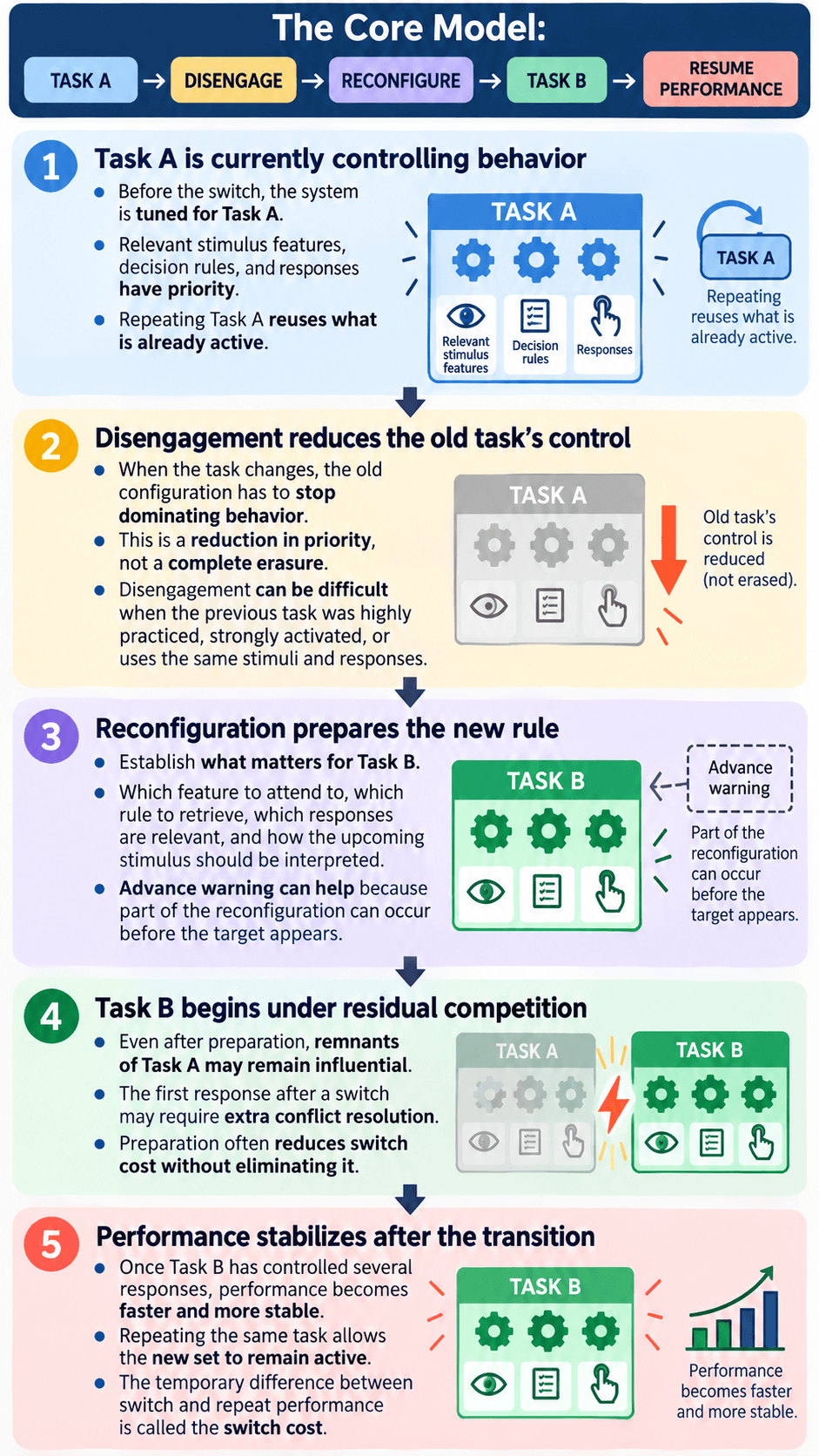
The Core Model: TASK A → DISENGAGE → RECONFIGURE → TASK B → RESUME PERFORMANCE
Task A is currently controlling behavior
Before the switch, the system is tuned for Task A. Relevant stimulus features, decision rules, and responses have priority.
Repeating Task A benefits from this existing configuration. The system can reuse what is already active rather than rebuild the task from scratch.
Disengagement reduces the old task’s control
When the task changes, the old configuration has to stop dominating behavior. This is not necessarily a complete erasure. It is a reduction in priority.
Disengagement can be difficult when the previous task was highly practiced, strongly activated, or uses the same stimuli and responses as the new task.
Reconfiguration prepares the new rule
The system must establish what matters for Task B: which feature to attend to, which rule to retrieve, which responses are relevant, and how the upcoming stimulus should be interpreted. Task switching also depends on attentional control because the system must disengage, redirect priority, and establish the new task set.
This process is often called task-set reconfiguration. It provides one explanation for why advance warning helps. If the person knows that Task B is coming, part of the reconfiguration can occur before the target appears.
Task B begins under residual competition
Even after preparation, Task B may begin while remnants of Task A remain influential. The first response after a switch can therefore require extra conflict resolution.
This is why preparation often reduces switch cost without eliminating it.
Performance stabilizes after the transition
Once Task B has controlled several responses, performance typically becomes faster and more stable. Repeating the same task allows the new set to remain active.
The temporary difference between switch and repeat performance is the core behavioral signature researchers call the switch cost.
What Is the Switch Cost?
Reaction time is usually slower after a switch
In a typical experiment, researchers compare trials on which the task repeats with trials on which the task changes. Responses on switch trials are usually slower.
The difference may be measured in milliseconds, but it is systematic enough to reveal the cost of changing task control.
Error rates can also increase
A switch can also increase errors, especially when the same stimulus supports more than one possible task or when the old rule produces a competing response.
This is important because a faster response is not automatically better. A participant may respond quickly by applying the wrong rule.
Switch cost is relative, not a universal delay
There is no single switch-cost number that applies to all people and tasks. The cost changes with task difficulty, similarity, preparation time, cues, practice, response mappings, and the predictability of the switch.
The useful question is therefore not “How many seconds does switching cost?” but “How does performance on a switch compare with performance when the same task repeats under these conditions?”
Why Does Switching Cost Time?
Task-set reconfiguration
One explanation is that switching requires an active control process that configures the new task set. The system must retrieve the new rule and prepare the appropriate stimulus-response mapping.
If the new task can be prepared in advance, part of this cost can occur before the next stimulus appears.
Interference from the previous task
A second explanation emphasizes persistence. The previous task set does not disappear immediately, so the new task must compete with recently relevant information.
The 2010 review by Kiesel and colleagues concludes that task switching reflects both control processes and several forms of interference rather than one single mechanism.
Reconfiguration and interference can coexist
These accounts are not mutually exclusive. The system may have to configure Task B while also overcoming carryover from Task A.
Another review of reconfiguration and interference in task switching concludes that both task preparation and interference control contribute to observed switch costs.
That combined view fits a common pattern: preparation helps, yet some residual cost remains.
Preparation Helps, but It Usually Does Not Erase the Cost
A cue can announce the next task
Many experiments present a cue before the target. One cue might mean “judge parity,” while another means “judge magnitude.” This gives the participant time to prepare the correct rule.
Longer preparation intervals often reduce switch costs because more of the new task configuration can be established before the target arrives.
Residual switch cost remains
Even with generous preparation, the first response after a switch is often still slower than a repeat response. This remaining difference is called residual switch cost.
Residual cost suggests that some processes cannot be completed fully before the target appears, or that interference from the previous task remains after preparation.
Newer evidence complicates simple preparation stories
A 2025 study of task preparation and subsequent switch cost found that preparation alone can contribute to later switching effects under some conditions, but the effect depends strongly on timing and task parameters. Costs following preparation-only trials were shorter-lived than those following completed task performance.
This supports a nuanced conclusion: switch cost can have more than one source. Preparing a task can shape later performance, while actually performing the task can create additional, more persistent carryover.
Predictable vs Unpredictable Switching
Knowing a switch is coming allows advance preparation
If tasks alternate in a predictable sequence, the person may know which rule will be needed next. That makes proactive preparation possible.
When the switch is unpredictable, the cue itself must first be interpreted before the new task can be configured.
Predictability reduces some costs, not every cost
Predictability helps because uncertainty is reduced. Yet knowing what comes next does not instantly remove the old task set or every competing response.
This is another reason switching should not be explained as a simple surprise effect.
Cue processing can become part of the task
In cued-switching experiments, the cue itself has to be recognized and translated into the correct task rule. If cues change frequently or are ambiguous, cue processing can add another demand.
Researchers therefore distinguish costs caused by changing the task from costs caused merely by changing the cue that signals the task.
Switch Cost vs Mixing Cost
Switch cost compares switch trials with repeat trials
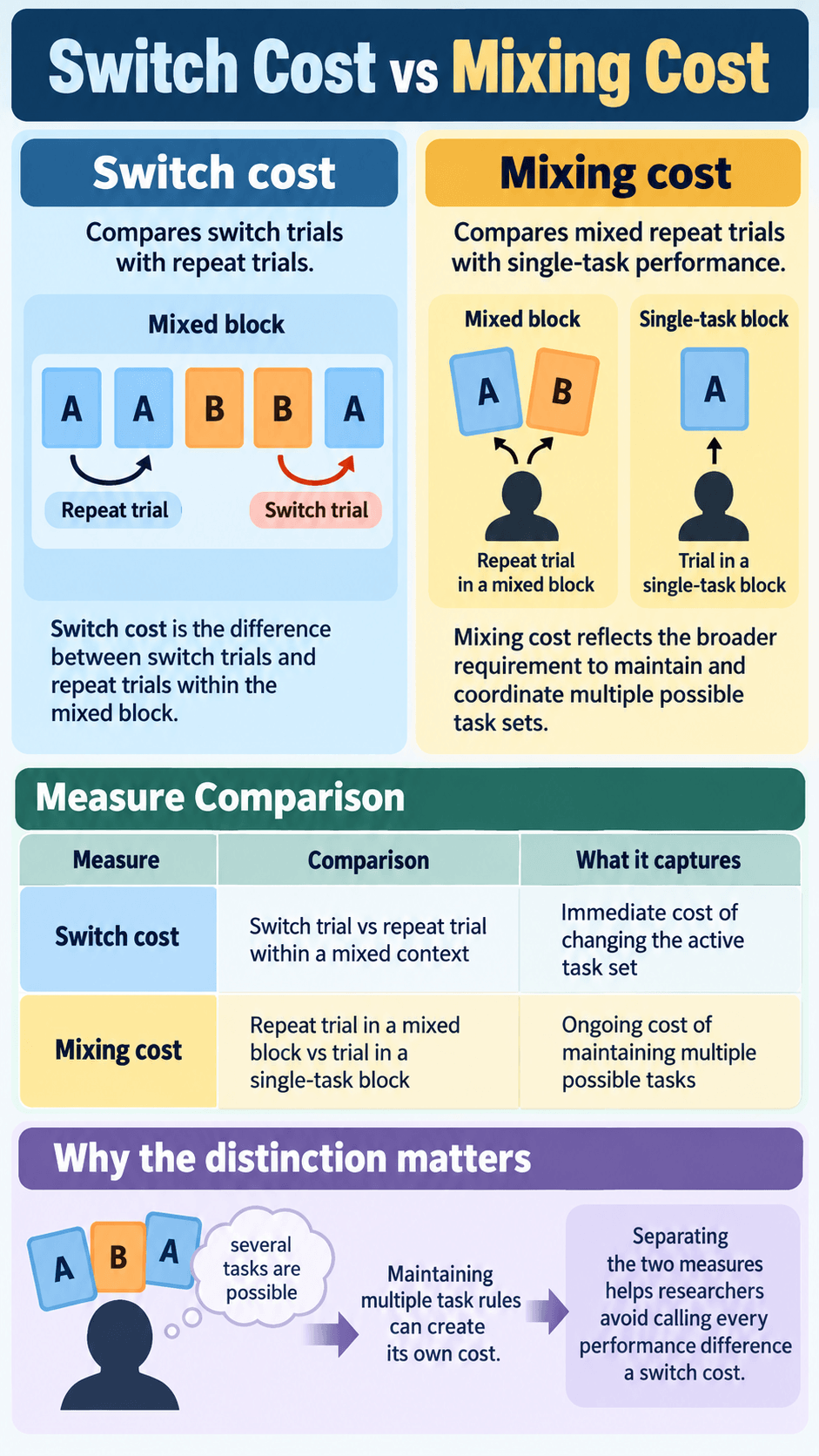
Imagine a block in which Task A and Task B are mixed. Some trials repeat the same task as the previous trial, while others require a switch.
Switch cost is the difference between those two trial types within the mixed block.
Mixing cost compares mixed repeat trials with single-task performance
Mixing cost asks a different question. Even on a repeat trial, performance can be slower when two possible tasks are being maintained than when only one task exists in the entire block.
Research on practice effects on switch and mixing costs treats these as distinct performance costs. Mixing cost reflects the broader requirement to maintain and coordinate multiple possible task sets, while switch cost reflects the immediate transition from one task to another.
| Measure | Comparison | What it captures |
|---|---|---|
| Switch cost | Switch trial vs repeat trial within a mixed context | Immediate cost of changing the active task set |
| Mixing cost | Repeat trial in a mixed block vs trial in a single-task block | Ongoing cost of maintaining multiple possible tasks |
Why the distinction matters
If someone performs more slowly whenever several tasks are possible, that does not mean every slowdown comes from the moment of switching. Maintaining multiple task rules can create its own cost.
Separating the two measures helps researchers avoid calling every performance difference a switch cost.
Task Similarity Can Increase Interference
Shared stimuli can activate both tasks
Task-switching experiments often use bivalent stimuli, meaning the same stimulus can be interpreted according to more than one task rule.
A digit such as 7 can be classified as odd or as greater than five. When both rules are relevant within the same experimental context, the stimulus can activate competing task pathways.
Shared responses can create conflict
Two tasks may also use overlapping responses. The same button might mean “odd” in one task and “less than five” in another.
When stimulus and response mappings overlap, the previous task can interfere more strongly with the new one.
Surface similarity is not the only factor
Two tasks can look different yet share the same decision or response processes. Conversely, two visually similar tasks may interfere less if their rules and responses are clearly separated.
The psychologically important question is which processing components overlap.
Why Switching Can Feel Faster Than It Performs
The transition can be subjectively smooth
You may switch from a document to a spreadsheet and feel immediately ready. The new screen appears, you recognize the task, and you begin responding.
Subjective smoothness does not guarantee that performance has returned to repeat-task speed. A small delay can be difficult to notice from the inside.
Costs are often detected across many trials
Researchers do not usually infer switching difficulty from one dramatic failure. They compare many repeat and switch trials and look for systematic differences in reaction time and error rate.
The cost can therefore be real even when no individual transition feels difficult.
Feeling ready is not identical to being fully reconfigured
A person can understand the new goal while some aspects of the previous task remain active. This is why preparation, confidence, and performance are related but not identical.
Task Switching vs Divided Attention
| Task switching | Divided attention |
|---|---|
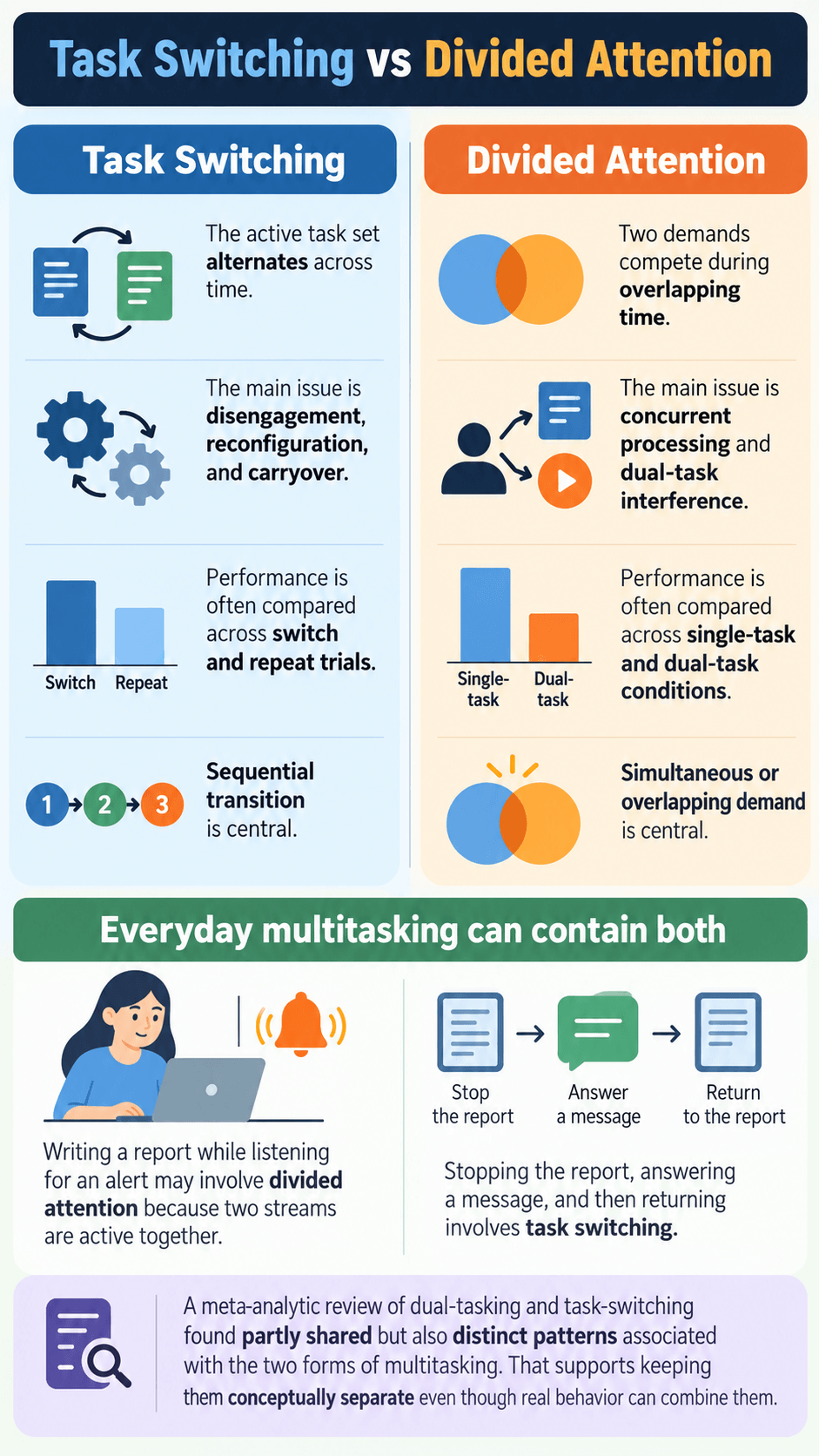
| The active task set alternates across time. | Two demands compete during overlapping time. |
| The main issue is disengagement, reconfiguration, and carryover. | The main issue is concurrent processing and dual-task interference. |
| Performance is often compared across switch and repeat trials. | Performance is often compared across single-task and dual-task conditions. |
| Sequential transition is central. | Simultaneous or overlapping demand is central. |
Everyday multitasking can contain both
Writing a report while listening for an alert may involve divided attention because two streams are active together. Stopping the report, answering a message, and then returning involves task switching.
A meta-analytic review of dual-tasking and task-switching found partly shared but also distinct patterns associated with the two forms of multitasking. That supports keeping them conceptually separate even though real behavior can combine them.
Task Switching vs Cognitive Flexibility

Task switching is an experimental transition process
Task-switching research usually studies what happens when people alternate between well-defined rules or tasks. The dependent measures are concrete: reaction time, error rate, switch cost, preparation effects, and mixing cost.
Cognitive flexibility is broader
A 2024 review of cognitive flexibility through task-switching research describes flexibility as the ability to shift from a current activity toward another when circumstances make the change useful. Flexibility also includes how readiness to switch adapts to context and experience.
Cognitive flexibility can therefore involve changing tasks, rules, strategies, perspectives, or priorities. Task switching is one way researchers study part of that broader capacity.
| Task switching | Cognitive flexibility |
|---|---|
| Focuses on transitions between defined task sets. | Refers broadly to adapting cognition or behavior when demands change. |
| Emphasizes switch cost and transition mechanisms. | Emphasizes adaptive readiness to change when useful. |
| Can be measured trial by trial in controlled tasks. | Can be studied through several kinds of tasks and broader behavioral measures. |
A switch cost does not mean flexibility is bad
The existence of a cost does not imply that people should avoid changing tasks whenever possible. Sometimes the environment changes and the old task is no longer the correct one.
Adaptive behavior balances stability and flexibility. Staying with the current rule has benefits, but so does changing when the situation requires it.
Does Practice Remove Switch Costs?
Practice can reduce the cost
Repeated exposure makes task rules more familiar and can improve cue interpretation, response selection, and coordination. Switch and mixing costs often decrease with practice.
The practice study cited earlier found reductions in both types of cost across extensive training.
Reduced cost does not mean switching becomes free
Some residual costs can remain even after substantial practice. Familiarity may reduce the time needed to retrieve a task set without completely removing carryover from the previous task or the need to resolve competition.
Practice is specific to the learned situation
Becoming efficient at switching between two laboratory rules does not prove a general ability to switch effortlessly between every real-world task.
Transfer depends on how much the new situation shares with the practiced one.
Why Inhibition Is Only One Part of the Explanation
The previous task may need to be suppressed
Some theories propose that the previous task is actively inhibited so it does not continue controlling behavior after the switch.
This can help explain why returning to a recently abandoned task may sometimes be harder than switching to another task.
But not every switch cost is inhibition
Task switching also involves activating the new task, interpreting cues, retrieving rules, preparing responses, and resolving stimulus or response interference.
Calling the whole phenomenon “inhibitory control” would therefore be too narrow.
Multiple processes can produce the same behavioral cost
Two people can show similar reaction-time costs for different reasons. One may prepare the new task slowly. Another may experience stronger interference from the old task.
The observable switch cost is a performance measure, not a direct reading of one hidden process.
A Practical Interpretation Framework
What was Task A?
Identify the rule, goal, and response pattern that was active before the transition.
What changed for Task B?
Did the relevant feature change? The response rule? The goal? The mental context? The more components that change, the more reconfiguration may be required.
Was the switch predictable?
If the next task was known in advance, some preparation may have occurred before the transition. If it was unexpected, cue interpretation and configuration may need to happen after the switch signal.
What from Task A could still interfere?
Consider whether the old stimulus rule, response mapping, or mental context remains relevant enough to compete.
Did performance stabilize after one or more Task B responses?
If the first response after the switch is slow but later responses improve, the pattern is consistent with a transition cost rather than a general inability to perform Task B.
This framework is descriptive. It is not a productivity score and does not diagnose an executive-function problem.
What Task Switching Does Not Mean
It does not mean people should never switch
Changing tasks is necessary when priorities change. The existence of measurable cost says that transitions require processing, not that switching is inherently irrational.
It does not mean every interruption has the same mechanism
An interruption may involve attentional capture, mind wandering, divided attention, or a full task-set switch. Real events can combine several processes.
It does not equal poor working memory
Working memory may help maintain task rules and recover context, but switch cost is not simply a measure of working-memory capacity.
It does not diagnose ADHD or another disorder
Switch costs appear in ordinary participants. A person feeling slow after changing tasks is not evidence of a clinical disorder. Diagnosis requires a much broader pattern of symptoms, duration, history, and functional impact.
FAQ About Task Switching
Why am I slower immediately after changing tasks?
The system has to reduce the influence of the previous task, establish the new rule, and resolve any remaining competition. These processes produce a measurable switch cost, especially on the first response after the transition.
Can preparation eliminate switch cost?
Preparation usually reduces switch cost, but it often does not eliminate it. Some reconfiguration may depend on the target stimulus, and parts of the previous task can remain active even after advance preparation.
What is the difference between switch cost and mixing cost?
Switch cost compares a switch trial with a repeat trial when multiple tasks are possible. Mixing cost compares repeat performance in a mixed-task context with performance when only one task is performed. Mixing cost reflects the ongoing burden of maintaining multiple possible task sets, not just the moment of switching.
Is task switching the same as cognitive flexibility?
No. Task switching is a specific process and experimental paradigm involving transitions between task sets. Cognitive flexibility is broader and includes adapting rules, strategies, goals, or behavior when circumstances change. Task switching is one way to study part of cognitive flexibility.
Does a switch cost mean multitasking is impossible?
No. Switch costs show that sequential task transitions often slow performance or increase errors relative to repetition. They do not prove that all forms of multitasking are impossible. Concurrent dual-task performance and sequential task switching are different problems with partly different mechanisms.
Key Takeaways
- Task switching occurs when the active task set changes from one rule or activity to another.
- A useful model is TASK A → DISENGAGE → RECONFIGURE → TASK B → RESUME PERFORMANCE.
- Switch trials are usually slower and often more error-prone than repeat trials, producing a measurable switch cost.
- Switch cost reflects both control processes, such as task-set reconfiguration, and interference from recently active task information.
- Preparation and practice can reduce switching costs, but they often do not eliminate every residual cost.
- Task switching is different from divided attention and narrower than cognitive flexibility, and the existence of switch costs does not mean adaptive switching should be avoided.
About the author: Michael Reed is the Founder & Lead Writer at Psychology Exposed. He explains psychology, human behavior, self-awareness, and everyday cognitive patterns in clear, research-aware language for general readers.
The most useful question after a difficult transition is not simply, “Why am I bad at switching?” Ask what task set was active, what had to be reconfigured, what information from the previous task remained competitive, and whether the first response was harder than later repetitions. That sequence captures the psychology of task switching far more precisely.

Michael Reed is the Founder and Lead Writer at Psychology Exposed. He writes about human behavior, relationships, emotional patterns, self-awareness, and practical psychology topics using research-informed, easy-to-understand content.
Read More About Michael Reed: https://psychologyexposed.com/michael-reed/