
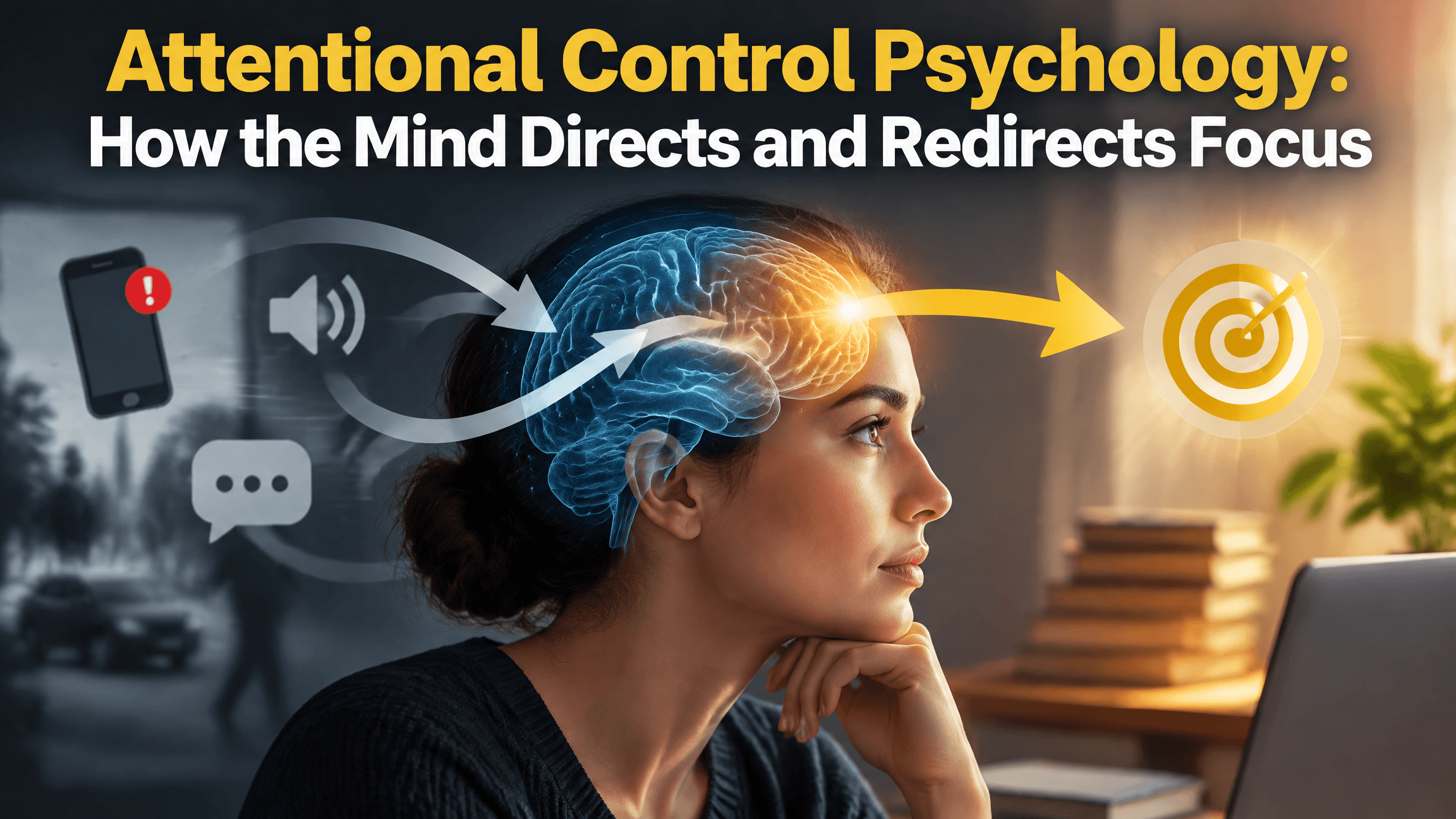
You are reading a difficult paragraph when a sound pulls your attention toward the window. A few seconds later, you realize you have lost the thread and deliberately return to the page. In another situation, you notice your mind drifting during a meeting and bring it back to the speaker before you miss anything important.
These moments involve more than “trying harder.” Attentional control refers to the processes that help keep processing aligned with a goal, disengage from one target when necessary, and redirect attention toward another. It is part of how the mind maintains priority when distractions, competing thoughts, or changing demands make that priority unstable.
Attentional control is not perfect, and it is not a simple measure of discipline. Fatigue, task difficulty, motivation, learned expectations, competing cues, and the structure of the task all influence how easy redirection feels. Understanding the process makes it easier to distinguish control from attentional capture, cognitive flexibility, metacognition, and broad executive function.
Quick Answer
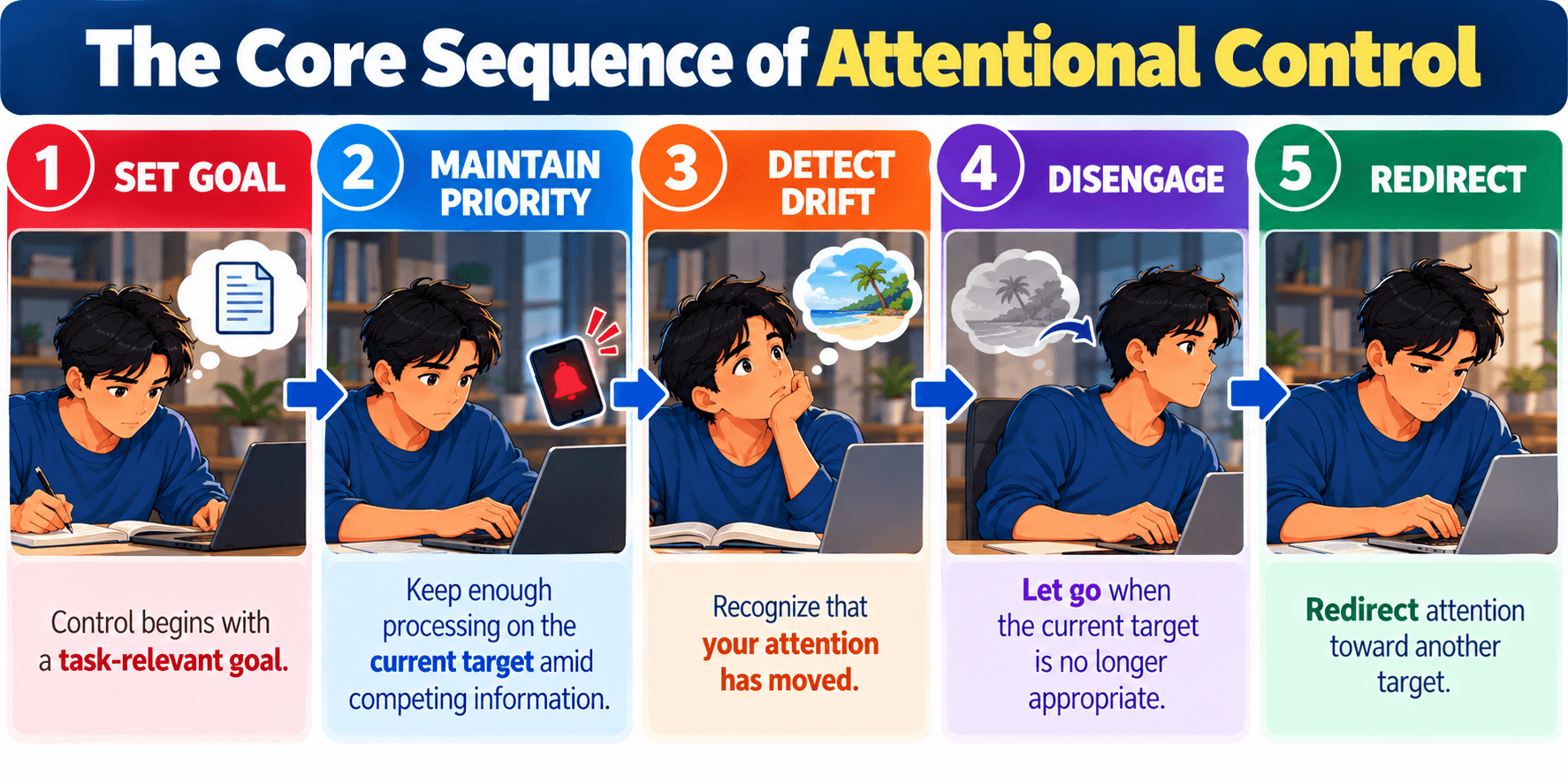
Attentional control is the goal-directed regulation of where cognitive processing is directed. It helps maintain attention on relevant information, disengage from a current target, redirect attention when priorities change, and return after distraction or drift. Control interacts with stimulus-driven capture and learned selection history, so attention is never governed by goals alone. Attentional control is related to executive function and cognitive flexibility but is narrower than either.
Attentional Control Is Goal-Directed Priority Regulation
Keeping processing aligned with a goal
The APA Dictionary of Psychology describes attention as the focusing of cognitive resources on some aspects of the environment rather than others. Attentional control concerns how that priority is regulated when a person has a current goal. Attentional control is one part of the broader psychology of attention, which also includes selection, capture, sustained attention, awareness limits, and switching.
If you are editing a document, the goal may be to track meaning, identify errors, and ignore irrelevant visual changes around the screen. If you are driving, the goal changes from moment to moment as road conditions, mirrors, pedestrians, and signs become relevant. Control helps keep the priority structure appropriate to what you are trying to do.
The process is not equivalent to holding one target forever. Good control also includes shifting away when the current target is no longer the most useful one.
Why control does not mean perfect control
The APA definition of voluntary attention emphasizes attention that is deliberately applied and controlled rather than spontaneously captured. That distinction is useful, but everyday attention does not divide neatly into a voluntary system and an involuntary system that operate independently.
A 2025 review of attentional capture and control describes attention as shaped by interaction among goal-directed influences, stimulus-driven competition, and selection history. In other words, intentions matter, but so do the properties of the environment and what past experience has taught the system to prioritize.
This is why losing attention briefly does not mean control “failed” in a moral sense. The system is constantly balancing competing sources of priority.
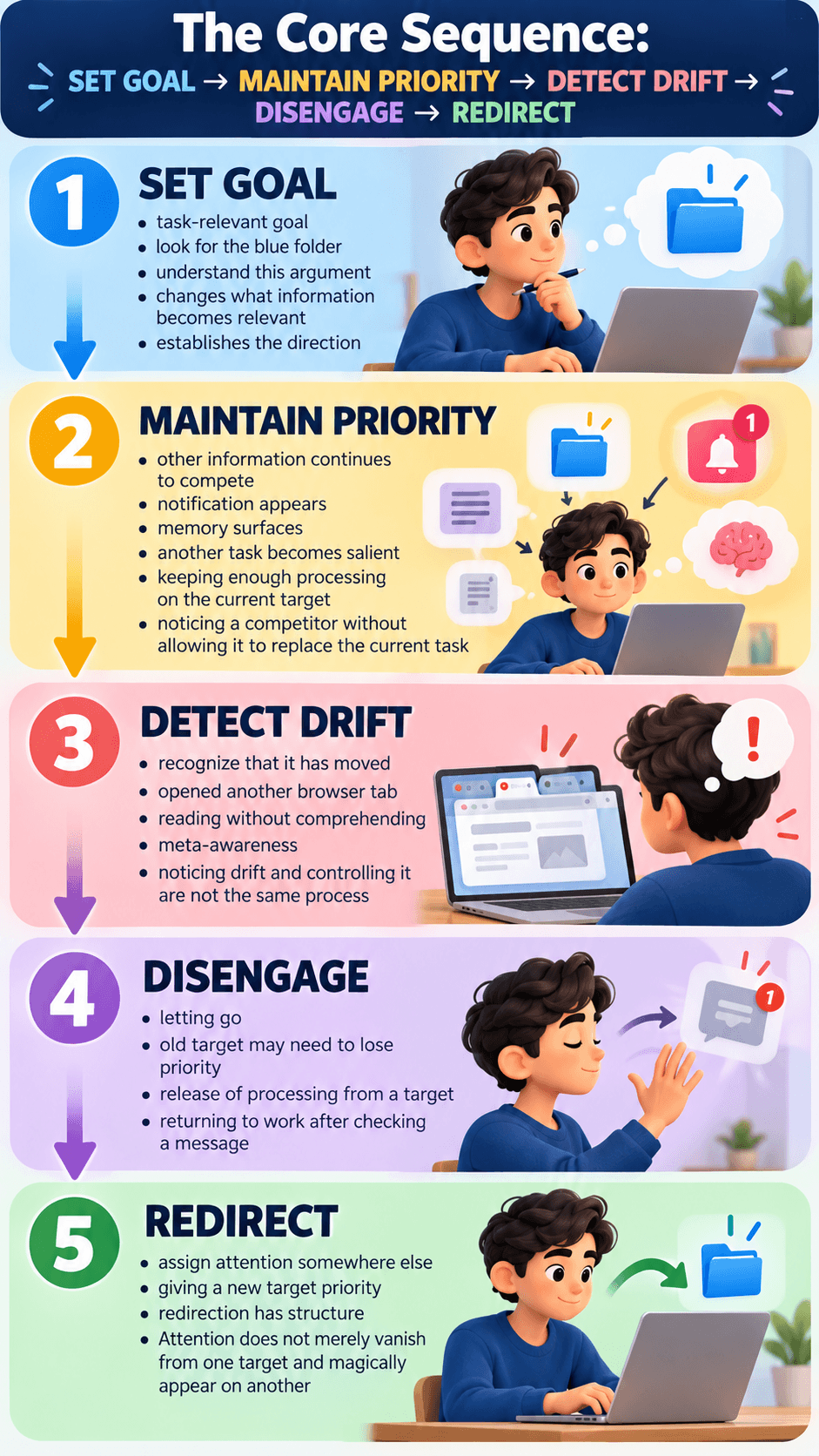
The Core Sequence: SET GOAL → MAINTAIN PRIORITY → DETECT DRIFT → DISENGAGE → REDIRECT
Setting a current attentional target
Control begins with a task-relevant goal. The goal may be explicit, such as “look for the blue folder,” or broader, such as “understand this argument.” That goal changes what information becomes relevant.
A clear target can make regulation easier because the system has a more specific criterion for what deserves priority. A vague goal such as “work on this” creates more room for competing information to appear equally relevant.
Setting the target does not guarantee success, but it establishes the direction that control is trying to preserve.
Maintaining priority amid competition
Once a target has priority, other information continues to compete. A notification appears. A memory surfaces. Another task becomes salient. Your own discomfort or boredom may pull processing away.
Maintaining priority means keeping enough processing on the current target for useful performance. It does not require suppressing every competing signal completely. In many situations, successful control means noticing a competitor without allowing it to replace the current task. Maintaining goal-directed priority across long periods also connects attentional control with sustained attention.
Detecting drift
You cannot redirect attention if you never recognize that it has moved. Sometimes the signal is obvious, such as realizing you have opened another browser tab. At other times, detection happens only after a delay, as when you notice that you have been reading without comprehending.
This step can involve meta-awareness, meaning awareness of your own current mental state. Yet noticing drift and controlling it are not the same process. You may notice that your attention has wandered and still find it difficult to return. When attention shifts inward without an external cue, mind wandering describes the drift that control may later detect and reverse.
Disengaging when the current target is no longer appropriate
Control also requires letting go. If you are focused on one part of a visual scene and new information appears elsewhere, the old target may need to lose priority before attention can move effectively.
Disengagement is not simply “stopping concentration.” It is the release of processing from a target that has been prioritized. In spatial attention research, disengaging from a location is treated as a distinct component of orienting.
The same idea can be used cautiously in everyday terms. Returning to work after checking a message often requires disengaging from the message before the original task can become central again.
Reorienting toward the intended target
After disengagement, attention has to be assigned somewhere else. Reorienting means giving a new target priority.
A study of attentional disengagement and reorienting illustrates that these are measurable components of spatial attention. The study itself examined a specific experimental training paradigm, so its findings should not be generalized into a promise that everyday focus can be “trained” in the same way.
The broader point is that redirection has structure. Attention does not merely vanish from one target and magically appear on another.
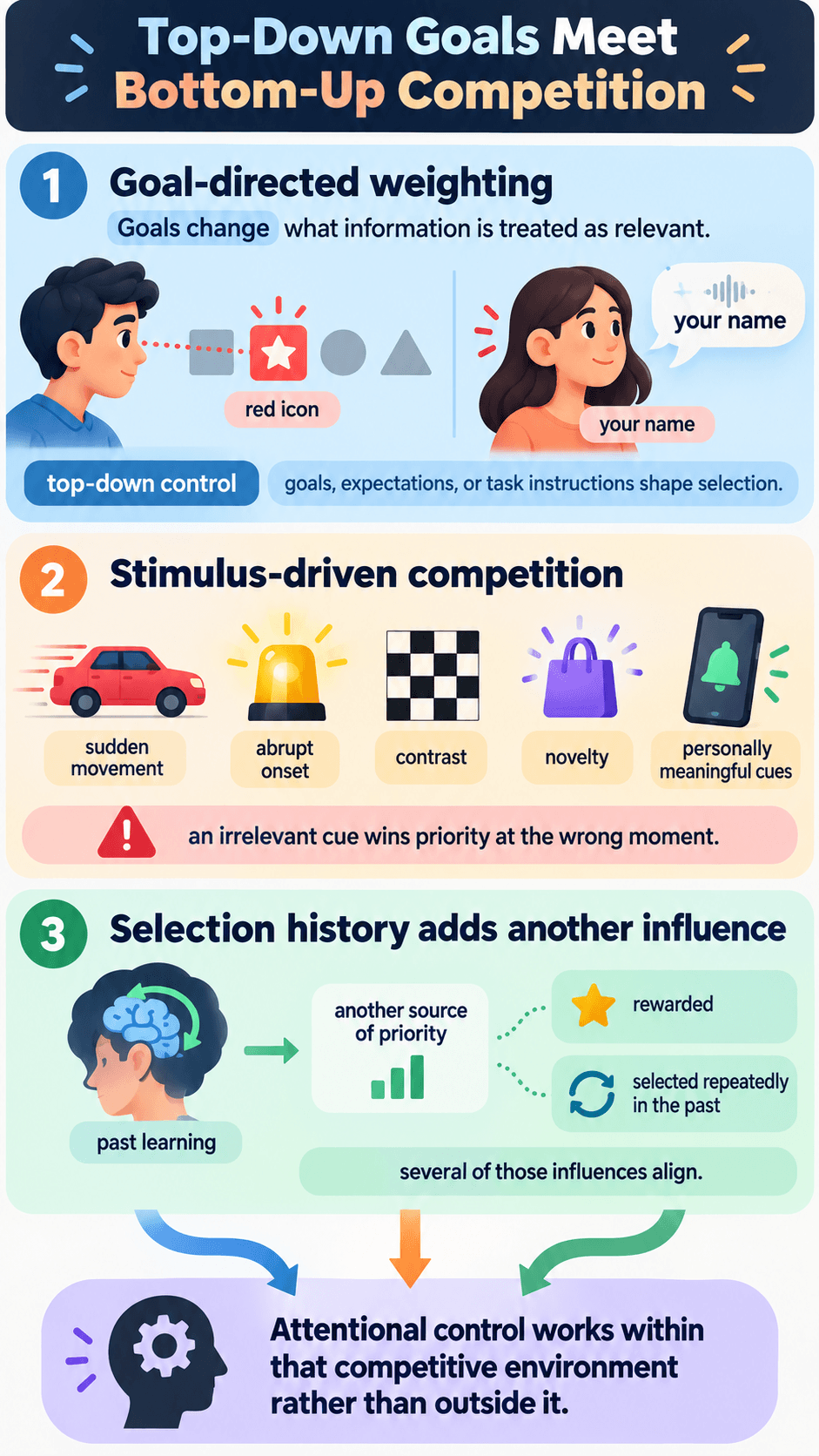
Top-Down Goals Meet Bottom-Up Competition
Goal-directed weighting
Goals change what information is treated as relevant. If you are searching for a red icon, red objects may receive more priority. If you are waiting for your name to be called, speech that resembles your name may gain extra weight.
This goal-directed influence is often described as top-down control. The phrase is useful when it means that current goals, expectations, or task instructions shape selection.
It becomes misleading if it implies that attention is fully controlled by conscious intention.
Stimulus-driven competition
Some events compete because of their own properties. Sudden movement, abrupt onset, contrast, novelty, or personally meaningful cues can challenge the current priority structure.
Stimulus-driven competition is not necessarily bad. A system that never responded to unexpected events would be dangerously rigid. The problem arises when an irrelevant cue wins priority at the wrong moment.
Selection history adds another influence
Modern attention research increasingly treats past learning as another source of priority. A 2024 theoretical review of goal, salience, and selection-history influences on attentional control discusses how experience can shape what later attracts or guides attention.
A cue may therefore receive priority because it matches a current goal, because it is physically salient, because it has been rewarded or selected repeatedly in the past, or because several of those influences align.
Attentional control works within that competitive environment rather than outside it.
What “Resisting Distraction” Means Cognitively
Filtering and prioritization rather than simply saying no
Everyday language makes resistance sound like an act of refusal: “ignore the distraction.” Cognitively, the situation is more complicated. The system may reduce the priority of irrelevant information, strengthen the current target, change expectations about where relevant information will appear, or recover quickly after interference.
Successful control does not always mean the distracting cue never receives processing. Sometimes the cue is noticed but does not alter behavior enough to disrupt the goal.
Inhibition is one concept, not the whole explanation
Inhibition is often invoked when people talk about self-control or distraction. In some tasks, suppressing an irrelevant response or competing representation may be important. But attentional control includes more than inhibition.
It also includes setting priorities, selecting targets, maintaining goals, disengaging, shifting, and reorienting. Reducing the entire process to “inhibitory control” hides those distinctions.
This is one reason broad executive-function language can become too vague. Different tasks rely on different combinations of control processes.
Returning After an Interruption
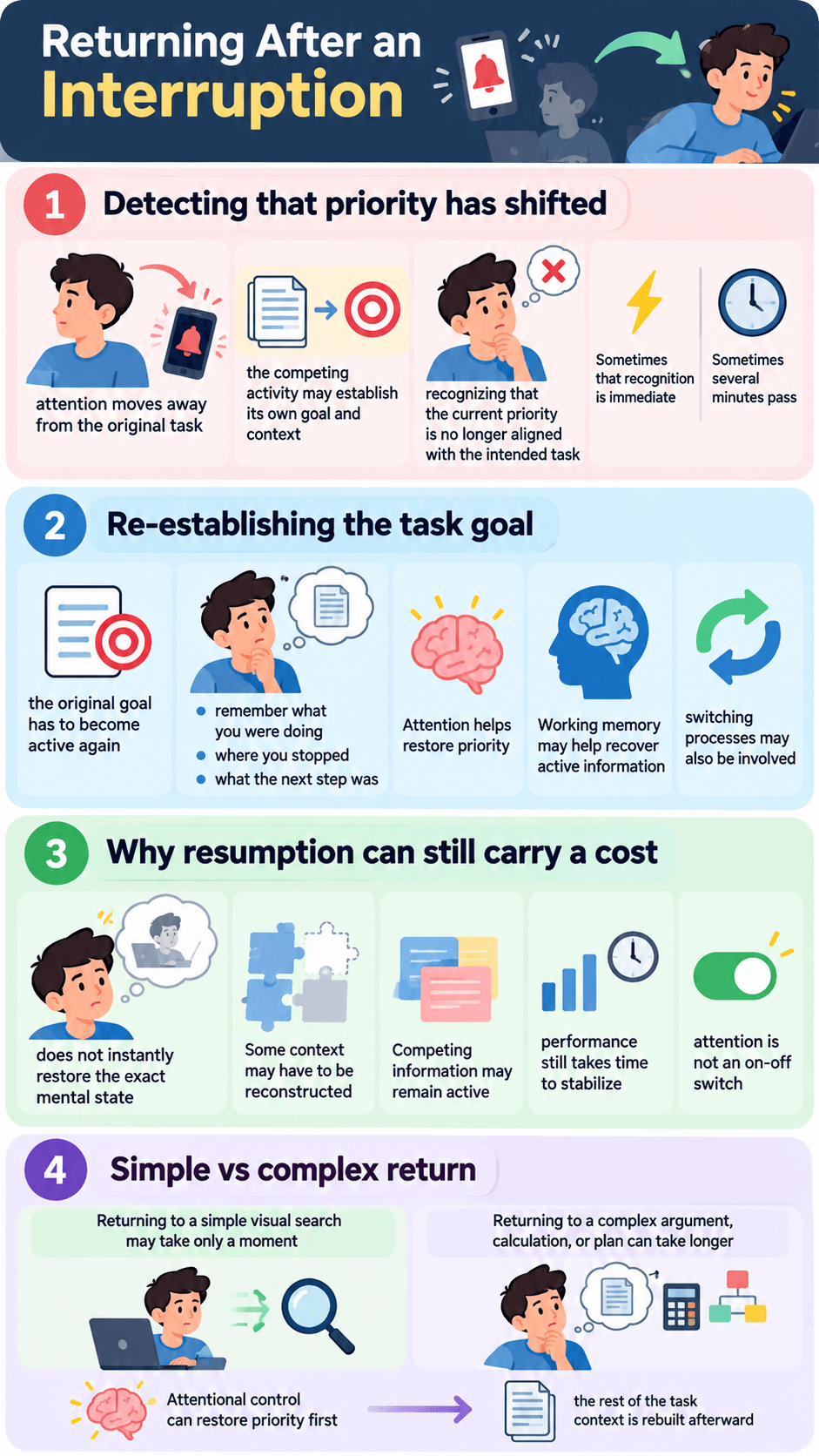
Detecting that priority has shifted
An interruption creates two problems. First, attention moves away from the original task. Second, the competing activity may establish its own goal and context.
Returning therefore begins with recognizing that the current priority is no longer aligned with the intended task. Sometimes that recognition is immediate. Sometimes several minutes pass before you realize that a small interruption became a different activity.
Re-establishing the task goal
Once the interruption ends, the original goal has to become active again. You may need to remember what you were doing, where you stopped, and what the next step was.
This is where attentional control interacts with working memory and task switching without becoming identical to either. Attention helps restore priority. Working memory may help recover active information. If the interruption involved another task set, switching processes may also be involved.
Why resumption can still carry a cost
Returning attention does not instantly restore the exact mental state that existed before the interruption. Some context may have to be reconstructed. Competing information may remain active. The new task may have changed your emotional or motivational state.
Control can redirect attention successfully while performance still takes time to stabilize. This is another reason to avoid treating attention as an on-off switch.
Resumption also depends on how much context the original task required. Returning to a simple visual search may take only a moment because the target rule is easy to recover. Returning to a complex argument, calculation, or plan can take longer because the relevant mental state included several linked ideas. Attentional control can restore priority first, while the rest of the task context is rebuilt afterward.
When Attentional Control Becomes Harder
Cognitive load
When a task already requires many controlled operations, fewer resources may be available for maintaining the target and handling competition. Complex instructions, unfamiliar rules, or multiple simultaneous demands can make redirection harder.
This does not mean all load is bad. Challenging tasks can hold attention well. The problem is whether the combination of demands exceeds what the current situation supports.
Fatigue and arousal
Fatigue can reduce readiness, slow monitoring, and make competing cues harder to resist. Very low or very high arousal can also affect performance, depending on the task.
Difficulty controlling attention after prolonged wakefulness should not be framed as a character problem. In safety-critical settings, fatigue may require rest, task reduction, or stopping the activity rather than greater effort.
Task familiarity
Familiar tasks can require less controlled processing than unfamiliar ones. This may free capacity for monitoring and redirection.
However, familiarity can also encourage automatic responding. If conditions change, the system may need extra control to override the familiar pattern and prioritize new information.
Motivation and goal strength
A meaningful goal can increase the stability of priority, but motivation is not an unlimited shield against distraction. A highly motivated person can still be interrupted, become fatigued, or experience strong competition.
Motivation changes the weights in the system. It does not erase cognitive limits.
Attentional Control vs Attentional Capture
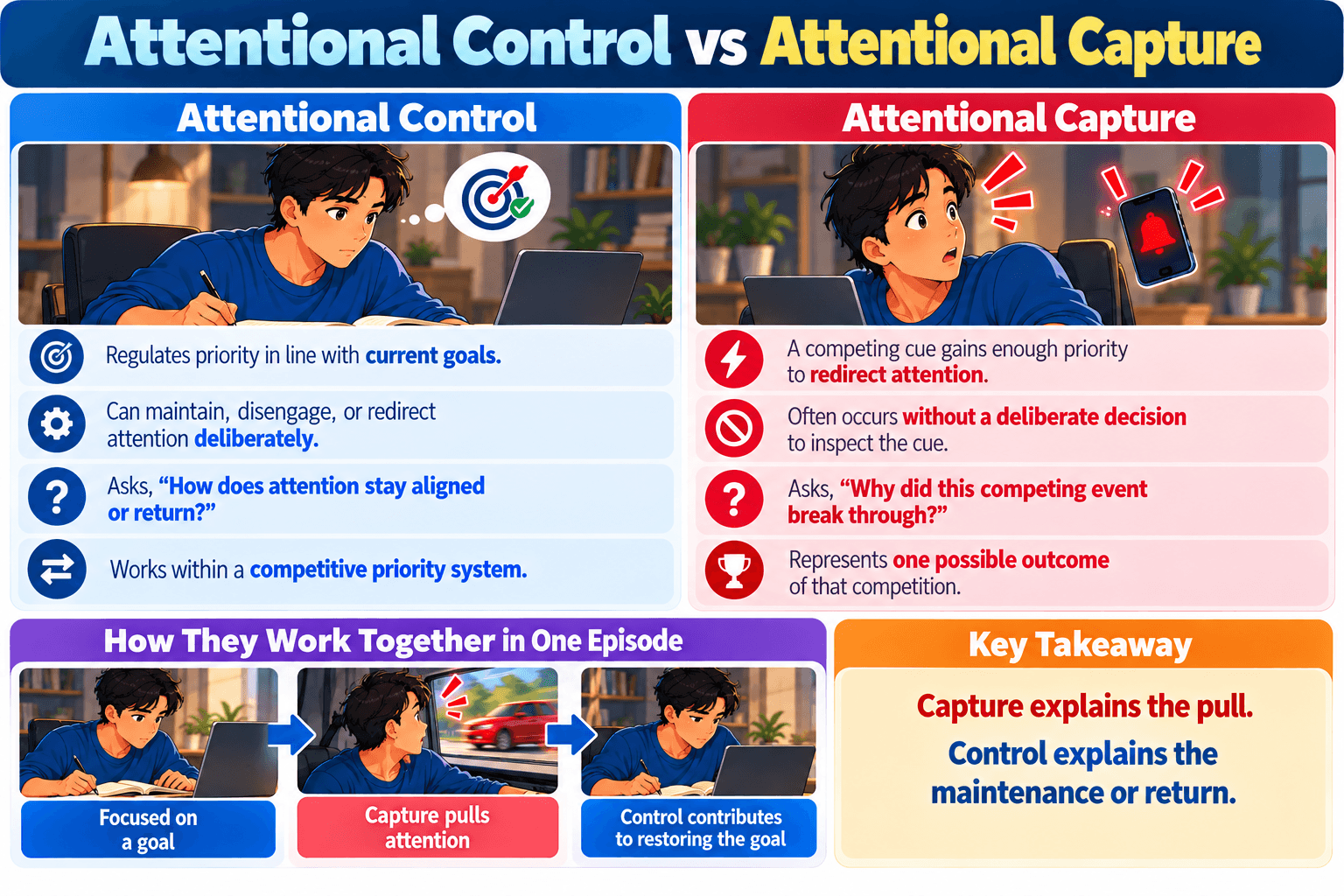
| Attentional control | Attentional capture |
|---|---|
| Regulates priority in line with current goals. | A competing cue gains enough priority to redirect attention. |
| Can maintain, disengage, or redirect attention deliberately. | Often occurs without a deliberate decision to inspect the cue. |
| Asks, “How does attention stay aligned or return?” | Asks, “Why did this competing event break through?” |
| Works within a competitive priority system. | Represents one possible outcome of that competition. |
Goal-aligned regulation vs competing cue gaining priority
Capture explains the pull. Control explains the maintenance or return.
If movement beside you redirects attention, capture helps explain why the competing event won priority. If you decide it is irrelevant and return to the document, attentional control contributes to restoring the previous goal.
Capture and control can operate in the same episode
It is therefore a mistake to treat capture and control as independent opposites. A person can be captured, evaluate the cue, and redirect attention within seconds.
The 2025 review on capture and control emphasizes precisely this interaction. Whether distraction occurs depends on goal-directed influences, salient competition, and learned history rather than a single internal “control strength.”
Attentional Control vs Cognitive Flexibility
Where attention goes vs whether the rule or strategy changes
Cognitive flexibility is broader than attentional control. A review of how cognitive flexibility is conceptualized and measured describes it as dynamic adaptation of thinking and behavior to changing contextual demands.
Attentional control asks where processing priority is directed. Cognitive flexibility asks whether thinking or behavior can adapt when the situation requires a different task, rule, perspective, or strategy.
You can redirect attention without changing the task. You can also change the task or rule, which may require both attentional redirection and broader reconfiguration.
Why switching tasks can require both constructs
Imagine moving from proofreading a document to responding to a financial spreadsheet. Attention must leave one target and engage another. At the same time, the active rules, goals, and response criteria change.
The attentional shift is part of control. The broader adaptation to the new task set is closer to cognitive flexibility and task switching.
This distinction matters because switch costs do not mean attentional control is poor, and efficient attentional redirection does not guarantee flexible strategy change.
Attentional Control vs Metacognition
Noticing drift vs redirecting priority
Metacognition involves thinking about and monitoring one’s own cognition. In an attention episode, meta-awareness may produce the realization, “My mind has drifted.”
Attentional control contributes to the next step: redirecting processing toward the intended target.
You can have one without fully achieving the other. A person may accurately notice distraction but struggle to return. Another person may redirect quickly with little explicit reflection.
Meta-awareness can trigger control without being the same process
Meta-awareness is useful because it can provide a signal that regulation is needed. But the signal is not the regulation itself.
This is similar to noticing that a car is drifting within a lane versus physically correcting the steering. Detection and correction interact, but they are different functions.
Executive Attention as a Related Concept
Where the term is useful
Executive attention is often used for control processes involved in resolving conflict, selecting among competing responses, and maintaining goal-directed behavior. A review of cognitive control and attentional functions discusses executive control as involving detection and resolution of conflict among competing mental processes.
The term is useful when the task involves conflict or competing responses, but it should not be used to make every attention process sound like one single executive system.
Why attentional control is narrower than executive function generally
Executive function is an umbrella covering processes such as planning, inhibition, working-memory management, task switching, and goal-directed behavior. Attentional control overlaps with that family but focuses more specifically on the regulation of processing priority.
Keeping that boundary prevents the topic from expanding into a general theory of self-control, planning, or decision-making.
A Self-Observation Framework
Goal
What are you actually trying to attend to? Name the target clearly. “Finish this paragraph” is more specific than “focus better.”
Drift
What changed priority? Was it an external cue, an internal thought, fatigue, another task, or uncertainty about what to do next?
Disengage
What currently holds attention? Sometimes the difficulty is not selecting the intended target but releasing the competing one.
Redirect
What is the smallest concrete target that needs priority again? Returning attention often works at the level of the next sentence, visual location, instruction, or action rather than an abstract demand to “concentrate.”
This framework is descriptive, not diagnostic. It helps separate parts of the regulation process without claiming that every difficulty reflects a disorder.
When Changes in Attention Need More Than a Cognitive Explanation
Ordinary lapses and interruptions are common. A different level of concern applies when attention changes suddenly, declines substantially, follows a head injury, appears with confusion or new neurological symptoms, is associated with severe daytime sleepiness, or causes major difficulty with familiar everyday tasks.
Educational information about attentional control cannot determine the cause of those changes. Qualified medical or psychological evaluation may be appropriate when the change is new, severe, or functionally significant.
FAQ About Attentional Control
Is attentional control the same as willpower?
No. Willpower is an everyday term for effortful self-control. Attentional control is a more specific cognitive concept involving regulation of processing priority. Motivation and effort can influence it, but fatigue, task demands, stimulus competition, and learning history also matter.
Is attentional control part of executive function?
It is closely related and is often discussed within executive attention or cognitive control. Executive function is broader, however, and includes planning, working-memory management, inhibition, switching, and other goal-directed processes. Attentional control is most useful when the question is specifically where processing priority is maintained or redirected.
How is attentional control different from cognitive flexibility?
Attentional control concerns where attention is directed. Cognitive flexibility concerns adapting thought or behavior when the task, rule, strategy, or context changes. A task switch can involve both, but the concepts answer different questions.
Can I notice attention drifting without successfully redirecting it?
Yes. Noticing drift involves awareness of your mental state. Redirecting attention involves changing processing priority. The two processes interact, but awareness does not guarantee successful control.
Key Takeaways
- Attentional control regulates where processing priority is directed in relation to current goals.
- A useful sequence is SET GOAL → MAINTAIN PRIORITY → DETECT DRIFT → DISENGAGE → REDIRECT.
- Control interacts with stimulus-driven capture and learning history, so conscious intention does not govern attention by itself.
- Resisting distraction involves selection, prioritization, disengagement, and recovery, not only inhibition.
- Attentional control is narrower than cognitive flexibility, metacognition, or executive function generally.
- Ordinary lapses do not diagnose a disorder, while sudden or substantial changes in attention may warrant professional evaluation.
About the author: Michael Reed is the Founder & Lead Writer at Psychology Exposed. He explains psychology, human behavior, self-awareness, and everyday cognitive patterns in clear, research-aware language for general readers.
A useful next step is to replace the vague question “Why can’t I control my focus?” with a more specific one: Is the problem maintaining the goal, noticing drift, disengaging from a competitor, or redirecting attention afterward? Those are different control problems, and separating them makes the experience easier to understand.

Michael Reed is the Founder and Lead Writer at Psychology Exposed. He writes about human behavior, relationships, emotional patterns, self-awareness, and practical psychology topics using research-informed, easy-to-understand content.
Read More About Michael Reed: https://psychologyexposed.com/michael-reed/