
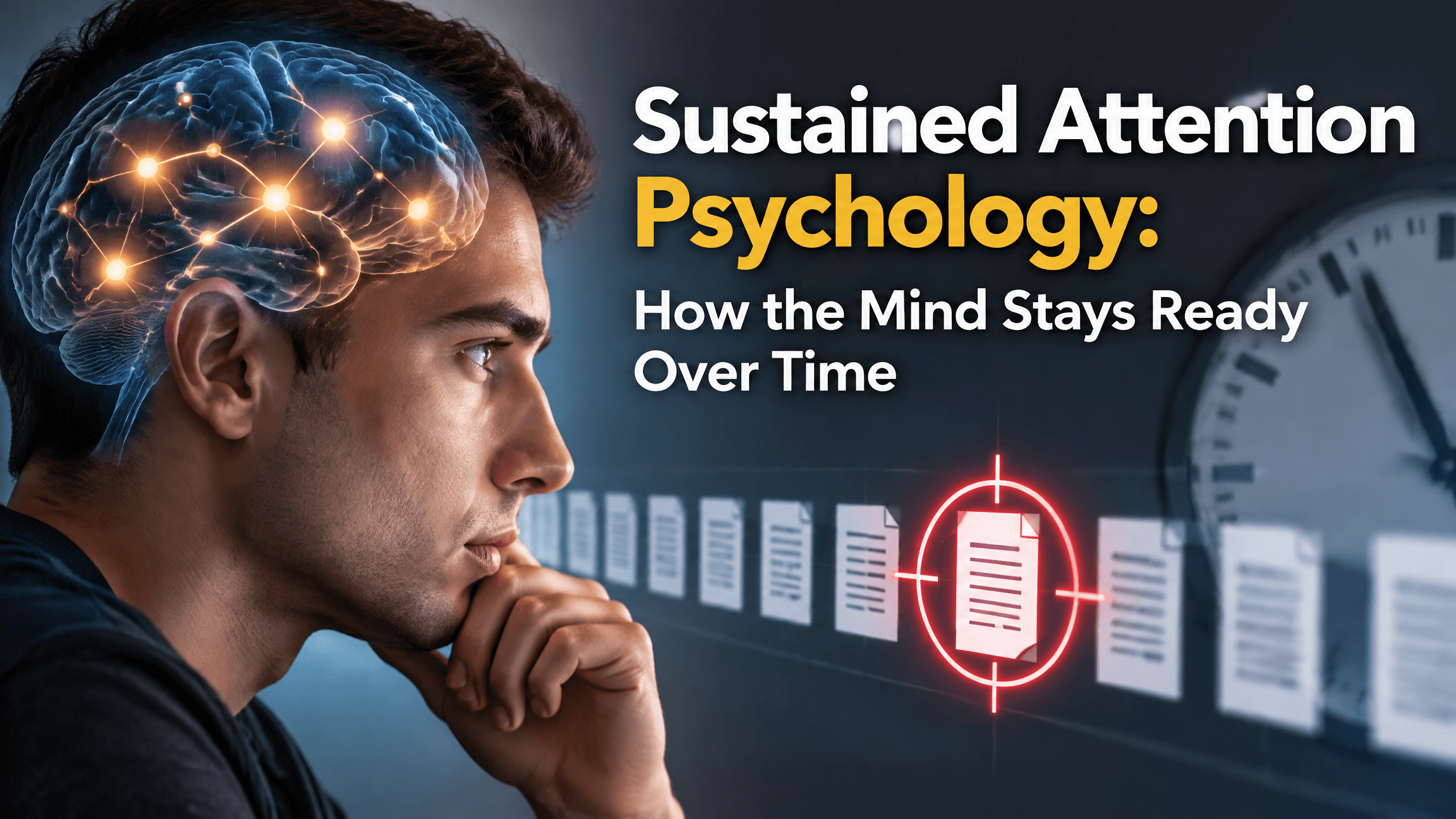
Some attention problems appear immediately. A notification flashes, a sound pulls you away, or two tasks compete at once. Sustained attention is different. The target may stay exactly the same while performance slowly becomes less consistent.
Think about proofreading a long report, watching a dashboard for a rare error, driving through an uneventful stretch of highway, or listening for one important detail in a long presentation. Nothing dramatic has to interrupt you. Yet response speed, detection accuracy, or readiness may fluctuate as time passes.
Psychologists study this ability under terms such as sustained attention and vigilance. The central question is not simply, “How long can someone focus?” It is how well the mind can maintain task-relevant readiness across time, especially when important signals are infrequent, the task is repetitive, or the consequences of a brief lapse are high.
Quick Answer
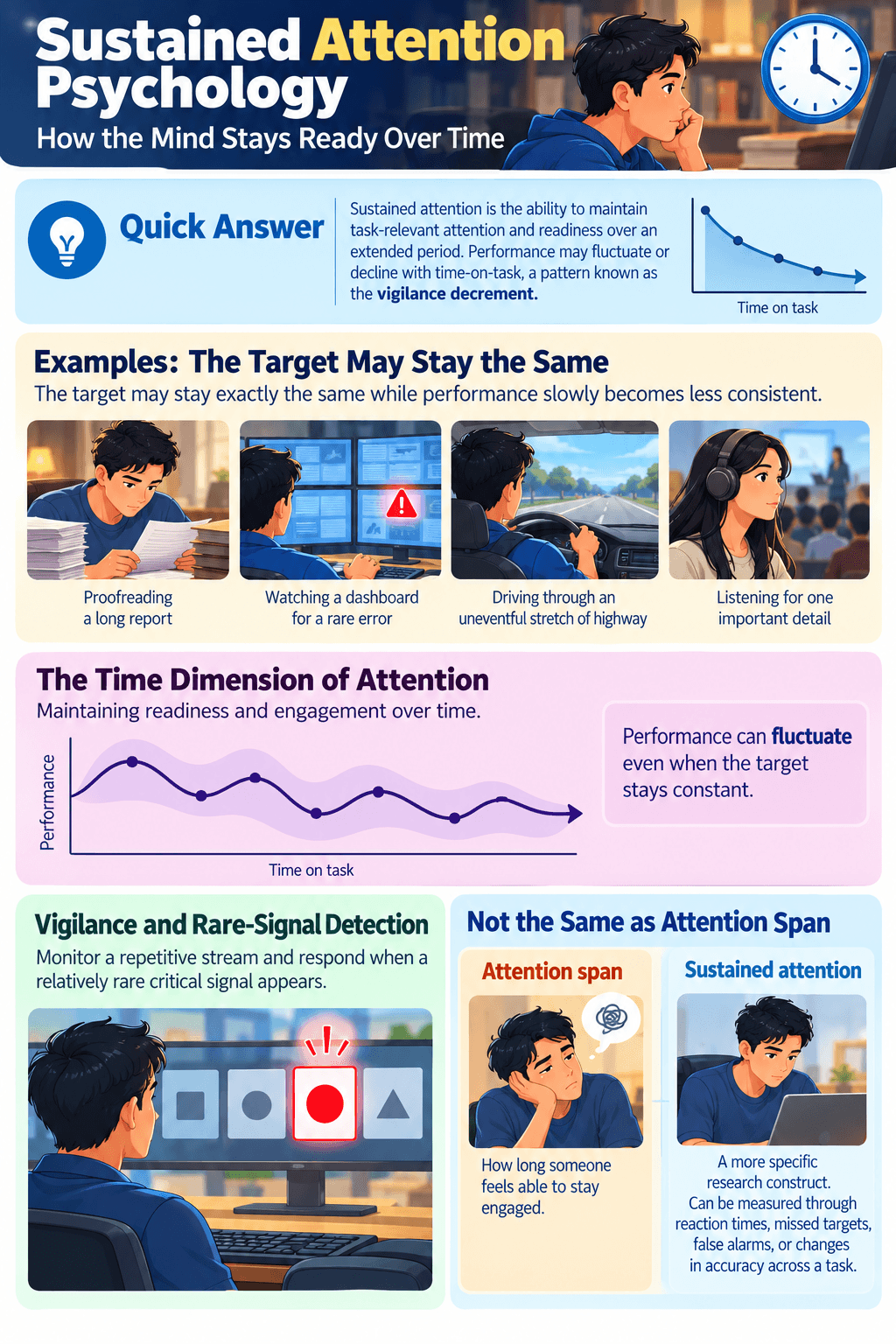
Sustained attention is the ability to maintain task-relevant attention and readiness over an extended period. In vigilance tasks, people often need to detect infrequent or unpredictable signals while monitoring a stream of otherwise repetitive information. Performance may fluctuate or decline with time-on-task, a pattern known as the vigilance decrement. This is not the same as laziness, a short attention span, or mind wandering alone.
Sustained Attention Is More Than “Paying Attention Longer”
Maintaining readiness and engagement over time
Sustained attention is easiest to understand as a time problem. The relevant task remains active, but the mind has to keep giving it enough priority across many moments rather than only at the beginning. Sustained attention is one part of the broader psychology of attention, alongside selection, capture, control, divided demands, and temporal limits.
A recent review of vigilance and the vigilance decrement emphasizes that vigilance, alertness, arousal, and sustained attention are closely related but not perfectly interchangeable. One useful distinction is that sustained attention generally refers to maintaining directed task engagement, while vigilance often emphasizes monitoring for important signals across time.
The exact terminology varies across research traditions, so it is better to focus on the functional question: can the person remain sufficiently ready to detect and respond to what matters as the task continues?
Why sustained attention is not identical to attention span
“Attention span” is an everyday phrase. It usually refers to how long someone feels able to stay engaged before attention drifts, interest fades, or another activity takes over.
Sustained attention is a more specific research construct. It can be measured through reaction times, missed targets, false alarms, response variability, or changes in accuracy across a task. A person can remain seated and outwardly engaged while sustained-attention performance becomes less stable.
This distinction matters because an article about sustained attention should not turn into a list of productivity techniques. The psychological issue is how performance is maintained and why it fluctuates, not how to build a perfect concentration routine.
The Time Dimension of Attention

Monitoring a stream rather than selecting a single moment
Selective attention asks which information wins priority among competitors. Sustained attention adds a second demand: can that priority remain useful over time?
Imagine an airport security operator monitoring repeated images for an unusual object. The first few minutes and the fortieth minute involve the same broad goal, but the cognitive challenge is not identical. Maintaining sensitivity to rare signals across many uneventful trials requires continued readiness even when most of what appears is ordinary.
The same principle appears in quality control, medical monitoring, proofreading, industrial inspection, and long-duration driving. The problem is not necessarily that the target is difficult to understand. It may be difficult to remain consistently prepared for it.
Performance can fluctuate even when the target stays constant
Sustained attention is not a perfectly steady state. Reaction times may become more variable. Detection may be excellent for a period, then briefly worsen, then recover. Some errors occur as isolated lapses rather than as a smooth downward slide.
This variability is important because it prevents an overly simple story in which attention starts full and then steadily empties. Performance reflects changing interactions among task demands, arousal, fatigue, motivation, expectations, internal thought, and control processes.
Vigilance and Rare-Signal Detection
What vigilance tasks require
Many classic vigilance tasks ask people to monitor a repetitive stream and respond when a relatively rare critical signal appears. The signal may be a particular visual pattern, tone, number, movement, or timing change.
The task sounds simple, but simplicity can be deceptive. When most events require little action, the observer must keep the task goal active while resisting the tendency to disengage. The important event may arrive at any time.
Vigilance performance is often measured through successful detections, missed signals, false alarms, response speed, and response variability. Different tasks emphasize different parts of the process.
These measures matter because “paying attention” cannot be reduced to one score. A person might maintain fast reaction times while becoming less accurate at distinguishing targets from non-targets. Another person might become more cautious, making fewer false alarms but also missing more genuine signals. Signal-detection measures help researchers separate sensitivity to the target from the decision criterion a person uses when deciding whether a signal is present.
That distinction is especially useful in rare-event monitoring. If almost every event is normal, repeatedly responding “nothing unusual” will often be correct. Over time, an observer may become more reluctant to declare that a rare signal has appeared. A decline in hit rate can therefore reflect changes in attentional sensitivity, response strategy, or both. Researchers need the pattern of hits, misses, false alarms, and response times to understand what changed.
Why rare events are difficult to monitor for continuously
Rare events create a distinctive problem. If nearly every trial is ordinary, the system repeatedly experiences evidence that “nothing important is happening.” Maintaining high readiness despite that pattern can become demanding.
Expectation also changes. If a target appears frequently, observers have repeated opportunities to respond and recalibrate. If it appears rarely, long quiet periods separate meaningful events. A momentary lapse becomes more consequential because the signal may not repeat soon.
Rare-signal tasks also create an unusual mismatch between effort and feedback. The observer must remain ready even though most moments confirm that no response is needed. In an ordinary conversation or game, frequent changes provide cues that re-engage attention. In low-event monitoring, the person may receive very little external evidence that continued readiness is useful until the one moment when it matters most.
Examples from dashboards, proofreading, quality control, and driving
A network technician may need to notice one abnormal indicator among hours of normal readings. A proofreader may scan many correct sentences before encountering a subtle error. A factory inspector may see hundreds of acceptable items before one defective item appears.
Long, uneventful driving creates a related monitoring problem, but it also adds real-world risks such as fatigue, speed, environmental conditions, and unexpected hazards. Sustained-attention research can help explain why vigilance is hard, but it should never be used to suggest that cognitive strategies eliminate driving risk.
The Vigilance Decrement

How performance can decline with time-on-task
The vigilance decrement refers to a decline in monitoring performance as a task continues. Depending on the task, this may appear as slower responses, more missed targets, reduced sensitivity, or greater variability.
A large 2022 study examining vigilance decrement and executive control found that aspects of executive control also worsened across time-on-task. The results supported parts of resource-control theory, but the authors noted small effect sizes and cautioned against treating one mechanism as a complete explanation.
That nuance is useful. The vigilance decrement is well established as a behavioral pattern, but researchers continue to debate why it occurs and why its size differs across tasks and people.
Why decrement is not simply boredom or laziness
Boredom may accompany repetitive monitoring, but calling vigilance decrement “boredom” skips the mechanism. People can care about the task, understand its importance, and still show performance decline.
Likewise, laziness is a moral judgment, not a cognitive explanation. Sustained-attention performance depends on the structure of the task and the demands placed on monitoring, response selection, arousal, and control.
Motivation can matter, but it is one influence among several. A highly motivated observer is not guaranteed perfect vigilance.
Competing explanations and task differences
Several theoretical accounts have been proposed. Resource-depletion views emphasize the cognitive effort required by continuous monitoring. Resource-control accounts focus more on the ability to keep processing allocated to the task as mind wandering becomes more competitive. Other approaches emphasize underload, arousal, expectations, decision criteria, or combinations of these factors.
Research comparing different vigilance task requirements shows why a single explanation can be difficult. The magnitude of the decrement changes with the way signals are presented and the cognitive operations required to detect them.
The safest conclusion is not that one theory has “solved” vigilance, but that time-on-task effects emerge from multiple interacting task and person factors.
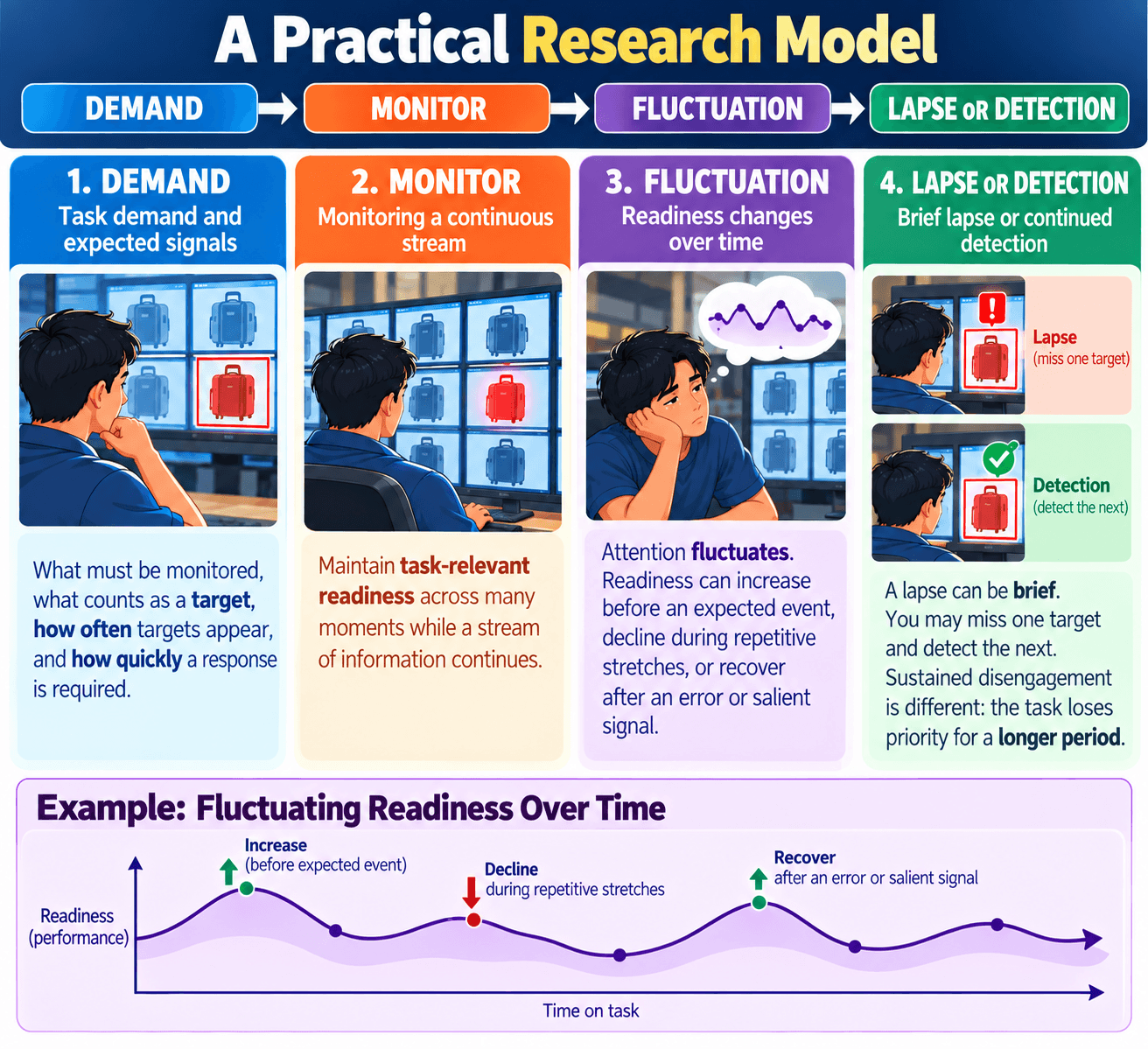
A Practical Research Model: DEMAND → MONITOR → FLUCTUATION → LAPSE OR DETECTION

Task demand and expected signals
Every sustained-attention task begins with a demand: what must be monitored, what counts as a target, how often targets appear, and how quickly a response is required.
These details matter. Monitoring a continuous visual display is not identical to waiting for an occasional tone. Detecting a subtle change is not identical to pressing a key whenever a specific number appears. Different tasks place different loads on perception, memory, decision-making, and response control.
Moment-to-moment fluctuations
During monitoring, attention fluctuates. Readiness can increase before an expected event, decline during repetitive stretches, or recover after an error or salient signal.
These fluctuations can be small enough that the person still feels “on task.” Subjective experience and measurable performance do not always move together. You can feel as though you have been paying attention continuously while reaction time becomes more variable.
Brief lapses versus sustained disengagement
A lapse can be brief. You may miss one target and detect the next. Sustained disengagement is different: the task loses priority for a longer period. When attention drifts during a long task, attentional control helps explain how priority can be restored to the monitoring goal.
This distinction prevents overinterpretation. A single missed signal does not prove that attention “shut off,” just as one accurate response does not prove that readiness remained perfect throughout the preceding minute.
What Makes Sustained Attention Harder?
Monotony and low event rate
When stimuli change very little and meaningful events are rare, the task provides limited external support for maintaining engagement. The observer must keep preparing for something that usually does not happen.
This is why seemingly easy monitoring can become demanding over time. Complexity is not the only source of cognitive effort.
Fatigue and arousal
Fatigue can slow responses, increase variability, and make sustained readiness harder. Arousal also matters because both very low and very high arousal can interfere with performance, although the optimal level depends on task and context.
It is important not to reduce fatigue to “not trying hard enough.” Sleep loss, prolonged wakefulness, illness, medication effects, and demanding schedules can all affect alertness and safety.
Task engagement and response demands
A task that requires frequent meaningful decisions may maintain engagement differently from a task with long stretches of passive observation. Response complexity also matters. Detecting a signal is one step; deciding what it means and choosing an action may add additional demands.
Researchers therefore compare tasks carefully rather than assuming every vigilance test measures exactly the same thing.
Expectations and signal frequency
If targets are very rare, observers may become more conservative about deciding that a signal is present. If targets are frequent, readiness and response strategy may differ.
This means a drop in “hits” can reflect more than one process. It may involve attention, decision thresholds, expectations, or changes in response strategy. Good interpretation requires looking at the full pattern rather than one number.
Sustained Attention and Mind Wandering

When internal thought competes with the monitored task
Mind wandering is one possible competitor during sustained attention. Instead of being pulled away by an external sound or movement, attention shifts toward internally generated thoughts such as plans, memories, imagined conversations, or unrelated concerns.
A recent systematic review of methods for measuring mind wandering highlights how difficult the phenomenon is to capture because self-report, behavioral tasks, eye tracking, physiology, and neuroimaging each measure different aspects.
This matters for vigilance research because a behavioral lapse does not automatically reveal what the person was thinking at that moment.
Why not every lapse is mind wandering
A missed target may occur during mind wandering, but it may also reflect low arousal, perceptual difficulty, uncertainty, fatigue, response confusion, or a brief timing failure.
Resource-control theories give mind wandering an important role, yet evidence does not justify treating every performance decrement as proof that attention moved inward.
Mind wandering is therefore a useful neighboring concept, not a complete synonym for sustained-attention failure.
Sustained Attention vs Attention Span
Research construct vs everyday duration label
| Sustained attention | Attention span |
|---|---|
| Research construct focused on maintaining task-relevant performance over time. | Everyday description of how long someone seems able to stay engaged. |
| Often measured with reaction time, target detection, errors, or variability. | Often inferred informally from behavior or subjective experience. |
| Depends strongly on task structure and signal properties. | Often treated too simply as a fixed personal trait. |
| Does not automatically imply a training recommendation. | Frequently appears in practical focus advice. |
A person does not have one universal attention-span number that applies equally to reading, driving, gaming, conversation, study, and monitoring. Engagement changes with the task, goals, fatigue, interest, difficulty, and environment.
Why mechanism should come before improvement advice
If someone misses rare signals during a long monitoring task, the relevant question is different from “How can I focus on studying for longer?” The first concerns vigilance and time-on-task. The second is a practical behavior-change question involving routines, environment, motivation, and task design.
Keeping these questions separate leads to clearer explanations and avoids turning every attention topic into the same self-help checklist.
Sustained Attention vs Flow and Concentration
Readiness and monitoring vs absorbed involvement
Flow describes a broader state of absorbed engagement often associated with challenge-skill balance, intrinsic involvement, and immediate feedback. Sustained attention may be part of that experience, but vigilance tasks are often almost the opposite: repetitive, externally imposed, and low in stimulation.
A person can perform sustained monitoring without entering flow, and a person in flow is doing more than merely remaining vigilant.
Everyday concentration language vs a research construct
Concentration is a useful everyday word for keeping attention on something. Sustained attention is more precise when the question involves performance across time and measurable lapses.
If the goal is explanation, precision helps. “I lost concentration” describes an experience. “My detection accuracy declined after prolonged monitoring” describes a pattern that sustained-attention research can investigate more directly.
Safety-Critical Monitoring Has Different Stakes
Driving, machinery, aviation, medical monitoring, and emergency work
In high-risk settings, vigilance is not merely about productivity. A missed signal can affect other people. This makes system design, staffing, alarms, workload, training, rest policies, and formal procedures important alongside individual attention.
A 2025 commentary on the limits of perfect vigilance argues that human systems should be designed around the reality that uninterrupted attention cannot be guaranteed indefinitely.
The broader lesson is practical: safety should not depend on assuming that a motivated person can maintain flawless monitoring forever.
Why psychological tips do not remove fatigue or formal safety requirements
No attention technique makes it safe to continue driving when dangerously sleepy or to ignore required breaks around hazardous machinery. When alertness is impaired, reducing competing tasks, following formal procedures, stopping the activity when necessary, and using trained support are more important than trying to “push through.”
Psychology can explain limits. It should not be used to minimize them.
First Step: Describe the Lapse Before Explaining It
Was the target stable, was the task long, and was a signal rare?
Before labeling a problem, describe what happened. Was the same stream being monitored for a long time? Were important signals infrequent? Did performance worsen gradually, or was there one isolated miss?
These questions help separate sustained-attention demands from other attention problems.
Distinguish external distraction, internal drift, and general fatigue
If a phone sound pulled attention away, external distraction may be central. If attention moved into unrelated thoughts, mind wandering may be more relevant. If reaction time slowed broadly after prolonged wakefulness, fatigue or alertness may deserve more attention.
Several causes can coexist. The value of the distinction is not to diagnose yourself, but to avoid treating every lapse as the same phenomenon.
When Changes in Attention Need Professional Evaluation
Ordinary lapses during long or repetitive tasks are common. A different level of concern applies when attention changes suddenly, declines markedly, follows a head injury, appears with confusion or new neurological symptoms, is associated with severe daytime sleepiness, or substantially disrupts familiar daily activities.
An educational explanation of sustained attention cannot determine the cause. Qualified medical or psychological evaluation may be appropriate when the change is new, severe, or functionally significant.
FAQ About Sustained Attention
Is vigilance the same as sustained attention?
They overlap strongly, but researchers do not always use them identically. Sustained attention broadly refers to maintaining task-relevant attention over time. Vigilance often emphasizes prolonged monitoring for important, infrequent, or unpredictable signals. Some modern research distinguishes vigilance further into components related to signal detection and arousal.
Does attention always get worse the longer a task lasts?
No. Vigilance decrements are common in many prolonged monitoring tasks, but their size and form depend on task demands, target frequency, response requirements, motivation, fatigue, and individual differences. Performance can also fluctuate rather than decline in a perfectly smooth line.
Is a short lapse evidence of a short attention span?
No. A brief lapse can occur during otherwise good sustained performance. “Attention span” is an informal duration label and should not be treated as a diagnosis or a fixed personal capacity based on one missed event.
Can mind wandering occur during sustained-attention tasks?
Yes. Attention may shift from the external task toward internally generated thoughts, and that can contribute to performance errors. However, not every lapse is caused by mind wandering, so the two concepts should not be treated as synonyms.
Key Takeaways
- Sustained attention concerns maintaining task-relevant readiness and performance over time, not simply “trying to focus longer.”
- Vigilance tasks often involve monitoring repetitive information for rare or unpredictable critical signals.
- The vigilance decrement describes worsening performance with time-on-task, but its causes remain theoretically debated.
- Mind wandering can contribute to lapses, yet fatigue, arousal, task structure, expectations, and response demands also matter.
- Sustained attention is different from the everyday idea of attention span and from absorbed states such as flow.
- In safety-critical settings, system design and formal safety procedures matter because perfect vigilance cannot be assumed.
About the author: Michael Reed is the Founder & Lead Writer at Psychology Exposed. He explains psychology, human behavior, self-awareness, and everyday cognitive patterns in clear, research-aware language for general readers.
A useful next step is to describe the attention problem more precisely. If the challenge appears only after prolonged monitoring, especially when meaningful signals are rare, sustained attention is a better starting point than the vague conclusion that you simply “cannot focus.”

Michael Reed is the Founder and Lead Writer at Psychology Exposed. He writes about human behavior, relationships, emotional patterns, self-awareness, and practical psychology topics using research-informed, easy-to-understand content.
Read More About Michael Reed: https://psychologyexposed.com/michael-reed/