

You are talking with a friend in a crowded restaurant. Plates clatter, music plays, several conversations overlap, and people move through your peripheral vision. Somehow, one voice remains central while much of the rest becomes background. A few minutes later, your attention shifts because someone nearby says your name.
Selective attention helps explain both moments. It is the process by which some information receives greater processing priority than competing information. The mind does not simply record everything in equal detail and decide what matters afterward. Instead, goals, stimulus properties, task demands, expectations, and learned relevance all influence what receives deeper processing.
This article focuses on attentional selection itself: how targets are prioritized over distractors, how visual and auditory selection work, what classic filter theories tried to explain, and why modern evidence makes an all-or-nothing “mental gate” too simple.
Quick Answer
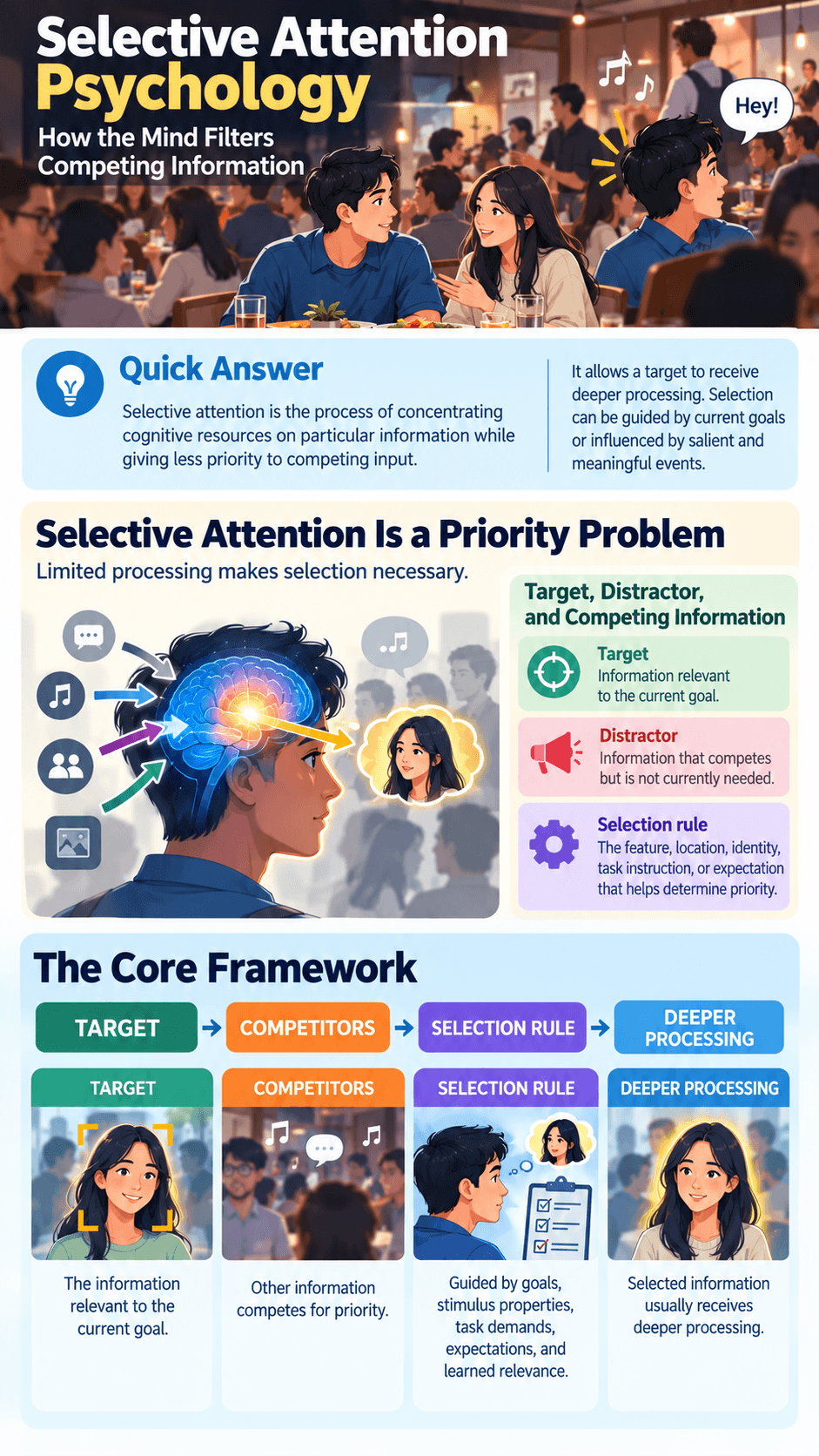
Selective attention is the process of concentrating cognitive resources on particular information while giving less priority to competing input. It allows a target, such as one voice, location, object, or task feature, to receive deeper processing. Selection can be guided by current goals or influenced by salient and meaningful events. Unattended information is not necessarily processed at zero level, and selection varies with task demands and context.
Selective Attention Is a Priority Problem
Limited processing makes selection necessary
The APA Dictionary of Psychology defines selective attention as concentrating on certain stimuli rather than others so that important information can be distinguished from peripheral or incidental input. That definition highlights a basic constraint: information competes. This selection process sits within the broader psychology of attention, which also includes sustained attention, capture, control, awareness limits, and switching.
At any moment, your senses provide far more potential input than you can analyze, compare, remember, and act on in equal depth. The same is true internally. You may have several thoughts, goals, memories, and intentions available at once, yet only some become central to current behavior.
Selection is therefore not a special event that happens only when you “try hard to focus.” It is a normal feature of mental processing. Reading a sentence requires favoring some visual information over the rest of the page. Following a speaker requires favoring one auditory stream over competing voices. Searching a dashboard requires giving particular features or locations priority.
Target, distractor, and competing information
A useful way to think about selective attention is to separate three roles:
- Target: the information relevant to the current goal.
- Distractor: information that competes with the target but is not currently needed.
- Selection rule: the feature, location, identity, task instruction, or expectation that helps determine what receives priority.
Suppose you are looking for a green exit sign. “Green” and “sign-like object” become useful selection rules. Red advertisements and moving people may be visually strong, but they are not the target. If a fire alarm suddenly sounds, however, the priority structure changes because a new cue may matter more than the original search.
This illustrates an important principle: target and distractor are not permanent properties of objects. They depend on the task.
The Core Framework: TARGET → COMPETITORS → SELECTION RULE → DEEPER PROCESSING
What counts as the target
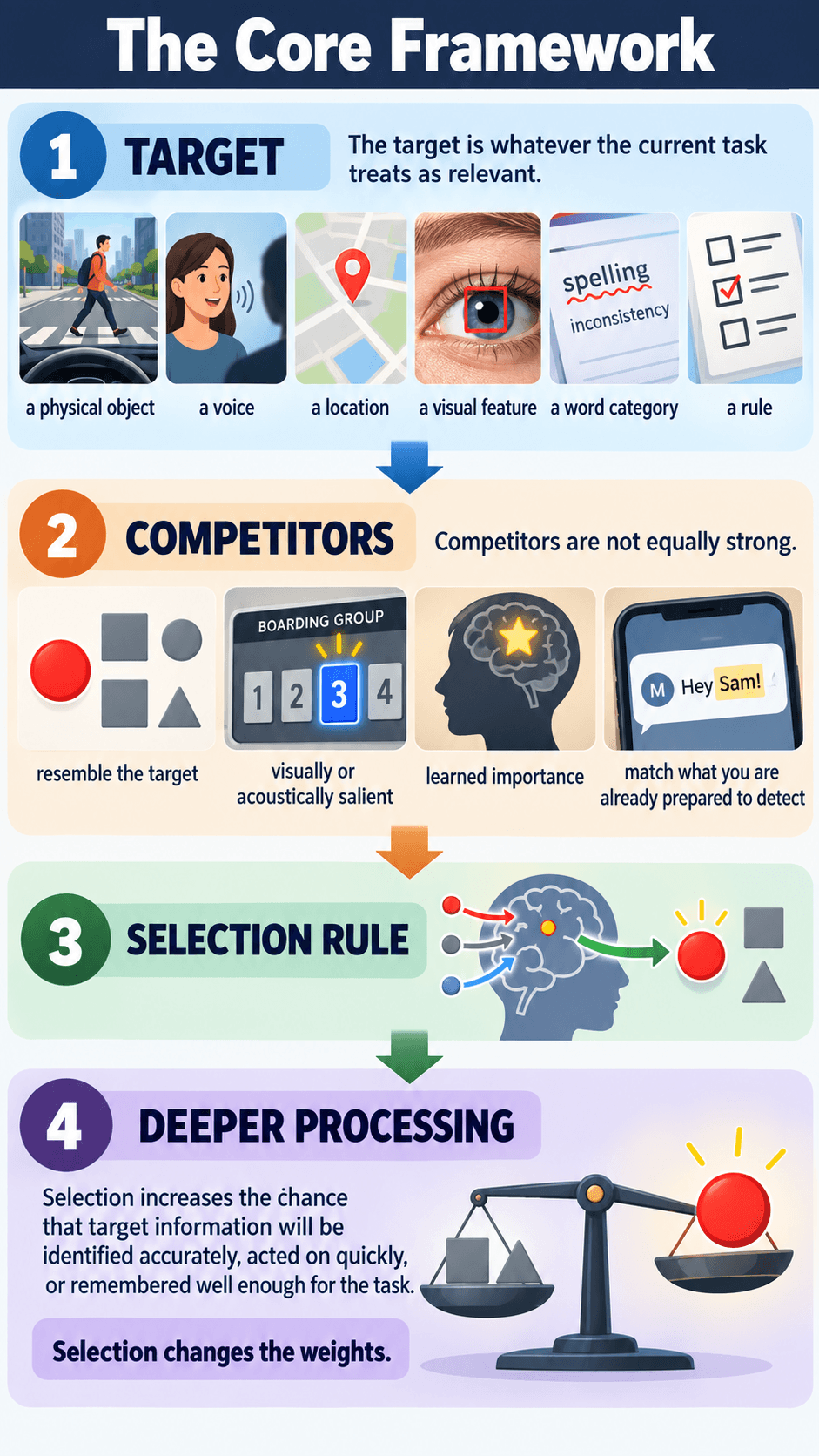
The target is whatever the current task treats as relevant. It may be a physical object, a voice, a location, a visual feature, a word category, or a rule. When driving, a pedestrian entering the road may become a target. When proofreading, a spelling inconsistency may become a target. In a conversation, a particular speaker’s words may be the target.
The target does not always have to be consciously described in detail. Practice can make some selection settings efficient. An experienced radiologist, musician, driver, or gamer may prioritize task-relevant patterns differently from a novice because repeated experience changes what is meaningful and expected.
What makes a competitor relevant
Competitors are not equally strong. Some resemble the target. Some are visually or acoustically salient. Some have learned importance. Others match what you are already prepared to detect.
If you are searching for a red circle, another red object may compete more strongly than a gray square. If you are listening for your boarding group, similar number phrases may briefly draw processing. If you are waiting for a message from one person, that person’s name may carry unusually high priority.
Why selected information usually receives deeper processing
Selection increases the chance that target information will be identified accurately, acted on quickly, or remembered well enough for the task. That does not imply that everything outside the target disappears. A competing cue may still influence behavior, especially when the task leaves capacity available or when the cue is especially relevant.
A better metaphor than a sealed gate is a weighted competition. Selection changes the weights.
What Can Attention Select?

Locations and spatial attention
You can prioritize a region of space without moving your eyes directly to it. For example, while looking straight ahead, you may monitor the left side of a screen because you expect a signal to appear there.
Spatial selection is one reason the “spotlight” metaphor became popular. The metaphor is useful because it captures the idea that one region can receive enhanced processing. It becomes misleading if taken too literally. Attention does not behave like a perfectly circular flashlight with fixed borders, and it can be distributed in more complex ways depending on the task.
Features such as color, motion, or orientation
Selection can also emphasize features. If you are searching for a friend wearing a yellow jacket, color becomes especially useful. In a motion-monitoring task, direction may matter more. In other tasks, shape, orientation, or size may help distinguish the target.
Feature-based selection matters because useful information is not always confined to one place. Several objects across a scene can share a task-relevant characteristic.
Objects and grouped information
Attention can operate at the level of objects as well as locations and isolated features. When information is perceived as belonging to one coherent object, selecting one part may influence processing of other parts of that same object.
For a general reader, the practical point is that attention does not simply choose pixels or coordinates. The structure of the scene matters. What the mind treats as belonging together can shape selection.
Auditory streams and voices
Auditory selective attention is especially obvious in crowded social settings. Several voices may reach your ears at the same time, yet you can often follow one speaker better than the others.
A broad review of visual and auditory selective attention describes selection across modalities and highlights how attention helps prioritize information in complex environments. Auditory selection can use cues such as spatial location, voice characteristics, timing, and meaning.
This is why “listening” is not simply receiving sound. It involves selecting a stream from competition.
Goal-Directed and Stimulus-Driven Selection

Endogenous selection based on current goals
When you deliberately search for a typo, watch the road for a turn, or listen for a specific instruction, your goals create an attentional set. Information that matches that set receives an advantage.
This goal-directed influence helps explain why the same scene can produce different selections for different people. A mechanic may notice an engine sound that a passenger ignores. A designer may spot alignment problems that another viewer does not register. A parent waiting for a child may detect a familiar voice rapidly in a noisy room.
Goals therefore do not merely tell you what to do after perception. They help shape what information receives priority during ongoing processing. Goal-directed selection also depends on attentional control when the system must maintain or restore priority to the intended target.
Stimulus-driven influences without treating every salient cue as irresistible
Some stimuli have properties that increase their chance of attracting attention: abrupt onset, movement, contrast, novelty, or unusual intensity. Yet salience is not an absolute command.
A visually bright object may fail to take over when it is irrelevant to a demanding task. A quieter but highly meaningful cue may be noticed quickly. Current goals and stimulus properties interact rather than operating as two isolated systems.
Why goal-driven and stimulus-driven influences interact
Imagine searching a baggage carousel for a black suitcase with a red strap. A red object may receive extra processing because it matches the search. The same red object may be much less important if you are searching for a silver backpack.
This interaction is central to selective attention. What “stands out” depends partly on the environment and partly on what the system is prepared to prioritize.
Classic Selection Models Without the Textbook Overload
Broadbent and the logic of early selection
Early theories of attention tried to explain how a limited system handles more incoming information than it can fully process. Broadbent’s filter model proposed that selection occurs relatively early, based heavily on physical characteristics of incoming signals.
The appeal of the model is easy to see. If the system is capacity-limited, perhaps irrelevant input must be filtered before deep analysis. In auditory experiments, participants could attend to one channel while ignoring another, suggesting some form of early prioritization.
But later findings made a rigid all-or-nothing filter difficult to maintain.
Treisman and attenuation
Anne Treisman proposed a more flexible account. Instead of completely blocking unattended information, the system could attenuate it, reducing its strength while still allowing some material to influence processing if it was sufficiently important or had a low threshold for recognition.
This helps explain why a person can follow one conversation yet occasionally notice meaningful information from another stream. The unattended channel is not necessarily treated as if it does not exist.
Why later evidence complicated the early-versus-late debate
Late-selection theories shifted the proposed point of selection further downstream. Some versions suggested that multiple inputs receive substantial identification before the system chooses which information will control response or awareness.
A review of attentional load and selection summarizes the historical contrast between early and late accounts while emphasizing limited capacity and the role of task conditions. Modern evidence does not support treating every task as if selection always occurs at one fixed stage.
Instead, how much irrelevant information is processed depends on the demands of the task, characteristics of the stimuli, the response requirements, and the way relevance is defined.
What Dichotic Listening Revealed
Attending to one ear or message stream
Dichotic listening experiments present different auditory messages to the two ears. Participants may be instructed to repeat, or “shadow,” one message while ignoring the other. These tasks became important because they allowed researchers to ask what properties of an unattended stream still influence behavior.
People often report little detail from the ignored message, yet unattended input is not always functionally invisible. Physical changes, meaningful items, and task-relevant cues can sometimes break through under particular conditions.
The cocktail party phenomenon as a limited example
The familiar cocktail party example captures a real attentional problem: following one conversation while many voices compete. People sometimes notice personally meaningful information, such as their own name, from outside the selected stream.
It would be an overreach to conclude that every unattended word is fully understood. Noticing one highly relevant item does not prove complete semantic analysis of everything in the background.
Why unattended information may still receive some processing
Selective attention changes priority, not necessarily existence. Lower-priority information may receive less detailed processing while still retaining enough influence to affect orienting or response under certain circumstances.
This is one reason selective attention should not be explained as a simple binary switch between “processed” and “not processed.”
Visual Selective Attention in Everyday Terms
Searching for a target among distractors
Visual search is one of the clearest ways to study selection. You may look for a particular product on a crowded shelf, a specific icon on a screen, or a friend in a station.
The difficulty changes with the relationship between target and distractors. A target that differs strongly on one feature may be easy to find. A target defined by a combination of features can require more selective inspection.
The spotlight metaphor and where it becomes too simple
The attentional spotlight metaphor suggests that processing is enhanced in a selected region. It is intuitive and useful for explaining spatial priority. But attention can select features across multiple locations, shift rapidly, or distribute priority unevenly.
Use the spotlight as a teaching tool, not as a literal map of a single beam inside the brain.
Target relevance and attentional settings
Your current task changes the effective competition. In a visual search, an object that matches the target template is more likely to receive priority. This helps explain why selection can feel effortless when the goal is clear and much harder when the target is poorly defined.
The mechanism is not simply “try harder.” Better-defined relevance changes what counts as useful evidence.
Perceptual Load and Selection
Why task demand can change distractor processing
One influential proposal is perceptual load theory. In simplified form, it suggests that when the relevant task uses substantial perceptual capacity, less capacity remains for irrelevant distractors. Under lower perceptual load, unused capacity may spill over into processing irrelevant information.
A classic study on perceptual load and selective attention reported greater distractor interference under lower-load conditions than under higher-load conditions. This line of research helped connect early and late selection by asking when irrelevant information is more likely to be processed.
Boundary conditions and why load is not a universal explanation
Load theory has been influential, but it should not be presented as if every result in attention research fits neatly inside it. Researchers have debated how perceptual load should be defined and manipulated, whether dilution or other factors explain some findings, and how cognitive load can sometimes have different effects from perceptual load.
A critical review of conceptual and methodological issues in perceptual load theory discusses these concerns directly. The broader lesson is valuable: task demand matters, but “high load” is not a magic phrase that explains every success or failure of selection.
Selective Attention vs Selective Perception

Priority allocation vs interpretation-shaped noticing
| Selective attention | Selective perception |
|---|---|
| Asks which information receives processing priority. | Concerns uneven noticing or weighting within perceptual experience. |
| Often studied through target-distractor tasks, listening tasks, visual search, and cueing. | Often discussed in relation to expectations, beliefs, context, and how perception is constructed. |
| Focuses on selection mechanisms. | Focuses more broadly on what becomes noticed or interpreted in experience. |
The concepts overlap, but treating them as identical creates confusion. Selective attention is most useful when the central question is, “Which signal gets priority among competitors?”
Why beliefs and expectations should not become the main explanation here
Expectations can influence attention, but selective attention is broader than belief-confirming perception. A visual target can be selected because of location, color, timing, task instruction, or learned relevance without requiring a belief-driven interpretation.
If the main issue is how prior beliefs shape what a person notices and how they interpret ambiguous events, selective perception is a better framework. If the issue is how the cognitive system prioritizes one stream over another, selective attention is the more precise term.
Selective Attention vs Attentional Capture
Ongoing selection vs a competing cue gaining priority
Selective attention describes the broad process of prioritizing information. Attentional capture describes a narrower event in which a competing stimulus gains priority and redirects attention.
Imagine reading while a notification appears. The reading task reflects ongoing selection. If the notification pulls your attention away, that redirection is an instance of capture. The distinction matters because the cause of selection and the cause of interruption are not always the same.
How selection settings influence what can capture attention
A cue is more likely to compete successfully when it matches what you are already prepared to detect. This is why attentional settings can influence capture. A color that is irrelevant in one task may become powerful in another if it matches the current target.
Selection and capture therefore interact, but capture should not replace the broader concept of selective attention.
Costs and Benefits of Narrowing Attention
Better processing of selected targets
The benefit of selection is obvious: it helps behavior stay organized. Without prioritization, every sound, object, movement, thought, and sensation would compete on equal terms.
Narrowing attention can improve target detection, response accuracy, comprehension, and efficient use of limited processing. This is especially valuable when irrelevant information is abundant.
Increased risk of missing information outside the attentional set
The tradeoff is that lower-priority information may be processed less deeply or fail to reach awareness. Strong selection can therefore improve performance on the chosen task while increasing the chance that unexpected information is missed.
This tradeoff connects selective attention with inattentional blindness, but the concepts are not interchangeable. Selective attention is the normal selection process. Inattentional blindness is one possible outcome when an unexpected event falls outside the active attentional set.
What to Notice Next in Your Own Attention
Identify the target, competitors, and current selection rule
A useful self-observation exercise is descriptive rather than corrective. During a demanding task, ask three questions:
- What is the target right now?
- What information is competing with it?
- What feature, location, rule, or expectation is guiding selection?
This can reveal why two superficially similar situations feel different. Searching for one clearly defined icon among unrelated objects is not the same attentional problem as listening to one voice among several similar voices.
Use observation as a description, not a diagnostic test
Selective attention varies with fatigue, familiarity, motivation, task difficulty, environmental competition, and many other conditions. A few lapses or distractible moments do not diagnose ADHD, anxiety, a neurological condition, or any other disorder.
If attention changes suddenly, declines substantially, follows a head injury, or is accompanied by confusion or major functional difficulties, that is a different question and may deserve qualified medical or psychological evaluation.
FAQ About Selective Attention
Is selective attention the same as selective perception?
No. The terms overlap, but selective attention is more specifically about allocation of processing priority among competing information. Selective perception is broader and often concerns what becomes noticed or weighted in perceptual experience, including influences from expectations and context.
Does unattended information receive zero processing?
Not necessarily. Classic and modern research suggests that unattended information can sometimes influence processing, depending on task demands, relevance, timing, and the kind of information involved. A rigid all-or-nothing filter is therefore too simple for many findings.
Is the cocktail party effect proof that every unattended word is understood?
No. Noticing a personally meaningful item from another conversation does not establish that every unattended word was fully identified and semantically analyzed. It shows that some lower-priority information can influence attention under particular conditions.
Can attention select sounds as well as visual objects?
Yes. Selective attention operates across modalities. People can prioritize an auditory stream, a spatial location, a visual feature, an object, or information that matches a current goal. The cues used for selection differ across tasks.
Key Takeaways
- Selective attention gives some information greater processing priority than competing input.
- A useful model is TARGET → COMPETITORS → SELECTION RULE → DEEPER PROCESSING.
- Selection can operate over locations, features, objects, and auditory streams.
- Goal-directed settings and stimulus properties interact, so selection is neither purely voluntary nor purely automatic.
- Classic early and late selection theories remain useful historically, but modern evidence shows that unattended processing depends strongly on task conditions.
- Selective attention is not the same as selective perception, attentional capture, or inattentional blindness.
About the author: Michael Reed is the Founder & Lead Writer at Psychology Exposed. He explains psychology, human behavior, self-awareness, and everyday cognitive patterns in clear, research-aware language for general readers.
The most useful next question is often not “Why am I distracted?” but “What is my attentional system currently treating as the target, and what else is competing with it?” That shift turns a vague complaint about focus into a more precise question about selection.

Michael Reed is the Founder and Lead Writer at Psychology Exposed. He writes about human behavior, relationships, emotional patterns, self-awareness, and practical psychology topics using research-informed, easy-to-understand content.
Read More About Michael Reed: https://psychologyexposed.com/michael-reed/