
You can look directly at a scene and still fail to notice something obvious. A pedestrian steps into view while you are concentrating on traffic signs. An unusual object appears during a visual task, yet you remember nothing about it. Someone later asks, “How could you not see that?” and the honest answer is that the object was physically visible but never became part of your conscious experience.
This phenomenon is called inattentional blindness. It occurs when an unexpected visible event goes unnoticed because attention is engaged elsewhere. The effect is striking because people often assume that looking at a scene means they are consciously aware of most important things within it. Research shows that this assumption is too optimistic.
Inattentional blindness does not mean the eyes are defective. It does not automatically imply carelessness, low intelligence, or a clinical attention problem. It reveals a normal limit of selective attention: what reaches awareness depends partly on what the mind is currently prioritizing.
Quick Answer
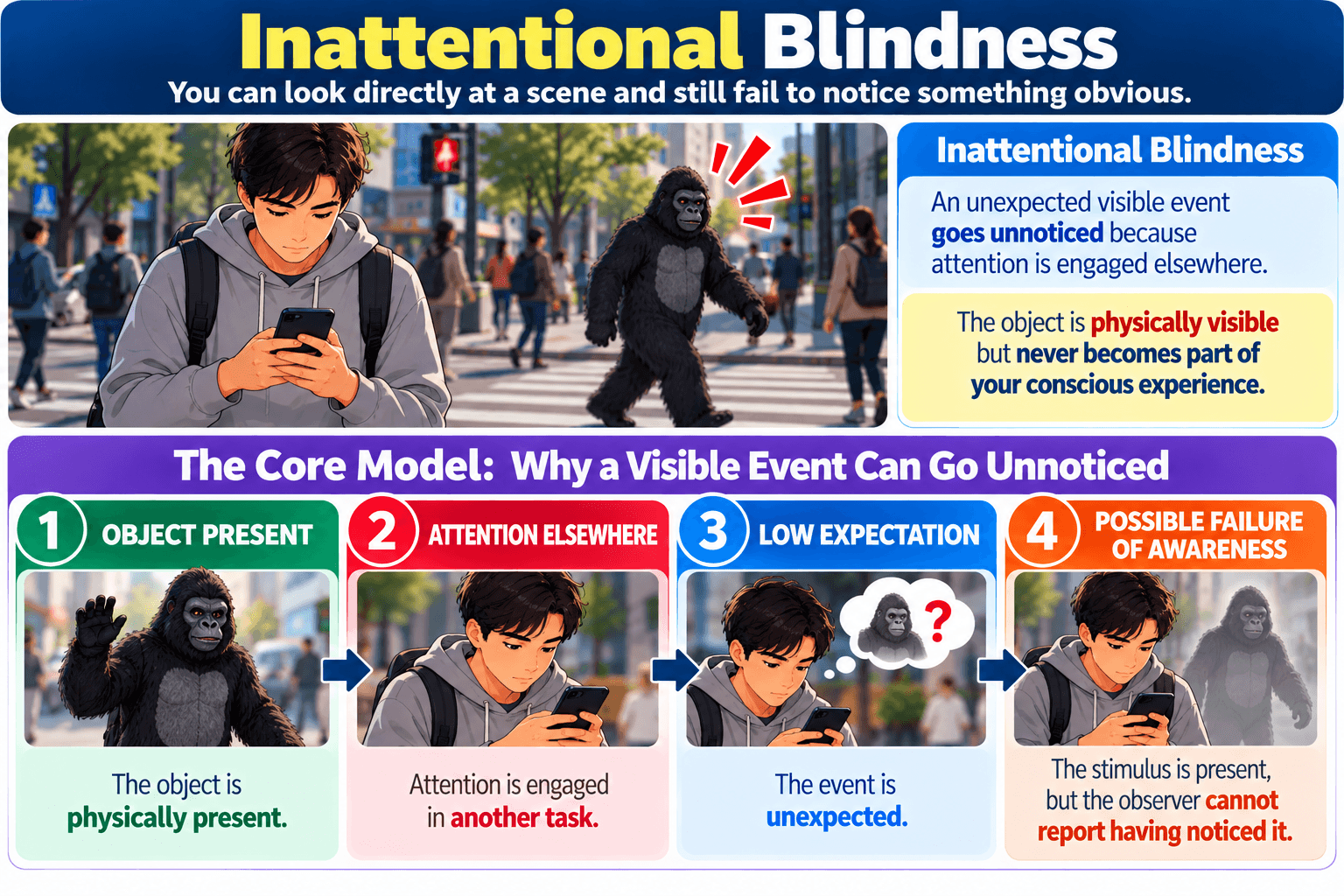
Inattentional blindness is the failure to consciously notice an unexpected but visible stimulus when attention is focused on another task or object. The stimulus may be directly in view, yet it does not reach reported awareness. Detection becomes more likely when the event matches current goals or expectations and less likely when the primary task consumes more perceptual resources. It differs from change blindness, which involves missing a change between two scene states.
What Inattentional Blindness Means
A visible stimulus can fail to reach awareness
The APA Dictionary of Psychology entry on inattentional blindness places the phenomenon within a broader family of attention-related failures to notice visual information. The defining feature is not that the stimulus is too faint or hidden. It is that attention is committed elsewhere when the unexpected event appears.
This distinction matters. A person can have normal vision, the object can be physically present, and the eyes can even be directed near its location. Yet conscious noticing can still fail.
Seeing, in the everyday sense, therefore includes more than retinal input. Information must also receive enough processing under the current attentional conditions to become consciously reportable. Inattentional blindness is one limit within the broader psychology of attention and conscious awareness.
Why “right in front of you” can be misleading
People often think spatial position determines awareness: if an object is near the center of vision, it should be noticed. Location certainly matters, but it is not the only factor.
A task can create a strong attentional set around particular objects, features, movements, or categories. Information outside that set may receive less priority even when it appears in a visually obvious place.
This is one reason inattentional blindness feels so surprising afterward. Once you know what was there, the event seems impossible to miss. But your later knowledge changes what you would attend to if you watched the scene again.
The Core Model: OBJECT PRESENT + ATTENTION ELSEWHERE + LOW EXPECTATION → POSSIBLE FAILURE OF AWARENESS
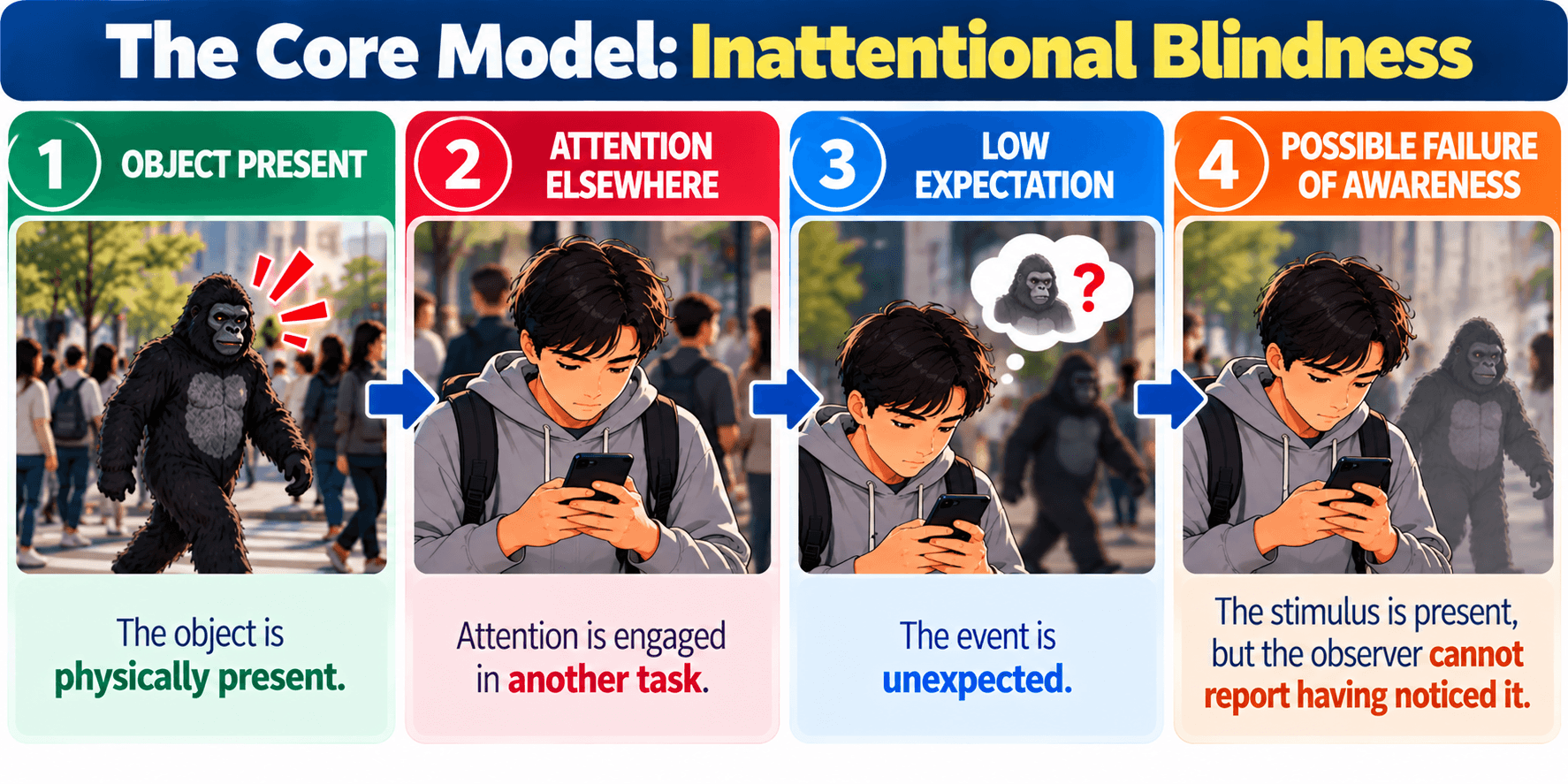
The object is physically present
Inattentional blindness begins with a real stimulus. It is not a memory of something that never appeared. The object, person, symbol, or event is available in the visual scene.
The experimental question is whether the observer reports consciously noticing it under conditions in which attention is occupied by something else.
Attention is engaged in another task
The observer usually has a primary task. They may count passes between players, track moving objects, judge shapes, identify symbols, or perform another visual discrimination.
The task matters because attention is not evenly distributed across everything in view. Processing priority is organized around what the observer has been asked or intends to do.
The event is unexpected
Unexpectedness is central. If participants know that an unusual object may appear, they can deliberately monitor for it. Once the event becomes expected, the conditions that create classic inattentional blindness have changed.
This is also why replaying a famous demonstration is not a fair test. If you already know what to look for, your attentional set is different.
Awareness may fail even without visual obstruction
The final step is the surprising one: the stimulus is present, but the observer cannot report having noticed it.
That is different from a blocked view, poor lighting, or visual impairment. The failure occurs within the relationship between attention and awareness.
The Famous “Gorilla” Demonstration
What the experiment actually tested
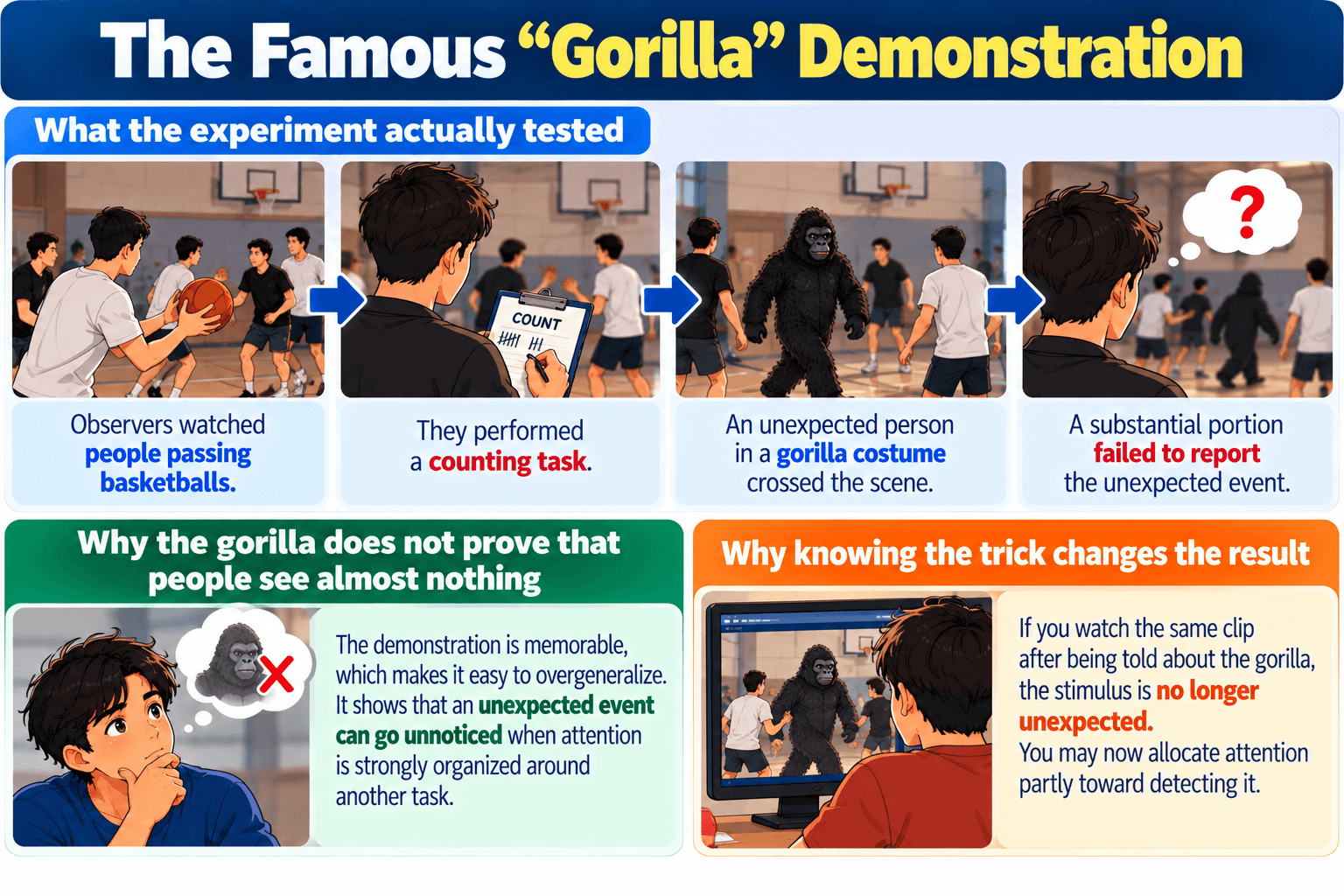
One of the best-known demonstrations comes from Daniel Simons and Christopher Chabris. In their 1999 study of sustained inattentional blindness, observers watched people passing basketballs and performed a counting task. During the event, an unexpected person in a gorilla costume or another unusual event crossed the scene.
A substantial portion of observers failed to report the unexpected event. The exact detection rate varied with the version of the task and the relationship between the unexpected event and the attended activity.
The study did not show that people are generally blind to obvious objects. It showed that an unexpected event can go unnoticed when attention is strongly organized around another task.
Why the gorilla does not prove that people see almost nothing
The demonstration is memorable, which makes it easy to overgeneralize. Inattentional blindness is not evidence that visual experience is mostly an illusion or that unattended information is never processed.
Observers notice many things outside their explicit task, and detection rates vary with stimulus features, task demands, expectations, and attentional settings. The phenomenon reveals a limit, not total blindness to the surrounding world.
Why knowing the trick changes the result
If you watch the same clip after being told about the gorilla, the stimulus is no longer unexpected. You may now allocate attention partly toward detecting it.
This illustrates a broader methodological issue. Inattentional blindness is often studied with a critical surprise trial because repeated exposure would change expectations and reduce the very condition researchers are trying to examine.
Why Attention to One Task Can Reduce Awareness Elsewhere
Selective processing has tradeoffs
Attention improves processing of information relevant to the current goal. The tradeoff is that information outside the active priority structure may receive less processing.
That tradeoff is not necessarily a flaw. A system that treated every available object as equally important would struggle to perform focused tasks. Selection makes behavior efficient, but it creates the possibility that an unexpected event will not reach awareness.
Perceptual load can matter
One influential explanation focuses on perceptual load. When the primary task requires substantial perceptual processing, fewer resources may remain for irrelevant stimuli.
A systematic review and three meta-analyses of perceptual and cognitive load in inattentional blindness found that perceptual load reliably influenced the phenomenon across studies, although the literature contains varied paradigms and theoretical interpretations.
This supports the idea that the demands of the attended task matter. It does not prove that all inattentional blindness comes from one simple resource pool.
Higher task demand does not explain every case
Inattentional blindness can occur under lower-demand conditions too. Expectations, similarity between the unexpected object and attended items, spatial location, stimulus meaning, and individual circumstances can all change detection probability.
Load is therefore one important factor rather than a universal explanation.
Expectation Shapes What Reaches Awareness
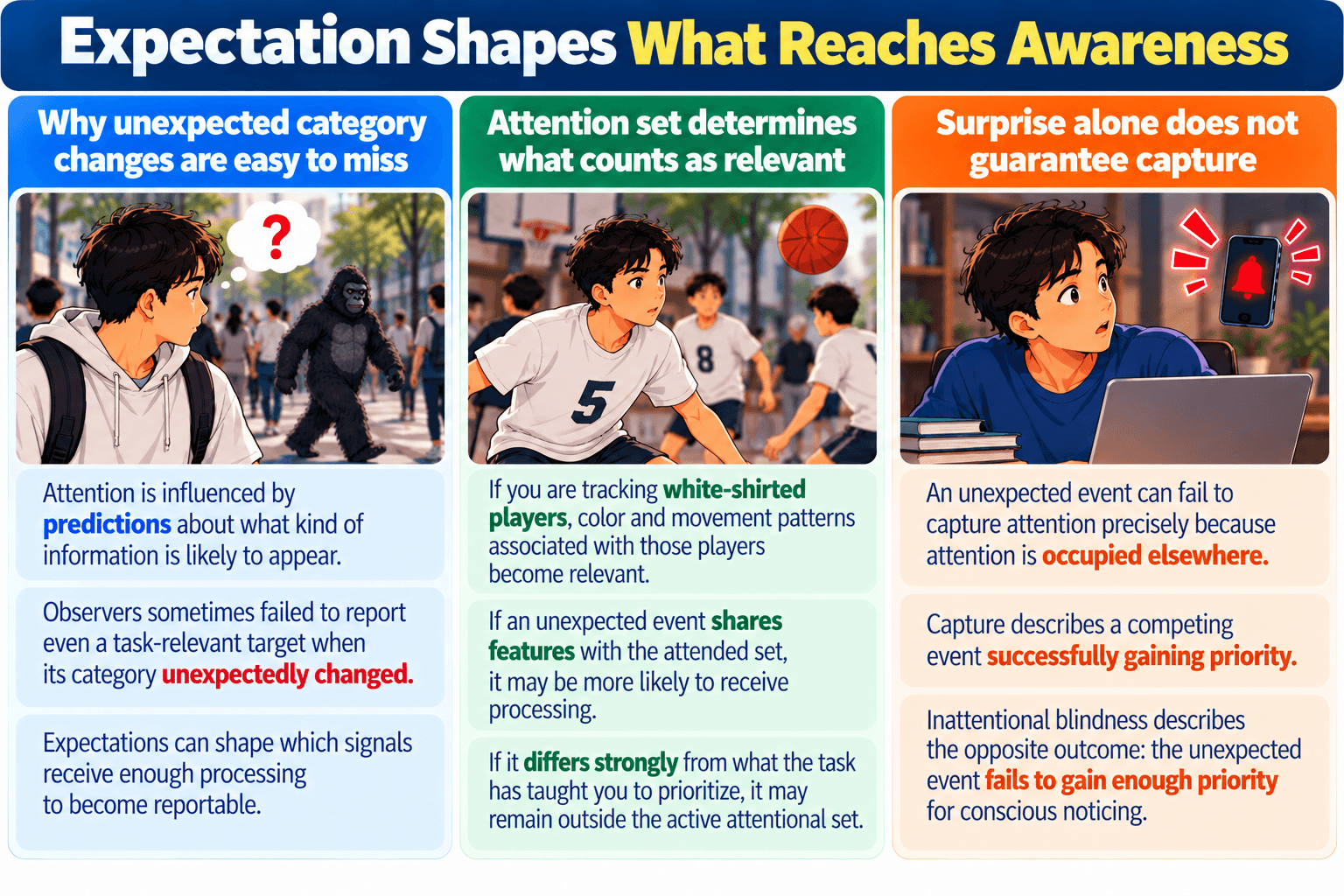
Why unexpected category changes are easy to miss
Attention is influenced by predictions about what kind of information is likely to appear. Those expectations can narrow what counts as a plausible target.
A 2022 study on expectation-based blindness found that observers sometimes failed to report even a task-relevant, centrally presented target when its category unexpectedly changed. The effect was not a classic inattentional-blindness setup in every respect, but it demonstrates how strongly expectations can shape visual awareness.
The lesson is not that expectations literally erase objects. They influence which signals receive sufficient processing to become reportable.
Attention set determines what counts as relevant
If you are tracking white-shirted players, color and movement patterns associated with those players become relevant. If the unexpected event shares features with the attended set, it may be more likely to receive processing.
If it differs strongly from what the task has taught you to prioritize, it may remain outside the active attentional set despite being visually obvious.
Surprise alone does not guarantee capture
It seems intuitive that a strange event should automatically grab attention. In reality, an unexpected event can fail to capture attention precisely because attention is occupied elsewhere.
This is one of the clearest differences between attentional capture and inattentional blindness. Capture describes a competing event successfully gaining priority. Inattentional blindness describes the opposite outcome: the unexpected event fails to gain enough priority for conscious noticing.
Inattentional Blindness vs Selective Attention
Selective attention is the mechanism, not the failure
Selective attention is the broader process of prioritizing some information over competing input. Inattentional blindness is one possible consequence when an unexpected event falls outside that priority structure.
If you follow one moving object among several, selective attention helps maintain the target. If another visible object appears and you fail to notice it, inattentional blindness describes the awareness failure.
Strong task selection can increase what is missed
Focused selection is often useful. It helps people read, search, monitor, and coordinate complex tasks. But stronger selection can reduce processing of irrelevant information under some conditions.
This creates a genuine tradeoff. Better performance on the selected task may coexist with lower awareness of unexpected events.
Inattentional Blindness vs Attentional Capture
| Attentional capture | Inattentional blindness |
|---|---|
| A competing event gains priority. | An unexpected visible event fails to gain enough priority for reported awareness. |
| The event redirects attention. | Attention remains sufficiently committed elsewhere. |
| The observer notices the competitor. | The observer may report no awareness of the event. |
| Asks why something broke through. | Asks why something obvious did not break through. |
The same type of event could produce either outcome depending on task demands, expectations, location, meaning, and the observer’s current attentional set.
Why an unexpected event may fail to capture attention
“Unexpected” and “attention-grabbing” are not synonyms. A novel stimulus may be surprising only if it receives enough processing to be noticed in the first place.
If attention is strongly engaged elsewhere, the event may never become consciously available despite having properties that seem salient in hindsight.
Inattentional Blindness vs Change Blindness
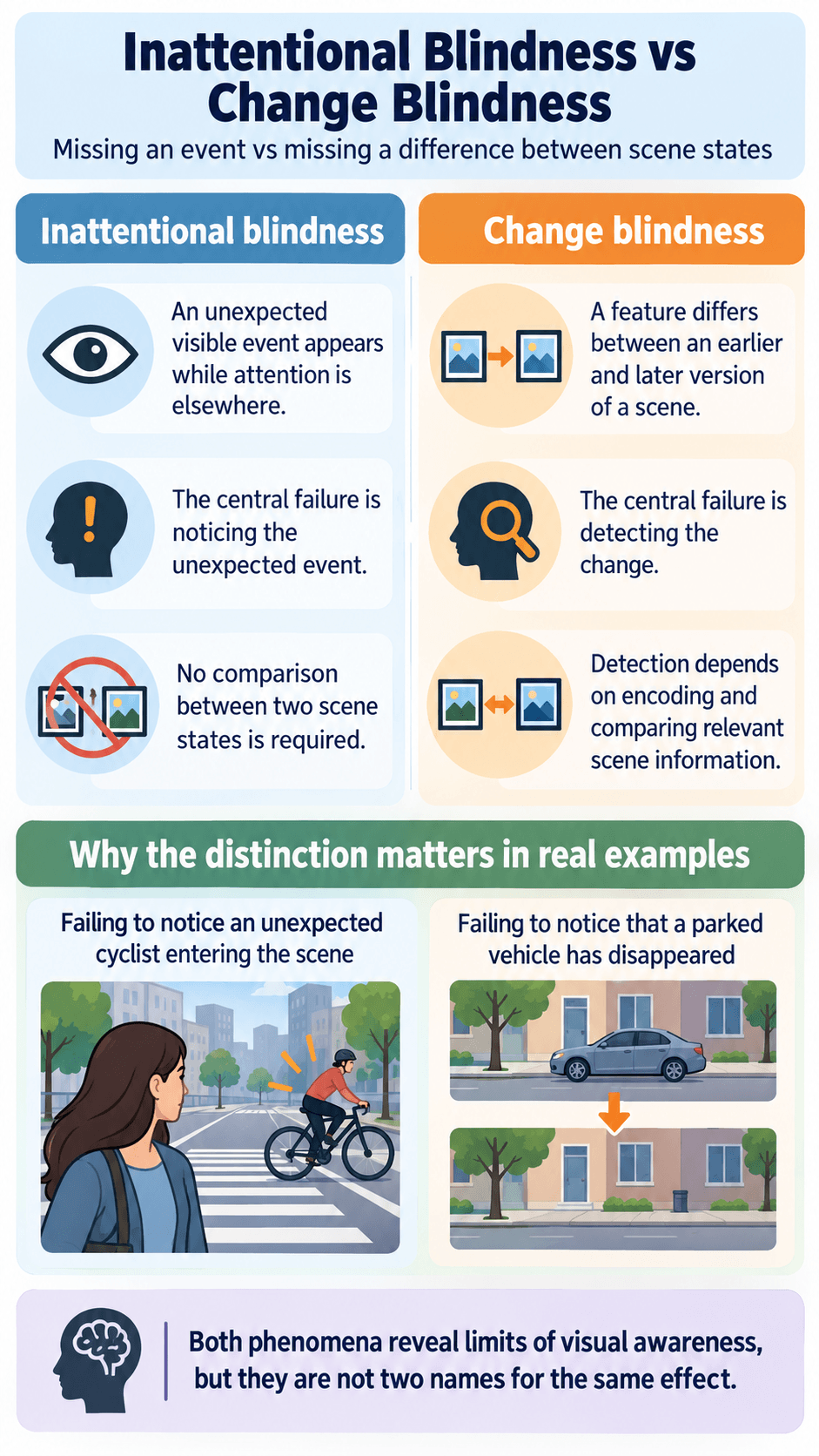
Missing an event vs missing a difference between scene states
| Inattentional blindness | Change blindness |
|---|---|
| An unexpected visible event appears while attention is elsewhere. | A feature differs between an earlier and later version of a scene. |
| The central failure is noticing the unexpected event. | The central failure is detecting the change. |
| No comparison between two scene states is required. | Detection depends on encoding and comparing relevant scene information. |
The APA description of change blindness emphasizes failures to notice differences across successive visual scenes, especially when the transient that normally signals a change is disrupted.
Both phenomena reveal limits of visual awareness, but they are not two names for the same effect.
Why the distinction matters in real examples
Suppose a person watches a street and fails to notice an unexpected cyclist entering the scene. That resembles inattentional blindness if attention is occupied elsewhere.
If the person sees the street before and after an interruption but fails to notice that a parked vehicle has disappeared, change blindness is the more precise concept.
Does the Brain Process an Object That Was Not Consciously Noticed?
Unreported awareness does not necessarily mean zero processing
This question is more difficult than it first appears. If an observer says, “I did not see it,” researchers still have to ask whether the unseen stimulus influenced behavior indirectly.
A systematic review and meta-analysis of implicit processing during inattentional blindness concluded that unnoticed visual stimuli can sometimes be processed enough to influence behavior. The review also found that conclusions depend partly on how awareness is measured.
That means a failure of conscious report should not automatically be interpreted as proof of zero visual processing.
Why awareness measures matter
Researchers may ask whether participants noticed anything unusual, whether they can identify its shape or location, or whether they can choose it from alternatives. Different questions create different thresholds for classifying someone as “aware.”
A person may have weak or partial information without being able to give a confident open-ended report. This makes the boundary between unnoticed and weakly noticed more complicated than a binary yes-or-no label suggests.
Do not turn implicit processing into a mystical claim
Evidence for processing without reported awareness does not mean the mind records every unattended detail accurately. Effects are typically limited, task-dependent, and measured statistically across participants.
The responsible conclusion is modest: some information can influence processing even when observers do not consciously report noticing the stimulus.
What Inattentional Blindness Does Not Mean
It does not mean poor eyesight
The phenomenon is defined in attentional terms rather than as a sensory deficit. An eye problem can certainly cause missed information, but that is a different explanation requiring appropriate visual or medical assessment.
Persistent difficulty seeing objects, blind spots, sudden vision changes, or other visual symptoms should not be dismissed as inattentional blindness.
It does not prove carelessness
People can be motivated and still miss an unexpected event. The primary task may be performed accurately while awareness of another event fails.
Calling the person careless adds a moral judgment without explaining the cognitive conditions that produced the miss.
It does not mean people are unaware of everything outside focus
Selective attention reduces priority for some information, but unattended information is not uniformly absent from processing. Some cues are noticed, some influence behavior without clear awareness, and others are missed completely.
The degree of processing depends on the task and the stimulus.
It does not diagnose ADHD or another disorder
Inattentional blindness occurs in ordinary observers. A single episode says nothing reliable about whether someone has ADHD, anxiety, dementia, or another condition.
Clinical concerns require a broader pattern of symptoms, history, functional impact, and qualified assessment.
Real-World Situations Where the Concept Matters
Driving and road hazards
Driving requires selective attention across signs, traffic, mirrors, pedestrians, navigation, and unexpected hazards. A driver concentrating heavily on one demand may have reduced awareness of another event.
This does not excuse unsafe driving. It supports the opposite conclusion: safety systems and behavior should assume that human awareness is limited rather than depend on perfect noticing.
Medical imaging and inspection tasks
Inattentional blindness has been studied in medical contexts because clinicians often search images for expected abnormalities while other findings may also be present.
A 2024 review of inattentional blindness in medicine concluded that realistic medical evidence remains more limited than popular examples sometimes imply. The review discusses missed findings in imaging and procedural settings while emphasizing the need for stronger real-world research.
This is a good reminder not to turn laboratory demonstrations into simple claims about professional error.
Security, monitoring, and quality control
Any role requiring prolonged search for expected targets may create conditions in which unusual events are harder to notice. Security screening, industrial inspection, and monitoring interfaces all involve choices about what operators are trained to expect.
Good system design can reduce reliance on one person noticing every unusual event under every condition.
A Practical Observation Framework
What was the primary task?
First identify where attention was allocated. Were you counting, searching, reading, navigating, monitoring, or making a decision?
This gives context for what information had priority.
How demanding was the task?
Was the task simple or did it require tracking several features, making rapid discriminations, or maintaining precise timing?
Greater perceptual demand can increase the probability that irrelevant events fail to reach awareness, although demand is not the only factor.
Was the missed event expected?
Did you have any reason to monitor for it? If not, the event may have fallen outside the active attentional set.
After you know the event occurred, hindsight can make it seem more obvious than it was under the original conditions.
Did the event match what attention was already tuned toward?
An unexpected object sharing features with the attended target may be easier to notice than one that differs from the active attentional set.
This question helps explain why some unusual events break through while others do not.
When a Missed Event Should Not Be Explained Away as Inattentional Blindness
A one-time miss during a demanding task can fit normal attentional limits. Repeated or sudden failures to see objects, new blind spots, confusion, major changes in awareness, head injury, or other neurological or visual symptoms are different situations.
In those cases, an attentional explanation should not replace medical, visual, or psychological evaluation. The concept of inattentional blindness is educational, not a way to rule out sensory or health problems.
FAQ About Inattentional Blindness
Can something be directly in front of me and still go unnoticed?
Yes. Physical visibility and conscious noticing are not identical. If attention is strongly occupied by another task and the event is unexpected, even a centrally visible stimulus may fail to reach reported awareness.
Is inattentional blindness the same as change blindness?
No. Inattentional blindness involves failing to notice an unexpected event while attention is elsewhere. Change blindness involves failing to detect a difference between two states of a scene. The two phenomena overlap in showing limits of visual awareness, but they require different conditions.
Does inattentional blindness mean the object received no processing at all?
Not necessarily. Meta-analytic evidence suggests that unnoticed stimuli can sometimes influence behavior despite not being consciously reported. How much processing occurs varies by task, stimulus, and the method used to measure awareness.
Why do people notice the unexpected object immediately on a second viewing?
Once you know what to expect, your attentional set changes. The event is no longer truly unexpected, and you can allocate processing toward it. That makes a second viewing fundamentally different from the original surprise trial.
Does missing an obvious event mean I have an attention disorder?
No. Inattentional blindness occurs in people without a clinical disorder. Diagnosis requires a much broader pattern of symptoms and functional impact. A single missed event cannot establish ADHD or any other condition.
Key Takeaways
- Inattentional blindness occurs when an unexpected visible event fails to reach conscious awareness because attention is engaged elsewhere.
- The stimulus can be physically present and visually available without being consciously reported.
- Task demand, expectations, attentional set, location, and stimulus features all influence the chance of noticing an unexpected event.
- Inattentional blindness differs from attentional capture because the unexpected cue fails to win priority rather than successfully redirecting attention.
- It differs from change blindness because no comparison between two changing scene states is required.
- Not reporting an object does not necessarily mean the visual system processed nothing, and ordinary episodes do not diagnose an attention disorder.
About the author: Michael Reed is the Founder & Lead Writer at Psychology Exposed. He explains psychology, human behavior, self-awareness, and everyday cognitive patterns in clear, research-aware language for general readers.
The useful question after an unexpected miss is not simply, “How could I have been blind to that?” Ask what attention was prioritizing, how demanding the task was, what you expected to see, and whether the missed event matched that attentional set. Those conditions explain much more than the assumption that looking guarantees awareness.

Michael Reed is the Founder and Lead Writer at Psychology Exposed. He writes about human behavior, relationships, emotional patterns, self-awareness, and practical psychology topics using research-informed, easy-to-understand content.
Read More About Michael Reed: https://psychologyexposed.com/michael-reed/