

A person in a photograph changes shirts between two views. A building disappears from a scene. An actor in a movie holds a cup in one hand, the camera cuts, and the cup is suddenly in the other. Once someone points out the difference, it looks obvious. Before that moment, you may have watched carefully and noticed nothing.
This is change blindness: a failure to detect a difference between an earlier and later state of a visual scene. The change itself may be large. What matters is whether the visual system has enough information, attention, and comparison across the two states to identify what changed.
Change blindness is not simply “bad memory,” and it is not poor eyesight. It is a change-detection problem. The phenomenon becomes especially likely when the local visual signal that normally announces a change is disrupted by a blank screen, eye movement, blink, camera cut, occlusion, or another competing transient.
Quick Answer
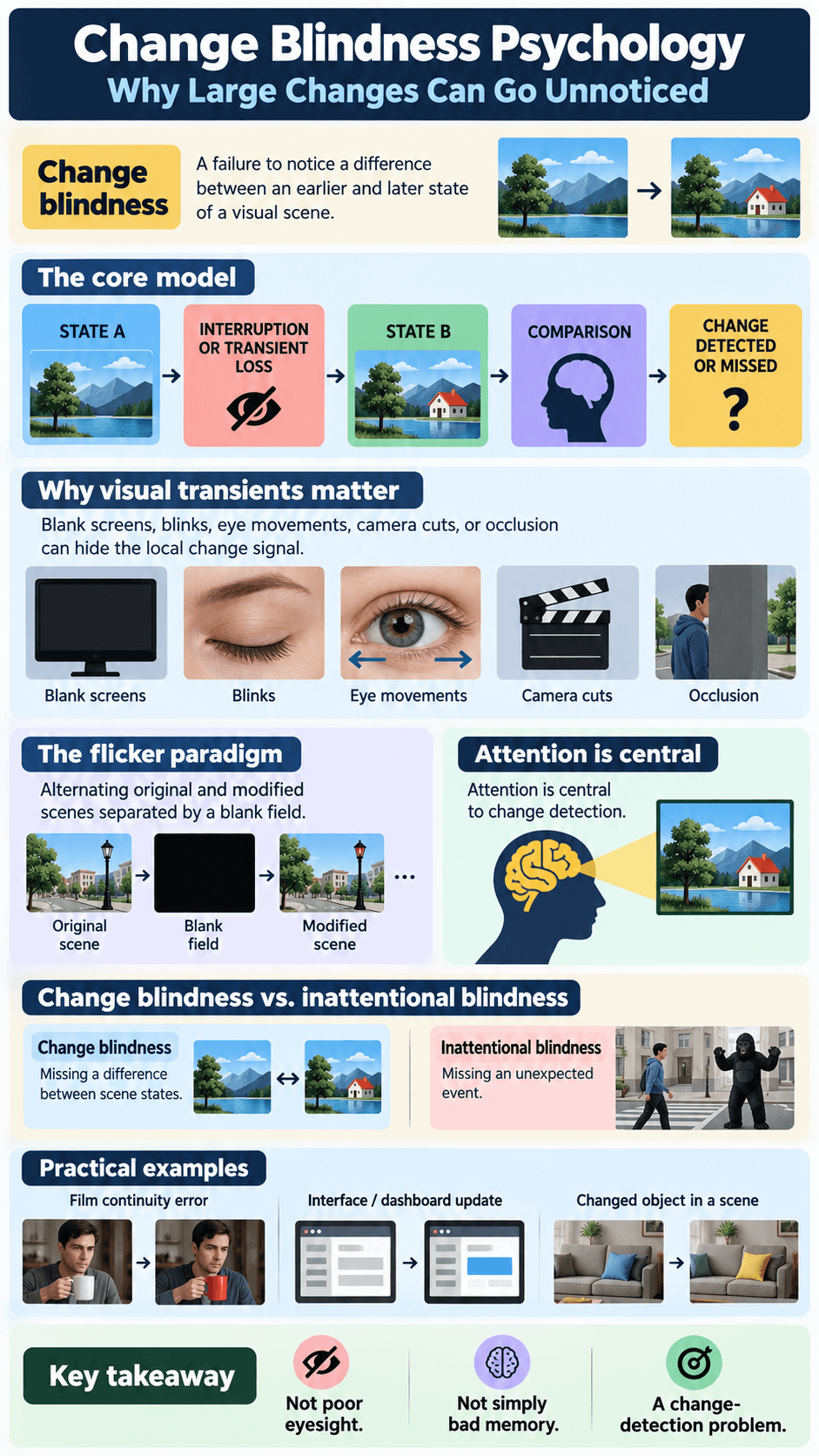
Change blindness is the failure to notice a difference between two successive states of a visual scene. Detection usually requires attention to relevant information, a usable representation of the earlier state, processing of the later state, and some form of comparison. Interruptions can remove or mask the local visual transient that would normally draw attention to the change, making even large differences surprisingly difficult to detect.
What Change Blindness Means
The key problem is detecting a difference across time
The APA Dictionary of Psychology defines change blindness as a failure to notice changes in a visual array across successive scenes, especially when the transient that normally accompanies the change is masked or interrupted.
That definition separates change blindness from ordinary failure to see an object. The observer is not merely searching for something that is present. Instead, the observer must detect that one state differs from another.
In simple terms, the mind needs some usable information about “before,” some information about “after,” and enough attention to register that the two do not match. Change blindness is one visual-awareness limit within the broader psychology of attention.
Why a large change can still be difficult to detect
Size alone does not guarantee detection. A change may involve a large object, a different color, a shifted location, or the appearance or disappearance of a major scene element. If the normal visual signal caused by the change is hidden, the observer may have to search the scene to discover the mismatch.
This is why a large difference can remain unnoticed for several seconds in a laboratory display even though the same change would be immediately obvious if it happened continuously in front of the viewer.
The challenge is not that the changed object became invisible. The challenge is that the visual system lost an efficient cue telling attention exactly where to look.
The Core Model: STATE A → INTERRUPTION OR TRANSIENT LOSS → STATE B → COMPARISON → CHANGE DETECTED OR MISSED
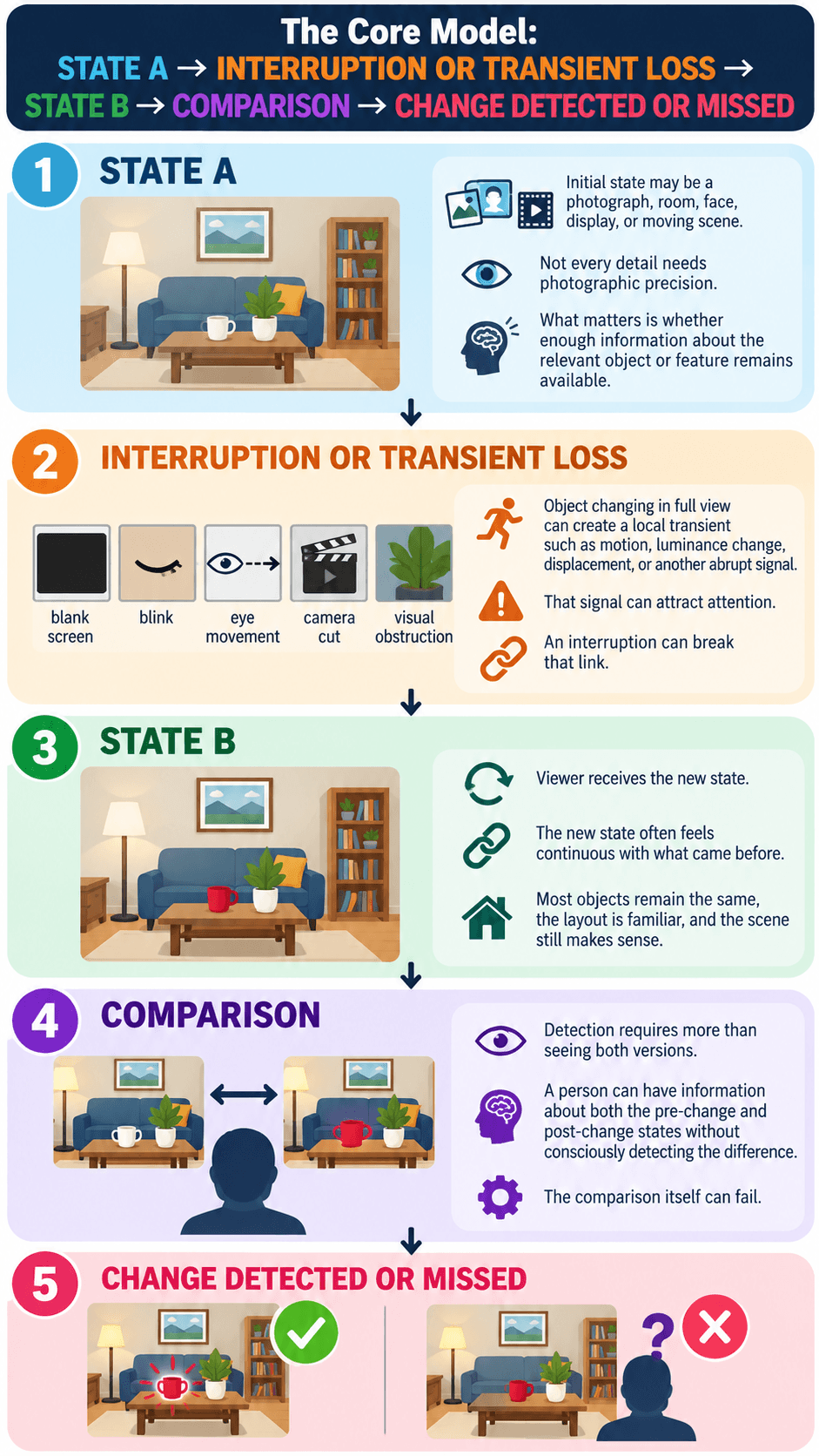
State A must provide information that can matter later
Before a change can be detected, the viewer encounters an initial state. That state may be a photograph, a room, a face, a display, or a moving scene.
Not every detail needs to be stored with photographic precision. What matters is whether enough information about the relevant object or feature remains available when the later state appears.
If the changing element was never attended, encoded only weakly, or treated as irrelevant, the later comparison may be difficult.
The interruption can remove the local change signal
When an object changes continuously in full view, the visual system receives a local transient: motion, luminance change, displacement, or another abrupt signal at the location of the change. That signal can attract attention.
An interruption can break that link. A blank screen, blink, eye movement, camera cut, or visual obstruction may create many competing signals at once or temporarily remove the scene. When the scene returns, attention no longer has an obvious pointer to the changed location.
State B must be processed as the current scene
The viewer then receives the new state. In everyday vision, this state often feels continuous with what came before. Most objects remain the same, the layout is familiar, and the scene still makes sense.
That overall continuity can be useful. Constantly treating every new eye fixation as a completely new world would be inefficient. But continuity also creates conditions in which a changed detail may not be compared explicitly.
Detection requires more than seeing both versions
A person can have information about both the pre-change and post-change states without consciously detecting the difference. Research on preserved representations during change blindness found that observers sometimes retained information about the earlier scene even when they failed to report that a change had occurred.
This finding is important because it shows that change blindness cannot always be reduced to “the first scene was forgotten.” The comparison itself can fail.
Why Visual Transients Matter
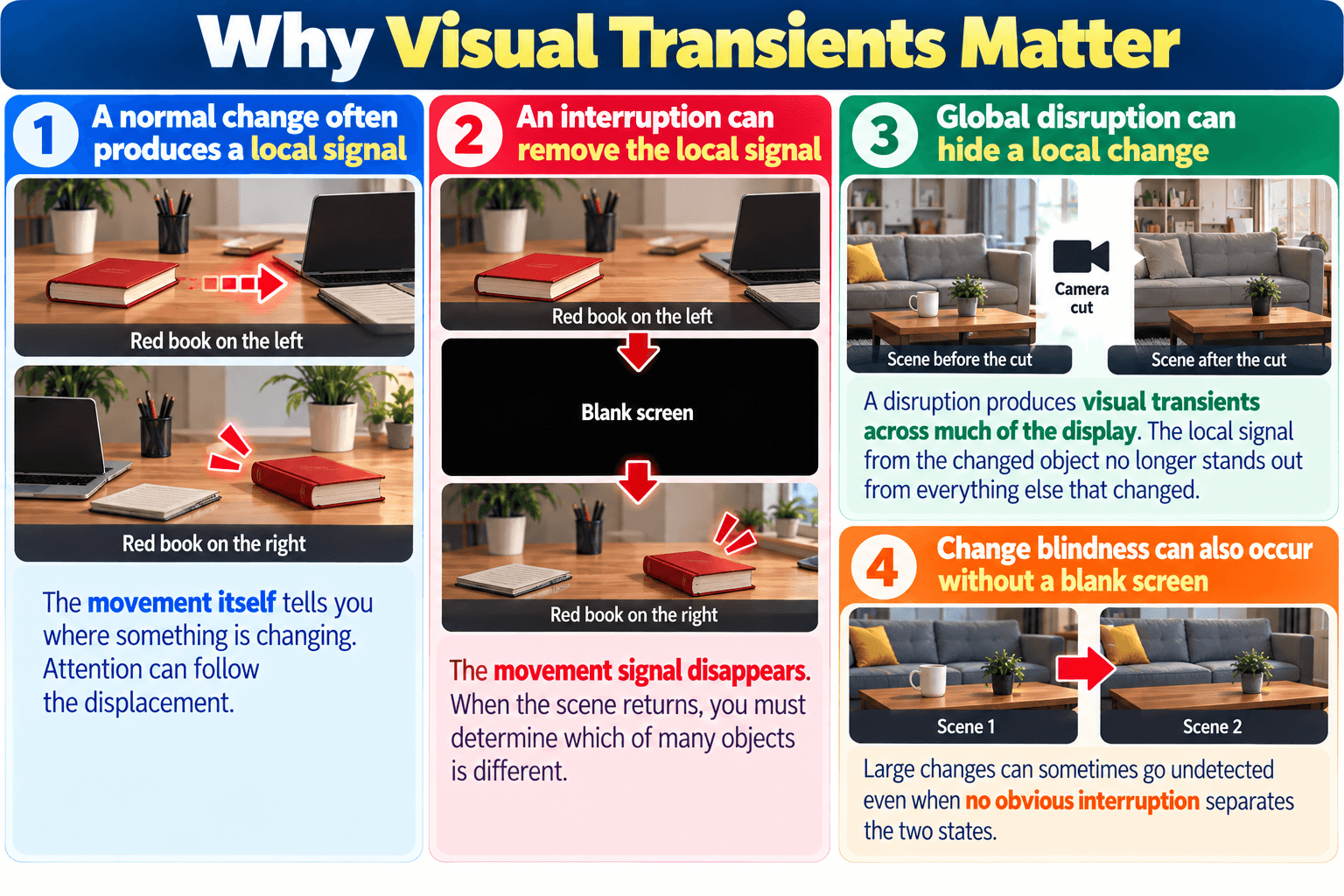
A normal change often produces a local signal
Imagine watching a red book move from the left side of a desk to the right side without interruption. The movement itself tells you where something is changing. Attention can follow the displacement.
Now imagine that the screen goes blank between the left-position image and the right-position image. The movement signal disappears. When the scene returns, you must determine which of many objects is different.
The perceptual challenge has changed from following a visible event to comparing two scene states.
Global disruption can hide a local change
Change blindness becomes especially striking when a disruption produces visual transients across much of the display. The local signal from the changed object no longer stands out from everything else that changed at the same moment.
A camera cut is an everyday example. The entire visual image changes at the cut, so small continuity errors within the scene may not create a distinctive local signal.
This helps explain why movie viewers can miss large continuity errors even when they are paying attention to the story.
Change blindness can also occur without a blank screen
Blank screens are useful experimental tools, but they are not required for the phenomenon. Research on change blindness without a visual disruption showed that large changes can sometimes go undetected even when no obvious interruption separates the two states.
This result matters because it prevents an overly narrow explanation. Interruptions make change blindness easier to demonstrate, but detection also depends on attention, expectations, scene structure, and whether the change generates a useful signal.
The Flicker Paradigm

How the original and modified scenes alternate
One of the most influential methods for studying change blindness is the flicker paradigm. An original image and a modified image alternate repeatedly, with a brief blank field inserted between them.
In the classic 1997 flicker study by Rensink, O’Regan, and Clark, large scene changes became surprisingly difficult to identify when the blank interval disrupted the local transient that would otherwise reveal the changed location.
The images can alternate many times before the viewer suddenly sees the change.
Why the blank interval is so effective
The blank field creates a strong visual event across the whole display. Instead of one object producing a unique transient, nearly everything changes at once when the image disappears and reappears.
Attention must therefore search for the relevant difference. When the viewer finally attends to the right location and compares the relevant feature across states, the change can become immediately obvious.
Why detection can feel sudden
People often describe the moment of detection as if the change suddenly “pops out.” Before detection, both images may look stable. After detection, the difference can seem impossible to miss.
This abrupt subjective shift is one reason the paradigm is memorable. It demonstrates that conscious awareness of change is not a simple readout of all visual information available to the eyes.
Attention Is Central to Change Detection
Local attention helps establish what should be compared
A review of visual change detection argues that focused attention plays a central role in detecting changes. When attention reaches the relevant location, the system is more likely to form a coherent representation that can support comparison.
This does not mean attention guarantees detection. The relevant feature still needs to be encoded and compared across time.
Scene importance can guide where attention goes
Not all parts of a scene are equally likely to receive attention. Objects that are important to the scene, relevant to the task, visually distinctive, or expected to matter may be checked earlier.
In the flicker paradigm, changes to high-interest objects are often detected faster than changes to less central details. This suggests that change detection depends partly on where attention is allocated during search.
Unattended changes may remain available but unreported
Some findings show that visual information can persist without explicit detection of the change itself. One study found that observers could retain information about both pre-change and post-change objects while still failing to report the difference.
The important lesson is that conscious change detection is not identical to visual storage. A mismatch must become accessible enough to produce a report such as “that object changed color” or “that item moved.”
Saccades, Blinks, Cuts, and Occlusion
Saccades naturally interrupt stable retinal input
Human vision is active. The eyes make rapid movements called saccades several times each second. During these movements, the retinal image changes dramatically.
Normally, perception feels stable across saccades. That stability is useful, but it creates opportunities for scene differences to go unnoticed when the change coincides with the eye movement.
Change blindness research shows that the visual system does not need to maintain a detailed pixel-by-pixel copy of every scene across every fixation in order for experience to feel continuous.
Blinks create another natural interruption
During a blink, visual input is briefly interrupted. A change made at that moment may lack the normal transient that would point attention toward its location.
Most blinks do not produce noticeable jumps in experience because the visual system treats the scene as continuing unless there is evidence that something important changed.
Camera cuts can preserve story continuity while hiding visual discontinuity
Film editing makes use of the mind’s tendency to preserve continuity. A cut may move the viewer from one camera angle to another while the story remains coherent.
If an actor’s posture changes slightly, an object moves, or a background detail disappears across the cut, viewers may not notice because attention is following the action, dialogue, or narrative goal rather than comparing every object across frames.
Occlusion can interrupt object continuity
An object may pass behind another object, a person may walk through the scene, or a visual obstacle may briefly cover the changing region. When the object reappears, the system often assumes continuity unless attention is directed toward checking the relevant feature.
Again, continuity is normally helpful. The cost is that some differences are not explicitly detected.
Why Change Blindness Is Not Simply Poor Memory
Memory is involved, but “forgotten scene” is too simple
Detecting a change across time obviously requires information from the earlier state. If nothing from State A were available, comparison would be impossible.
But evidence from change-detection studies with preserved access to changed information shows that observers can sometimes retain information about both states while failing to compare them successfully.
This means the failure may occur at encoding, retention, retrieval, comparison, attention, or some combination of these stages. “Bad memory” is too broad to explain the phenomenon.
Explicit detection and visual memory can dissociate
In another study, observers experienced gradual scene rotation without explicitly detecting the change. Yet their later responses showed that visual memory had been updated to reflect the changed orientation.
That pattern suggests an important distinction: the visual system can update information without producing conscious awareness that a change occurred.
Change blindness therefore tells us something about the relationship between attention, memory, comparison, and conscious report rather than proving that no representation was stored.
Why Change Blindness Is Not Poor Eyesight
The changed information can be fully visible
In classic demonstrations, the altered scene is clear enough to inspect. When viewers are told where to look, they often identify the difference quickly.
The difficulty arises because they do not know which location or feature requires comparison.
Visual impairment is a separate explanation
Change blindness is a cognitive phenomenon studied under conditions where the relevant visual information is available. Persistent blurred vision, missing regions of the visual field, sudden visual changes, or other sensory symptoms are different problems.
Those concerns should not be explained away as normal change blindness. They may require appropriate visual or medical evaluation.
Change Blindness vs Inattentional Blindness
| Change blindness | Inattentional blindness |
|---|---|
| A difference between two scene states is missed. | An unexpected event or object is missed while attention is engaged elsewhere. |
| Requires some relation between a “before” and an “after.” | Does not require a comparison between two versions of the scene. |
| Often becomes strong when the change transient is disrupted. | Often depends on the unexpected event falling outside the active attentional set. |
| Asks, “Why did I fail to notice that something changed?” | Asks, “Why did I fail to notice that something was there?” |
Two states vs one unexpected event
The distinction is easiest to see in the question being asked. Change blindness requires a mismatch across time. Inattentional blindness requires an unexpected event that fails to reach awareness.
If a red car becomes blue across a cut and you miss the color difference, that is a change-detection problem. If a cyclist enters a scene while your attention is elsewhere and you never notice the cyclist at all, that is closer to inattentional blindness. A different attention failure occurs across a much shorter time scale when a second target follows the first too quickly, a phenomenon known as the attentional blink.
Why the two phenomena are often confused
Both demonstrate that conscious visual experience is less complete than it feels. Both depend on attention. Both can involve surprisingly large missed information.
But combining them under one vague idea of “not seeing” hides the different mechanisms that researchers are trying to study.
Visual Continuity Can Hide Change
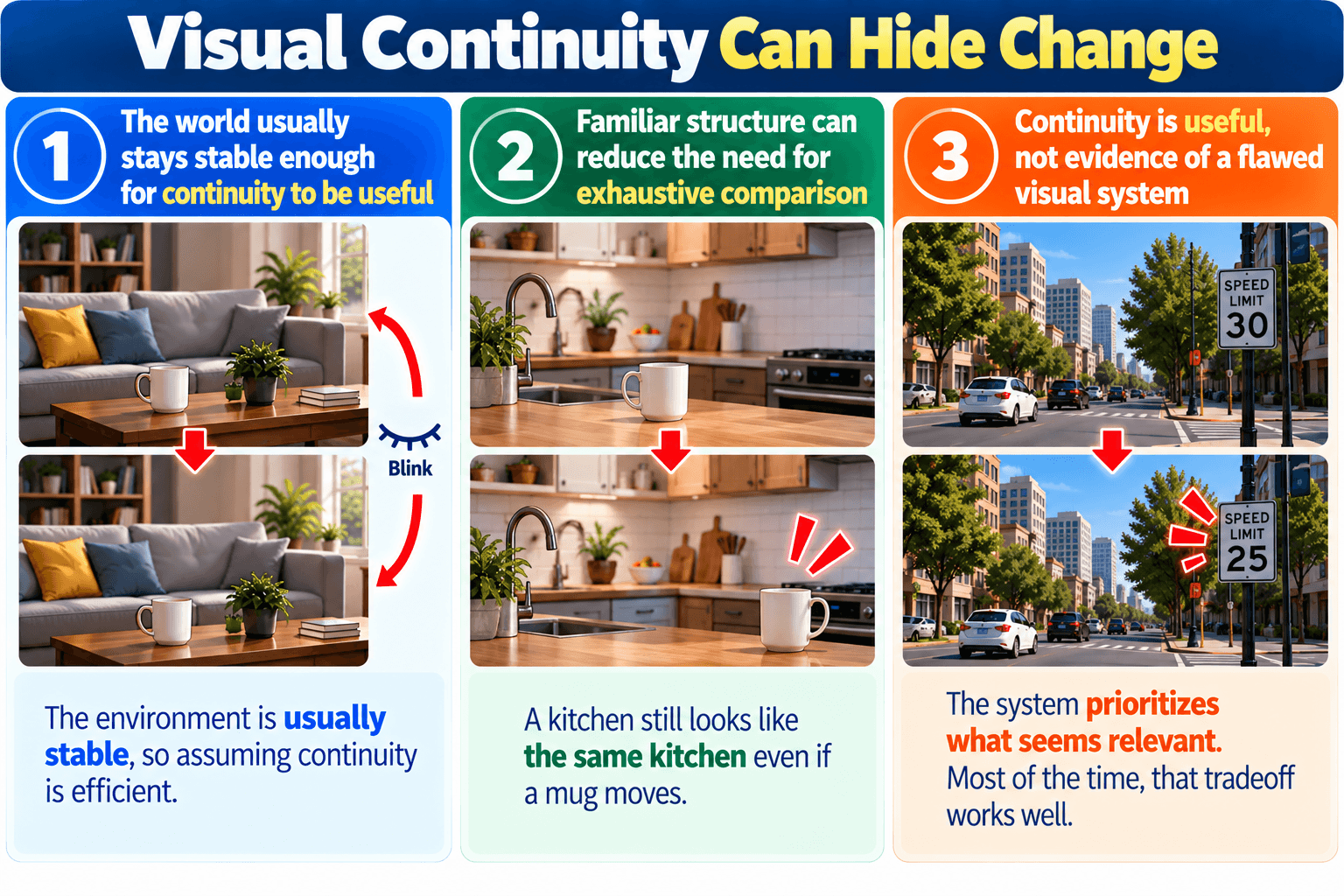
The world usually stays stable enough for continuity to be useful
Most objects do not transform radically each time you blink or move your eyes. The environment is usually stable, so assuming continuity is efficient.
This stability allows perception to feel coherent even though the retinal image changes constantly.
Familiar structure can reduce the need for exhaustive comparison
When the overall scene still makes sense, the mind does not necessarily compare every object with a detailed earlier copy. A kitchen still looks like the same kitchen even if a mug moves. A street remains the same street even if one sign changes.
The sense of continuity can therefore coexist with failure to detect a local difference.
Continuity is useful, not evidence of a flawed visual system
Change blindness is sometimes described as if human vision were badly designed. A better interpretation is that detailed comparison is selective because exhaustive comparison would be expensive and often unnecessary.
The system prioritizes what seems relevant. Most of the time, that tradeoff works well. The phenomenon becomes noticeable in the unusual cases where a meaningful change occurs outside the comparison process.
Large Changes, Small Changes, and Scene Importance
Physical size is only one factor
A large object can change and remain unnoticed, while a small but task-relevant feature is detected quickly. Visual size affects visibility, but attention and meaning affect priority.
A small change to a traffic signal may matter more than a large change to an irrelevant billboard.
Semantic importance can guide detection
Objects that are central to the meaning of a scene often attract attention earlier than peripheral details. This can speed change detection.
However, “important” is context-dependent. The same object can be central in one task and irrelevant in another.
Expectations change the comparison process
If you know a change will occur in a particular region, you can allocate attention there and compare more effectively. If you expect continuity, you may not inspect the relevant feature at all.
This is why demonstrations become easier after the change is pointed out. Your expectations and search strategy have changed.
Real-World Examples Without Overgeneralizing
Interface and dashboard monitoring
A value changes after a screen refresh, but several elements update at once. If the interface does not clearly signal which value changed, the user may overlook the difference even though both versions were visible.
This example shows why clear change signals can matter in design, but change blindness research does not provide a complete user-interface design system. Usability depends on many other factors.
Film continuity errors
Movies provide familiar examples because camera cuts disrupt visual transients. Viewers usually follow characters, dialogue, and action rather than compare object positions across every shot.
A changed prop or posture can therefore escape awareness without interfering with understanding of the story.
Inspection and observation tasks
When people compare images, products, documents, or displays across time, important differences can be missed if attention is not directed to the relevant feature.
The lesson is not that inspection is unreliable by nature. It is that systems requiring accurate change detection should make critical differences easy to localize rather than assuming people will automatically notice every alteration.
Limits of What Change Blindness Research Proves
It does not prove that visual representations contain almost nothing
Early findings inspired claims that very little visual detail is preserved across views. Later evidence complicated that interpretation by showing preserved information even when explicit change detection failed.
A review of what change blindness can and cannot establish cautions against drawing stronger conclusions than the experiments support.
Failure to report a change tells us that explicit detection failed. It does not by itself reveal exactly how much information was represented at every processing stage.
Laboratory demonstrations are not automatic explanations for every real-world error
Real environments include repeated viewing, movement, expertise, consequences, alarms, teamwork, and other information that may reduce or increase the chance of missing a change.
Change blindness can help explain a cognitive vulnerability, but it should not be used as a blanket excuse for negligence or as proof that a particular error had one psychological cause.
A Practical Change-Detection Checklist
What are the two states being compared?
Identify State A and State B. If there is no meaningful earlier and later state, change blindness may not be the right concept.
Was the normal change signal interrupted?
Did a blank screen, eye movement, blink, cut, occlusion, screen refresh, or other visual event make it harder to localize the difference?
Was attention directed to the changing feature?
A visible difference is easier to detect when attention reaches the relevant location or object. If attention was elsewhere, the comparison may never have been completed.
Was information from the earlier state available for comparison?
If the relevant feature was never encoded or could not be retrieved, comparison becomes difficult. But remember that failure to detect a change does not automatically prove that the earlier representation was absent.
Did the scene still feel continuous and familiar?
If the overall structure remained coherent, the visual system may have accepted the later state as a continuation of the earlier one without checking every local detail.
When a Missed Change Should Not Be Explained Away
Ordinary change blindness occurs under specific attentional and perceptual conditions. Repeated difficulty seeing changes in everyday vision, new visual-field problems, sudden confusion, neurological symptoms, head injury, or substantial functional decline are different concerns.
Educational information about change blindness cannot determine whether a sensory, neurological, medication-related, sleep-related, or other health factor is involved. New or serious changes deserve appropriate professional evaluation.
FAQ About Change Blindness
Why can a very large change go unnoticed?
Large size does not guarantee detection if the local transient is disrupted and attention is not directed to the changing object. The viewer may see both versions of the scene without successfully comparing the relevant feature across time.
Is change blindness just a memory failure?
No. Memory is involved because change detection requires information from an earlier state, but research shows that people can preserve information about pre-change and post-change objects while still failing to detect the difference. The failure can involve attention, comparison, retrieval, or several stages together.
Is change blindness the same as inattentional blindness?
No. Change blindness is failure to detect a difference between two states. Inattentional blindness is failure to notice an unexpected object or event while attention is occupied elsewhere. Both involve attention, but the experimental problem is different.
Why do camera cuts make continuity errors easier to miss?
A cut creates a large visual disruption that removes the local motion signal produced by the changed object. Attention follows the new shot, story, or action instead of being automatically directed to the exact location of the continuity error.
Does change blindness mean the brain stored no information about the earlier scene?
Not necessarily. Some studies show preserved information about earlier scene elements even when the observer cannot explicitly report the change. Change blindness demonstrates a failure of conscious change detection, not proof that all earlier information disappeared.
Key Takeaways
- Change blindness is the failure to detect a difference between an earlier and later state of a visual scene.
- A useful model is STATE A → INTERRUPTION OR TRANSIENT LOSS → STATE B → COMPARISON → CHANGE DETECTED OR MISSED.
- Blank screens, saccades, blinks, camera cuts, and occlusion can hide the local transient that normally draws attention to a change.
- Attention helps determine which scene elements are encoded and compared, but failure to detect a change does not prove that no information was stored.
- Change blindness is different from inattentional blindness, which concerns an unexpected event failing to enter awareness rather than a missed difference across two states.
- The effect is not simply poor eyesight or poor memory, and laboratory findings should not be used as a blanket explanation for real-world errors.
About the author: Michael Reed is the Founder & Lead Writer at Psychology Exposed. He explains psychology, human behavior, self-awareness, and everyday cognitive patterns in clear, research-aware language for general readers.
A useful next step is to ask a more precise question when a change goes unnoticed: What information was available in State A, what interrupted the normal change signal, where was attention directed, and was the relevant feature actually compared with State B? Those questions capture the mechanism more accurately than simply saying, “I must not have been looking.”

Michael Reed is the Founder and Lead Writer at Psychology Exposed. He writes about human behavior, relationships, emotional patterns, self-awareness, and practical psychology topics using research-informed, easy-to-understand content.
Read More About Michael Reed: https://psychologyexposed.com/michael-reed/