
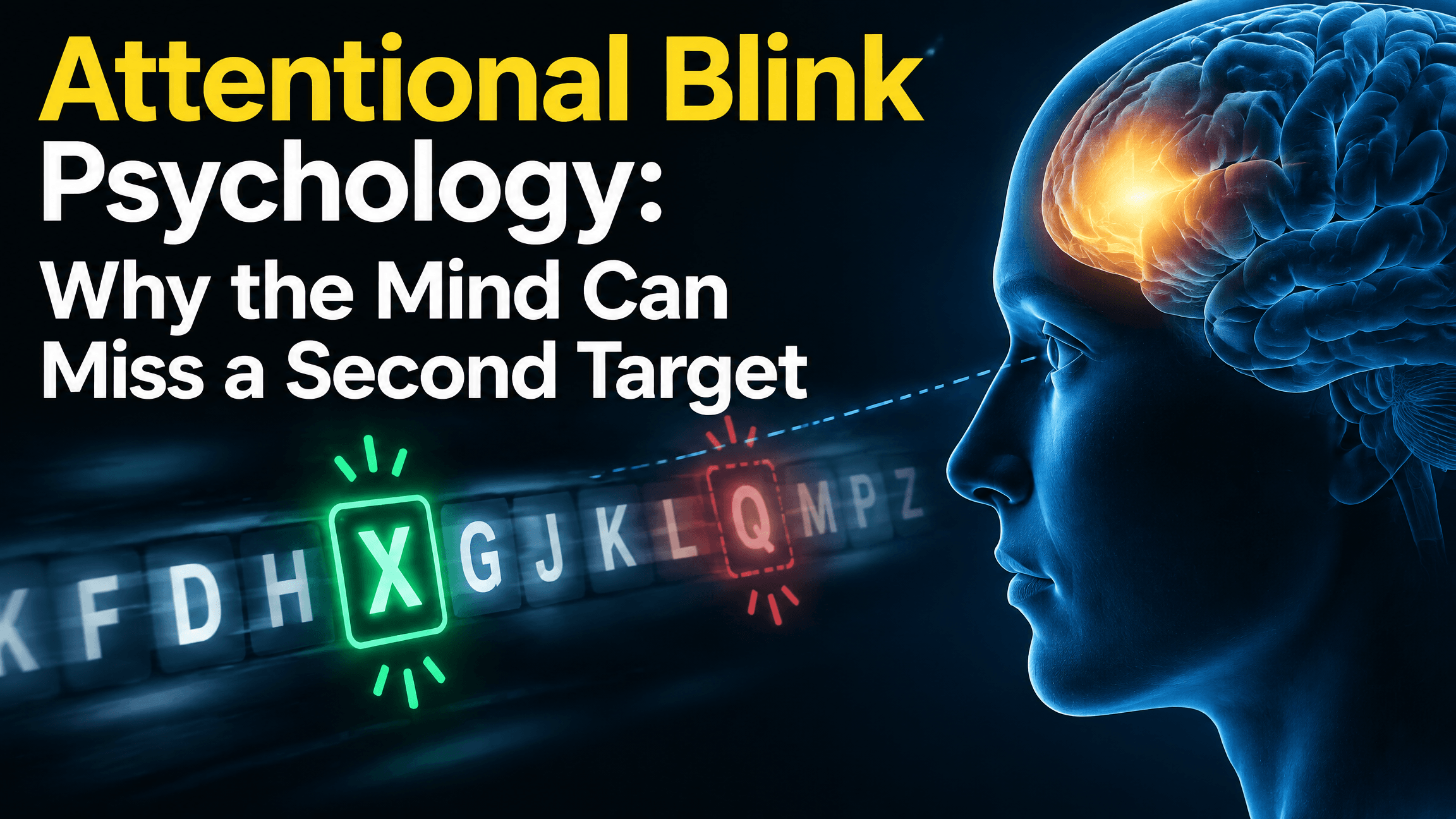
A rapid stream of letters appears on a screen. You are asked to identify two targets hidden among the distractors. You spot the first target correctly, yet when the second target appears a fraction of a second later, it seems to vanish from experience. The second item was physically present. Your eyes were open. Nothing blocked the screen. Still, you may fail to report it.
This temporary limit is called the attentional blink. It occurs when processing one target in a rapid sequence makes it harder to consciously report a second target that follows soon afterward. The effect is usually studied under tightly controlled laboratory conditions, where timing can be measured in milliseconds.
The name is memorable but slightly misleading. The eyes do not literally blink. Instead, the “blink” describes a brief reduction in the ability to select and consolidate a second target across time. It is a phenomenon of temporal attention, not visual impairment.
Quick Answer
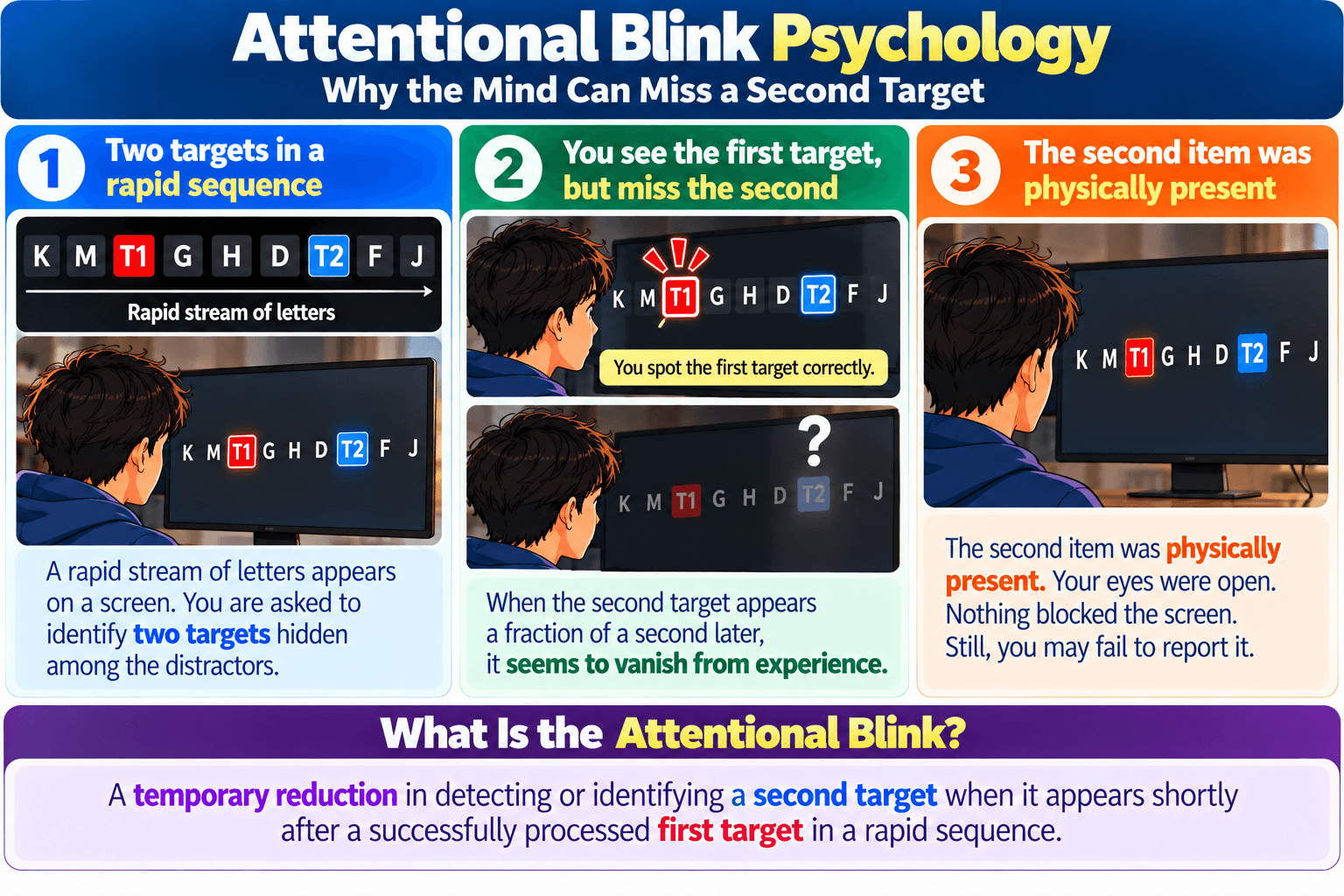
The attentional blink is a temporary reduction in detecting or identifying a second target, called T2, when it appears shortly after a successfully processed first target, called T1, in a rapid sequence. The effect is often strongest when T2 appears roughly 200 to 500 milliseconds after T1, although timing depends on the task. It reflects limits in temporal attention and target processing, not a literal eye blink.
What the Attentional Blink Means
The problem occurs across time, not simply across space
Many attention problems involve deciding where to look or what object to prioritize. The attentional blink asks a different question: what happens when two relevant events arrive too close together in time?
A major review of attentional blink research describes the effect as reduced ability to report a second target when it appears within several hundred milliseconds of the first target during rapid serial visual presentation.
The important feature is temporal proximity. T2 may appear in the same location as T1, and the observer may know that two targets are coming. The difficulty arises because processing T1 changes the system’s readiness for the next target. The attentional blink is one timing-related limit within the broader psychology of attention.
T1 and T2 are both task-relevant
Unlike inattentional blindness, the second target is not necessarily an irrelevant surprise. In a standard attentional blink task, participants are actively instructed to look for both targets.
This makes the effect especially informative. The second target can be expected, relevant, and visually clear, yet still be reported less accurately because of when it appears relative to T1.
The failure is therefore not well described as “you were paying attention to the wrong thing.” Both items belong to the task. The problem is that processing one relevant item temporarily affects access to another relevant item.
The Core Model: T1 DETECTED → TEMPORARY PROCESSING BOTTLENECK → T2 ARRIVES → T2 MAY BE MISSED
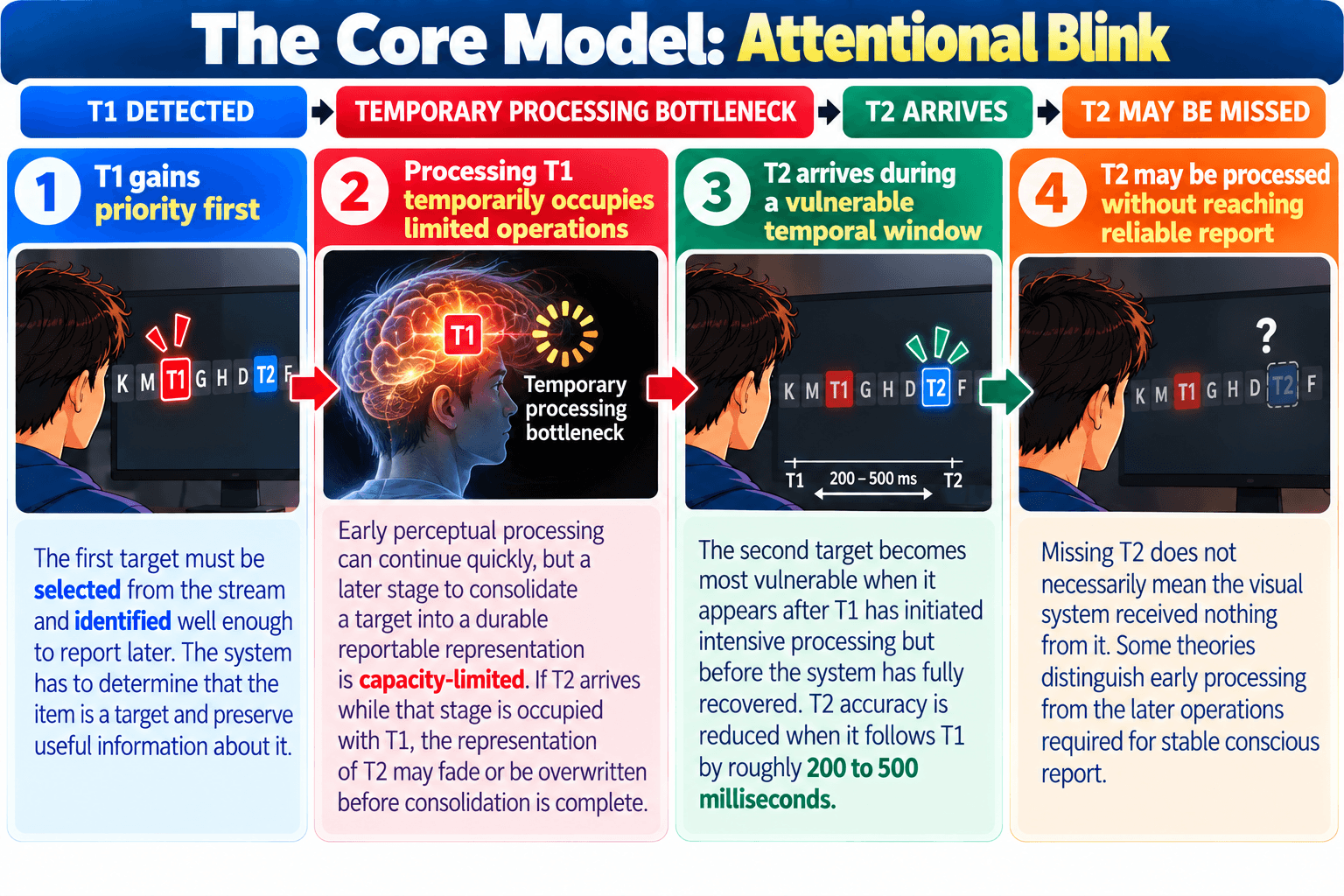
T1 gains priority first
The first target must be selected from the stream and identified well enough to report later. That requires more than registering a flash of color or shape. The system has to determine that the item is a target and preserve useful information about it.
If T1 is not processed successfully, the classic attentional blink pattern is often reduced or altered. The effect is closely tied to what happens after the first target receives priority.
Processing T1 temporarily occupies limited operations
One influential explanation proposes that early perceptual processing can continue quickly, but a later stage needed to consolidate a target into a durable reportable representation is capacity-limited.
In the classic two-stage model by Chun and Potter, rapid stimuli first receive an initial stage of processing. A target then requires a second, more limited stage to become consolidated strongly enough for later report. If T2 arrives while that second stage is occupied with T1, the representation of T2 may fade or be overwritten before consolidation is complete.
The model is historically important, but modern research includes several competing and complementary accounts. It is best treated as a useful explanation of limited consolidation, not as the final settled mechanism.
T2 arrives during a vulnerable temporal window
The second target becomes most vulnerable when it appears after T1 has initiated intensive processing but before the system has fully recovered.
Across many classic tasks, T2 accuracy is reduced when it follows T1 by roughly 200 to 500 milliseconds. This range is not a universal biological timer. Stimulus type, task difficulty, masking, target similarity, expectations, and experimental design all influence the shape and size of the effect.
T2 may be processed without reaching reliable report
Missing T2 does not necessarily mean the visual system received nothing from it. Some theories distinguish early processing from the later operations required for stable conscious report.
This is why researchers often describe the attentional blink as a limit on access, consolidation, or episodic registration rather than a moment of complete sensory blindness.
Rapid Serial Visual Presentation: The Classic Setup
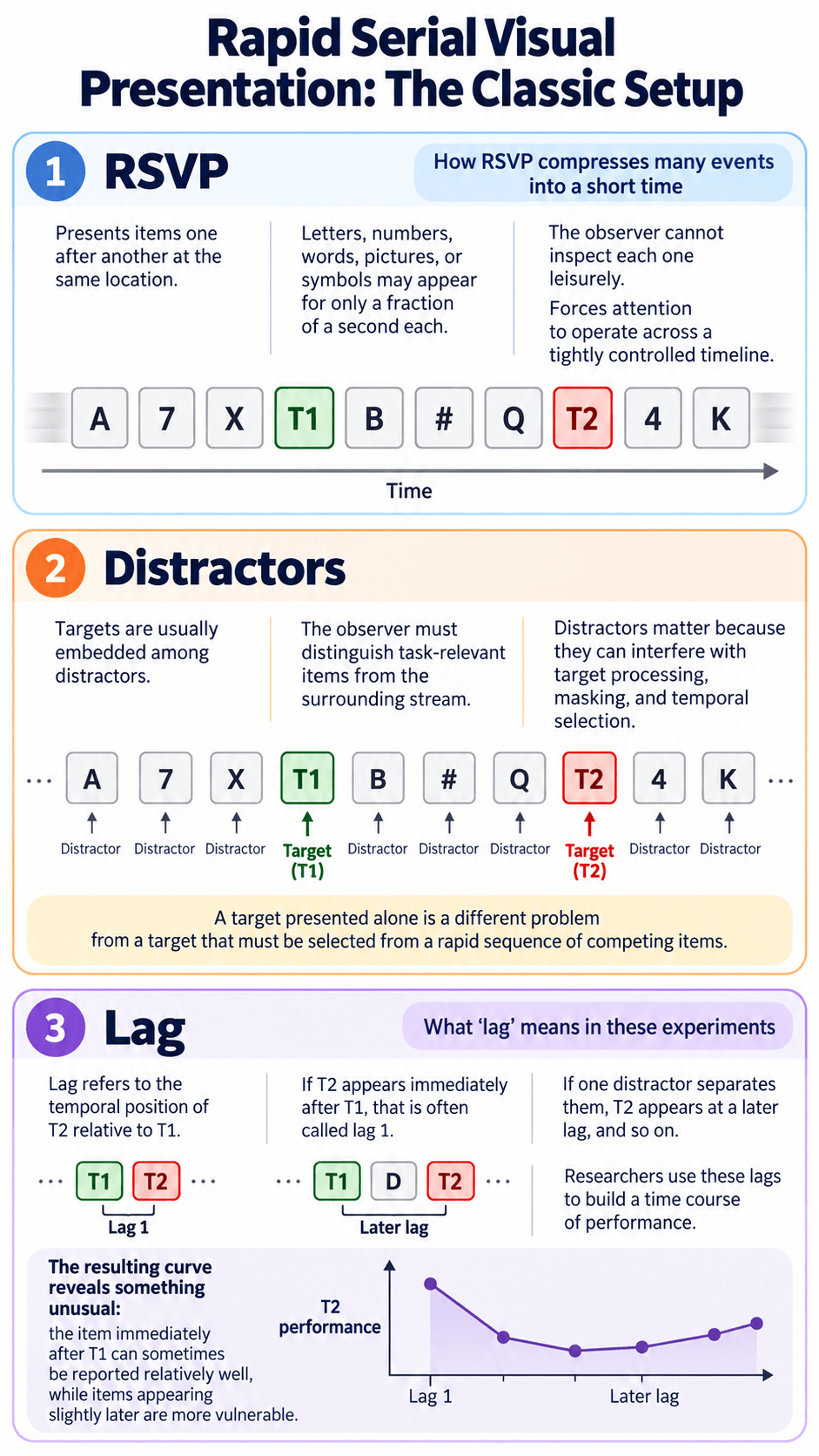
How RSVP compresses many events into a short time
Rapid serial visual presentation, usually shortened to RSVP, presents items one after another at the same location. Letters, numbers, words, pictures, or symbols may appear for only a fraction of a second each.
Because the items arrive so quickly, the observer cannot inspect each one leisurely. The task forces attention to operate across a tightly controlled timeline.
Researchers can then vary how many items separate T1 and T2 and measure how T2 performance changes as temporal distance increases.
Why distractors matter
Targets are usually embedded among distractors. The observer must distinguish task-relevant items from the surrounding stream.
Distractors matter because they can interfere with target processing, masking, and temporal selection. A target presented alone is a different problem from a target that must be selected from a rapid sequence of competing items.
This is one reason the attentional blink should not be generalized to every situation in which two events happen quickly.
What “lag” means in these experiments
Lag refers to the temporal position of T2 relative to T1. If T2 appears immediately after T1, that is often called lag 1. If one distractor separates them, T2 appears at a later lag, and so on.
Researchers use these lags to build a time course of performance. The resulting curve reveals something unusual: the item immediately after T1 can sometimes be reported relatively well, while items appearing slightly later are more vulnerable.
The Surprising Exception: Lag-1 Sparing
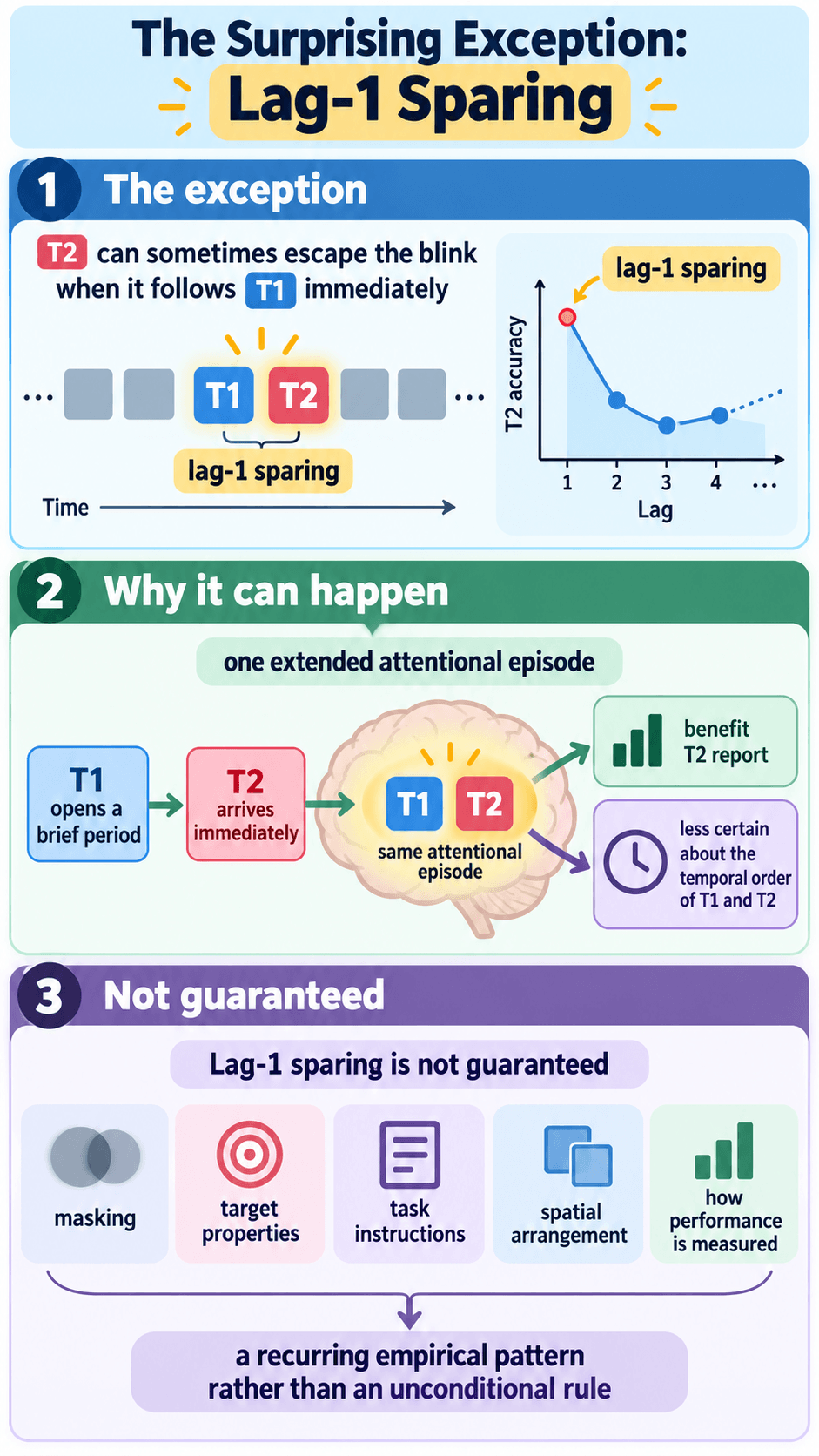
T2 can sometimes escape the blink when it follows T1 immediately
It might seem logical that the closer T2 is to T1, the worse performance should become. Yet many experiments show an exception called lag-1 sparing.
A study of the attentional blink and lag-1 sparing summarizes the basic pattern: T2 perception is often impaired at short temporal distances, but that impairment can be greatly reduced when T2 appears immediately after T1.
So the blink does not always begin at the earliest possible moment.
Why immediate succession may allow one extended attentional episode
One explanation is that T1 opens a brief period during which additional target information can still enter the same attentional episode. If T2 arrives immediately, the system may process both targets together before a later bottleneck or gate becomes restrictive.
Research on lag-1 sparing and target integration suggests that closely spaced targets may sometimes be integrated into a shared episode. That can benefit T2 report while creating another cost: the observer may become less certain about the temporal order of T1 and T2.
This tradeoff is important. Good T2 accuracy at lag 1 does not mean temporal processing is unlimited.
Lag-1 sparing is not guaranteed
Lag-1 sparing varies with masking, target properties, task instructions, spatial arrangement, and how performance is measured. Some experiments show strong sparing; others show weaker effects or different patterns.
The phenomenon is therefore a recurring empirical pattern rather than an unconditional rule.
Why the Blink Is Not a Literal Blink
The eyelids do not need to close
The term “blink” is a metaphor. Participants can keep their eyes open throughout the sequence. The deficit appears even when the second target is physically visible and lands on the retina normally.
The temporary loss occurs in information processing and reportability, not because the eye shuts out the stimulus.
Normal vision does not prevent the effect
People with ordinary corrected or uncorrected vision can show the attentional blink under laboratory conditions. It is studied as a feature of attention across time.
Persistent visual loss, blind spots, flashes, sudden blurred vision, or other sensory symptoms are separate concerns and should not be explained as an attentional blink.
The effect has a specific laboratory meaning
Calling every fast miss an “attentional blink” stretches the concept too far. The research phenomenon involves a specific relationship between two targets in a rapid stream and a measurable decline in T2 performance at certain temporal lags.
An everyday event can be used as an analogy, but without controlled timing and task conditions we usually cannot know that the same mechanism caused the miss.
What Creates the Temporary Bottleneck?
Consolidation accounts
Consolidation accounts propose that T1 requires limited processing to become stable enough for report. While that process is occupied, T2 remains vulnerable.
This explanation fits the intuition that quickly detecting something is not the same as fully encoding it into a form that can be identified seconds later.
However, consolidation is not the only proposed mechanism.
Selection and episodic registration
The Dux and Marois review concluded that the attentional blink likely reflects several demands created by T1, including target selection, encoding, episodic registration, and response-related processes. These demands temporarily reduce the availability of high-level attention for T2.
That multifactor view helps explain why manipulations affecting different stages can change the size of the blink.
Control and gating accounts
Other theories emphasize how the attentional system opens and closes selection windows. After T1, the system may suppress distractors or temporarily restrict access to protect the first target from interference.
From this perspective, the blink is not simply an empty tank of resources. It can also reflect how the system controls what enters an episode and prevents neighboring distractors from disrupting target processing.
Episodic distinctiveness accounts
Another family of theories asks how the system keeps rapidly arriving events separate in time. A computational account of episodic distinctiveness proposes that some attentional limitations help create distinct event representations rather than reflecting simple resource exhaustion.
This perspective is useful because it turns the question around. The temporary limitation may partly arise from the need to keep separate targets from being blended into one confusing episode.
Why One Single Theory Does Not Explain Every Finding
The blink changes with task design
The size of the effect changes when researchers alter target salience, masking, distractor characteristics, expectations, response requirements, or the similarity between targets.
A theory that explains one RSVP setup may struggle with another. That is why modern reviews compare multiple mechanisms rather than treating the attentional blink as proof of one universal bottleneck.
Extended sparing challenges a simple refractory-period story
In some conditions, several targets presented consecutively can be reported surprisingly well. If the system simply became unavailable immediately after T1, this pattern would be difficult to explain.
Research on expectancy and extended sparing shows that expectations about target sequences can influence these patterns. Temporal attention is therefore affected not only by capacity limits but also by how the system is prepared to organize incoming events.
The safest conclusion is a temporary high-level processing limitation
For a general reader, the most defensible summary is that identifying T1 creates a temporary period in which processing and reporting T2 becomes more difficult. Exactly why that difficulty occurs depends on several interacting mechanisms.
The attentional blink is real as a performance pattern. The debate is about how best to explain it.
A Temporal Attention Timeline
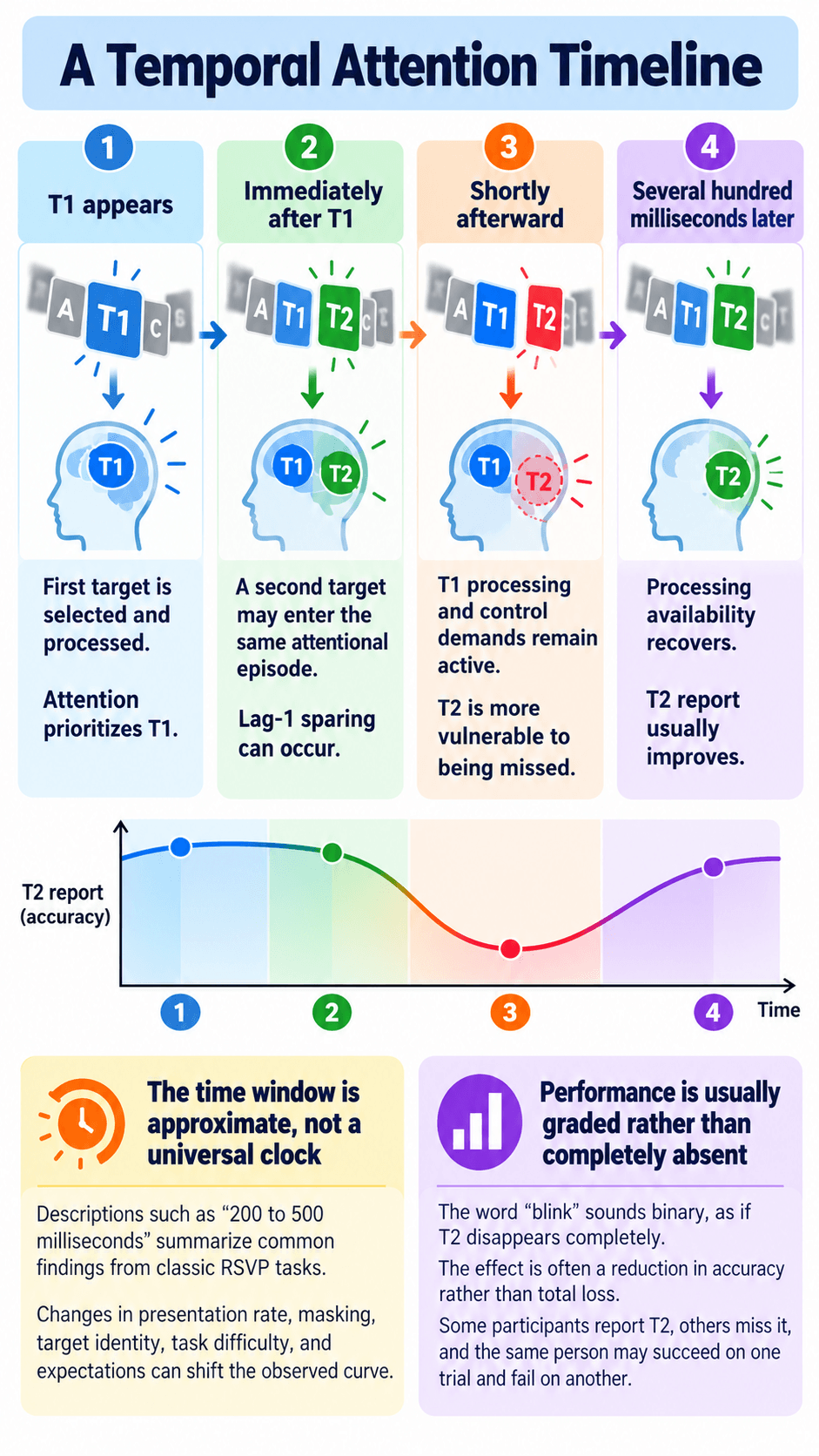
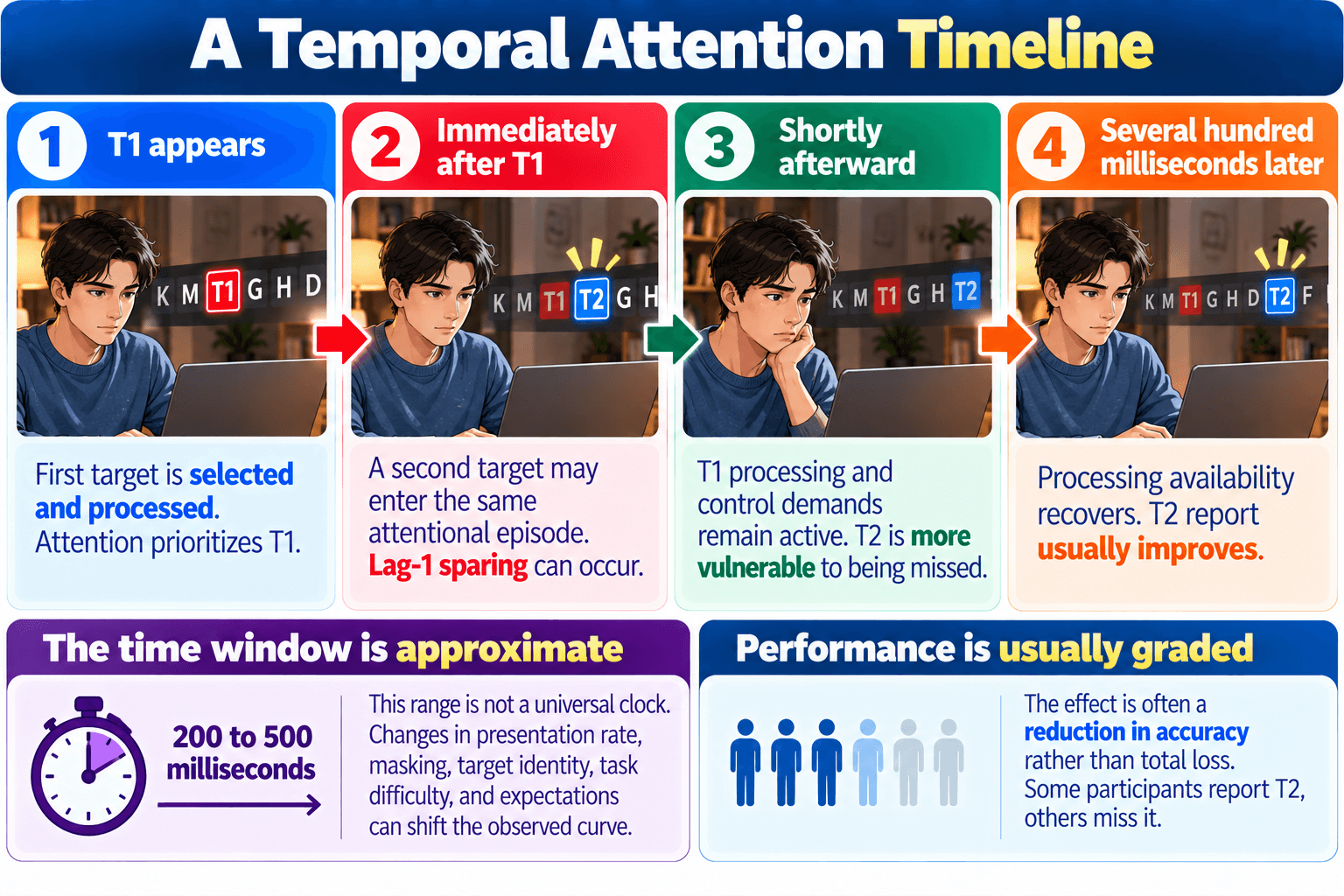
| Moment | What is happening | Typical consequence |
|---|---|---|
| T1 appears | First target is selected and processed. | Attention prioritizes T1. |
| Immediately after T1 | A second target may enter the same attentional episode. | Lag-1 sparing can occur. |
| Shortly afterward | T1 processing and control demands remain active. | T2 is more vulnerable to being missed. |
| Several hundred milliseconds later | Processing availability recovers. | T2 report usually improves. |
The time window is approximate, not a universal clock
Descriptions such as “200 to 500 milliseconds” summarize common findings from classic RSVP tasks. They should not be treated as a fixed duration that applies identically to every person and every stimulus.
Changes in presentation rate, masking, target identity, task difficulty, and expectations can shift the observed curve.
Performance is usually graded rather than completely absent
The word “blink” sounds binary, as if T2 disappears completely. In experiments, the effect is often a reduction in accuracy rather than total loss.
Some participants report T2, others miss it, and the same person may succeed on one trial and fail on another. Researchers analyze probabilities across many trials to identify the temporal pattern.
Attentional Blink vs Inattentional Blindness
| Attentional blink | Inattentional blindness |
|---|---|
| T2 is a task-relevant second target. | The missed event is typically unexpected while attention is engaged elsewhere. |
| The problem is strongly tied to T2 appearing shortly after T1. | The problem is tied to the active attentional set and competing task demands. |
| Usually studied with tightly controlled rapid sequences. | Often studied with an unexpected event embedded in another task. |
| Asks why a second target is vulnerable after a first target. | Asks why a visible event never reaches awareness. |
Both involve awareness limits, but the trigger is different
Both phenomena show that physically visible information does not guarantee conscious report. The similarity ends there.
In the attentional blink, the critical factor is the temporal relationship between two targets. In inattentional blindness, the key issue is that an unexpected event competes with an existing attentional task.
Attentional Blink vs Change Blindness
| Attentional blink | Change blindness |
|---|---|
| A second target is impaired after a first target in rapid sequence. | A difference between two scene states goes undetected. |
| Temporal target processing is central. | Comparison across scene states is central. |
| No scene change is required. | A before-and-after difference is required. |
| Often measured through T2 accuracy by lag. | Often measured through change-detection accuracy or search time. |
If you miss the second letter in a rapid target stream, the attentional blink may describe the laboratory effect. If a photograph changes between two views and you fail to detect the difference, change blindness is the relevant phenomenon.
What Everyday Analogies Can and Cannot Tell Us
A rapid sequence of names or instructions can feel similar
Imagine someone reading two unfamiliar names in very quick succession. You may remember the first and lose the second. That experience resembles the idea that one event can temporarily interfere with processing the next.
But it is only an analogy. Speech introduces language processing, memory demands, pacing, and other factors that differ from a controlled RSVP experiment.
Fast-moving displays can create temporal competition
Sports broadcasts, dashboards, games, and rapid interfaces may present several relevant events close together. One event can dominate processing long enough that the next receives less attention.
Again, these situations may contain mechanisms resembling temporal selection, but calling a particular miss an attentional blink requires evidence about the timing and task structure.
Do not use the term as a catch-all explanation
If someone misses a traffic signal, skips a word while reading, or fails to notice a fast event in a video, many explanations are possible. Selective attention, eye movements, expectations, fatigue, distraction, masking, task switching, or ordinary perceptual limitations may contribute.
The attentional blink is most useful when the specific T1-to-T2 timing relationship is central.
A Practical Interpretation Framework
Was there a clearly defined T1?
First ask whether one relevant target was processed successfully before the miss. Without a meaningful first target, the classic attentional blink framework may not fit.
Was the missed item also a target?
T2 should be something the observer was meant to detect or identify. If the missed item was unexpected and irrelevant to the original task, inattentional blindness may be the closer concept.
Did T2 arrive very soon after T1?
The temporal relationship is essential. The classic effect appears when the second target falls inside a short vulnerable window after the first.
Were distractors or masks part of the sequence?
Intervening stimuli can affect how T1 and T2 are selected, consolidated, and separated. A rapid target sequence without distractors can produce different patterns, including sparing across successive targets.
Is the example controlled enough to support the label?
Laboratory researchers can manipulate timing to the millisecond and compare performance across many trials. Everyday observation rarely provides that precision.
Outside the laboratory, it is usually safer to say that an event illustrates a temporal-attention limitation rather than claiming that a specific attentional blink definitely occurred.
What the Attentional Blink Does Not Mean
It is not evidence of weak eyesight
The target can be visually available and still be missed because of temporal-attention constraints. A visual impairment is a different issue.
It is not proof of poor concentration
Participants are often concentrating intensely on the task and successfully reporting T1. The blink emerges partly because the first target receives substantial processing.
That makes the phenomenon almost the opposite of a simple “not trying hard enough” explanation.
It is not automatically a working-memory problem
Some theories involve consolidation into a durable reportable representation, and working-memory processes may interact with the effect. But the attentional blink should not be reduced to a general claim that working memory is full.
The phenomenon includes temporal selection, target competition, episodic organization, distractor control, and task-specific timing.
It does not diagnose a neurological or attention disorder
Attentional blink effects are observed in ordinary experimental participants. A missed rapid event does not diagnose ADHD, a visual disorder, or a neurological condition.
Sudden or persistent changes in vision, awareness, cognition, or everyday functioning require a broader professional assessment rather than an attentional-blink label.
FAQ About the Attentional Blink
How long does the attentional blink last?
In many classic RSVP studies, T2 performance is reduced when the second target appears roughly 200 to 500 milliseconds after T1. That range is approximate. Presentation rate, target type, masking, task difficulty, and other design choices can alter the timing and size of the effect.
Why is T2 sometimes easier to report when it appears immediately after T1?
This is called lag-1 sparing. One explanation is that an immediately following target can enter the same attentional episode as T1 before later selection restrictions become strong. The benefit may come with reduced certainty about which target appeared first.
Does the attentional blink mean the second target was not processed at all?
Not necessarily. Many theories distinguish early perceptual processing from later selection, consolidation, or episodic registration needed for reliable conscious report. A failed T2 report does not prove that no information from the stimulus was processed.
Is the attentional blink the same as inattentional blindness?
No. In the attentional blink, the second item is usually an expected task target that appears soon after another target. In inattentional blindness, an unexpected visible event is missed while attention is engaged with another task.
Can an everyday fast miss be called an attentional blink?
Only cautiously. Everyday misses can have many causes, and attentional blink research depends on precise timing between two targets. Without controlled conditions, it is better to describe the example as a possible temporal-attention limitation rather than a confirmed attentional blink.
Key Takeaways
- The attentional blink is a temporary reduction in reporting a second target when it follows a first target very quickly.
- A useful model is T1 DETECTED → TEMPORARY PROCESSING BOTTLENECK → T2 ARRIVES → T2 MAY BE MISSED.
- The effect is usually studied with rapid serial visual presentation and is often strongest at short T1-to-T2 intervals of a few hundred milliseconds.
- Lag-1 sparing shows that an immediately following T2 can sometimes escape the usual deficit, possibly by entering the same attentional episode as T1.
- The attentional blink differs from inattentional blindness and change blindness because it concerns temporal competition between two targets rather than an unexpected event or a missed scene change.
- The “blink” is not an eyelid movement, visual impairment, or diagnosis, and not every rapid everyday miss should be labeled an attentional blink.
About the author: Michael Reed is the Founder & Lead Writer at Psychology Exposed. He explains psychology, human behavior, self-awareness, and everyday cognitive patterns in clear, research-aware language for general readers.
The clearest way to recognize the concept is to ask about timing. Was one target processed first, did another target arrive within a very short window, and did performance recover when the second target appeared later? That temporal pattern is what makes the attentional blink different from other ways the mind can miss visible information.

Michael Reed is the Founder and Lead Writer at Psychology Exposed. He writes about human behavior, relationships, emotional patterns, self-awareness, and practical psychology topics using research-informed, easy-to-understand content.
Read More About Michael Reed: https://psychologyexposed.com/michael-reed/