

You read half a page and suddenly realize you have no idea what the last paragraph said. During a routine meeting, your attention shifts from the speaker to tomorrow’s plans. While washing dishes, you replay an old conversation, imagine a future trip, or mentally solve a problem that has nothing to do with the sink in front of you.
These experiences are examples of mind wandering: attention moving away from the current task or external environment toward internally generated thought. The content may involve memories, plans, imagined scenarios, personal concerns, creative ideas, or seemingly random associations.
Mind wandering is common, but it is not one single mental state with one single consequence. It can happen spontaneously or deliberately. It can occur with or without awareness. It can interfere with reading, monitoring, and other tasks, yet under some conditions it may also support planning or creative incubation. The key is to understand where attention goes, why it leaves the task, and what happens next.
Quick Answer
Mind wandering is a shift of attention away from the current task or external input toward internally generated thoughts. It often involves task-unrelated or stimulus-independent thinking, such as memories, future plans, personal concerns, or imagined events. Mind wandering can be spontaneous or deliberate, and people may or may not notice it while it is happening. Its effects depend on context: it can impair ongoing performance but may sometimes support planning or creative incubation.
What Mind Wandering Means in Psychology
Attention shifts away from the current task
A major review of the science of mind wandering describes the experience as attention shifting away from a current task toward unrelated thoughts and feelings. The defining feature is not simply that thoughts are present. Thinking is present during most tasks. The key is that mental content becomes decoupled from what the current activity requires.
If you are reading and thinking about the argument on the page, your thoughts are internally generated but still task-related. If you begin planning dinner while your eyes continue moving across the sentences, attention has shifted away from the reading goal.
This makes mind wandering an attentional phenomenon, not merely a category of thought content. Mind wandering is one way attention can shift within the broader psychology of attention.
Task-unrelated thought
Researchers often measure mind wandering through the idea of task-unrelated thought. During a task, participants may be interrupted by a thought probe asking whether their attention was on the task or elsewhere.
The strength of this definition is clarity. It asks whether the current thought serves the task at hand.
The limitation is that “task-related” depends on context. Thinking about a future meeting is off-task while reading a novel, but it may be directly relevant while preparing tomorrow’s schedule. The same thought can count differently depending on the current goal.
Stimulus-independent thought
Another related concept is stimulus-independent thought. This refers to thoughts that are not directly driven by the immediate external environment.
You may look out a window and begin thinking about a childhood memory that the current scene did not obviously require. Attention becomes centered on internally generated information rather than ongoing sensory input.
Task-unrelated and stimulus-independent thought often overlap, but they are not perfectly identical. A thought can be internally generated and still support the current task.
The Core Framework: TASK → ATTENTION DECOUPLES → INTERNAL THOUGHT → META-AWARENESS OR CONTINUED DRIFT → RETURN
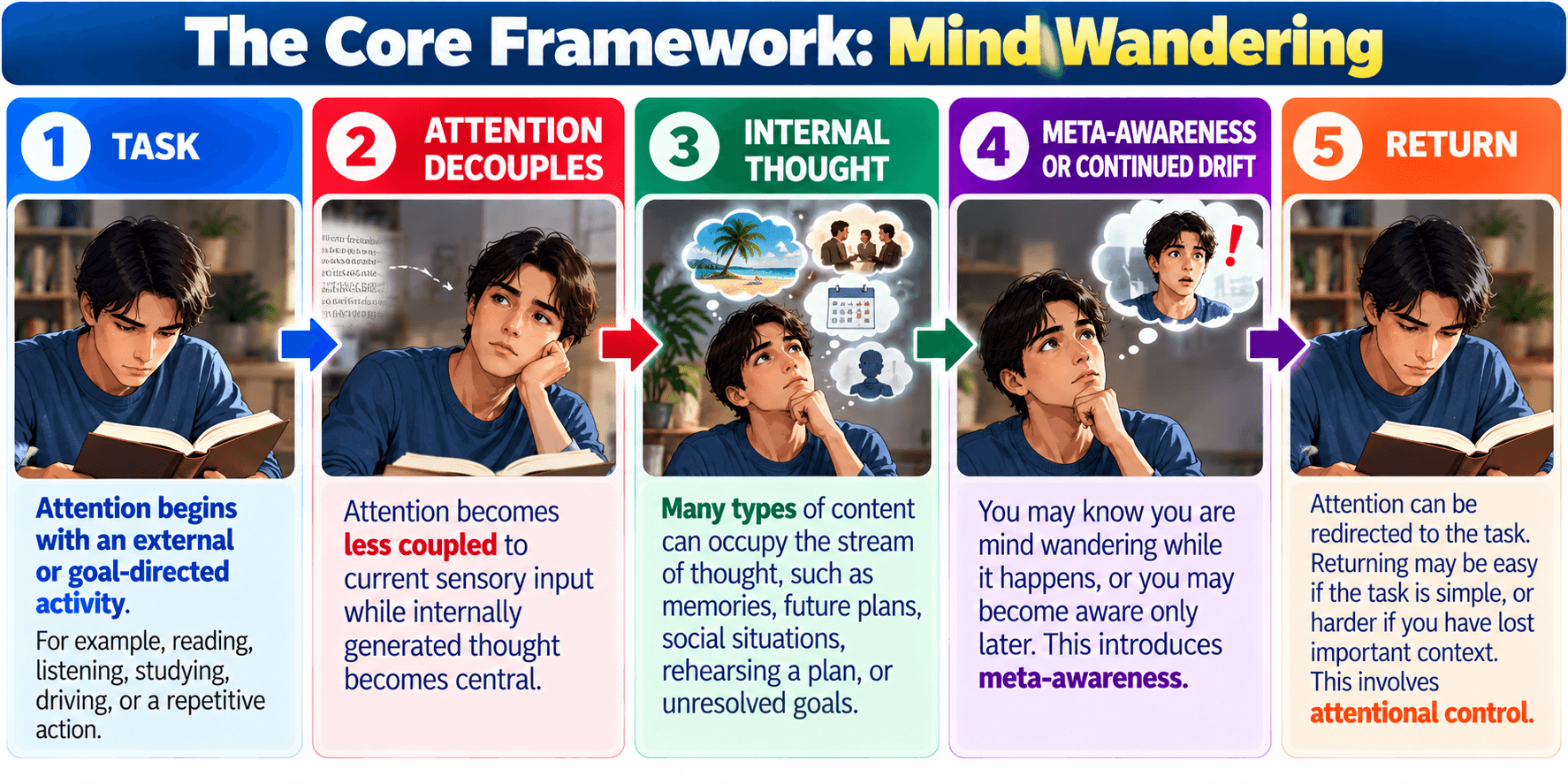
Task: attention begins with an external or goal-directed activity
Mind wandering is defined relative to something attention has left. That starting point may be reading, listening, monitoring, studying, driving, or carrying out a repetitive action.
The task does not have to be difficult. In fact, low-demand or repetitive conditions can leave room for internally generated thought to become more competitive.
Attention decouples from the immediate environment
One influential idea is perceptual decoupling. A review of meta-awareness and perceptual decoupling during mind wandering describes how attention can become less coupled to current sensory input while internally generated thought becomes central.
Your eyes may continue scanning a page, yet the words receive less meaningful processing. You may continue walking along a familiar route while attention turns toward an imagined conversation.
Decoupling is not total sensory shutdown. People can still respond to important events. It describes a shift in processing priority away from the external task.
Internally generated thought becomes the active stream
Once attention turns inward, many types of content can occupy the stream of thought. The mind may revisit the past, anticipate the future, simulate social situations, rehearse a plan, consider unresolved goals, or move through loosely connected ideas.
This diversity is important. Mind wandering is not synonymous with negative thinking. Its emotional tone and function depend on what the person is thinking about.
Meta-awareness may appear, or drift may continue unnoticed
Sometimes you know you are mind wandering while it happens. You deliberately allow your thoughts to move away from the task or notice the drift quickly.
At other times, you become aware only later. You reach the bottom of a page and suddenly realize your attention left several paragraphs ago.
That difference introduces meta-awareness: awareness of the current contents of your own mind.
Attention may return to the task
Once the drift is noticed or the internal thought ends, attention can be redirected. Returning may be easy if the task is simple. It may be harder if you have lost important context.
This return involves attentional control. Meta-awareness can signal that attention has drifted, but control is what helps restore priority to the task.
Spontaneous vs Deliberate Mind Wandering

Not every drift is accidental
It is easy to assume that mind wandering always “happens to you.” Research suggests otherwise.
A review of mind wandering with and without intention argues that deliberate and spontaneous mind wandering should be distinguished because they are dissociable forms of experience.
Sometimes attention moves away despite an intention to stay focused. At other times, a person intentionally allows the mind to wander because the task permits it or because internal thought feels more useful.
Spontaneous mind wandering
Spontaneous mind wandering occurs without an intention to disengage. You may be reading carefully and suddenly discover that your thoughts have moved elsewhere.
This form is especially relevant when mind wandering interferes with a goal. The person wanted to stay on task but internal thought gained priority anyway.
Deliberate mind wandering
Deliberate mind wandering involves intentionally allowing attention to leave the immediate task. Someone on a familiar walk may choose to think through a future decision. A person taking a break from a difficult problem may let thoughts move freely.
Deliberate drift is still mind wandering if attention moves away from the current external activity. Intentionality changes how the episode begins, not necessarily the type of internal content that follows.
Why the distinction changes interpretation
If all mind wandering is treated as accidental failure, deliberate episodes get mislabeled. If all mind wandering is treated as useful free thought, involuntary lapses that impair performance get minimized.
The distinction helps explain why two people can report similar amounts of mind wandering yet experience different levels of frustration or task disruption.
What the Wandering Mind Thinks About
Future-oriented thought
Mind wandering often includes future-oriented thinking. People mentally rehearse upcoming conversations, imagine possible outcomes, or organize future actions.
The foundational review by Smallwood and Schooler highlights future planning as one possible function of mind wandering. This does not mean every future-oriented thought is productive. A plan may be vague, unrealistic, repetitive, or distracting from a more important present task.
Autobiographical memories
Past experiences can also enter attention without deliberate retrieval. A smell, phrase, or internal association may lead to a memory that becomes the center of thought.
The memory may be emotionally neutral, pleasant, embarrassing, or personally important. Mind wandering therefore includes a broad range of autobiographical content rather than one fixed emotional pattern.
Current concerns
Unfinished goals can remain mentally active. A pending deadline, unresolved conversation, financial decision, or relationship issue may repeatedly appear during unrelated tasks.
These current concerns can make internal thought highly competitive because they carry personal relevance. The mind does not need an external notification to be interrupted. Its own unresolved goals can provide the competing signal.
Imagined scenarios and social simulation
People frequently simulate possibilities: what they might say, what someone else might do, how an event could unfold, or what a different choice would feel like.
Such simulations may help preparation, but they can also become repetitive or disconnected from useful action. The category “mind wandering” alone does not determine whether the outcome is beneficial.
Why Mind Wandering Becomes More Likely
Low task demand can leave room for internal thought
When a task requires little active processing, internally generated thoughts can compete more successfully. Familiar walking, routine household tasks, and repetitive monitoring often allow attention to move inward.
This does not mean low-demand tasks always cause mind wandering. The person’s goals, fatigue, interest, and current concerns also matter.
Time-on-task
A large 2025 individual-participant meta-analysis of mind wandering over time examined data from more than 10,000 participants and found that mind wandering increased in frequency as task performance continued across a broad range of studies.
This pattern helps explain why internal drift often becomes more common during prolonged work. However, time itself is not a single cause. Changes in boredom, motivation, fatigue, arousal, and control may accompany time-on-task.
Boredom
Boredom signals that the current activity is not providing enough engagement or meaning relative to alternative mental options. Internal thought can become more attractive under those conditions.
Still, boredom and mind wandering are not identical. You can feel bored while staying on task, and you can mind wander during an activity you genuinely value.
Fatigue
Fatigue can make sustained external engagement harder and reduce the stability of task goals. As the cost of maintaining attention rises, internal thought may gain priority more easily.
Severe sleepiness is different from ordinary mind wandering. In driving, machinery operation, or other safety-critical settings, dangerous fatigue should be addressed directly rather than treated as a simple attention-management issue.
Personally important concerns
A thought about something emotionally or practically important can outcompete a low-priority task even when the environment is not distracting.
This is one reason removing notifications does not eliminate every form of distraction. The source of competition may be internal.
Meta-Awareness: Knowing That Your Mind Has Wandered
Mind wandering can occur with awareness
You may recognize, “I am no longer listening to this lecture. I am thinking about the weekend.” In this case, the mind has wandered and you are aware of it.
You might choose to return or deliberately continue the internal thought. Meta-awareness makes that choice more available.
Mind wandering can also occur without awareness
At other times, the drift continues without explicit recognition. You may keep performing the outward behavior of the task while meaningful processing has declined.
The review by Schooler and colleagues emphasizes that people are only intermittently aware of their own mind wandering. This “zoning out” helps explain why some lapses persist longer than intended.
Noticing drift is not the same as controlling it
Meta-awareness answers, “What is my mind doing right now?” Attentional control answers, “Where should processing go next?”
A person can notice the drift yet struggle to return. Another person can redirect almost immediately. Keeping these processes separate prevents mind wandering from becoming a broad metacognition article.
Mind Wandering During Reading
Eyes can continue moving while comprehension drops
Reading provides a clear example of perceptual decoupling. The eyes can continue moving across words even while attention is centered on internally generated thought.
When this happens, the reader may retain only fragments of the passage and need to reread once awareness returns.
The performance cost is measurable
A meta-analysis of mind wandering and reading comprehension found a significant negative relationship between mind wandering and comprehension across the included studies.
The relationship was not identical in every task or participant group, which matters. Mind wandering is associated with poorer comprehension on average, but the size of the cost depends on text characteristics, measurement methods, and individual differences.
Reading failure is not the definition of mind wandering
Mind wandering can reduce reading comprehension, but reading difficulty can have many causes. Complex vocabulary, low background knowledge, visual problems, fatigue, or confusing writing can also impair comprehension.
The phenomenon should therefore be identified by the shift in attention, not by one poor reading outcome.
Mind Wandering During Repetitive Tasks
Routine action can continue while attention turns inward
Highly familiar tasks often allow some external behavior to continue with limited conscious supervision. Folding clothes, walking a familiar route, or carrying out repetitive sorting can leave room for internal thought.
This can feel efficient because the task continues while the mind explores something else.
Monitoring tasks create a different risk
If a repetitive task requires detection of rare important signals, mind wandering can reduce readiness at exactly the wrong moment.
That connects mind wandering with sustained attention, but the concepts remain different. Sustained attention concerns maintaining readiness over time. Mind wandering specifically describes attention shifting toward internally generated content.
Safety matters more than the label
In low-risk repetitive activities, internal drift may be harmless. In aviation, driving, medical monitoring, or hazardous industrial work, the consequences can be very different.
No benefit associated with mind wandering should be used to justify allowing attention to drift during a task where lapses could harm someone.
Mind Wandering vs External Distraction
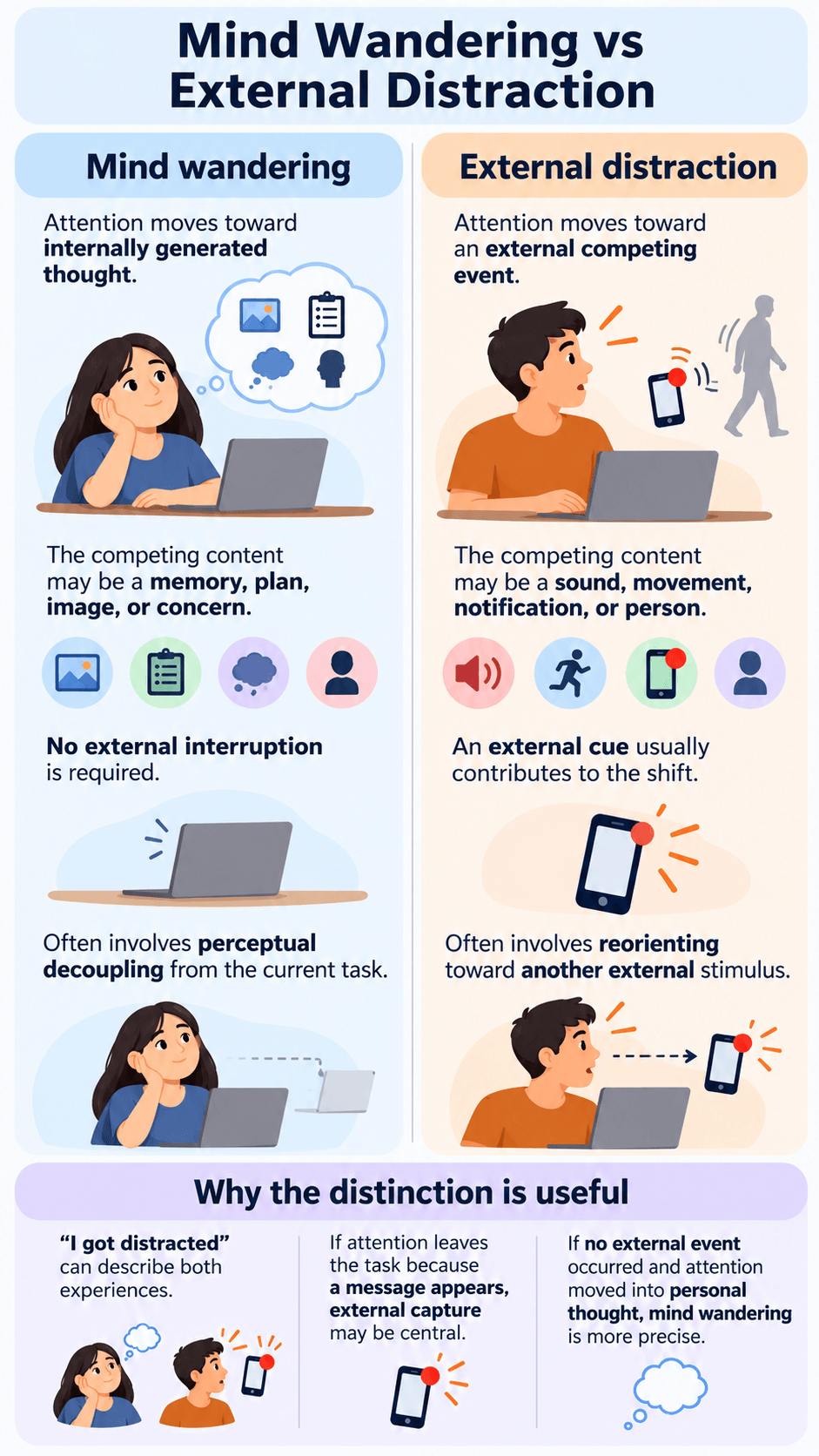
| Mind wandering | External distraction |
|---|---|
| Attention moves toward internally generated thought. | Attention moves toward an external competing event. |
| The competing content may be a memory, plan, image, or concern. | The competing content may be a sound, movement, notification, or person. |
| No external interruption is required. | An external cue usually contributes to the shift. |
| Often involves perceptual decoupling from the current task. | Often involves reorienting toward another external stimulus. |
The distinction is useful because “I got distracted” can describe both experiences. If attention leaves the task because a message appears, external capture may be central. If no external event occurred and attention moved into personal thought, mind wandering is more precise.
Mind Wandering vs Rumination
Mind wandering is defined by attentional direction
Mind wandering is defined mainly by where attention has moved relative to the current task. The internal content can be pleasant, neutral, practical, imaginative, or distressing.
Rumination is defined more by repetitive thought pattern and emotional content
Rumination usually refers to repetitive thinking about distress, problems, causes, consequences, or negative emotional experiences. It can occur during mind wandering, but the concepts are not identical.
A person planning a holiday during a routine train ride may be mind wandering without ruminating. A person repeatedly replaying a painful event may be doing both.
Why the distinction matters
If every internal drift is called rumination, normal autobiographical thought and planning become pathologized. If every repetitive negative thought is dismissed as ordinary mind wandering, meaningful emotional difficulties may be minimized.
The content and repetitiveness of thought matter in addition to the fact that attention left the external task.
Mind Wandering vs Daydreaming
The terms overlap but are not perfect synonyms
Daydreaming often refers to immersive imagined scenes, fantasies, or narratives. Mind wandering is broader. It can include a single practical thought, memory fragment, future plan, verbal rehearsal, or image.
Some mind wandering looks like daydreaming. Much of it does not.
Mind wandering can be brief and ordinary
A mind-wandering episode may last only a few seconds. You remember an appointment, consider what to cook, and then return.
There is no need for a rich fantasy world or prolonged imaginative absorption.
Can Mind Wandering Ever Be Useful?
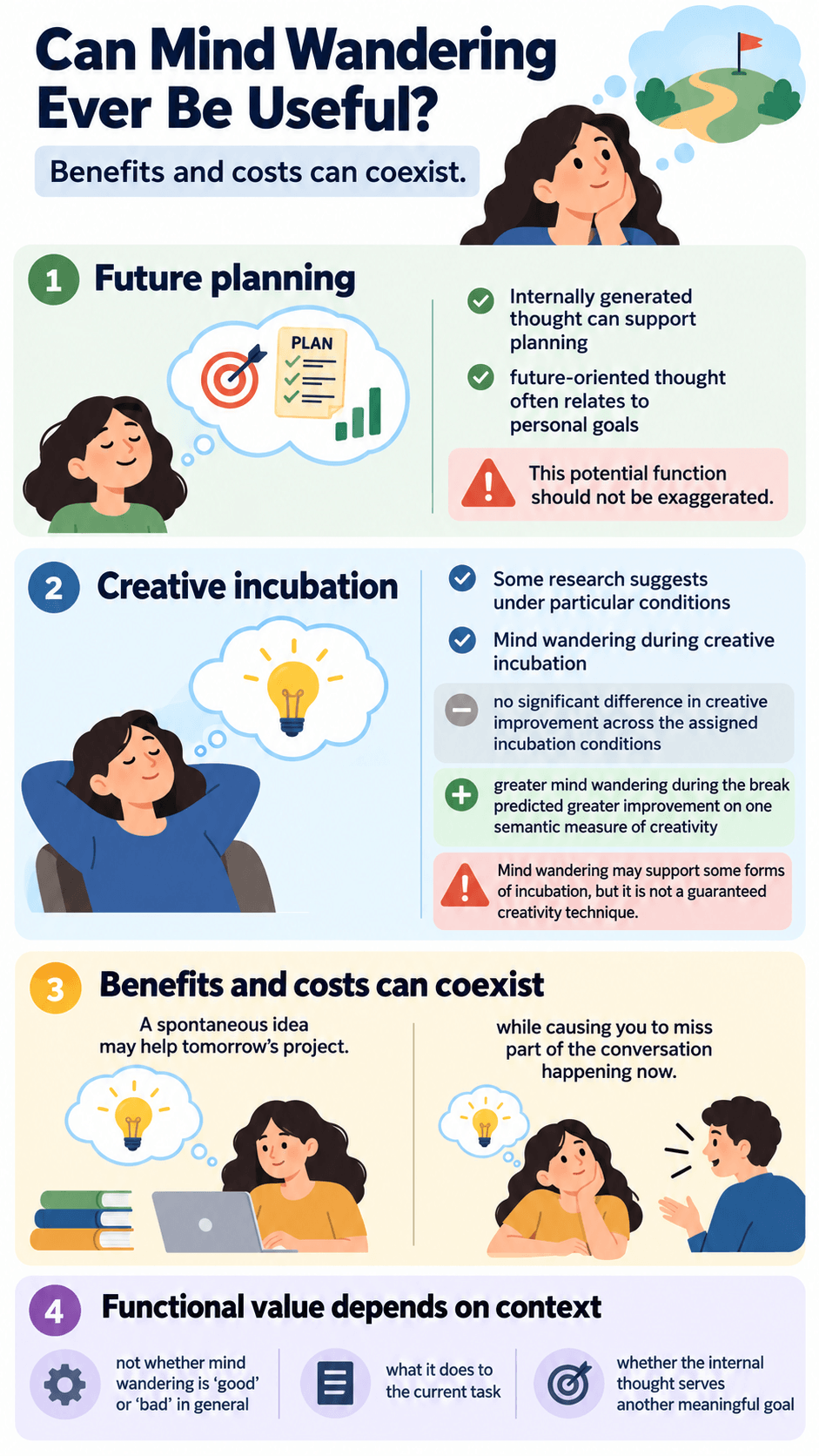
Future planning
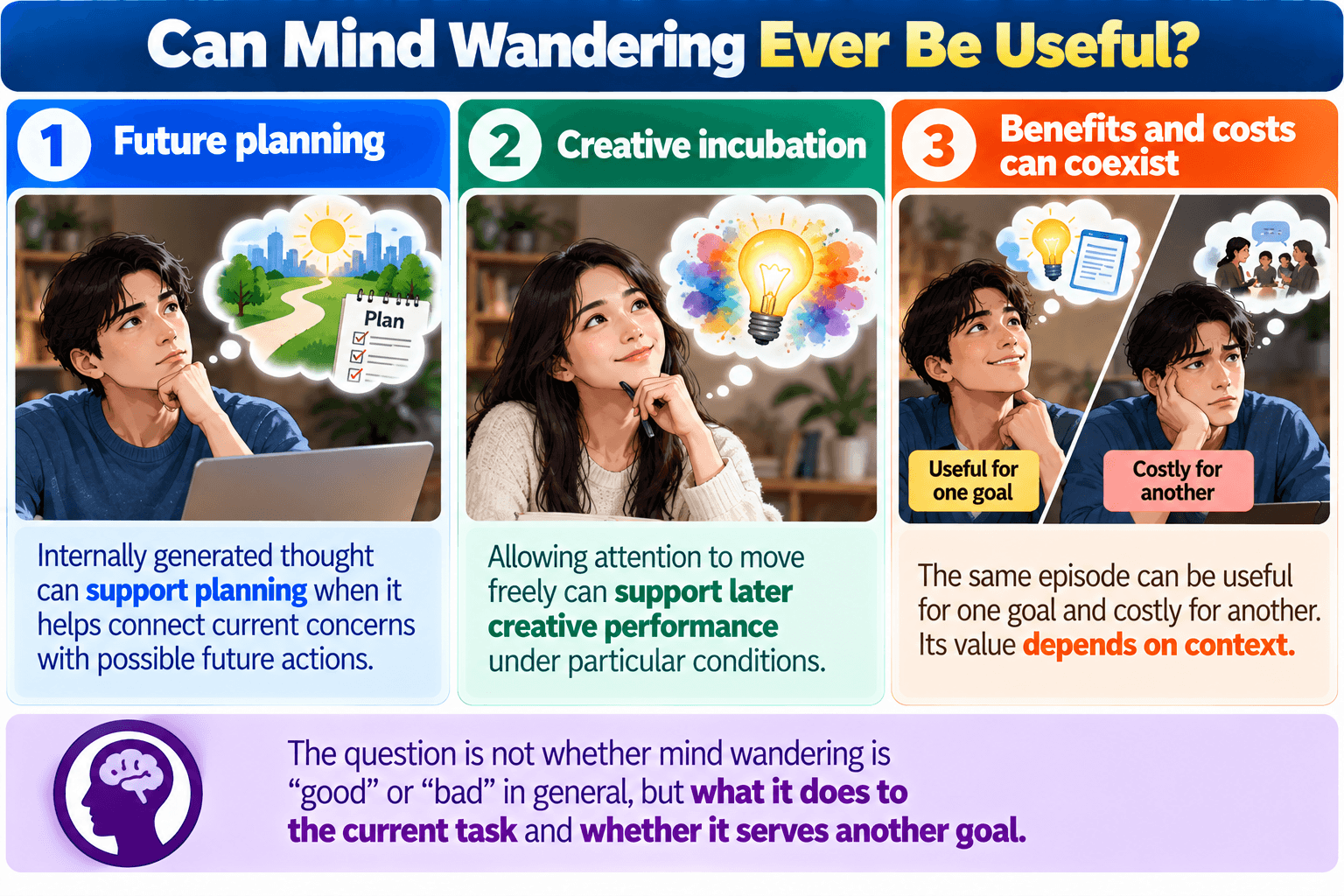
Internally generated thought can support planning when it helps connect current concerns with possible future actions. The broad mind-wandering literature includes evidence that future-oriented thought often relates to personal goals.
This potential function should not be exaggerated. A future thought can be productive planning, vague fantasy, worry, or repetition. The label alone does not tell you which.
Creative incubation
Some research suggests that stepping away from a problem and allowing attention to move freely can support later creative performance under particular conditions.
A 2025 preregistered study of mind wandering during creative incubation found no significant difference in creative improvement across the assigned incubation conditions. However, greater mind wandering during the break predicted greater improvement on one semantic measure of creativity when participants returned to the same writing prompt.
This is a useful example of the right level of caution. Mind wandering may support some forms of incubation, but it is not a guaranteed creativity technique.
Benefits and costs can coexist
The same episode can be useful for one goal and costly for another. A spontaneous idea may help tomorrow’s project while causing you to miss part of the conversation happening now.
Functional value therefore depends on context. The question is not whether mind wandering is “good” or “bad” in general, but what it does to the current task and whether the internal thought serves another meaningful goal.
Why Mind Wandering Is Not Always Dysfunctional
Internal thought is part of ordinary cognition
The mind routinely moves through memories, plans, simulations, goals, and associations. Treating every off-task thought as a defect would ignore the role of internally generated cognition in everyday life.
Context determines whether drift is costly
Mind wandering during a high-stakes monitoring task can be dangerous. Mind wandering during a safe, undemanding walk may have little immediate cost. The same cognitive shift can therefore have very different consequences.
Control and timing matter
Deliberately allowing internal thought during a low-demand period differs from involuntarily losing the thread of an important task. Meta-awareness and the ability to return also shape the outcome.
This is why frequency alone is an incomplete measure of whether mind wandering is causing a problem.
A Practical Observation Framework
What task did attention leave?
Identify the original task. Reading, listening, monitoring, writing, driving, or routine movement create different costs when attention shifts away.
Where did attention go?
Was the new content a memory, plan, current concern, imagined scene, creative association, or repetitive worry?
This helps distinguish the attentional event from the emotional or functional nature of the thought.
Was the drift deliberate or spontaneous?
Did you intentionally allow your mind to move elsewhere, or did you notice only after it happened?
Intentionality can change how the episode should be interpreted.
Were you aware of the drift while it was happening?
Awareness matters because it creates an opportunity to decide whether to continue the internal thought or return to the task.
What did the drift cost or provide?
Did you miss important information, make an error, or need to repeat work? Did the thought help you remember a goal, form a plan, or generate a useful idea?
This final question keeps evaluation tied to context rather than treating mind wandering as automatically harmful or beneficial.
When Ordinary Mind Wandering Is Not the Whole Story
Mind wandering is common and does not by itself diagnose ADHD, anxiety, depression, dissociation, or another condition. A diagnosis requires a broader pattern of symptoms, duration, functional impact, history, and qualified assessment.
Professional evaluation may be appropriate when attention changes suddenly, internal experiences become severely distressing, episodes involve confusion or loss of awareness beyond ordinary drift, functioning declines substantially, or other neurological or mental-health concerns are present.
In safety-critical situations, severe fatigue, sleepiness, confusion, or impaired awareness should be addressed directly rather than explained as ordinary mind wandering.
FAQ About Mind Wandering
Is mind wandering always unintentional?
No. Research distinguishes spontaneous mind wandering from deliberate mind wandering. Sometimes attention drifts despite an intention to stay on task. At other times, people intentionally allow attention to move toward internal thoughts because the situation permits it.
Is mind wandering the same as rumination?
No. Mind wandering describes attention shifting away from the current task toward internally generated thought. Rumination is more specifically repetitive thinking, often about distress or negative concerns. Rumination can occur during mind wandering, but many mind-wandering episodes are neutral, practical, positive, or future-oriented.
Why can I keep reading while not taking in the words?
Some outward components of reading, such as eye movements, can continue while attention becomes decoupled from meaningful processing of the text. Research consistently links mind wandering during reading with reduced comprehension on average.
Can mind wandering help creativity?
Possibly under some conditions, especially during incubation after prior work on a problem. The evidence is mixed and context-dependent. Recent research suggests that more mind wandering during a break can predict improvement on some creativity measures, but assigning people to a mind-wandering-friendly condition does not always produce a reliable creative advantage.
Is frequent mind wandering a sign of ADHD?
Not by itself. Mind wandering occurs widely in ordinary cognition. ADHD assessment requires a much broader and persistent pattern of attention and behavioral symptoms with meaningful functional impact. Frequency of off-task thought alone is not diagnostic.
Key Takeaways
- Mind wandering occurs when attention leaves the current task and becomes centered on internally generated thoughts.
- A useful model is TASK → ATTENTION DECOUPLES → INTERNAL THOUGHT → META-AWARENESS OR CONTINUED DRIFT → RETURN.
- Mind wandering can be spontaneous or deliberate, and people may or may not be aware that it is happening.
- It commonly affects reading, sustained attention, and other tasks that require ongoing external processing.
- Mind wandering is not the same as rumination, external distraction, daydreaming, or metacognition.
- Its effects are context-dependent: it can impair current performance while sometimes contributing to planning or creative incubation.
About the author: Michael Reed is the Founder & Lead Writer at Psychology Exposed. He explains psychology, human behavior, self-awareness, and everyday cognitive patterns in clear, research-aware language for general readers.
The most useful question after your mind drifts is not simply, “Why can’t I focus?” Ask what task attention left, what internal content replaced it, whether the drift was deliberate, whether you noticed it, and what the shift cost or contributed. Those questions describe mind wandering more precisely than treating every off-task thought as the same problem.

Michael Reed is the Founder and Lead Writer at Psychology Exposed. He writes about human behavior, relationships, emotional patterns, self-awareness, and practical psychology topics using research-informed, easy-to-understand content.
Read More About Michael Reed: https://psychologyexposed.com/michael-reed/