
You can walk while talking, stir a pot while listening to a podcast, or fold laundry during a phone call. Yet other combinations fall apart quickly. Try reading a complex email while someone gives you unfamiliar directions, or making a difficult decision while responding to another demanding question. Both tasks may feel possible for a moment, but accuracy, speed, or comprehension often changes.
Divided attention psychology studies what happens when two or more demands need processing during overlapping time. The important question is not simply whether people “can multitask.” Some activities can overlap reasonably well. Others compete strongly because they require similar processing, difficult decisions, precise timing, or controlled responses. Divided attention is one part of attention psychology, alongside selection, sustained attention, capture, control, and other limits on processing.
Understanding divided attention means looking at where tasks interfere, how much their demands overlap, what practice changes, and when apparent multitasking is actually rapid switching between task sets.
Quick Answer
Divided attention is the allocation of attention across two or more information streams or tasks during overlapping time. Performance depends on task difficulty, similarity, sensory and response demands, timing, and automaticity. Some processing can occur in parallel, but certain stages can create bottlenecks that delay or disrupt another task. Divided attention is therefore not identical to task switching, working memory, or a universal inability to do two things at once.
Divided Attention Means Overlapping Demands
Two tasks can occur in the same time window
The APA Dictionary of Psychology defines divided attention as attention directed to two or more channels of information at the same time so that multiple tasks may be performed concurrently. The tasks may use one sensory modality or several.
The word “concurrently” is important. Divided attention concerns overlap. You may be listening while walking, monitoring traffic while following navigation guidance, or watching one display while responding to another source of information.
That does not mean every part of both tasks is processed at exactly the same moment. Some stages may overlap while others wait. The useful question is which parts can operate together and which parts compete.
Overlap does not mean both tasks receive equal processing
When two tasks are active, people often prioritize one over the other. The primary task may receive more attention, faster responses, or greater protection from interference. The secondary task may become slower or less accurate.
Even instructions to “give both tasks equal attention” do not guarantee perfectly equal allocation. People may shift emphasis from moment to moment. This is one reason dual-task experiments have to be designed carefully when researchers want to estimate interference.
Divided attention is therefore not a clean fifty-fifty split. It is a coordination problem under limited processing conditions.
The Dual-Task Problem
Primary and secondary tasks
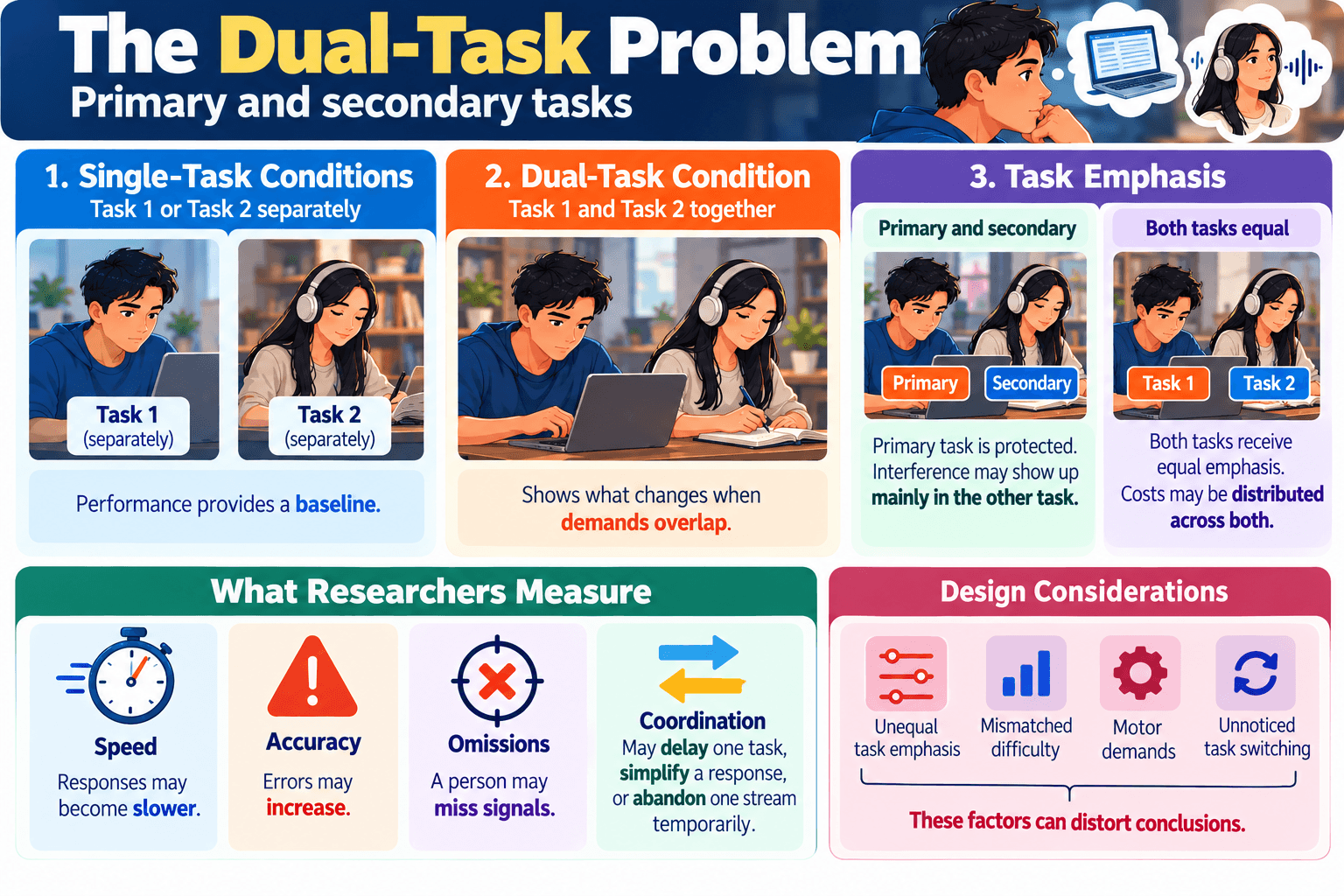
In many experiments, researchers ask participants to perform Task 1 and Task 2 either separately or together. Performance during the single-task conditions provides a baseline. The dual-task condition shows what changes when demands overlap.
One task may be designated as primary, meaning participants are told to protect its performance. The other may be secondary. In other designs, both tasks receive equal emphasis.
The difference matters. If one task is protected, interference may show up mainly in the other task. If both are treated equally, costs may be distributed across both. Attentional control becomes relevant when the system must protect one goal, shift priority, or recover after interference between competing demands.
What researchers measure: speed, accuracy, omissions, and coordination
Dual-task cost can appear in several ways. Responses may become slower. Errors may increase. A person may miss signals, delay one task, simplify a response, or abandon one stream temporarily.
A review on confounds and design problems in dual-task research emphasizes that divided-attention experiments are more complicated than simply subtracting one score from another. Unequal task emphasis, mismatched difficulty, motor demands, and unnoticed task switching can all distort conclusions.
This is why “multitasking performance” is not one single variable. Different measures can reveal different kinds of interference.
Why Two Tasks Interfere
Limited processing and shared demands
The simplest explanation is that two tasks sometimes need the same limited processing operations at the same time. If both depend heavily on controlled attention, response selection, verbal processing, or precise visual monitoring, interference becomes more likely.
A foundational review of dual-task interference and the psychological refractory period concluded that even relatively simple tasks can interfere strongly when they overlap. The review highlighted a stubborn central limitation associated particularly with choosing actions, while also noting additional sources of interference in preparation, perception, timing, and other operations.
The key point is that limited attention is not necessarily one generic pool. Interference can arise at several stages.
Task similarity and modality overlap
Two tasks that rely on similar information or responses often compete more strongly. Listening to two people speak at once is usually harder than walking while listening to one person because both conversations require overlapping auditory and language processing.
Similarly, monitoring two visual displays can create more competition than combining a simple visual task with a highly practiced motor activity. But modality alone does not determine the outcome. Two tasks in different modalities can still conflict if both require difficult decisions or competing responses.
“Different senses” therefore does not automatically mean “no interference.”
Response-selection bottlenecks
One influential idea is that some central operations cannot proceed independently for two tasks at the same moment. In psychological refractory period experiments, two stimuli appear close together, each requiring a response. The second response often becomes slower when the tasks occur closer in time.
This pattern has often been interpreted as evidence that a central stage, especially response selection, creates a bottleneck. Some perceptual or motor processes may continue in parallel, while the second task waits for a restricted central operation to become available.
Later research has refined and debated the exact location of that bottleneck, so it is better to say that certain central operations show strong capacity limits than to claim that the mind contains one proven single-file queue.
A Core Model: TASK A + TASK B → SHARED DEMANDS → INTERFERENCE OR COEXISTENCE
When demands overlap heavily
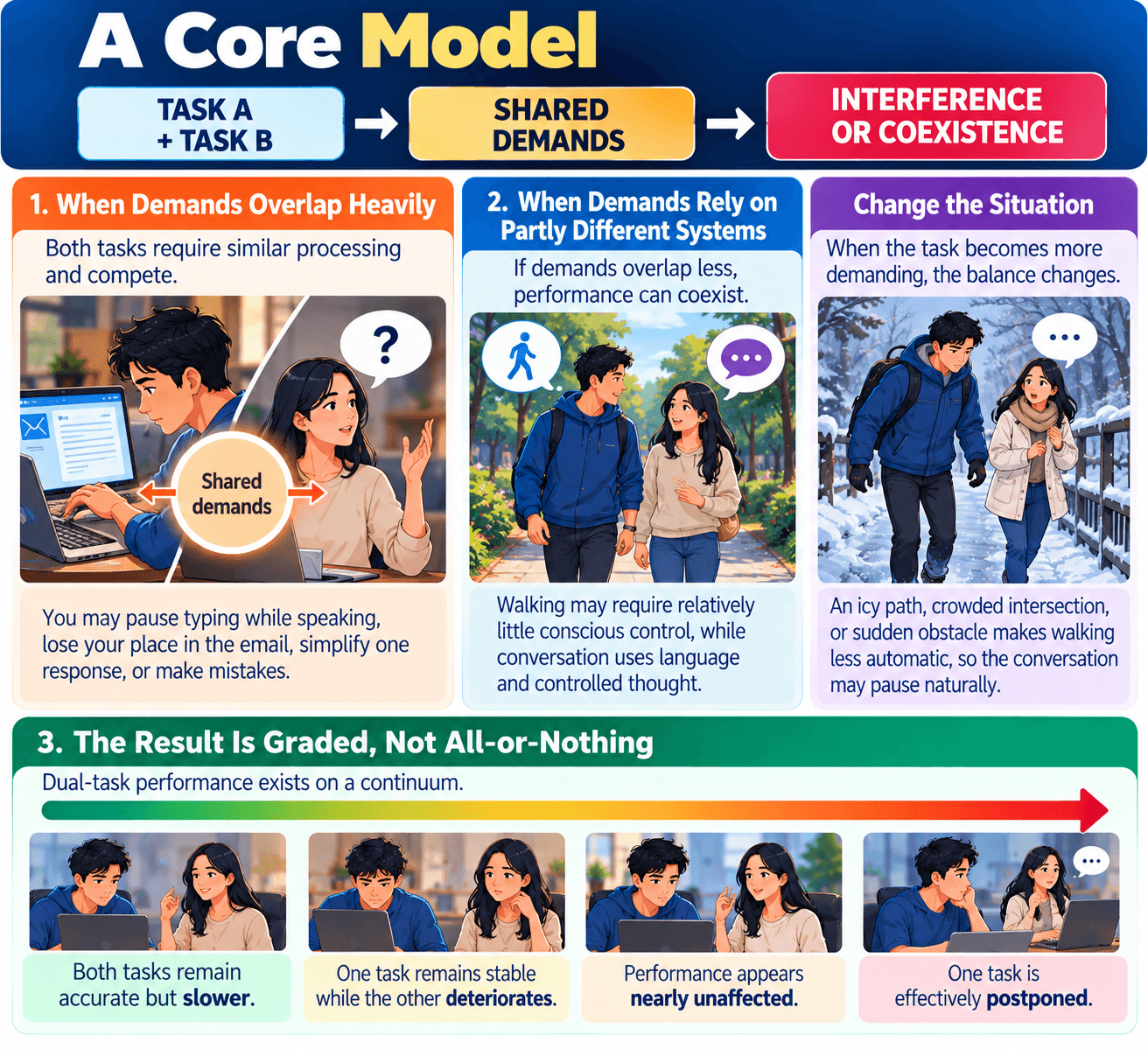
Imagine trying to compose a careful email while answering a complicated question aloud. Both tasks require language production, choosing words, holding goals in mind, and monitoring whether the response makes sense.
The tasks overlap in several ways. You may pause typing while speaking, lose your place in the email, simplify one response, or make mistakes. The subjective feeling may be “I am doing both,” but performance shows that the tasks are competing.
Heavy overlap does not guarantee complete failure. It increases the chance that one task will be delayed, degraded, or temporarily postponed.
When demands rely on partly different systems
Now compare walking on a familiar path while having an ordinary conversation. Walking is highly practiced and may require relatively little conscious control under easy conditions. The conversation uses language and controlled thought. Because the demands overlap less, performance can coexist more successfully.
Change the situation, however, and the balance changes. An icy path, crowded intersection, or sudden obstacle makes walking less automatic. The motor task begins demanding more attention, so the conversation may pause naturally.
This illustrates why divided attention depends on context, not just task labels.
Why the result is graded rather than all-or-nothing
Dual-task performance exists on a continuum. Sometimes both tasks remain accurate but responses slow. Sometimes one task remains stable while the other deteriorates. Sometimes performance appears nearly unaffected. In other cases, one task is effectively postponed.
The graded nature of interference is one reason simplistic statements about multitasking are misleading. The scientifically useful question is not “possible or impossible?” but “what costs appear under these conditions?”
Automatic and Controlled Processing
Practice can reduce some attentional demand
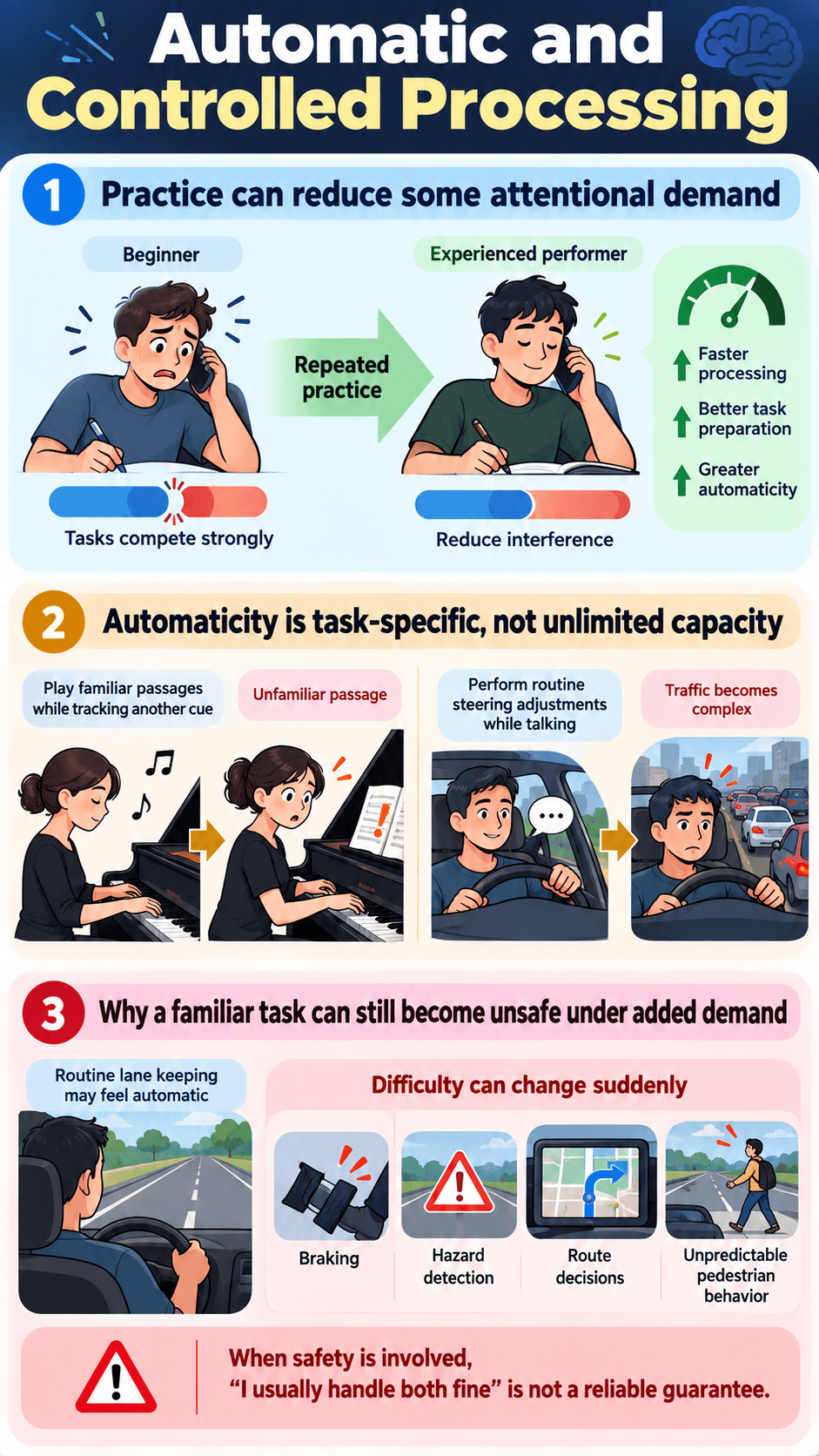
Repeated practice can make parts of a task faster and less effortful. Research on why practice reduces dual-task interference found that extensive training can substantially reduce interference in some psychological refractory period tasks.
This does not mean practice creates unlimited capacity. It means that the operations required by a task can change. Faster processing, better task preparation, and greater automaticity may reduce the period during which tasks compete strongly.
That is why experienced performers can sometimes combine activities that overwhelm beginners.
Automaticity is task-specific, not unlimited capacity
A skilled pianist may play familiar passages while tracking another cue. An experienced driver may perform routine steering adjustments while talking. These examples show that practice matters.
But automaticity is conditional. A familiar task can suddenly become attention-demanding when something unusual happens. The pianist reaches an unfamiliar passage. Traffic becomes complex. The conversation requires a difficult decision.
Automaticity reduces some demands. It does not make the person immune to interference.
Why a familiar task can still become unsafe under added demand
People often underestimate the risk of combining a well-practiced activity with another demanding task because the practiced activity feels easy. The problem is that difficulty can change suddenly.
Driving is an obvious example. Routine lane keeping may feel automatic, but braking, hazard detection, route decisions, and unpredictable pedestrian behavior can abruptly require controlled processing.
When safety is involved, “I usually handle both fine” is not a reliable guarantee.
Why Some Task Combinations Work Better Than Others
Walking while talking
Under ordinary conditions, walking is highly practiced for most adults, so a conversation may add little visible interference. But the balance changes on stairs, uneven ground, in crowds, or when precise navigation is required.
The lesson is that task compatibility depends partly on how much conscious control the motor task currently needs.
Listening while taking simple notes
Listening and note-taking can overlap, but the quality of both depends on the note-taking demand. Writing a few key words may coexist reasonably well with listening. Trying to produce polished sentences may compete with understanding the speaker because both depend heavily on language processing.
What looks like the same “two tasks” can therefore produce different costs depending on how each task is performed.
Cooking while following instructions
Stirring a familiar dish while listening to a simple instruction may be easy. Measuring an unfamiliar ingredient while interpreting several new steps is different. The cooking task now requires more visual attention, memory, sequencing, and decision-making.
As one task becomes less automatic, the available coordination changes.
Monitoring two visual streams
When both tasks require continuous visual inspection, interference can become substantial. The person may have to divide spatial priority, move the eyes between regions, maintain two sets of target criteria, and decide which signal deserves response first.
This is why interface design and alarm systems in high-risk environments matter. Human performance should not depend on the assumption that one person can monitor unlimited streams with equal sensitivity.
Driving and Demanding Conversation as a Safety Example
Different modalities do not make a second task harmless
Driving is primarily visual and motor, while conversation is largely auditory and verbal. That difference may suggest that the tasks should coexist easily. Yet both can require central decision-making, prediction, response selection, and goal maintenance.
A simulated-driving study of dual-task interference in ecologically relevant driving tasks found that when two driving-related responses occurred close together, the second response slowed, consistent with a psychological refractory period effect.
The broader principle is that different sensory channels do not eliminate central competition.
Do not treat dual-task research as permission for risky behavior
Research can explain why performance costs occur. It cannot establish that a particular person is safe to combine demanding tasks while driving or operating machinery.
In safety-critical situations, reduce competing tasks, follow formal rules, and prioritize the activity that protects people from harm. Familiarity with divided-attention research is not a substitute for those precautions.
Divided Attention vs Task Switching
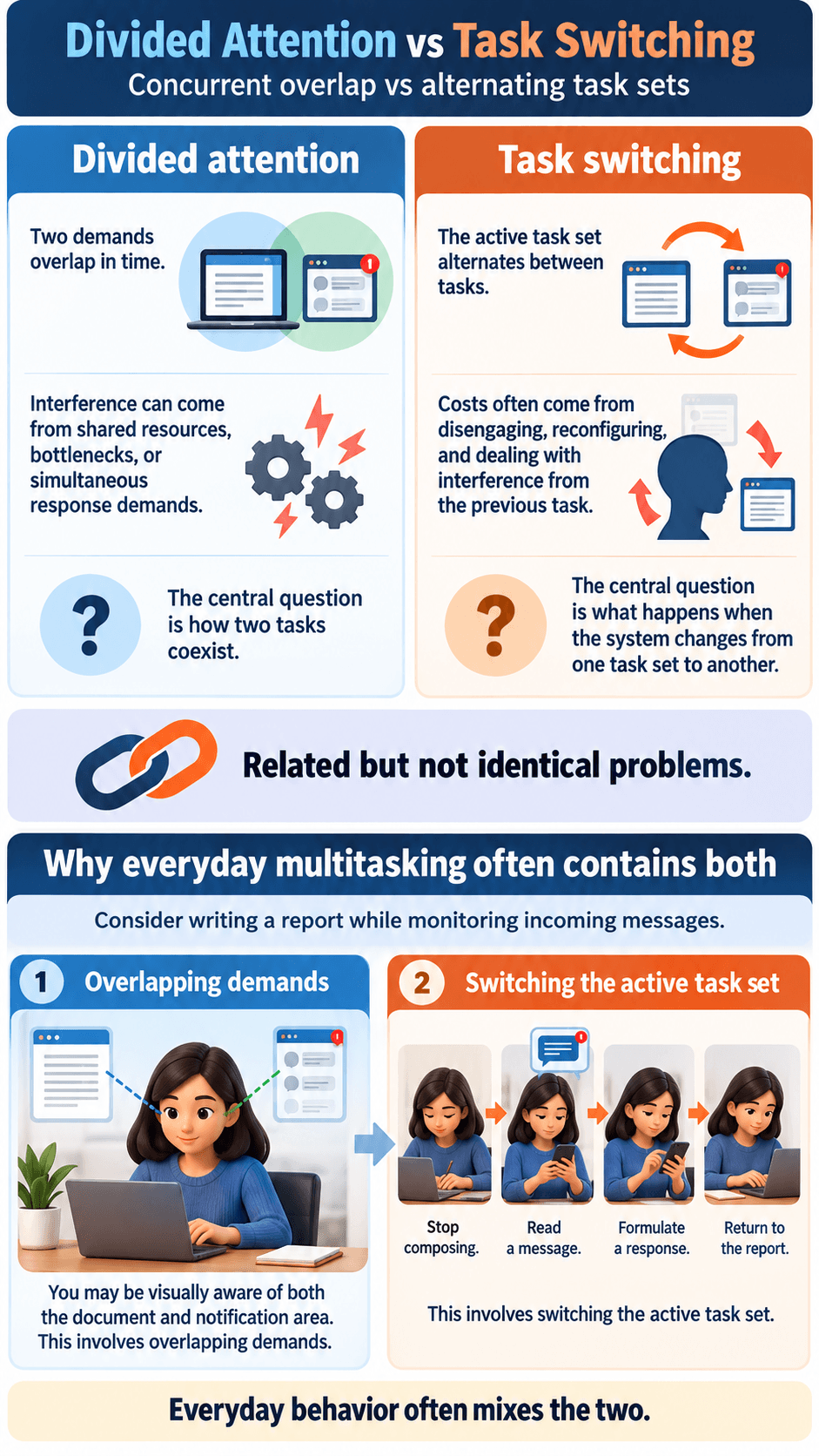
Concurrent overlap vs alternating task sets
| Divided attention | Task switching |
|---|---|
| Two demands overlap in time. | The active task set alternates between tasks. |
| Interference can come from shared resources, bottlenecks, or simultaneous response demands. | Costs often come from disengaging, reconfiguring, and dealing with interference from the previous task. |
| The central question is how two tasks coexist. | The central question is what happens when the system changes from one task set to another. |
A meta-analytic review of dual-tasking and task-switching found both shared and distinct patterns associated with the two forms of multitasking. The review supports treating them as related but not identical problems.
Why everyday “multitasking” often contains both
Consider writing a report while monitoring incoming messages. At some moments, you may be visually aware of both the document and notification area. At other moments, you stop composing, read a message, formulate a response, then return to the report.
The first part involves overlapping demands. The second involves switching the active task set. Everyday behavior often mixes the two, which is why the broad word “multitasking” can hide important distinctions.
Divided Attention vs Working Memory
Processing allocation vs temporary maintenance and manipulation
Working memory refers to the temporary maintenance and manipulation of information needed for current thinking. Divided attention concerns how processing is allocated when multiple demands overlap.
The systems interact. If both tasks require holding several pieces of information active, working-memory demands may add to interference. But divided attention is not simply “using too much working memory.”
A dual-task cost can appear because of response selection, perceptual competition, motor coordination, timing, or task preparation even when temporary storage is not the main problem.
Why “limited capacity” should not be treated as one single definition
Psychology uses the idea of limited capacity in several contexts. Attention is limited. Working memory is limited. Response selection can be bottlenecked. Perceptual systems can compete.
Those statements do not prove that all limitations come from one shared mental container. A stronger explanation identifies which operation is limited in the specific task.
A Task-Overlap Matrix
| Task combination | Likely overlap | What may happen |
|---|---|---|
| Two demanding language tasks | High | Pauses, slower responses, reduced comprehension, or one task postponed. |
| Two visual monitoring tasks | Moderate to high | Missed signals, slower orienting, or uneven monitoring. |
| Highly practiced motor task + simple listening | Often lower | Both may coexist reasonably well under easy conditions. |
| Practiced task + sudden difficult event | Can rise quickly | Attention shifts toward the newly demanding task and secondary performance may drop. |
| Two tasks requiring rapid response selection | High at central stages | The second response may be delayed when events occur close together. |
Similar vs dissimilar processing demands
Similarity is not only about whether two tasks look alike. Two very different activities may still require the same critical operation, such as choosing between responses quickly or producing language.
Conversely, two activities that appear related may interfere less if one has become highly automatic and the other uses different processing stages.
High vs low automaticity
Automaticity changes the matrix. A well-practiced operation may require less controlled processing than the same operation did during learning. This can reduce interference, but only for the practiced components and familiar conditions.
A sudden change can pull the task back into controlled processing, increasing competition almost immediately.
What the matrix can and cannot predict
The matrix is a thinking tool, not a performance calculator. It helps identify likely sources of competition, but actual dual-task costs depend on timing, instructions, expertise, fatigue, signal probability, motor requirements, and individual differences.
Two tasks that seem compatible in theory may interfere more than expected once real response demands are added.
First Step: Ask Whether the Tasks Truly Overlap
Concurrent processing, rapid switching, or a mixture
Before explaining a multitasking problem, identify what is actually happening. Are both tasks genuinely active at the same time? Are you alternating every few seconds? Or do the tasks overlap during some stages and switch during others?
This one distinction often clarifies the problem. If you are alternating between writing and messaging, task switching may explain much of the cost. If you are listening for one signal while continuously controlling another task, divided attention may be more central.
Identify which stage of processing competes
Next ask where the interference appears. Is it hard to perceive both signals? Hold both instructions in mind? Choose two responses? Coordinate two movements? Maintain both goals?
“I cannot multitask” is too broad to answer any of those questions. Identifying the competing stage produces a more useful explanation.
FAQ About Divided Attention
Is multitasking the same as divided attention?
Not exactly. Multitasking is a broad everyday term that can include true overlapping demands, rapid task switching, or a mixture of both. Divided attention specifically concerns multiple streams or tasks requiring processing during overlapping time.
Can two tasks ever be performed at the same time?
Yes. Some perceptual, motor, or highly practiced operations can proceed in parallel under certain conditions. The important limitation is that demanding central processes may still interfere. It is more accurate to say that simultaneous performance is constrained than to say that all dual-tasking is impossible.
Does practice eliminate dual-task interference?
Practice can reduce interference substantially for some task combinations by speeding operations or increasing automaticity. It does not guarantee zero cost, and gains may not transfer to unfamiliar tasks, unusual conditions, or sudden high-demand situations.
Why do similar tasks often interfere more?
Similar tasks are more likely to compete for the same sensory, cognitive, language, response, or motor operations. However, surface similarity is not enough to predict interference. Two apparently different tasks can still compete strongly if they require the same central processing stage.
Key Takeaways
- Divided attention concerns two or more demands that overlap in time, not simply switching back and forth.
- Dual-task interference depends on task similarity, timing, response requirements, difficulty, and automaticity.
- Some processing can occur in parallel, while certain central operations can create strong bottlenecks.
- Practice can reduce some interference, but automaticity is task-specific and can break down when conditions become difficult.
- Divided attention and working memory interact, but limited attention is not identical to working-memory capacity.
- In safety-critical activities, the safest assumption is that competing demands can matter even when one task feels familiar.
About the author: Michael Reed is the Founder & Lead Writer at Psychology Exposed. He explains psychology, human behavior, self-awareness, and everyday cognitive patterns in clear, research-aware language for general readers.
The most useful question is not whether you are “good at multitasking.” Ask what the two tasks require at the same time. When you can identify the shared demands, the interference usually becomes easier to understand.

Michael Reed is the Founder and Lead Writer at Psychology Exposed. He writes about human behavior, relationships, emotional patterns, self-awareness, and practical psychology topics using research-informed, easy-to-understand content.
Read More About Michael Reed: https://psychologyexposed.com/michael-reed/