
Claims about language and thought often arrive in dramatic form. You may hear that the language you speak “creates your reality,” that people cannot understand a concept unless their language has a word for it, or that different languages produce completely different minds. At the other extreme, you may hear that language is only a communication tool and has no meaningful effect on cognition.
Psychological research supports a more careful question. Language and thought are deeply connected, but they are not identical. Linguistic labels and grammatical patterns can sometimes guide attention, categorization, memory, or the way information is organized for a task. Those effects can be real without implying that language traps people inside a fixed worldview. Within language psychology, this question concerns how linguistic systems may influence cognition without assuming that language and thought are the same thing.
The useful goal is therefore not to choose between “language controls thought” and “language does nothing.” It is to ask what kind of cognitive process is being measured, how language is involved, whether the effect persists when language is not actively used, and whether competing explanations such as culture, task strategy, or experience have been addressed.
Quick Answer
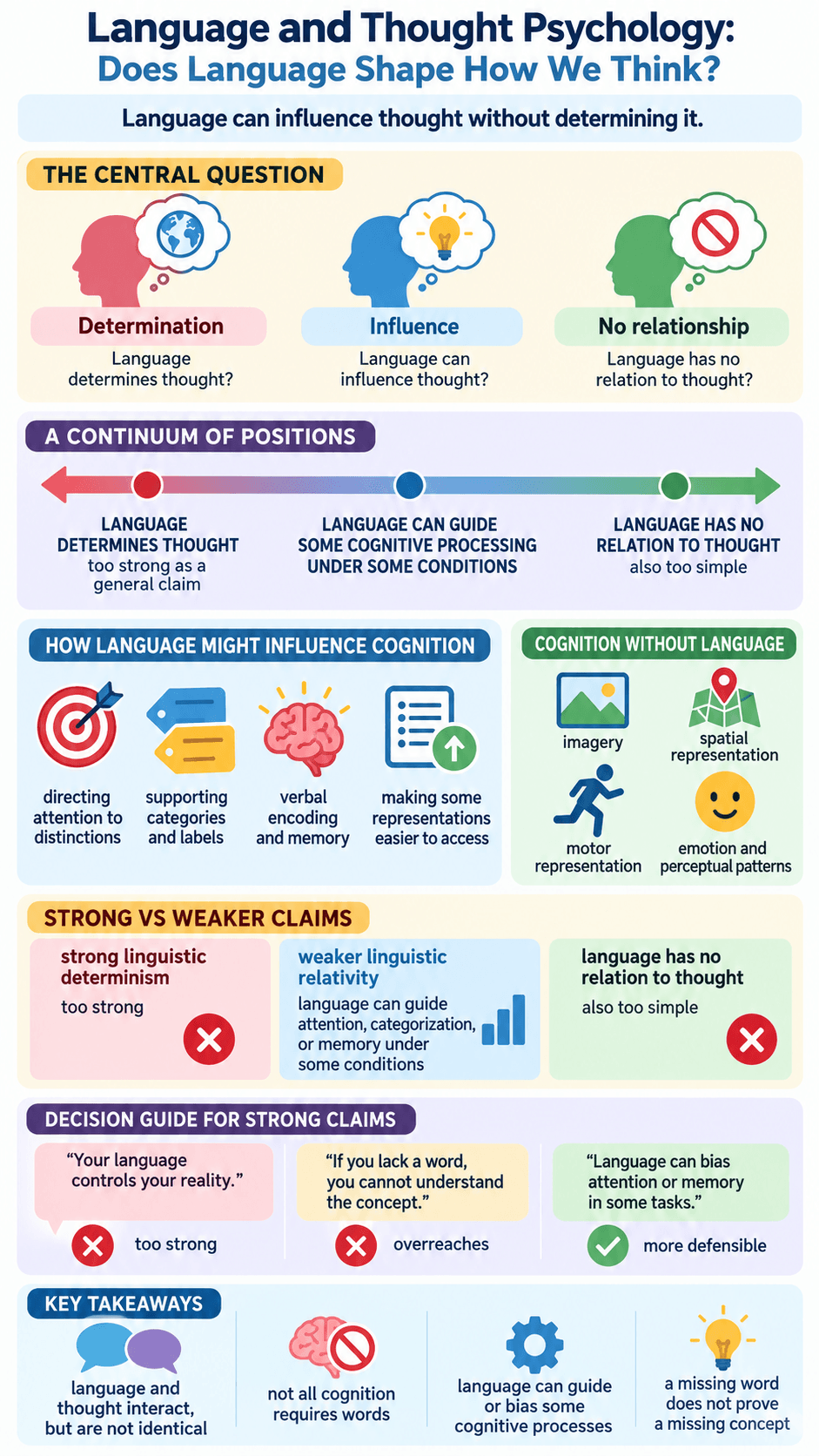
Language can influence thought without determining it. Research on linguistic relativity suggests that labels and habitual language patterns may guide attention, categorization, memory, spatial reasoning, and other cognitive processes under some conditions. However, humans also think nonverbally, and many cognitive abilities exist before or outside language. The strength of linguistic influence depends on the domain, task, context, and evidence.
The Central Question: Influence, Determination, or No Relationship?
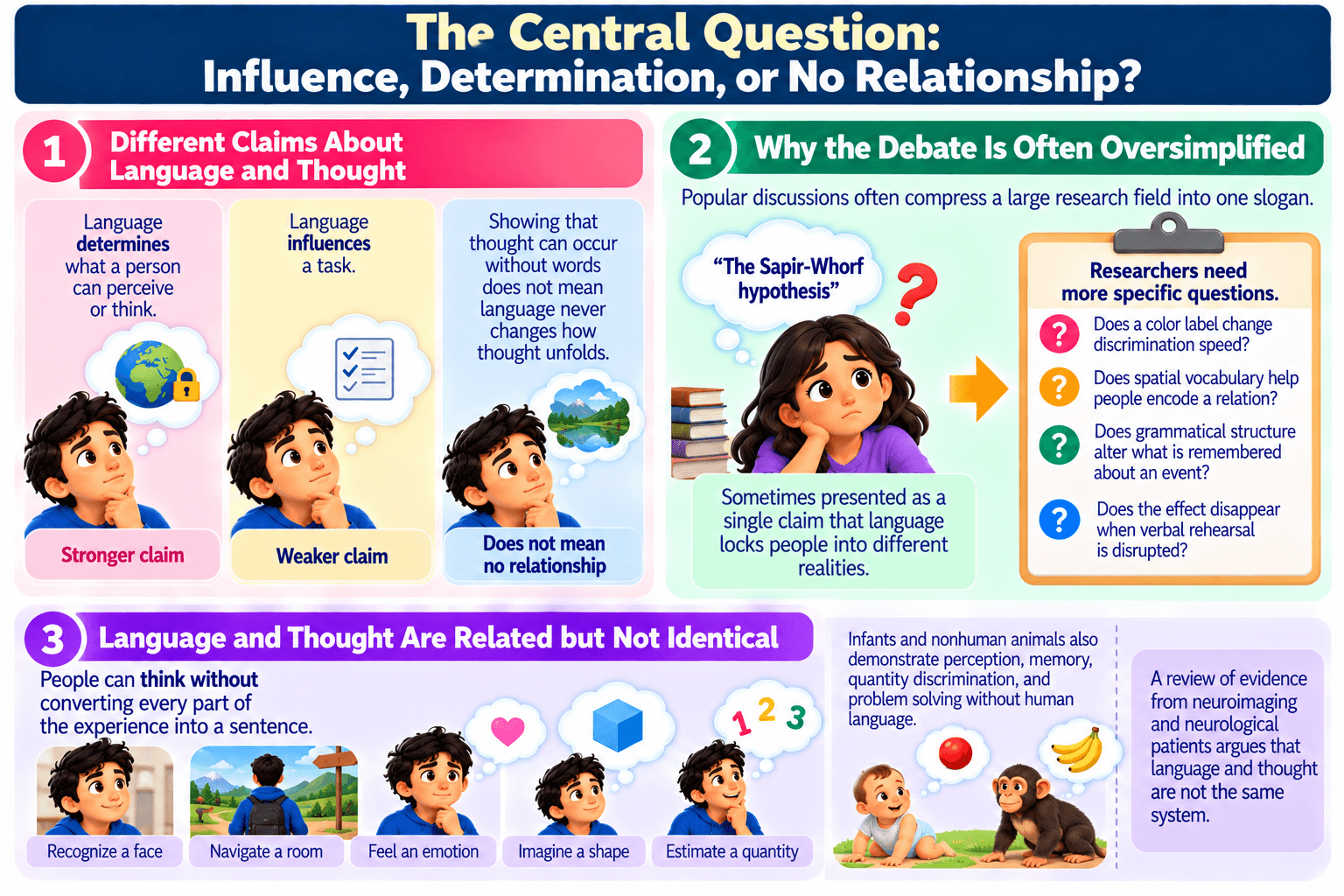
The debate becomes easier to understand once several different claims are separated. Saying that language influences a task is much weaker than saying language determines what a person can perceive or think. Likewise, showing that thought can occur without words does not prove that language never changes how thought unfolds.
Why the debate is often oversimplified
Popular discussions often compress a large research field into one slogan. “The Sapir-Whorf hypothesis” is sometimes presented as a single claim that language locks people into different realities. Yet a review discussing whether language may influence thought notes that the familiar label covers a much more complicated research program and that possible language effects differ in type, context, and mechanism.
Researchers therefore need more specific questions. Does a color label change discrimination speed? Does spatial vocabulary help people encode a relation? Does grammatical structure alter what is remembered about an event? Does the effect disappear when verbal rehearsal is disrupted? Each question tests a narrower claim than “language shapes reality.”
Language and thought are related but not identical
A person can recognize a face, navigate a room, feel an emotion, imagine a shape, or estimate a quantity without converting every part of the experience into a sentence. Infants and nonhuman animals also demonstrate forms of perception, memory, quantity discrimination, and problem solving that do not depend on human language.
A review of evidence from neuroimaging and neurological patients argues that language and thought are not the same system. The broader lesson is not that language is irrelevant. It is that a theory of language-thought interaction must allow cognition to exist outside language.
A Continuum for Thinking About the Evidence
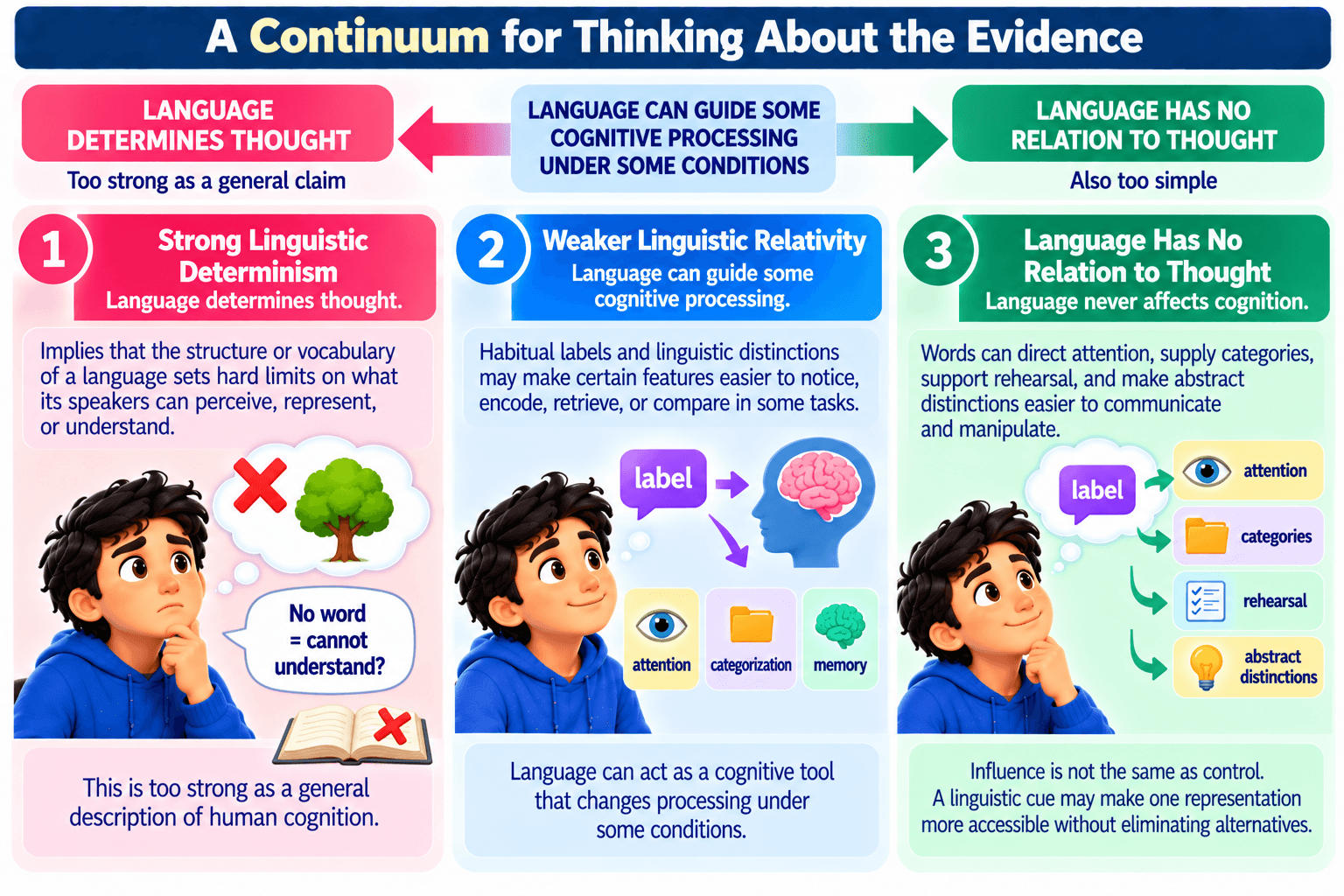
A simple continuum helps prevent strong and weak claims from being treated as equivalent.
LANGUAGE DETERMINES THOUGHT ← too strong as a general claim | LANGUAGE CAN GUIDE SOME COGNITIVE PROCESSING UNDER SOME CONDITIONS | LANGUAGE HAS NO RELATION TO THOUGHT ← also too simple
Strong linguistic determinism: language determines thought
Strong determinism implies that the structure or vocabulary of a language sets hard limits on what its speakers can perceive, represent, or understand. If a language lacked a particular word, a deterministic interpretation might suggest that its speakers could not grasp the corresponding concept.
This is too strong as a general description of human cognition. People can learn new concepts, understand paraphrases, invent terminology, use diagrams, compare unfamiliar categories, and translate ideas even when languages divide experience differently. Nonverbal cognition also places clear limits on the idea that all thought must be linguistically encoded.
Weaker linguistic relativity: language can guide attention, categorization, or memory under some conditions
A weaker claim is more compatible with contemporary research: habitual labels and linguistic distinctions may make certain features easier to notice, encode, retrieve, or compare in some tasks. Language can act as a cognitive tool that changes processing without becoming an absolute boundary.
The label-feedback hypothesis, for example, proposes that verbal labels can flexibly modulate ongoing perception and cognition. This approach predicts task-sensitive effects rather than a permanent restructuring of reality.
The opposite extreme: language has no relation to thought
The claim that language never affects cognition is also difficult to maintain. Words can direct attention, supply categories, support rehearsal, and make abstract distinctions easier to communicate and manipulate. Learning a new label can change what information is easy to retrieve during a task.
The important qualification is that influence is not the same as control. A linguistic cue may make one representation more accessible without eliminating alternatives.
Sapir and Whorf in Historical Context
Edward Sapir and Benjamin Lee Whorf are closely associated with linguistic relativity, but the familiar phrase “Sapir-Whorf hypothesis” can create a false impression that they proposed one precise experimental hypothesis together.
What the labels are commonly used to describe
The label is generally used for the idea that differences among languages may be associated with differences in habitual thought or attention. Whorf was especially interested in how recurring grammatical and lexical patterns might encourage speakers to attend to experience in particular ways.
Historical writing in this area included stronger and weaker formulations, which is one reason modern discussions should identify exactly which claim is being evaluated.
Why modern evidence should not be reduced to one historical slogan
Current research uses experiments, cross-linguistic comparisons, developmental evidence, neurophysiological methods, and interference tasks that did not exist in Whorf’s era. Modern linguistic relativity is therefore better understood as a family of questions about language-cognition interaction than as a vote for or against one historical sentence.
When a new study finds a language effect, it does not automatically validate every Whorfian claim. When another study fails to find an effect, it does not automatically show that language never influences cognition.
How Language Might Influence Cognition
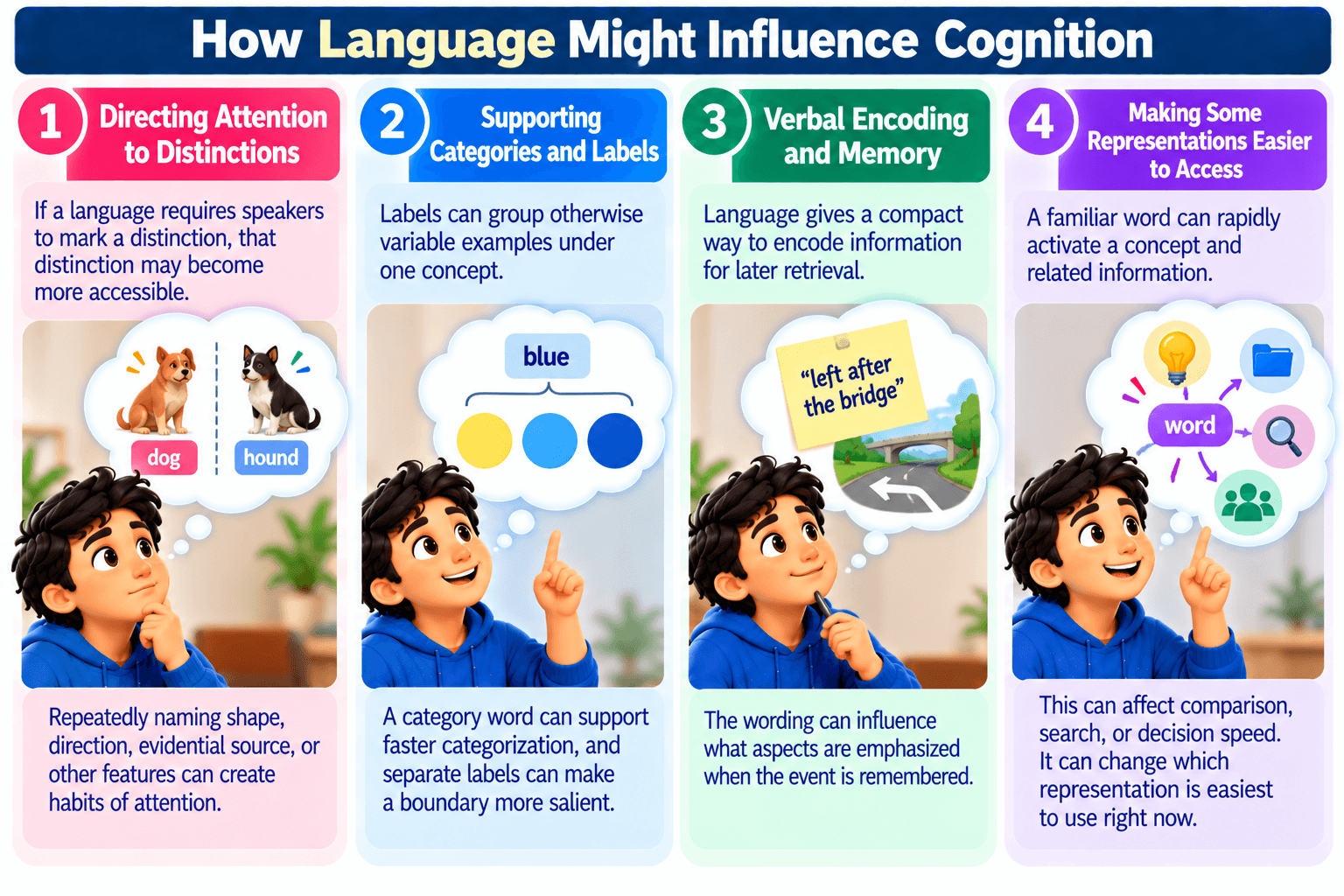
Language can affect cognition through several possible routes. These mechanisms are not mutually exclusive, and different tasks may rely on different combinations.
Directing attention to distinctions
If a language routinely requires speakers to mark a distinction, that distinction may become especially accessible during relevant tasks. Repeatedly naming shape, direction, evidential source, or other features can create habits of attention without making alternative distinctions impossible.
The critical question is whether the effect appears outside the immediate act of speaking and whether other experiences could explain it.
Supporting categories and labels
Labels can group otherwise variable examples under one concept. Naming several shades with one category word can support fast categorization. Learning separate labels can make a boundary more salient.
This does not mean the label creates the underlying sensory differences. It can change how the differences are organized, remembered, or used during a task.
Verbal encoding and memory
Language gives people a compact way to encode information for later retrieval. If you describe a color as “deep blue,” a route as “left after the bridge,” or an event as “the cyclist hit the cone,” the wording can influence what aspects are emphasized when the event is remembered.
Verbal encoding can therefore shape memory without implying that memory consists only of words.
Making some representations easier to access
A familiar word can rapidly activate a concept and related information. That accessibility can affect comparison, search, or decision speed. The effect may be temporary and task-dependent rather than a permanent difference in conceptual capacity.
This is a useful way to understand many language effects: language can change which representation is easiest to use right now.
Color Language Research With Nuance
Color is one of the most famous test cases because human visual systems share broad biological constraints while languages divide and name the color spectrum in different ways.
Category labels and discrimination
Some experiments report that color distinctions aligned with language categories can influence discrimination. A study comparing Greek and English speakers found electrophysiological evidence that linguistic color categories can modulate color processing.
Such findings are important because they suggest that language can interact with perceptual processing. They do not establish that speakers literally see entirely different physical worlds.
Why findings do not prove different languages create separate realities
Color perception also reflects shared visual biology, continuous sensory structure, learning, and task demands. People can discriminate colors for which they do not have unique basic words, and speakers can learn new labels without acquiring a new visual system.
The evidence is therefore more compatible with modulation than imprisonment. Language categories can bias how a distinction is processed while leaving substantial common perceptual structure across speakers.
Space, Time, Number, and Other Cross-Linguistic Domains
Linguistic relativity is not limited to color. Researchers have studied spatial reference, temporal metaphors, numerical representation, motion events, object categories, and memory. The strength of evidence differs across domains.
Spatial frames of reference where supported
Languages differ in how commonly they describe space using left and right, landmarks, body-centered directions, or absolute directions such as north and south. Spatial language can provide tools for encoding relations that matter during navigation and reasoning.
Research with children who lacked conventional spatial language found that spatial language can facilitate spatial cognition. At the same time, other spatial studies show that people can solve tasks in ways that do not simply mirror the habitual vocabulary of their language. Context and task design remain important.
Time concepts where supported
Languages use different spatial and grammatical resources to talk about time. English speakers often describe future events as “ahead” and past events as “behind,” while other linguistic systems can organize temporal relations differently.
A recent multidisciplinary review of temporal perception, cognition, and memory characterizes language and culture as influences on default temporal orientation and interpretation while rejecting the strong idea that linguistic systems create inescapable cognitive prisons.
Number representation where supported
Number provides an especially useful boundary case. Humans and other animals can represent approximate quantity without number words, and preverbal infants show numerical sensitivities. At the same time, language supplies exact number words and counting systems that support representations far beyond approximate quantity.
This combination shows why “language versus thought” is often the wrong framing. Nonlinguistic numerical capacities can exist first, while linguistic symbols later extend what people can represent and manipulate exactly.
Why findings vary by task, language, and context
A language effect found in one experiment may disappear when participants cannot use verbal rehearsal, when a different response measure is used, or when the context favors another strategy. Cross-linguistic differences can also reflect education, literacy, geography, cultural practices, or other experiences correlated with language.
Strong evidence therefore requires careful controls and replication across methods. The question is not merely whether two language groups differ, but why they differ.
Cognition Without Language
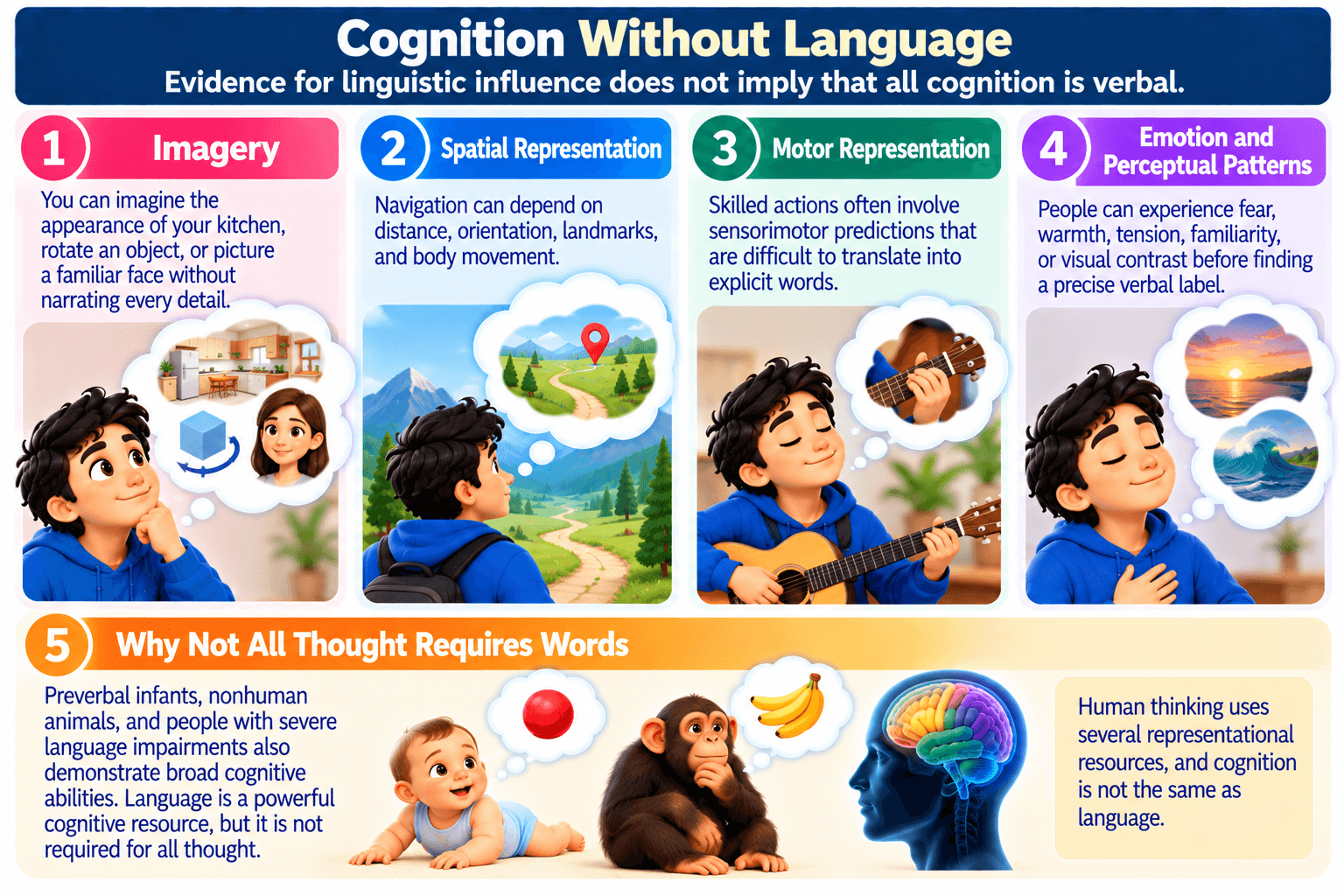
Evidence for linguistic influence does not imply that all cognition is verbal. Human thinking uses several representational resources.
Imagery
You can imagine the appearance of your kitchen, rotate an object mentally, or picture a familiar face without narrating every visual detail. Words may accompany the image, but the spatial and visual structure is not reducible to a sentence.
Spatial representation
Navigation can depend on distance, orientation, landmarks, and body movement. Language can help encode those relations, yet the ability to represent space is not created entirely by spatial vocabulary.
Motor representation
Skilled actions often involve sensorimotor predictions that are difficult to translate into explicit words. A practiced musician or athlete may know how a movement should feel without silently describing every component.
Emotion and perceptual patterns
People can experience fear, warmth, tension, familiarity, or visual contrast before finding a precise verbal label. Language may later help categorize or communicate the experience without being its sole source.
Why not all thought requires words
If language were required for every thought, preverbal infants, nonhuman animals, and people with severe language impairments would lack broad cognitive abilities. Evidence does not support that conclusion.
Language is better understood as one powerful cognitive resource that interacts with systems for perception, memory, action, attention, and reasoning.
Language and Thought vs Inner Speech
These topics are close enough to be confused but answer different questions.
Internal verbal experience
Inner speech asks what it is like when language appears inside the mind: full sentences, compressed fragments, imagined dialogue, silent rehearsal, or self-guidance. It focuses on the form and function of internal verbal experience.
Broader influence of linguistic systems on cognition
Language and thought research asks whether vocabulary, grammatical categories, or habitual linguistic distinctions influence cognition even beyond conscious inner speech. A person can show a language-related categorization effect without reporting that they silently talked through the task.
Not all language effects are inner speech, and not all inner speech demonstrates linguistic relativity.
Language and Thought vs Belief Psychology
Understanding or using a linguistic category does not tell us whether a person accepts a proposition as true.
Cognitive processing shaped by linguistic categories
Linguistic relativity focuses on processing. A label may change which distinction is easier to notice or remember, or which category becomes more accessible during a task.
Accepting propositions as true
Belief concerns what a person accepts, rejects, doubts, or treats as true. Someone can understand a linguistic frame or category without believing the claim expressed through it.
This boundary matters because language effects should not be inflated into claims that words automatically determine beliefs.
Language and Thought vs Framing Effects
Language can influence cognition in many ways, but not every effect of wording belongs to linguistic relativity.
Broad language-cognition relation
Language and thought research asks whether habitual linguistic categories or representations influence perception, categorization, memory, attention, or reasoning.
Different presentations altering judgment or choice
A framing effect occurs when different presentations of equivalent information alter judgment or choice. That is primarily a decision-making question. Calling a treatment “90 percent survival” rather than “10 percent mortality,” for example, concerns how presentation affects evaluation rather than whether the grammar of a language restructures cognition.
Keeping these topics separate prevents linguistic relativity from becoming a catch-all explanation for every wording effect.
Why Translation and Cross-Linguistic Understanding Matter
The possibility of translation places an important limit on strong determinism. Languages do not divide experience in exactly the same way, yet speakers can explain unfamiliar distinctions to one another.
Concepts can often be represented across languages
A language may lack one compact word for a concept but still express it with a phrase, example, definition, gesture, or borrowed term. A missing lexical item therefore does not automatically imply a missing concept.
Learning a new word can make a distinction easier to discuss and remember, but the ability to acquire the word already suggests that cognition is not permanently trapped by the previous vocabulary.
Translation is possible even when categories do not align perfectly
Translation is often approximate because one word may cover a slightly different range than its nearest equivalent. Translators use context, explanation, and reformulation to bridge those mismatches.
Imperfect equivalence demonstrates that languages organize meaning differently. Successful explanation demonstrates that those differences are not absolute cognitive walls.
A Decision Guide for Strong Claims
When you encounter a striking statement about language and reality, the wording of the claim matters as much as the evidence offered for it.
Claim: “Your language controls your reality”
This claim is too strong. To support it, evidence would need to show that speakers are unable to represent or perceive relevant distinctions outside their language, not merely that they respond differently on one task. Existing evidence is much more compatible with selective influence than total control.
Claim: “If you lack a word, you cannot understand the concept”
This also overreaches. People can learn new categories, understand definitions, reason with images, and communicate concepts through phrases rather than single words. A convenient label may improve accessibility without creating the entire concept from nothing.
Claim: “Language can bias attention or memory in some tasks”
This is a much more defensible form of claim. Research provides examples in which linguistic labels or habitual distinctions are associated with measurable changes in categorization, perception, memory, or reasoning.
The exact effect still needs to be judged study by study.
What evidence would be needed for each strength of claim
| Claim strength | What evidence would help | What would not be enough |
|---|---|---|
| Language changes performance on a task | Replicated task differences with plausible linguistic mechanism | One anecdote or translation example |
| Language habitually guides cognition | Effects across tasks, contexts, or methods with competing explanations addressed | A single language-group difference |
| Language determines what can be thought | Evidence of hard cognitive limits that cannot be overcome by learning, nonverbal representation, or explanation | Faster categorization or memory bias |
What to Read Next
The next topic depends on what part of the language-cognition relationship you want to understand more precisely.
Inner Speech for internal verbal experience
If your question is why you sometimes think in words inside your head, inner speech is the better focus. That topic deals with internal verbal phenomenology rather than cross-linguistic effects on perception or categorization.
Bilingualism for multiple language systems
If you want to know what happens when two languages remain active in one mind, bilingualism is the more precise topic. It focuses on cross-language activation, selection, switching, and control rather than the broad theory of linguistic relativity.
Cognitive Psychology or Perception for broader cognition boundaries
If you want a wider map of attention, perception, memory, learning, reasoning, and language, Cognitive Psychology Explained provides the broader cognitive context. Perception psychology is the better direction when the main question concerns how sensory information becomes meaningful experience.
FAQ
These questions address the strongest recurring claims in the language-and-thought debate.
What is linguistic relativity?
Linguistic relativity is the idea that characteristics of a language may influence patterns of cognition, such as attention, categorization, memory, or spatial reasoning. Modern evidence generally supports examining specific, context-dependent forms of influence rather than assuming that language completely determines a speaker’s worldview.
Is the Sapir-Whorf hypothesis proven?
There is no single modern “Sapir-Whorf hypothesis” that can simply be marked proven or disproven. Strong deterministic interpretations are not well supported as a general theory. Weaker questions about whether linguistic distinctions influence particular cognitive processes have received support in some domains, mixed results in others, and continuing methodological debate.
Can people think without language?
Yes. Evidence from perception, imagery, spatial cognition, numerical cognition, preverbal development, nonhuman animals, and people with language impairments shows that many cognitive processes do not require full linguistic representation. Language can still enrich, organize, or extend those processes.
Do different languages create completely different minds?
No. Human cognition shows substantial common structure across languages, and people can learn, translate, and understand unfamiliar distinctions. Language differences may guide habitual attention or representation in particular contexts, but that is very different from creating mutually inaccessible realities.
Can language influence memory or attention without determining thought?
Yes. A label can make a category more accessible, guide attention toward a distinction, or provide a compact verbal encoding that affects later recall. Such effects can change processing probabilities without preventing people from using other representations or learning alternative ways to think about the same information.
Key Takeaways
- Language and thought interact, but they are not identical systems and not all cognition requires words.
- Strong linguistic determinism is a much larger claim than evidence that labels or linguistic habits influence a particular task.
- Modern linguistic relativity is best treated as a set of testable questions about when, how, and how strongly language affects cognition.
- Research on color, space, time, categorization, and memory provides examples of language-related effects, but results depend on task design, context, and competing explanations.
- A missing word does not prove a missing concept, and translation remains possible even when languages divide meaning differently.
- The most defensible conclusion is that language can guide or bias some cognitive processes while leaving substantial room for nonverbal thought and flexible learning.

Michael Reed is the Founder and Lead Writer at Psychology Exposed. He writes about human behavior, relationships, emotional patterns, self-awareness, and practical psychology topics using research-informed, easy-to-understand content.
Read More About Michael Reed: https://psychologyexposed.com/michael-reed/