

If you see the word doctor and then quickly encounter nurse, you may respond to the second word a little faster than if it had followed an unrelated word such as window. That small shift in processing speed is the kind of effect researchers call semantic priming.
Semantic priming psychology focuses on how prior semantic context can temporarily change the accessibility or processing of a later target. It is usually studied with tightly controlled laboratory tasks that measure reaction time and accuracy across many trials. The important outcome is not that a prime secretly “controls” what a person thinks or does. It is that a related context can alter how efficiently a later word is recognized or evaluated under particular experimental conditions.
This distinction matters because the word priming has accumulated much broader popular meanings. In psycholinguistics, semantic priming is a precise experimental phenomenon. It connects research on word recognition and semantic processing, but it should not be stretched into claims about subliminal persuasion, automatic belief change, or guaranteed real-world behavior.
Quick Answer
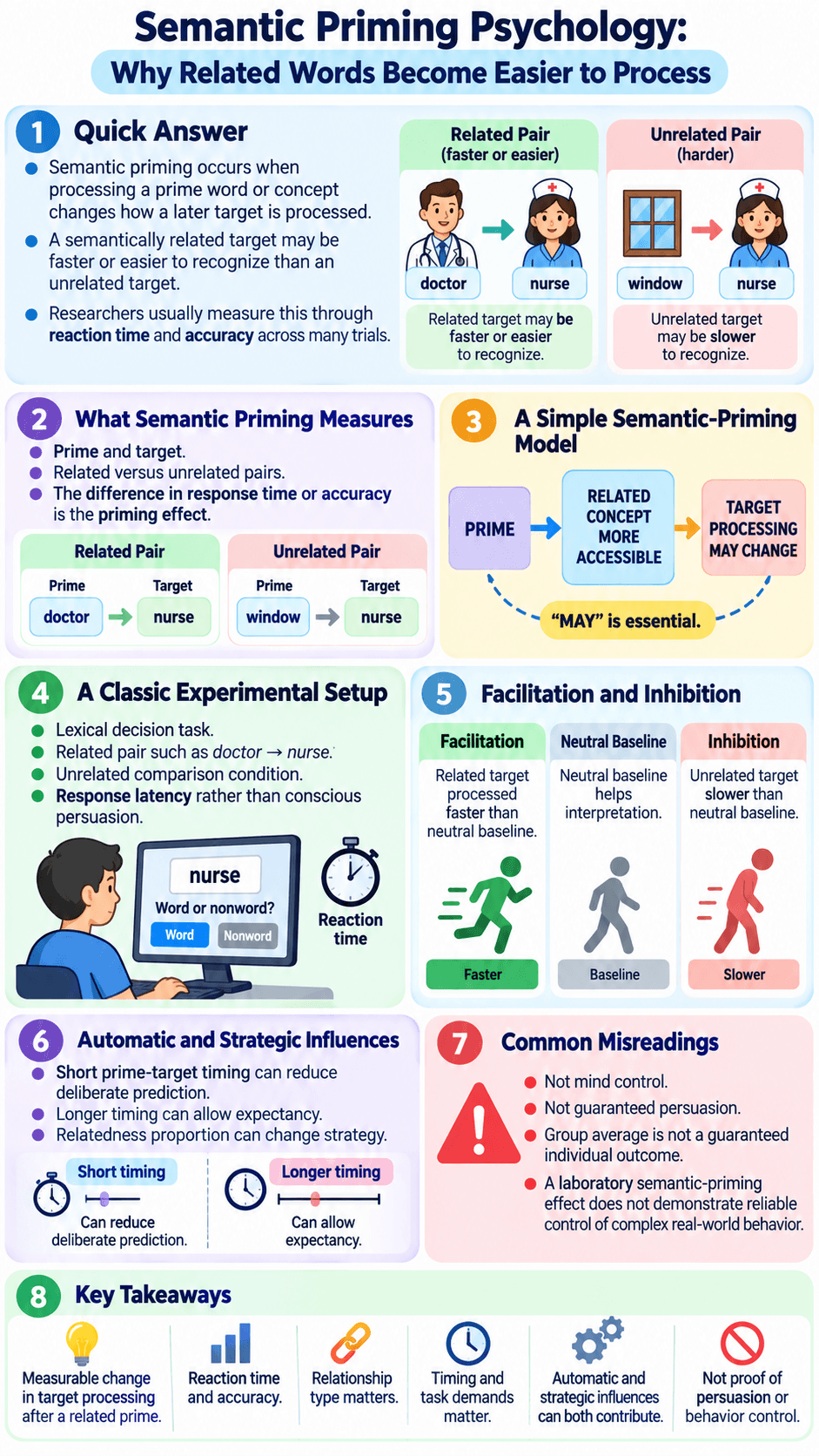
Semantic priming occurs when processing a prime word or concept changes how a later target is processed, often making a semantically related target faster or easier to recognize than an unrelated target. Researchers usually measure this effect through reaction time and accuracy across many trials. The size and mechanism of priming depend on timing, relationship type, task demands, and strategic expectations.
What Semantic Priming Measures

Semantic priming is about a difference between conditions. Researchers compare responses to targets preceded by related primes with responses to the same or comparable targets preceded by unrelated or neutral primes. The difference in response time or accuracy is the priming effect.
Prime and target
The prime is the item presented first. The target is the item whose processing is measured afterward. In a word experiment, doctor might be the prime and nurse the target.
The classic 1971 study by Meyer and Schvaneveldt, indexed by PubMed, found faster responses for commonly associated word pairs than for unassociated pairs. That work became a foundation for decades of research using related and unrelated word conditions to study lexical and semantic processing.
Related versus unrelated pairs
A related pair might share meaning, category membership, association, or some combination of these. Cat → dog can be related because both are animals and are commonly associated. Bread → butter is strongly associated through everyday experience even though the two words do not belong to the same category.
An unrelated condition provides a comparison. If doctor → nurse produces faster responses than table → nurse, the difference suggests that prior related context changed processing of the target.
Why response time is usually measured across many trials and participants
A priming effect is not normally inferred from one person responding quickly to one word pair. Reaction times fluctuate for many reasons, including attention, fatigue, motor speed, familiarity, and random variation. Researchers therefore compare patterns across repeated trials and groups of participants.
This is why a group-average priming effect should not be translated into “this word will make every person respond in exactly this way.” The effect is statistical and probabilistic.
A Simple Semantic-Priming Model
A useful starting model is:
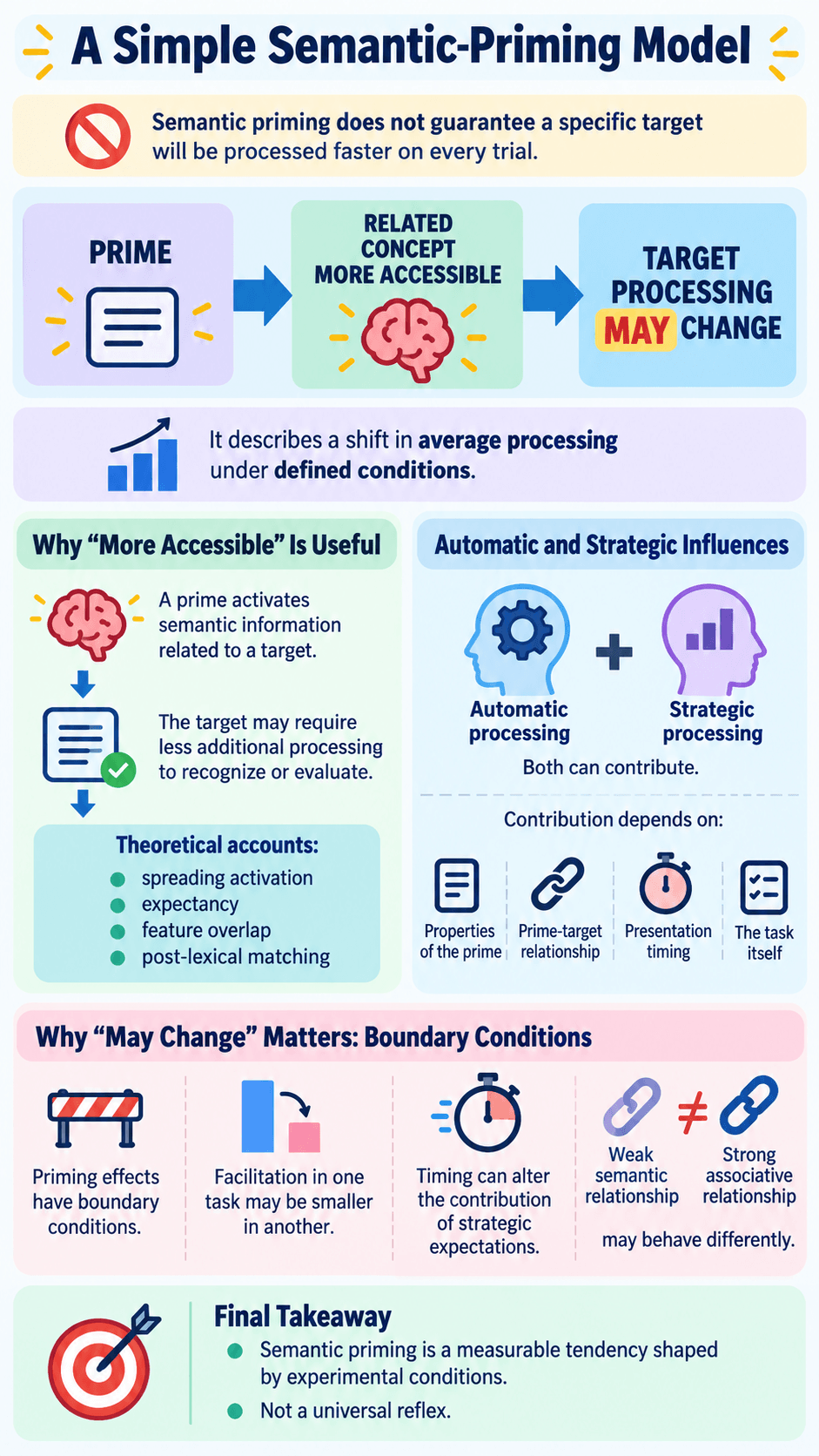
PRIME → RELATED CONCEPT MORE ACCESSIBLE → TARGET PROCESSING MAY CHANGE
The word may is essential. Semantic priming does not guarantee that a specific target will be processed faster on every trial. It describes a shift in average processing under defined conditions.
Why “more accessible” is a useful description
When a prime activates semantic information related to a target, the target may require less additional processing to recognize or evaluate. Several theoretical accounts can explain that advantage, including spreading activation, expectancy, feature overlap, and post-lexical matching.
A recent review of prime characteristics in semantic priming emphasizes that both automatic and strategic processing can contribute, depending on properties of the prime, the prime-target relationship, presentation timing, and the task itself.
Why “may change” matters
Priming effects have boundary conditions. A relationship that produces facilitation in one task may produce a smaller effect in another. Timing can alter the contribution of strategic expectations. A weak semantic relationship may behave differently from a strong associative relationship.
Semantic priming is therefore better understood as a measurable tendency shaped by experimental conditions than as a universal reflex.
A Classic Experimental Setup

One of the most common ways to study semantic priming is the lexical decision task. The design makes a subtle change in processing measurable in milliseconds.
Lexical decision task
Participants see a target letter string and decide as quickly and accurately as possible whether it is a real word. A real target might be nurse. A nonword might look pronounceable but have no lexical entry, such as nirse.
A review of semantic priming methods notes that lexical decision and naming tasks have been used extensively because they provide sensitive measures of how prior context changes target recognition. Research on semantic priming in lexical decision also shows that response mode and task demands can influence the observed effect.
Related pair such as doctor → nurse
Imagine that participants first see doctor, followed shortly by nurse. If the two concepts are related in the participant’s semantic experience, the target may be identified as a real word more quickly than it would be after an unrelated prime.
The important observation is the average difference between conditions, not the intuitive feeling that the second word “makes sense.”
Unrelated comparison condition
The target nurse might instead follow window. The unrelated prime gives researchers a baseline for comparison. If responses are slower in this condition, the related prime appears to have facilitated target processing.
Some designs also include neutral conditions so researchers can distinguish facilitation from inhibition. A related prime can make a target faster than neutral, while an unrelated prime can sometimes slow the target relative to neutral.
Response latency rather than conscious persuasion
In this setup, the dependent measure is often response latency, meaning how long it takes to make the word/nonword decision. The task is not asking whether the prime persuaded the participant to believe something.
That difference protects the interpretation. Faster lexical access is evidence about language processing. It is not direct evidence that the prime changed a political attitude, purchase decision, moral judgment, or complex behavior.
Facilitation and Inhibition Are Different Effects
Researchers sometimes talk about semantic priming as if related words simply “speed things up.” In many experiments, however, the interpretation becomes clearer when a neutral condition is included. That lets researchers ask whether the related prime helped, the unrelated prime hurt, or both processes contributed.
Facilitation
Facilitation occurs when a related target is processed faster than a neutral baseline. If doctor → nurse produces a shorter reaction time than a condition with a neutral prime, the related context appears to have made the target easier to process.
This is the effect most people have in mind when they hear “semantic priming.”
Inhibition
Inhibition occurs when an unrelated target is slower than a neutral baseline. One explanation is strategic expectancy. If a participant learns that primes are usually followed by related targets, they may prepare a small set of likely words. An unrelated target then requires abandoning that expectation before responding.
Inhibition is not always present, and it tends to depend more heavily on task design and strategic processing than the basic facilitation effect.
Why a neutral baseline helps interpretation
If a study compares only related and unrelated trials, a difference can show that the conditions are not equivalent, but it cannot always reveal whether the effect came mainly from faster related trials, slower unrelated trials, or a mixture of both.
Neutral conditions are therefore useful when the research question concerns mechanism rather than only the existence of a relatedness effect.
Semantic Relationships and Associative Relationships
Words can be related in more than one way, and the type of relationship can affect priming.
Category or meaning similarity
Words such as dog and elephant share semantic category information because both are animals, even though they may not be the first pair that people spontaneously produce together. Words can also share features, functions, or conceptual structure.
Frequently associated pairs such as bread → butter
Association refers more to how strongly two items are linked through experience or word use. Bread → butter is a familiar example. The words often occur in related contexts even though one is not a subtype of the other.
Research distinguishing semantic and associative priming notes that pairs can be semantically related, associatively related, or both, and that these relationships do not always produce identical effects.
Why relationship type can matter
A strongly associated pair may produce a robust response advantage because the prime makes the target highly expected. A semantically similar but weakly associated pair may reveal a different kind of conceptual relationship.
This means that “related” should not be treated as one simple category. Researchers need to know what kind of relation connects the words and how strongly that relation is represented in the stimulus set.
How Researchers Explain the Effect
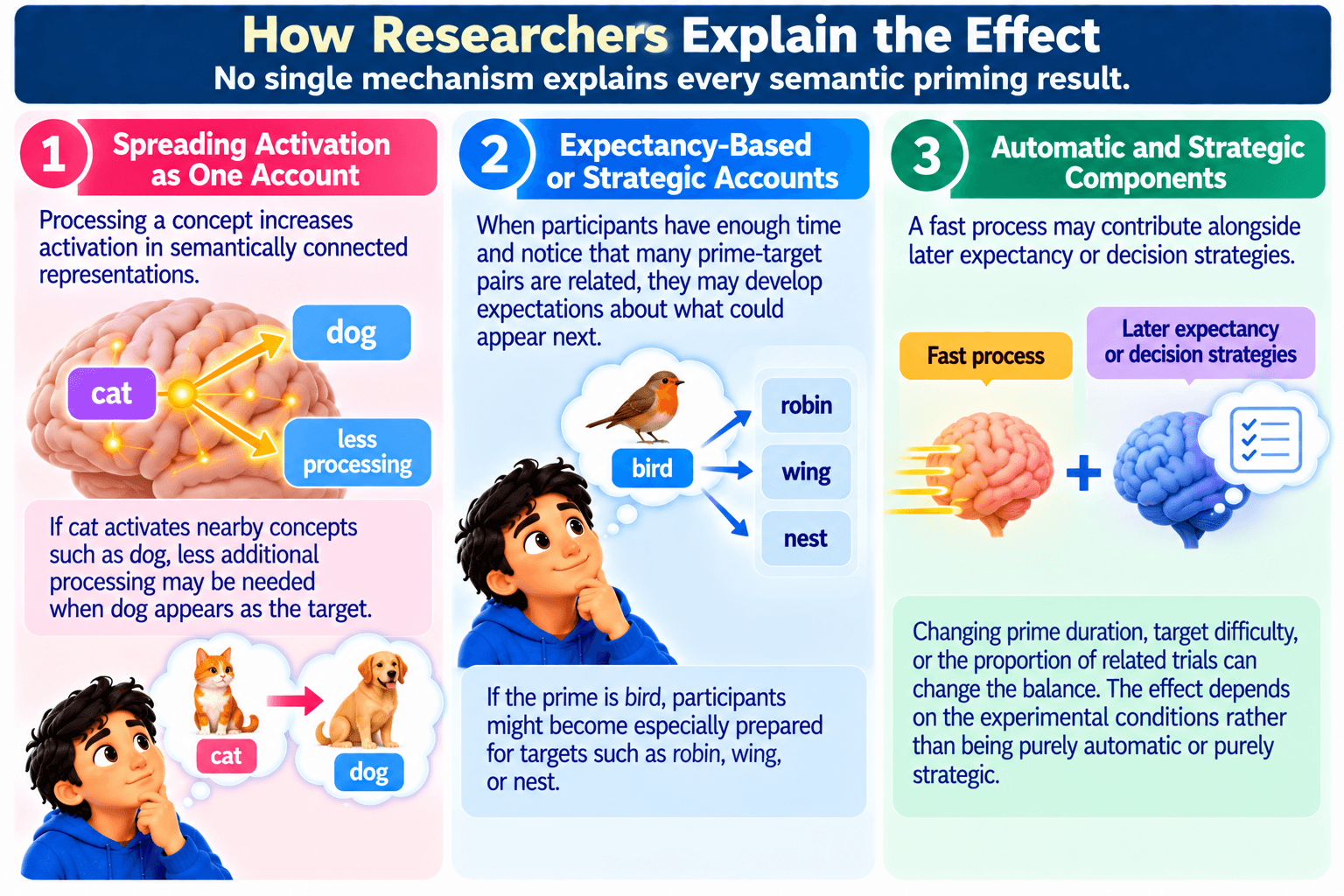
No single mechanism explains every semantic priming result. Several accounts have been proposed, and more than one can contribute within the same experiment.
Spreading activation as one account
The spreading-activation account proposes that processing a concept increases activation in semantically connected representations. If cat activates nearby concepts such as dog, less additional processing may be needed when dog appears as the target.
This is a useful model, not a literal picture of energy moving between fixed dictionary entries in the brain. Modern semantic theories include distributed and feature-based accounts as well as network approaches.
Expectancy-based or strategic accounts
When participants have enough time and notice that many prime-target pairs are related, they may develop expectations about what could appear next. If the prime is bird, they might become especially prepared for targets such as robin, wing, or nest.
Research on strategic mechanisms in semantic priming describes expectancy generation and semantic matching as controlled processes that can contribute when timing and task structure allow participants to use the relationship between prime and target strategically.
Automatic and strategic components are not a simple binary
It is tempting to divide priming into “automatic” and “conscious” effects. Real experiments are more complicated. A fast process may contribute alongside later expectancy or decision strategies. Changing prime duration, target difficulty, or the proportion of related trials can change the balance.
For that reason, modern accounts often ask which mechanisms are likely under a particular set of conditions rather than labeling the entire effect as purely automatic or purely strategic.
Timing and Context
The interval between prime and target is one of the most important variables in semantic priming research.
How prime-target timing can change the observed effect
Researchers often discuss stimulus onset asynchrony, or SOA, which is the time from the onset of the prime to the onset of the target. Shorter intervals reduce the time available to consciously generate likely targets. Longer intervals can allow expectancy strategies or retrospective comparison to contribute.
A review of automatic and strategic processes in semantic priming describes how short and long timing conditions can recruit different mixtures of mechanisms rather than revealing one single process.
Why task demands and expectations matter
If most pairs in an experiment are obviously related, participants may learn that semantic relationships are useful for predicting the target. If related pairs are rare, such a strategy is less useful. Likewise, a lexical decision task can encourage processes that differ from a simple pronunciation task.
The observed priming effect is therefore partly a property of the experimental design. This is not a flaw. It is precisely why researchers manipulate timing, relatedness proportion, and task instructions to test competing explanations.
Relatedness Proportion Can Change Strategy
The percentage of related prime-target pairs in an experiment can influence what participants learn about the task. Researchers often call this the relatedness proportion.
High relatedness can make prediction useful
If most prime-target pairs are related, participants have a reason to use the prime strategically. After seeing bird, preparing for likely related words may improve performance often enough to be worthwhile.
That strategic benefit can increase measured priming, especially when the interval between prime and target is long enough to form expectations.
Low relatedness reduces the value of expectancy
If related pairs are rare, trying to predict the target from the prime may waste effort. Under those conditions, any remaining priming effect is less easily explained as deliberate expectancy alone.
This is one reason researchers do not interpret a reaction-time difference without looking at the broader stimulus list and procedure. The same word pair can behave differently when embedded in a different experimental environment.
Semantic Processing vs Semantic Priming
The terms overlap but should not be treated as synonyms.
General meaning access
Semantic processing refers broadly to how meanings and conceptual relationships become available when language is understood. It includes ambiguity resolution, category knowledge, feature relationships, and context-dependent meaning.
Prior semantic context changing later processing
Semantic priming is more specific. It asks whether processing one item changes how a later target is processed. The emphasis is on the measurable effect of prior context, usually through a comparison between related and unrelated conditions.
In short, semantic processing concerns meaning access generally; semantic priming concerns what happens to later processing after semantic information has already been activated.
Word Recognition and Semantic Priming
Semantic priming often uses word-recognition tasks, which is why the topics connect naturally.
Faster identification as one measurable outcome
If a related prime makes a target easier to classify as a real word, researchers can use that difference to infer something about lexical access and semantic organization. Priming becomes a tool for studying word recognition rather than a separate form of persuasion.
Why priming does not mean a word was consciously predicted
A faster response does not prove that the participant consciously thought, “The next word will be nurse.” Some priming effects occur under conditions designed to minimize deliberate prediction.
Other conditions do allow strategic expectancy. The correct interpretation depends on the timing and design, which is why the same reaction-time difference cannot always be assigned to the same mechanism.
Semantic Priming vs Persuasion or Manipulation
This boundary is especially important because popular psychology often uses the word prime much more broadly than psycholinguistics does.
Laboratory accessibility effect
Semantic priming typically concerns a small change in target processing, such as faster lexical decisions or pronunciation after a related prime. It is a controlled measure of accessibility and recognition.
Attempts to change attitudes, beliefs, or behavior
Persuasion involves attempts to influence judgments, attitudes, beliefs, intentions, or actions. Behavioral priming research is also a separate literature with different outcomes and substantial methodological debate.
The existence of that separate literature does not turn a standard semantic lexical-decision effect into evidence for behavioral control. The outcome being measured still matters.
Why one cannot be treated as proof of the other
Showing that doctor speeds recognition of nurse does not demonstrate that a hidden word can reliably make someone buy a product, change a political view, or obey a suggestion. Those are much more complex outcomes involving goals, context, prior beliefs, incentives, social influence, and many other processes.
Evidence must match the claim being made.
Common Misreadings of Priming Research
Semantic priming is easy to exaggerate because the basic finding sounds intuitive and powerful. Careful interpretation keeps the effect within the scale of what was actually measured.
Tiny cue equals behavior control
A millisecond-level difference in recognizing a word is not equivalent to control over a complex choice. The target outcome matters. Reaction time, memory accessibility, preference ratings, and real-world behavior are different dependent variables.
One successful study equals a universal effect
A result can depend on timing, stimulus selection, sample size, task structure, and analysis choices. One experiment establishes a finding under its conditions, not a law that applies unchanged in every setting.
Group average equals guaranteed individual outcome
A group may respond faster on average in one condition while individual trials vary widely. That does not allow a researcher to predict exactly how one person will respond to one prime.
Priming effects describe distributions and average tendencies, not guaranteed personal reactions.
A Reality Check for Viral Priming Claims
When a headline says that one word, image, or hidden cue can “program” behavior, three questions quickly reveal whether the claim matches the evidence.
Ask what the target behavior was
Was the outcome deciding whether a string was a word, naming a target, rating an item, choosing between two options, or performing a real-world behavior? The farther the claim moves from the original dependent variable, the more additional evidence is needed.
Ask whether the outcome was reaction time or complex behavior
A faster response to a related target is a meaningful cognitive result, but it is not the same as changing a deeply held belief or producing a costly action. Do not let the shared label priming erase the difference between outcome types.
Ask whether the result replicated and under what conditions
Look for repeated findings, larger samples, preregistered work where available, reviews, and evidence about boundary conditions. A robust effect should survive more than one exact demonstration, while still being interpreted within the tasks where it has actually been measured.
Bridge Back to Meaning and Word Recognition
Semantic priming sits between broader questions about meaning and more specific questions about identifying words.
When Semantic Processing is the better topic
If your question is how a word activates meaning, why bank supports more than one interpretation, or how concepts are related in semantic knowledge, semantic processing is the broader framework.
When Word Recognition is the better topic
If your question is how visual or spoken input becomes identified as a familiar lexical item, why frequent words are recognized faster, or how similar word candidates compete, word recognition is the more direct topic.
Semantic priming becomes the better question when the focus is specifically on how a previously processed item changes the speed or accessibility of processing a later target.
FAQ
These questions address the most common confusions about semantic priming experiments.
What is the difference between a prime and a target?
The prime is the stimulus presented first. The target is the later stimulus whose processing is measured. Researchers compare target responses across conditions, such as when the target follows a semantically related prime versus an unrelated prime.
Does semantic priming happen consciously?
It can involve both relatively automatic and more strategic processes. Short timing and low predictability can reduce opportunities for deliberate expectancy, while longer timing and highly related stimulus sets can encourage strategic prediction or semantic matching. The mechanism depends on the design.
Is semantic priming the same as subliminal persuasion?
No. Semantic priming usually measures how prior semantic context affects processing of a later target, often through reaction time or accuracy. Subliminal persuasion makes a much stronger claim about changing attitudes or behavior without awareness. Evidence for faster word processing does not by itself establish persuasion.
Why do researchers use lexical decision tasks?
Lexical decision provides a simple, repeatable way to measure word recognition. Participants classify targets as words or nonwords, and researchers can compare reaction times across related and unrelated prime conditions. The task makes relatively small processing differences quantifiable.
Can semantic priming control real-world behavior?
Semantic priming by itself does not justify that conclusion. A reliable reaction-time effect shows that related context can influence later word processing. Complex real-world behavior depends on many additional factors, so claims about behavioral control require direct behavioral evidence rather than extrapolation from lexical priming.
Key Takeaways
- Semantic priming is a measurable change in target processing after a related prime, commonly studied with reaction time and accuracy.
- The classic finding is that related targets can be processed faster than unrelated targets, but the size and mechanism of the effect depend on experimental conditions.
- Semantic and associative relationships are not identical, and different relationship types can produce different priming patterns.
- Spreading activation, expectancy, semantic matching, and other mechanisms can contribute, so priming should not be reduced to one automatic process.
- Timing, relatedness proportion, task demands, and response mode can change the balance between automatic and strategic influences.
- A laboratory semantic-priming effect does not demonstrate mind control, guaranteed persuasion, or reliable control of complex real-world behavior.

Michael Reed is the Founder and Lead Writer at Psychology Exposed. He writes about human behavior, relationships, emotional patterns, self-awareness, and practical psychology topics using research-informed, easy-to-understand content.
Read More About Michael Reed: https://psychologyexposed.com/michael-reed/