

Some thoughts arrive as images, sensations, or a general sense of knowing. Others feel unmistakably verbal. You may silently rehearse what to say in a meeting, hear yourself reading a sentence in your head, talk through a difficult decision, or mentally remind yourself to pick up groceries. These experiences are often described as inner speech.
Inner speech psychology examines what happens when language is experienced internally without being spoken aloud. It asks why verbal thought sometimes feels like a full sentence and sometimes like a compressed fragment, how inner language may support planning and memory, why people differ in how often they experience it, and how it relates to overt speech without being identical to it. Within language psychology, inner speech focuses on internal linguistic experience rather than language directed to an external listener.
The most important starting point is variability. Not everyone reports a constant internal monologue, and verbal thought is not the only form of thinking. People can also think through imagery, spatial representations, emotion, sensory impressions, or concepts that do not feel like words. Inner speech is one way language participates in cognition, not a requirement for every thought.
Quick Answer
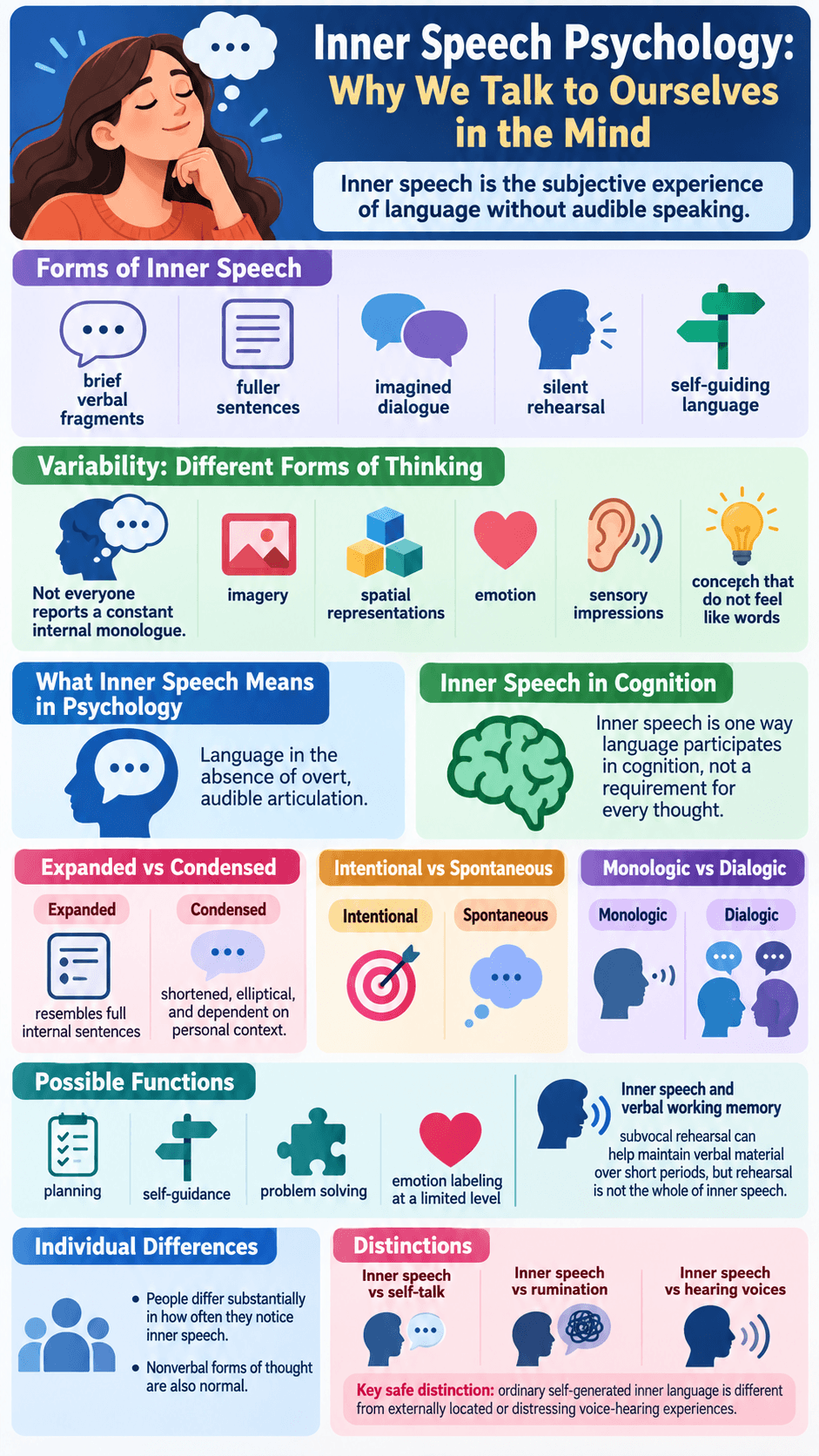
Inner speech is the subjective experience of language without audible speaking. It can take the form of brief verbal fragments, fuller sentences, imagined dialogue, silent rehearsal, or self-guiding language. Research suggests it may support planning, memory, self-regulation, and problem solving, but its form and frequency vary widely. Inner speech is not the same as constant self-talk, rumination, working memory, or hearing an externally located voice.
What Inner Speech Means in Psychology
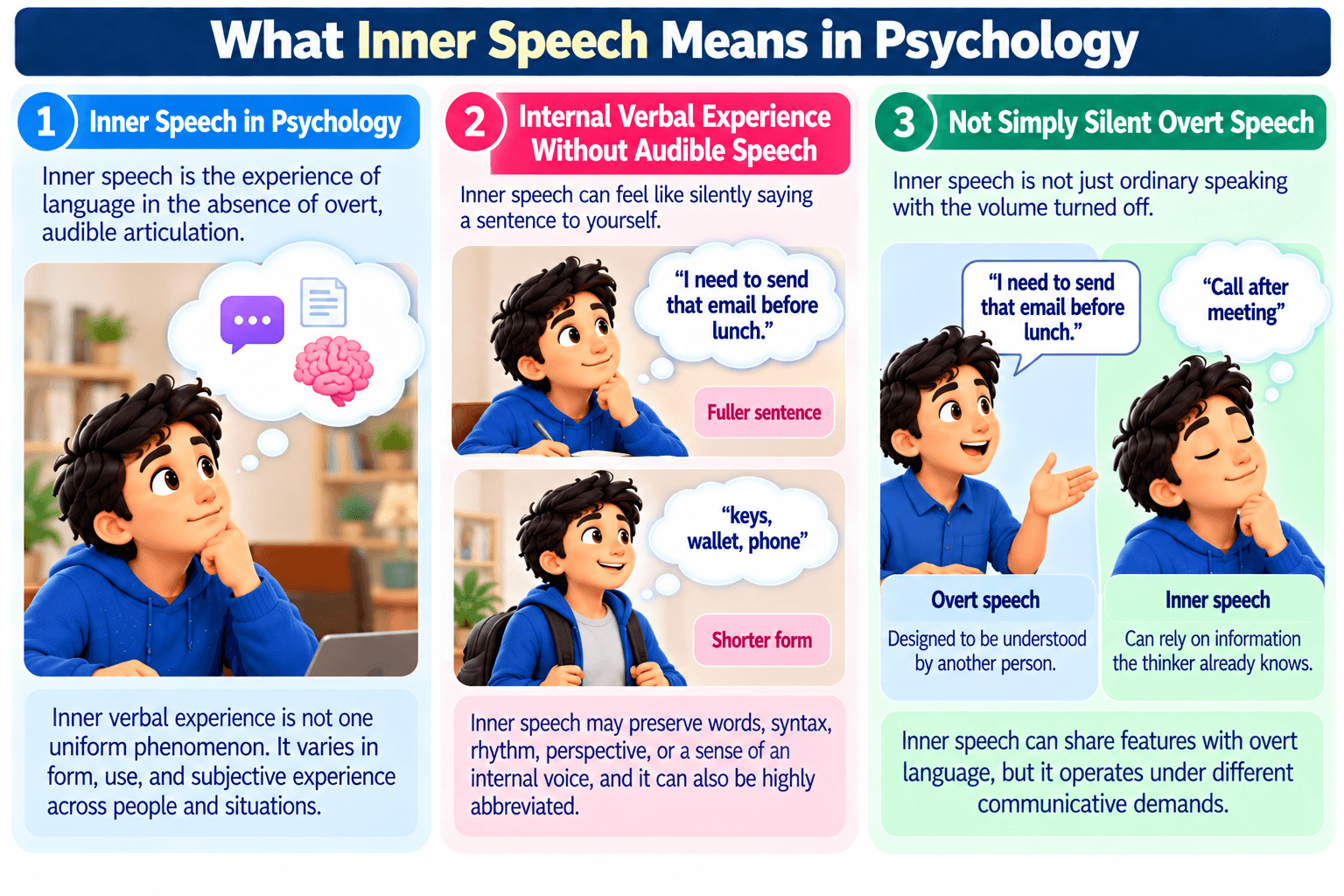
A major review defines inner speech broadly as the experience of language in the absence of overt, audible articulation. That definition is intentionally flexible because inner verbal experience is not one uniform phenomenon. The same review of inner speech development, functions, and phenomenology emphasizes variation in form, use, and subjective experience across people and situations.
Internal verbal experience without audible speech
Inner speech can feel like silently saying a sentence to yourself. You might think, “I need to send that email before lunch,” without moving your lips or producing sound. In other moments, the verbal content may be much shorter, such as “keys, wallet, phone” while leaving the house.
The absence of audible speech does not mean that inner language has no structure. Depending on the situation, it may preserve words, syntax, rhythm, perspective, or some sense of an internal voice. In other cases, it can be highly abbreviated.
Why inner speech is not simply silent overt speech
It is tempting to imagine inner speech as ordinary speaking with the volume turned off. That picture is too simple. Overt speech is designed to be understood by another person, so it usually needs enough detail, grammar, and pronunciation to survive outside the speaker’s mind. Inner speech can rely on information the thinker already knows.
That allows internal language to be compressed. “Call after meeting” may carry enough meaning internally even though an external listener would need to know whom to call, which meeting, and why. Inner speech can therefore share features with overt language while operating under different communicative demands. The complementary question of how an intended message becomes spoken or written output belongs to language production.
Inner Speech Can Be Expanded or Condensed
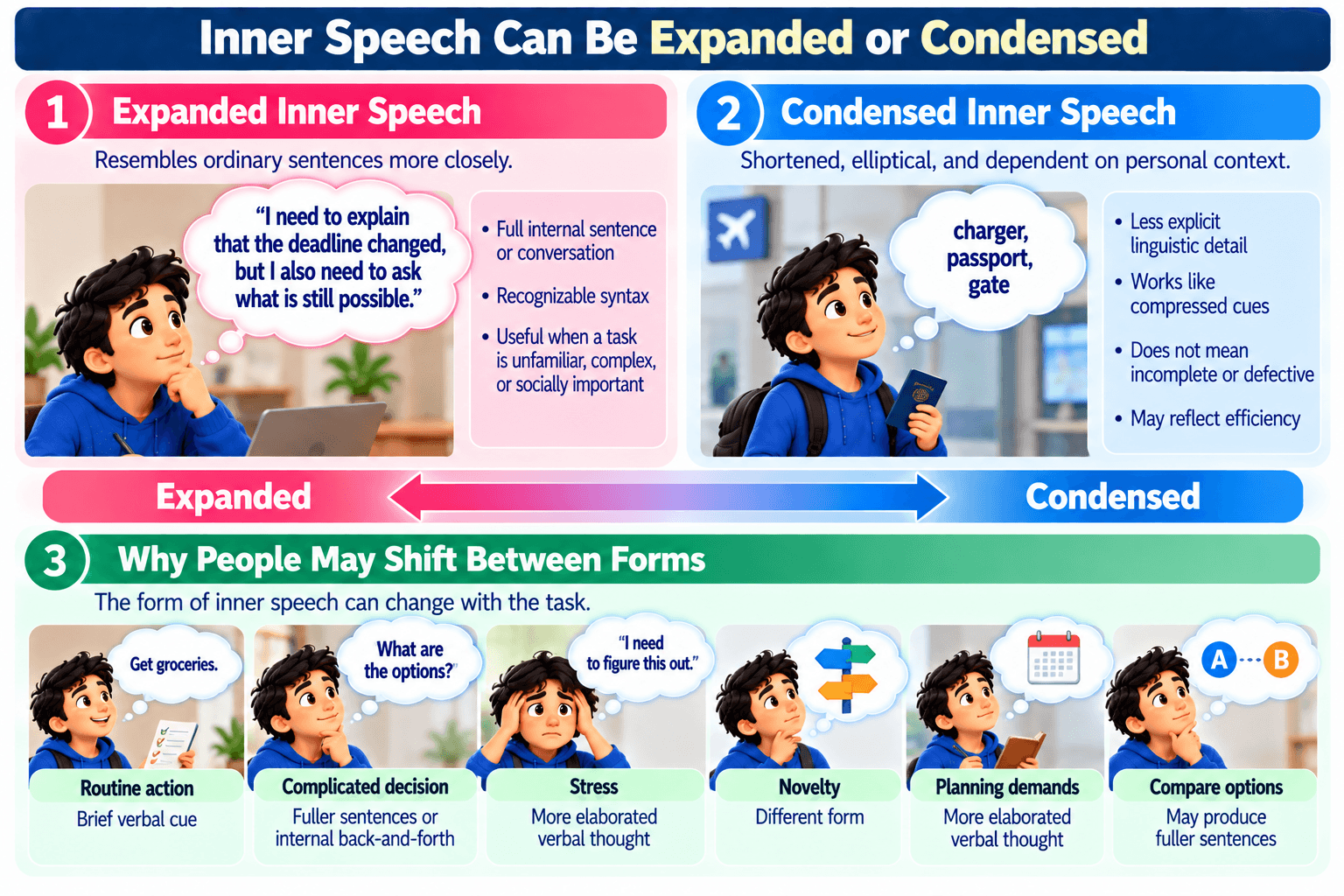
One useful framework describes inner speech along a continuum from expanded to condensed forms. Expanded inner speech resembles ordinary sentences more closely. Condensed inner speech can be shortened, elliptical, and dependent on personal context.
A model of condensation and dialogality in inner speech develops this idea by treating inner speech as variable rather than as one fixed format.
Expanded inner speech
Expanded inner speech can resemble a full internal sentence or conversation. Before a difficult phone call, you might mentally formulate: “I need to explain that the deadline changed, but I also need to ask what is still possible.” The thought has recognizable syntax and a fairly complete linguistic form.
This kind of internal language may be useful when a task is unfamiliar, complex, or socially important. Fuller wording can help organize several parts of a message that would be difficult to hold as a vague impression.
Condensed inner speech
Condensed inner speech contains less explicit linguistic detail. During a familiar routine, “charger, passport, gate” may be enough to guide action. The words function more like compressed cues because much of the surrounding meaning is already known.
Condensation is not evidence that the thought is incomplete or defective. It may reflect efficiency. The thinker does not need to explain the background to themselves in the same way they would explain it to another person.
Why people may shift between forms
The form of inner speech can change with the task. A routine action may require only a brief verbal cue. A complicated decision may produce fuller sentences or an internal back-and-forth. Stress, novelty, planning demands, and the need to compare options may also affect how elaborated verbal thought becomes.
This flexibility is more useful than imagining that every person has one permanent style of internal monologue.
Intentional and Spontaneous Inner Speech
Not every internal sentence is deliberately produced. Sometimes people intentionally use words to guide themselves through a task. At other times verbal thoughts appear without being summoned, such as a phrase that comes to mind while walking or a remembered conversation that briefly replays.
Intentional inner speech
Intentional inner speech has a clear purpose. You may silently rehearse a name before introducing someone, repeat a direction while navigating, or formulate the opening line of a difficult conversation. In these cases, internal language is being used as a cognitive tool.
Deliberate inner speech can also change form as the task changes. A simple reminder may remain condensed, while planning an unfamiliar explanation may become more expanded and sentence-like.
Spontaneous inner speech
Spontaneous inner speech is not necessarily tied to a conscious goal. A line from an earlier conversation may return unexpectedly, a comment about what you are seeing may appear, or your mind may verbalize an observation before you decide to do anything with it.
Spontaneous does not mean meaningless or pathological. Much ordinary thought arises without deliberate initiation. The important point is that inner speech can be both something people intentionally use and something they simply notice occurring.
A Historical Idea: From Social Speech to Inner Speech
One influential developmental account comes from Lev Vygotsky, who proposed that speech used socially and speech used aloud for self-guidance can become increasingly internalized. In this view, internal language retains some of the functions of social speech while becoming more abbreviated because the thinker does not need to make every connection explicit.
Why the idea remains useful
The Vygotskian account helps explain why inner speech can have a dialogic quality and why it may support self-guidance. Language first used between people can provide structures for asking questions, giving instructions, evaluating alternatives, and organizing action.
Why it should not be treated as the only explanation
Modern research treats inner speech as a heterogeneous phenomenon, and not every feature is explained by one developmental pathway. The historical framework is useful for generating questions about internalization, condensation, and self-regulation, but it should not be presented as a complete final model of how every person develops verbal thought.
Inner Speech Can Be Monologic or Dialogic
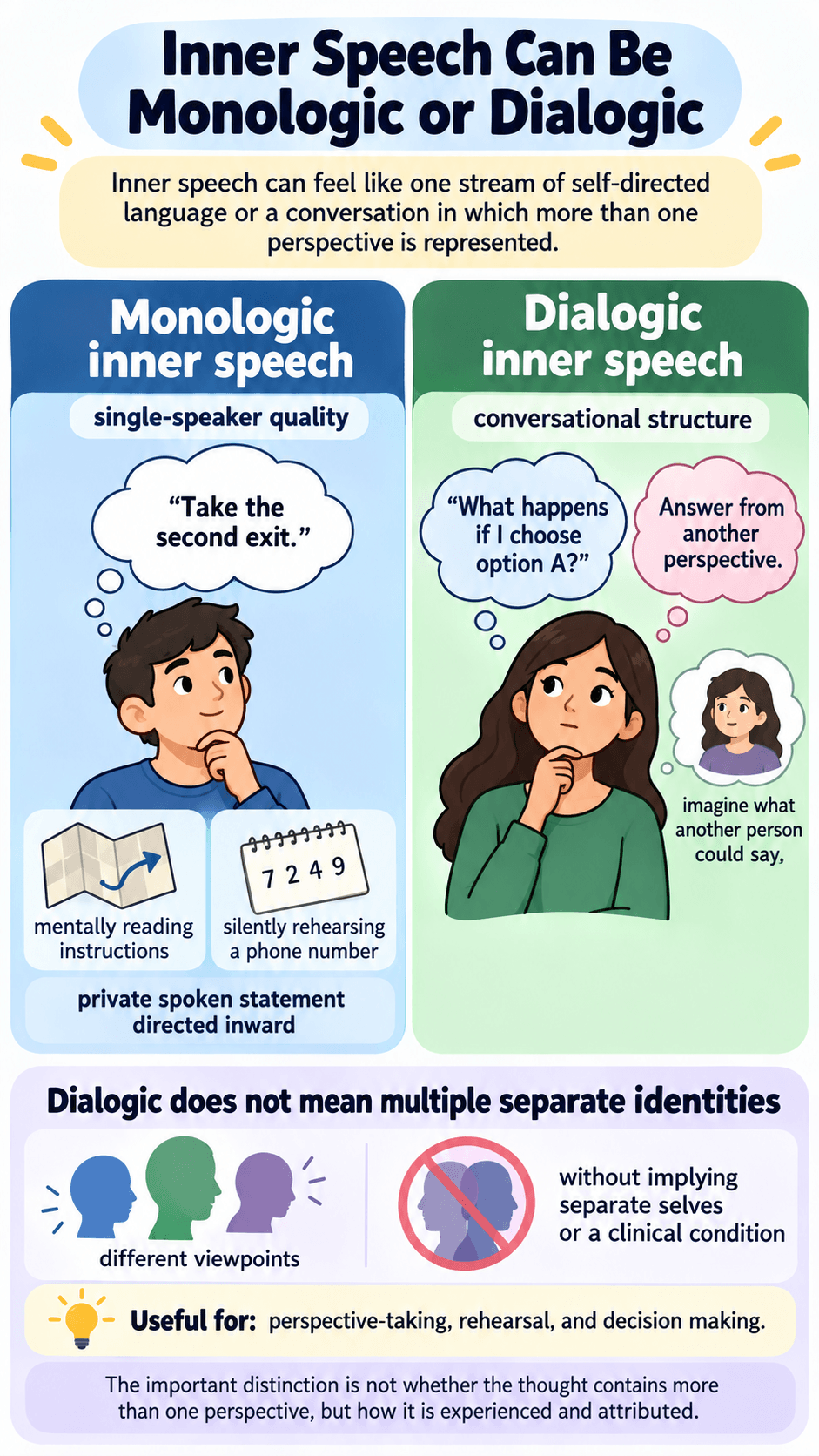
Sometimes inner speech feels like one stream of self-directed language. At other times it resembles a conversation in which more than one perspective is represented.
Monologic inner speech
Monologic inner speech has a single-speaker quality. Examples include mentally reading instructions, silently rehearsing a phone number, or telling yourself, “Take the second exit.” The content may be descriptive, instructional, evaluative, or simply observational.
This form is easy to recognize because it resembles a private spoken statement directed inward.
Dialogic inner speech
Dialogic inner speech has a conversational structure. You might mentally ask, “What happens if I choose option A?” and then answer from another perspective. Before a disagreement, you may imagine what another person could say and mentally test possible responses.
Questionnaire and experience-sampling research suggests that dialogality and condensation are useful dimensions for describing inner speech, although no single method captures the whole experience perfectly.
Dialogic does not mean multiple separate identities
An internal dialogue can represent different viewpoints without implying separate selves or a clinical condition. A person can mentally take the perspective of a friend, supervisor, parent, or imagined audience while knowing that they are generating the thought.
This ability can be useful for perspective-taking, rehearsal, and decision making. The important distinction is not whether the thought contains more than one perspective, but how it is experienced and attributed.
Possible Functions of Inner Speech
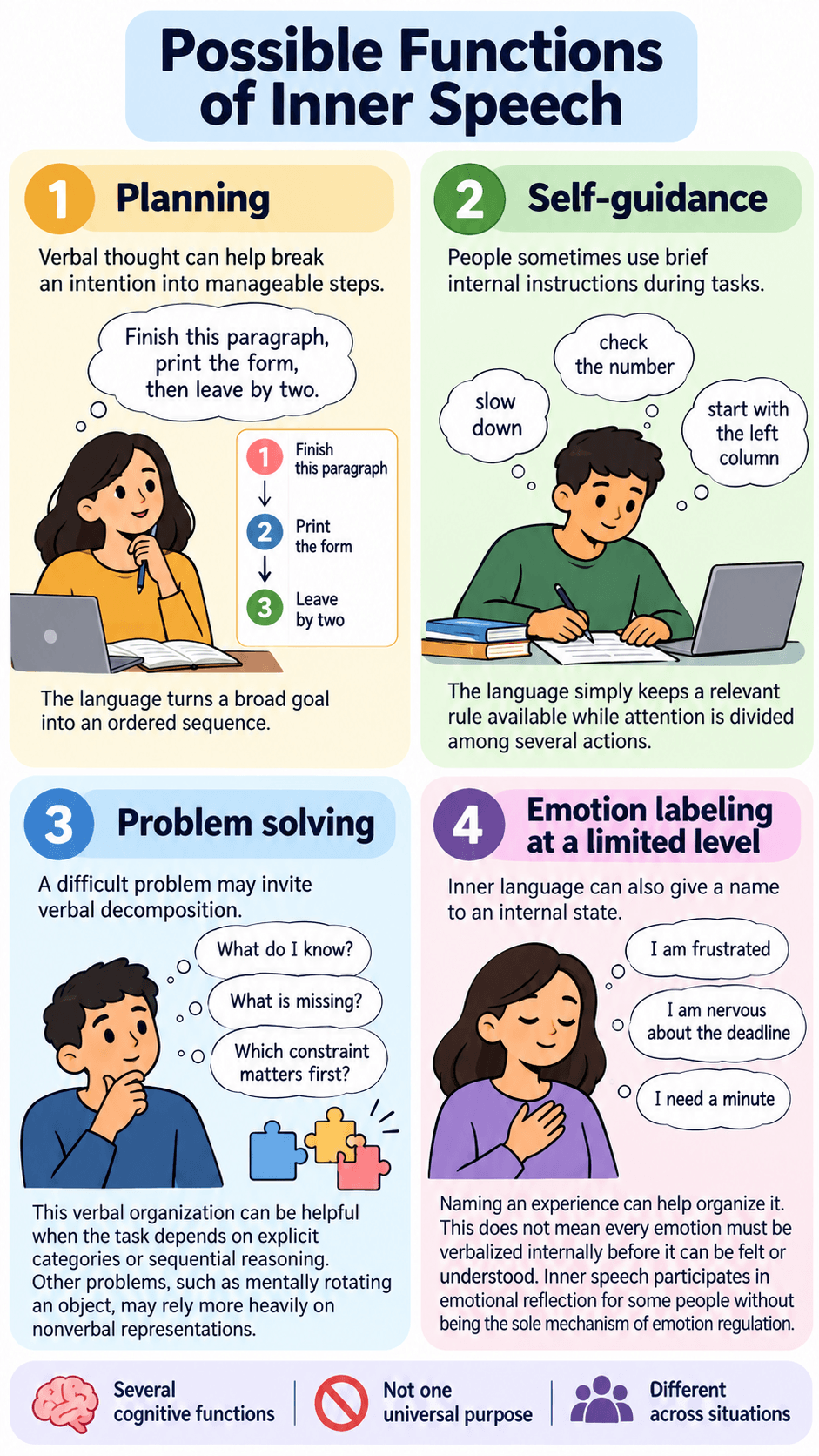
Inner speech has been linked to several cognitive functions, but it should not be assigned one universal purpose. The same person may use internal language differently across situations.
Planning
Verbal thought can help break an intention into manageable steps. Before leaving for an appointment, someone might think, “Finish this paragraph, print the form, then leave by two.” The language turns a broad goal into an ordered sequence.
Planning does not always require words, but inner speech can provide a convenient format when sequence, labels, or explicit rules matter.
Self-guidance
People sometimes use brief internal instructions during tasks: “slow down,” “check the number,” or “start with the left column.” This resembles overt self-directed speech but occurs internally.
The function is not necessarily motivational. Often the language simply keeps a relevant rule available while attention is divided among several actions.
Problem solving
A difficult problem may invite verbal decomposition. Instead of holding the entire problem as one vague difficulty, a person may silently state the parts: “What do I know? What is missing? Which constraint matters first?”
This verbal organization can be helpful when the task depends on explicit categories or sequential reasoning. Other problems, such as mentally rotating an object, may rely more heavily on nonverbal representations.
Emotion labeling at a limited level
Inner language can also give a name to an internal state: “I am frustrated,” “I am nervous about the deadline,” or “I need a minute.” Naming an experience can help organize it, but this does not mean every emotion must be verbalized internally before it can be felt or understood.
Inner speech participates in emotional reflection for some people without being the sole mechanism of emotion regulation.
Inner Speech and Verbal Working Memory
One of the clearest overlaps between inner language and memory involves silent rehearsal. If you repeat a short code to yourself long enough to type it, you are using language-like processes to keep verbal information available.
Subvocal rehearsal
Models of verbal working memory often include a rehearsal process that refreshes phonological information. A review of verbal rehearsal in working memory describes how language-based rehearsal can help maintain verbal material over short periods.
Examples include repeating a room number while walking down a hallway or silently cycling through a short grocery list until you can write it down.
Why rehearsal is not the whole of inner speech
Rehearsal is narrow and repetitive. Inner speech can also involve planning, imagined conversation, explanation, reflection, or spontaneous commentary. The two therefore overlap without being identical.
The distinction matters because otherwise every verbal thought gets reduced to memory maintenance. Inner speech is a broader category of internal linguistic experience.
Why inner speech is not identical to working memory
Working memory includes more than verbal rehearsal. It can involve visual-spatial information, attention, temporary retrieval, and manipulation of information. Conversely, inner speech can occur when there is no obvious memory-maintenance goal.
The broader Working Memory Psychology topic is the better framework for understanding temporary cognitive storage and manipulation across tasks. Inner speech is one language-related process that may sometimes contribute to that system.
Inner Speech While Reading
Many readers report an internal voice when reading, but the experience differs in strength and detail. Sometimes the text seems to be silently “heard.” At other times comprehension feels faster and less voice-like.
Silent reading can have a verbal quality
When reading a dramatic sentence, you may mentally represent rhythm or emphasis. Quoted dialogue may feel more voice-like than a technical instruction. Familiarity with the speaker can also affect the imagined quality of the words.
This does not mean that every unit of reading must be converted into a fully specified internal voice. Reading comprehension can draw on several forms of linguistic and conceptual processing.
The internal voice may become less detailed
During fast or familiar reading, the experience can become compressed. You may retain meaning while noticing fewer phonological details. During difficult material, the verbal form may become more explicit as you slow down and mentally restate a sentence.
This shift resembles the broader contrast between condensed and expanded inner speech.
Individual Differences in Inner Experience
One of the easiest mistakes is to assume that everyone’s inner life resembles your own. Research suggests substantial differences in how frequently people report inner speech and how it combines with imagery, feeling, sensory awareness, and other forms of thought.
Not everyone reports a constant internal monologue
An editorial review of individual differences in inner experience describes wide variation across inner speech, imagery, bodily awareness, planning, and other experiences. That makes a simple “everyone talks to themselves all day” claim difficult to defend.
Some people may notice frequent verbal thought. Others may experience it only in particular tasks. Self-report methods also differ in what they capture, so estimates of frequency should be treated cautiously.
Words, imagery, and nonverbal thought can coexist
A person planning a trip might visualize a route, feel a sense of urgency, remember a landmark, and silently think “turn after the bridge” within the same period. Thought does not have to choose one format exclusively.
This is also why the absence of frequent inner speech should not be treated as an intellectual deficit. Language is one resource available to cognition, not the only medium in which cognition can occur.
Why self-report is difficult
Inner experience is private and changes quickly. Asking people how often they “usually” think in words requires them to summarize many moments from memory. Experience-sampling methods capture specific moments but may interrupt the very experience being studied.
Different methods therefore reveal different aspects of inner speech. This is a measurement challenge, not a reason to assume one person’s introspection describes everyone.
Inner Speech vs Self-Talk
The terms are sometimes used interchangeably, but they can be separated usefully.
Inner speech refers to internal linguistic experience
Inner speech is specifically language experienced internally without audible articulation. It may arise spontaneously or be used deliberately. It can be brief, dialogic, condensed, or sentence-like.
Self-talk is a broader applied category
Self-talk often refers to statements directed toward oneself, whether spoken aloud or internally. A review of self-talk research notes functions that include problem solving, self-regulation, reflection, rehearsal, and emotional expression.
Athletes saying “steady” aloud, a student whispering instructions while working, and a person silently saying “I can handle the next step” could all be described as forms of self-talk. Only the internal cases necessarily overlap with inner speech.
Inner Speech vs Rumination
Inner speech is a format of thought. Rumination is a repetitive pattern of thought. Confusing them can make normal verbal thinking sound more pathological than it is.
Inner speech can be neutral, practical, or creative
Internal language might involve remembering an errand, composing a sentence, imagining a conversation, solving a puzzle, or narrating an observation. None of those experiences is inherently negative or repetitive.
Rumination is defined more by repetition and unresolved focus
A person can ruminate in words, but rumination can also include images and other forms of repetitive cognition. The defining feature is not simply “thinking to yourself.” It is the repetitive return to material in a way that may feel difficult to disengage from.
That distinction prevents every unpleasant internal sentence from being labeled rumination.
Inner Speech vs Language and Thought
Inner speech is one example of language participating in thinking. The broader question of language and thought asks whether linguistic categories and structures influence cognition more generally.
Inner speech asks about verbal experience inside the mind
The focus is phenomenological and functional: what does internal language feel like, what forms can it take, and what might it help a person do?
Language and thought asks a broader theoretical question
The larger issue concerns whether language affects categorization, attention, memory, spatial reasoning, or other cognitive processes. A person can have little noticeable inner speech and still use language extensively in perception, reasoning, and communication.
Not all thinking is inner speech, and evidence that language can influence cognition would not establish that all thought requires words.
Inner Speech vs Hearing Voices
Ordinary inner speech is usually experienced as self-generated internal language. Hearing a voice that seems externally located, autonomous, or not self-generated is a different kind of experience and should not be casually equated with everyday verbal thought.
Ordinary internal language
With typical inner speech, people generally recognize the verbal experience as part of their own thinking, even when they imagine another person’s perspective or voice. The experience can be vivid without being mistaken for an external sound source.
When an experience is new, distressing, or externally located
Hearing voices can occur for different reasons, and an article about inner speech cannot determine the cause. The National Institute of Mental Health guidance on psychosis distinguishes hallucinations, including hearing things others do not hear, from ordinary thought and describes them as one possible symptom within a broader clinical picture.
If someone experiences new or markedly changed voices that feel external, cause severe distress, are accompanied by major confusion or loss of contact with reality, or tell them to harm themselves or someone else, qualified professional or urgent local support may be appropriate. The presence of inner speech itself is not evidence of psychosis.
A Simple Self-Check for Understanding Your Inner Speech
These questions are for observation rather than diagnosis. They can help clarify the form your internal language tends to take.
Does it sound like full sentences or shorthand?
Notice whether your verbal thoughts resemble complete spoken language or compressed cues. The answer may change by task. Planning a difficult conversation may produce full sentences while a routine checklist may be only a few words.
Is it usually one perspective or an internal dialogue?
Some thoughts may feel like a single stream. Others may involve imagined replies or competing viewpoints. Neither form is automatically better.
When does verbal thinking become most noticeable?
Inner speech may become more obvious during reading, planning, decision making, memory rehearsal, or preparation for social situations. Identifying the context is often more informative than trying to calculate how much inner speech you have overall.
FAQ
These questions address common misconceptions about internal verbal experience.
Does everyone have an inner monologue?
No evidence supports the idea that everyone experiences a continuous inner monologue in the same way. Research suggests substantial individual differences in frequency, detail, and form. Some people report frequent verbal thought, while others describe more imagery, unsymbolized thought, sensory awareness, or other forms of inner experience.
Is inner speech the same as thinking?
No. Inner speech is one form of thought that uses internal language. Thinking can also involve imagery, spatial relationships, emotions, motor representations, perceptual patterns, and concepts that do not feel verbally formulated. Inner speech may contribute to cognition without defining cognition as a whole.
Why is my inner speech sometimes only a few words?
Internal language does not need to explain background information that you already know. For familiar tasks, a few words may carry enough meaning to guide action. Researchers often describe this abbreviated quality as condensed inner speech, in contrast with more expanded sentence-like forms.
Is silently repeating information inner speech?
Yes, subvocal rehearsal can be considered one form or use of inner speech, especially when verbal information is being maintained in working memory. But inner speech is broader than rehearsal and can include planning, reflection, imagined dialogue, and spontaneous verbal thought.
Is having inner speech a sign of a mental health problem?
No. Inner speech is a widely studied aspect of ordinary cognition. It should not be equated with hallucinations or hearing an external voice. If an experience is new, frightening, externally located, disruptive, or accompanied by major changes in reality testing or functioning, an individualized professional evaluation may be appropriate.
Key Takeaways
- Inner speech is internal linguistic experience without audible speaking, and it can range from full sentences to highly compressed verbal fragments.
- It may support planning, self-guidance, problem solving, reading, and verbal rehearsal, but no single function explains every instance.
- Inner speech can be monologic or dialogic, and people can shift between more expanded and more condensed forms.
- People differ substantially in how often they notice inner speech, and nonverbal forms of thought are also normal.
- Inner speech overlaps with self-talk and verbal working memory but is not identical to either, and it should not be confused with rumination.
- Ordinary self-generated inner language is different from externally located or distressing voice-hearing experiences that may warrant professional attention.

Michael Reed is the Founder and Lead Writer at Psychology Exposed. He writes about human behavior, relationships, emotional patterns, self-awareness, and practical psychology topics using research-informed, easy-to-understand content.
Read More About Michael Reed: https://psychologyexposed.com/michael-reed/