

You may know the feeling: someone gives you three instructions, your phone buzzes, a question pops into your mind, and suddenly the first instruction is gone. You were not careless. Your mind was trying to hold information, use it, update it, and protect itself from interruption at the same time.
Working memory psychology explains that everyday mental juggling. It is the active system that lets you keep a small amount of information available while you think, decide, read, calculate, follow a conversation, or complete a task. The APA Dictionary of Psychology describes working memory as temporary maintenance and manipulation of information for complex tasks such as learning, reasoning, and comprehension.
This matters because many moments that feel like “bad memory” are really moments of overload. The issue may not be that your mind failed to store something forever. It may be that too many demands competed for the same small mental workspace before you could use the information well.
Quick Answer
Working memory as mental workspace
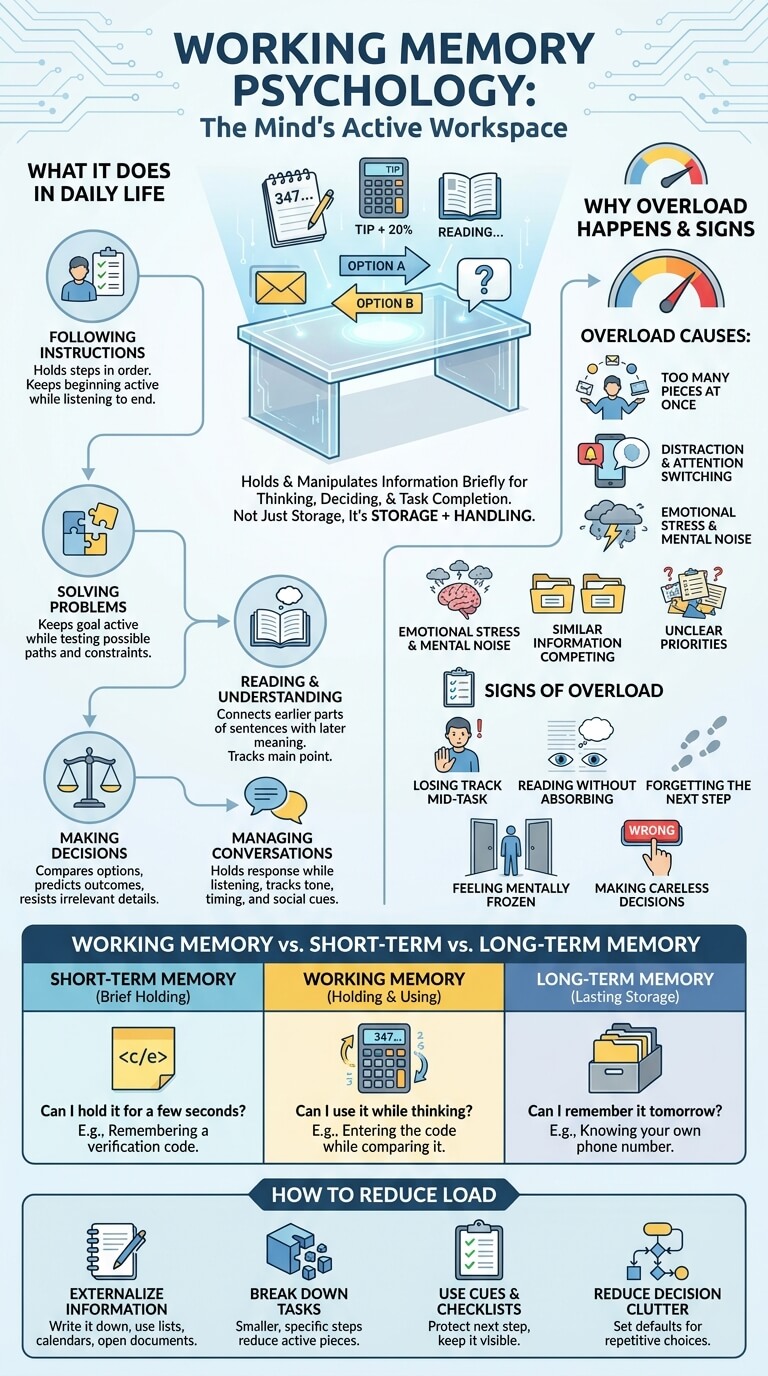
Working memory is the mind’s active workspace. It holds information briefly while you use it, such as remembering a number long enough to type it, comparing two options, following a recipe step, or keeping your point in mind during a conversation. It is not simply storage. It is storage plus mental handling.
Why overload makes thinking harder
Working memory is limited, so overload happens when too much information, distraction, emotion, or uncertainty enters the workspace at once. When that happens, you may lose your place, reread the same sentence, forget the next step, or make a rushed decision because your mind is trying to manage more than it can comfortably hold.
What Working Memory Means
Although people often confuse working memory with short-term memory, the difference becomes clearer when comparing short-term and long-term memory with the active mental workspace used for problem-solving.
Holding information while using it
A simple way to understand working memory is to picture a small desk. Long-term memory is like a large storage room. Short-term holding is like placing a note on the desk for a few seconds. Working memory is what happens when you actually use the note, compare it with another note, change the plan, and decide what to do next.
For example, when you calculate a tip in your head, you are not only remembering numbers. You are holding the bill total, applying a percentage, keeping intermediate results available, and checking whether the answer makes sense. That is working memory in action.
It also helps you understand language. When you read a long sentence, your mind holds the beginning while interpreting the end. When someone says, “Before you reply to that email, check the attachment and ask Mia if the numbers changed,” your working memory keeps the order and meaning available long enough to act.
How it differs from short-term memory
Short-term memory is often described as brief holding. Working memory includes brief holding, but it adds manipulation. The difference is easiest to see with a phone number. Holding a phone number in mind for a few seconds is closer to short-term memory. Rearranging the digits, comparing them with another number, or using them while filling out a form depends more on working memory.
The APA definition of short-term memory emphasizes limited recall over a short period, often around seconds. Working memory goes further because it supports reasoning, comprehension, and task control during that same short window.
| Memory process | Main job | Everyday example |
|---|---|---|
| Short-term memory | Briefly holds information | Remembering a code long enough to enter it |
| Working memory | Holds and uses information | Comparing two codes, choosing the right one, and entering it correctly |
| Long-term memory | Stores information beyond the immediate moment | Knowing your own phone number without rehearsing it |
Why working memory is limited
Working memory feels powerful because it lets you think flexibly, but it has a narrow capacity. You cannot keep every detail of a meeting, every worry, every instruction, and every possible next step active with equal clarity. Something has to fade, be simplified, or be pushed into an external note.
Research discussions of working memory capacity often emphasize that complex thinking depends on having enough ability to hold information while it is being processed. In one open-access review, Nelson Cowan describes a central capacity limit of only a few meaningful items in young adults, not an unlimited mental shelf for every detail at once.
This is why “just remember it” is often poor advice when the task is complex. A mind can remember a small amount briefly, but it works better when important details are organized, written down, grouped, repeated, or connected to something already known.
What Working Memory Does in Daily Life
Following instructions
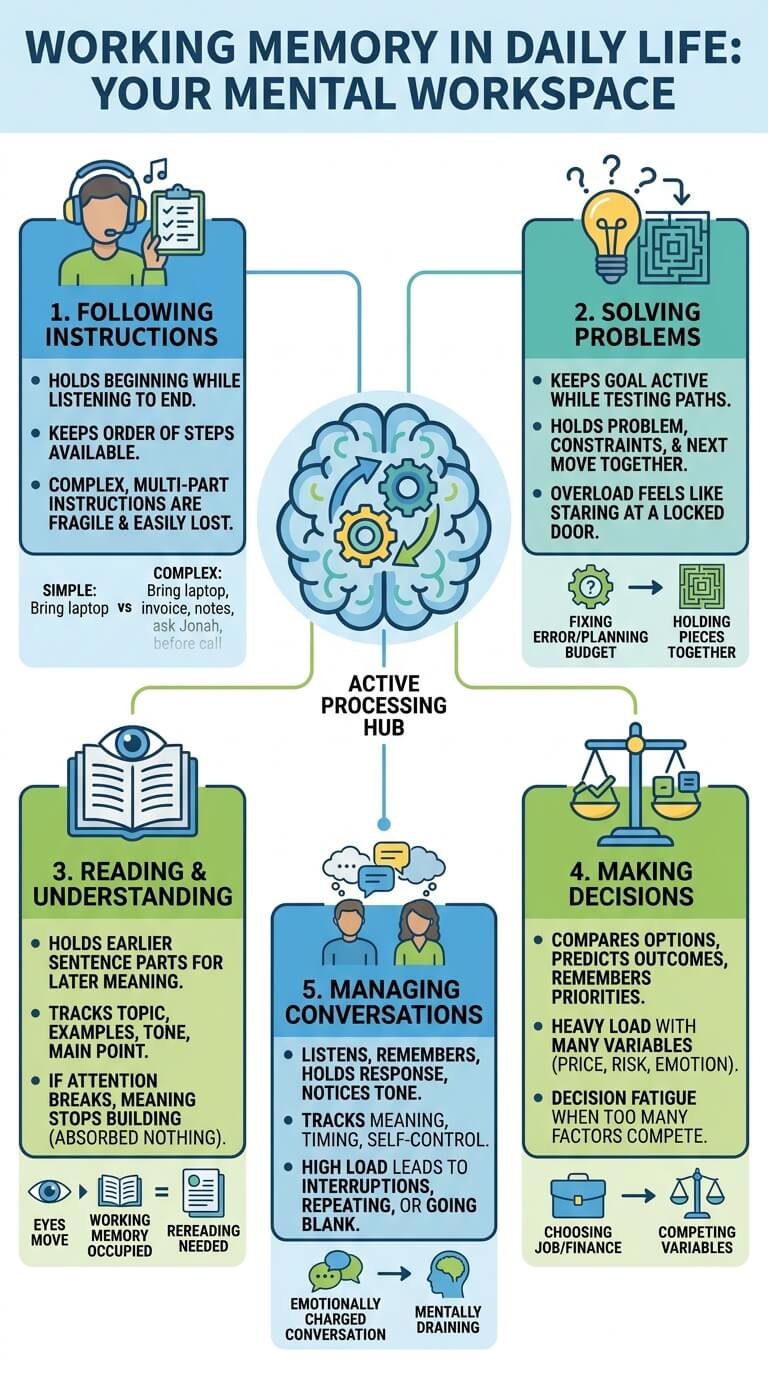
Working memory lets you hold the beginning of an instruction while listening to the end. It keeps the order of steps available just long enough for you to act. When the instruction has too many parts, or when it arrives while you are distracted, the middle steps are often the first to disappear.
This is why a simple instruction like “bring your laptop” is easy, while “bring your laptop, the invoice, the revised notes, and ask Jonah about the updated date before the call” is more fragile. The second version demands holding items, order, timing, and social action at once.
Solving problems
Problem solving depends on working memory because you need to keep the goal active while testing possible paths. If you are fixing a small website error, planning a budget, or deciding how to explain a difficult idea, you must hold the problem, the constraints, and the next move in mind together.
When working memory is overloaded, problem solving can feel like staring at a locked door. You may know there is an answer, but the pieces will not stay still long enough for you to combine them. Writing the pieces down often helps because it moves some of the load out of your head.
Reading and understanding
Reading is not just seeing words. Your mind holds the earlier part of a sentence while making sense of the later part. It keeps track of the topic, the examples, the emotional tone, and the author’s main point. If your attention breaks, the sentence may still be visible, but the meaning stops building.
That is why you can reach the end of a page and realize you absorbed almost nothing. Your eyes moved, but your working memory was occupied by another concern. In that moment, rereading is not laziness. It is a way to put the content back into the workspace.
Making decisions
Decisions use working memory because you compare options, predict outcomes, remember priorities, and resist irrelevant details. Choosing between two meals is usually light. Choosing between job options, financial commitments, or a difficult conversation can become heavy because each option carries more consequences.
Decision fatigue often grows when the mind must keep too many variables alive at once. Price, timing, risk, social pressure, emotion, and future regret all compete for space. A decision chart, written priorities, or a simple “must have vs nice to have” list can reduce that competition.
Managing conversations
Working memory helps you listen, remember what was just said, hold your own response, notice tone, and adjust when the other person adds something new. This is why emotionally charged conversations can feel so mentally draining. You are not only hearing words. You are tracking meaning, timing, self-control, and social consequences.
When the load becomes too high, people may interrupt, repeat themselves, go blank, or answer only the last thing they heard. Slowing the conversation can help. So can saying, “Let me make sure I understood the first part before we move on.”
Why Working Memory Gets Overloaded
Too many pieces at once
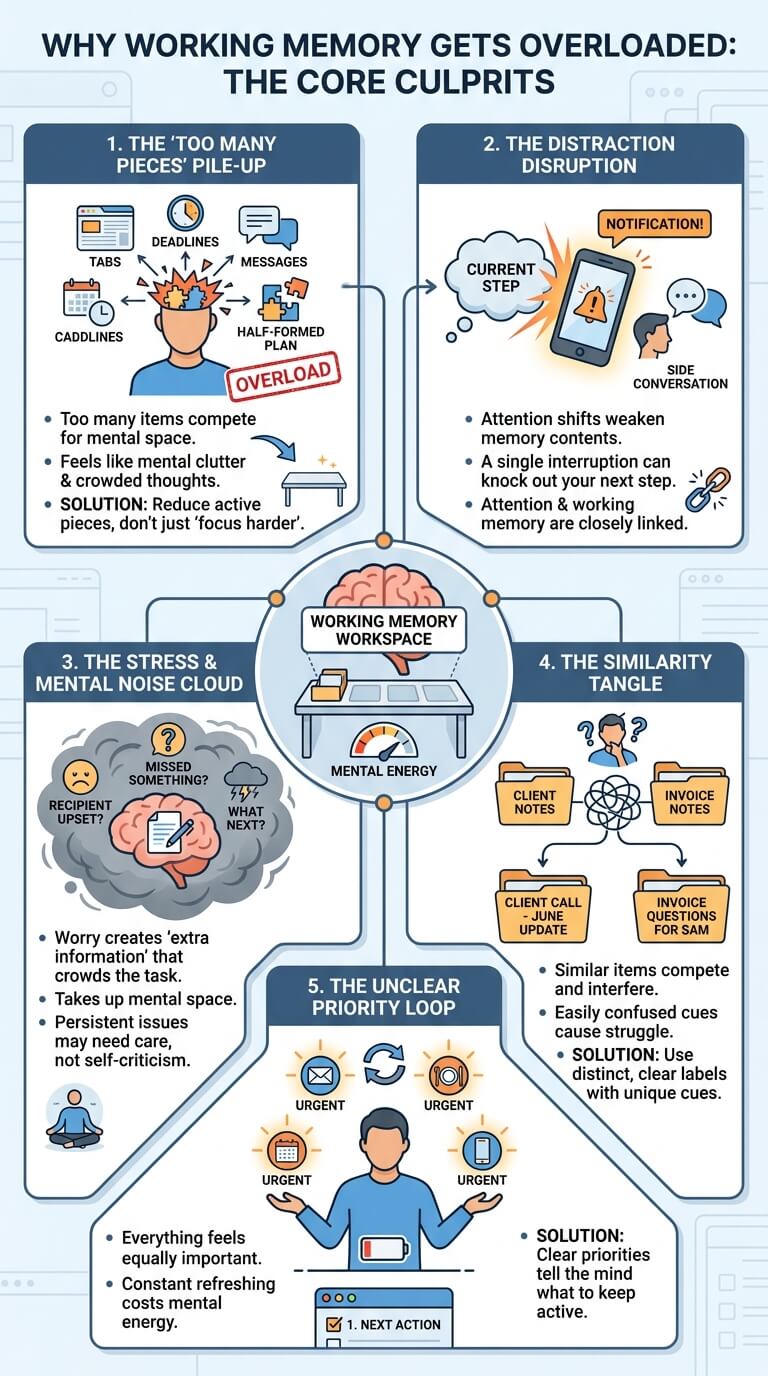
The most obvious overload happens when there are simply too many pieces. A task may involve five tabs, three deadlines, two messages, and a half-formed plan. Your working memory tries to keep the whole scene active, but the details start bumping into each other.
This kind of overload often feels like mental clutter. You may not be tired in a physical sense, yet your thoughts feel crowded. The first step is usually not to “focus harder.” It is to reduce how many pieces must stay in your mind at the same time.
Distraction and attention switching
Working memory depends heavily on attention. When attention shifts, the contents of working memory can lose strength. A notification, a side conversation, or a sudden question may be enough to knock out the step you were about to take.
Researchers continue to debate exactly how attention and working memory relate, but there is broad agreement that the two are closely connected. A detailed analysis in Psychological Bulletin on working memory and attention explains several ways the two systems may support each other.
Emotional stress and mental noise
Stress can crowd working memory because worry creates extra information to manage. You may be trying to write an email while also thinking about whether the recipient will be upset, whether you missed something, and what could happen next. Those thoughts are not separate from the task. They take up mental space inside the task.
This does not mean every concentration problem is an anxiety disorder. Still, anxiety and high stress can make attention and memory feel harder. NIMH lists trouble concentrating among common symptoms seen in generalized anxiety disorder, which is one reason persistent and distressing concentration problems deserve care rather than self-criticism.
Similar information competing
Working memory struggles when similar pieces compete. Two similar passwords, two similar project names, or two instructions that begin the same way can interfere with each other. The problem is not only the number of items. It is how easily one item can be confused with another.
This is why clear labels help. “Client notes,” “invoice notes,” and “meeting notes” may feel easy when you create them, but later they can blur. “Client call notes, June update,” “invoice questions for Sam,” and “team meeting decisions” reduce competition because each label carries a different cue.
Unclear priorities
Working memory also gets overloaded when everything feels equally important. If you are trying to answer a message, remember a deadline, plan dinner, and decide whether to take a call, your mind may keep refreshing all four tasks. That constant refreshing costs energy.
Priorities reduce load because they tell the mind what to keep active and what can wait. A clear next action is often calming, not because life is suddenly simple, but because the workspace has fewer open loops to maintain.
Signs Your Working Memory Is Overloaded
When working memory is overloaded, forgetfulness can increase because the mind is trying to hold too many pieces at once, which is one reason people forget things during busy or stressful moments.
Losing track mid-task
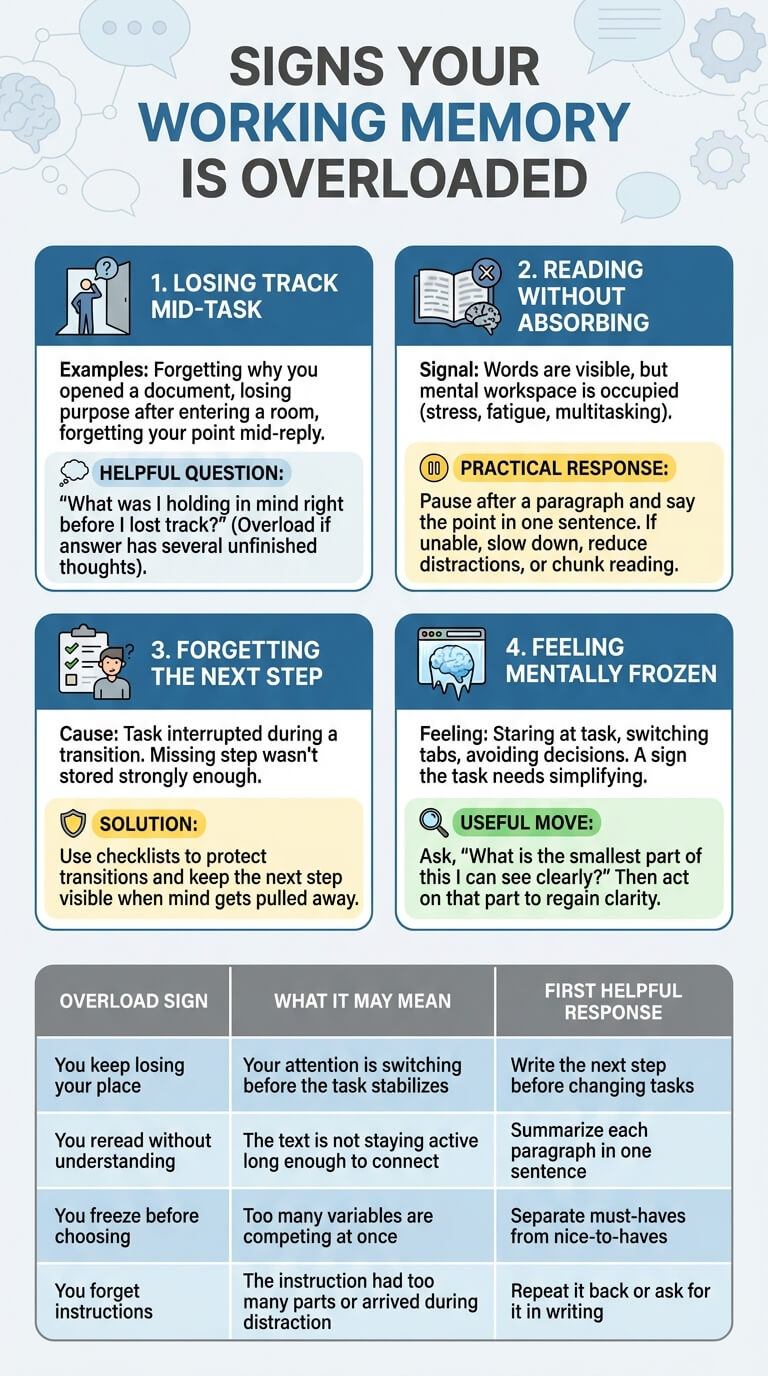
You start to open a document, then forget why you opened it. You walk into another room and lose the purpose of the trip. You begin a reply and then cannot remember the point you wanted to make. These moments are common, especially when your attention was split before the action began.
A helpful question is: “What was I holding in mind right before I lost track?” If the answer includes several unfinished thoughts, the issue may be overload rather than poor intelligence or laziness.
Reading without absorbing
Reading without absorbing is a classic overload signal. The words are visible, but the mental workspace is occupied by something else. This can happen during stress, fatigue, boredom, or multitasking. It can also happen when the text itself is too dense and each sentence requires too much holding before meaning becomes clear.
One practical response is to pause after a paragraph and say the point in one sentence. If you cannot, the next step is not to blame yourself. Slow down, reduce distractions, or break the reading into smaller chunks.
Forgetting the next step
Forgetting the next step often happens when a task is interrupted during a transition. You finish one part, notice another demand, and then the next step disappears. The missing step was not stored strongly enough yet. It was only being held for immediate use.
That is why checklists are not only for people with poor memory. They protect transitions. A checklist keeps the next step visible when the mind gets pulled away.
Feeling mentally frozen
Working memory overload can feel like freezing. You have options, but none of them feels clear. You may stare at the task, switch tabs, look for an easy action, or avoid the decision entirely. The freeze is often a sign that the task needs to be simplified before it can be solved.
A useful move is to ask, “What is the smallest part of this I can see clearly?” Then act on that part. Clarity often returns after one piece is removed from the mental pile.
Making careless decisions
When working memory is crowded, the mind may choose speed over accuracy. You may click the wrong file, skim a message too quickly, forget a constraint, or agree before checking your calendar. These errors do not always mean you lacked knowledge. They may mean the relevant information was not active at the moment of decision.
| Overload sign | What it may mean | First helpful response |
|---|---|---|
| You keep losing your place | Your attention is switching before the task stabilizes | Write the next step before changing tasks |
| You reread without understanding | The text is not staying active long enough to connect | Summarize each paragraph in one sentence |
| You freeze before choosing | Too many variables are competing at once | Separate must-haves from nice-to-haves |
| You forget instructions | The instruction had too many parts or arrived during distraction | Repeat it back or ask for it in writing |
Working Memory, Focus, and Attention
Working memory depends heavily on attention, which is why understanding how memory works helps explain why distraction weakens both thinking and recall.
Why attention feeds working memory
Attention decides what enters the workspace. Working memory then holds and works with that selected information. If attention is scattered, working memory receives fragments. If attention is steady, the mind has a better chance of keeping the relevant pieces available long enough to use them.
This is why focus and memory often feel linked. You may think you forgot a detail, but sometimes the detail never received enough attention to become usable in the first place. The doorway into working memory was crowded.
Why multitasking is costly
Multitasking often feels productive because many things are open at once. Mentally, it can be expensive because each switch requires the mind to reload the task goal, the current step, the rules, and the context. Even if the switch is brief, working memory must rebuild what matters.
A useful rule is to protect tasks that require holding relationships between ideas. Writing, analysis, planning, learning, and emotional conversations suffer more from switching than simple repetitive tasks do.
How focus problems can look like memory problems
Focus problems can look like memory problems because attention is part of how information becomes available. If you are half-listening while reading a message, you may later think your memory failed. In reality, your working memory may have received only a weak, partial version of the information.
This distinction matters because the solution changes. A storage problem asks, “How do I remember this longer?” A working memory problem asks, “How do I keep the right information active long enough to use it?”
How to Reduce Working Memory Load
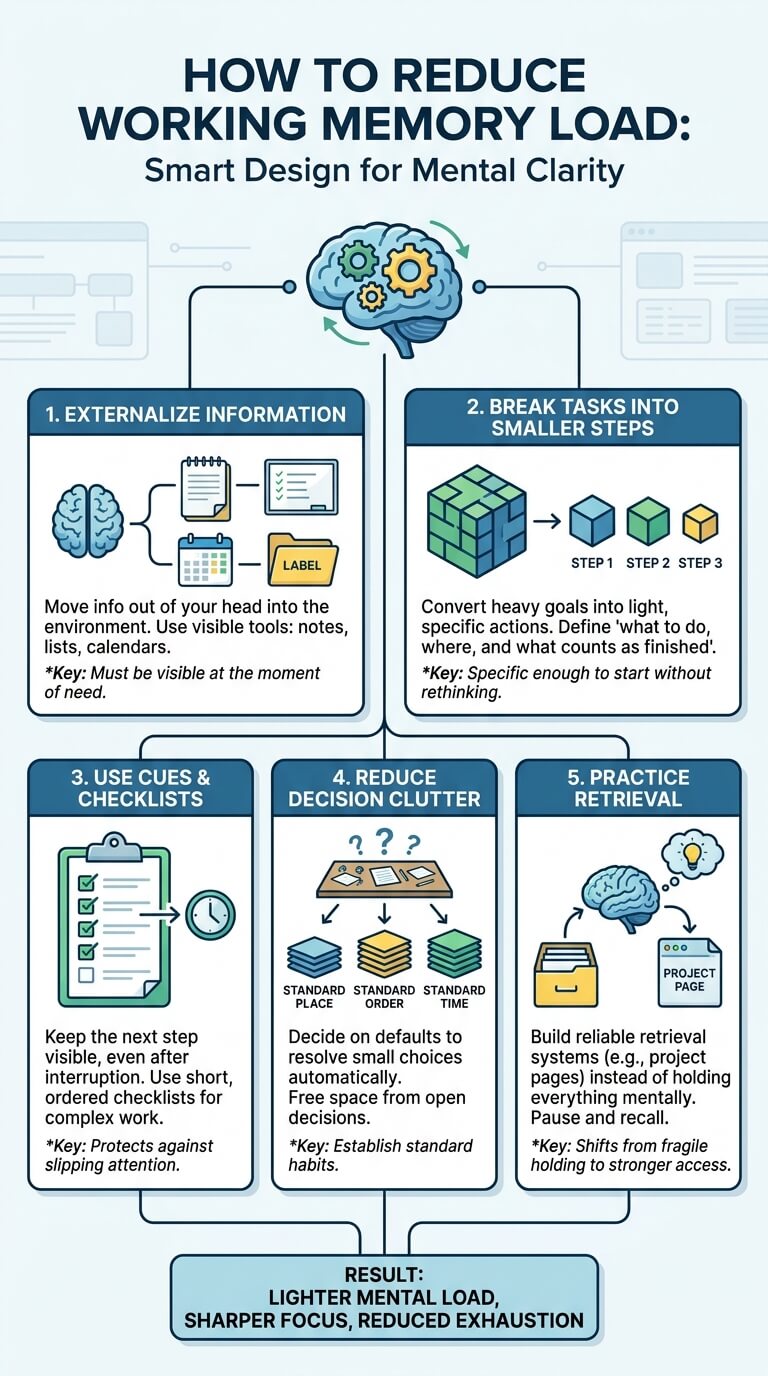
Externalize information
Externalizing means moving information out of your head and into the environment. Notes, lists, whiteboards, calendars, open documents, and labeled folders all reduce the amount your working memory must hold at once. This is not weakness. It is smart design.
The best external tools are visible at the moment you need them. A note hidden in an app you never open may not help. A short list next to the task can act like an extra surface for your mind.
Break tasks into smaller steps
Large tasks overload working memory because they require holding the goal, the plan, the sequence, and the uncertainty at once. Smaller steps reduce the number of active pieces. “Prepare the presentation” is heavy. “Open the draft and add three missing examples” is lighter.
Good steps are specific enough to start without rethinking the whole project. They should answer what to do, where to do it, and what counts as finished for now.
Use cues and checklists
Cues help your mind retrieve the right next action at the right time. A checklist protects you from interruption because the next step remains visible even if working memory drops it. Pilots, surgeons, editors, and project managers use checklists not because they know less, but because complex work has many points where attention can slip.
A useful checklist is short and ordered. If it becomes too long, it may create its own load. Keep the checklist close to the task and update it when repeated errors show you where the memory burden really is.
Reduce decision clutter
Decision clutter happens when too many small choices remain open. What should I do first? Which file should I use? Should I reply now? Where did I save that note? Each small unresolved choice takes a little space. Together, they make the task feel heavier.
Reduce clutter by deciding defaults. Choose a standard place for notes, a standard order for recurring tasks, and a standard time to handle low-value decisions. Defaults free working memory for the parts that actually need judgment.
Practice retrieval instead of holding everything mentally
Trying to hold everything in mind is exhausting. A better approach is to build reliable ways to retrieve information when needed. Instead of keeping every project detail active, keep a clear project page. Instead of keeping every idea in mind, keep an idea capture habit. Instead of rereading endlessly, pause and recall the main point without looking.
This helps learning because it shifts the goal from fragile holding to stronger retrieval. Working memory still matters, but it does not have to carry the entire burden alone.
Working Memory vs Short-Term Memory vs Long-Term Memory
Working memory belongs to a wider set of types of memory, including sensory, episodic, semantic, procedural, and emotional memory.
A practical comparison
These memory terms overlap in everyday speech, but they answer different questions. Short-term memory asks, “Can I hold this briefly?” Working memory asks, “Can I use this while thinking?” Long-term memory asks, “Can I store and retrieve this later?”
| Question | Memory process involved | Example |
|---|---|---|
| Can I hold it for a few seconds? | Short-term memory | Remembering a verification code |
| Can I use it while doing something? | Working memory | Entering the code while comparing it with an email |
| Can I remember it tomorrow? | Long-term memory | Remembering your account password because it is familiar |
Researchers have also connected working memory capacity with attention control and broader executive functioning. One open-access study in Psychology and Aging on working memory and executive functioning discusses how controlled processing includes directing attention, maintaining task goals, decision making, and retrieval.
Which article to read next
If you want the broad map, start with memory psychology. If you want categories such as sensory, procedural, episodic, and semantic memory, look at types of memory. If your question is about how brief holding differs from lasting storage, the short-term versus long-term comparison is the better fit.
If your main issue is mental overload while studying, working, deciding, or having conversations, stay with working memory. It explains the active pressure of holding and using information in the moment.
When Working Memory Struggles Feel Bigger Than Normal
Stress, sleep, anxiety, and burnout factors
Working memory varies from day to day. Poor sleep, high stress, grief, burnout, pain, medication side effects, heavy multitasking, or emotional overload can make thinking feel less stable. A bad day does not mean your memory is permanently broken.
It can help to look for patterns. Are the struggles worse after poor sleep? During conflict? When your task environment is noisy? When your schedule has no pauses? When everything feels urgent? These patterns can point to practical changes before you assume the worst about yourself.
When to consider professional support
Consider support if concentration and memory problems are sudden, severe, worsening, or interfering with safety, work, school, relationships, or daily functioning. It is also worth talking to a qualified professional if memory problems come with intense anxiety, depression, panic, trauma reminders, substance changes, head injury, or major sleep disruption.
This kind of support is not about labeling yourself. It is about checking whether something larger is affecting attention, stress, sleep, mood, or cognitive functioning. The right help can give you a clearer picture and safer next steps.
FAQ About Working Memory Psychology
Is working memory the same as attention?
No. They are closely connected, but they are not exactly the same. Attention helps select what enters the mental workspace. Working memory holds and uses selected information for a short time. If attention keeps switching, working memory often becomes unstable because the relevant information is not protected long enough.
Why do I forget instructions right after hearing them?
This often happens when the instruction has several parts, arrives while you are distracted, or includes details that sound similar. The information may have been briefly available, but not stable enough to guide action. Repeating the instruction back, writing it down, or asking for one step at a time can reduce the load.
Can stress reduce working memory?
Stress can make working memory feel smaller because worry, body tension, and threat scanning take up attention. That leaves less room for the task itself. Mild pressure may sharpen focus for some tasks, but ongoing or intense stress often makes complex thinking, recall, and decision making harder.
Does multitasking hurt working memory?
Multitasking can make working memory work harder because each switch forces the mind to reload task goals and context. Simple tasks may tolerate switching better. Tasks that involve reading, writing, planning, learning, or emotional conversation usually suffer more because they require keeping several relationships between ideas active.
Can working memory improve?
You may be able to improve how you use working memory by reducing load, building routines, practicing retrieval, organizing information, sleeping enough, and protecting attention. Some training tasks may improve performance on similar tasks, but in everyday life, the most reliable help often comes from designing your environment so your mind has less to juggle.
Key Takeaways
- Working memory is the mind’s active workspace, used for holding and manipulating information in the moment.
- Many “memory problems” are actually overload problems caused by distraction, stress, unclear priorities, or too many pieces at once.
- Working memory differs from short-term memory because it uses information, not only holds it briefly.
- Reading, decision making, problem solving, conversations, and following instructions all depend on working memory.
- Writing things down, using cues, breaking tasks into smaller steps, and reducing decision clutter can lower mental load.
- Sudden, severe, persistent, or distressing concentration and memory problems deserve professional support.
Final Thoughts
The next time your mind feels crowded, try not to treat it as a character flaw. Ask what your working memory is being asked to carry. If it is holding instructions, worries, decisions, deadlines, and interruptions at the same time, the wiser move is not always to push harder. Often, the first step is to make the invisible load visible, then remove one piece from the workspace.

Michael Reed is the Founder and Lead Writer at Psychology Exposed. He writes about human behavior, relationships, emotional patterns, self-awareness, and practical psychology topics using research-informed, easy-to-understand content.
Read More About Michael Reed: https://psychologyexposed.com/michael-reed/