
You walk into a room and forget why you went there. You meet someone, repeat their name, and lose it a minute later. You read a message, plan to reply, then remember hours later with a small jolt of guilt. These moments can feel personal, as if your mind is unreliable or you are not trying hard enough.
Most everyday forgetting is less dramatic than that. It often happens because attention was divided, the information was never encoded deeply, another memory competed with it, or the right cue was missing when you tried to remember. The APA Dictionary of Psychology describes forgetting as a failure to retain or retrieve previously learned information, which means the problem is not always that the memory was destroyed.
This page explains why we forget things in daily life without turning every slip into a medical concern. It can help you separate ordinary forgetfulness from changes that deserve professional support, and it gives you practical first steps for names, tasks, conversations, and small details that keep falling through the cracks.
Quick Answer
Forgetting is one of the most useful topics inside memory psychology because it shows that memory can fail at attention, encoding, storage, retrieval, or updating.
Forgetting is often a process issue, not a character flaw
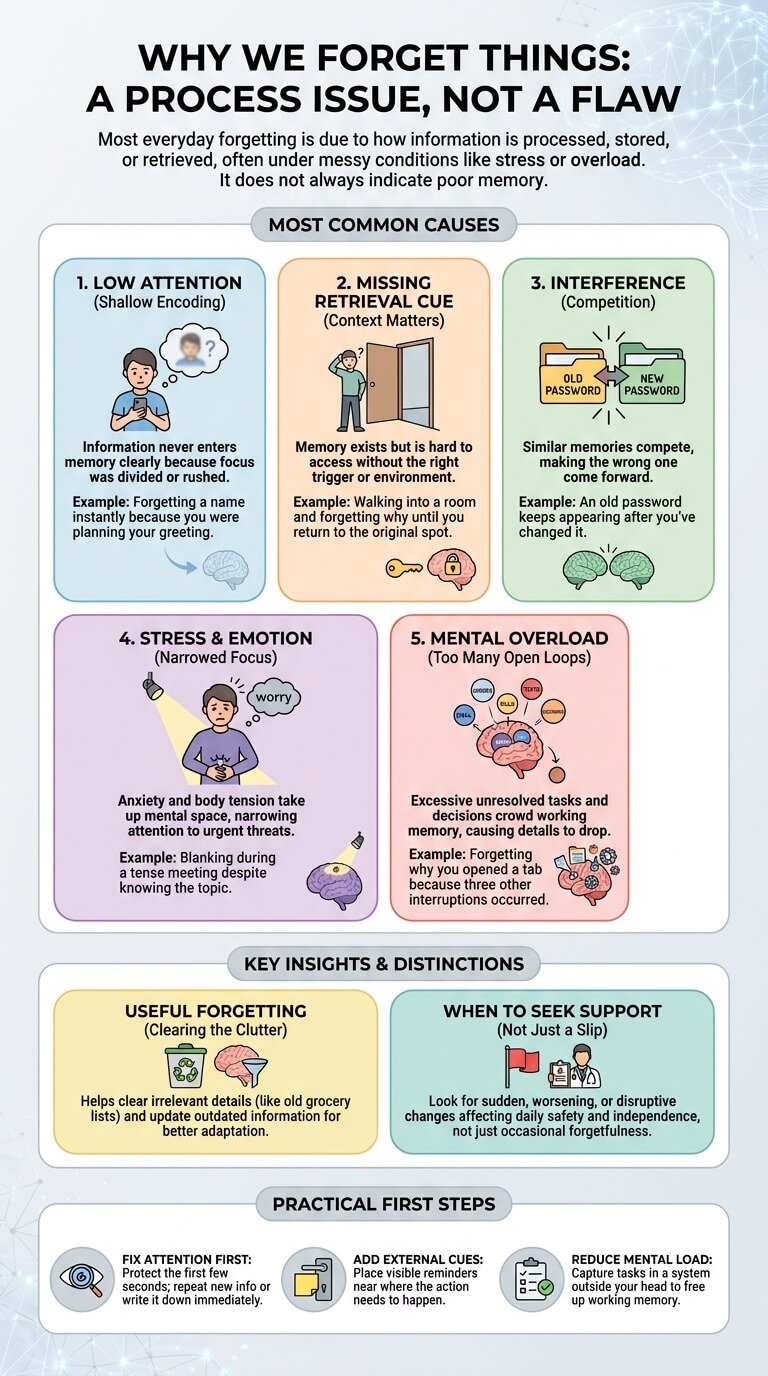
We forget things for many reasons: weak attention, shallow encoding, interference from similar information, missing retrieval cues, stress, emotion, overload, and normal updating. Forgetting does not always mean poor intelligence, laziness, or a broken memory. Often, the memory system was asked to work under messy conditions.
The most common causes at a glance
| Cause | What happens | Everyday example |
|---|---|---|
| Low attention | The information never enters memory clearly | You forget a name because you were thinking about what to say next |
| Interference | Similar information competes during learning or recall | An old password keeps coming to mind after you changed it |
| Missing cue | The memory is hard to access without the right reminder | You remember the errand only after seeing the grocery bag |
| Stress or anxiety | Worry and body tension take up mental space | You blank during a meeting even though you knew the point earlier |
| Overload | Too many open tasks compete at once | You forget why you opened a tab because three other tasks interrupted |
Forgetting Is Not Always a Memory Failure
To understand forgetting clearly, it helps to look at how memory works through encoding, storage, and retrieval.
The information may never have encoded well
Encoding is the first fragile step. If you were distracted, rushed, emotionally preoccupied, or only half listening, the information may not have been registered in a useful way. Later, it feels like you forgot it, but your mind may never have made a strong memory in the first place.
This happens often with names. When someone says, “Hi, I am Daniel,” you may be noticing the room, planning your greeting, worrying about your handshake, or trying to place their face. The name reached your ears, but it did not get enough attention to become stable.
The memory may exist but lack the right cue
Sometimes a memory is available only when something unlocks it. You cannot remember the title of a movie, then someone mentions one actor and the whole thing returns. You forget what you needed from the kitchen, then return to your desk and remember instantly.
That does not mean the memory vanished. It means retrieval needed help. The APA Dictionary explains a retrieval cue as a stimulus that helps bring a memory into awareness, which matches many everyday “it came back to me” moments.
Similar information may interfere
Forgetting can also happen because memories compete. If you learn several similar passwords, park in a different spot each day, or meet three people with similar names, the mind has to choose among overlapping traces. The more similar they are, the easier it is for the wrong one to come forward.
The APA definition of interference describes memory retrieval being blocked by conflicting material. This is why forgetting is not always about time passing. It can be about competition.
Reason 1: You Were Not Fully Paying Attention
Some information disappears because it was only held briefly and never became stable long-term memory, which is why the difference between short-term and long-term memory matters.
Shallow encoding
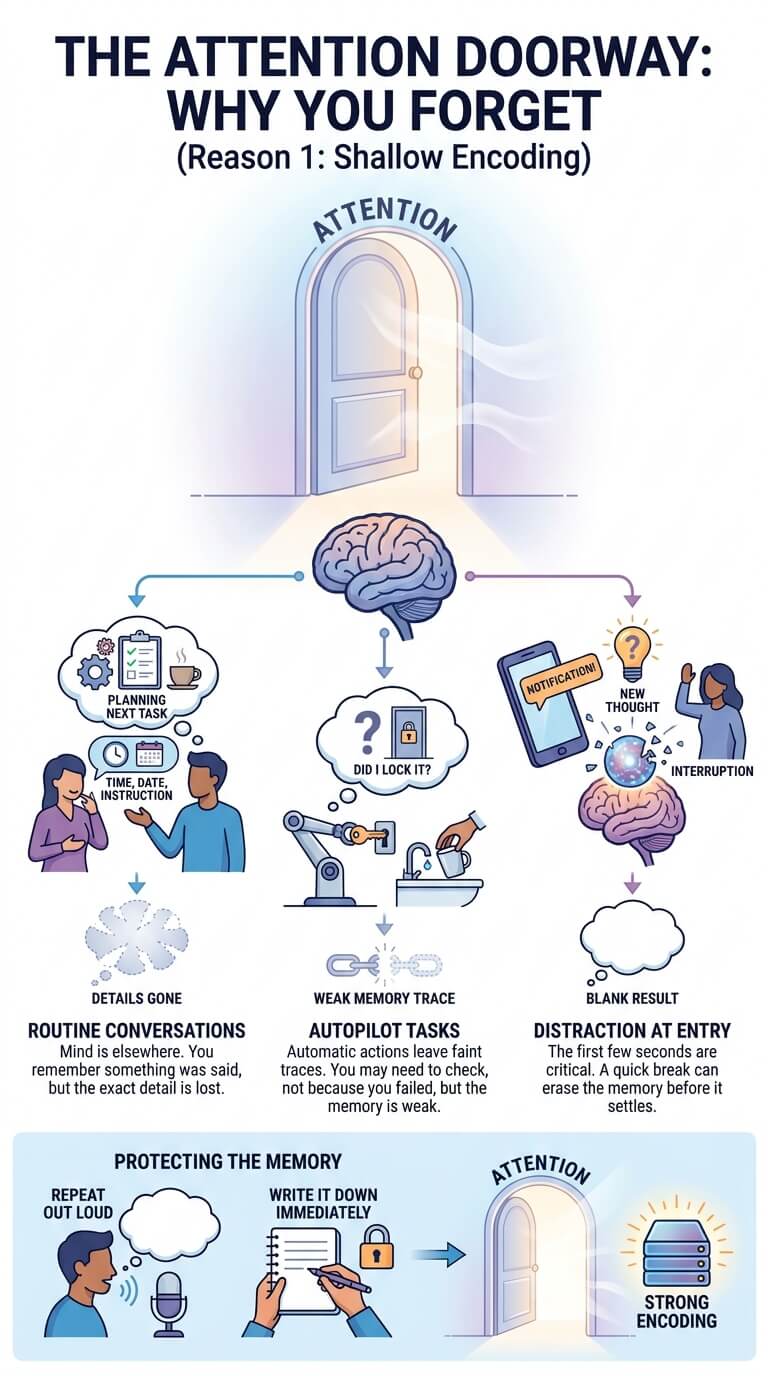
Attention is the doorway. If attention only brushes against information, memory is often shallow. You may recognize that something happened without being able to recall the details later.
Shallow encoding is common during routine conversations. You nod while someone explains a time, date, or instruction, but part of your mind is already planning your next task. Later, you remember that they said something important, but the exact detail is gone.
Autopilot tasks
Autopilot helps you move through familiar actions without using full attention. It is useful for brushing your teeth, locking the door, closing apps, or putting a cup in the sink. The downside is that low-attention actions leave weak memory traces.
This is why you may lock the door and doubt it five minutes later. The action happened, but it was so automatic that your mind did not mark it as a distinct event. You may need to check not because you failed to lock it, but because the memory of locking it was faint.
Distraction during the first few seconds
The first seconds after hearing or seeing information matter. A notification, a new thought, a change of room, or someone interrupting can break the moment before the memory has had time to settle. The result can feel oddly blank.
A useful clue is whether the forgotten detail was brief, new, and given while something else was happening. If so, the issue may be attention at entry, not long-term memory. Repeating the detail out loud or writing it down immediately can protect it from being bumped away.
Reason 2: Interference Gets in the Way
Old information blocks new information
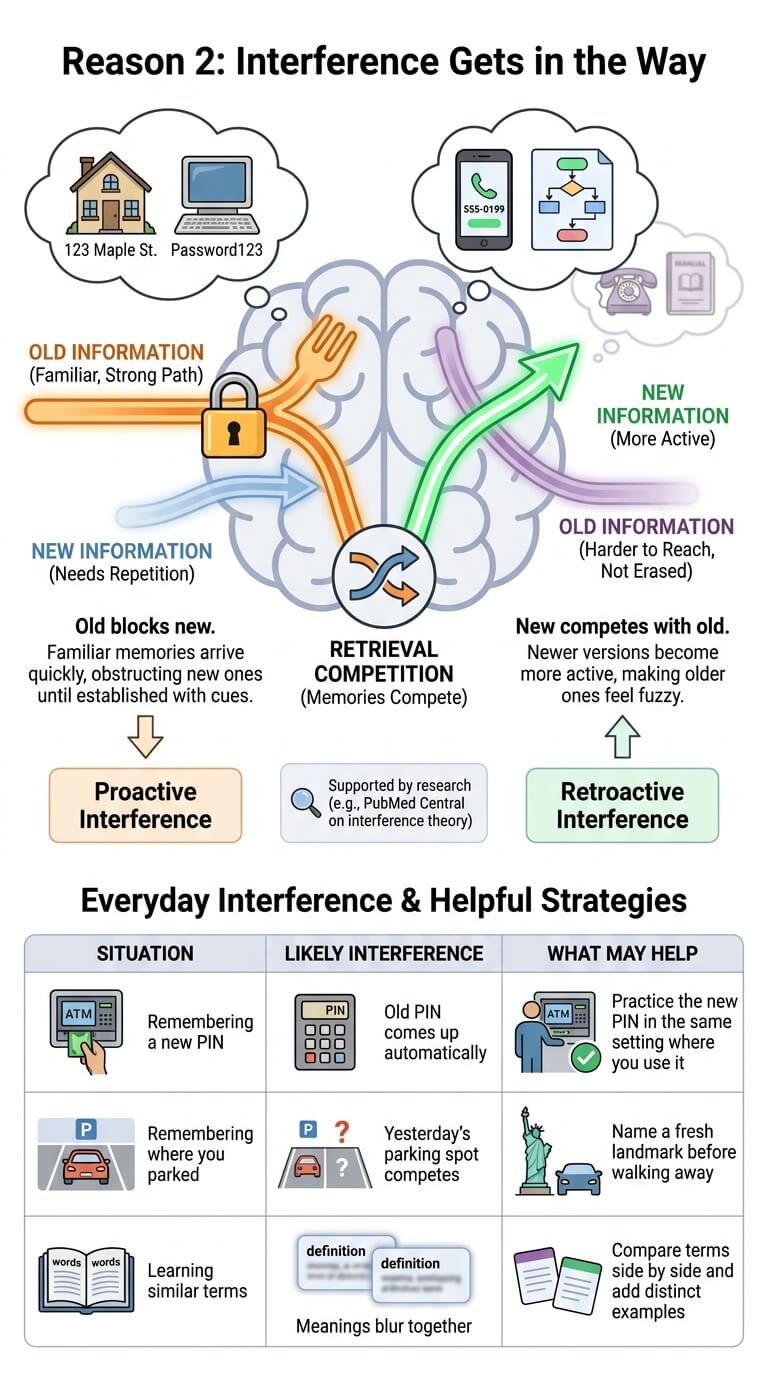
Old information can keep appearing when you need newer information. You type an old address after moving, use an old password after updating it, or call a coworker by the name of someone from a previous job. The older memory is familiar, so it arrives quickly.
This is not random. Familiar memories often have stronger paths. New information needs repetition and distinct cues before it can compete. Until then, the old version may keep stepping forward first.
New information overwrites or competes with old information
New information can also make older information harder to access. After you learn a new phone number, your old number may become harder to recall. After you study a new procedure, the earlier procedure may feel fuzzy.
In many cases, the old information is not truly erased. It is harder to reach because the newer version is now more active. A research paper on forgetting and memory competition in PubMed Central discusses interference theory as a way memories can compete during retrieval.
Everyday examples of interference
| Situation | Likely interference | What may help |
|---|---|---|
| Remembering a new PIN | The old PIN comes up automatically | Practice the new PIN in the same setting where you use it |
| Remembering where you parked | Yesterday’s parking spot competes | Name a fresh landmark before walking away |
| Learning similar terms | Meanings blur together | Compare the terms side by side and add distinct examples |
| Meeting several people at once | Names and faces overlap | Use each name in a specific sentence soon after hearing it |
Reason 3: You Lack the Right Retrieval Cue
Why context matters
Memory is tied to context more than people realize. Place, mood, smell, sound, task, and even posture can become part of the mental surroundings of a memory. When those surroundings are missing, the memory may be harder to reach.
That is why a thought can return when you reopen the same document, stand near the same shelf, hear the same song, or speak to the same person again. The cue recreates part of the original context, which gives your mind a better route back.
Why returning to a place can help
Forgetting why you entered a room is a classic cue problem. Your intention may have formed in one place, then the doorway, movement, and new visual scene changed your mental context. The goal was not lost forever, but the cues around it changed.
Returning to the original place sometimes helps because it brings back the cue that was present when the intention formed. This is not magic. It is a practical way to restore part of the mental environment that held the plan.
Why one clue can unlock a memory
A single clue can bring back a memory because memory is associative. A face, smell, phrase, street corner, or calendar notification can connect to a larger web of information. Once one part activates, nearby parts may return.
Use this deliberately. Instead of telling yourself, “Remember the appointment,” connect it to a cue: “After I make coffee, I will check the appointment time.” The stronger and more visible the cue, the less your mind has to hold the intention alone.
Reason 4: Stress and Emotion Change Memory Access
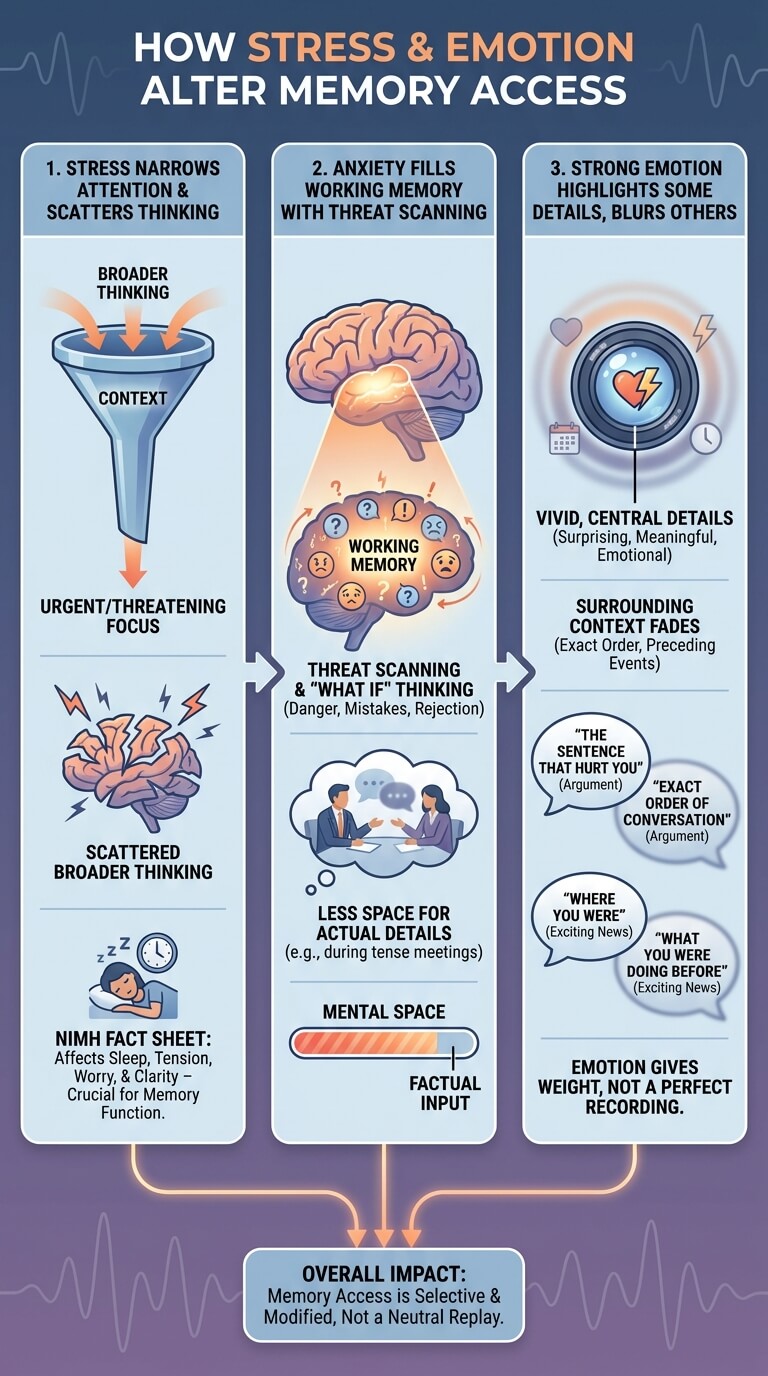
Emotion can also affect what stays available and what becomes harder to access, especially when emotional memory gives certain details more weight than others.
Stress can narrow attention
Stress does not affect all memory in one simple way. A moderate amount of pressure may make one urgent detail stand out, while ongoing stress can make broader thinking feel scattered. Under pressure, attention often narrows toward what feels most urgent or threatening.
The NIMH fact sheet on stress and anxiety notes that both can affect the mind and body, including sleep, tension, worry, and daily functioning. Those effects matter because memory depends on attention, sleep, and the ability to think clearly.
Anxiety can fill working memory with threat scanning
When anxiety rises, the mind may keep checking for danger, mistakes, rejection, or future problems. That scanning uses mental space. You may still be present in the room, but part of your working memory is occupied by “what if” thinking.
This can explain why you forget parts of a conversation during a tense meeting. You may be listening, but you are also monitoring facial expressions, worrying about how you sound, and preparing for possible criticism. Less space remains for the actual details.
Strong emotion can highlight some details and blur others
Emotion can make certain memories feel vivid, especially if the event felt surprising, meaningful, embarrassing, frightening, or joyful. But vivid does not always mean complete. Emotion can highlight central details while surrounding details fade or shift.
For example, after an argument, you may clearly remember the sentence that hurt you but forget the exact order of the conversation. After exciting news, you may remember where you were but forget what you were doing right before the call. Emotion gives memory weight, but it does not turn memory into a perfect recording.
Reason 5: Mental Overload Reduces Memory Reliability
Too many open loops
An open loop is an unfinished task, unanswered message, unresolved decision, or loose plan that keeps asking for attention. One open loop is manageable. Many open loops create a noisy mental background.
When your mind is holding grocery items, work tasks, appointments, family messages, bills, and half-finished ideas, small details are more likely to drop. That is not because the details are unimportant. It is because too many items are competing for active space.
Decision fatigue and task switching
Every switch asks the mind to reload context. You move from email to a document, from a document to a message, from a message to a calendar, and each jump requires remembering what mattered in that setting. The faster the switching, the more fragile memory becomes.
Decision fatigue adds another layer. When you must keep choosing what to do next, what to ignore, what to reply to, and what can wait, working memory becomes crowded by decision management. Forgetting often increases when the day has too many unresolved choices.
Why external systems help
External systems help because they reduce the burden on memory. A calendar, checklist, labeled basket, recurring alarm, or visible note gives the intention a home outside your head. That does not make you dependent. It lets memory do its job under better conditions.
For recurring tasks, try a cue plus a container: keys go in one dish, medicine stays near the morning routine, bills go into one folder, and ideas go into one capture note. The goal is not to remember more by force. The goal is to stop asking your mind to hold what the environment can hold.
Reason 6: Forgetting Can Be Useful
Clearing irrelevant details
A mind that remembered everything with equal strength would be overwhelmed. Forgetting helps lower the volume on details that no longer matter. You do not need to remember every license plate you saw, every sentence of a casual conversation, or every item on last month’s grocery list.
Forgetting can feel frustrating when it removes something useful, but its broader function is not only failure. It helps attention stay available for what is current, meaningful, repeated, or needed.
Updating old information
Forgetting also helps you update. You need to weaken old directions after a road changes, old procedures after software updates, old assumptions after new evidence, and old routines after a life change. If outdated information stayed too strong, adaptation would be harder.
This is why some forgetting is part of learning. The mind must not only add new information. It must also reduce the pull of information that no longer fits.
Protecting attention for what matters now
Attention is limited, so memory has to be selective. The mind tends to prioritize repetition, emotional meaning, usefulness, novelty, and current goals. This is imperfect, but it is also practical.
You may remember a random comment because it was surprising, while forgetting a routine errand because nothing made it stand out. A detail that matters to your schedule may need a cue, not just importance.
Normal Forgetting vs Concerning Memory Changes
Everyday examples that are usually normal
Occasional forgetfulness is common. Misplacing keys, forgetting a name and recalling it later, needing a list, losing your place after interruption, or forgetting why you opened a tab can happen to many people, especially during stress, poor sleep, busy schedules, or emotional strain.
Normal forgetting usually has a pattern you can understand. It may happen when you are tired, rushed, distracted, overloaded, or doing something automatic. It also tends to improve when you slow down, use cues, rest, or reduce competing demands.
Warning signs that deserve support
It is worth seeking professional input when memory changes are sudden, worsening, unusual for you, or disrupting daily independence. This includes getting lost in familiar places, repeating questions often without noticing, forgetting important recent events repeatedly, leaving dangerous items on, or struggling with familiar tasks that used to be manageable.
Mayo Clinic notes that typical age-related memory changes do not usually disrupt independent life, while more serious changes can affect work, social interactions, relationships, and familiar tasks. Their guidance on when to seek help for memory loss also explains that some causes of memory symptoms may be treatable.
Sudden changes, confusion, safety issues, or major disruption
Do not treat sudden confusion, memory change after a head injury, serious disorientation, new trouble speaking, severe mood changes, or safety problems as ordinary forgetfulness. Those situations deserve medical or professional attention. The same is true when forgetfulness is paired with severe distress, major sleep disruption, substance changes, or fear that you may not be safe.
Getting help is not an admission that something is “wrong” with you. It is a way to check whether stress, sleep, medication, health conditions, mood, injury, or another factor is affecting memory and attention.
What to Do First When You Keep Forgetting
Fix attention before blaming memory
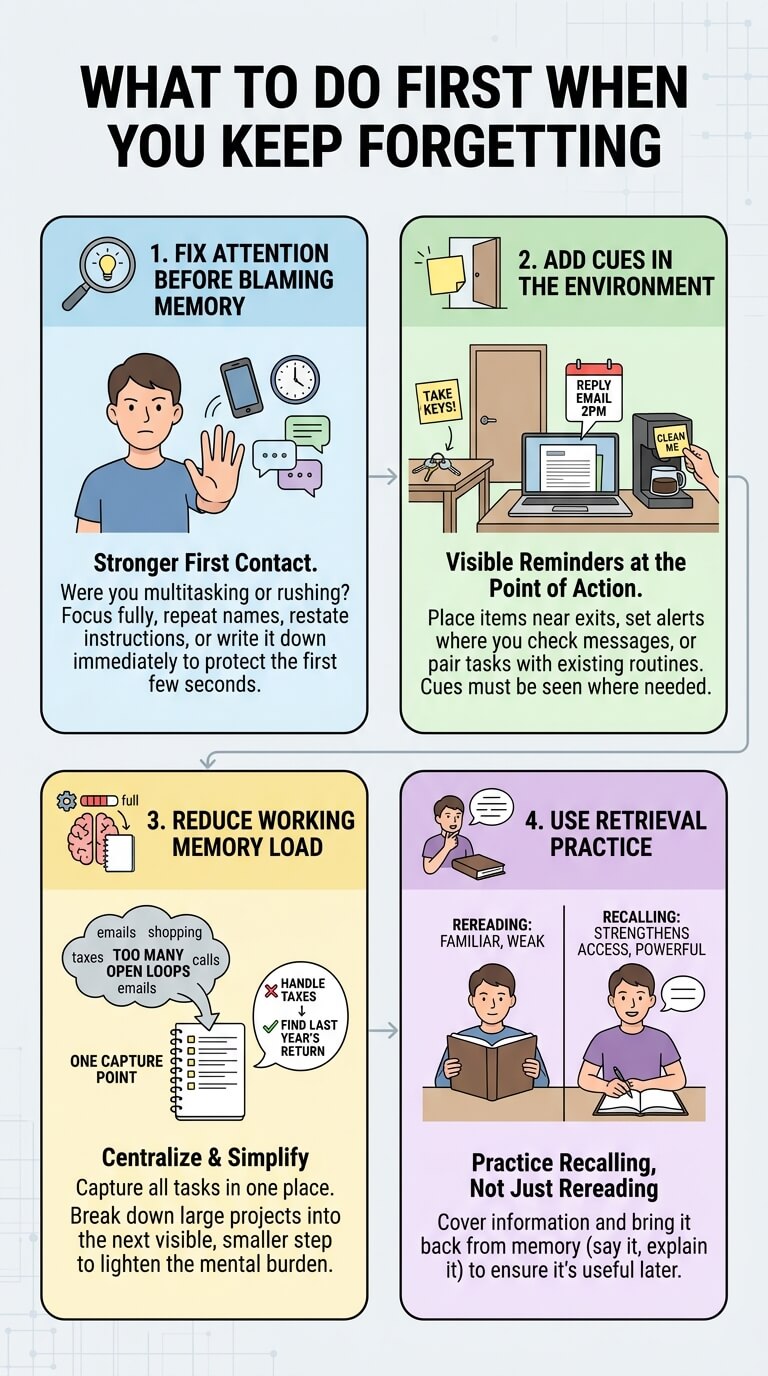
Before assuming your memory is weak, ask whether the information had your full attention when it arrived. Were you multitasking? Were you anxious? Were you rushing? Did someone tell you three things at once?
A simple repair is to make the first contact stronger. Repeat a name, restate an instruction, pause before changing rooms, or write down the task as soon as it appears. Many memory problems improve when the first few seconds are protected.
Add cues in the environment
Turn important intentions into visible cues. Put the item near the door, set the document on your desk, create a calendar alert, place a sticky note where the action happens, or pair the task with a routine you already do.
The cue should live where the behavior needs to happen. A reminder to take something with you works best near the exit. A reminder to reply works best where you check messages. Cues fail when they are hidden from the moment that needs them.
Reduce working memory load
If your mind is carrying too many open loops, write them down in one place. Do not scatter them across five apps, three scraps of paper, and your memory. Choose one capture point for tasks and one calendar for timed commitments.
Then choose the next visible action. “Handle taxes” is too large. “Find last year’s return and put it in the tax folder” is easier for working memory to hold. A smaller step reduces the number of things your mind must manage at once.
Use retrieval practice for important information
For information you truly need to remember, practice bringing it back without looking. Read a name, cover it, say it. Learn a concept, close the page, explain it in your own words. Review a plan, then recall the first three steps from memory.
Retrieval practice is different from rereading. Rereading feels familiar, but recall strengthens access. When the memory needs to be useful later, practice finding it, not just seeing it again.
FAQ About Forgetting Things
Why do I forget names so quickly?
Names are easy to forget because they are often brief, new, and given during a socially busy moment. You may be looking at the person, planning your response, noticing the environment, and managing first impressions at the same time. To improve recall, repeat the name naturally, connect it to a feature or context, and use it once soon after hearing it.
Why do I forget what I was about to do?
This often happens when your intention was tied to a context that changed. You formed the plan in one room, moved somewhere else, then the new environment replaced the cue. Returning to the original place, retracing the previous thought, or using visible reminders can help bring the intention back.
Can stress make me more forgetful?
Stress can make forgetting more likely by narrowing attention, disrupting sleep, increasing worry, and filling working memory with urgent concerns. It does not mean your memory is permanently damaged. If stress is constant, severe, or interfering with daily life, support from a qualified professional may help you understand what is affecting attention and recall.
Why do I remember random things but forget important tasks?
Importance alone does not guarantee memory. Random things may stick because they are surprising, emotional, unusual, repeated, or strongly cued. Important tasks can still be forgotten if they are routine, poorly timed, not attached to a visible cue, or buried under too many other responsibilities.
When should I worry about forgetfulness?
Worry less about occasional slips and more about changes that are sudden, worsening, unsafe, or disruptive. Seek professional guidance if forgetfulness affects familiar tasks, causes confusion, leads to safety problems, follows a head injury, or comes with major changes in mood, sleep, speech, movement, or daily functioning.
Key Takeaways
- Everyday forgetting often comes from attention, cues, interference, stress, or overload, not from a personal weakness.
- Some forgotten information was never encoded well enough to be easily retrieved later.
- Similar memories compete, which is why old passwords, names, addresses, and routines can interfere with newer ones.
- Visible cues, fewer open loops, and stronger first-contact attention can reduce many daily memory slips.
- Forgetting can be useful when it clears irrelevant details and helps the mind update old information.
- Sudden, worsening, unsafe, or disruptive memory changes deserve professional attention rather than self-blame.

Michael Reed is the Founder and Lead Writer at Psychology Exposed. He writes about human behavior, relationships, emotional patterns, self-awareness, and practical psychology topics using research-informed, easy-to-understand content.
Read More About Michael Reed: https://psychologyexposed.com/michael-reed/