
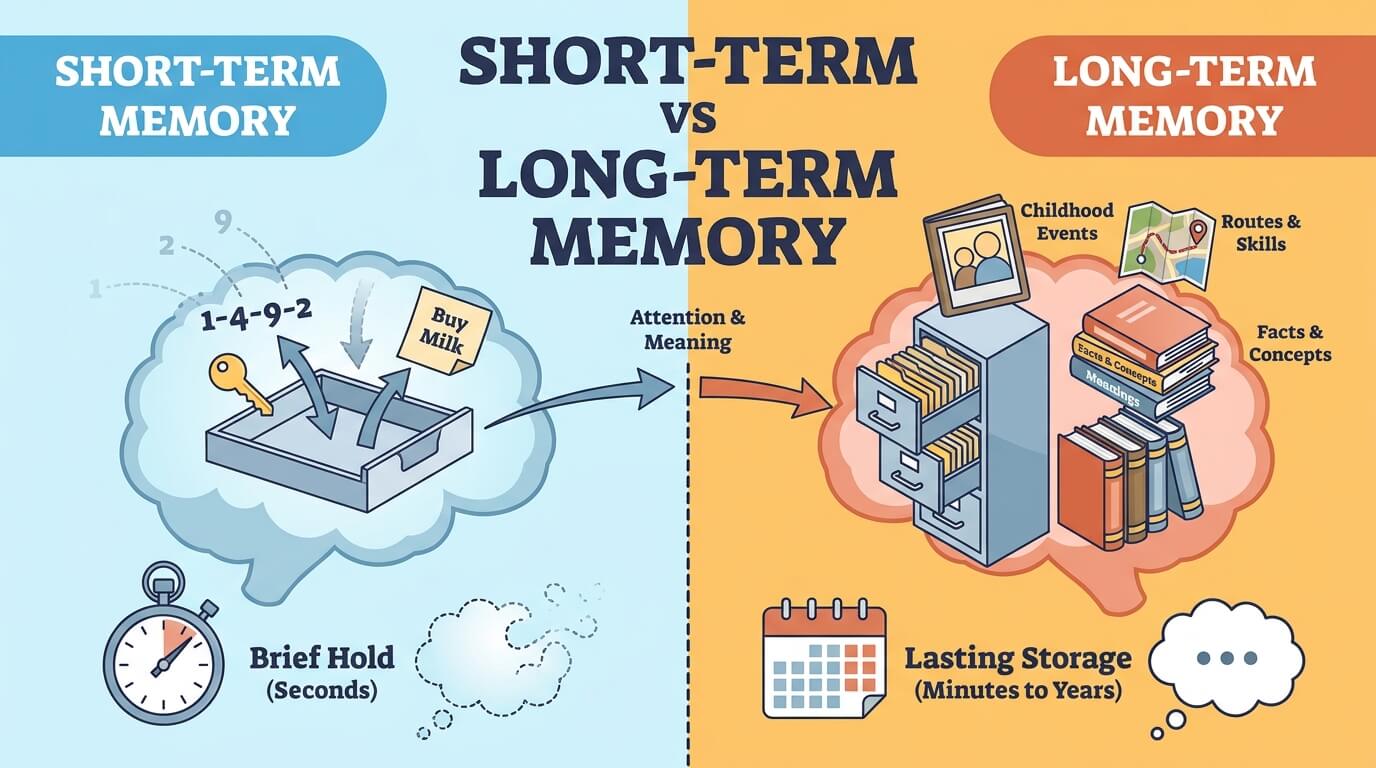
You can remember a number long enough to type it into a form, then lose it thirty seconds later. You can also remember a childhood street name, a song lyric, or how to ride a bicycle years after you first learned it. Both involve memory, but they are doing different jobs.
The difference between short-term and long-term memory matters because people often treat every forgotten detail as a sign that their memory is “bad.” In reality, some information was only being held briefly. It was never deeply encoded, connected to meaning, or made easy to retrieve later.
This guide compares short-term vs long-term memory in plain English. It explains what each one does, how information may move from a brief mental hold into more lasting storage, why temporary information disappears so quickly, and why long-term memories can still change over time. It is educational only and not a way to diagnose memory problems.
Quick Answer
The difference between short-term and long-term memory is one piece of memory psychology, which also looks at attention, retrieval, emotion, forgetting, and memory distortion.
The simplest difference
Short-term memory holds a small amount of information briefly, usually for immediate use. Long-term memory stores information beyond the moment, including facts, skills, events, meanings, and familiar patterns. Short-term memory is like holding a note in your hand. Long-term memory is more like filing information so it can be found again later.
| Memory type | Simple job | Everyday example |
|---|---|---|
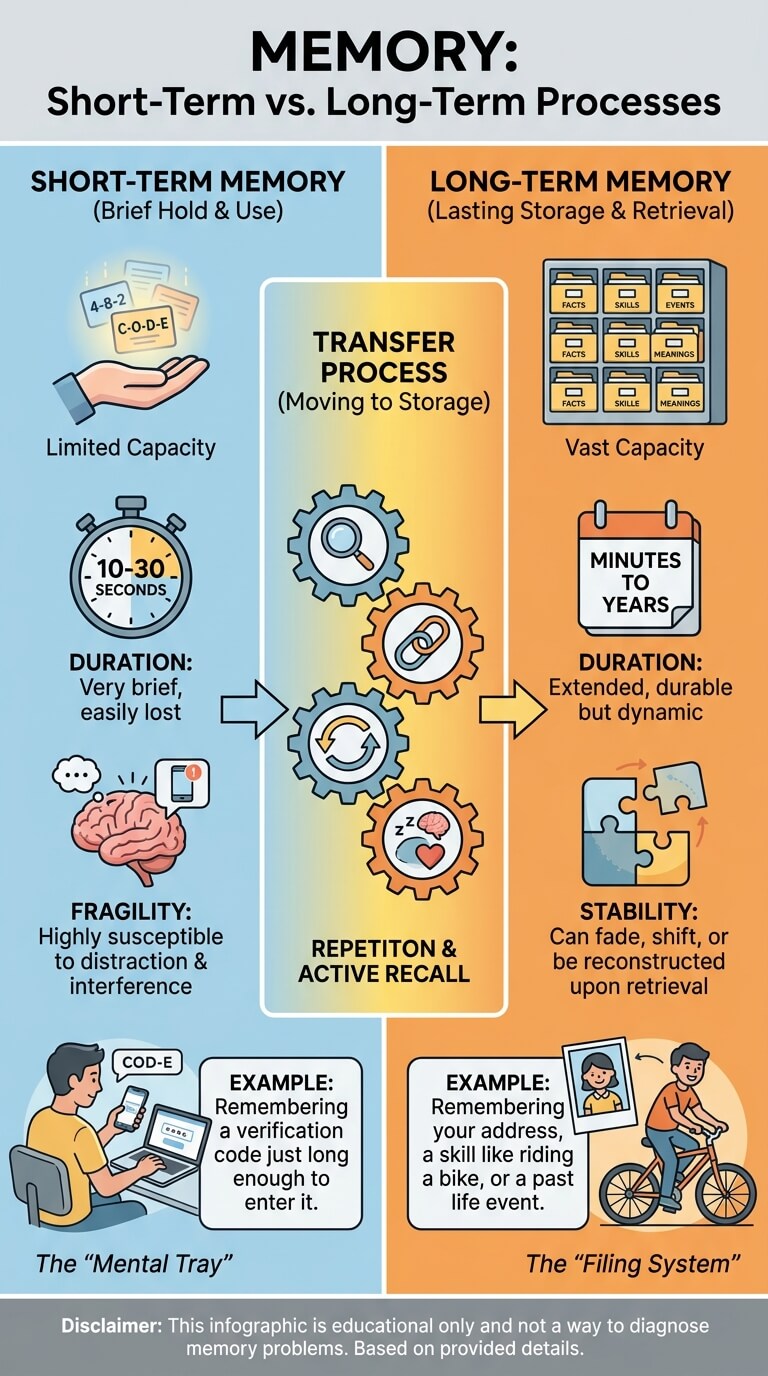
| Short-term memory | Briefly holds limited information | Remembering a six-digit code long enough to enter it |
| Long-term memory | Stores information beyond the current moment | Remembering your address, a recipe, a route, or a life event |
Why the line is not always perfect
The line between short-term and long-term memory is useful, but real life is messy. A new name may sit briefly in short-term memory, become more stable after repeated use, then later be hard to recall without the right cue. A long-term memory may feel strong for years but still lose details, shift in meaning, or become easier to remember in one context than another.
That is why memory is better understood as a process than as a fixed container. Information is noticed, held, organized, connected, stored, and retrieved. At each step, attention, meaning, repetition, emotion, sleep, and interference can change what remains available later.
What Short-Term Memory Means
Holding information briefly
Short-term memory is the ability to hold a limited amount of information for a short time. The APA Dictionary of Psychology describes short-term memory as recall of a limited amount of material after a brief period, often about 10 to 30 seconds. In daily life, it helps you keep information active long enough to use it.
You use short-term memory when you repeat a phone number while reaching for your phone, remember a room number while walking down a hallway, or hold the beginning of a sentence in mind while listening to the end. The information is active, but it is not guaranteed to last.
A helpful way to picture short-term memory is as a small mental tray. You can place a few items on it, but it cannot hold everything. If new information arrives or attention shifts, an item can fall off the tray before it becomes part of a longer-lasting memory.
Common examples in daily life
Short-term memory often shows up in ordinary moments that feel too small to call “learning.” You might remember a Wi-Fi password just long enough to type it. You might carry a coffee order from the counter to a table. You might remember the first half of someone’s question while they finish the second half.
| Situation | What short-term memory is doing | Why it may disappear |
|---|---|---|
| Typing a verification code | Holding digits briefly | The code is not meaningful once the task is done |
| Walking to another room for scissors | Holding an intention | The doorway, new visual cues, or another thought interrupts the intention |
| Meeting someone at a noisy event | Holding a new name | Attention moves to your reply, the room, or your own nerves |
| Following a short instruction | Holding a sequence | The sequence has too many steps or similar details |
Why capacity and attention matter
Short-term memory is limited. It is not meant to carry a full day of information. Attention decides what gets held, and capacity limits how much can stay active at once.
This is why chunking helps. A number like 149217761945 is hard to hold as twelve separate digits. But if you recognize it as 1492, 1776, and 1945, the mind can group the information into meaningful chunks. You are still using memory, but you are making the load easier to carry.
Attention also explains why a person can forget something seconds after hearing it. They may not have ignored it on purpose. Their attention may have shifted before the information was organized, repeated, or connected to anything useful.
What Long-Term Memory Means
Storing information beyond the moment
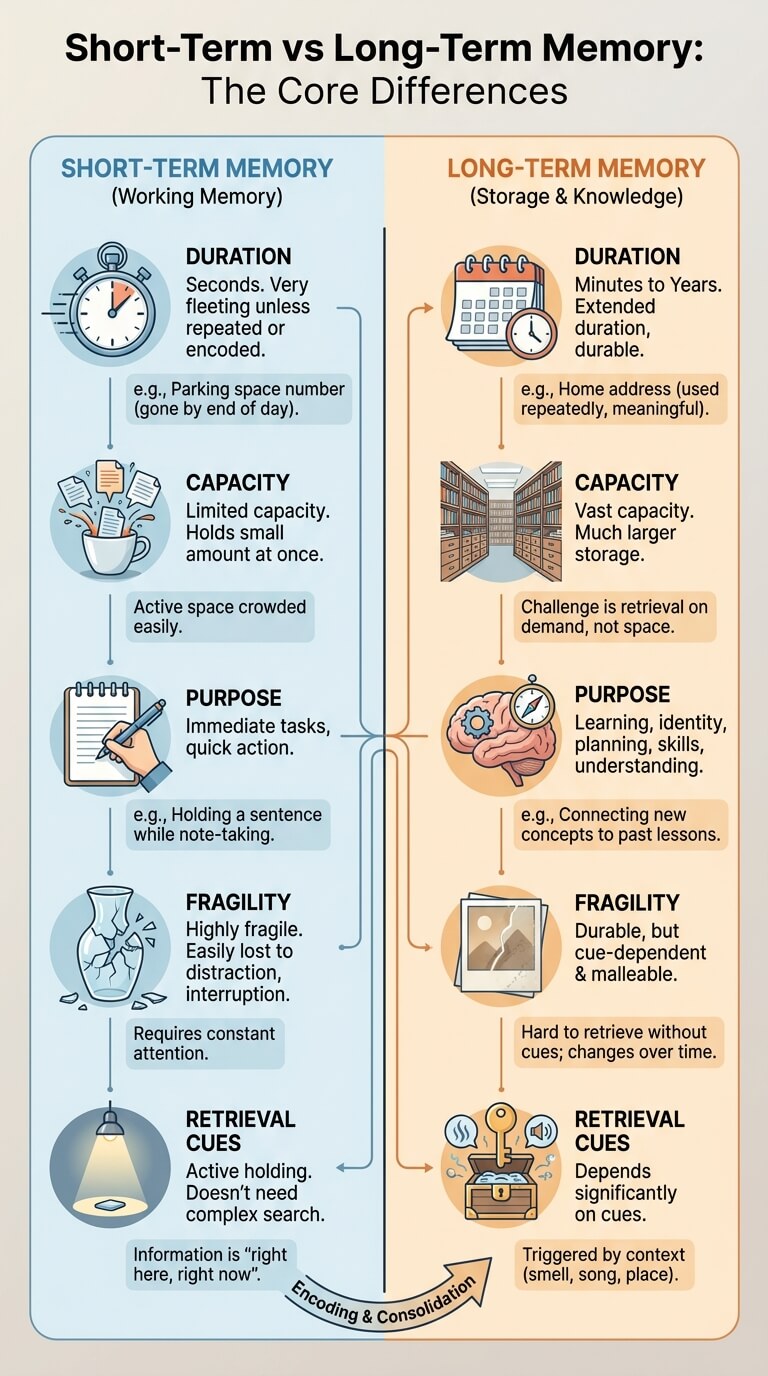
Long-term memory stores information beyond immediate use. The APA Dictionary of Psychology defines long-term memory as memory that lasts from a few minutes to many years, depending on the material and how it is learned, stored, and retrieved. It is the reason you can use knowledge, skills, and past experiences after the original moment has passed.
Long-term memory includes the address you know without checking, the route to a familiar store, the story of a family trip, the meaning of a word, and the steps involved in making tea. Some of it is easy to say aloud. Some of it guides action quietly.
Long-term does not mean perfect or permanent in every detail. It means the information has moved beyond a brief mental hold and can influence later thought or behavior.
Examples of facts, skills, events, and meanings
Long-term memory is broader than “things you studied.” It includes facts, skills, personal events, emotional associations, habits, and general meanings. A NCBI Bookshelf chapter on long-term memory explains that long-term memory includes procedural memory, such as practiced skills, and declarative memory, such as facts and personally experienced events.
| Kind of long-term memory | What it stores | Example |
|---|---|---|
| Facts and concepts | General knowledge and meanings | Knowing that a triangle has three sides |
| Skills and routines | Learned actions | Typing, driving, tying shoes, or playing a chord |
| Personal events | Experiences from your own life | Remembering a first day at school or a meaningful conversation |
| Associations | Connections between cues and meaning | A smell that brings back a place or period of life |
Why long-term memory still changes
Long-term memory is not a video recording stored untouched. When a memory is retrieved, you often reconstruct it from stored pieces, cues, current knowledge, and the meaning you now attach to the event. The broad memory may remain, while details can fade, merge, or be updated.
This is why two people can remember the same event differently without either person knowingly lying. They may have noticed different details, cared about different meanings, or rehearsed different parts of the event afterward.
Long-term memory is powerful because it helps you learn from experience. It is imperfect because the mind stores useful patterns, not flawless copies of every moment.
Short-Term vs Long-Term Memory: The Core Differences
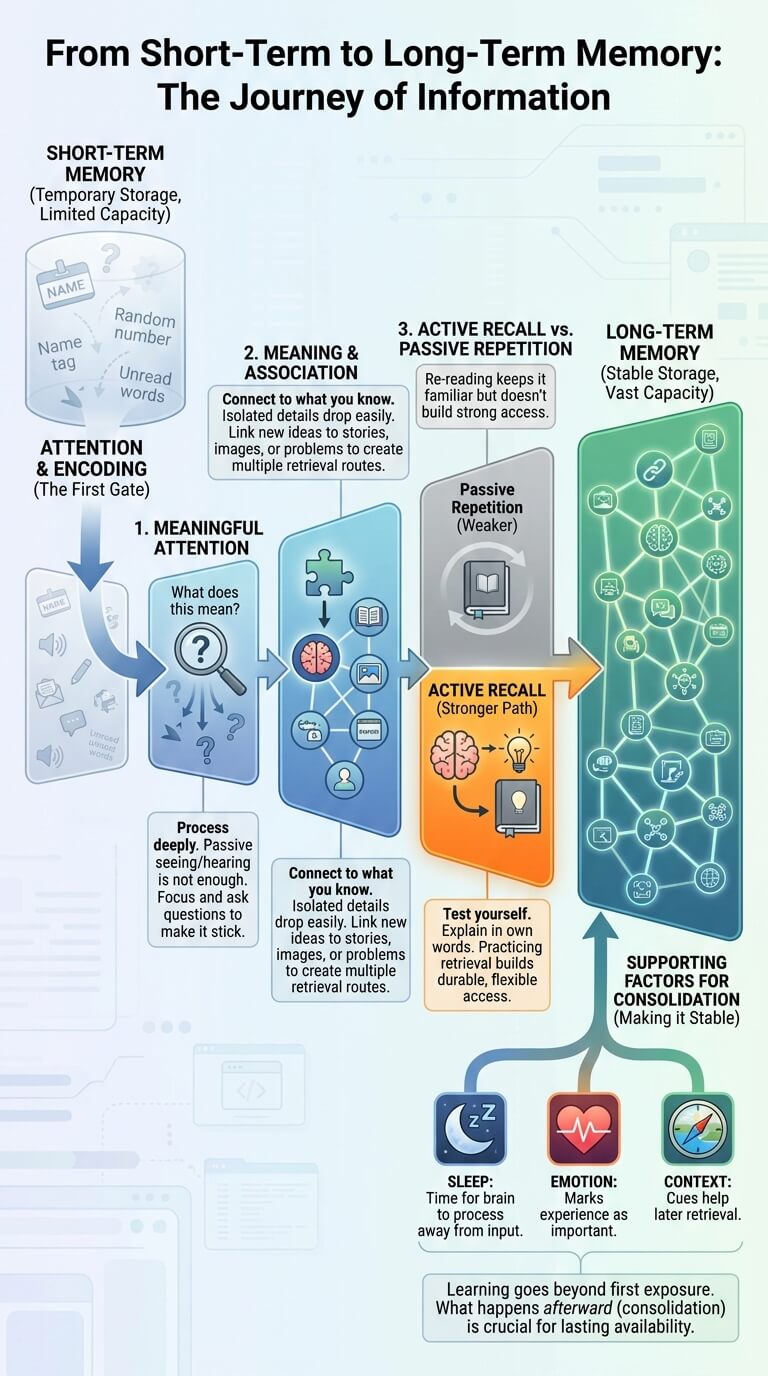
Short-term and long-term memory are two major categories, but they sit within a wider set of types of memory that also includes working, episodic, semantic, procedural, and emotional memory.
Duration
Duration is the most obvious difference. Short-term memory usually lasts seconds unless information is repeated, used, or encoded more deeply. Long-term memory can last from minutes to years, although ease of retrieval varies.
For example, a parking space number may disappear by the end of the day if you never need it again. Your home address remains available because you use it repeatedly, it has meaning, and it is connected to many other details about your life.
Capacity
Short-term memory has limited capacity. It can hold only a small amount of information at once. Long-term memory has a much larger capacity, although it is not always easy to search on demand.
This distinction explains a common frustration. You may know a lot, but still feel overloaded when too many details arrive at once. The issue is not that long-term memory is empty. The issue is that the active holding space is crowded.
Purpose
Short-term memory is useful for immediate tasks. It keeps information available long enough to act. Long-term memory is useful for learning, identity, decision-making, skill, recognition, and future planning.
In a classroom, short-term memory helps you hold a sentence while taking notes. Long-term memory helps you understand the concept later, connect it to earlier lessons, and use it on a test or in real life.
Fragility
Short-term memory is fragile because it depends strongly on attention. A distraction, interruption, similar detail, or sudden emotional reaction can push information out quickly.
Long-term memory is usually more durable, but it has its own kind of fragility. It may be hard to retrieve without the right cue. It may also change as new beliefs, repeated retellings, later information, and emotional meaning shape what comes to mind.
Retrieval cues
Short-term memory often does not need complex retrieval cues because the information is still active. You are holding the number right now, so you do not need to search for it deeply.
Long-term memory depends more on cues. A place, smell, song, question, face, or mood can bring back information that felt absent moments earlier. This is why returning to the room where you learned something, seeing an old photo, or hearing the first line of a song can make recall easier.
How Information Moves From Short-Term to Long-Term Memory
Understanding how memory works through encoding, storage, and retrieval helps explain how briefly held information can become available later.
Attention and encoding
Information is more likely to move beyond short-term memory when attention gives it enough processing. Encoding is the process of taking in information in a way that makes later storage and retrieval more possible.
Simply seeing or hearing something does not guarantee encoding. You may look at a name tag but focus on your own introduction. You may read a paragraph but mentally rehearse a worry. The words entered your senses, but they did not receive enough meaningful attention to become easy to retrieve later.
Better encoding often begins with a small question: “What does this mean?” When information has meaning, context, or a purpose, it has more ways to attach to what you already know.
Meaning and association
Meaning helps memory because isolated details are easy to drop. A random number is harder to remember than a birthday. A name is easier to remember if it matches someone you already know. A concept is easier to keep if you can connect it to a story, image, example, or problem you care about.
Association gives long-term memory more possible routes back to the information. If you connect a new idea to an example, a diagram, a person, and a use case, you are not relying on one fragile path. You are creating several ways to find it again.
Repetition vs active recall
Repetition can help, but not all repetition works equally well. Re-reading a sentence may keep it familiar, but active recall asks the mind to bring the information back without looking. A review on retrieval practice in Trends in Cognitive Sciences describes retrieval practice as important for long-term retention and flexible use of knowledge.
In plain terms, testing yourself gently often builds stronger access than only looking at the answer again. You might close the book and explain the idea in your own words. You might write what you remember before checking notes. You might ask, “Where would I use this?”
Active recall matters because long-term memory is not only storage. You also need practice retrieving the information when the original page, teacher, or conversation is not in front of you.
Sleep, emotion, and context as supporting factors
Sleep, emotion, and context can support memory, but none of them works like a magic switch. Sleep gives the brain time away from incoming information. Emotion can mark an experience as important. Context gives cues that help later retrieval.
A PubMed Central review of memory consolidation explains consolidation as the process through which a temporary, fragile memory becomes more stable. For general readers, the useful point is simple: learning is not only what happens during the first exposure. What happens afterward can also affect what remains available.
Why You Can Hold Something Briefly but Forget It Later
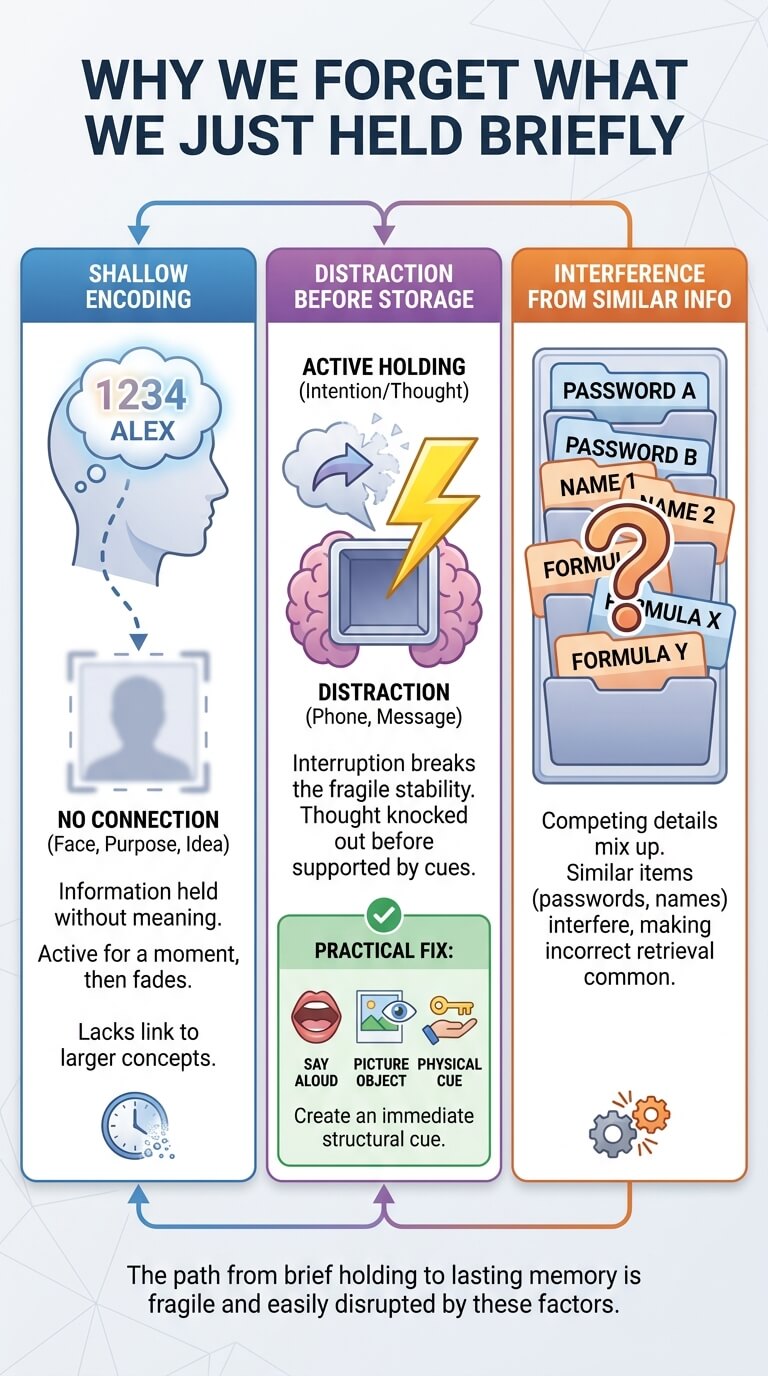
When information disappears before it becomes useful later, the issue may involve attention, interference, or missing cues, which are common reasons why we forget things.
Shallow encoding
Shallow encoding happens when information is held briefly without much meaning. You may repeat a name, code, or instruction, but never connect it to a face, purpose, image, or larger idea. It was active for a moment, then faded.
This is common when people are distracted or socially busy. At a party, you may hear someone’s name and immediately think about whether you should shake hands, what you look like, or what to say next. The name entered short-term memory, but it did not get enough attention to settle.
Distraction before storage
Distraction can interrupt the fragile period before information is more stable. You may walk into a room for a reason, see a message on your phone, then lose the original intention. The memory was not gone from your whole mind forever. It was knocked out of active holding before it was supported by cues.
One practical fix is to create an immediate cue. Say the purpose aloud, picture the object, or place a related item in your hand. These small actions give the intention more structure than a silent, floating thought.
Interference from similar information
Similar information competes. If you learn several passwords, names, formulas, or directions close together, one can interfere with another. The mind may hold pieces of each, then mix the details or retrieve the wrong one.
Interference is one reason spaced practice usually works better than cramming similar material without breaks. When every item feels alike, short-term holding and later retrieval both become harder.
Why Long-Term Memory Is Not Perfect Storage
Details can fade
Long-term memory often preserves the main idea better than every detail. You may remember that a conversation felt supportive but forget the exact wording. You may remember the route to a place but not the color of the building beside it.
This is not always a flaw. The mind often keeps what seems useful or meaningful. The problem comes when we assume that a vivid general memory guarantees every detail is exact.
Later beliefs can reshape recall
Later beliefs can influence how old events are remembered. If you later decide a person was untrustworthy, you may recall earlier moments through that lens. If you later understand a stressful period with more compassion, you may remember your own behavior differently.
This does not mean memories are invented from nothing. It means recall is influenced by the present. Current emotions, explanations, and relationships can color which details feel central.
Confidence can outgrow accuracy
Confidence and accuracy are related in some situations, but they are not the same thing. A memory can feel clear because it has been repeated many times, told as a story, or tied to strong emotion. That clarity may reflect importance more than exact detail.
A careful memory habit is to separate “I remember this strongly” from “every part of this must be exact.” The first statement honors experience. The second may go further than memory can responsibly support.
Short-Term Memory vs Working Memory
Holding information vs using information
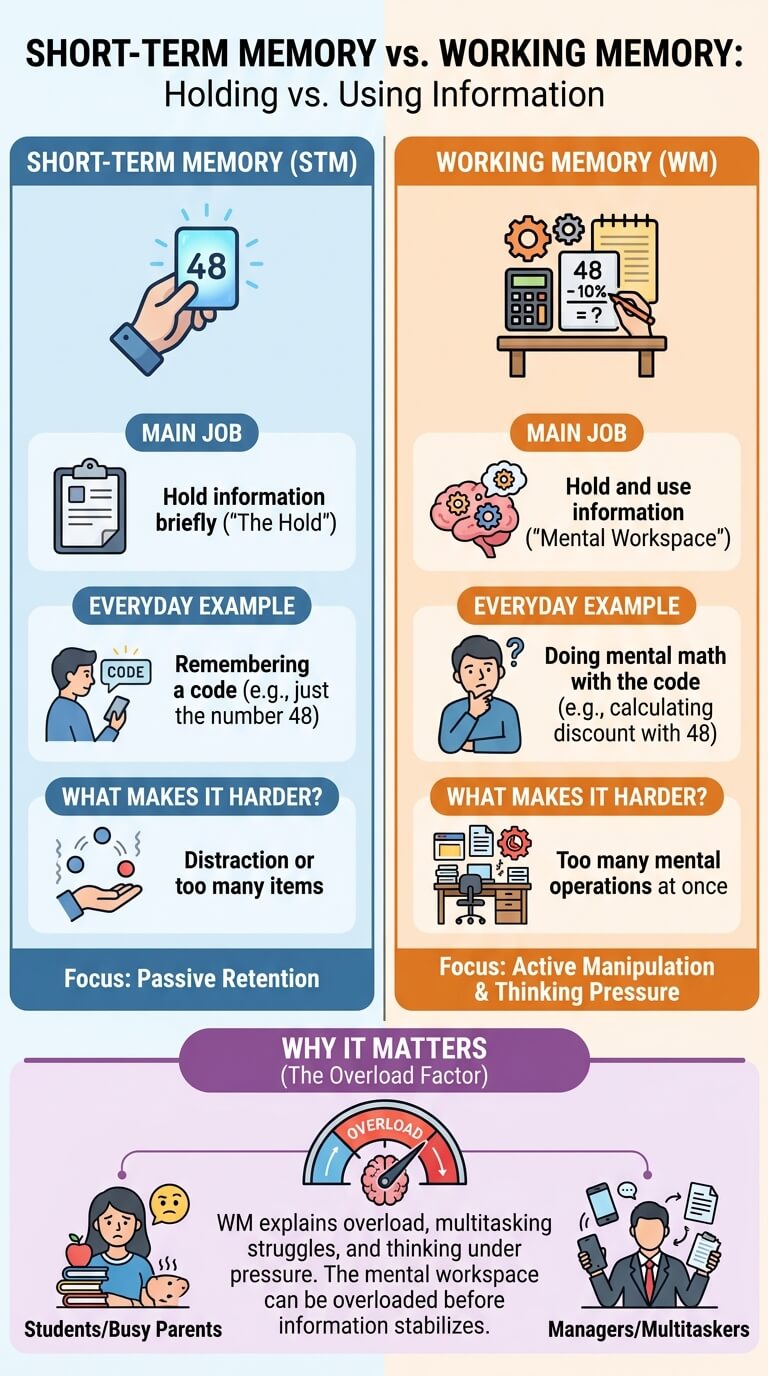
Short-term memory and working memory are closely related, but they are not identical. The APA Dictionary of Psychology explains working memory as a limited-capacity system that temporarily stores and manipulates information for complex tasks.
Short-term memory might hold the number 48. Working memory helps you use 48 while calculating a discount, comparing prices, or remembering which step comes next. Short-term memory is the hold. Working memory is the mental workspace where the information is handled.
| Question | Short-term memory | Working memory |
|---|---|---|
| What is the main job? | Hold information briefly | Hold and use information |
| Everyday example | Remembering a code | Doing mental math with that code or number |
| What makes it harder? | Distraction or too many items | Too many mental operations at once |
When to read the working memory guide next
If your main question is why your mind feels overloaded, why multitasking makes you lose track, or why it is hard to think while holding several details at once, working memory is probably the better next topic. Short-term memory explains brief holding. Working memory explains the pressure of using that information while thinking.
That distinction is especially useful for students, busy parents, managers, and anyone juggling instructions, messages, and decisions. Sometimes the issue is not that long-term memory is weak. It is that the mental workspace is overloaded before the information has a chance to become stable.
Everyday Examples That Show the Difference
Remembering a phone number
If you look at a phone number and repeat it until you dial, short-term memory is doing most of the work. If you use that number every week for months and eventually know it without looking, it has become part of long-term memory.
The transition depends on repetition, meaning, use, and cues. A number connected to someone important is more likely to last than a random number used once.
Studying for a test
During studying, short-term memory may help you hold a definition while reading the next sentence. Long-term memory is what you need when the book is closed and the question appears later.
This is why recognition can be misleading. A page may look familiar while you are reading it, but that does not always mean you can retrieve the idea later. Explaining the concept without looking is a stronger sign that learning is becoming available for long-term use.
Learning a route
The first time you hear directions, short-term memory holds steps like “left after the bridge, right at the library.” After you travel the route several times, long-term memory begins to store landmarks, turns, timing, and the general feel of the path.
Eventually, the route may feel automatic. You may arrive with little conscious effort because repeated experience has created a lasting map.
Remembering a childhood event
A childhood event belongs more to long-term memory than short-term memory, but that does not mean every detail is fixed. You may remember the main feeling, the people, the place, or one vivid image while other parts remain unclear.
Old memories can be meaningful even when incomplete. The careful question is not only “Do I remember it?” but also “Which parts are clear, which parts are inferred, and how might later stories have shaped the way I recall it now?”
When Forgetfulness Deserves More Attention
Forgetting a name, losing a code, or walking into a room and forgetting why is common, especially when attention is divided. It does not automatically mean something serious is happening. Stress, poor sleep, distraction, multitasking, and information overload can all make short-term memory feel weaker.
It may be worth getting professional guidance if memory changes are sudden, severe, worsening, connected to injury, or disrupting daily life in a way that feels unusual for you. The National Institute on Aging explains normal forgetfulness and warning signs in a way that can help people decide when to ask for support.
For everyday memory slips, the first step is usually gentler: reduce competing inputs, write down important details, repeat information with meaning, use cues, and avoid judging your whole mind based on one moment of distraction.
FAQ About Short-Term and Long-Term Memory
How long does short-term memory last?
Short-term memory is usually measured in seconds, often around 10 to 30 seconds when information is not rehearsed or used. In everyday life, it may feel even shorter if you are distracted, tired, stressed, or trying to hold too many details at once.
Can short-term memories become long-term memories?
Yes. Information held briefly can become long-term memory when it receives attention, meaning, repetition, association, and later retrieval practice. Not every short-term memory needs to become long-term, though. A one-time code or temporary instruction may disappear because it has served its purpose.
Why do I remember old events but forget what I just walked into a room to do?
Old events may be supported by long-term memory, emotion, repetition, identity, and many cues. A room intention is often a fragile short-term memory. When the scene changes or a new thought appears, the intention may lose its cue before it is acted on.
Is long-term memory permanent?
Long-term memory can last for years, but permanent is too strong for many everyday memories. Some memories remain stable in broad outline, while details fade or change. Other memories become hard to retrieve until the right cue brings them back.
Is working memory the same as short-term memory?
No, although they overlap. Short-term memory refers to briefly holding information. Working memory refers to holding and using information during thinking, problem-solving, reading, planning, or decision-making. Working memory is the more active mental workspace.
Key Takeaways
- Short-term memory holds a small amount of information briefly, usually for immediate use.
- Long-term memory stores facts, skills, events, meanings, and associations beyond the current moment.
- Information is more likely to last when attention, meaning, repetition, cues, and active recall support it.
- Forgetting something quickly does not always mean your memory is poor. It may mean the information was only briefly held.
- Long-term memory is useful and durable, but it is not a perfect recording of every detail.
- Working memory is different from short-term memory because it uses information while you think, decide, or solve problems.
Final Thoughts
The clearest way to understand short-term vs long-term memory is to ask what job the mind is doing. Is it holding a small detail for immediate use, or has the information become part of what you can use later? That question makes everyday forgetting less mysterious.
For a simple first step, choose one detail you actually want to remember today and give it more than repetition. Attach it to meaning, say it in your own words, create a cue, and retrieve it once without looking. That small shift helps information move from a brief mental hold toward a memory you can find again.

Michael Reed is the Founder and Lead Writer at Psychology Exposed. He writes about human behavior, relationships, emotional patterns, self-awareness, and practical psychology topics using research-informed, easy-to-understand content.
Read More About Michael Reed: https://psychologyexposed.com/michael-reed/