
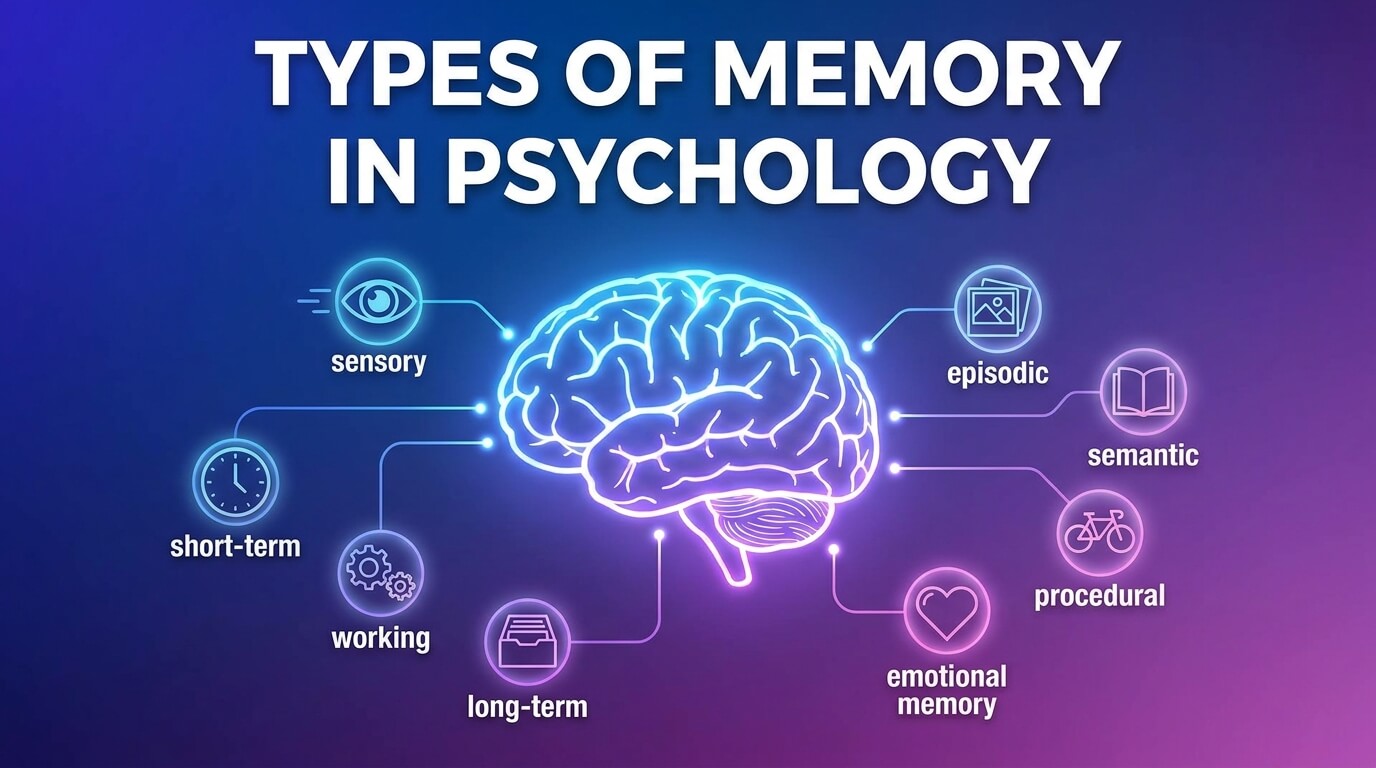
Memory is not one single mental folder. You use one kind of memory when you hold a phone number for a few seconds, another when you remember your first day at a new job, another when you know what the word “winter” means, and another when your hands remember how to type without thinking through each letter.
That is why the types of memory in psychology can feel confusing at first. Terms like sensory memory, short-term memory, working memory, long-term memory, episodic memory, semantic memory, procedural memory, and emotional memory all describe different jobs the mind performs. They are related, but they are not interchangeable.
This guide explains the main memory types in plain English, with everyday examples for each one. It is not a memory test and it is not meant to diagnose memory problems.
Quick Answer
These categories make more sense inside the broader field of memory psychology, where memory is understood as an active system for storing, retrieving, and updating experience.
The main memory types at a glance
The main types of memory in psychology include sensory memory, short-term memory, working memory, long-term memory, episodic memory, semantic memory, procedural memory, and emotional memory. Some describe how long information is held. Others describe what kind of information is stored, such as facts, events, skills, or feelings connected to experience.
| Memory type | Simple meaning | Everyday example |
|---|---|---|
| Sensory memory | A very brief trace of sights, sounds, and sensations | You still “hear” the last second of a sentence after someone stops talking. |
| Short-term memory | Temporary holding of a small amount of information | You remember a code long enough to type it. |
| Working memory | Mental workspace for holding and using information | You calculate a tip while remembering the bill total. |
| Long-term memory | More durable storage of knowledge, experiences, and skills | You remember your childhood street or how to make coffee. |
| Episodic memory | Memory for events you experienced | You remember where you were during an important conversation. |
| Semantic memory | Memory for facts, words, and meanings | You know that Paris is in France without remembering when you learned it. |
| Procedural memory | Memory for skills, routines, and learned actions | You ride a bicycle or unlock your phone by habit. |
| Emotional memory | Memory shaped by emotional importance | A certain smell brings back a strong feeling from years ago. |
Why categories overlap in real life
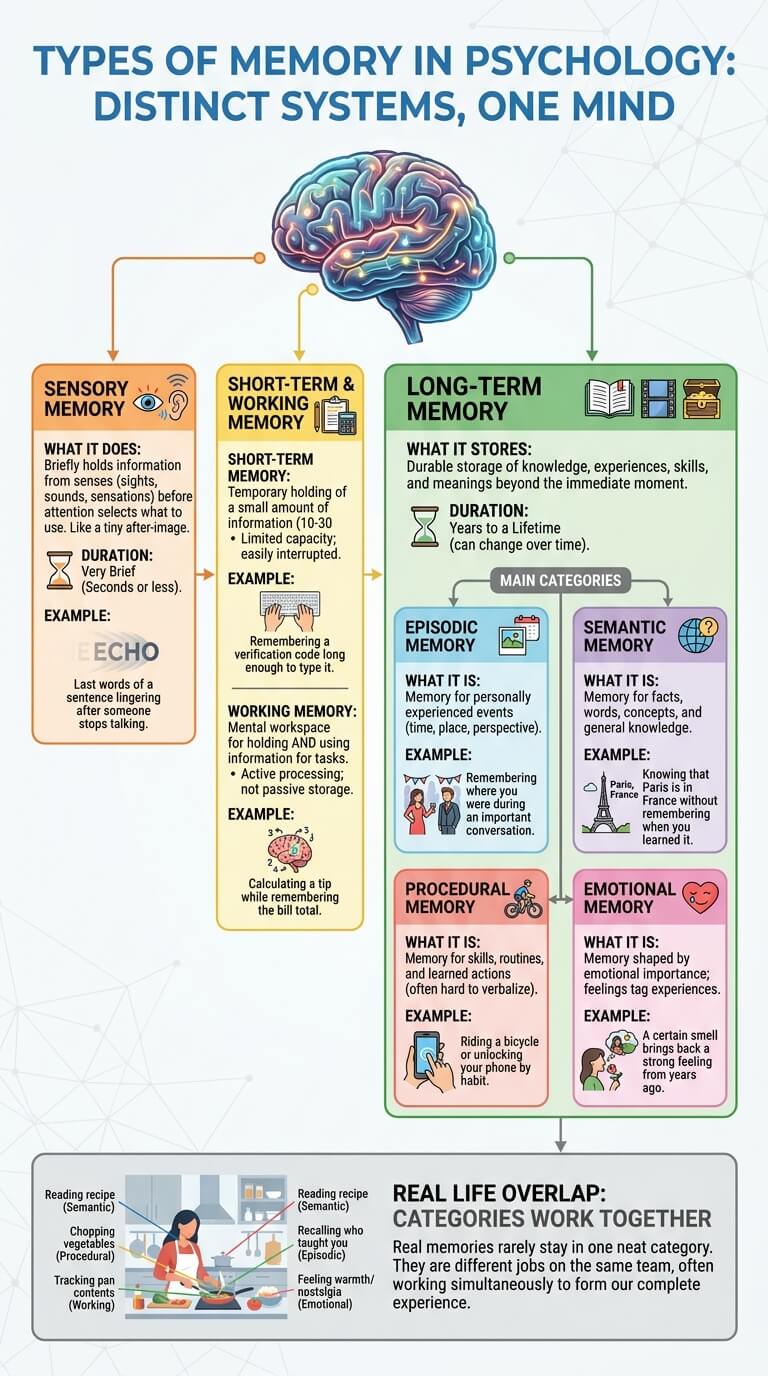
Real memories rarely stay inside one neat category. A birthday party can be episodic because you remember the event, semantic because you know who was there, emotional because the day felt meaningful, and sensory because a song or smell brings it back. Categories are tools for understanding memory, not walls inside the mind.
Think of memory types as different jobs on the same team. One job holds information for a moment, another gives meaning, another stores a skill, and another tags an experience as emotionally important.
Why Psychologists Divide Memory Into Types
Each memory type still depends on how memory works at the process level: encoding information, storing it, and retrieving it when the right cue appears.
Different jobs require different memory systems
Psychologists divide memory into types because remembering a sound for two seconds is not the same as remembering your graduation day, solving a math problem in your head, or driving a familiar route. The APA Dictionary of Psychology describes the information-processing model as a view of memory with sensory memory, short-term memory, and long-term memory as distinct components that process information through encoding, storage, and retrieval.
That model shows why memory is not only about “good memory” or “bad memory.” You might remember stories well but feel overloaded when too many instructions arrive at once.
Different memory types also explain why one kind of forgetting does not always mean every memory system is weak. Forgetting a name after hearing it once is different from forgetting how to tie your shoes. Losing your train of thought during a busy conversation is different from not remembering where you learned a fact.
Why no single type explains all remembering
No single memory type can explain all remembering because memory has different time spans, contents, and levels of awareness. Some memories are conscious and easy to describe. Others guide behavior quietly. Some last for seconds. Others can remain for years, though even long-lasting memories may change in detail.
Consider cooking a familiar meal. Semantic memory helps with ingredients, procedural memory guides chopping and stirring, working memory tracks what is already in the pan, and episodic memory may recall who taught you the recipe.
Sensory Memory
What sensory memory does
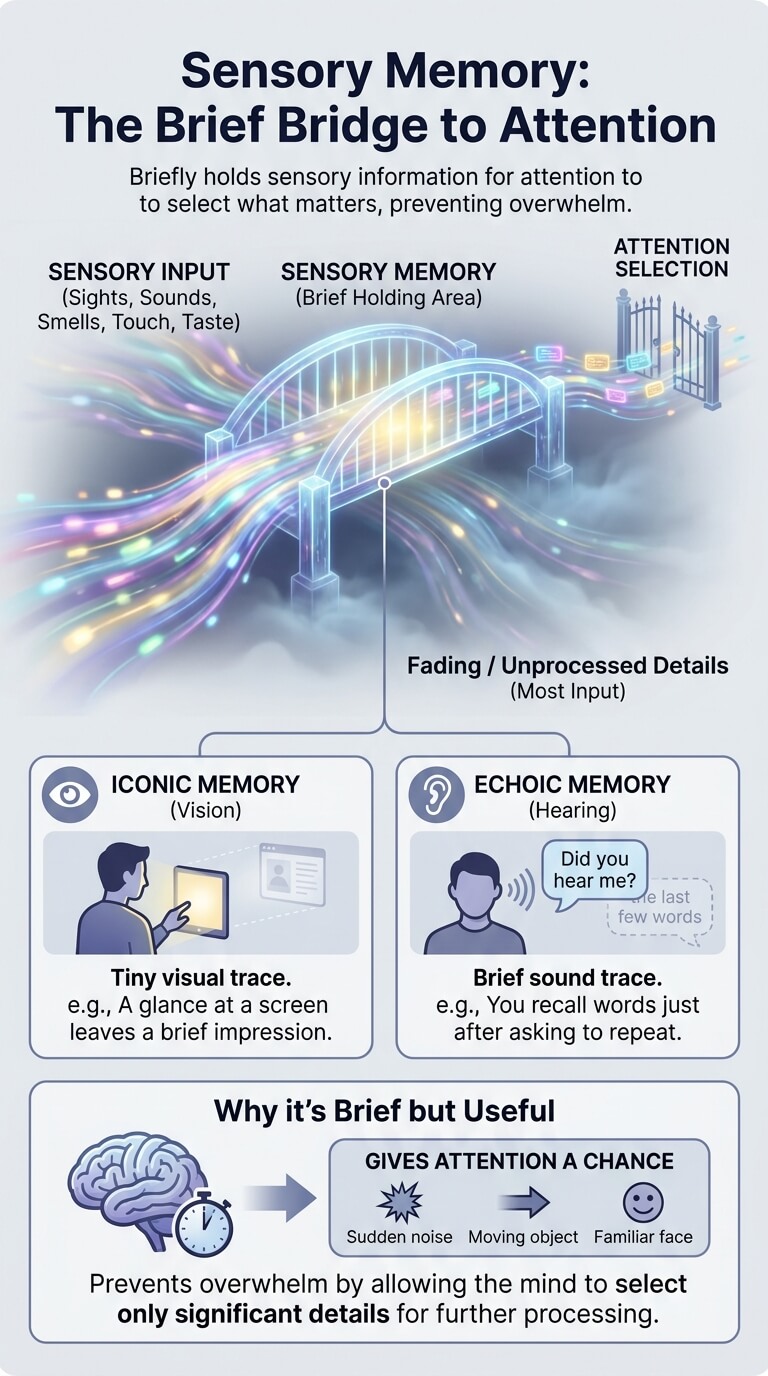
Sensory memory briefly holds information from the senses before attention decides what to use. It is like a tiny after-image of experience. Most of it disappears quickly, but it gives the mind a moment to select what matters.
You use sensory memory when a car passes and the sound lingers for a split second, when a bright light leaves a brief visual trace, or when you can repeat the last few words someone said even though you were not fully listening until they asked, “Did you hear me?”
This type of memory is short, but it matters. It gives the mind a brief bridge from one instant to the next.
Iconic and echoic examples without getting too technical
Two common examples are iconic memory and echoic memory. Iconic memory refers to a very brief visual trace. Echoic memory refers to a brief sound trace. You do not need technical detail to notice them in daily life.
| Type | Sense involved | Simple example |
|---|---|---|
| Iconic memory | Vision | You glance at a screen and hold a tiny visual impression for a moment. |
| Echoic memory | Hearing | You ask someone to repeat themselves, then realize you can still recall what they said. |
These traces are not detailed memories of an event. They are brief sensory impressions. Attention has to catch them quickly if they are going to become more useful.
Why sensory memory is brief but useful
Sensory memory is brief because the mind cannot process every sight, sound, smell, touch, and taste in depth. If every sensory detail stayed active, the mind would quickly be overwhelmed. The short duration is part of its usefulness.
Its job is to give attention a chance. A sudden noise, a moving object, a familiar voice, or a change in facial expression may be selected for more processing. Details that are not selected usually fade before they become lasting memories.
Short-Term Memory
One useful distinction is the difference between short-term and long-term memory, because holding information briefly is not the same as storing it for later use.
What short-term memory holds
Short-term memory holds a limited amount of information for a short period. The APA Dictionary of Psychology defines short-term memory as recall of a limited amount of material after roughly 10 to 30 seconds. In everyday life, this is the mental holding space you use when information needs to stay available briefly.
Short-term memory is useful when you remember a verification code, a street number, a sentence you are about to write down, or the first half of a question while listening to the second half. It is temporary by design.
Because it is limited, short-term memory is sensitive to interruption. If someone talks to you while you are holding a number in mind, the number may vanish before it reaches longer storage.
Everyday examples of temporary holding
Short-term memory often appears in small moments that people barely notice until it fails. You look up a gate number, walk toward the airport sign, and repeat the number silently. You hear a new name, hold it long enough to answer politely, then lose it minutes later.
| Situation | Short-term memory is doing this | Why it may fail |
|---|---|---|
| Remembering a parking level | Holding a small detail temporarily | You get distracted before making it meaningful. |
| Typing a one-time code | Keeping digits active for a few seconds | Another message interrupts you. |
| Following a short direction | Holding a sequence in order | The sequence has too many steps. |
| Repeating a new name | Holding sound information briefly | You focus on what to say next instead of the name. |
Why short-term memory is limited
Short-term memory is limited because active mental holding takes effort. The mind cannot keep unlimited details ready at the same time. Rehearsal, chunking, and meaning can help, but the space remains narrow.
This is why a number like 739184 is harder to hold than 739-184, and why a familiar phrase is easier to remember than a random string of letters. The information becomes easier when the mind can group it or connect it to something already known.
Working Memory
What working memory does differently
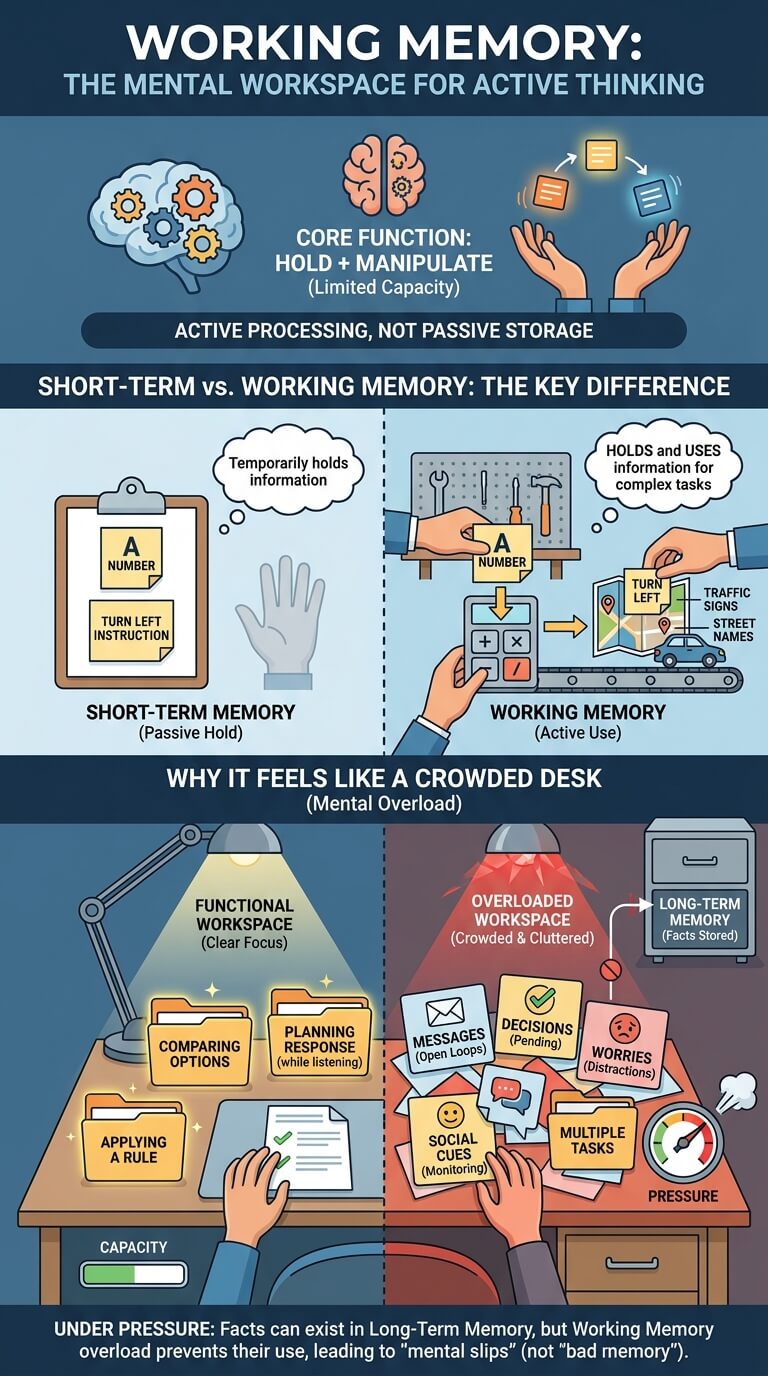
Working memory is closely related to short-term memory, but it does more than hold information. It holds and uses information at the same time. The APA Dictionary of Psychology describes working memory as a limited-capacity system for temporarily storing and manipulating information needed for complex cognitive tasks.
That difference matters. Short-term memory may hold a number. Working memory helps you use that number in a calculation. Short-term memory may hold the beginning of a sentence. Working memory helps you understand how the whole sentence fits together.
Working memory is why mental overload feels like a crowded desk. You are not only keeping information available. You are comparing, updating, choosing, suppressing distractions, and deciding what to do next.
Holding and manipulating information
Working memory is active when you solve a problem in your head, follow a recipe while cooking, compare two options, plan what to say while listening, or remember a rule while applying it. It is not passive storage. It is mental handling.
If someone gives you directions, short-term memory may hold “turn left at the pharmacy.” Working memory helps you apply that direction while checking street signs and adjusting to traffic.
Why working memory feels like mental workspace
Working memory often feels like mental workspace because it is where current thinking happens. When there are too many open loops, such as messages, decisions, worries, numbers, tasks, and social cues, the workspace feels crowded.
This is why a person can know a fact perfectly and still be unable to use it under pressure. The fact may exist in long-term memory, but working memory may be overloaded in the moment. That distinction helps people avoid blaming every mental slip on “bad memory.”
Long-Term Memory
What long-term memory stores
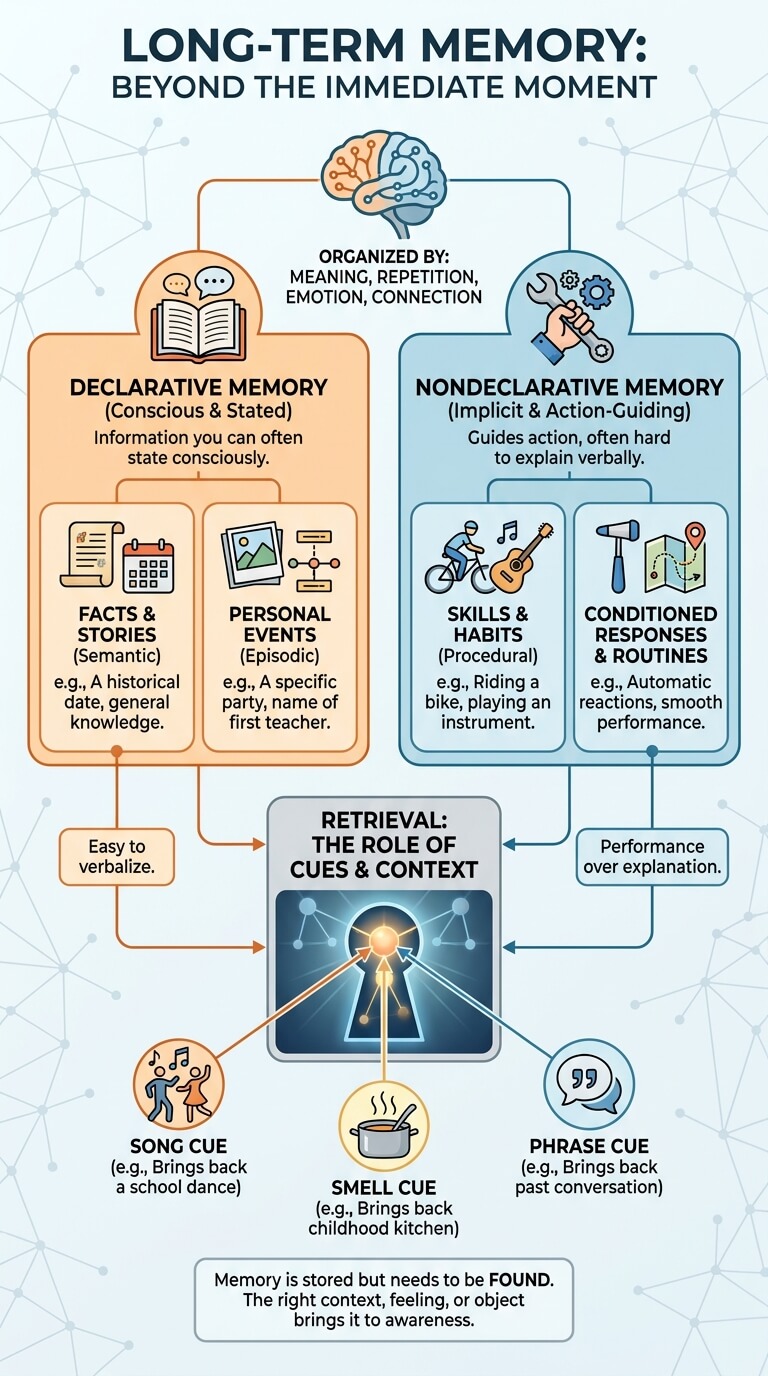
Long-term memory stores information that lasts beyond the immediate moment. It can include facts, personal experiences, meanings, skills, habits, emotional associations, and familiar patterns. A PubMed Central overview of memory describes long-term memory as including declarative and nondeclarative forms, with declarative memory including episodic and semantic memory and nondeclarative memory including skills and related learning.
Long-term memory is organized by meaning, cues, repetition, emotion, usefulness, and connection to what you already know. Some information is easy to retrieve because you use it often. Other information needs the right cue.
Why long-term memory is not one single box
Long-term memory includes different kinds of remembering. Knowing a historical date is not the same as remembering a personal event. Knowing how to ride a bike is not the same as remembering the name of your first teacher. These all last beyond the moment, but they are not stored or used in identical ways.
| Long-term memory category | What it usually holds | Example |
|---|---|---|
| Declarative memory | Information you can often state consciously | A fact, a story, a personal event |
| Nondeclarative memory | Learning that may guide action without easy verbal explanation | A skill, habit, conditioned response, or practiced routine |
This is why people can sometimes perform a skill smoothly but struggle to explain each step. The memory is real, but it is not organized like a verbal fact.
How long-term memory connects to meaning and cues
Long-term memory often becomes easier to retrieve when it has strong meaning or strong cues. A song may bring back a school dance. A smell may bring back a kitchen from childhood. A phrase may bring back a conversation you had years ago.
Cues matter because memory is not only stored. It has to be found. A memory may feel absent until the right context, question, place, feeling, or object brings it closer to awareness.
Episodic Memory
Memory for events and experiences
Episodic memory is memory for personally experienced events. The NCBI Bookshelf review of explicit memory explains episodic memory as conscious recollection of an episode, including the sequence of events and its space-time location. In plain language, it helps you remember what happened, where it happened, and what it was like for you.
Examples include your first day at a job, a family trip, a difficult conversation, or the moment you heard important news. Episodic memory usually includes a point of view: you remember it as something you lived through.
Why time, place, and perspective matter
Episodic memory is tied to context. Time, place, people, body state, emotion, and personal meaning can all shape how the event is remembered. You may remember sitting near a window, feeling nervous, noticing someone’s expression, or thinking, “This changes things.”
Because perspective is involved, episodic memory can feel vivid without being perfectly complete. You may remember the emotional turning point but not every sentence. You may remember the room but not the exact date. That does not make the memory fake. It means the mind kept some parts more strongly than others.
How episodic memory connects to autobiographical memory
Autobiographical memory is the broader personal story that includes many episodic memories. A single remembered event may become part of a larger life theme, such as “that was when I became more independent” or “that was when I stopped trusting that person as easily.”
Episodic memory provides the scenes. Autobiographical memory helps connect those scenes into a story about who you are, what has shaped you, and how you understand your past.
Semantic Memory
Memory for facts, words, and general knowledge
Semantic memory is memory for facts, concepts, words, meanings, and general knowledge. It helps you know that a triangle has three sides, that dogs are animals, that water freezes at a certain temperature, and that “generous” describes someone willing to give or help.
Semantic memory is often less tied to a specific personal scene. You may know a fact without remembering the day you learned it. You may know what a word means without recalling the teacher, book, or conversation that introduced it.
Why you can know facts without remembering where you learned them
Many facts become separated from their learning context. At first, a fact may be episodic: you remember sitting in a classroom and hearing it. Over time, the fact may remain while the personal learning scene fades.
This is efficient. You do not need to remember every original moment of learning to use knowledge. Semantic memory lets knowledge become available without dragging the whole backstory with it.
Procedural Memory
Memory for skills and habits
Procedural memory is memory for how to do things. It includes skills, habits, motor routines, and learned sequences of action. You use it when you type, brush your teeth, play an instrument, make a familiar gesture, or drive a route you know well.
Procedural memory often improves through repetition. At first, a skill may require focused attention. Later, the action becomes smoother and less verbal. You do not think through every finger movement while typing a common password. Your hands may move before you can describe the sequence.
Why some memories are easier to do than explain
Procedural memory is often easier to demonstrate than describe. A skilled swimmer may move naturally in the water but struggle to explain every adjustment of breath, balance, and timing. A person may cook a family recipe by feel but find it hard to write exact instructions.
This is not a lack of knowledge. It is a different kind of knowledge. Procedural memory lives closer to practiced action than spoken explanation.
Emotional Memory
Why feelings can tag experiences as important
Emotional memory refers to the way feelings can mark experiences as important. Strong emotion can make certain moments easier to notice and more likely to return. Research on emotion and episodic memory has found that shifting emotional states can influence how experiences are organized into memorable events.
This helps explain why some memories carry a strong feeling even when the factual details are incomplete. You may not remember every word from a criticism, but you remember the embarrassment. You may not remember every detail of a holiday, but you remember warmth, safety, or excitement.
Emotional memory vs accurate detail
A strong emotional memory does not automatically mean every detail is accurate. Emotion can sharpen attention toward what feels important while leaving other details weak. It may also color the way the event is interpreted later.
For example, fear may make a place feel unsafe long after the original event has passed. Joy may make a memory feel warmer than it looked from the outside. Shame may make one sentence from a conversation stand out more than the rest. The feeling matters, but it is not the same thing as a perfect record.
How the Types Work Together
Example: learning a new skill
Imagine learning to play a simple song on piano. Sensory memory briefly holds the sound of a note. Working memory helps you hold the next movement in mind while reading the music. Semantic memory helps you understand what the symbols mean. Procedural memory grows as your fingers learn the pattern. Episodic memory may store the experience of your first lesson.
Over time, the skill becomes less mentally crowded. You no longer need to consciously process every note. Procedural memory carries more of the action, while semantic and episodic memory remain available in the background.
Example: remembering a conversation
A conversation can involve several memory types. Sensory memory briefly holds the sound of someone’s words. Working memory helps you follow the sentence and prepare a response. Episodic memory stores the event: where you were, who was there, and what happened. Semantic memory helps you understand the words. Emotional memory may tag the moment as comforting, tense, confusing, or meaningful.
This helps explain why two people can remember the same conversation differently. One may remember the topic, another the tone, one the promise, and another the feeling of being interrupted.
Example: reacting to a stressful place
Suppose you feel tense when entering a certain building. Semantic memory may tell you what the building is. Episodic memory may connect it to a past event. Emotional memory may bring back the feeling associated with that event. Sensory cues, such as the smell of the hallway or the sound of the door, may help trigger the reaction.
The reaction may feel sudden because several memory types are working before you have fully explained the feeling to yourself. Naming the difference between fact, event, skill, sensation, and emotion can make the experience easier to understand.
Comparison Guide: Which Type of Memory Is This?
Quick everyday matching examples
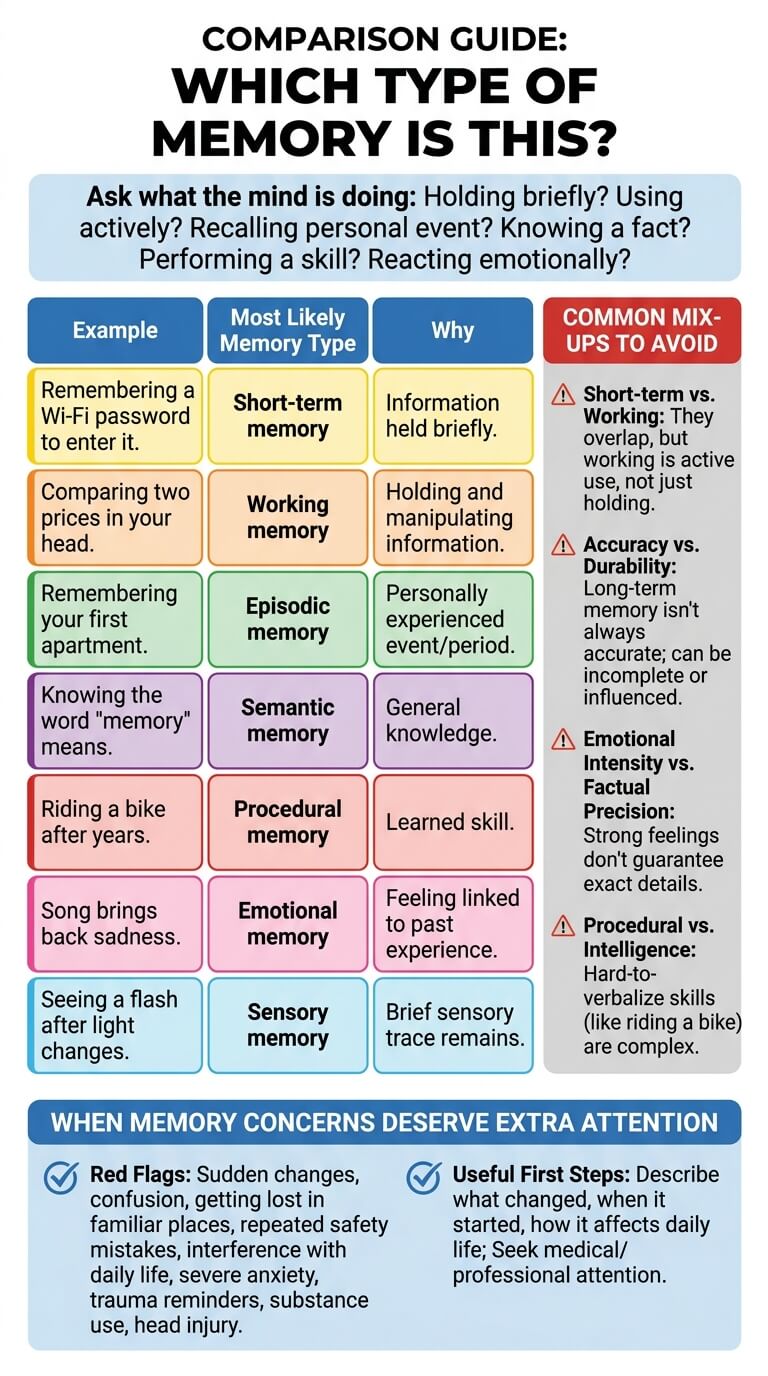
When you are trying to identify a memory type, ask what the mind is doing. Is it holding something briefly? Using information actively? Recalling a personal event? Knowing a fact? Performing a skill? Reacting to emotional meaning?
| Example | Most likely memory type | Why |
|---|---|---|
| You remember a Wi-Fi password long enough to enter it. | Short-term memory | The information is held briefly. |
| You compare two prices in your head. | Working memory | You are holding and manipulating information. |
| You remember your first apartment. | Episodic memory | It is a personally experienced event or period. |
| You know what the word “memory” means. | Semantic memory | It is general knowledge. |
| You ride a bike after years without practicing. | Procedural memory | It is a learned skill. |
| A song brings back sadness from a breakup. | Emotional memory | A feeling is strongly linked to a past experience. |
| You see a flash of movement after a light changes. | Sensory memory | A brief sensory trace remains. |
Common mix-ups to avoid
One common mix-up is treating short-term memory and working memory as identical. They overlap, but working memory is more active. Holding a number is one thing. Using that number while solving a problem is another.
Another mix-up is treating long-term memory as always accurate. A memory can last a long time and still be incomplete, emotionally colored, or influenced by later knowledge. Durability and accuracy are not the same.
A third mix-up is assuming emotional intensity proves factual precision. A strong feeling may signal importance, threat, grief, attachment, or surprise. It does not guarantee that every detail is exact.
A final mix-up is thinking procedural memory is less intelligent because it is hard to verbalize. Many learned skills are complex even when they feel automatic.
When memory concerns deserve extra attention
Everyday forgetfulness is common, especially during stress, poor sleep, multitasking, or information overload. Still, sudden memory changes, confusion, getting lost in familiar places, repeated safety mistakes, or memory problems that interfere with daily life deserve medical or professional attention. A general educational guide cannot tell what is happening in a specific person’s health, brain, or life circumstances.
It is also worth getting support when memory concerns are tied to severe anxiety, trauma reminders, substance use, head injury, depression, or major changes in functioning. A useful first step is describing what changed, when it started, and how much it affects daily life.
FAQ About Types of Memory
Is working memory the same as short-term memory?
They are closely related, but they are not exactly the same. Short-term memory usually means temporarily holding information. Working memory means holding information while using it for a task, such as reasoning, problem-solving, following instructions, or understanding a sentence. A simple way to remember the difference is this: short-term memory holds, while working memory holds and works.
Is long-term memory always accurate?
No. Long-term memory can last for years and still be incomplete or changed by later knowledge, repeated retelling, emotion, or missing context. A memory may contain true parts while still being inaccurate in order, detail, emphasis, or interpretation. This is why confidence and accuracy should not be treated as the same thing.
What type of memory stores habits?
Habits and practiced skills are usually connected with procedural memory. This includes learned actions that become easier through repetition, such as typing, driving a familiar route, playing an instrument, or making a routine gesture. These memories may be hard to explain step by step because they are stored closer to action than verbal description.
What type of memory stores personal life events?
Episodic memory stores personally experienced events, such as a trip, a conversation, a birthday, or a first day somewhere. When many episodic memories become part of a larger life story, they also contribute to autobiographical memory. That broader form of memory helps people understand their past and identity over time.
Can one memory use more than one type?
Yes. Most real-life memories involve more than one type. Remembering a wedding may involve episodic memory for the event, semantic memory for names and facts, sensory memory for music or visual impressions, emotional memory for the feeling of the day, and procedural memory if you danced or played an instrument. The categories help explain parts of remembering, but lived experience often combines them.
Key Takeaways
- Memory has different types because the mind must hold, use, store, feel, and perform different kinds of information.
- Sensory memory is extremely brief, but it gives attention a moment to select sights, sounds, and sensations.
- Short-term memory holds information temporarily, while working memory holds and manipulates information during active thinking.
- Long-term memory includes facts, personal events, skills, habits, and emotional associations, not one single storage box.
- Episodic memory is for personally experienced events, while semantic memory is for facts, words, and meanings.
- Emotional intensity can make a memory feel important, but it does not prove every detail is perfectly accurate.

Michael Reed is the Founder and Lead Writer at Psychology Exposed. He writes about human behavior, relationships, emotional patterns, self-awareness, and practical psychology topics using research-informed, easy-to-understand content.
Read More About Michael Reed: https://psychologyexposed.com/michael-reed/