
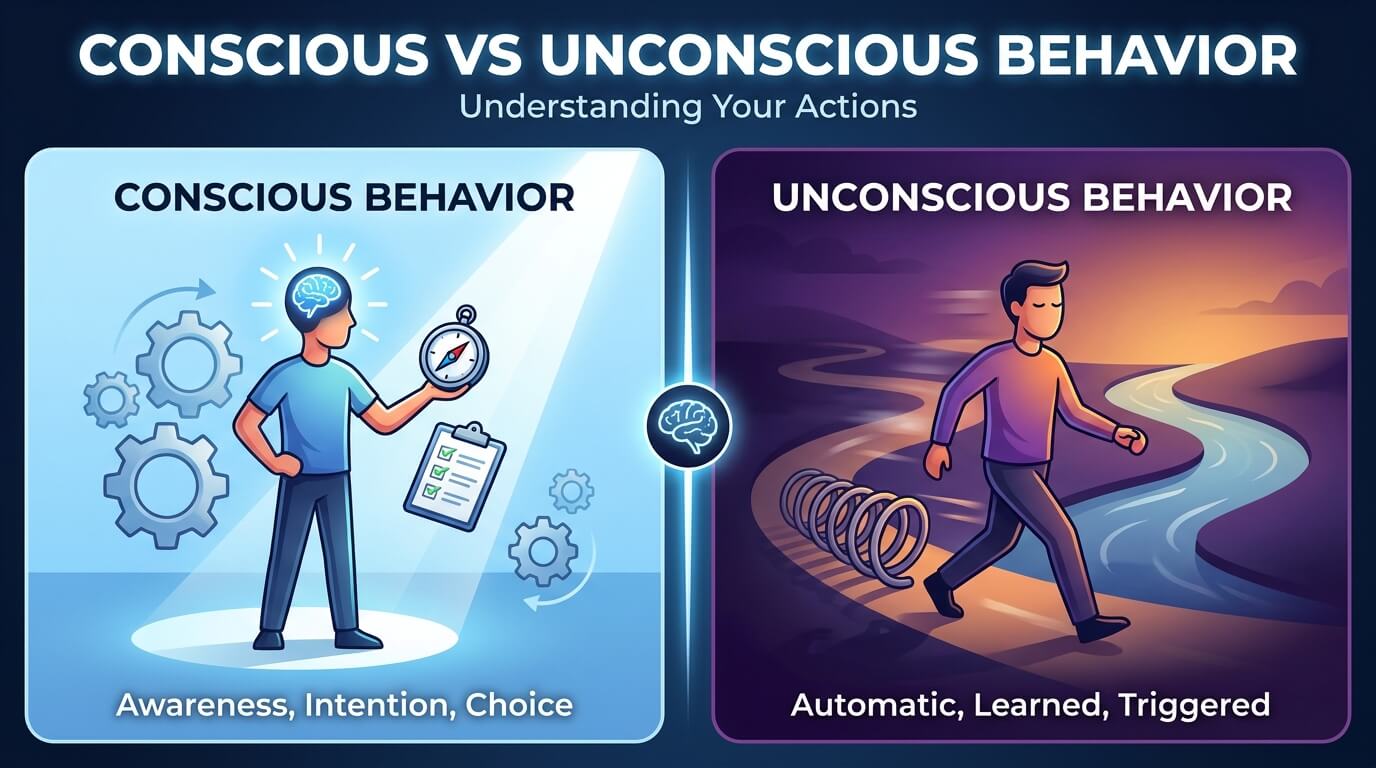
Sometimes you know exactly why you did something. You chose your words carefully, made a plan, weighed the options, and acted on purpose. Other times, behavior seems to happen before you fully notice it. You unlock your phone without deciding to, drive a familiar route while thinking about something else, reply defensively before you meant to, or reach for a snack because the bag is nearby.
That difference is the center of conscious vs unconscious behavior. Some behavior is deliberate and guided by active awareness. Some behavior is automatic, learned, emotionally triggered, or carried out with little moment-by-moment attention. Most daily life includes both. You may consciously decide to cook dinner, then automatically open the same cabinet, use the same pan, and check your phone during the waiting time.
This distinction is useful, but it should be handled carefully. Automatic behavior does not reveal a secret “real self,” and conscious intention does not guarantee perfect control. The practical question is not “Am I fully in control of everything?” It is “Which parts of this behavior are intentional, which parts are automatic, and where can I create more room to choose?”
Quick Answer

Conscious behavior is action guided by awareness, attention, intention, and choice. Unconscious or automatic behavior happens with little active awareness, often because it is learned, repeated, emotionally cued, or tied to a familiar context. Many everyday actions blend both, so change usually starts by noticing the cue before the next automatic response. This topic belongs inside human behavior psychology.
What Conscious Behavior Means
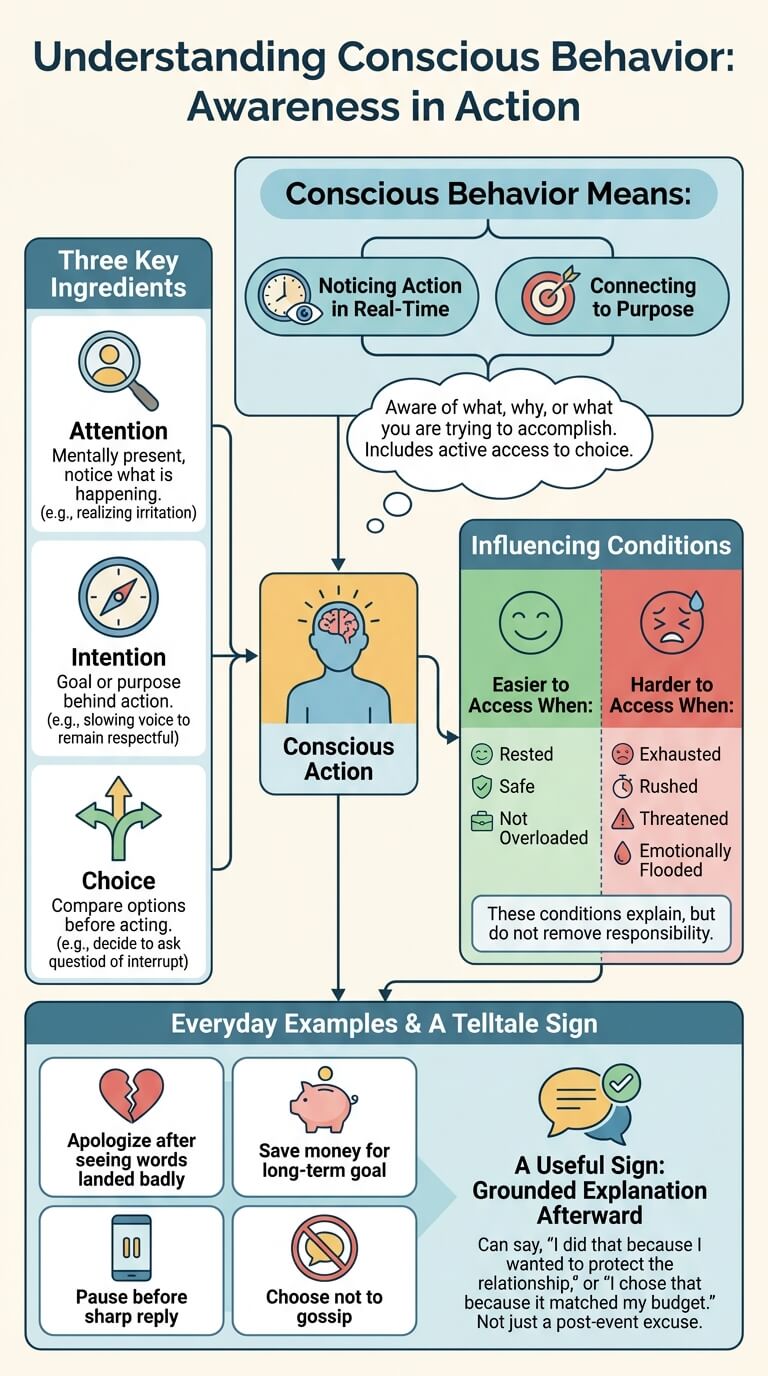
Conscious behavior is behavior you can notice while it is happening and connect to a purpose. You are aware of what you are doing, why you are doing it, or what you are trying to accomplish. The level of awareness may not be perfect, but you have some active access to the choice.
The APA Dictionary of Psychology describes consciousness as awareness of something internal or external to the self. In behavior, that awareness may include your intention, your surroundings, your emotional state, your options, and the likely effect of what you do next.
Deliberate attention, intention, and choice
Three ingredients usually make behavior feel conscious: attention, intention, and choice. Attention means you are mentally present enough to notice what is happening. Intention means there is a goal, even a small one. Choice means you can compare options before acting.
| Ingredient | What it means | Everyday example |
|---|---|---|
| Attention | You notice the action while it is happening | You realize you are getting irritated during a meeting |
| Intention | You have a purpose behind the action | You slow your voice because you want to stay respectful |
| Choice | You can consider more than one response | You decide to ask a question instead of interrupting |
These ingredients are easier to access when you are rested, safe, and not overloaded. They become harder to access when you are exhausted, rushed, embarrassed, threatened, hungry, or emotionally flooded. That does not remove responsibility, but it explains why conscious behavior often needs supportive conditions.
Examples of conscious behavior
Conscious behavior shows up in ordinary moments. You may decide to apologize because you see that your words landed badly. You may choose to save money instead of buying something because a longer-term goal matters more. You may pause before replying to a message because you know your first reaction is too sharp.
Other examples include planning your schedule, asking for clarification, choosing not to gossip, setting a screen limit, comparing two job options, taking a different route to avoid traffic, or practicing a skill on purpose. In each case, you are not simply being carried by the next impulse. You are using awareness to guide action.
A useful sign of conscious behavior is that you can usually explain it afterward in a grounded way. You can say, “I did that because I wanted to protect the relationship,” or “I chose that because it matched my budget,” or “I waited because I needed more information.” The explanation may still have emotion in it, but it is not only a post-event excuse.
What Unconscious or Automatic Behavior Means
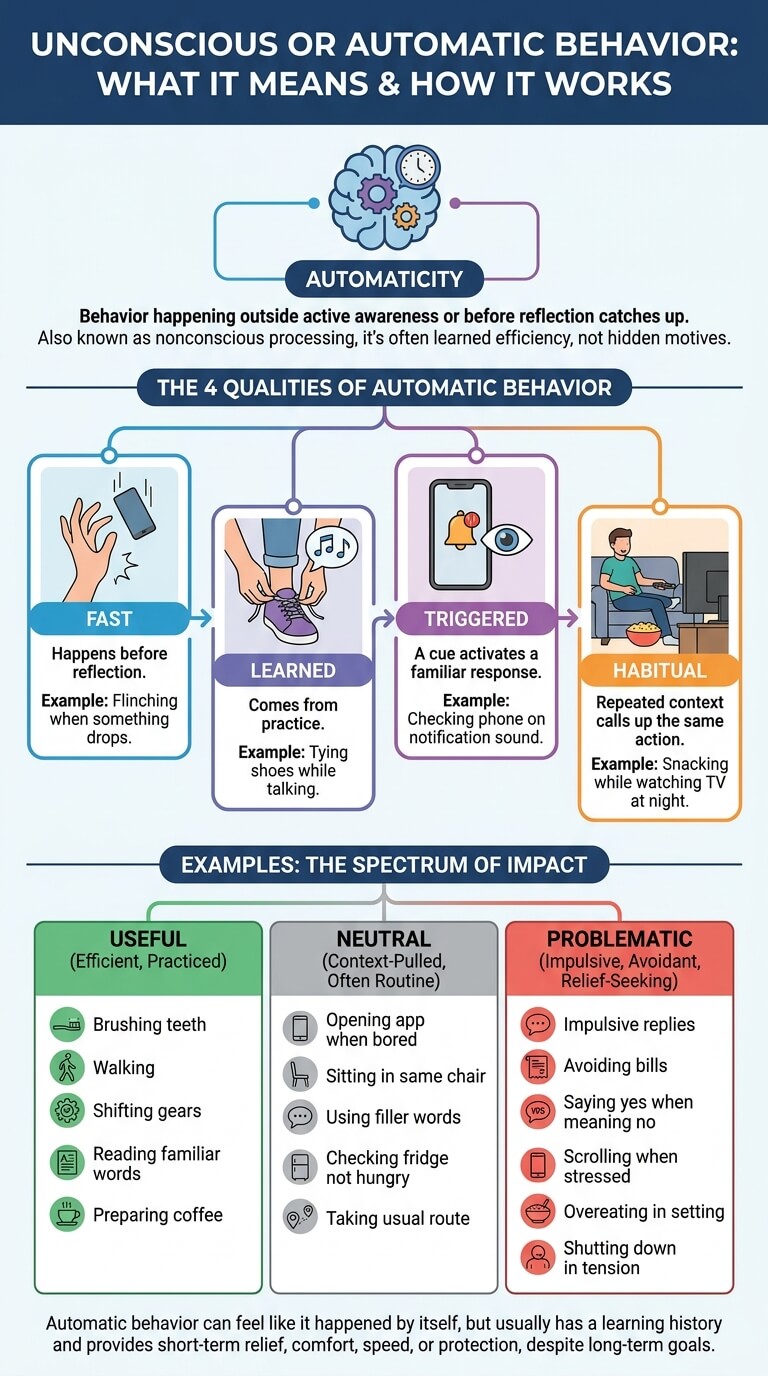
Unconscious behavior, in everyday psychology language, refers to behavior that happens outside active awareness or before reflection fully catches up. Many psychologists use the word nonconscious for some of these processes to avoid confusing ordinary automatic processing with older psychoanalytic ideas about hidden motives. For this article, the focus is practical: behavior that runs with little deliberate attention. Automatic processing also connects with cognitive psychology.
The APA Dictionary entry on unconscious describes it as relating to an absence of awareness or consciousness, and notes that psychologists often prefer nonconscious in this sense. That distinction matters because not every automatic act is mysterious or deeply symbolic. Much of it is simply learned efficiency.
Automatic behavior can be simple, such as typing a familiar password without thinking through each finger movement. It can also be emotional, such as smiling politely when uncomfortable, avoiding a difficult email, or sounding defensive when feedback touches an old sensitivity.
Fast, learned, triggered, or habitual action
Automatic behavior often has one or more of four qualities. It is fast, learned, triggered, or habitual. Fast behavior happens before you have time to fully reflect. Learned behavior comes from practice. Triggered behavior starts when a cue activates a familiar response. Habitual behavior repeats in a stable context until it requires less mental effort.
The APA Dictionary defines automaticity as behavior or mental processing that can be carried out rapidly and without effort or explicit intention. That is why automatic behavior can feel like it happened by itself, even though it usually has a learning history.
| Type of automatic behavior | How it works | Example |
|---|---|---|
| Fast | The response begins before reflection | You flinch when something drops nearby |
| Learned | Practice reduces the need for attention | You tie your shoes while talking |
| Triggered | A cue brings up a familiar reaction | You check your phone when you hear a notification |
| Habitual | A repeated context calls up the same action | You snack when watching TV at night |
Examples of automatic behavior
Automatic behavior can be useful, neutral, or harmful. Useful examples include brushing your teeth, walking, shifting gears while driving, reading familiar words, or preparing coffee in the same order each morning. You do not need to consciously plan every tiny step because your mind and body have practiced the sequence.
Neutral examples include opening the same app when bored, sitting in the same chair, using filler words, checking the fridge when you are not hungry, or taking the usual route home. These actions may not be serious problems, but they show how context pulls behavior.
Problematic examples include sending impulsive replies, avoiding bills, repeatedly saying yes when you want to say no, scrolling when stressed, overeating in a familiar setting, or shutting down when a conversation feels tense. The person may not want the long-term result, but the short-term action provides relief, comfort, speed, or protection.
Conscious vs Unconscious Behavior in Real Life

The difference between conscious and unconscious behavior is easiest to see in real life, where the two are often mixed. You may consciously choose a goal, then unconsciously rely on old routines to carry it out. You may consciously want to be patient, but an automatic tone comes out when you feel criticized.
A better question than “Was this conscious or unconscious?” is often “Which part was conscious, and which part was automatic?” That question gives a more accurate map of what happened.
Speaking, driving, scrolling, eating, reacting, and avoiding
| Situation | Conscious part | Automatic part |
|---|---|---|
| Speaking in a tense conversation | You choose the topic you want to discuss | Your tone rises before you notice it |
| Driving a familiar route | You decide where you are going | Your hands and eyes follow practiced patterns |
| Scrolling at night | You tell yourself you will check one thing | Your thumb keeps moving through the feed |
| Eating while distracted | You choose to sit with a snack | You finish more than intended without noticing |
| Reacting to feedback | You want to understand the point | You defend yourself before the person finishes |
| Avoiding a task | You know the task matters | You open a smaller task that feels easier |
This is why self-judgment is often less useful than sequence tracking. “I have no discipline” is vague. “When I feel uncertain, I switch to a task that gives quick relief” is something you can work with.
Why the line is not always clear
The line between conscious and automatic behavior is not always clean. You can be aware of a behavior but not fully aware of what is driving it. You can make a deliberate choice that is shaped by unconscious expectations. You can act automatically, then become conscious halfway through.
For example, someone may consciously say, “I am fine,” while automatically avoiding a deeper conversation. Another person may consciously decide to be productive, then unconsciously choose low-risk tasks that protect them from possible failure. A third person may automatically reach for their phone, notice it, then consciously put it down.
Awareness often arrives in layers. First you notice the behavior after it happens. Then you notice it during the behavior. Later, with practice, you may notice the cue before the behavior starts. That earlier noticing is where choice becomes more realistic.
Why the Brain Uses Autopilot
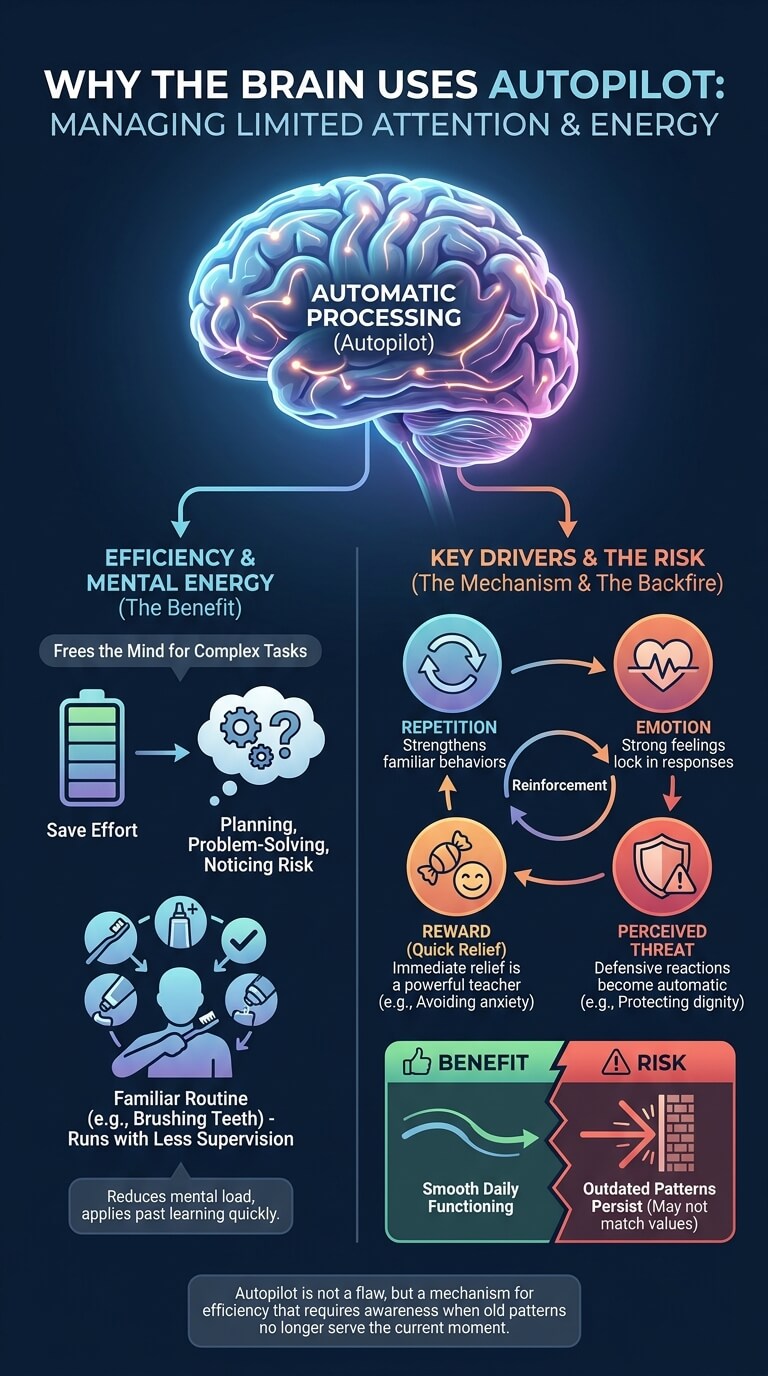
Autopilot is not a personal flaw. It is part of how human beings manage limited attention and constant demands. If you had to consciously decide every movement, word, routine, and social response, daily life would become exhausting. Autopilot makes more sense when you understand how attention, memory, emotion, and prediction guide behavior.
The brain and mind use automatic processing to save effort, respond quickly, and apply past learning to current situations. This helps people function, but it also means old learning can keep running after it stops serving the current moment.
Efficiency and mental energy
Automatic behavior reduces mental load. Once a task becomes familiar, it requires less active attention. This frees the mind for other things, such as conversation, planning, problem-solving, or noticing risk.
Imagine needing to consciously plan each step of brushing your teeth: pick up toothbrush, turn wrist, locate toothpaste, squeeze, lift, brush upper left side, adjust pressure. Automaticity lets the sequence run without full supervision. That is efficient.
The same efficiency can backfire when the old sequence is no longer helpful. If your automatic response to stress is avoidance, the mind may choose relief before it considers long-term cost. If your automatic response to criticism is self-defense, the mind may protect dignity before it considers the other person’s point.
Repetition, emotion, reward, and threat
Automatic behavior is strengthened by repetition, but repetition is not the only factor. Emotion, reward, and perceived threat also matter. A behavior that brings quick relief can become automatic even if it causes trouble later.
A review in PubMed Central on habit formation explains that habits are closely tied to automaticity, and that changing existing habits often requires different strategies than building new ones. In ordinary terms, a repeated behavior becomes easier to start when the same cue appears again.
Relief is a powerful teacher. Avoiding a difficult call may reduce anxiety for the next hour, so the mind learns, “Avoidance works.” Snapping back during criticism may reduce shame for a moment, so the mind learns, “Attack protects me.” These lessons may be understandable, but they may not match your values.
When Automatic Behavior Helps
Automatic behavior has a bad reputation because people usually notice it when it causes problems. Yet many automatic behaviors are helpful. They let you move through life with skill, speed, and less mental strain.
Skills, routines, safety, and speed
Skills often become automatic through practice. A musician does not consciously calculate every finger movement. A cook does not rethink every basic knife motion. A driver does not relearn steering each morning. Practice turns complex actions into smoother sequences.
Routines also protect attention. A morning routine can reduce decision fatigue. A shutdown routine at the end of work can help you transition into rest. A repeated medication routine, if prescribed, can reduce the chance of forgetting. A safety routine, such as checking mirrors before changing lanes, can protect you before danger is obvious.
Automatic behavior also supports social life. Saying thank you, lowering your voice in a quiet place, stepping aside for someone carrying something heavy, or washing your hands after certain tasks can happen quickly because the behavior is familiar.
Why not all autopilot is bad
Autopilot becomes a problem when it runs against your values, safety, relationships, health, or responsibilities. It is not a problem simply because it is automatic. A lot of mature behavior depends on automaticity. The goal is not to make every action conscious. The goal is to make important actions more available to awareness when it matters.
For example, a person who practices pausing before answering difficult questions may eventually pause automatically. That is a helpful automatic response. Someone who repeatedly places their keys in the same spot may stop losing them. Someone who practices checking assumptions before reacting may build a more useful default.
The best use of consciousness is often temporary. You bring attention to a behavior long enough to shape it, practice it, and let the better version become easier.
When Automatic Behavior Causes Problems
Automatic behavior becomes harder to ignore when it creates results you do not want. This can happen with avoidance, impulsive replies, old social scripts, emotional habits, spending, eating, screen use, procrastination, or repeated conflicts. Automatic actions can become part of broader behavior patterns.
Avoidance, impulsive replies, old scripts, and repeated mistakes
Avoidance is one of the most common automatic patterns. A task feels uncomfortable, so the mind moves toward something easier. The relief is immediate, even if the future cost is higher. This is why avoidance can feel like a choice in the moment but look confusing afterward.
Impulsive replies work in a similar way. A message feels unfair, embarrassing, or threatening, so the body prepares a quick defense. The reply may be sent before the person has asked, “What outcome do I actually want?”
Old scripts are automatic responses learned through repeated experience. Someone raised around criticism may explain themselves quickly. Someone used to being ignored may speak more loudly than needed. Someone who learned that mistakes were dangerous may hide errors instead of repairing them. These scripts may have a history, but they still need attention if they harm the present.
When automatic behavior conflicts with values
A key sign of problematic automatic behavior is a gap between values and action. You value honesty but avoid difficult truths. You value rest but keep scrolling late. You value respect but use a cutting tone when stressed. You value long-term goals but keep choosing short-term relief.
This gap does not mean your values are fake. It means the automatic system is solving a more immediate problem than the conscious value is solving. The automatic behavior may be reducing discomfort, protecting pride, seeking stimulation, avoiding uncertainty, or escaping a body state that feels unpleasant.
The most helpful response is specific accountability. Instead of “I am a bad person,” try “When I feel exposed, I switch into defense.” Instead of “I never change,” try “When the cue is boredom, the phone is too easy to reach.” Specific language makes behavior easier to interrupt.
Conscious Awareness vs Behavior Change
Awareness matters, but awareness is not the same as change. Many people can clearly describe an automatic behavior and still repeat it under pressure. That does not mean awareness is useless. It means awareness needs to be paired with practice, environment design, and a replacement action.
Awareness is the first step, not the whole solution
Awareness gives you a place to intervene. Without awareness, the behavior may complete itself before you realize what happened. With awareness, you can begin to see the cue, the urge, the short-term reward, and the longer-term cost.
But awareness alone often arrives too late. If you notice the behavior only after the damage is done, the next step is not self-attack. It is moving awareness earlier. Ask: “What happened right before this?” “What did I feel in my body?” “What did the behavior give me for a few minutes?”
Why environment and reinforcement still matter
Environment matters because cues live in places, objects, times, people, and routines. If your phone is beside your bed, the cue is close. If snacks are visible on the counter, the cue is visible. If every difficult task starts in a noisy room, avoidance has an easier path.
Reinforcement matters because behavior follows consequences. If a behavior gives relief, approval, stimulation, control, comfort, or escape, the mind may repeat it. This is true even when the person consciously dislikes the bigger outcome.
Change becomes more realistic when you reduce the cue, make the better action easier, and give the new behavior some kind of immediate reward. For example, place the phone outside the bedroom, prepare the document before the work session, or write the calm reply in notes before sending anything.
How to Notice Automatic Behavior Earlier
Track cues, body signals, and consequences
Automatic behavior usually has a cue. The cue may be external, such as a notification, a certain room, a person’s tone, a time of day, or an unfinished task. It may be internal, such as tightness in the chest, shame, boredom, hunger, loneliness, anger, or fatigue.
| What to track | Question to ask | Example |
|---|---|---|
| Cue | What started the sequence? | A message that sounded critical |
| Body signal | What did I feel first? | Heat in the face, tight jaw, fast heart |
| Urge | What did I want to do immediately? | Defend, leave, scroll, eat, agree, avoid |
| Short-term payoff | What did the action give me? | Relief, control, comfort, distraction |
| Long-term cost | What happened afterward? | More stress, distance, delay, regret |
You do not need to track every behavior. Choose one repeated action that matters. The smaller and more specific the behavior, the easier it is to study without becoming overwhelmed.
Create a pause point before the next action
A pause point is a small action that interrupts the automatic sequence. It does not need to be dramatic. It might be putting the phone face down, taking one breath before opening a message, standing up before snacking, writing the reply but waiting two minutes to send it, or asking, “What am I trying to avoid right now?”
The pause should fit the behavior. For impulsive replies, the pause may be a delay before sending. For avoidance, it may be opening the task for five minutes. For stress scrolling, it may be moving the phone across the room. For defensive speech, it may be saying, “Give me a second, I want to answer this well.”
A good pause point gives consciousness a doorway back into the sequence. It does not make you perfect. It makes the next choice more available.
What This Helps Explain Next
Once you understand the difference between conscious and automatic behavior, several related parts of everyday psychology become easier to understand. The same awareness skills can help with habits, repeated behavior patterns, and everyday decisions. Habits show how repeated behavior becomes easier to run without much thought.
Habit formation
Habits are repeated behaviors tied to cues. They often begin with conscious choice, but with repetition they can become easier and less effortful. This is why habit change usually needs more than motivation. It needs a clear cue, a specific action, and a context that makes repetition easier.
When people say they want better habits, they often mean they want a helpful action to become automatic. That is a good use of autopilot. The work is choosing which behaviors deserve that kind of practice.
Behavior patterns
Behavior patterns are broader than single habits. They may include emotional reactions, social roles, avoidance cycles, spending patterns, conflict styles, or ways of handling pressure. Some parts are conscious. Other parts run because the sequence is familiar.
Looking at behavior patterns through the lens of awareness helps reduce shame. Instead of treating the whole pattern as a personality flaw, you can identify the cue, the interpretation, the urge, the payoff, and the part where a different response could enter.
Everyday decisions
Everyday decisions often feel conscious, but they are shaped by automatic shortcuts. Mood, fatigue, social pressure, convenience, default settings, and past rewards can influence choices before you fully reason through them.
This does not mean your decisions are meaningless. It means better decisions often come from designing better conditions: fewer distracting cues, clearer options, lower friction for the better choice, and a pause before choices that matter.
When Automatic Behavior May Need More Help
Most automatic behavior is part of normal life. Still, support may be important if automatic actions feel dangerous, severely distressing, disconnected from your values in a way you cannot manage, or linked to self-harm, aggression, dissociation, substance misuse, or major loss of functioning.
NIMH recommends seeking professional help when severe or distressing symptoms last two weeks or more and interfere with daily life, such as sleep, concentration, usual activities, appetite, or mood. Its page on caring for your mental health gives general guidance on when support may be useful.
If you feel at risk of harming yourself or someone else, or you feel unable to stay safe, seek urgent local help now. Educational insight is not a substitute for immediate safety, medical care, or professional support when risk is present.
FAQ About Conscious and Unconscious Behavior
Can unconscious behavior be changed?
Yes, many automatic behaviors can change, but change usually works best when it targets the cue, the environment, the short-term reward, and the replacement action. Simply telling yourself to stop may not be enough if the old behavior gives fast relief or has been practiced for years.
Are habits unconscious behavior?
Habits are often partly automatic. You may consciously choose the overall goal, such as exercising after work, while the repeated cue and action become less effortful over time. A habit is not always fully unconscious, but it often runs with less active thought than a new behavior would require.
Does unconscious behavior reveal the real self?
Not in a simple way. Automatic behavior may reveal learning history, stress responses, repeated cues, emotional associations, or short-term coping strategies. It should not be treated as proof of someone’s true character. A fuller view includes intentions, values, context, accountability, and willingness to repair or change.
Why do I act before I think?
You may act before you think because the situation triggers a fast learned response, especially under stress, embarrassment, fear, anger, hunger, or fatigue. The first goal is not to shame yourself for having a fast response. The first goal is to notice the early cue and create a pause before the behavior completes itself.
Key Takeaways
- Conscious behavior involves awareness, intention, and some ability to compare options before acting.
- Unconscious or automatic behavior often runs quickly because it is learned, repeated, emotionally cued, or tied to a familiar context.
- Autopilot is not always bad. It supports skills, routines, safety behaviors, and useful defaults.
- Automatic behavior becomes a problem when it repeatedly conflicts with values, safety, responsibilities, or relationships.
- Awareness helps most when it moves earlier in the sequence, from after the behavior to during the urge to before the cue takes over.
- Changing automatic behavior usually requires a practical pause point, a better environment, and a replacement action, not just more self-criticism.
Final Thoughts
Conscious vs unconscious behavior is not a battle between a good self and a hidden self. It is a practical way to understand how choice, learning, emotion, and context work together. Some behavior needs active attention. Some behavior becomes easier when it becomes automatic. The skill is knowing which is which.
Choose one repeated behavior you want to understand. Do not start with your whole personality. Start with the cue, the body signal, the urge, the short-term payoff, and one pause point you can practice next time. That small amount of awareness can make a familiar reaction less automatic and a better response easier to reach.

Michael Reed is the Founder and Lead Writer at Psychology Exposed. He writes about human behavior, relationships, emotional patterns, self-awareness, and practical psychology topics using research-informed, easy-to-understand content.
Read More About Michael Reed: https://psychologyexposed.com/michael-reed/