
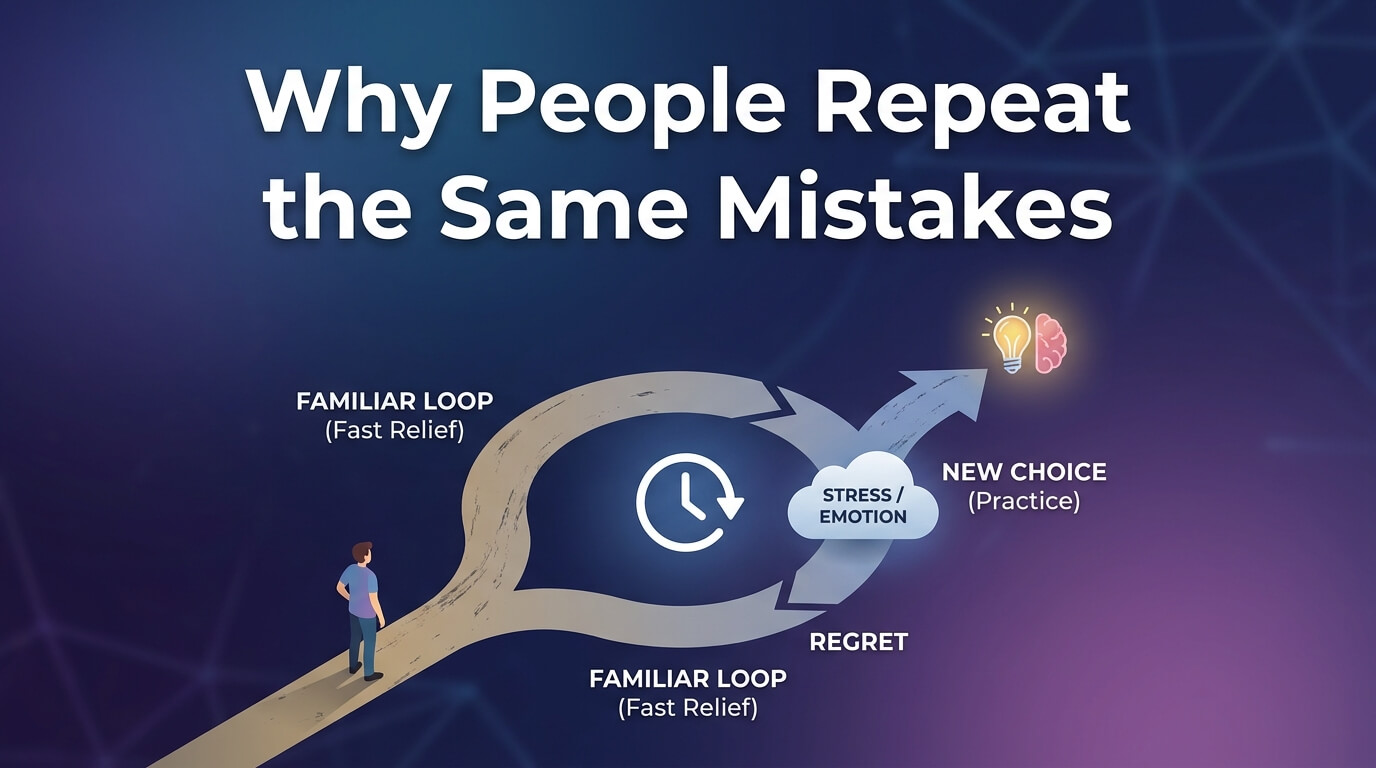
Repeating the same mistake can feel confusing because the problem is rarely a lack of awareness. You may already know the consequence. You may dislike the outcome. You may even warn yourself in advance, then still end up in the same place: another delayed task, another impulsive purchase, another argument that escalates, another warning sign ignored, another promise made too late.
The frustrating part is that regret often arrives after the decision point has already passed. By then, the lesson feels obvious, but the next real-life moment may not feel obvious at all. It may feel urgent, uncomfortable, familiar, tempting, or emotionally loaded. That is why repeating mistakes is less about being weak and more about understanding the chain between cue, emotion, interpretation, action, and short-term payoff.
Psychology does not treat learning as a simple matter of knowing facts. The American Psychological Association describes learning as the acquisition of new information, behaviors, or abilities through practice, observation, or experience, which means insight has to become usable in the moment, not only understandable afterward. You can read the APA overview of learning and memory for a broader explanation of how experience can shape later responses.
This guide explains why people repeat the same mistakes, why shame often makes the loop worse, and how to interrupt the next repetition at an earlier point. It is educational, not a diagnosis. If repeated behavior involves self-harm, violence, substance misuse, coercion, or danger, support matters more than trying to handle it alone.
Quick Answer
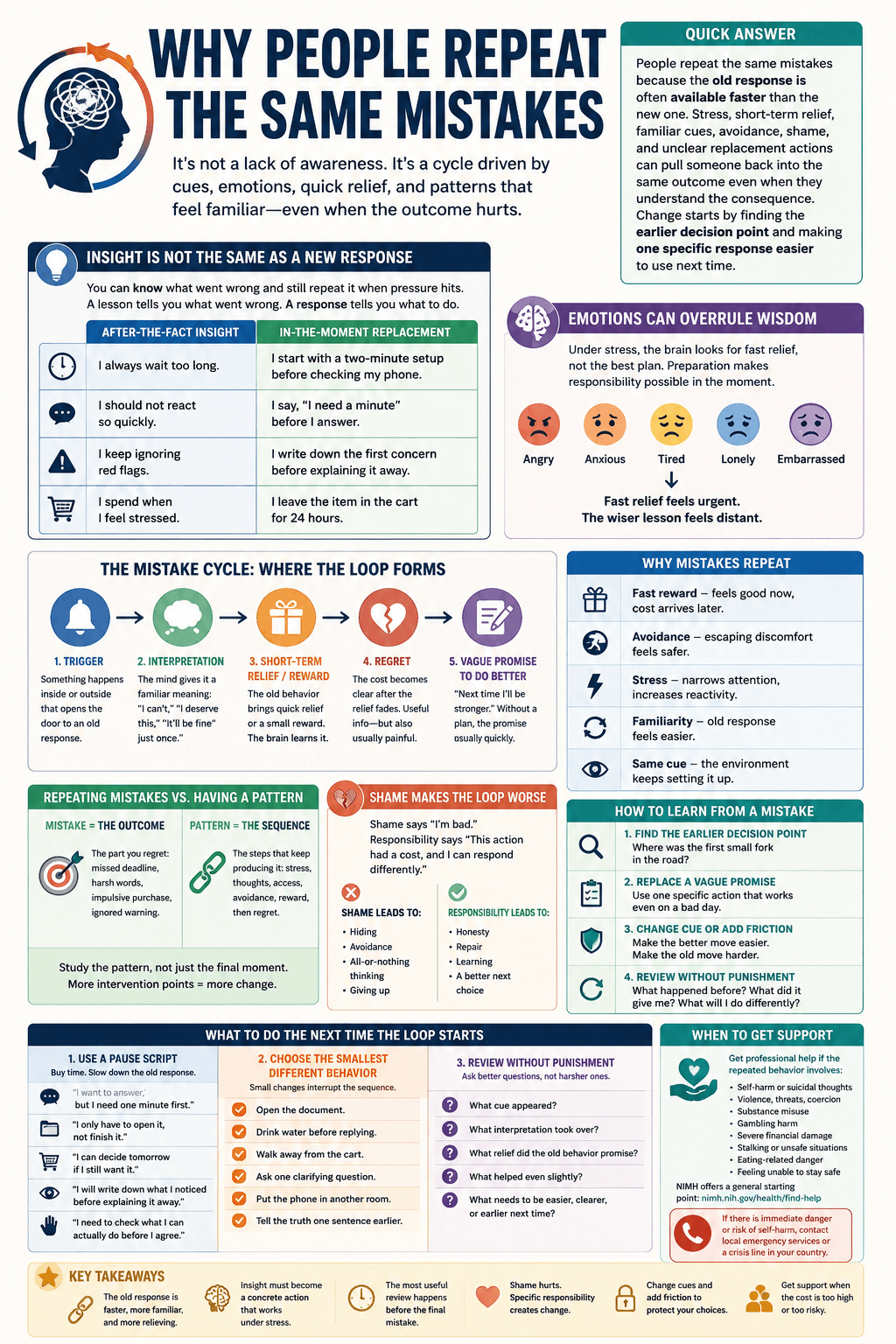
People repeat the same mistakes because the old response is often available faster than the new one. Stress, short-term relief, familiar cues, avoidance, shame, and unclear replacement actions can pull someone back into the same outcome even when they understand the consequence. Change usually starts by finding the earlier decision point and making one specific response easier to use next time. Repeating mistakes is part of human behavior psychology.
Why Insight Does Not Always Stop a Mistake
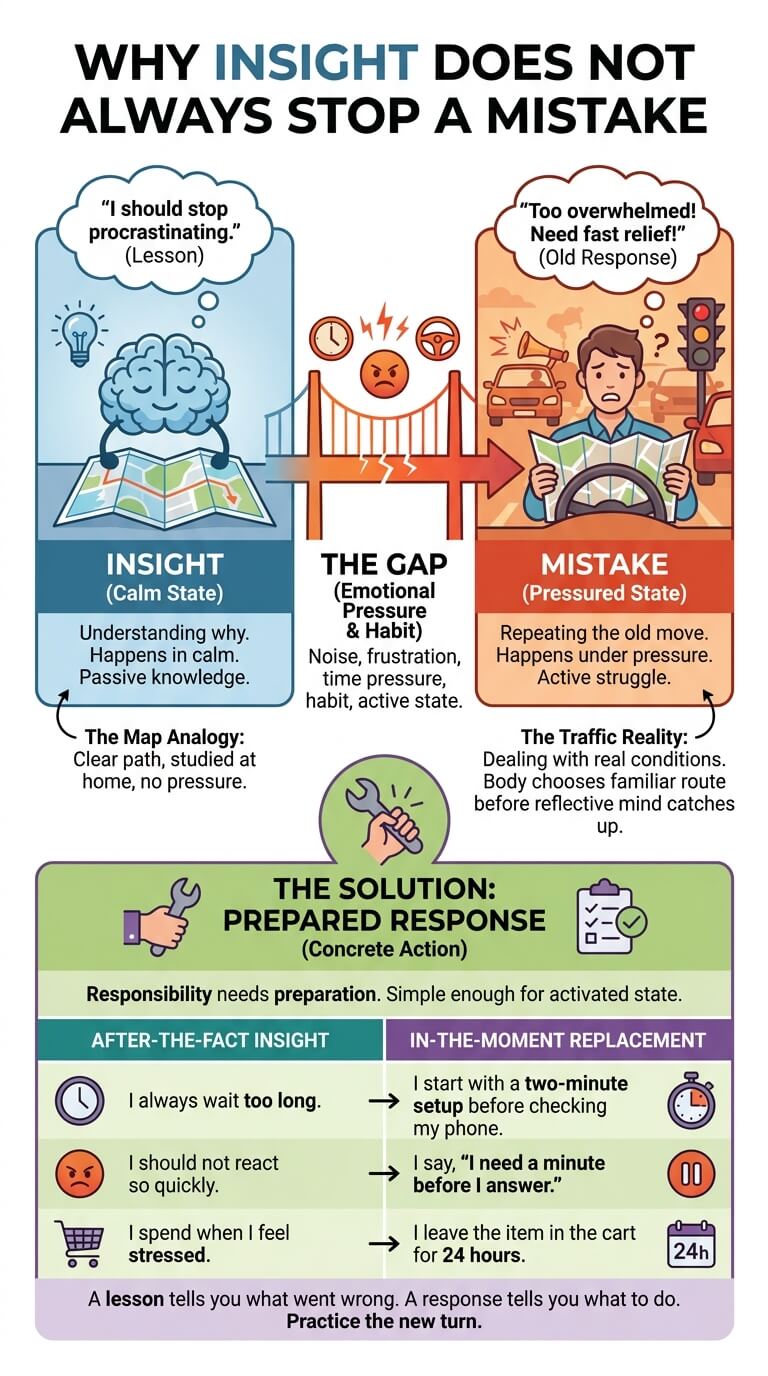
Insight is useful, but it is not the same as a new behavior. You can understand why a choice hurts you and still repeat it when the same emotional pressure returns. This is common because insight often happens in a calm state, while the mistake happens in a pressured state.
Think about the difference between looking at a map and driving through traffic. The map may be clear when you study it at home. In traffic, you are dealing with noise, time pressure, frustration, and habit. If you have not practiced the new turn in real conditions, your body may choose the familiar route before your reflective mind catches up.
Knowing Is Different From Having a New Response Ready
Many repeated mistakes survive because the person has a lesson but not a replacement. “I should stop procrastinating” is not a usable response at 10:45 p.m. when the project feels overwhelming. “Open the document for five minutes and write the worst first sentence” is more usable because it gives the mind a concrete action.
A lesson tells you what went wrong. A response tells you what to do when the same situation starts again. Without a response, the mind may only have two options: repeat the old move or freeze, which can become another route back to the same mistake.
| After-the-fact insight | In-the-moment replacement |
|---|---|
| I always wait too long. | I start with a two-minute setup before checking my phone. |
| I should not react so quickly. | I say, “I need a minute before I answer.” |
| I keep ignoring red flags. | I write down the first concern before explaining it away. |
| I spend when I feel stressed. | I leave the item in the cart for 24 hours. |
Emotional State Can Overpower Long-Term Memory
People often assume that a lesson should automatically appear when needed. In reality, emotional state affects what feels available. When you are calm, the wiser lesson may seem obvious. When you are embarrassed, lonely, angry, anxious, tired, or rushed, the brain may look for fast relief rather than the most thoughtful plan.
This does not remove responsibility. It explains why responsibility needs preparation. If a mistake usually happens when you are activated, then the new response must be simple enough to use while activated. A long reflection journal may help later, but the moment itself may require one sentence, one pause, one environmental change, or one small delay.
The Mistake Cycle

Most repeated mistakes have a cycle. The final action may be the part you notice, but the cycle begins earlier. Once you can name the steps, you can stop treating the mistake as a mysterious character flaw and start looking for a point of intervention.
Trigger
A trigger is the situation that starts the old route. It may be external, such as a notification, a criticism, a sale, a stressful deadline, or seeing a familiar person. It may also be internal, such as boredom, shame, loneliness, pressure, resentment, or the thought that you already failed.
The trigger does not force the mistake. It opens the door to a familiar response. That is why noticing the trigger matters. If you only review the final behavior, you may miss the first moment when the cycle was still easier to interrupt.
Familiar Interpretation
After the trigger, the mind often gives the situation a familiar meaning. “I cannot handle this.” “They are judging me.” “I deserve this because today was hard.” “It will be fine just once.” “If I say no, I will lose them.” These interpretations can feel like facts because they arrive quickly.
The interpretation matters because it tells the body what kind of action seems necessary. If a deadline feels like proof that you are inadequate, avoidance may feel protective. If criticism feels like humiliation, defensiveness may feel urgent. If loneliness feels unbearable, returning to a bad situation may feel like relief.
Short-Term Relief or Reward
Many repeated mistakes continue because they work in the short term. Avoiding the task reduces pressure. Snapping back releases tension. Spending gives a brief lift. Saying yes prevents immediate discomfort. Checking one more time lowers uncertainty for a moment. Short-term relief can become a way of acting against your own interests over time.
That short-term effect can teach the brain to repeat the behavior, even if the long-term outcome is painful. APA’s dictionary defines behavior change as an alteration or adjustment in behavior, but the adjustment usually requires changing what happens before and after the action, not only wanting the final outcome to be different.
Regret
Regret often appears when the short-term relief fades and the long-term cost becomes visible. You see the missed deadline, the bank balance, the hurt expression, the ignored warning sign, or the familiar mess left behind. This stage can bring useful information, but it can also bring harsh self-talk.
The useful part of regret is that it highlights a mismatch between what happened and what you value. The risky part is that regret can turn into self-attack. If the only lesson becomes “I am hopeless,” the next trigger may feel even harder to face.
Vague Promise to Do Better
The cycle often ends with a sincere but vague promise: “Next time I will be stronger.” “I will stop doing this.” “I know better now.” The promise may feel powerful because regret is fresh. But if it does not identify the next cue, the next decision point, and the next small behavior, it may fade before the next real test.
A better ending is specific. “When I feel the urge to avoid the email, I will open it and write only the subject line.” “When I want to buy something because I am stressed, I will wait until tomorrow.” “When I feel myself getting defensive, I will ask what part hurt them before explaining my side.”
Common Reasons People Repeat Mistakes
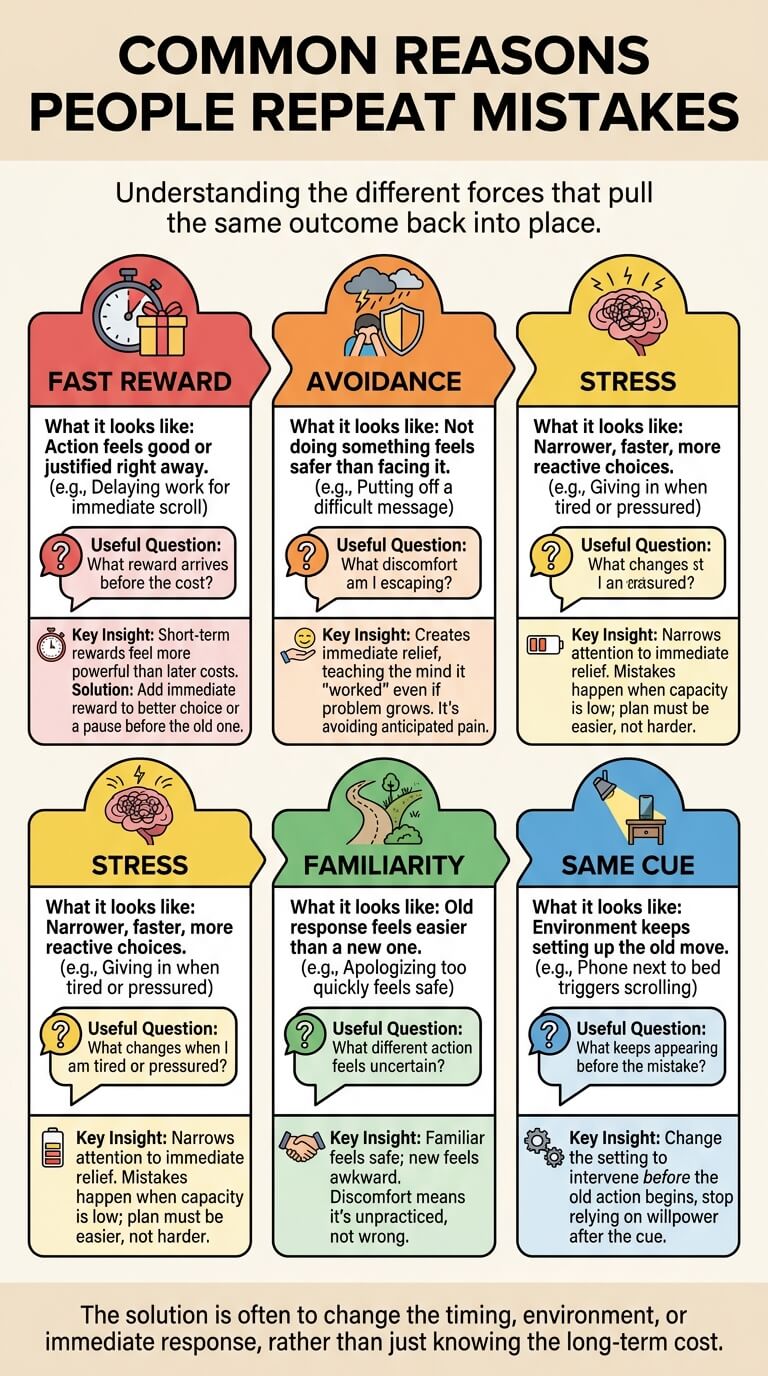
Repeating a mistake usually has more than one cause. The following table gives a quick way to separate different forces that may be pulling the same outcome back into place. Thinking shortcuts can play a role when cognitive biases make the same choice feel reasonable.
| Reason | What it may look like | Useful question |
|---|---|---|
| Fast reward | The action feels good, calming, or justified right away. | What reward arrives before the cost? |
| Avoidance | Not doing something feels safer than facing it. | What discomfort am I escaping? |
| Stress | You make narrower, faster, more reactive choices. | What changes when I am tired or pressured? |
| Familiarity | The old response feels easier than a new one. | What different action feels uncertain? |
| Same cue | The environment keeps setting up the old move. | What keeps appearing before the mistake? |
Short-Term Rewards Arrive Faster Than Long-Term Costs
The brain is sensitive to timing. A reward that arrives now can feel more powerful than a cost that arrives later. That is one reason a person may overeat, overspend, delay work, interrupt someone, or check messages repeatedly even when they know the later outcome will not feel good.
The solution is not always to lecture yourself about the long-term cost. You may already know the cost. A more practical move is to change the timing. Add a small immediate reward to the better choice, or add a small pause before the old one. The goal is to make the wiser action easier to choose before the old reward takes over.
Avoidance Reduces Discomfort Immediately
Avoidance is one of the strongest reasons mistakes repeat. Avoiding a hard conversation, a bill, a decision, or a task may create immediate relief. That relief can teach the mind that avoidance “worked,” even if the problem grows larger later.
The APA Dictionary describes avoidance behavior as actions that allow someone to avoid or anticipate unpleasant or painful situations. In daily life, this may look like putting off a message because you fear the reply, avoiding feedback because it feels embarrassing, or staying busy so you do not have to make a difficult choice.
Stress Narrows Attention
Stress can make people focus on the most immediate threat, not the full picture. This is why someone may say, “I knew it was a bad idea, but in the moment I just wanted it to stop.” Under pressure, the mind may favor speed, relief, and control over long-term reflection.
This is also why repeated mistakes often happen at predictable times: late at night, after conflict, before deadlines, after a long day, when hungry, when lonely, or when overwhelmed. The timing is part of the information. If the same mistake happens when your capacity is low, the prevention plan has to be easier, not more complicated.
Familiar Patterns Feel Easier Than Uncertain Alternatives
New behavior can feel awkward even when it is healthier. A person who is used to apologizing too quickly may feel selfish when they pause. A person who is used to arguing may feel exposed when they listen first. A person who is used to avoiding money may feel anxious when they open the account.
The old move may not be good, but it is familiar. Familiarity can feel like safety. The new move may be better, but it may also feel uncertain, unpracticed, or emotionally strange. That discomfort does not mean the new response is wrong. It may mean your system has not learned it yet.
The Environment Keeps Offering the Same Cue
Some repeated mistakes are maintained by the setting. If your phone is next to your bed, the morning scroll is easier. If snacks are on the desk, grazing is easier. If the same person can reach you at any hour, old emotional routines may be easier. If every hard task starts in a cluttered workspace, delay becomes more likely.
Changing the environment is not a shallow trick. It is a way to stop relying on willpower after the cue has already appeared. A review of behavior change research describes change as involving different stages where strategies can target the situation, the response, or the outcome; the environment is often one practical place to intervene before the old action begins.
Repeating Mistakes vs Having a Behavior Pattern

These two ideas overlap, but they are not identical. A repeated mistake is the outcome you regret. A behavior pattern is the sequence that keeps producing that outcome. Understanding the difference helps you stop focusing only on the final moment. A repeated mistake often has a larger behavior pattern behind it.
Mistake as the Regretted Outcome
The mistake is usually the part that hurts: you missed the deadline, said the harsh thing, ignored the sign, bought the item, skipped the appointment, or returned to a situation you promised to leave. It is concrete, visible, and easy to blame yourself for.
Looking only at the mistake can make change feel like a moral test. “Do not do that again” becomes the whole plan. But the final action may have been shaped by several earlier steps: fatigue, interpretation, pressure, access, avoidance, and a reward that arrived before the cost.
Pattern as the Sequence That Produces It
The sequence is more useful to study than the final moment alone. For example, overspending may begin with stress, continue with a thought like “I deserve something,” receive support from saved payment details, and end with regret when the bill arrives. The purchase is the mistake. The sequence is what makes it likely to happen again.
When you study the sequence, you gain more possible intervention points. You can reduce the stress cue, challenge the interpretation, create friction around the purchase, delay the decision, or set a review time. You do not have to depend on one heroic act of willpower at the end.
Why Shame Can Make Repetition Worse
Shame can feel like accountability, but it often behaves differently. Accountability says, “This action had a cost, and I need to respond differently.” Shame says, “This proves something bad about me.” The first can lead to repair. The second often leads to hiding, denial, avoidance, or giving up.
Shame Pushes Hiding, Avoidance, and All-or-Nothing Thinking
The APA Dictionary describes shame as a self-conscious emotion often involving feelings of inadequacy or humiliation. In repeated mistakes, shame can make the next attempt harder because the person is not only facing the task or decision. They are also facing the fear of what the mistake says about them.
That fear can create all-or-nothing thinking. “I already failed, so why try?” “I messed up once, so the day is ruined.” “If I tell someone, they will think I am irresponsible.” This mindset can send someone back to the same avoidant or impulsive behavior that created the regret in the first place.
Responsibility Without Self-Attack
Responsibility works better when it stays specific. Instead of “I am a failure,” try “I avoided the email after I felt overwhelmed.” Instead of “I always ruin things,” try “I raised my voice when I felt criticized.” Instead of “I have no control,” try “I need to change what happens in the first five minutes after the trigger.”
This kind of language is not an excuse. It is more accurate. Specific responsibility gives you something to change. Global self-attack gives you a heavy identity to carry, but very little instruction for the next moment.
How to Learn From a Mistake More Effectively
Learning from a mistake does not mean replaying it until you feel worse. It means extracting usable information. A useful review should answer three questions: What happened before the mistake? What did the mistake do for me in the short term? What will I do differently at the earlier decision point? To move from insight to action, behavior change focuses on the next different step.
Identify the Earlier Decision Point
The earlier decision point is the moment before the final action, when a small different move was still possible. It may be the moment you noticed the urge, opened the app, read the message, felt your tone change, walked into the store, or decided not to ask for help.
Ask yourself: “Where was the first small fork in the road?” Do not start with the biggest, most dramatic moment. Start earlier. The earlier the decision point, the smaller the new behavior can be.
Replace One Vague Promise With One Specific Action
Vague promises feel meaningful after a mistake because emotion is high. Specific actions work better because they reduce the amount of thinking required later. “I will be more disciplined” is vague. “I will put the bill on the kitchen table and pay it before coffee” is specific.
The action should be small enough to do on a bad day. If your plan only works when you are rested, calm, and motivated, it may fail in the same state where the mistake usually happens. Build the plan for the real moment, not the ideal version of yourself.
Change the Cue or Friction Before the Next Attempt
If the same cue keeps appearing, change the setup. Move the phone. Remove saved payment details. Put the form on your desk. Set a reminder before the emotional part of the day. Ask a trusted person to check in before the old situation begins. Make the better move visible and the old move slightly harder.
Friction is not punishment. It is design. It gives your reflective mind a chance to catch up before the old response becomes automatic.
What to Do the Next Time the Loop Starts
The next repetition usually starts quietly. It may not announce itself as “the same mistake.” It may feel like a normal urge, a reasonable excuse, a small delay, or a familiar emotional pull. That is why the first response should be simple.
Use a Pause Script
A pause script is a short phrase that buys time without requiring a full explanation. It helps because the old action often depends on speed. The script should sound like something you would actually say or think.
| Situation | Pause script |
|---|---|
| You are about to react sharply. | “I want to answer, but I need one minute first.” |
| You are about to avoid a task. | “I only have to open it, not finish it.” |
| You are about to spend impulsively. | “I can decide tomorrow if I still want it.” |
| You are about to ignore a warning sign. | “I will write down what I noticed before explaining it away.” |
| You are about to make a promise from guilt. | “I need to check what I can actually do before I agree.” |
Choose the Smallest Different Behavior
When the loop starts, do not aim for a perfect personality transformation. Choose the smallest different behavior that changes the direction. Open the document. Drink water before replying. Walk away from the cart. Ask one clarifying question. Put the phone in another room. Tell the truth one sentence earlier.
Small does not mean meaningless. A small different behavior interrupts the expectation that the old sequence must complete itself. Once the sequence is interrupted, you have more room to choose the next step.
Review Without Punishment
After the moment passes, review it briefly. Ask what cue appeared, what interpretation took over, what relief the old behavior promised, and what helped even slightly. If you repeated the mistake again, review where the plan became too hard.
Punishment may create fear, but fear does not always create learning. A clear review gives you usable feedback. The question is not “How can I make myself feel bad enough to change?” The better question is “What needs to be easier, clearer, or earlier next time?”
Other Ideas That Can Help You Understand the Loop
Repeating mistakes sits near several other areas of human behavior. These ideas are worth separating because each one points to a slightly different kind of solution.
Repeated Sequences
Some mistakes are part of broader repeated sequences. You may notice the same emotional build-up, same setting, same justification, same reaction from others, and same regret. In that case, the helpful question is not only “Why did I do it?” but “What sequence keeps leading me there?”
Habits
Some repeated mistakes become habits when the cue and response are practiced often enough. This does not mean the behavior is impossible to change. It means the plan may need to focus more on cues, routines, friction, and replacement actions than on insight alone.
Choices That Work Against Your Own Interests
Sometimes the issue is not repetition after feedback, but a conflict between short-term comfort and long-term values. A person may choose something that brings relief now while damaging something they care about later. That kind of choice may need a deeper look at fear, identity, pressure, values, and the cost of the alternative.
When to Get Support
Many repeated mistakes can be worked on with reflection, planning, support from trusted people, and small environmental changes. Some situations need more help. Consider reaching out to a mental health professional, medical professional, crisis service, or specialized support organization if the repeated behavior involves self-harm, suicidal thoughts, violence, threats, coercion, substance misuse, gambling harm, severe financial damage, stalking, eating-related danger, or feeling unable to stay safe.
NIMH offers a general starting point for people who are struggling emotionally or concerned about mental health through its help for mental illnesses page. If there is immediate danger or a risk of self-harm, contact local emergency services or a crisis line in your country right away.
Support is not a sign that the mistake defines you. It means the loop has become too costly or too risky to handle with willpower alone.
FAQ About Repeating Mistakes
Why do I repeat mistakes even when I hate the outcome?
You may hate the outcome but still get short-term relief, comfort, control, or avoidance from the behavior before the cost appears. The mind often responds to what feels urgent in the moment. To change the loop, look for the earlier cue and the immediate payoff, then create a small replacement action before the old response begins.
Is repeating mistakes a sign of self-sabotage?
Sometimes repeated mistakes can look self-sabotaging, but the label is not always helpful. The behavior may be driven by avoidance, stress, shame, habit, fear, poor planning, or an environment that keeps offering the same cue. If you use the term self-sabotage, keep it specific: what action is hurting you, what does it provide in the short term, and what would be a safer replacement?
Can stress make mistakes more likely?
Yes. Stress can narrow attention and make fast relief feel more important than long-term consequences. This is why people often repeat mistakes when tired, rushed, lonely, embarrassed, or overwhelmed. A good plan should account for your stressed state instead of assuming you will be calm next time.
What is the first step to stop repeating a mistake?
The first step is to identify the earliest decision point you can realistically notice. Do not begin with “I will never do it again.” Begin with “When this cue appears, I will do this one small thing.” The smaller and earlier the action, the more likely you are to use it when pressure returns.
Key Takeaways
- People often repeat mistakes because the old response is faster, more familiar, or more relieving than the new response.
- Insight helps, but it must be turned into a concrete action that can work under stress.
- The most useful review starts before the final mistake, at the cue, interpretation, and short-term payoff.
- Shame can make repetition worse when it leads to hiding, avoidance, or all-or-nothing thinking.
- Changing cues and adding friction can give your reflective mind more time to choose differently.
- Get support when repeated behavior involves danger, self-harm, coercion, addiction-like loss of control, or serious life damage.
Final Thoughts
If you keep repeating the same mistake, start smaller than a total life overhaul. Pick one mistake, one cue, and one earlier decision point. Then choose one action that is easy enough to do even when you are not at your best.
The goal is not to shame yourself into becoming a different person overnight. The goal is to make the next repetition less automatic. One earlier pause, one clearer plan, one changed cue, or one honest review can become the first place where the old loop starts to loosen.

Michael Reed is the Founder and Lead Writer at Psychology Exposed. He writes about human behavior, relationships, emotional patterns, self-awareness, and practical psychology topics using research-informed, easy-to-understand content.
Read More About Michael Reed: https://psychologyexposed.com/michael-reed/