

You can live through an experience, pay only half attention, and later wonder why it disappeared. You can also hear a song once, smell a familiar meal, or walk past an old street and suddenly remember something you had not thought about for years. Memory can feel mysterious because it is not one single mental action. It is a chain of steps: what your mind takes in, what it keeps, what it can find again, and what it may update each time you remember.
In psychology, memory is usually explained as a process of encoding, storage, and retrieval. The APA Dictionary of Psychology describes memory as the ability to retain information or representations of past experience through learning, retention, and later reactivation. That definition matters because it shows that memory is active from the beginning. Your mind is not simply recording life like a camera. It is selecting, organizing, connecting, and later rebuilding parts of experience.
This guide explains how memory works in psychology in plain English, using everyday examples such as names, directions, conversations, studying, and remembering why you walked into a room. It is not a medical guide to memory loss, and it is not a full list of every memory type. The focus here is the basic sequence that turns experience into something you may be able to recall later.
Quick Answer
This three-step process is one part of memory psychology, which also includes forgetting, false memory, emotional recall, memory bias, and personal life memories.
Memory works through three main steps: encoding, storage, and retrieval. Encoding is how information first enters memory, storage is how it is kept and organized over time, and retrieval is how it is brought back when needed. Recall is not perfect playback. Each time you remember, context, cues, emotion, and later knowledge can shape what comes back.
The three-step version
| Step | Plain English meaning | Everyday example |
|---|---|---|
| Encoding | Your mind turns an experience into something memorable. | You repeat a person’s name and connect it to their face. |
| Storage | The memory is kept in an organized but imperfect way. | The name becomes linked with the place you met, their job, or a shared topic. |
| Retrieval | You use cues to bring the memory back later. | Seeing the person again helps the name return. |
This three-step model is simple, but useful. It explains why memory can fail at different points. Sometimes you never encoded the information clearly. Sometimes similar information interferes with storage. Sometimes the memory is there, but the right cue is missing.
Why memory also changes during recall
Remembering is not only opening a file. When you recall something, your mind often rebuilds the event from stored details, meaning, context, and expectations. That is why two people can remember the same conversation differently without either person intentionally lying. One person may recall the exact phrase. Another may recall the emotional meaning.
Research on constructive memory describes remembering as an active process that can support flexible thinking but may also allow error or distortion. This does not mean memory is useless. It means memory is designed for sense-making, not perfect replay.
The Memory Process in Plain English

The easiest way to understand memory is to stop asking, “Why did I forget?” and start asking, “Where did the process break down?” A lost name, a blank moment during a test, or a forgotten password may look like one problem, but each case can fail at a different step.
Experience does not automatically become memory
Being present for something does not guarantee that your mind stored it. You can read a page while thinking about dinner and reach the end with almost nothing retained. Your eyes moved across the words, but your attention did not turn the words into useful memory.
This is why people often forget small routine actions. You lock the door, put down your keys, or send a short message while your mind is already on the next task. The action happened, but it may not have received enough attention or meaning to become easy to recall.
Memory depends on attention, meaning, and cues
Attention helps decide what gets through the front door. Meaning helps decide where the information fits. Cues help you find it again later. If you remember a new coworker’s name because it reminds you of your cousin, that connection becomes a cue. If you remember directions because you pictured the coffee shop on the corner, that landmark becomes a cue.
Memory works best when those parts cooperate. Attention without meaning can create fragile memory. Meaning without retrieval practice may feel familiar but remain hard to produce. A stored memory without a good cue can feel temporarily lost, even when it returns later.
Step 1: Encoding

Encoding is the first active step in memory. It is the process of turning what you see, hear, read, feel, or think into a form your mind can use later. Encoding is why the same event may become memorable for one person and forgettable for another.
What encoding means
Encoding is not just exposure. It is mental processing. When you hear a phone number, your mind may encode the sound of the digits, the visual shape of the numbers, or the meaning of the pattern. When you meet someone, you may encode their face, voice, name, mood, clothing, or the story they told you.
Some encoding is shallow. You notice the surface but do not connect it to much. Some encoding is deeper. You relate the information to something you already know, ask why it matters, imagine it, explain it, or use it. Deeper processing usually gives memory more ways to be found again later.
Why attention acts like the front door of memory
Attention does not guarantee long-term remembering, but weak attention makes strong memory less likely. If your mind is split between a conversation and your phone, the conversation may be encoded in scattered pieces. Later, you may remember the mood but not the details, or the topic but not the decision.
Attention is also selective. In a busy restaurant, you may encode your friend’s story better than the conversations around you because your mind gives priority to what matters. In a stressful moment, you may encode the threat, the tone, or the mistake more strongly than background details. Attention tells memory what seems worth keeping.
How meaning, emotion, and repetition improve encoding
Meaning turns loose information into a connected idea. A random date is easier to forget than a date connected to a family event, a historical story, or a personal goal. Emotion can also sharpen encoding because emotionally significant experiences tend to receive more attention. Repetition helps when it is not empty repetition but repeated contact with meaning.
Elaborative rehearsal is the everyday habit of linking new information with what someone already knows. In practical terms, that means asking, “What does this remind me of?” or “How would I explain this to someone else?” instead of only repeating words silently.
Everyday examples of strong and weak encoding
| Situation | Weak encoding | Stronger encoding |
|---|---|---|
| Meeting someone | You hear the name while planning what to say next. | You repeat the name, notice their face, and connect the name to the conversation. |
| Reading a chapter | You highlight lines without asking what they mean. | You pause after each section and explain the idea in your own words. |
| Parking your car | You walk away while checking messages. | You notice the floor, row, nearby sign, and direction you walked. |
| Hearing instructions | You nod while holding three other tasks in mind. | You repeat the first step, write the sequence, and ask one clarifying question. |
The difference is not intelligence. It is the quality of the first mental contact. Stronger encoding gives storage and retrieval more material to work with.
Step 2: Storage
One useful distinction is the difference between short-term and long-term memory, because holding information briefly is not the same as storing it for later use.
The memory process also works differently across different types of memory, from brief sensory impressions to long-term knowledge and skills.
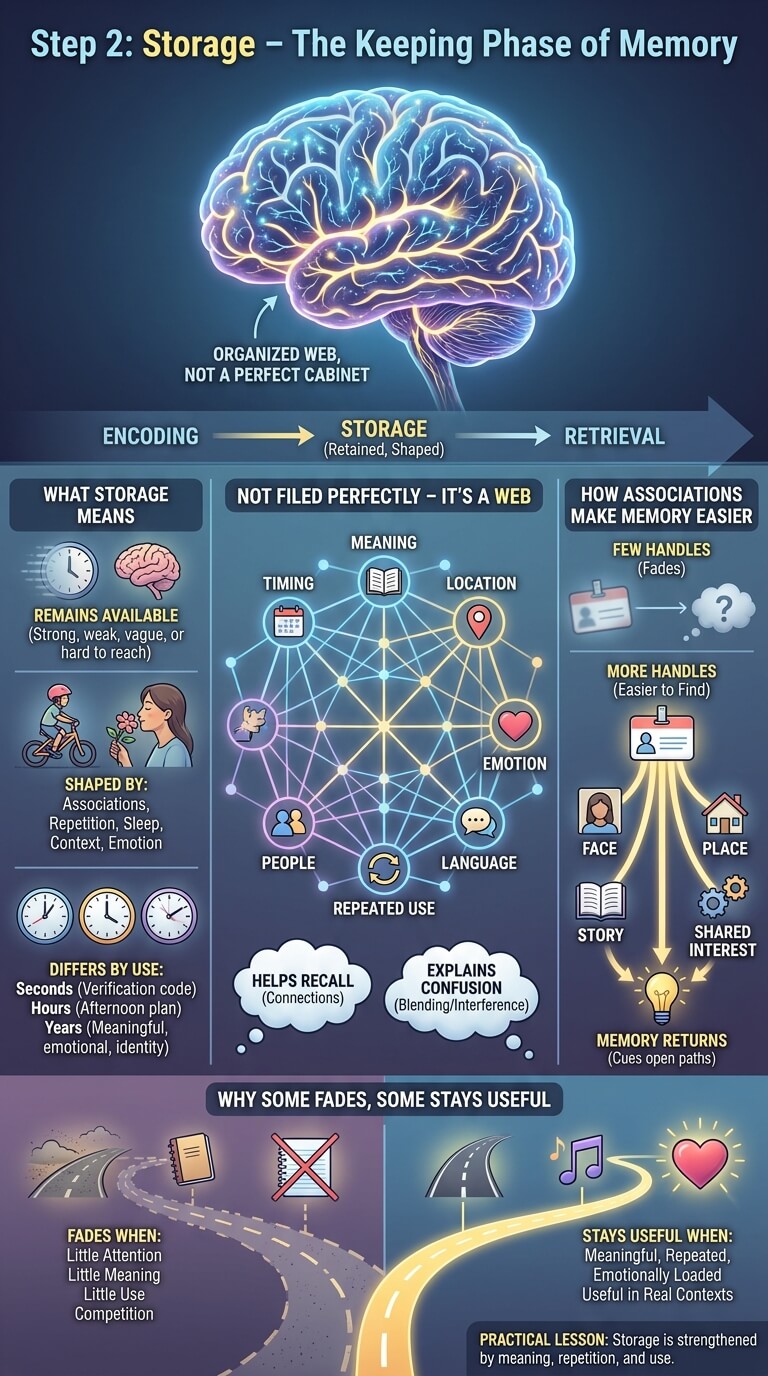
Storage is what happens after information has been encoded. It is the keeping phase of memory, but “keeping” does not mean placing a perfect copy in a mental cabinet. In psychology, storage refers to information being retained after encoding and before retrieval. In real life, stored information is shaped by associations, repetition, sleep, context, and later use.
What storage means
Storage means information remains available in some form after the original experience is gone. A stored memory may be strong, weak, detailed, vague, conscious, or hard to reach. You might not think about a childhood classroom for years, yet a smell or song can bring back an image of it. You might know how to ride a bike without being able to describe every movement.
Memory storage also differs by use. Some information needs to stay for seconds, such as a verification code. Some needs to stay for hours, such as a plan for the afternoon. Some may remain for years because it is repeated, meaningful, emotional, or deeply connected to identity and habits.
Why stored information is organized, not filed perfectly
A helpful metaphor is a web rather than a filing cabinet. Memories connect to other memories through meaning, timing, location, emotion, people, language, and repeated use. Your memory of a holiday may connect to a smell, a song, a relative’s voice, a recipe, a photo, and a story your family tells.
This organization helps recall, but it also explains confusion. If two meetings happened in the same room with the same people, details can blend. If you studied two similar topics in one night, one may interfere with the other. Storage is useful because it is connected, but connected information can compete.
How associations make memory easier to find
Associations act like handles. A memory with more handles is easier to pick up. A name connected only to sound may disappear quickly. A name connected to a face, a place, a story, and a shared interest has more routes back.
You see this when a memory returns after someone gives one extra clue. You cannot remember the movie title, then a friend names the actor and suddenly the title appears. The memory was not necessarily gone. The cue opened a better path to it.
Why some information fades while some stays useful
Information may fade when it receives little attention, little meaning, little use, or too much competition from similar material. A route you drove once may disappear. A route you drive weekly becomes familiar. A song you heard during an important year may stay vivid because it was repeated and emotionally loaded.
An NCBI Bookshelf overview of long-term memory physiology notes that memory helps people respond to familiar situations, recognize faces, and learn from repeated stimuli. For a general reader, the practical lesson is simple: storage is strengthened when information is meaningful, repeated, and useful in real contexts.
Step 3: Retrieval

Retrieval is the bringing-back step. It is what you use when you answer a question, recognize a person, tell a story, follow a learned route, or remember what you promised to do. The APA Dictionary defines retrieval as recovering or locating information stored in memory, after earlier encoding and retention.
What retrieval means
Retrieval can feel effortless or blocked. Sometimes a memory appears immediately. Sometimes you have a tip-of-the-tongue experience where the answer feels close but unreachable. Sometimes you only recognize the answer when you see it, which is why multiple-choice questions can feel easier than open recall.
Retrieval is not one skill. Recognition, free recall, cued recall, and reconstruction are different ways of accessing stored information. Recognizing a face is not the same as producing a name. Remembering the meaning of a conversation is not the same as quoting the exact sentence.
Why cues help memories come back
A cue is anything that helps point your mind toward the stored memory. It might be a place, smell, image, first letter, question, emotion, song, or part of the original context. Cues work because memory is associative. The cue activates part of the web, and the rest may follow.
This is why walking back into the kitchen can help you remember what you needed there. The room itself provides cues that were missing in the hallway. It is also why explaining where you were, who was present, and what happened before a moment can help a detail return.
Why context can make recall easier or harder
Context is not only location. It includes mood, purpose, surroundings, time pressure, and what your mind expects. A student may know the answer at home but blank during a test because the test context adds pressure. A person may forget a colleague’s name at a crowded event but remember it later when calm.
Context also explains why memory sometimes returns when you stop forcing it. When stress drops, attention becomes less narrow. The mind has more room to search. That does not mean pressure is always bad, but heavy pressure can make retrieval feel less smooth.
Why recall can feel different from accuracy
Confidence and accuracy are related sometimes, but they are not the same thing. A memory can feel vivid because the emotion is strong, the story has been repeated, or the meaning is important. That vividness does not prove every detail is exact.
One useful distinction is between the core meaning and the fine detail. You may correctly remember that a meeting felt dismissive, while misremembering the exact order of comments. You may remember that someone helped you, but forget which day it happened. Good memory judgment leaves room for both real recall and possible detail shifts.
Step 4: Updating and Reconstruction
This is also why reconstructed recall can sometimes lead to false memories, where details feel familiar even when they may not be accurate.
The basic model says encoding, storage, and retrieval, but real remembering often includes a fourth process: updating. Once a memory is recalled, it may be reinterpreted, reconnected, or slightly reshaped by new information. This makes memory flexible, but it also makes it imperfect.
Why remembering can slightly reshape a memory
When you tell a story, you select details. When you hear someone else’s version, you may notice details you missed. When your feelings about a person change, old events may take on a different meaning. These changes do not always rewrite memory dramatically, but they can shift emphasis.
This is why repeated storytelling matters. A story told for humor may become sharper and funnier over time. A story told during anger may become more centered on offense. A story told with compassion may include more context. The memory is not being played back in isolation. It is being rebuilt in the present.
How later knowledge can blend with earlier experience
Later knowledge can help memory make sense, but it can also blend with the original experience. If you learn after a meeting that someone was upset, you may start remembering their neutral expression as colder than it looked at the time. If you learn a friend was struggling, an old short reply may seem less personal than it once did.
This updating is not always bad. It allows growth, forgiveness, learning, and better judgment. The risk appears when later assumptions become confused with original details. A careful question is: “Did I clearly notice this then, or am I interpreting it now?”
Why confidence can grow even when details shift
Confidence often grows with repetition. The more you tell a story, the smoother it becomes. Smoothness can feel like truth because the mind has less effort retrieving it. Yet fluency is not the same as proof.
That is why memory is strongest when you separate levels of certainty. You might say, “I clearly remember the topic and how I felt, but I am not fully sure of the exact words.” This kind of precision protects both honesty and self-trust.
What Helps Memory Work Better in Everyday Life

You do not need to turn memory into a complicated productivity system to work with it better. The most useful improvements usually match the memory process itself: encode more clearly, organize what matters, retrieve actively, and reduce overload before important moments.
Pay attention before trying to remember
Many memory problems begin as attention problems. Before blaming your memory, ask whether you truly gave the information a clear landing place. When something matters, pause for a few seconds. Look at it, repeat it, write it, or connect it to a visible cue.
For example, when you put your keys down, say the location once: “Keys on the blue bowl.” That small act increases attention and creates a cue. When someone gives you instructions, repeat the first step back. You are not only checking accuracy. You are encoding.
Add meaning instead of only repeating
Plain repetition can help, but meaning usually helps more. If you repeat a person’s name ten times without linking it to anything, it may still fade. If you connect the name to their face, story, job, or something distinctive about the meeting, the memory has more structure.
Meaning also helps with learning. Instead of rereading a paragraph five times, ask what problem it answers, what example fits it, and how you would explain it in one sentence. The goal is not to make everything emotional or dramatic. The goal is to give the information a place to belong.
Practice retrieval, not just rereading
Rereading often creates familiarity. Retrieval practice builds access. If you close the book and try to explain the idea, answer a question, or write what you remember, you train the retrieval path. A recent review on retrieval practice in learning describes active recall as a strategy with strong support in cognitive psychology.
In daily life, this can be simple. After a meeting, write three decisions from memory before checking your notes. After reading, say the main idea aloud without looking. Before a test, answer practice questions instead of only scanning highlighted lines.
Reduce overload before important learning
Overload makes memory work harder because attention becomes divided and working space becomes crowded. If you are trying to learn something important while tracking messages, worries, background noise, and several unfinished tasks, encoding and retrieval both suffer.
Reducing overload does not require perfect silence. It may mean closing extra tabs, writing down distracting tasks, taking one minute to breathe, or learning in shorter blocks. The point is to give the information a clearer path into memory.
How This Differs From Types of Memory
People often mix up the process of memory with the kinds of memory. Both matter, but they answer different questions. The process asks, “How does information get in, stay available, and come back?” Memory types ask, “What kind of information is being held or used?”
Process vs category
| Question | This article focuses on | A memory-type article focuses on |
|---|---|---|
| How does a memory begin? | Encoding | Sensory, short-term, working, or long-term memory |
| How is it kept? | Storage and association | Episodic, semantic, procedural, or emotional memory |
| How does it come back? | Retrieval cues and context | Which system is being used for facts, skills, events, or feelings |
| Why does it change? | Reconstruction and updating | How different memory systems may be affected differently |
For example, remembering how to make coffee, remembering a birthday party, and remembering a vocabulary word are different kinds of memory. But each still depends in some way on encoding, storage, and retrieval.
When to read the memory-type guide next
Once the process feels clear, the next useful question is often about categories. If you want to understand why remembering a skill differs from remembering a fact, why a short number disappears quickly, or why a personal event feels different from general knowledge, a memory-type breakdown is the better next step.
When Forgetting Is Part of the Process
Forgetting is frustrating, but it is not always a sign that something is wrong. A useful memory system must also filter, update, and let some details fade. If every trivial detail stayed equally strong, daily life would become mentally crowded.
Normal fading
Normal fading often happens when information was not meaningful, not repeated, or no longer useful. You may forget a one-time parking spot, a code used once, or a casual detail from a busy day. That is not failure in the dramatic sense. It is the mind prioritizing.
Fading can even be helpful. It allows you to keep the gist of an experience without carrying every small detail. You may remember that a restaurant was pleasant without remembering the exact table number or every sentence from dinner.
Interference and missing cues
Forgetting can also happen because similar memories compete. If you learn several passwords, names, routes, or definitions close together, one may interfere with another. This is especially common when details are similar but not meaningful enough to stand apart.
Missing cues create a different kind of forgetting. The memory may be available, but the path is weak. That is why a first letter, a location, a face, or a smell can suddenly bring something back. The memory was not erased. It needed a better handle.
When memory problems feel unusual
Everyday lapses are common, but sudden, severe, worsening, or disruptive memory changes deserve attention. It is worth speaking with a qualified health professional if memory problems interfere with daily tasks, cause confusion, follow a head injury, come with major mood or sleep changes, or worry people close to you. Mayo Clinic offers plain-language guidance on when memory loss should be evaluated.
This kind of support is not about assuming the worst. Many factors can affect memory, including stress, sleep, medication, medical conditions, aging, mood, injury, and substance use. Getting help can clarify what is happening and what kind of care may be useful.
FAQ About How Memory Works
Does everything I notice become a memory?
No. Noticing something briefly is not the same as encoding it well. Many details pass through awareness without becoming easy to recall. Attention, meaning, emotion, repetition, and later use all influence whether something becomes memorable.
Why can I remember something later but not now?
Sometimes retrieval fails because the right cue is missing or pressure is narrowing your attention. You may know the information but not be able to access it in that exact moment. A change in context, a hint, or a calmer state can help the memory return.
Does repetition always make memory stronger?
Repetition helps most when it involves attention and meaning. Repeating words without understanding may create short-term familiarity, but it may not create flexible recall. Connecting the information to examples, explaining it, and retrieving it from memory usually works better than passive repetition alone.
Why do I remember the meaning but not the exact words?
The mind often stores gist more easily than exact wording, especially in ordinary conversation. You may remember the main idea, tone, or emotional meaning without holding every sentence. Exact recall usually needs stronger attention, repetition, or written support.
Can recalling something change it?
Yes, recall can update a memory’s emphasis, meaning, or details, especially when the story is repeated or mixed with later information. That does not mean every memory is false. It means careful memory use includes humility about fine details while respecting the core experience.
Key Takeaways
- Memory is a process, not a perfect recording. Information must be encoded, stored, and retrieved.
- Attention is often the first gate. If attention is divided, memory may be weak from the start.
- Meaning creates stronger memory because it connects new information to what you already know.
- Retrieval depends heavily on cues, context, and the way information was stored.
- Remembering can update a memory, so confidence and vividness do not always prove exact accuracy.
- Everyday forgetting is often normal, but sudden, worsening, or disruptive memory changes should be checked by a qualified professional.
Final Thoughts
The most useful way to think about memory is not “good memory versus bad memory.” It is process awareness. When something matters, give it attention, add meaning, create cues, and practice bringing it back before you need it under pressure.
Start with one small habit: when you want to remember something today, pause for five seconds and name what you are encoding. That simple pause gives your memory a better beginning, and a better beginning makes storage and retrieval easier later.

Michael Reed is the Founder and Lead Writer at Psychology Exposed. He writes about human behavior, relationships, emotional patterns, self-awareness, and practical psychology topics using research-informed, easy-to-understand content.
Read More About Michael Reed: https://psychologyexposed.com/michael-reed/