
Behavior change psychology is about why changing what you do is often harder than deciding what you want. A person may genuinely want to stop procrastinating, spend less time scrolling, speak more calmly during conflict, save money, move more, or stop avoiding difficult tasks. The wish is real, yet the old behavior still returns when stress, tiredness, cues, rewards, and familiar environments pull in the same direction as before.
That does not mean the person is weak. It usually means the behavior is serving a short-term function, even if the long-term result is frustrating. Avoidance may bring relief. Scrolling may bring stimulation. Overspending may bring a quick emotional lift. Snapping in a conversation may create a sense of protection. To change a behavior sustainably, you need more than a burst of motivation. You need to understand the loop that keeps the behavior alive and build a replacement that your real life can support.
This guide explains behavior change as a practical process: define the behavior, identify the cue, understand the payoff, choose a replacement, redesign the environment, and review what happens. It is educational and not a diagnosis, treatment plan, or substitute for professional care. If the behavior involves self-harm, addiction, compulsions, trauma, abuse, or serious distress, support from a qualified professional or crisis service is more appropriate than self-help alone.
Quick Answer

Behavior change psychology explains how people shift repeated actions by working with motivation, cues, consequences, habits, thoughts, environment, values, and setbacks. Sustainable change usually starts with a clearly defined behavior, a realistic replacement, fewer triggers, better immediate rewards, and a plan for restarting after slips.
Why Behavior Change Is Hard
Motivation is real but unstable
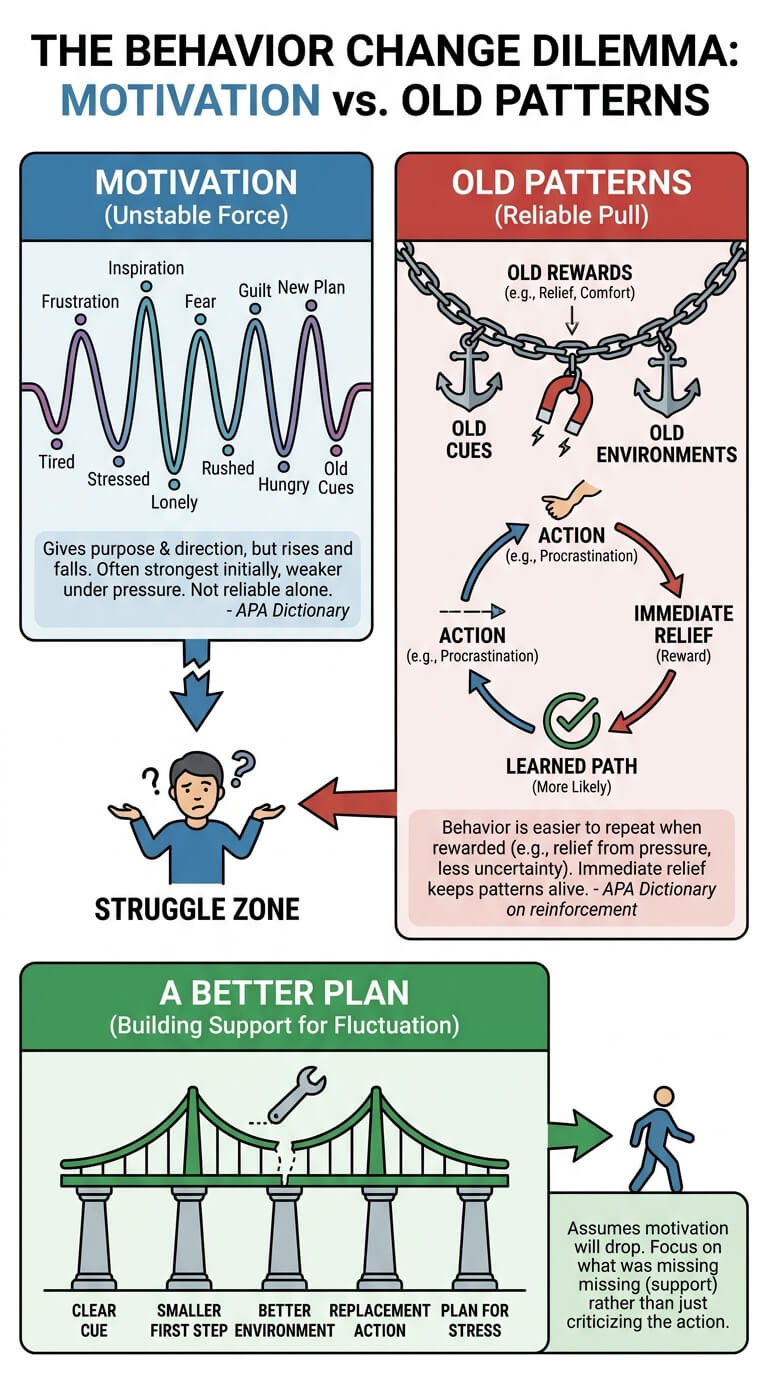
Motivation matters. It gives you a reason to begin, a sense of direction, and the emotional push to try something different. The problem is that motivation rises and falls. It is often strongest after frustration, inspiration, fear, guilt, or a new plan. It is often weaker when you are tired, stressed, lonely, rushed, hungry, or surrounded by old cues. Behavior change is part of human behavior psychology.
The APA Dictionary of Psychology describes motivation as a force that gives behavior purpose and direction. That makes motivation useful, but not always reliable enough to carry a whole change by itself. A better plan assumes that motivation will fluctuate and builds support for the days when wanting change is not enough.
This is why many people start strong and then feel confused when they return to the old behavior. They may think, “I must not really want this.” A more useful question is, “What was missing when motivation dropped?” The answer might be a clear cue, a smaller first step, a better environment, a replacement action, or a plan for stress.
Old rewards, old cues, and old environments keep pulling
Behavior is easier to repeat when it has been rewarded before. Reinforcement does not always mean a pleasant prize. It can also mean relief from pressure, less uncertainty, more comfort, approval, escape from boredom, or avoiding an awkward feeling. The APA Dictionary entry on reinforcement explains that a response becomes more likely when it is followed by a dependent consequence that strengthens it.
Consider procrastination. The long-term cost may be stress, missed deadlines, and lower confidence. The short-term reward is relief from starting something uncomfortable. The mind learns, “Avoiding this gives me a break.” That immediate relief can keep the behavior alive even when the person knows the delay will hurt later.
The same logic applies to many everyday patterns. A phone gives novelty when you feel restless. Saying yes too quickly avoids possible disappointment. Snacking after work creates a transition ritual. Staying silent in a tense conversation avoids conflict for a moment. These behaviors may not match your values, but they have a job. Behavior change becomes more realistic when you identify that job instead of only criticizing the action.
A Practical Behavior Change Framework
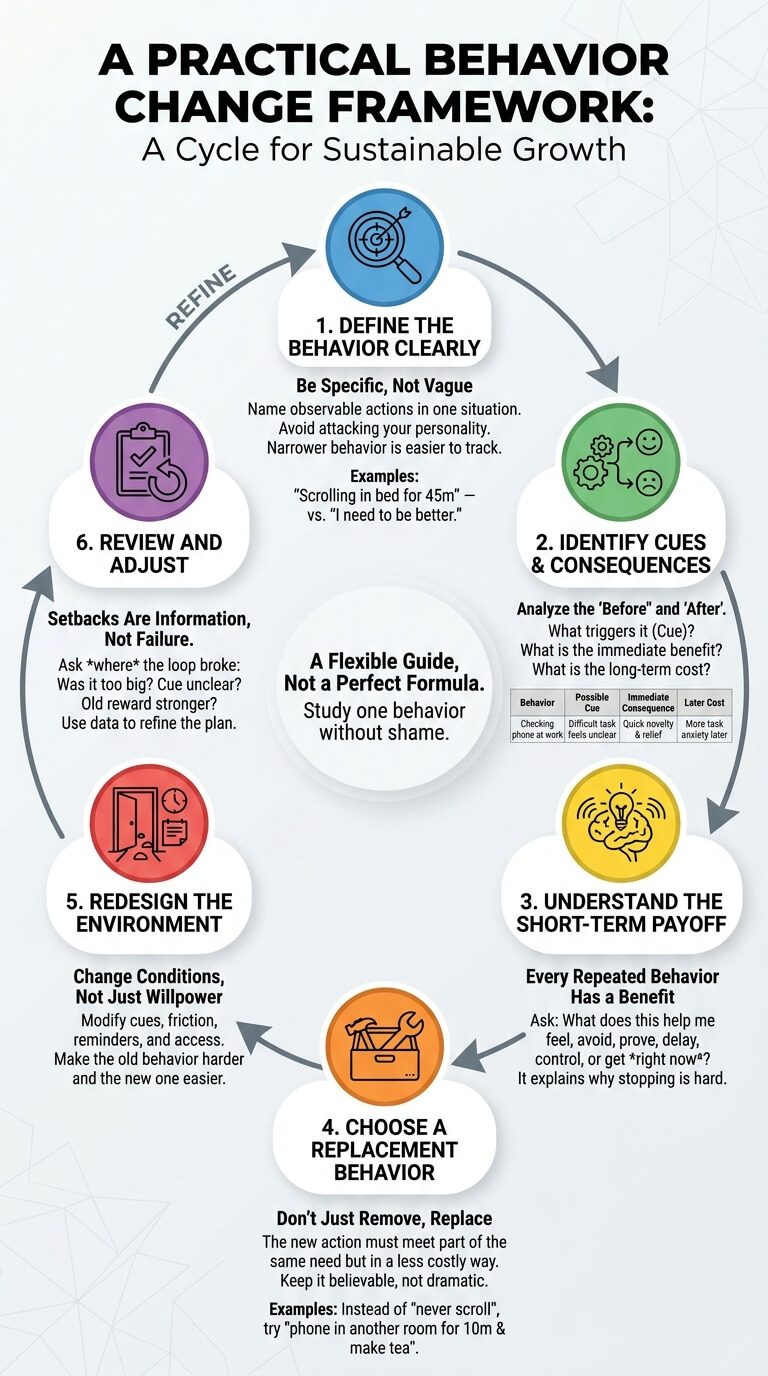
A useful behavior change plan is specific enough to guide action, but flexible enough to survive real life. The steps below are not a perfect formula for every situation. They are a way to study one behavior without shame and change the conditions that keep it repeating.
Define the behavior clearly
Start by naming the behavior in observable terms. “I need to be better” is too vague. “I scroll in bed for 45 minutes after turning off the light” is workable. “I procrastinate” is broad. “I open email, feel overwhelmed, and switch to videos before sending the hard reply” gives you something to study.
A clear definition helps you avoid fighting your whole personality. You are not trying to become a different person overnight. You are changing one repeated action in one situation. The narrower the behavior, the easier it is to notice when it starts, what keeps it going, and what small difference would count as progress.
Identify cues and consequences
Next, look at what happens before and after the behavior. A cue may be a time, place, person, object, emotion, thought, body state, notification, smell, sound, or repeated situation. A consequence may be relief, pleasure, social approval, quiet, control, escape, comfort, or a delayed cost.
| Behavior | Possible cue | Immediate consequence | Later cost |
|---|---|---|---|
| Checking the phone during work | A difficult task feels unclear | Quick novelty and relief | More task anxiety later |
| Snapping during a disagreement | Feeling accused or cornered | Sense of protection | More distance and regret |
| Overspending at night | Stress, boredom, or feeling deprived | Brief excitement or comfort | Financial pressure |
| Avoiding a hard message | Fear of a bad reaction | Temporary calm | More tension and uncertainty |
This step is not about excusing the behavior. It is about understanding why it makes sense in the moment. When the cue and consequence are clear, the change plan can address the real loop instead of attacking the behavior in isolation.
Understand the short-term payoff
Every repeated behavior has some kind of payoff, even when it creates problems later. Ask, “What does this behavior help me feel, avoid, prove, delay, control, or get right now?” The answer may be uncomfortable, but it is often the missing clue.
For example, a person who interrupts may be trying to avoid being misunderstood. A person who gives up after one mistake may be trying to escape shame. A person who keeps checking for reassurance may be trying to lower uncertainty. The payoff does not make the behavior ideal, but it explains why simply telling yourself to stop may not work.
Choose a replacement behavior
Removing a behavior without replacing its function often leaves a vacuum. If scrolling reduces stress, what else will help you transition? If avoidance brings relief, what smaller action gives relief without creating a bigger problem? If snapping protects you from feeling blamed, what phrase helps you pause without attacking?
A replacement does not need to be dramatic. It needs to be believable. Instead of “never scroll after work,” the replacement might be “put the phone in another room for ten minutes and make tea first.” Instead of “never get defensive,” the replacement might be “say, ‘I need a minute to understand what you mean’ before replying.” The replacement should meet part of the same need in a less costly way.
Redesign the environment
Environment change is not cheating. It is one of the most practical parts of behavior change. A plan that depends on constant self-control in an environment designed for the old behavior is fragile. A plan that changes cues, friction, reminders, and access is more forgiving.
The process model of behavior change, discussed in a PubMed Central article on behavior change, organizes strategies by where they act in the behavior process, including the situation, attention, appraisal, response, and consequences. In everyday language, this means you can change more than the final action. You can change what you are exposed to, what you notice, how you interpret the moment, how easy the response is, and what follows it.
Review and adjust
Most behavior change needs adjustment. If the plan fails, do not only ask whether you tried hard enough. Ask where the loop broke. Was the behavior too big? Was the cue unclear? Was the old reward stronger? Did stress change the situation? Was the replacement too awkward? Did the environment keep inviting the old action?
Reviewing turns a setback into information. This is what keeps change from becoming a pass-fail test. You are not proving your worth each time you try. You are learning how the behavior works under real conditions.
Motivation, Identity, and Values
Why wanting change is not the same as being ready
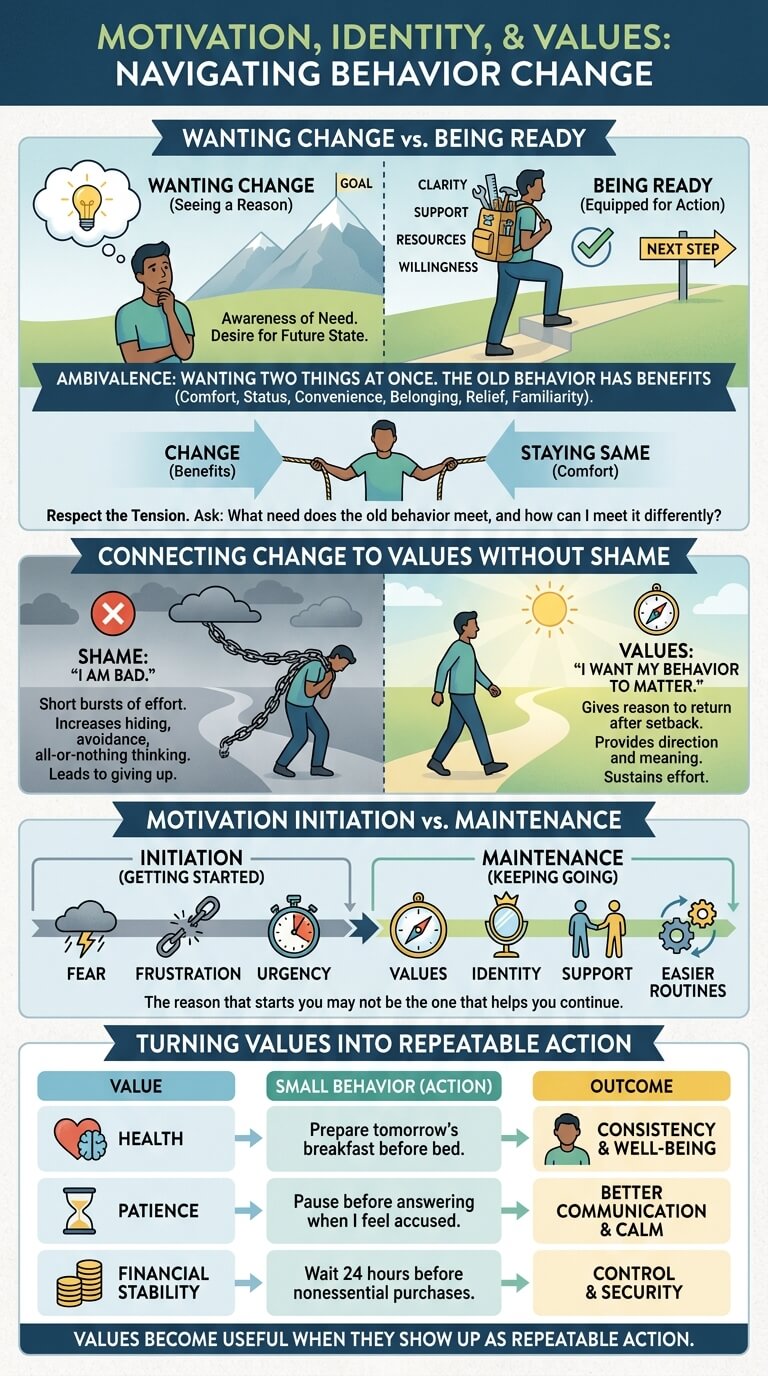
Wanting change means you see a reason. Being ready means you have enough clarity, support, resources, and willingness to take a specific next step. A person may want to change a behavior but still feel conflicted because the old behavior has benefits. It may bring comfort, status, convenience, belonging, relief, or a familiar sense of control.
This is not hypocrisy. It is ambivalence. Human beings can want two things at once: the benefits of change and the comfort of staying the same. A practical plan respects that tension. Instead of saying, “I should just want it more,” ask, “What part of me still benefits from the old behavior, and how can I meet that need differently?”
Connect change to values without shame
Values are different from shame. Shame says, “I am bad because I do this.” Values say, “I want my behavior to move closer to what matters.” That difference affects how change feels. Shame may create a short burst of effort, but it often increases hiding, avoidance, and all-or-nothing thinking. Values give you a reason to return after a setback.
A review on motivation and health behavior change in PubMed Central discusses how initiation and maintenance can involve different motivational processes. Applied carefully to daily life, this means the reason that gets you started may not be the same reason that helps you continue. Fear, frustration, or urgency may start the process, but values, identity, support, and easier routines often help maintain it.
Try turning a value into a small behavior. “I value health” becomes “I prepare tomorrow’s breakfast before bed.” “I value patience” becomes “I pause before answering when I feel accused.” “I value financial stability” becomes “I wait 24 hours before nonessential purchases.” Values become useful when they show up as repeatable action.
The Role of Thoughts in Behavior Change
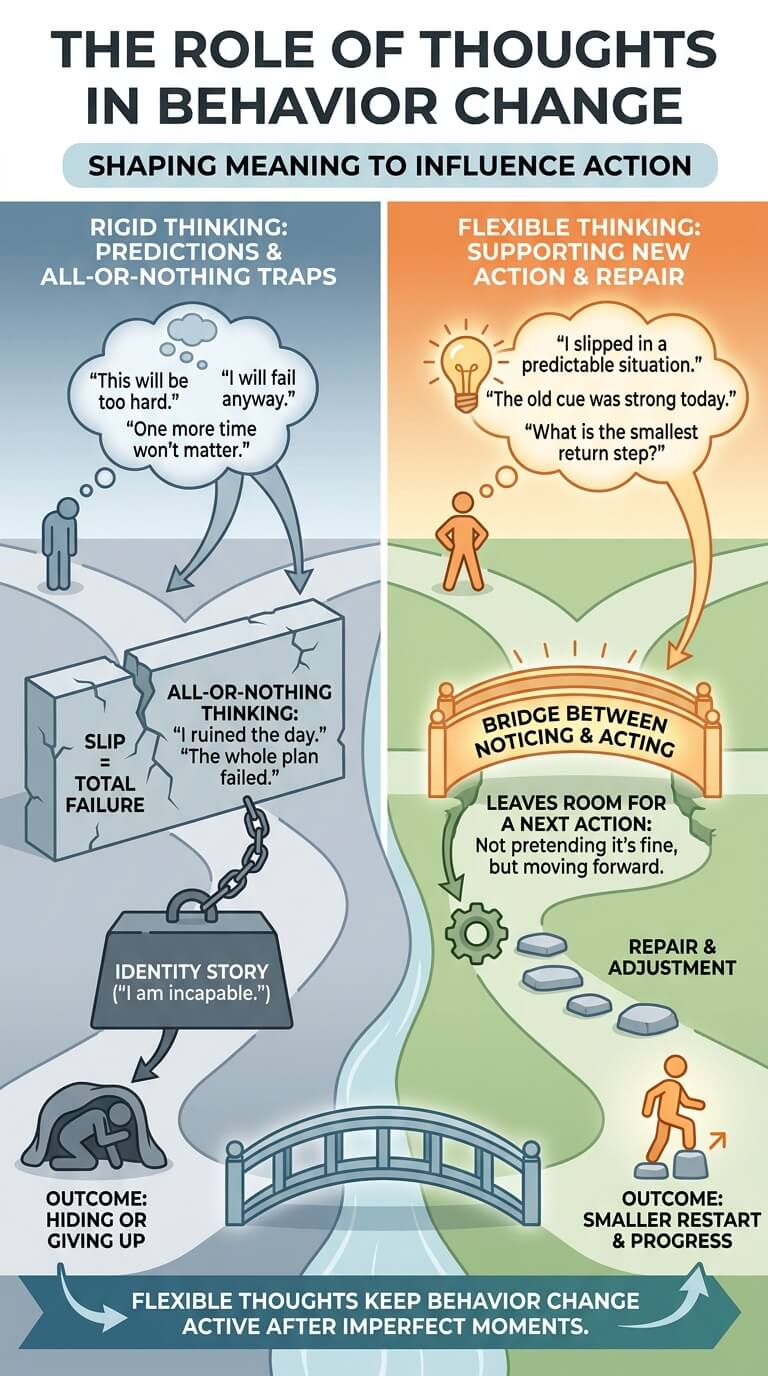
Predictions, self-talk, and all-or-nothing thinking
Thoughts influence behavior because they shape what a moment seems to mean. Before a behavior happens, the mind often makes predictions: “This will be too hard,” “I will fail anyway,” “They will be angry,” “I deserve this,” “One more time will not matter,” or “I already ruined the day.” These thoughts can make the old action feel reasonable. Self-talk matters because how thoughts influence behavior can support or block action.
All-or-nothing thinking is especially common during change. If you miss one workout, you may think the whole plan failed. If you spend money once, you may abandon the budget. If you react badly in one conversation, you may decide you are incapable of changing. The behavior problem then becomes a thinking problem too. The slip is no longer one event. It becomes a story about identity.
How flexible thinking supports new action
Flexible thinking does not mean pretending everything is fine. It means leaving room for a next action. Instead of “I failed,” try “I slipped in a predictable situation.” Instead of “I never change,” try “The old cue was stronger than my plan today.” Instead of “I ruined it,” try “What is the smallest return step?”
Flexible thoughts help because they keep behavior change active after imperfect moments. They create a bridge between noticing and acting. A harsh thought often leads to hiding or giving up. A flexible thought is more likely to lead to repair, adjustment, or a smaller restart.
The Role of Environment
Make desired behavior easier
If you want a behavior to happen more often, reduce the distance between intention and action. Put the book where you sit. Keep walking shoes near the door. Place the water bottle on your desk. Save the document open on your computer. Prepare the ingredients before the busy moment arrives. A plan often works better when it includes how environment shapes behavior.
This kind of setup matters because many good behaviors fail at the starting line. The person agrees with the goal, but the first step requires too much activation. Making the desired behavior easier lowers the cost of beginning. It also creates visual reminders that compete with old cues.
Make unwanted behavior harder
To reduce an unwanted behavior, add friction without turning the plan into punishment. Put tempting apps behind time limits. Keep the phone outside the bedroom. Remove saved card details from shopping sites. Do not keep the most impulsive snack in the most visible place. Write the difficult message in a draft before opening the inbox.
Friction works best when it gives you time to choose. The goal is not to prove you have perfect self-control. The goal is to interrupt the automatic path long enough for a different response to become possible.
The Role of Habits and Reinforcement
Build repetition around stable cues
Habits support behavior change when a new action is repeated in a predictable context. Stable cues matter because they reduce the need to remember. A behavior attached to an existing event, such as after coffee, after lunch, after arriving home, or after brushing your teeth, has a clearer starting point than a behavior planned for “sometime today.” Many change efforts involve habit formation.
For a new behavior, choose a cue that already happens. Then make the first version small enough that it can survive ordinary resistance. The early goal is not maximum intensity. It is repeatability. A repeatable action teaches the mind, “This is what happens here now.” The process also connects with behavioral psychology principles.
Reward progress and reduce friction
Progress needs to feel visible. This does not require a large reward. A checkmark, a short pause, a clean desk, a saved amount, a message sent, or a calmer conversation can become feedback. People often quit because they only notice the long road ahead and not the evidence that the new behavior is beginning to appear.
Rewarding progress is not childish. It is how repeated action becomes more attractive. If the old behavior gives quick relief and the new behavior gives only distant benefits, the old behavior has an advantage. Give the new action a small immediate signal that it mattered.
Setbacks and Relapse Loops
Why slipping is information, not proof of failure
A slip tells you something about the conditions around the behavior. Maybe the plan depended too much on energy. Maybe a stressful conversation triggered the old response. Maybe the replacement did not meet the same need. Maybe the cue was stronger than expected. Maybe the environment stayed arranged for the old behavior. If the same setback keeps returning, look at why people repeat the same mistakes.
This matters because the interpretation of a slip shapes the next behavior. If you treat a slip as proof that you cannot change, you may stop trying. If you treat it as data, you can change the plan. The difference is not motivational fluff. It changes what you do next.
How to restart without the shame spiral
The shame spiral usually sounds like this: “I did it again. I knew I would. I always ruin things. There is no point.” That sequence adds emotional pain to the original slip. The pain then increases the urge for the old coping behavior, which creates another slip.
A restart plan should be simple and immediate. Name what happened, identify the cue, choose the next smallest different action, and return without trying to make up for everything at once. If you overspent, pause the next purchase and check your balance. If you scrolled too long, put the phone down and complete one tiny task. If you snapped, repair one sentence instead of trying to fix the whole relationship in a single conversation.
| After a slip | Less helpful response | More useful restart |
|---|---|---|
| You avoid a task all afternoon | Decide the day is ruined | Do the first two minutes before stopping |
| You react sharply in a conversation | Defend the reaction for hours | Name the reaction and repair one part |
| You return to an old comfort habit | Use shame to force change tomorrow | Ask what need the habit met today |
Behavior Change vs Habit Formation vs Repeating Mistakes
Change as the larger process
Behavior change is the larger process of moving from an old action pattern to a different one. It includes motivation, values, cues, thoughts, emotion, environment, reinforcement, identity, setbacks, and support. A behavior change plan asks, “What has to shift so this different action becomes more likely in real life?”
This is why behavior change is broader than a simple tip list. You may need to adjust the situation, not just the final action. You may need a different way to handle discomfort. You may need to make the first step smaller. You may need to repair a belief that says one mistake means total failure.
Habits as one mechanism
Habit formation is one important mechanism inside behavior change. If you want a new behavior to repeat with less effort, habit design helps. Stable cues, repetition, immediate feedback, and reduced friction make the behavior easier to return to.
But not every change is only a habit problem. Some behaviors involve fear, conflict, shame, values, social pressure, trauma history, financial stress, or mental health symptoms. In those cases, habit tools may still help, but they are not the whole picture.
Repeated mistakes as feedback signals
Repeating the same mistake often means there is a predictable decision point that has not been addressed. The person may understand the lesson afterward but miss the moment before the behavior begins. They may also return to the same short-term payoff under stress.
Behavior change uses repeated mistakes as clues. Where does the loop begin? What feeling makes the old choice attractive? What would make the better choice easier by five percent? The lesson becomes useful only when it changes the next cue, step, or environment.
First Step: The Next Smallest Different Action
Choose one action for the next 24 hours
The best first step is often smaller than the one you want to announce. Choose one behavior that can happen in the next 24 hours. It should be specific, visible, and easy enough that you can do it on a normal day, not only on an ideal day.
Examples include: put the phone outside the bedroom tonight, write the first sentence of the avoided email, prepare one breakfast option, take a five-minute walk after lunch, pause before replying to criticism, or remove one shopping app from the home screen. The action should create evidence. You are teaching your mind that change begins with a different move, not a perfect life plan.
Track friction, not just success
Most people track whether they succeeded. It is also useful to track friction. What made the action harder? Was it time, tiredness, awkwardness, uncertainty, location, emotion, another person, or lack of preparation? Friction shows you what to redesign.
A simple tracking question is: “What got in the way, and what would make this one step easier tomorrow?” This keeps attention on adjustment rather than self-judgment. Over time, reducing friction may matter more than increasing pressure.
When to Get Support
Behavior involving harm, addiction, compulsion, self-harm, trauma, or severe distress
Some behaviors should not be handled as ordinary self-improvement problems. If a behavior involves self-harm, thoughts of suicide, substance dependence, compulsions that feel out of control, eating disorder behaviors, violence, coercion, trauma responses, severe anxiety, or serious impairment, professional support is important. In those situations, the priority is safety and care, not stronger willpower.
The National Institute of Mental Health offers guidance for finding help when someone is struggling emotionally or has mental health concerns. If there is immediate danger or possible self-harm, contact local emergency services or a crisis line in your country. A behavior that feels impossible to control may need more support than a personal plan can provide.
FAQ About Behavior Change Psychology
Why is behavior change so hard?
Behavior change is hard because old actions often have immediate rewards, familiar cues, and low friction. The new behavior may have better long-term results, but it may feel harder at first. Stress also makes people more likely to return to familiar responses. A stronger plan changes the cue, replacement action, environment, and reward instead of relying only on motivation.
What is the first step to changing behavior?
The first step is to define one behavior clearly. Instead of saying “I need to stop wasting time,” describe the exact moment: “I open social media after sitting at my desk and lose 30 minutes before starting work.” Then identify the cue, the short-term payoff, and one smaller replacement action you can test in the next 24 hours.
Can behavior change without motivation?
Some motivation helps, but behavior change does not have to wait for high motivation. Clear cues, smaller actions, environment design, social support, and immediate feedback can carry you on low-motivation days. In many cases, action creates motivation after the first step, especially when the step is small enough to begin.
Why do I go back to old behavior under stress?
Stress makes familiar behavior more attractive because it often promises quick relief. Under pressure, the mind may choose the fastest known coping response, even when it has long-term costs. This does not mean change is impossible. It means your plan needs a stress version: a smaller action, fewer cues for the old behavior, and a restart step after slips.
Key Takeaways
- Behavior change works best when you define one repeated action clearly instead of trying to fix your whole life at once.
- Motivation can start change, but cues, environment, rewards, replacement actions, and restart plans help maintain it.
- Unwanted behaviors often continue because they provide short-term relief, comfort, control, or escape.
- A replacement behavior should meet part of the same need with fewer long-term costs.
- Setbacks are useful when they help you identify friction, cues, and missing support.
- Behaviors involving harm, addiction, compulsion, trauma, or severe distress deserve qualified support, not self-blame.
Final Thoughts
Behavior change becomes more realistic when you stop treating it as a test of character and start treating it as a change in conditions. Choose one behavior, study what starts it, understand what it gives you, and build a smaller response that fits the life you actually have. The next useful step is not to promise a complete transformation. It is to do one different action in the next 24 hours and learn from what happens.

Michael Reed is the Founder and Lead Writer at Psychology Exposed. He writes about human behavior, relationships, emotional patterns, self-awareness, and practical psychology topics using research-informed, easy-to-understand content.
Read More About Michael Reed: https://psychologyexposed.com/michael-reed/