
Habit formation psychology explains why some repeated actions start to feel almost automatic. You may decide to check your phone for one minute and end up scrolling for twenty. You may keep reaching for a snack in the same chair every evening, even when you are not very hungry. You may also build useful habits, such as putting your keys in the same place, drinking water after waking, or taking a short walk after lunch.
The practical value of understanding habits is that it moves the question away from “Why am I so undisciplined?” and toward “What cue, reward, routine, or environment is training this behavior?” That shift matters. Habits are not just choices repeated by a weak or strong person. They are learned responses that become easier when the setting is stable, the payoff is noticeable, and the behavior is repeated often enough.
This article explains how habits form, why they can feel hard to change, how long habit formation may take, and what to do when you want to build a helpful habit or change an unwanted one. It is educational, not a diagnosis or treatment plan. If a repeated behavior involves self-harm, substance misuse, eating disorder behaviors, compulsions, or serious impairment, it is worth seeking qualified support rather than treating it as an ordinary habit problem.
Quick Answer

Habit formation psychology is the study of how repeated behaviors become easier, faster, and more automatic through cues, repetition, rewards, relief, and context. A habit usually forms when the same situation repeatedly leads to the same action and the brain learns that the action is useful, satisfying, relieving, or efficient.
What a Habit Is

Repeated behavior that becomes easier and more automatic
A habit is a learned behavior that becomes easier to perform with repetition. It does not always feel completely unconscious, but it often begins before much deliberate thinking happens. You may notice the action only after your hand has reached for the phone, after the snack is already open, or after you have taken the same route home without planning it. Habit formation is part of human behavior psychology.
The National Institute of Mental Health describes habits as repetitive behaviors triggered by internal or external cues that may continue without constant conscious oversight. That definition is useful because it includes both helpful and unhelpful habits. A habit can save effort, but it can also keep a behavior running when the original reason is no longer helpful.
Psychology often describes habits in relation to automaticity. The APA Dictionary of Psychology defines automaticity as the quality of a behavior or mental process that can be carried out rapidly and with little effort or explicit intention. In daily life, automaticity is why you do not need to relearn how to brush your teeth each morning or how to type a familiar password. The same mechanism can also make unwanted behaviors feel strangely quick.
Habit vs routine vs behavior pattern
People often use habit, routine, and behavior pattern as if they mean the same thing. They overlap, but they are not identical. A routine is usually a sequence you intentionally follow, such as a morning routine or workout routine. A behavior pattern is a repeated way of acting across situations, such as avoiding hard conversations or overcommitting at work. A habit is narrower: it is a repeated action that becomes linked to a cue and easier to do with less active decision-making.
| Term | What it usually means | Daily example |
|---|---|---|
| Habit | A learned action triggered by a cue and repeated with less effort over time. | Opening a social app whenever you sit on the couch. |
| Routine | A planned sequence that may contain several habits. | Shower, coffee, breakfast, check calendar. |
| Behavior pattern | A repeated style of responding across moments or relationships. | Saying yes too quickly, then feeling resentful later. |
This distinction matters because the solution depends on what you are working with. A messy routine may need better planning. A broad behavior pattern may need reflection, support, or emotional skills. A habit often needs cue awareness, repetition, reward design, and environment change.
The Habit Loop

A simple way to understand habit formation is to look at the habit loop: cue, routine, reward or relief, then repetition. The loop is not a perfect formula for every behavior, but it gives you a practical map. Instead of judging the action by itself, you study what starts it, what the behavior does, and what teaches your brain to repeat it. The habit loop connects closely with behavioral psychology principles.
Cue
The cue is the signal that starts the habit. It can be external, such as a time of day, location, notification, object, smell, person, or open browser tab. It can also be internal, such as boredom, stress, loneliness, tiredness, hunger, uncertainty, or the feeling that you deserve a break.
Cues are powerful because they reduce the need for a fresh decision. The more often a cue is followed by the same action, the more that situation begins to suggest the action. A kitchen counter with visible snacks, a phone beside the bed, or a running shoe placed by the door can all become cues. One cue may pull you toward an unwanted habit, while another cue can support a useful one.
Routine
The routine is the behavior itself. It might be brushing your teeth, checking email, stretching, smoking, snacking, scrolling, procrastinating, making coffee, or turning on a podcast when you start cleaning. In habit formation, the routine is not just something you “choose.” It is the response that has become familiar in a certain context.
Many routines are small, which makes them easy to overlook. You may not think of putting your phone on the desk as part of a habit, but if that placement leads to checking messages every few minutes, it belongs to the routine chain. A habit often has a visible action and a few hidden steps before it.
Reward or relief
The reward is what makes the brain more likely to repeat the routine. Sometimes the reward is pleasure, such as taste, entertainment, comfort, or a sense of accomplishment. Sometimes it is relief, such as avoiding boredom, reducing tension, escaping uncertainty, or putting off an unpleasant task.
This is why unwanted habits can feel rewarding even when you do not truly like their long-term effects. The reward may be immediate, while the cost arrives later. For example, avoiding a difficult email may bring quick relief. The later stress of delay does not always weaken the habit because the brain already learned that avoidance reduces discomfort in the moment.
Repetition and automaticity
Repetition teaches the loop. When the same cue is followed by the same routine and some form of reward or relief, the behavior becomes easier to activate next time. The APA Dictionary entry on reinforcement explains reinforcement as a process that increases the frequency or probability of a response. In plain language, if an action reliably gives the brain something useful, the brain is more likely to keep offering that action. Once a habit is familiar, it can feel like automatic behavior.
Automaticity builds when the behavior becomes tied to context. This is why stable cues help. A habit performed at the same time, in the same place, after the same event, or with the same object has a clearer trigger than a behavior performed randomly. Repetition alone matters, but repetition in a stable context usually matters more.
Why Habits Form

The brain saves effort
The mind cannot treat every repeated action as a brand-new problem. If it did, daily life would be exhausting. Habits help conserve attention. Once a behavior becomes familiar, the brain can run it with less conscious planning while attention moves elsewhere. Habits become easier to understand when you notice environmental cues.
This is helpful when the habit serves you. Driving a familiar route, washing dishes in a usual order, or packing a work bag the same way can reduce mental load. The same efficiency becomes a problem when the automatic behavior no longer matches your current goals. The brain may keep suggesting the old shortcut because it is familiar, not because it is wise.
Rewards and relief teach repetition
Habits form because behavior has consequences. A behavior that brings comfort, pleasure, relief, approval, or less effort is easier to repeat. This does not mean people are simple machines. It means consequences teach the nervous system what seems useful in a given moment.
Relief is especially important. Many habits are not built around excitement. They are built around reducing discomfort. You may clean when anxious because it creates a sense of control. You may check messages because uncertainty feels tense. You may delay a project because starting feels overwhelming. The behavior may not solve the deeper issue, but if it reduces discomfort briefly, the loop can strengthen.
Environment makes cues reliable
Environment is one reason habits can feel stronger in some places than others. A behavior that rarely appears at work may appear immediately at home. A habit you thought you broke may return when you visit an old neighborhood, see certain friends, or enter a room arranged the same way as before.
That does not mean environment controls everything. It means the environment helps the brain predict what usually happens next. The chair where you snack, the desk where you procrastinate, the phone beside your pillow, and the calendar reminder after lunch all shape the likelihood of action.
How Long Does Habit Formation Take?
Why there is no universal number
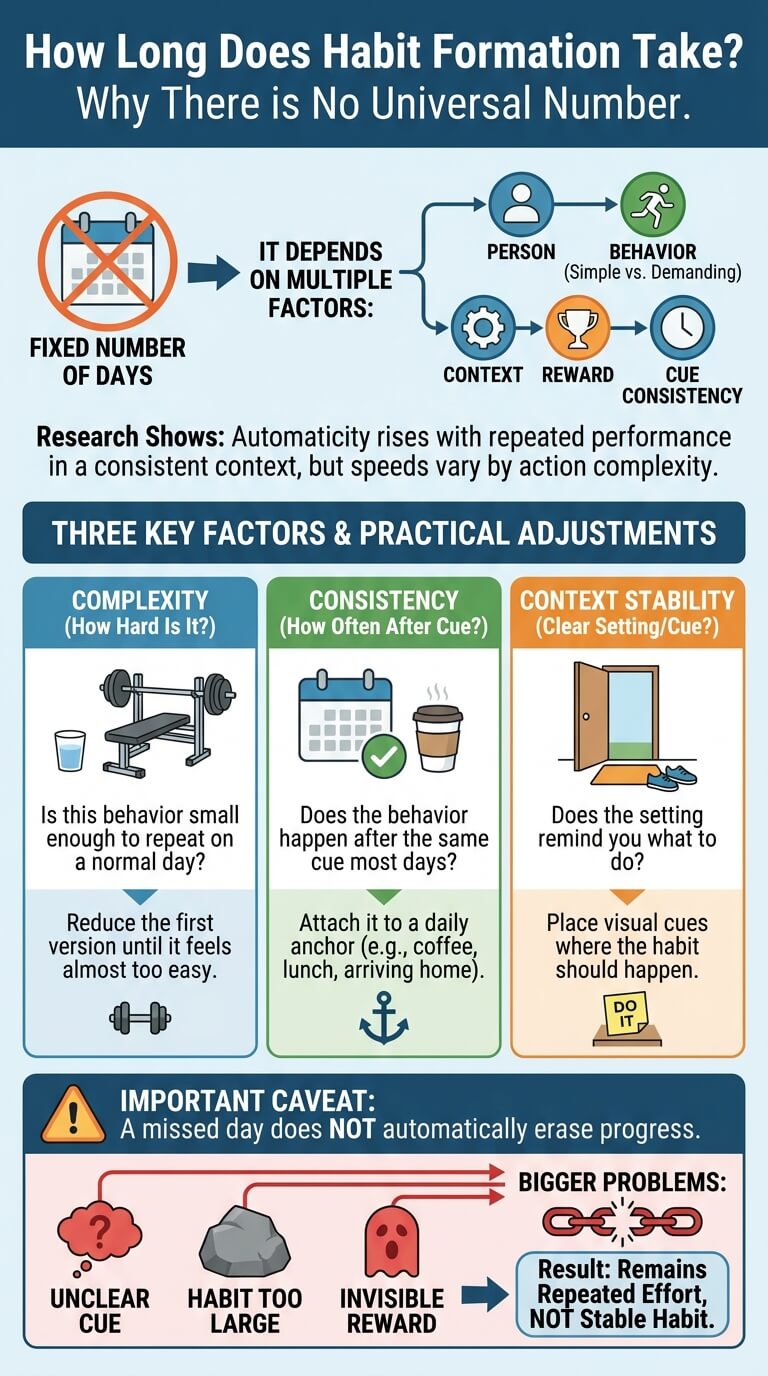
One popular claim says habits take a fixed number of days to form. That is too simple. Habit formation depends on the behavior, the person, the context, the reward, and how consistent the cue is. A tiny habit tied to a daily event may become easier faster than a demanding habit that requires time, energy, equipment, or emotional effort.
Research reviews also suggest that timing varies. A PubMed Central review on habit formation describes evidence that automaticity tends to rise with repeated performance in a consistent context, but that simple actions and more complex routines can develop at different speeds. A newer systematic review and meta-analysis on time to form a habit also emphasizes that habit formation is not best reduced to one universal timeline.
Complexity, consistency, and context stability
Three factors affect how long a habit may take: complexity, consistency, and context stability. Complexity means how hard the behavior is. Drinking a glass of water after brushing your teeth is simpler than doing a full workout before work. Consistency means how often the behavior follows the cue. Context stability means whether the cue and setting are clear enough to repeat.
| Factor | Habit-building question | Practical adjustment |
|---|---|---|
| Complexity | Is this behavior small enough to repeat on a normal day? | Reduce the first version until it feels almost too easy. |
| Consistency | Does the behavior happen after the same cue most days? | Attach it to a daily anchor, such as coffee, lunch, or arriving home. |
| Context stability | Does the setting remind you what to do? | Place visual cues where the habit should happen. |
A missed day does not automatically erase progress. The bigger problem is when the cue stays unclear, the habit is too large, or the reward is invisible. In that case, the behavior may remain a repeated effort rather than becoming a stable habit.
Building a New Habit
Start with a small behavior
New habits often fail because the starting version is too big. “Exercise every day” sounds inspiring, but it may require clothes, time, energy, weather, motivation, and recovery. “Put on walking shoes after lunch” is smaller. “Walk for five minutes after coffee” is smaller still. A small behavior is not the final goal. It is the entry point that trains consistency.
Small habits also reduce the emotional resistance that comes from pressure. When a behavior feels huge, the brain may protect you by avoiding it. When the first step is small, you lower the barrier. The habit becomes easier to begin, and beginning is often the hardest part.
Attach it to a clear cue
A new habit needs a reliable starting signal. Vague timing like “later,” “more often,” or “when I have time” gives the brain little to work with. A clearer cue sounds like: after I brush my teeth, after I pour coffee, when I sit at my desk, after I close my laptop, or when I put dinner dishes away.
The cue should already exist in your day. This is sometimes easier than creating an entirely new schedule. You are not relying on memory alone. You are letting an existing event carry the new behavior.
Make the reward noticeable
Many useful habits have delayed rewards. Exercise, saving money, practicing a skill, or sleeping earlier may help later, but the brain learns faster from immediate feedback. That does not mean you need a dramatic reward. You need a noticeable one.
A reward can be a checkmark on a tracker, a moment of satisfaction, music during the behavior, a cleaner space, a small pause after completion, or the relief of knowing the task is no longer hanging over you. The point is to help your brain register, “This action did something for me.”
Protect consistency without perfectionism
Consistency matters, but perfectionism can break consistency. When people miss one day and decide the habit is ruined, they turn a small gap into a full stop. A more useful rule is to return quickly and keep the habit small enough that returning is realistic.
Protecting consistency means planning for imperfect days. Create a minimum version of the habit. If your full habit is a thirty-minute walk, the minimum version might be walking to the end of the block. If your full habit is writing for twenty minutes, the minimum version might be opening the document and writing one sentence. The minimum version keeps the cue-response connection alive.
Changing an Unwanted Habit
Identify the cue and payoff
To change an unwanted habit, begin by studying it without moral judgment. Ask: when does it happen, where does it happen, what happens right before it, and what does it give me immediately? The payoff may be comfort, stimulation, relief, distraction, control, social connection, or escape.
For example, evening snacking may not be only about food. It may signal transition, reward after work, comfort, tiredness, or a need for quiet. Phone checking may not be only about distraction. It may reduce uncertainty, offer novelty, or delay a task that feels unpleasant. You cannot design a good replacement until you understand what the habit is doing.
Replace the routine instead of relying only on willpower
Many people try to break a habit by removing the behavior and leaving the cue and payoff untouched. That often creates tension. The cue still appears, the need still exists, and the brain still wants relief. A replacement routine gives the loop a new path.
| Unwanted habit | Likely cue | Possible payoff | Replacement to test |
|---|---|---|---|
| Scrolling in bed | Getting under the blanket | Decompression and low-effort stimulation | Put the phone across the room and keep a low-effort book or audio beside the bed. |
| Snacking after work | Entering the kitchen tired | Transition and comfort | Drink water, sit for five minutes, then choose a planned snack if still wanted. |
| Avoiding a difficult task | Seeing a task with unclear first steps | Relief from pressure | Write the first action only, then work for five minutes. |
The first replacement does not have to be perfect. Treat it as a test. If it does not meet the real payoff, adjust it. A replacement that looks good on paper but does not provide relief, clarity, or satisfaction will be hard to repeat.
Add friction and redesign the environment
Friction is anything that makes a behavior slightly harder. Removing friction helps a wanted habit. Adding friction helps interrupt an unwanted one. You can move an app off your home screen, keep snacks out of sight, place workout clothes where you will see them, set a device outside the bedroom, or prepare the first step before the cue appears.
Environment design is not a sign of weakness. It is a way of working with how habits actually form. If a cue keeps triggering the same action, changing the cue or the path can make the old behavior less automatic and the new behavior easier to choose.
Habit Formation vs Behavior Change
Habits as one kind of behavior change
Habit formation is one part of behavior change. It works best when the behavior is repeatable, cue-based, and small enough to practice often. Drinking water after coffee, reviewing tomorrow’s calendar before closing the laptop, or stretching after brushing your teeth are habit-friendly changes. For broader routines, behavior change psychology gives the wider framework.
Not every behavior goal is a simple habit. Some goals require planning, emotional regulation, relationship boundaries, learning new skills, or changing the environment in a larger way. A habit can support those goals, but it may not be enough by itself.
When a broader change plan is needed
A broader plan is needed when the behavior is tied to strong emotion, fear, social pressure, addiction, compulsive urges, chronic stress, or a setting you cannot easily control. In those cases, the habit loop may still help you understand the behavior, but the solution may require support, safety planning, medical care, therapy, coaching, or practical changes in the environment.
For example, reducing late-night scrolling may respond well to phone placement and bedtime cues. Reducing alcohol misuse, compulsive checking, or self-injury should not be treated as a normal habit experiment. The NIMH overview of obsessive-compulsive disorder is one example of why repetitive behavior can sometimes belong in a clinical support context rather than a simple self-improvement frame.
Common Habit Mistakes
Starting too big
The most common mistake is choosing a habit that requires the best version of your day. A habit that only works when you are energized, calm, and organized is fragile. A better starting habit works on an ordinary day, including a day with some stress and distraction.
Instead of asking, “What would be impressive?” ask, “What could I repeat even when my day is not ideal?” That answer may feel smaller than you want. It is also more likely to become stable.
Depending only on motivation
Motivation is useful, but it changes. Habit formation becomes more reliable when the behavior does not need a fresh motivational speech every time. Clear cues, reduced friction, visible rewards, and a small starting step are more dependable than waiting to feel ready.
This does not mean motivation is irrelevant. It means motivation should help you design the system, not carry the whole system forever. Use motivated moments to prepare cues, remove obstacles, and make the next repetition easier.
Ignoring stress and environment
Stress can pull people back toward familiar habits because familiar actions require less thinking. When tired or overwhelmed, the brain often chooses what is easiest, quickest, or most relieving. That is why unwanted habits may return during busy seasons, travel, conflict, or poor sleep.
Ignoring environment has a similar effect. If the old cue is still strong and the new habit is hidden, the old routine has the advantage. Change the room, the timing, the object placement, or the first step before blaming yourself.
What This Helps You Understand Next
Conscious and automatic behavior
Habits show how behavior can begin with intention and later become more automatic. This helps explain why you can want one thing consciously while still doing something else quickly. The gap is not always hypocrisy. Sometimes it is a learned cue-response link acting faster than reflection.
Learning principles
Habit formation also makes behavioral learning easier to understand. Reinforcement, cues, consequences, and repetition are not abstract textbook ideas. They show up when a behavior becomes easier because it repeatedly produces a result the brain recognizes as useful.
A wider plan for behavior change
When a habit is part of a larger life change, the next question is not only “How do I repeat this?” It is also “What support, environment, identity, stress level, and decision points affect this behavior?” Habits are powerful, but they work best when they are placed inside a realistic plan.
FAQ About Habit Formation
How do habits become automatic?
Habits become automatic when a behavior is repeated in a stable context and the brain learns that the behavior reliably produces a reward, relief, or useful result. Over time, the cue begins to activate the routine with less deliberate thought. The behavior may still be adjustable, but it starts faster and feels easier than it did at first.
Can you break a habit without replacing it?
Sometimes, but replacing the routine is often easier than simply removing it. If the cue and payoff remain, the old urge may keep returning. A replacement gives your brain another way to meet the same need, such as relief, stimulation, comfort, transition, or clarity. The replacement has to fit the real payoff, not just look healthier from the outside.
Why do habits return under stress?
Stress makes familiar behaviors more tempting because they require less decision-making and often provide quick relief. When energy is low, the brain may prefer the routine it already knows. This is why it helps to design minimum versions of good habits and reduce access to unwanted habits before stressful moments arrive.
Are bad habits a lack of discipline?
Not usually. Discipline can help, but unwanted habits are often maintained by cues, rewards, relief, stress, and environment. Calling them only a discipline problem can hide the parts you can actually change. A more useful approach is to study the loop, reduce friction for the wanted behavior, add friction to the unwanted behavior, and get support when the behavior is harmful or feels out of control.
Key Takeaways
- Habit formation psychology explains how repeated actions become easier and more automatic through cues, repetition, reward, relief, and context.
- The habit loop is a practical way to study a behavior: cue, routine, payoff, then repetition.
- There is no universal number of days for habit formation. Complexity, consistency, and context stability all matter.
- Building a new habit is easier when the first version is small, tied to a clear cue, and followed by a noticeable reward.
- Changing an unwanted habit usually works better when you identify the cue and payoff, then test a replacement routine rather than relying only on willpower.
- Professional support matters when a repeated behavior involves self-harm, substance misuse, eating disorder behaviors, compulsions, or serious impairment.
Final Thoughts
Habits are not proof that you are weak or strong. They are evidence that your brain learns from repetition, cues, rewards, relief, and the environment around you. That learning can work against your goals, but it can also work for them.
Choose one habit to study this week. Do not begin by judging it. Notice the cue, the routine, and the payoff. Then make one small adjustment: shrink the wanted behavior, attach it to a clear cue, make the reward visible, or redesign the environment so the better choice is easier to repeat.

Michael Reed is the Founder and Lead Writer at Psychology Exposed. He writes about human behavior, relationships, emotional patterns, self-awareness, and practical psychology topics using research-informed, easy-to-understand content.
Read More About Michael Reed: https://psychologyexposed.com/michael-reed/