
The psychology of everyday decisions explains why ordinary choices often feel more complicated than they look. What to eat, what to buy, whether to reply now or later, which task to start, whether to speak up, when to stop scrolling, and what to avoid are not decided by logic alone. They are shaped by emotion, attention, memory, habit, social pressure, environment, and the amount of mental energy you have left in that moment.
Small decisions become the texture of daily life. A single choice may not define you, but repeated choices shape routines, relationships, money habits, health behavior, work patterns, and self-trust. Understanding the process helps you ask better questions: What pulled my attention? What reward did this offer? What option was easiest?
This article focuses on everyday choices, not high-stakes legal, medical, financial, or safety decisions. For those, it is wise to slow down and seek qualified guidance. Here, the goal is practical understanding: how ordinary decisions form and how to design better conditions.
Quick Answer
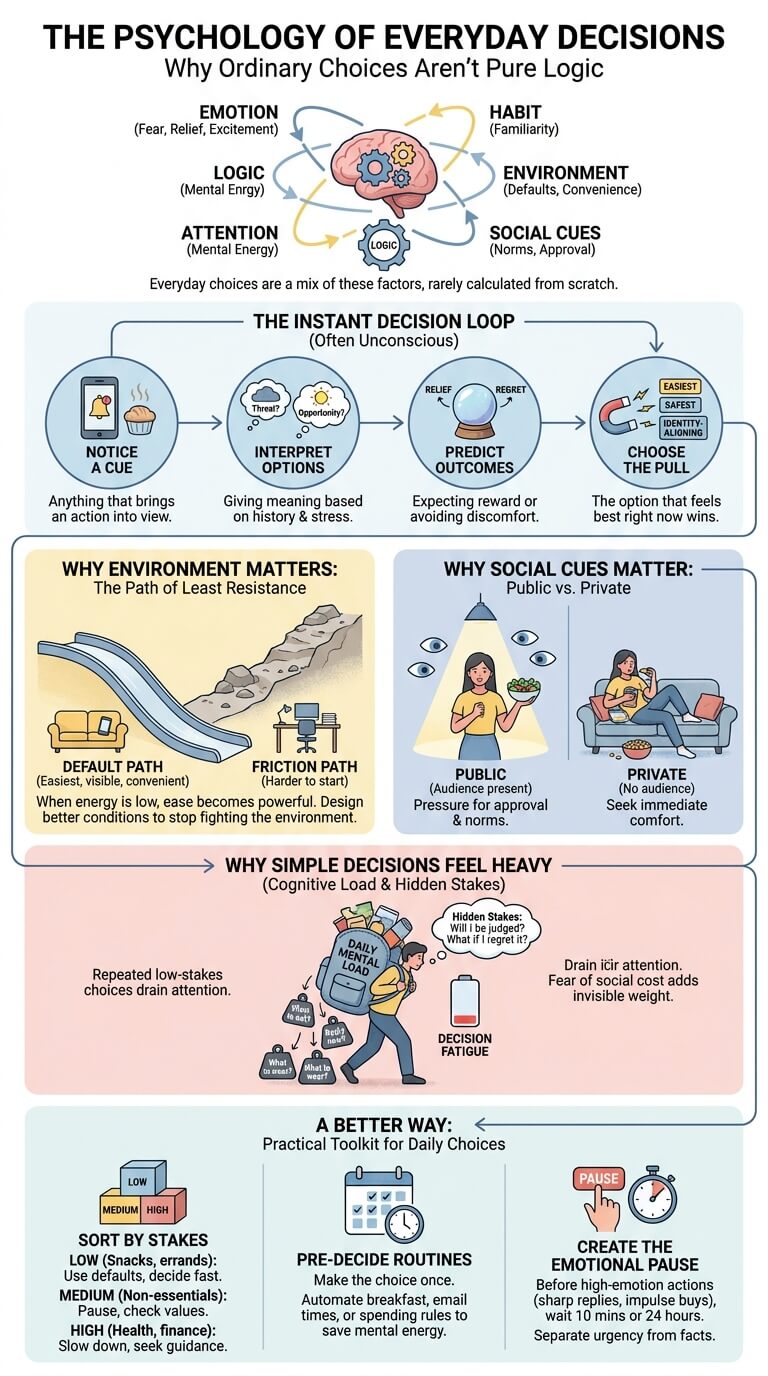
Everyday decisions come from a mix of logic, emotion, habit, attention, bias, social cues, and environment. People usually do not calculate every option from scratch. They notice cues, interpret the situation, predict outcomes, feel the pull of rewards or risks, and often choose the option that feels easiest, safest, most familiar, or most relieving in the moment.
Why Everyday Decisions Are Not Pure Logic
Emotion, attention, memory, habit, and context
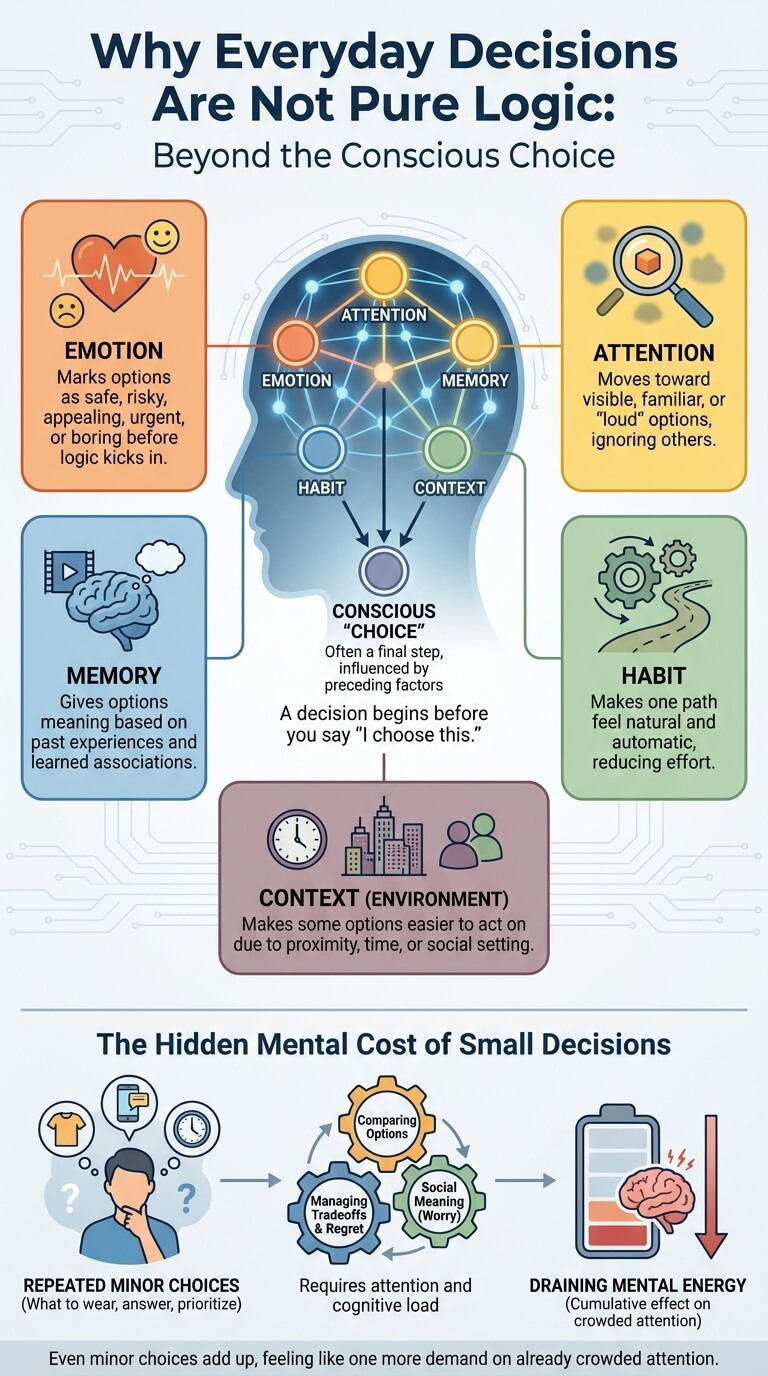
A decision may look like a simple mental choice, but it usually begins before you consciously say, “I choose this.” Your attention moves toward something. A memory gives the option meaning. An emotion marks it as safe, risky, appealing, embarrassing, urgent, or boring. A habit makes one path feel natural. The environment makes one option easier to act on than another. Everyday decisions are part of human behavior psychology.
The APA Dictionary of Psychology defines decision making as the cognitive process of choosing between alternatives. That definition is useful because it reminds us that decisions involve options. But in real life, people do not always notice all available options. The mind often works with the options that are visible, familiar, emotionally loud, or easy enough to choose quickly.
For example, choosing lunch may involve hunger, price, time, memories, stress, what is nearby, and whether colleagues are ordering together. A person may say, “I just picked something,” but the choice came from many small influences working together.
Why small decisions still use mental energy
Small decisions can still feel draining because they require attention. You compare options, imagine outcomes, manage tradeoffs, and sometimes worry about regret. If a decision carries social meaning, such as what to say in a message or whether to decline an invitation, the mental load grows. The choice is no longer just “yes or no.” It becomes, “What will this say about me? How will they react? What happens next?”
People often underestimate the cost of repeated low-stakes decisions. Deciding what to wear, what to answer, what to prioritize, what to ignore, and when to stop adds up. When attention is already crowded, even a minor choice may feel like one more demand.
The Everyday Decision Process
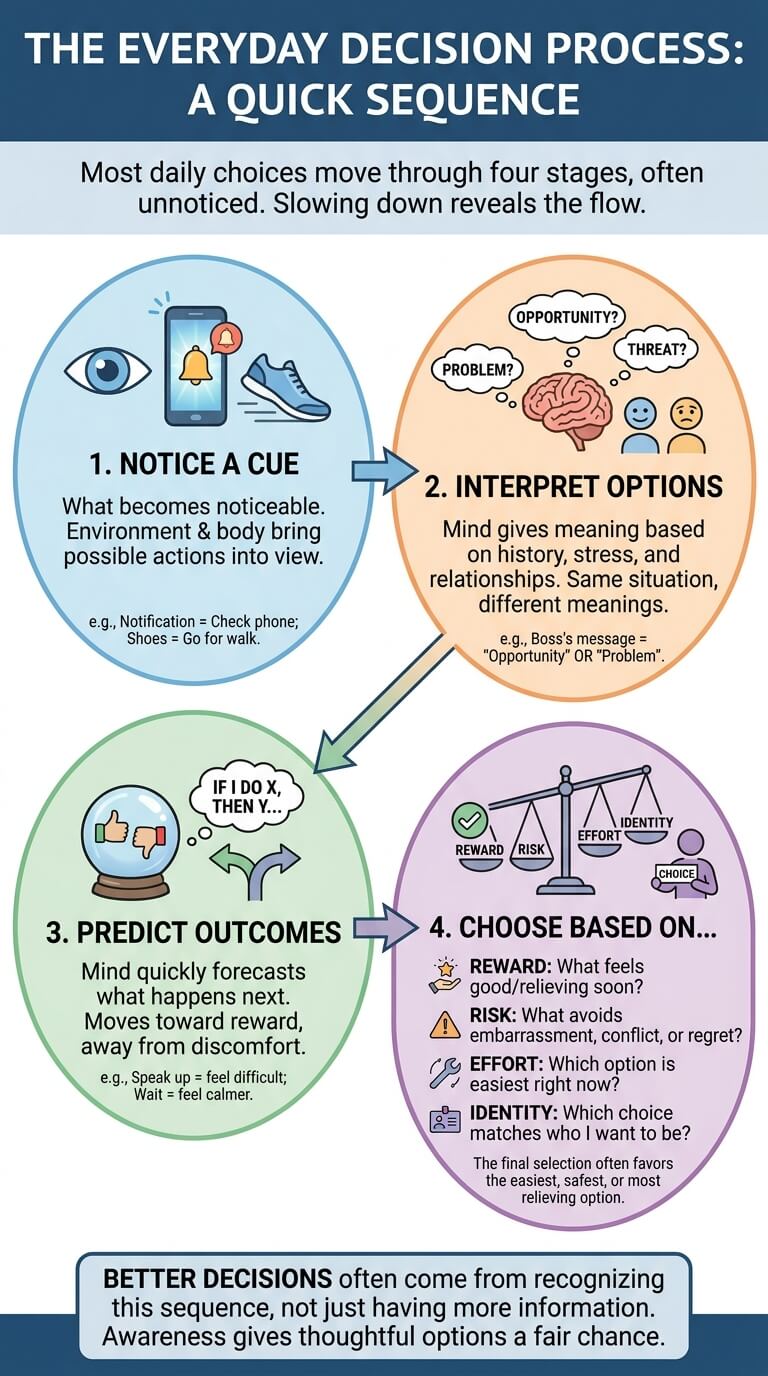
Most daily decisions move through a quick sequence. You may not notice each step, especially when a choice is familiar, but slowing the sequence down makes it easier to understand why you choose what you choose. Interpretation also matters, which is why how thoughts influence behavior can change a choice.
Notice a cue
A cue is anything that brings a possible action into view. A notification invites you to check your phone. A smell from a bakery makes buying a snack more likely. A tense facial expression makes you think about apologizing or defending yourself. A sale sign makes a purchase feel urgent. A messy desk makes starting work feel heavier.
Cues matter because people cannot choose from every possible action at once. The mind responds to what becomes noticeable. If the phone is beside your hand, checking it is more available than taking a quiet breath. If the running shoes are buried in a closet, walking is less available than sitting down. Everyday decisions often start with what the environment and body place in front of your attention.
Interpret options
After a cue appears, the mind gives it meaning. A message from your boss may mean “problem,” “opportunity,” “interruption,” or “I am being watched,” depending on your history, stress level, workload, and relationship with that person. A friend not replying may mean “they are busy” to one person and “they are upset with me” to another.
Interpretation changes the decision. If you interpret a task as manageable, you may begin. If you interpret it as proof that you are behind, you may avoid it. If you interpret a comment as feedback, you may listen. If you interpret it as disrespect, you may argue. The same situation can lead to different choices because people do not experience the situation in the same way.
Predict outcomes
The mind quickly predicts what might happen next. “If I speak up, I might look difficult.” “If I wait, I will feel calmer.” “If I buy this, I will feel better.” “If I start now, I may discover I cannot do it.” These predictions may be accurate, exaggerated, incomplete, or based on old experience.
Predictions influence behavior because people tend to move toward expected reward and away from expected discomfort. A vague sense of dread may delay a task. A quick image of relief may make the easier option feel reasonable.
Choose based on reward, risk, effort, and identity
Many everyday choices come down to four practical questions, even when you do not ask them directly: What feels rewarding? What feels risky? What takes the least effort? What fits the person I think I am or want to be?
| Decision pull | Question the mind may be answering | Everyday example |
|---|---|---|
| Reward | What will feel good or relieving soon? | Opening a delivery app after a stressful day |
| Risk | What might create embarrassment, conflict, loss, or regret? | Not asking a question in a meeting |
| Effort | Which option is easiest right now? | Choosing the default setting instead of changing it |
| Identity | Which choice matches the kind of person I believe I am? | Keeping a promise because reliability matters to you |
This is why better decisions are not always about having more information. Sometimes the issue is that the easiest, safest, or most relieving option wins before the more thoughtful option has a fair chance.
How Emotion Shapes Choices
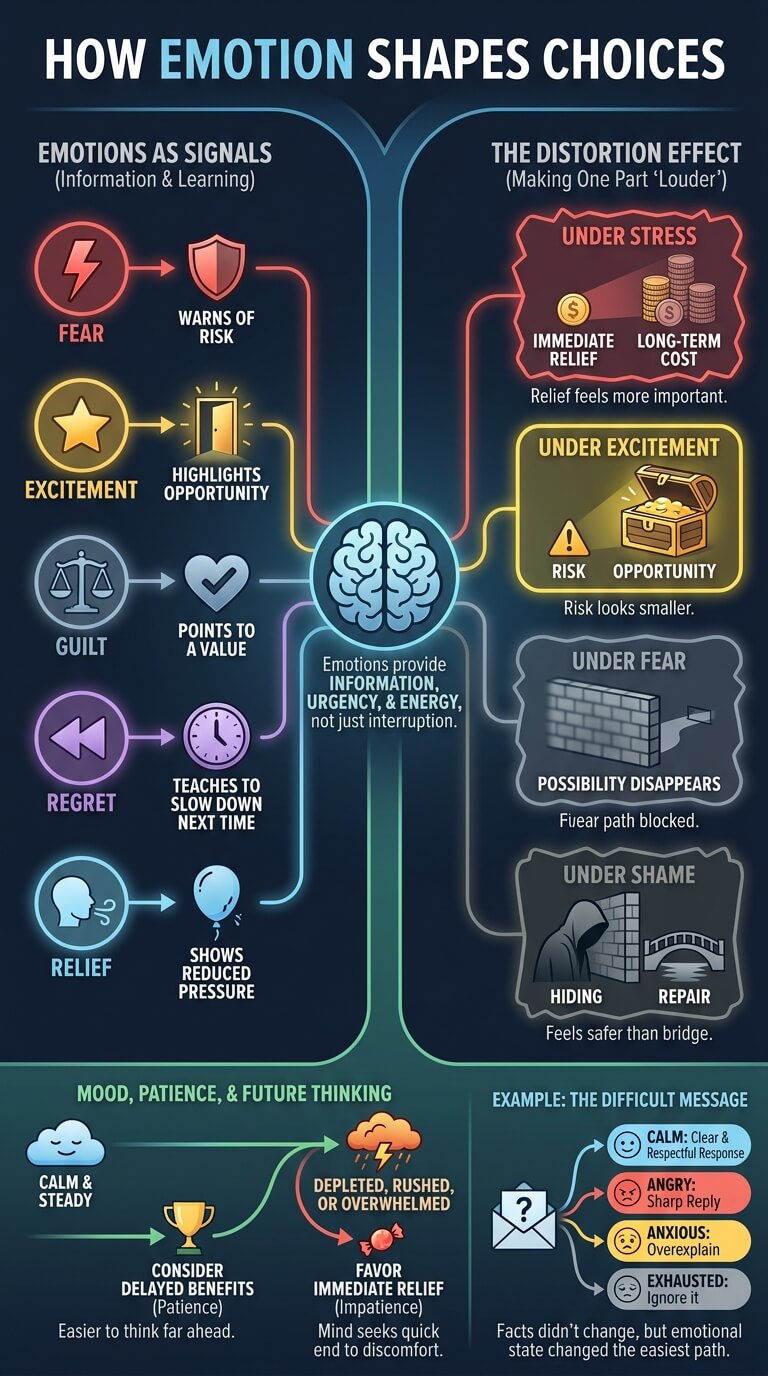
Stress, relief, fear, excitement, and regret
Emotions do not simply interrupt decisions. They provide information, urgency, and energy. Fear may warn you about risk. Excitement may highlight opportunity. Guilt may point to a value. Regret may teach you to slow down next time. Relief may show that a decision reduced pressure. When relief now creates a larger cost later, the choice may involve acting against your own interests.
The difficulty is that emotions can make one part of the situation louder than the rest. Under stress, relief may feel more important than long-term cost. Under excitement, risk may look smaller. Under fear, possibility may disappear. Under shame, hiding may feel safer than repair. A review in PubMed Central on stress and decision making describes stress effects as complex, not a simple shift toward one kind of choice in every situation.
This nuance matters. Stress does not always make people choose badly, and calm does not guarantee wisdom. But emotion often changes what you notice, what you avoid, and how quickly you want discomfort to end.
Why mood can change risk and patience
Your mood can change how far into the future you are willing to think. When you feel calm and steady, it is often easier to consider delayed benefits. When you feel depleted, rejected, rushed, or overwhelmed, the mind may favor immediate relief. That is why a choice you would make in the morning may look different at 11 p.m.
Imagine deciding whether to reply to a difficult message. When calm, you may choose a clear and respectful response. When angry, you may want to send a sharp reply. When anxious, you may overexplain. When exhausted, you may ignore it. The facts have not changed much, but your emotional state has changed the path that feels easiest.
How Cognitive Biases Shape Decisions
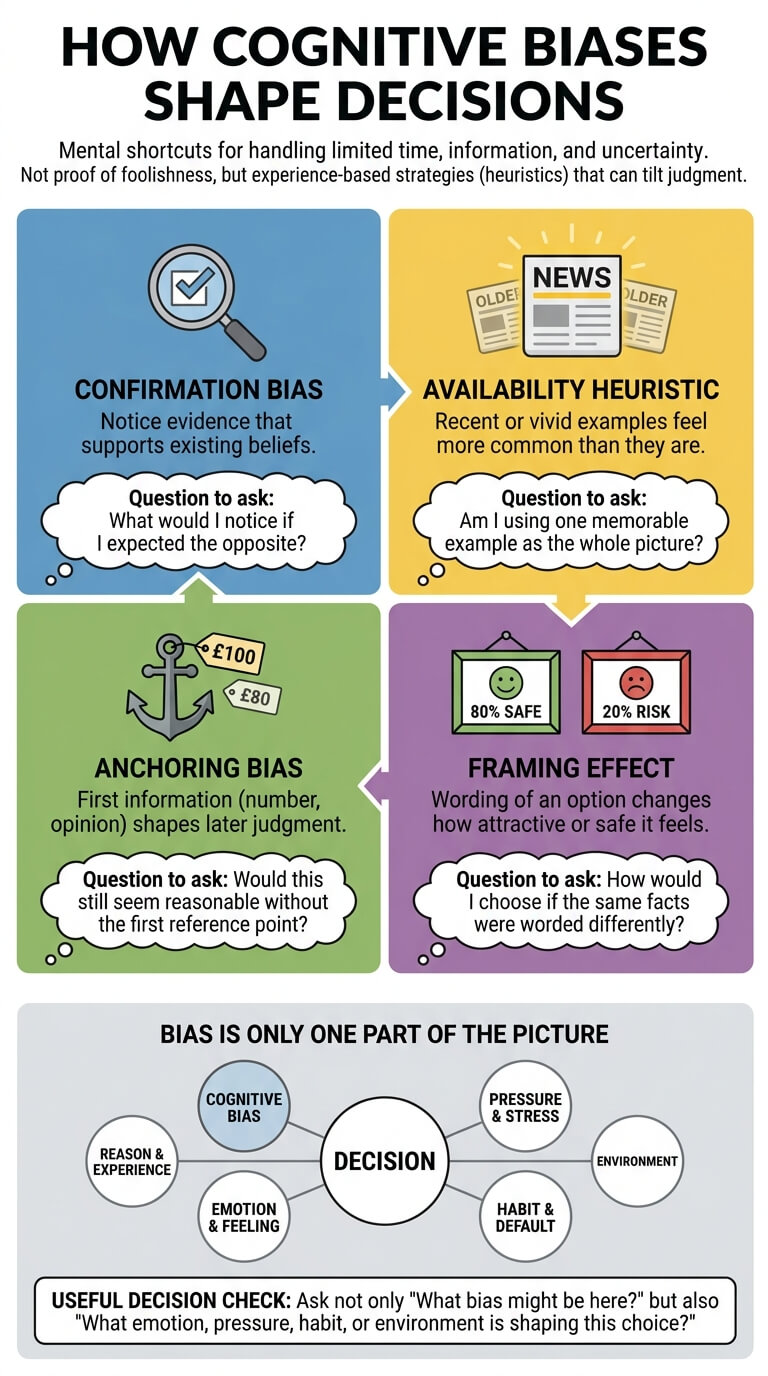
Confirmation, availability, anchoring, and framing
Cognitive biases are mental shortcuts that can influence judgment. They are not proof that someone is foolish. They are part of how the mind handles limited time, limited information, and uncertainty. A shortcut may help you decide quickly, but it may also tilt the decision. Some daily choices are influenced by cognitive biases.
The APA Dictionary of Psychology describes a heuristic as an experience-based strategy for solving a problem or making a decision efficiently, though it does not guarantee a correct answer. In everyday decisions, heuristics often show up as “I have seen this before,” “This feels familiar,” “People like me choose this,” or “The first price I saw is my reference point.”
| Bias or shortcut | How it may show up | Question to ask |
|---|---|---|
| Confirmation bias | You notice evidence that supports what you already believe. | What would I notice if I expected the opposite? |
| Availability | A recent or vivid example feels more common than it is. | Am I using one memorable example as the whole picture? |
| Anchoring | The first number, opinion, or option shapes later judgment. | Would this still seem reasonable without the first reference point? |
| Framing | The wording of an option changes how safe or attractive it feels. | How would I choose if the same facts were worded differently? |
Bias as one part of decision-making
Bias is important, but it is not the whole story. A person may choose something because of bias, but also because they are tired, pressured, avoiding conflict, following a group norm, seeking comfort, or responding to a default. If every decision is explained only as bias, the explanation becomes too narrow.
A PubMed Central review on decision-making heuristics and biases discusses judgment and decision-making as involving deliberative, experiential, and affective processes. Put simply, people use reason, experience, and feeling together. A useful decision check asks not only “What bias might be here?” but also “What emotion, pressure, habit, or environment is shaping this choice?”
How Environment Shapes Decisions
Defaults, friction, visibility, and convenience
The environment quietly organizes your choices. Defaults suggest what happens if you do nothing. Friction makes some options harder. Visibility makes some options come to mind first. Convenience lowers the effort required to act. A person may feel as if they freely chose the easiest path, but the path was often made easy before the decision began. Many choices are partly shaped by how environment shapes behavior.
Think about digital settings, grocery store layouts, app notifications, streaming autoplay, food placed at eye level, or a form with a preselected option. These details influence attention and effort. They do not remove choice, but they change the cost of each choice. A choice that requires one tap competes differently than a choice that requires searching, logging in, reading fine print, and waiting.
Why the easiest option often wins
The easiest option often wins because people are not deciding in perfect conditions. They decide while hungry, busy, tired, distracted, hopeful, annoyed, or responsible for several things at once. When mental energy is limited, ease becomes powerful.
Research on choice design often studies how the arrangement of options affects behavior. A PubMed Central meta-analysis of choice architecture interventions found that changes in how choices are presented can influence behavior across many settings, though effects vary by context. For daily life, the practical lesson is simple: make the choice you want easier to notice and easier to start.
If you want to drink more water, put water where your hand reaches first. If you want to stop checking your phone during work, move the phone out of reach. If you want to spend less impulsively, remove saved payment details. These are not tricks. They are ways to stop asking willpower to fight a poorly designed environment all day.
How Social Cues Shape Decisions
Social proof, norms, comparison, and approval
People often decide in relation to other people. What others buy, praise, criticize, avoid, recommend, or normalize can change what feels reasonable. Social proof says, “If many people are doing this, it may be safe or valuable.” Norms say, “This is what people like us do.” Comparison says, “Where do I stand?” Approval says, “Will I still belong if I choose differently?” Daily choices are also shaped by social influence.
This does not mean people are weak for being influenced. Humans are social. Paying attention to others can help us learn, cooperate, and avoid unnecessary mistakes. The problem appears when social cues override personal needs, values, or facts. You may agree to a plan you do not want, buy something because others seem impressed, or stay silent because no one else is objecting.
Why people decide differently in public and private
Public decisions carry an audience. Even when no one is judging harshly, the possibility of being seen can change the choice. A person may eat differently with friends than alone, speak differently in a meeting than in a private message, or choose a more expensive option because status is part of the moment.
Private decisions reduce some social pressure but may increase other pressures. Without an audience, immediate comfort may become louder. A person who chooses carefully in public may scroll, snack, avoid, or overspend privately because the social cost is lower. Understanding this difference helps you ask, “What changes when someone is watching?” and “What changes when no one is?”
Why Simple Decisions Feel Hard
Cognitive load and decision fatigue
A simple decision can feel hard when your mind is already carrying too much. Cognitive load includes the mental work of remembering, comparing, planning, filtering, worrying, and switching tasks. When the load is high, the mind looks for shortcuts. You may delay the decision, choose the default, copy someone else, or pick whatever ends the discomfort fastest.
During the pandemic, the American Psychological Association reported that many adults found both day-to-day decisions and major life decisions more stressful than before. The context was unusual, but the point applies more broadly: when uncertainty and stress increase, ordinary decisions may start to feel heavier.
Decision fatigue is not a formal excuse for every poor choice. It is a useful way to notice when your decision system is overloaded. If you are repeatedly choosing impulsively late in the day, avoiding basic choices, or feeling irritated by options that normally seem manageable, your problem may be overload rather than laziness.
When ordinary choices carry hidden stakes
Some simple decisions feel hard because they are not simple emotionally. Choosing a restaurant may carry fear of disappointing others. Replying to a message may carry fear of conflict. Buying something may carry guilt about money. Saying no may carry anxiety about being seen as selfish. Starting a task may carry fear of finding out you are not ready.
When a small choice feels too large, ask what hidden stake is attached to it. The visible decision might be “Should I go?” The hidden decision might be “Will I still be liked if I say no?” The visible decision might be “Should I start this?” The hidden decision might be “Can I tolerate feeling imperfect?” Naming the hidden stake often reduces confusion.
A Better Way to Make Everyday Decisions
Sort decisions by stakes
Not every decision deserves the same amount of thought. One of the simplest improvements is to sort choices by stakes. Low-stakes decisions need speed and good-enough standards. Medium-stakes decisions need a little reflection. High-stakes decisions need time, reliable information, and sometimes professional advice.
| Decision type | Examples | Useful approach |
|---|---|---|
| Low-stakes | What to wear, what snack to choose, which minor errand to do first | Use a default or time limit |
| Medium-stakes | Whether to accept an invitation, buy a nonessential item, raise a concern | Pause, check values, consider the next consequence |
| High-stakes | Medical, legal, major financial, safety, or long-term life decisions | Slow down, gather facts, seek qualified guidance |
This sorting prevents overthinking small choices and underthinking important ones. Many people do the reverse, spending too much energy on minor choices and making larger choices when tired or rushed.
Pre-decide low-stakes choices
Pre-deciding means making a choice once so you do not have to remake it every day. You might choose a standard breakfast for weekdays, a default time to answer email, a spending rule for nonessential purchases, a phone-free place in the house, or a simple rule for when to say, “Let me check and get back to you.”
Pre-decisions reduce mental clutter. They also protect you from emotional moments. If you already decided not to shop online after 10 p.m., you do not need to negotiate with stress, boredom, and ads at the same time. The rule does some of the work for you.
Use a facts, feelings, and future check
For medium-stakes decisions, try a three-part check. Facts: What do I actually know? Feelings: What emotion is loud right now? Future: How will this choice likely feel tomorrow, next week, or after the immediate emotion passes?
This check helps separate information from urgency. It does not tell you to ignore emotion. It gives emotion a place without letting it run the whole decision. A feeling may be valid and still not be the best driver of the next action.
Create a pause before high-emotion choices
Some decisions are most vulnerable when emotion is high. Sending a sharp reply, making an impulsive purchase, quitting a task, agreeing out of guilt, or avoiding a conversation may all feel right for a short moment. A pause creates space between the feeling and the action.
A useful pause is specific: wait ten minutes before sending, leave the item in the cart for 24 hours, draft the message without sending it, take a short walk before deciding, or ask for time instead of answering immediately. The pause is not avoidance if you return to the decision. It is a way to choose with more of your mind available.
Common Mistakes That Make Decisions Harder
Trying to optimize every choice
Optimization sounds responsible, but using it everywhere is exhausting. Not every choice needs the best possible answer. Many daily decisions only need an answer that is good enough, reversible, and aligned with your basic needs. Saving your deepest thinking for everything leaves less energy for what truly matters.
Deciding while flooded by feeling
Strong emotion narrows attention. If a decision does not need to happen immediately, waiting may improve the quality of the choice. This is especially true for replies, purchases, commitments, and conversations that could create lasting consequences. Calm does not guarantee the perfect answer, but it often gives you more options.
Ignoring the default path
People often blame themselves for choices their environment keeps inviting. If the default path is to scroll, snack, spend, delay, or agree too quickly, the better question is not only “Why do I keep doing this?” It is also “What path has my environment made easiest?” Change the path, and the decision may change with less inner conflict.
Asking for advice before knowing your own criteria
Advice helps more when you know what matters to you. Without criteria, every opinion can pull you in a different direction. Before asking others, write down the two or three things the decision must protect. It might be time, money, health, honesty, peace, learning, safety, or relationship trust. Then advice becomes input, not a substitute for your own judgment.
Everyday Decision Examples
| Situation | What may be shaping the choice | A clearer next step |
|---|---|---|
| You keep delaying a small task | The task feels vague, boring, or tied to fear of doing it badly. | Define the first visible action and do it for two minutes. |
| You buy something after a stressful day | The purchase promises relief, reward, or a sense of control. | Wait 24 hours and ask what feeling the purchase is trying to change. |
| You say yes too quickly | Approval, guilt, or fear of awkwardness is louder than your capacity. | Use a delay phrase: “Let me check my schedule first.” |
| You choose the same meal every day | Familiarity reduces effort and uncertainty. | Keep the default if it works, or preselect one simple variation. |
| You avoid replying to a message | The hidden stake may be conflict, rejection, or not knowing the right tone. | Draft one honest sentence before deciding whether to send now. |
What To Do Next
Pick one daily decision that keeps frustrating you. Do not start with the biggest decision in your life. Choose something ordinary enough to study: phone checking, food choices, spending, replying, delaying tasks, saying yes, or deciding what to do first.
Then trace the sequence: What cue starts it? What emotion is present? What option looks easiest? What reward is expected? What social pressure or default path matters? What would make the better choice easier by one step? This turns decision-making from a mystery into a pattern you can adjust.
If decisions feel impossible because of panic, depression, trauma symptoms, compulsions, substance use, self-harm thoughts, or a controlling or unsafe relationship, the next step is not to optimize your decision system alone. It is to seek appropriate support from a qualified professional or emergency resource in your area.
FAQ
Why do I make different decisions when I am tired?
Tiredness reduces patience, attention, and willingness to compare options carefully. When energy is low, the mind often favors convenience, relief, habit, or the default path. That does not mean every tired choice is wrong. It means important decisions deserve better conditions whenever possible.
Are emotions bad for decision-making?
No. Emotions can give useful information about risk, values, attraction, discomfort, and urgency. Problems arise when one emotion becomes so loud that it blocks facts, long-term consequences, or other options. A better goal is not emotion-free decision-making, but emotion-aware decision-making.
Why do I overthink small decisions?
Small decisions often become heavy when they carry hidden stakes. You may be worried about regret, judgment, disappointing someone, wasting money, or making the “wrong” choice. Sorting decisions by stakes can help. Low-stakes choices usually need a time limit or default, not endless analysis.
How can I make better daily decisions without becoming rigid?
Use flexible rules instead of harsh rules. For example, “I wait before impulse purchases at night” is more useful than “I never buy anything extra.” A flexible rule lowers repeated mental effort while still allowing judgment when the situation truly changes.
When should I ask someone else for help with a decision?
Ask for help when the decision is high-stakes, when you lack expertise, when strong emotion is narrowing your view, or when your safety, health, money, legal situation, or long-term wellbeing could be affected. Advice works best when you also know your own values and limits.
Key Takeaways
- Everyday decisions are shaped by logic, emotion, attention, habit, environment, bias, and social context.
- Small choices may feel hard when they carry hidden stakes such as approval, regret, conflict, or uncertainty.
- Cognitive shortcuts help people decide quickly, but they may also tilt choices toward familiar or vivid information.
- Environment matters because defaults, visibility, friction, and convenience change which options feel easy.
- Better daily decisions often come from sorting choices by stakes, pre-deciding low-stakes routines, and pausing before high-emotion actions.
- High-stakes decisions involving health, safety, money, law, or serious distress deserve more time and qualified support.
Final Thoughts
Everyday decisions are not random, and they are not pure willpower tests. They are small moments where your mind, mood, body, habits, surroundings, social world, and predictions meet. The practical next step is not to judge every choice after the fact. It is to study one repeated decision and change the conditions around it.
Start with one choice you make often. Make the better option easier to see, easier to start, and less dependent on a perfect mood. When the decision matters more, slow down and give yourself better information, more time, and the right kind of support.

Michael Reed is the Founder and Lead Writer at Psychology Exposed. He writes about human behavior, relationships, emotional patterns, self-awareness, and practical psychology topics using research-informed, easy-to-understand content.
Read More About Michael Reed: https://psychologyexposed.com/michael-reed/