

Chronic stress is not just a busy week, a hard conversation, or one tense deadline. It is what can happen when pressure stays active for so long that your body and mind begin treating stress as the default setting. You may still be functioning, answering messages, caring for people, working, paying bills, but inside you feel wired, depleted, irritable, foggy, or physically worn down.
The confusing part is that chronic stress often builds quietly. It may not arrive as one dramatic event. It can come from months of uncertainty, caregiving, financial strain, conflict, health concerns, work pressure, loneliness, or too many responsibilities with too little recovery. Over time, stress stops feeling like a response and starts feeling like the atmosphere you live in.
This guide explains chronic stress psychology in practical terms: what it means, why duration matters, what signs to watch for, and what first steps can reduce the load. It is educational, not a diagnosis. If stress is affecting your health, sleep, safety, or ability to function, support can matter.
Quick Answer

Chronic stress is a prolonged physical and psychological stress response that continues because demands, threat, uncertainty, or pressure keep returning without enough recovery. The APA Dictionary of Psychology defines chronic stress as a response to a prolonged stressful event, and that response can continue even when the stressor is remembered rather than physically present.
Chronic stress is easier to understand after looking at stress psychology more broadly, because long-term stress is not just a stronger version of one bad day.
Chronic stress in plain English
In plain English, chronic stress means your system has been carrying pressure for too long. The stress may come from one major issue, many smaller pressures, or a situation that never feels fully resolved. You may not feel panicked every minute, but your body may still be preparing, bracing, scanning, or compensating.
People often notice chronic stress as a shift in baseline: “I am always tired but cannot relax,” “I snap over small things,” or “I do not feel like myself.” These are not proof of one condition, but they are useful signals that the current load may be larger than the recovery available.
Why duration and recovery matter
Short-term stress is not automatically harmful. It can help you respond quickly, focus attention, and mobilize energy. The problem begins when stress activation repeats or stays turned on without enough return to rest, connection, movement, sleep, safety, or relief.
Duration changes the meaning of stress. A ten-minute surge before a presentation is different from months of waking up already tense. Chronic stress is less about one spike and more about repeated activation plus recovery debt.
What Chronic Stress Means
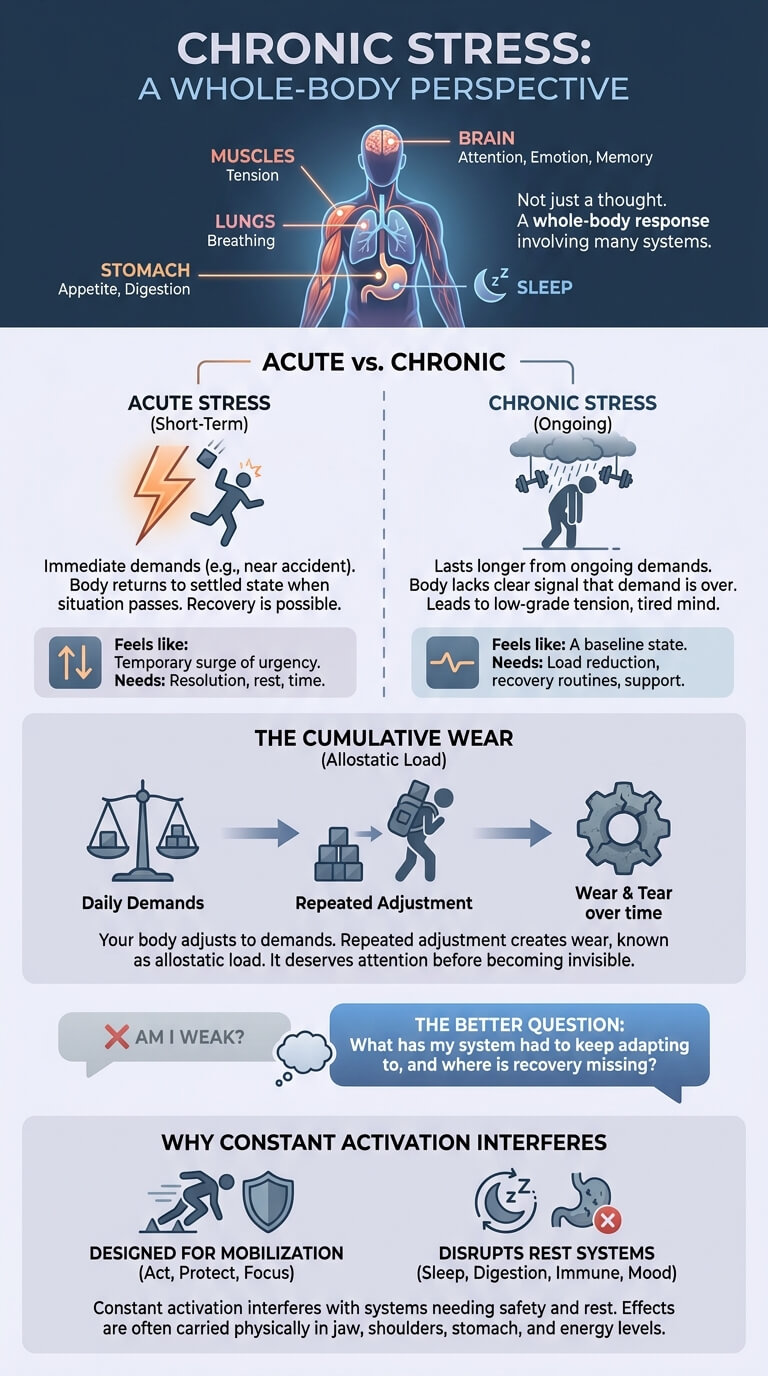
Stress is a whole-body response, not only a thought. It involves attention, emotion, muscle tension, breathing, sleep, memory, appetite, and behavior. When stress lasts, adaptation has a cost.
Acute stress vs chronic stress
Acute stress is short-term. It appears when something immediate requires attention, such as a near accident, an urgent task, a difficult phone call, or a conflict. When the situation passes and recovery is possible, the body can return toward a more settled state.
Chronic stress lasts longer. It may come from ongoing demands or repeated reminders of a stressful event. The body may not get a clear signal that the demand is over. The result may be low-grade tension, vigilance, reduced patience, or a tired mind that cannot switch off.
| Type of stress | What it often feels like | What recovery usually needs |
|---|---|---|
| Acute stress | A temporary surge of alertness, urgency, or fear | Resolution, rest, reassurance, and time to settle |
| Repeated stress | Pressure that keeps returning in waves | Predictable breaks, problem-solving, boundaries, and support |
| Chronic stress | Stress that feels like a baseline rather than an event | Load reduction, recovery routines, medical or mental health support when needed, and changes to repeated demands |
Stress load and allostatic load
A useful way to understand chronic stress is the idea of load. Your body keeps adjusting to demands. That adjustment helps in the short term, but repeated adjustment can create wear over time. Researchers often discuss this through allostatic load, a concept used to study the cumulative wear and tear connected with chronic stress.
This does not mean one stressful season will ruin your health. It means repeated stress deserves attention before it becomes invisible. The question is not “Am I weak?” The better question is, “What has my system had to keep adapting to, and where is recovery missing?”
Why the body is not built for constant activation
Your stress response is designed for mobilization. It helps you act, protect, focus, and respond. But constant activation can interfere with systems that need safety and rest, including sleep, digestion, immune function, mood, and memory. Mayo Clinic explains that long-term activation of the stress response system can disrupt many body processes.
That is why chronic stress can feel both mental and physical. You may think you are “just stressed,” but your body may be carrying the effects in your jaw, shoulders, stomach, sleep, heart rate, appetite, or energy. Chronic stress psychology is about seeing the whole system, not blaming yourself for every symptom.
Why Chronic Stress Builds Slowly

Many people do not recognize chronic stress at first because each individual demand seems manageable. One more bill, deadline, family issue, poor night of sleep, or tense conversation. The problem is accumulation.
Repeated activation can also contribute to nervous system dysregulation when the body rarely gets a full return to baseline.
Repeated demands without recovery
Stress becomes more draining when demands repeat faster than you can recover. A difficult day can be repaired by rest, support, movement, or a sense that tomorrow will be easier. But when tomorrow brings the same pressure again, the system begins to budget energy differently.
You may become more efficient but less present. You may stop noticing hunger, fatigue, loneliness, or sadness because the next task feels more urgent. Over time, the body learns that slowing down is unsafe, inconvenient, or impossible.
Uncertainty and lack of control
Uncertainty is especially stressful because the mind keeps trying to prepare. Waiting for test results, worrying about job security, managing unpredictable conflict, or living with unstable finances can keep attention locked on “what if” questions. Even when nothing is happening in the moment, the system may keep rehearsing possible outcomes.
Lack of control adds another layer. If you cannot predict what will happen or cannot take a clean break from it, stress may remain active in the background. This is one reason chronic stress can feel exhausting even when you are not physically doing much.
Caregiving, work, money, conflict, or health pressure
Chronic stress often grows from ordinary life roles, not personal failure. A caregiver may feel love and exhaustion at the same time. A person under financial pressure may seem calm while constantly calculating risk. Someone in long-term conflict may monitor tone, timing, and possible reactions.
Health pressure can also become chronic. Pain, medical appointments, uncertainty, and lifestyle changes can create steady demand. Work can be another source, but chronic stress is not only a work problem. It can come from one life domain or several at once.
Normalizing stress until it feels invisible
One of the most common signs of chronic stress is that it stops looking unusual. You may stop saying you are stressed because there is no contrast anymore. You may describe yourself as “bad at relaxing,” “always behind,” “just tired,” or “not good with people lately.”
When stress becomes normal, you may lower your expectations for how you should feel. Recognition matters because invisible load is hard to reduce. Naming the load does not fix everything, but it makes the next step clearer.
Common Signs of Chronic Stress
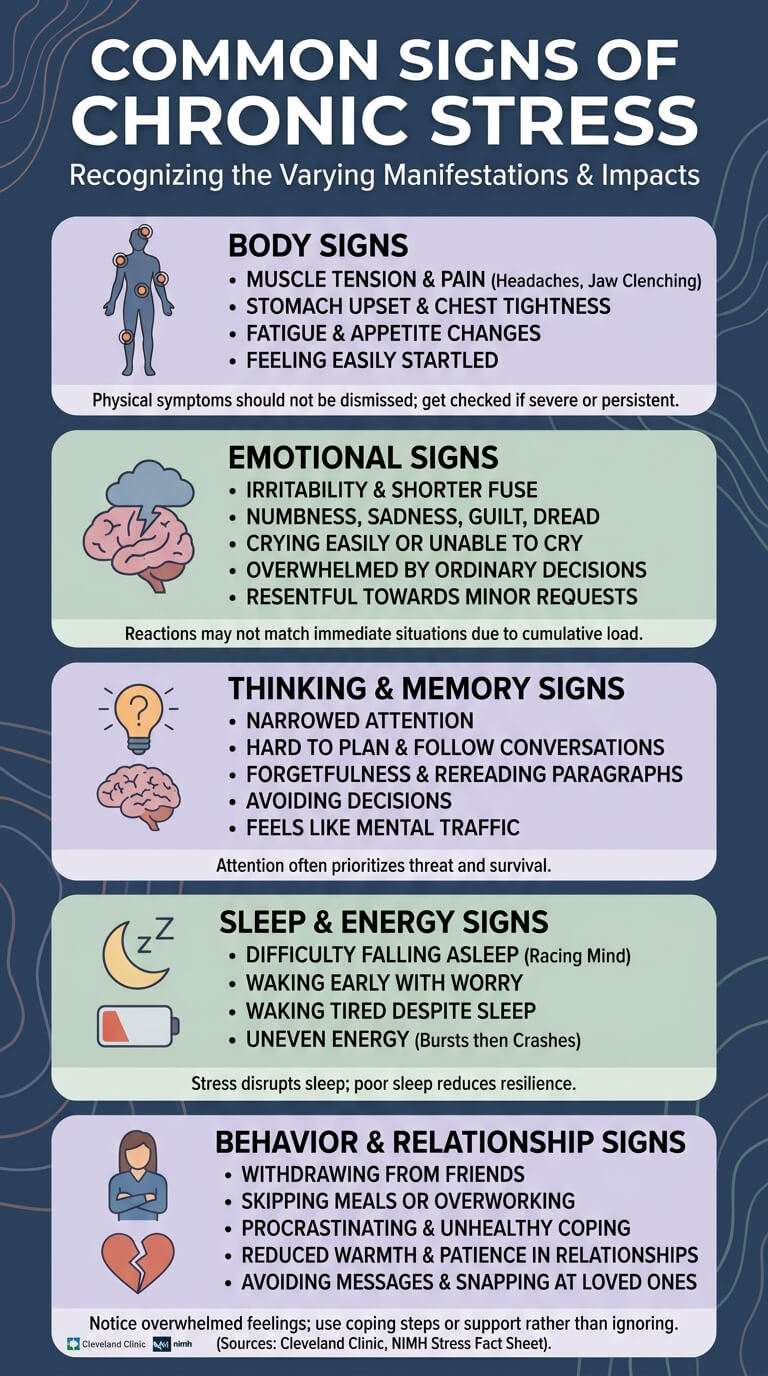
Chronic stress signs vary from person to person. Some people become more activated and restless. Others become flat, tired, or detached. Some feel both: wired at night, exhausted in the morning, impatient by afternoon, and guilty by evening.
Over time, how stress affects the brain matters because focus, memory, and decision-making can stay under pressure for long periods.
Body signs
Body signs can include muscle tension, headaches, jaw clenching, stomach upset, chest tightness, fatigue, appetite changes, or feeling easily startled. Cleveland Clinic describes stress as a reaction that can create physical, emotional, and behavioral responses throughout the body.
Physical symptoms should not be dismissed as “just stress,” especially if they are new, severe, persistent, or frightening. Stress may contribute to symptoms, but symptoms can also have medical causes. When in doubt, getting checked is a responsible step, not an overreaction.
Emotional signs
Emotionally, chronic stress may show up as irritability, numbness, sadness, guilt, dread, or a shorter fuse. You may cry more easily or feel unable to cry at all. You may feel overwhelmed by ordinary decisions or resentful when someone asks for something small.
These reactions can be confusing because they may not match the immediate situation. A minor inconvenience may trigger a major reaction because it lands on top of months of load and very little spare capacity.
Thinking and memory signs
Chronic stress can narrow attention. You may find it harder to plan, remember names, follow conversations, or finish tasks that used to be simple. You may reread the same paragraph, forget why you entered a room, or avoid decisions because every option feels heavy.
This does not mean your mind is broken. Under stress, attention often prioritizes threat, urgency, and immediate survival tasks. From the outside it may look like carelessness, but inside it may feel like mental traffic.
Sleep and energy signs
Sleep changes are common. Some people cannot fall asleep because their mind keeps running. Others wake early with a surge of worry. Some sleep more but still wake tired. Energy may become uneven, with short bursts of productivity followed by crashes.
Sleep problems can also make stress worse. A tired brain has less capacity for patience, planning, emotional flexibility, and problem-solving. Stress disrupts sleep, poor sleep reduces resilience, and the next day feels harder.
Behavior and relationship signs
Behavioral signs may include withdrawing from friends, skipping meals, overworking, procrastinating, scrolling longer than intended, using alcohol or substances to unwind, avoiding messages, or snapping at people you care about. The NIMH stress fact sheet encourages people to notice when stress or anxiety feels overwhelming and to use coping steps or support rather than ignoring it.
In relationships, chronic stress can reduce warmth. You may still care deeply, but have less patience for questions, noise, affection, or negotiation because your system is already carrying too much.
Chronic Stress vs Burnout

Chronic stress and burnout overlap, but they are not identical. Chronic stress describes prolonged stress load. Burnout is usually tied more closely to persistent work-related or role-related depletion, often involving exhaustion, cynicism, and reduced effectiveness.
When long-term stress is tied closely to work, motivation, cynicism, and reduced effectiveness, it may be useful to compare burnout vs stress.
Life-wide load vs work-related depletion
Chronic stress can come from life as a whole. It may involve family, finances, health, caregiving, conflict, social pressure, uncertainty, or many small demands. Burnout often points to a more specific pattern of prolonged demand in work or caregiving roles, especially when effort no longer feels meaningful or effective.
For example, chronic stress may come from debt, childcare, a sick parent, and poor sleep. Burnout may come from a role that demands constant output with little control, recognition, or recovery.
When stress becomes cynicism and reduced effectiveness
One clue that burnout may be part of the picture is a shift from pressure to emotional distance. The person may feel exhausted, detached, cynical, or ineffective in a role they once cared about. Chronic stress can make someone tired and reactive, but burnout often includes a deeper loss of connection to the role itself.
This distinction matters because the solution may differ. Chronic stress often requires load mapping across life. Burnout may require changes to role demands, recovery, meaning, boundaries, or work conditions.
Why burnout gets its own comparison
Burnout deserves separate attention because it is not just “more stress.” It has its own emotional tone and its own practical questions: Is this role still sustainable? Is there enough control? Is there enough recovery? Has the person become detached as a way to survive the role?
The main point is simple: chronic stress can happen anywhere pressure persists. Burnout is one possible outcome, especially when chronic demand is tied to work, caregiving, or responsibility without relief.
Chronic Stress vs Nervous System Dysregulation
Another nearby idea is nervous system dysregulation. The two are related, but they describe different angles. Chronic stress focuses on duration and load. Dysregulation focuses on how the system shifts into states that feel too activated, too shut down, or hard to move out of.
Load over time vs stuck state patterns
Think of chronic stress as the weight you have been carrying. Think of dysregulation as what happens when the system struggles to return to a workable state. Chronic stress may increase the chance of dysregulation, but a person can also feel dysregulated after a short intense event.
A person under chronic stress may become more easily startled, irritable, or numb over time. That does not mean something is permanently wrong. It may mean the system has had too many demands and too few chances to reset.
How chronic stress can increase dysregulation risk
When recovery is scarce, the body may become quicker to react and slower to settle. A small delay, tone change, bill, message, or criticism can feel bigger than it is because the system is already near capacity. This is why chronic stress can make everyday life feel sharper, louder, or more threatening.
Reducing chronic load is not the same as forcing calm. It often means reducing repeated demands where possible, adding reliable recovery, and learning which signs tell you that your system is nearing its limit.
How Chronic Stress Can Affect Daily Decisions
Chronic stress changes how decisions feel. A choice that once felt ordinary can become draining. A small request can feel like a threat to your remaining energy. A delay can feel like danger. These shifts can affect behavior long before a person understands why.
Shorter patience
When stress is high, patience becomes expensive. You may interrupt, answer sharply, rush people, or feel annoyed by normal needs. This does not make you a bad person, but it does signal that your emotional margin may be thin.
A useful repair is to name the capacity issue without blaming the other person: “I am overloaded and I am getting short. I need ten minutes before I answer this properly.” That sentence does not erase responsibility, but it creates a pause before stress becomes harm.
Narrower attention
Stress narrows attention toward urgency. You may focus on the one thing that feels most dangerous and miss context, options, or support. This can make decisions feel binary: quit or endure, say yes or lose approval, fix everything tonight or fail.
When attention narrows, write the decision down. Then sort it into three columns: urgent, important, and can wait. This helps the brain stop treating every demand as equal.
More avoidance or urgency
Chronic stress can pull people in opposite directions. Some avoid tasks because they feel too heavy. Others become urgent and controlling because slowing down feels unsafe. Both reactions are attempts to manage load.
Neither avoidance nor urgency is a character flaw. Ask: “What would reduce the load by five percent this week?” The answer may be one phone call, one boundary, one appointment, one honest conversation, or one task removed.
First Steps to Reduce Chronic Stress Load

The first step is not to redesign your whole life overnight. Chronic stress often builds through repetition, so early recovery also needs repetition. Small load changes usually work better than dramatic plans that collapse under pressure.
Identify the biggest repeat stressor
Start by identifying the pressure that repeats most often. Not the most dramatic stressor, but the one that keeps costing energy. It might be morning chaos, constant notifications, caregiving gaps, unclear expectations at work, money avoidance, conflict at home, or sleep disruption.
Ask: “What problem keeps reappearing every week?” Then ask: “What part of this is within my influence, even if the whole problem is not?” Chronic stress becomes less blurry when you map repeated demand instead of judging yourself for being tired.
Add recovery before adding goals
Many stressed people respond by adding goals: better fitness, better productivity, better routines, better attitude. Goals can help, but they can also become another demand. Recovery needs to come first.
Recovery does not have to be a full day off. It can be a quiet meal, a walk without multitasking, a phone-free hour, a calmer bedtime routine, a supportive conversation, or permission to stop solving problems for a short time. The key is that the body receives a real signal that it can stand down.
Reduce unnecessary demand where possible
Some demands cannot be removed. Others can be simplified, delayed, delegated, automated, or made less perfect. Chronic stress often improves when people stop treating every task as equally necessary.
Try sorting demands into four groups: must do, can delay, can simplify, can ask for help with. This is not laziness. It is nervous system budgeting. When capacity is limited, choosing what not to carry is part of health.
Choose one support or boundary step
Support might mean telling a friend what is actually happening, asking a family member for a specific task, talking with a manager about workload, scheduling a medical appointment, or working with a counselor. A boundary might mean limiting a recurring demand, refusing a nonessential request, or creating a predictable time when you are not available.
Keep the first step concrete. “I need support” is true, but vague. “Can you handle dinner on Tuesdays for the next month?” is easier to act on. “I will not check work messages after 8 p.m. twice this week” gives the system a clearer break.
How Brain Changes and Coping Styles Fit In
Chronic stress can influence how people think, choose, and cope. This does not mean your personality has changed forever. It means the brain and body may be prioritizing protection, speed, and energy conservation under pressure.
Why chronic stress can change thinking patterns
Under long-term stress, people may become more threat-focused, forgetful, reactive, or rigid. It can be harder to access perspective because the mind is busy scanning for what could go wrong. This is why time and recovery matter when thinking about stress effects.
This is why self-compassion is practical, not fluffy. Shame adds another demand. Curiosity gives you information. Instead of “Why am I like this?” try “What has my system been preparing for, and is that preparation still needed right now?”
Why coping style matters when load is high
Coping style can either reduce load or hide it temporarily. Problem-solving helps when the stressor can be changed. Emotion-focused coping helps when feelings need care. Support-seeking helps when isolation is making the load heavier. Avoidance may help for a short pause, but it can increase stress if it lets problems grow.
The best coping style depends on the situation. Chronic stress often improves when people stop using one coping method for every problem. A bill may need a plan. Grief may need support. Conflict may need safety, timing, and boundaries. A tired body may need sleep before analysis.
When to Get Support
Getting support for chronic stress does not mean you failed. It means the load may be too large to carry alone or too persistent to solve with willpower. Support can include medical care, therapy, social support, workplace changes, community resources, or crisis support when safety is involved.
Stress affects sleep, work, relationships, or health
Consider support if stress is interfering with sleep, appetite, concentration, work, parenting, relationships, or physical health. Stress can affect the body, emotions, and behavior, which is why persistent stress deserves attention across daily life.
If symptoms are physical, medical support matters. Chest pain, fainting, severe headaches, ongoing digestive issues, or major sleep disruption should not be treated as a mindset problem.
Severe anxiety, depression symptoms, numbness, or hopelessness
If stress comes with severe anxiety, panic, persistent sadness, emotional numbness, hopelessness, substance misuse, or thoughts of self-harm, reach out for mental health or crisis support. You do not need to wait until everything collapses before asking for help.
Support is especially important when stress reduces your sense of options. Another person, especially a trained professional, can help slow the situation down and separate urgent risks from solvable next steps.
Medical symptoms or safety concerns
If your stress is connected to threats, fear, coercion, stalking, humiliation, retaliation, or feeling unsafe at home or in a relationship, prioritize safety over communication tips. A calm conversation is not the right first step when someone may punish you for being honest. The National Domestic Violence Hotline offers relationship abuse safety planning tools for people who may need confidential support.
If you are in immediate danger, contact local emergency services. If you feel trapped or monitored, consider using a safer device and reaching out to a trusted local service or advocate.
FAQ About Chronic Stress
How long does stress need to last to become chronic?
There is no single number of days that makes stress chronic for every person. The more useful question is whether stress keeps returning or staying active without enough recovery. If pressure has become your normal baseline for weeks or months, and it is affecting sleep, mood, focus, health, or relationships, it is worth taking seriously.
Can chronic stress make me feel sick?
Yes, chronic stress can contribute to physical symptoms such as headaches, muscle tension, stomach upset, fatigue, sleep problems, appetite changes, or feeling run down. It does not mean every symptom is caused by stress. New, severe, persistent, or worrying symptoms deserve medical attention, especially if they involve pain, breathing, fainting, or major changes in functioning.
Is chronic stress the same as anxiety?
No. Stress is often connected to demands or pressure, while anxiety can continue as fear or worry even when the immediate stressor is unclear or gone. They can overlap, and long-term stress can make anxiety feel stronger. If worry, panic, avoidance, or fear is interfering with daily life, mental health support may help.
Can rest alone fix chronic stress?
Rest can help, but rest alone may not be enough if the same demands keep recreating the stress. Chronic stress often needs both recovery and load change. That might mean more sleep, but it might also mean clearer boundaries, practical help, medical support, financial planning, workload changes, conflict safety, or reducing unnecessary commitments.
What is the first sign I should pay attention to?
Pay attention to the sign that shows your baseline has changed. For some people, it is poor sleep. For others, it is irritability, constant fatigue, stomach issues, avoidance, forgetfulness, or feeling unable to relax. The first sign is personal. Track what repeats, what worsens under pressure, and what improves when recovery becomes real.
Key Takeaways
- Chronic stress is prolonged stress activation, not simply one hard day or one emotional reaction.
- The main issue is repeated demand without enough recovery, which can create a sense of constant pressure.
- Signs can appear in the body, mood, thinking, sleep, behavior, and relationships.
- Chronic stress is different from burnout, although burnout can be one outcome when role demands keep draining a person.
- Early recovery works best when it combines rest with practical load reduction, support, and realistic boundaries.
- Professional or safety support matters when stress affects health, functioning, severe distress, self-harm thoughts, or unsafe environments.
Final Thoughts
If chronic stress has started to feel normal, begin with one small act of recognition. Name the repeat demand. Notice the body signal that tells you your capacity is low. Choose one recovery step that gives your system a real break, and one practical step that reduces the demand even slightly.
You do not have to solve your whole life at once. Chronic stress usually builds through repetition, so healing often begins through repeated signals of safety, support, and reduced load. The next useful step is not the most impressive one. It is the one you can actually take this week.

Michael Reed is the Founder and Lead Writer at Psychology Exposed. He writes about human behavior, relationships, emotional patterns, self-awareness, and practical psychology topics using research-informed, easy-to-understand content.
Read More About Michael Reed: https://psychologyexposed.com/michael-reed/