

Some days, a hard conversation is uncomfortable but manageable. On another day, the same tone of voice, email, deadline, or family comment can make your body feel flooded, frozen, irritable, numb, or unable to think clearly. The difference is not always the size of the stressor. Often, it is the amount of capacity your nervous system has in that moment.
Window of tolerance psychology gives you a simple way to understand that capacity. It describes the zone where stress is present, but still workable. Inside the window, you may feel pressure, emotion, or discomfort, yet you can still notice choices, take in information, and respond with some flexibility. Outside the window, the body may shift into high activation, low activation, or a mix of both.
This article explains the model in everyday language. It is educational, not a diagnosis or a substitute for medical or mental health care.
Quick Answer
The window of tolerance in one sentence
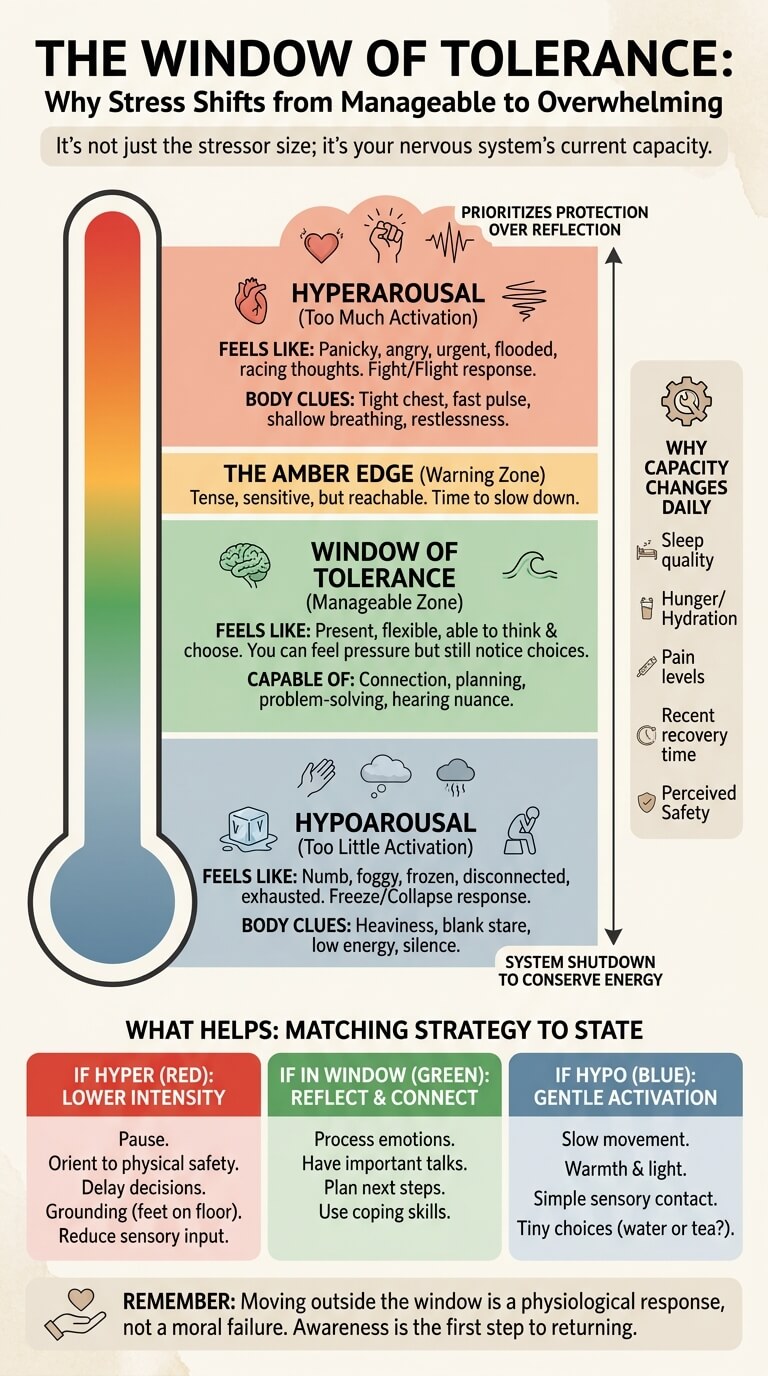
The window of tolerance is the range where your nervous system can handle stress without becoming overwhelmed, shut down, or unable to respond flexibly. Inside the window, you can still think, feel, connect, and choose. Outside the window, your body may move into hyperarousal, hypoarousal, or a stuck state that needs a different kind of support.
The window of tolerance is one way to understand stress psychology because it focuses on how much pressure the mind and body can handle before stress becomes overwhelming.
Why capacity changes from day to day
Your window is not a fixed personality trait. It can widen or narrow depending on sleep, hunger, pain, workload, past stress, safety, relationships, sensory load, health, and how much recovery you have had recently. That is why the same problem can feel workable on Friday morning but impossible after three nights of poor sleep and constant pressure.
What the Window of Tolerance Means
The manageable zone
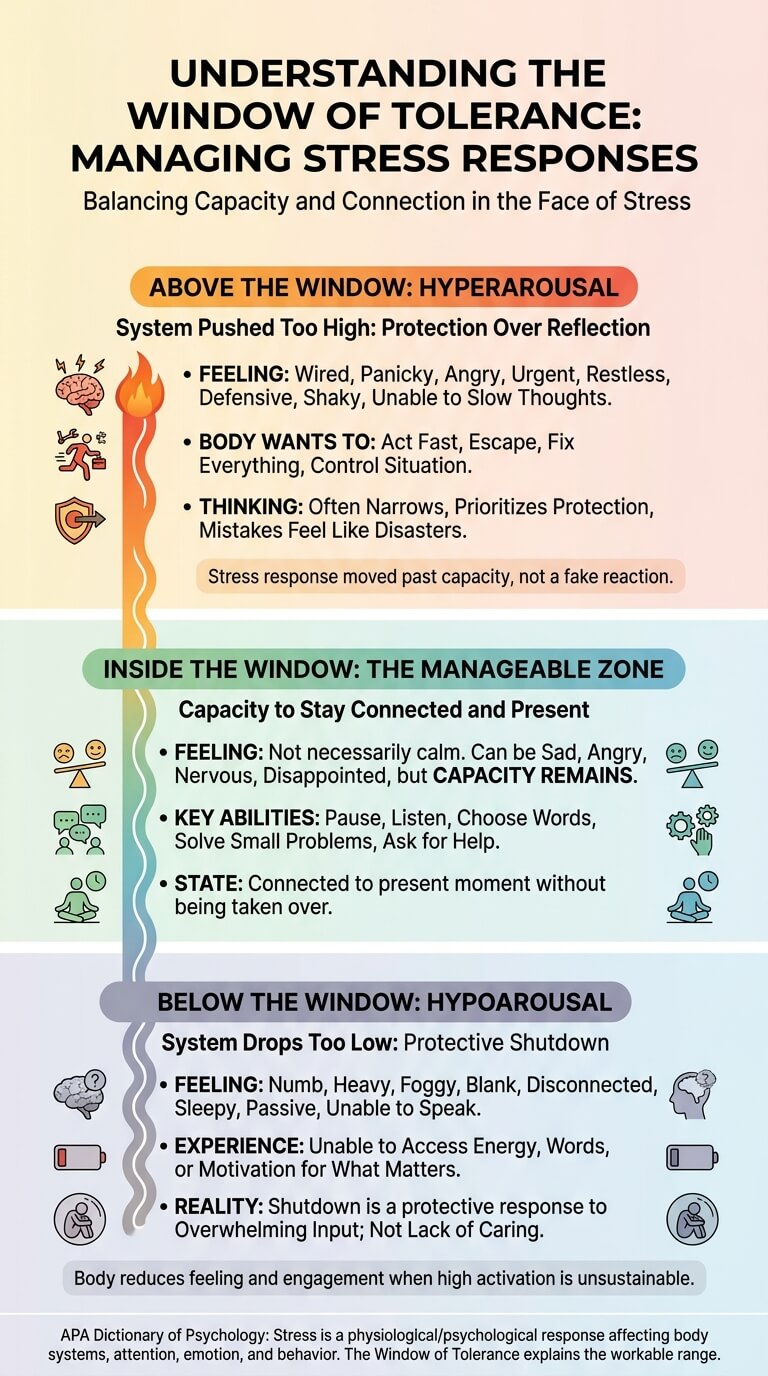
Inside the manageable zone, you are not necessarily calm or cheerful. You may feel sad, angry, nervous, disappointed, or embarrassed. The key difference is that you still have enough capacity to stay connected to the present moment. You can pause, listen, choose words, solve a small problem, or ask for help without feeling fully taken over.
When stress moves outside this workable range, nervous system dysregulation can show up as high activation, shutdown, or switching between both.
The APA Dictionary of Psychology defines stress as a physiological or psychological response to stressors, which means stress is not only a thought or mood. It affects body systems, attention, emotion, and behavior. The window of tolerance model helps explain when those changes stay within a workable range and when they become too much.
Hyperarousal above the window
Hyperarousal means the system is pushed too high. You may feel wired, panicky, angry, urgent, restless, defensive, shaky, or unable to slow your thoughts. Your body may want to act fast, argue, escape, fix everything, check repeatedly, or control the situation before it gets worse.
Above the window, thinking often narrows. The brain and body prioritize protection over reflection. A small delay may feel like rejection. A mistake may feel like disaster. A conversation may feel like threat. This does not mean your reaction is fake. It means the stress response has moved past your current capacity.
Hypoarousal below the window
Hypoarousal means the system drops too low. Instead of urgency, you may feel numb, heavy, foggy, blank, disconnected, sleepy, passive, or unable to speak. You might know something matters, but you cannot access energy, words, or motivation.
Below the window, people may confuse shutdown with not caring. In reality, shutdown can be a protective response when the system has too much to process. The body may reduce feeling, movement, and social engagement because high activation has become unsustainable.
Why the Same Stressor Can Feel Different on Different Days
Sleep, hunger, pain, and recovery
Basic body conditions shape capacity. When you are rested, fed, hydrated, and not in pain, the window is often wider. When you are sleep-deprived, hungry, sick, overstimulated, or physically uncomfortable, the window may narrow before the day even begins.
This is why a practical response often starts with the body, not with a perfect mindset. Eating a real meal, lowering noise, taking medication as prescribed, resting your eyes, or stepping into a quieter space may not solve the stressor, but it can increase the chance that you return to a workable zone.
Past stress load
Capacity is also affected by what has already happened. A single difficult email may not push someone outside the window. But the same email after months of uncertainty, caregiving, conflict, financial pressure, or health worries may land very differently.
The body keeps track of load. You may be reacting not only to the current moment, but also to the amount of stress your system has been carrying. The NIMH fact sheet on feeling stressed out explains stress and anxiety in a way that highlights when overwhelm becomes harder to manage and when extra help may be useful.
Safety, support, and control
Your window tends to widen when you feel physically and emotionally safe enough. It tends to narrow when you feel trapped, watched, threatened, humiliated, rushed, or powerless. Support also matters. A hard moment with one trustworthy person nearby may feel different from the same moment when you feel completely alone.
Control matters too. People often tolerate more intensity when they have choices. A stressful task can feel manageable if you can ask a question, take a break, change the order, or say no to something unreasonable. When there is no room to adjust, the nervous system may treat the situation as more dangerous.
A Simple Capacity Map for Everyday Stress

Green zone: present and flexible
Green does not mean easy. It means you can stay present. You may notice emotion without being swallowed by it. You can listen to feedback, read the room, use a coping strategy, and recover after a small rupture. This is the best zone for problem-solving, serious conversations, planning, and repair.
Amber edge: stressed but reachable
Amber is the edge of the window. You may feel tense, impatient, teary, defensive, distracted, or sensitive, but you are still reachable. This is the moment where small adjustments can prevent escalation. You might need a slower pace, a shorter conversation, a drink of water, a walk, or a clearer next step.
Red zone: too much activation
Red is above the window. You may feel sped up, cornered, furious, terrified, or desperate to make something happen. In this state, more information is not always helpful. Long explanations can feel like pressure. Your first task is usually to reduce intensity, not to win the point or solve the whole situation.
Blue zone: too little activation
Blue is below the window. You may feel flat, distant, frozen, ashamed, depleted, or unable to respond. In this state, pushing harder can make shutdown stronger. Your first task is usually gentle activation: light, movement, warmth, orientation, simple choices, or contact with a safe person.
| Zone | What it may feel like | What helps first |
|---|---|---|
| Green | Present, emotional but flexible, able to think | Use reflection, planning, conversation, or problem-solving |
| Amber | Stressed, tense, sensitive, still reachable | Slow the pace, name the edge, reduce one demand |
| Red | Panicky, angry, urgent, flooded, unable to settle | Pause, orient to safety, lower stimulation, delay big decisions |
| Blue | Numb, foggy, frozen, heavy, disconnected | Use gentle movement, warmth, light, simple contact, tiny choices |
How to Tell You Are Leaving Your Window
Body clues
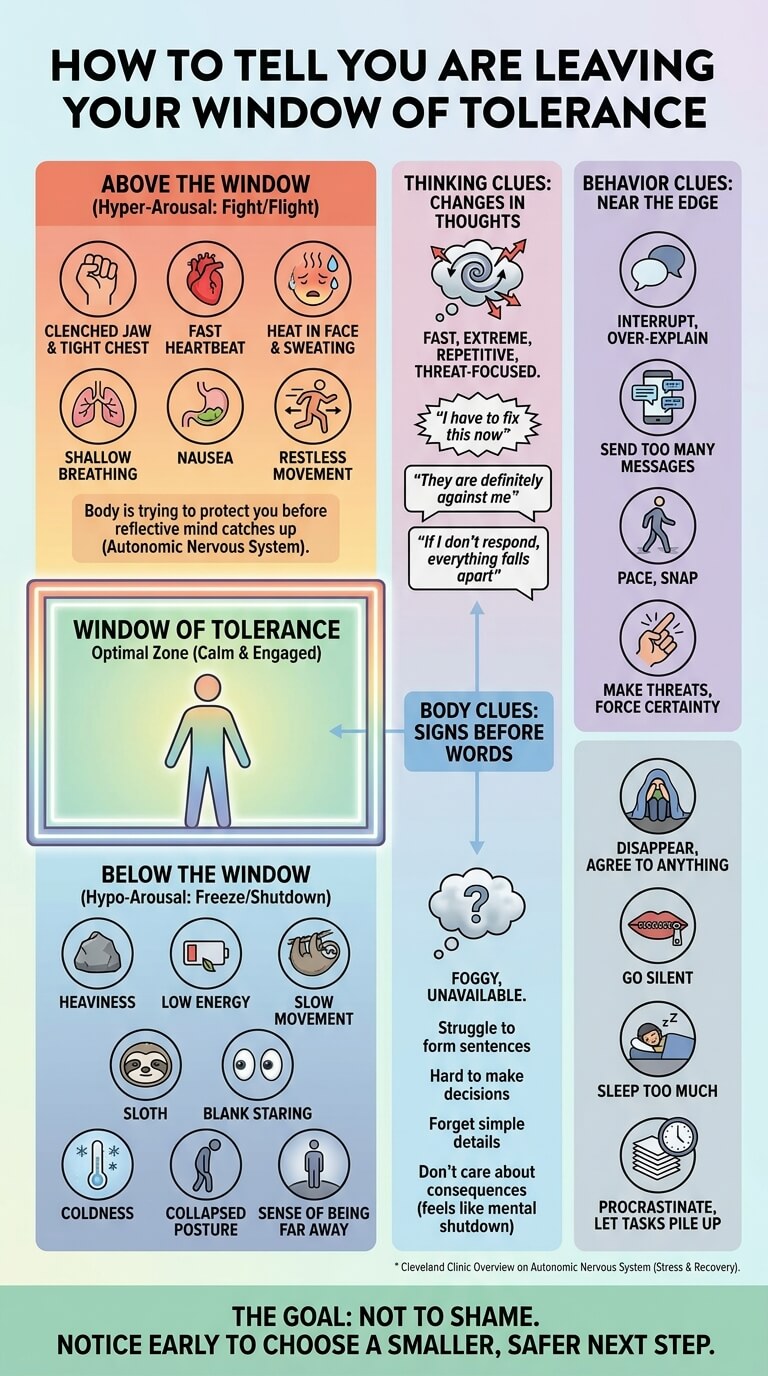
Body signs often show up before words do. Above the window, you might notice a tight chest, clenched jaw, fast heartbeat, heat in the face, shallow breathing, sweating, nausea, or restless movement. Below the window, you might notice heaviness, low energy, slow movement, blank staring, coldness, collapsed posture, or a sense of being far away.
A Cleveland Clinic overview of the autonomic nervous system explains how this system influences automatic body processes, including functions related to stress and recovery. In everyday terms, the body may be trying to protect you before your reflective mind has caught up.
Thinking clues
Thinking changes when you move outside the window. Above it, thoughts may become fast, extreme, repetitive, or threat-focused. You might think, “I have to fix this now,” “They are definitely against me,” or “If I do not respond immediately, everything will fall apart.”
Below the window, thinking may become foggy or unavailable. You may struggle to form sentences, make decisions, remember simple details, or care about consequences. This can look like avoidance from the outside, but internally it may feel more like mental shutdown.
Behavior clues
Behavior can also signal that you are near the edge. Above the window, you may interrupt, over-explain, send too many messages, pace, snap, make threats you do not mean, or try to force certainty. Below the window, you may disappear, agree to anything, go silent, sleep too much, procrastinate, or let important tasks pile up.
The goal is not to shame these behaviors. The goal is to notice them early enough that you can choose a smaller, safer next step.
Hyperarousal and Hypoarousal Are Not Moral Failures
Why high activation can feel like urgency
When the body is highly activated, urgency can feel like truth. Your nervous system may interpret waiting as danger, uncertainty as threat, and disagreement as attack. This is why red-zone decisions often feel necessary in the moment and too intense later.
The problem is not that you are weak or dramatic. The problem is that the system is using short-term protection. It wants immediate relief. That relief might come through arguing, escaping, controlling, checking, or forcing closure, even if those actions create problems afterward.
Why low activation can feel like disappearance
Low activation can feel like the lights dimming inside. You may still hear people talking, but the words do not land. You may want to explain yourself, yet nothing comes out. You may feel guilty for not responding, but guilt does not create energy.
Shutdown is often misunderstood because it is quiet. People may assume silence means agreement, indifference, manipulation, or laziness. Sometimes silence can be used in harmful ways, but hypoarousal is different: the person may be losing access to engagement rather than choosing punishment.
Why mixed states feel confusing
Some people feel both wired and shut down. They may look still while their mind is racing. They may feel exhausted but unable to sleep. They may avoid a task while obsessing about it. Mixed states are confusing because the body is sending both activation and collapse signals.
In a mixed state, the most useful next step is usually small and concrete. You may need to reduce stimulation and add gentle orientation at the same time, such as standing up, looking around the room, naming five neutral objects, then choosing one tiny action.
What Helps You Move Back Toward the Window

First, identify the state before choosing the strategy
A strategy that helps in red may not help in blue. If you are highly activated, an intense debate, complex worksheet, or major life decision may add fuel. If you are shut down, long breathing exercises may make you feel more collapsed. Matching the strategy to the state matters.
This is why stress coping styles should match the state you are in, not just the problem you are trying to solve.
Ask yourself: “Am I too high, too low, or still inside the window?” This question is simple, but it changes the goal. You stop asking, “What is wrong with me?” and start asking, “What does my system need first?”
If you are above the window
If you are above the window, aim to lower intensity. Reduce input where possible. Step away from the screen. Lower your voice. Unclench your hands. Put both feet on the floor. Look at the room and name what is actually happening now, not what might happen next.
Try a short phrase: “I am too activated to solve this well right now. I need ten minutes and I will come back.” The promise to return matters when another person is involved. A pause is more helpful when it has a plan, not when it becomes disappearance.
If you are below the window
If you are below the window, aim for gentle activation. Open a curtain. Drink water. Stand up. Stretch slowly. Put on a sweater if you feel cold. Walk to another room. Text a safe person one plain sentence: “I am shut down and need a little contact.”
Do not demand a full emotional explanation from yourself right away. A blue-zone system often needs movement and orientation before insight. Start with one small choice: shower or wash face, tea or water, sit outside or stand by the window.
If you are near the edge but still reachable
Amber is the best moment for prevention. You might say, “I can keep talking, but I need us to slow down,” or “I am getting close to overwhelmed, so I want to focus on one issue.” You can also change the conditions: sit instead of stand, write the main point, turn off background noise, or set a time limit.
Amber-zone skills are powerful because they happen before the system fully leaves the window. Many people only notice red or blue. Learning amber cues gives you more choices.
How the Window Changes in Relationships and Work
Conversations feel different when you are inside the window
Inside the window, you can hear nuance. A partner saying, “I need more help,” may sound like a request instead of an attack. A manager asking for revisions may feel disappointing instead of humiliating. A friend needing space may feel uncomfortable without becoming proof that you are unwanted.
Outside the window, the same words can sound more threatening. Red may push you to defend, chase, interrupt, or accuse. Blue may push you to disappear, agree automatically, or freeze. This is why timing matters. A difficult conversation may go better after food, rest, and a clear return plan.
Co-regulation does not mean someone else must manage you
Other people can affect your window. A steady tone, patient pacing, safe distance, and clear expectations can help the body settle. But co-regulation does not mean another person is responsible for absorbing every reaction or fixing your state for you.
A more balanced approach is shared clarity. One person can say, “I want to understand, and I also need us not to yell.” The other can say, “I am getting flooded. I need a pause and I will come back at 7.” This protects connection without turning one person into the other person’s regulator.
Capacity is different from permission
Understanding your window explains why certain reactions happen. It does not excuse harm. Being above the window does not make yelling, intimidation, or threats acceptable. Being below the window does not make repeated disappearance harmless. Capacity explains the starting point; responsibility is about what you do next.
This distinction matters because self-understanding should lead to safer behavior, not less accountability. A good next step might be apologizing for impact, changing the timing of hard talks, creating pause agreements, or getting outside help if the pattern keeps harming you or others.
What the Model Does Not Mean
It does not mean you should avoid all stress
The goal is not to live without stress. Some stress is part of learning, caring, grieving, working, parenting, creating, and repairing relationships. A useful window is not a bubble. It is the range where you can experience difficulty without losing all access to choice.
Growth often happens near the edge of the window, not far outside it. A manageable challenge can build confidence. Too much intensity can create shutdown or chaos. The art is learning the difference.
It does not mean every reaction is trauma
The window of tolerance model is often used in trauma-informed settings, and trauma can affect capacity. But not every stress reaction means trauma is the reason. Poor sleep, illness, grief, sensory overload, chronic pressure, conflict, or lack of support can also narrow the window.
A PubMed-indexed review on autonomic dysregulation and the window of tolerance model discusses the concept in relation to severe emotional trauma. For everyday readers, the model can still be a helpful map, as long as it is not used to diagnose yourself or someone else.
It does not replace therapy, medical care, or safety planning
The model can help with self-awareness, but it is not a treatment plan by itself. If stress reactions are severe, persistent, connected to trauma reminders, causing panic, affecting sleep or work, or leading to self-harm thoughts, professional support is worth considering.
If stress is happening in a relationship where there are threats, coercion, stalking, humiliation, physical danger, or retaliation, communication tips may not be enough and may not be safe. The National Domestic Violence Hotline offers safety planning guidance for people dealing with unsafe relationship dynamics.
Common Mistakes That Make the Window Narrower
Trying to reason while flooded
Reasoning is useful when enough capacity is available. When you are flooded, more reasoning can turn into arguing with your own nervous system. You may keep explaining, analyzing, rereading, or debating while the body gets more activated.
A better first step is to lower the intensity enough that reasoning becomes possible again. This might mean a pause, a change of location, a simpler sentence, or a clear agreement to return to the topic later.
Using the same coping tool for every state
One person may use breathing exercises for everything. Another may use productivity, distraction, talking, scrolling, food, silence, or sleep. Any tool can help in one state and miss the mark in another.
The question is not, “Is this coping tool good?” The better question is, “Does this tool fit my state right now?” If it brings you closer to present, safer, and more flexible, it may be useful. If it makes you more frantic or more collapsed, try a different approach.
Waiting until you are far outside the window
Many people wait until red or blue is obvious. By then, the system has fewer choices. The earlier signs matter: jaw tension, faster speech, blankness, heat, impatience, urge to quit, urge to send five messages, or sudden certainty that nothing will help.
Your edge cues are personal. Learning them is more useful than memorizing a perfect list. Keep a simple note after stressful moments: What was the first sign? What made it worse? What helped even slightly?
How to Gently Widen Your Window Over Time

Build recovery into normal days
A wider window is not built only during crisis. It is often built through ordinary recovery: sleep, movement, food, sunlight, hydration, realistic workload, meaningful connection, and breaks from constant stimulation. These habits sound basic because the nervous system is basic before it is complex.
Over time, chronic stress can shrink capacity when recovery is too limited.
The Mayo Clinic guide to stress symptoms notes that stress can affect the body, mood, and behavior. Recovery habits matter because stress is not limited to one mental channel.
Practice small doses of manageable discomfort
The window can grow when you meet manageable discomfort and recover afterward. This might mean making a short phone call you have been avoiding, naming one feeling in a conversation, asking one clear question, or staying present for a few seconds longer before escaping into distraction.
The dose matters. Too much challenge can flood the system. Too little challenge may not build confidence. Aim for a step that is uncomfortable but still possible.
Use reflection after the body has settled
Reflection works best when you are back inside the window. After a hard moment, ask: What zone was I in? What pushed me there? What did I need first? What did I do that helped? What made it worse? What would I like to try next time?
This is not a self-criticism exercise. It is pattern recognition. Over time, you may become faster at noticing the edge and kinder in how you respond to it.
When to Get Support
When stress reactions are severe or persistent
Consider professional help if you regularly feel unable to function, sleep, work, study, connect, or recover after stress. Support may also help if you often feel outside your body, lose time, have panic-like symptoms, rely on substances to get through the day, or feel trapped in cycles that are getting worse.
You do not need to wait until everything is falling apart. Getting help early can make patterns easier to understand and easier to work with.
When the environment is unsafe
If your window is constantly narrowed because someone threatens, controls, humiliates, monitors, isolates, or retaliates against you, the main issue is not only nervous system capacity. It may be safety. In that situation, private support from a qualified professional, advocate, or trusted local service may matter more than trying to communicate better with the unsafe person.
When physical symptoms worry you
Stress can affect the body, but not every physical symptom should be assumed to be stress. Chest pain, fainting, severe shortness of breath, new neurological symptoms, or symptoms that feel medically urgent deserve medical attention. A body-based explanation should never replace appropriate care.
FAQ
Is the window of tolerance the same as emotional regulation?
No. Emotional regulation is a broader set of skills for working with feelings, impulses, and behavior. The window of tolerance is a capacity map. It helps you understand whether your system is in a state where certain skills are likely to work. If you are far above or below the window, the first step may be state-shifting before reflection or conversation.
Can my window of tolerance get wider?
It can often become more flexible with recovery, supportive relationships, safer environments, body awareness, therapy when needed, and practice with manageable stress. The point is not to become calm all the time. The point is to recover more reliably and stay connected to choice during more situations.
Why do I shut down instead of getting angry?
Shutdown may happen when the system drops below the window, especially if the stress feels too intense, inescapable, or exhausting. It can look like not caring, but inside it may feel like blankness, heaviness, or loss of words. Gentle activation usually helps more than self-criticism.
What should I do if someone else is outside their window?
Lower the pressure if it is safe to do so. Use a steady tone, fewer words, more space, and simple choices. Do not corner, mock, chase, or demand instant insight. If the person is threatening, violent, coercive, or unsafe, prioritize distance and safety over calming the conversation.
Is being outside my window always a problem?
Not always. Everyone moves outside their ideal range sometimes. The concern grows when it happens often, lasts a long time, leads to harmful behavior, keeps you from functioning, or happens because the environment is unsafe. The goal is awareness, recovery, and better support, not perfection.
Key Takeaways
- The window of tolerance is the range where stress is present but still workable.
- Hyperarousal sits above the window and often feels urgent, panicky, angry, or flooded.
- Hypoarousal sits below the window and often feels numb, foggy, frozen, or disconnected.
- Your window can narrow because of sleep loss, chronic pressure, pain, threat, sensory load, or lack of recovery.
- The best first step depends on your state: lower intensity when too activated, gently activate when shut down, and use reflection when back inside the window.
- The model is useful for self-awareness, but severe distress, unsafe relationships, or worrying physical symptoms deserve appropriate support.
Final Thoughts
Window of tolerance psychology gives you a kinder and more practical question to ask during stress: “Am I still inside my workable range?” If the answer is yes, you can use reflection, conversation, planning, or problem-solving. If the answer is no, the first step is not to force yourself to think perfectly. It is to help your body move one small step closer to safety, presence, and choice.
Start by learning your edge cues. Notice what red feels like in your body. Notice what blue feels like in your behavior. Then choose one small state-matching action. Over time, those small moments of noticing and returning can become the foundation for a wider, steadier window.

Michael Reed is the Founder and Lead Writer at Psychology Exposed. He writes about human behavior, relationships, emotional patterns, self-awareness, and practical psychology topics using research-informed, easy-to-understand content.
Read More About Michael Reed: https://psychologyexposed.com/michael-reed/