
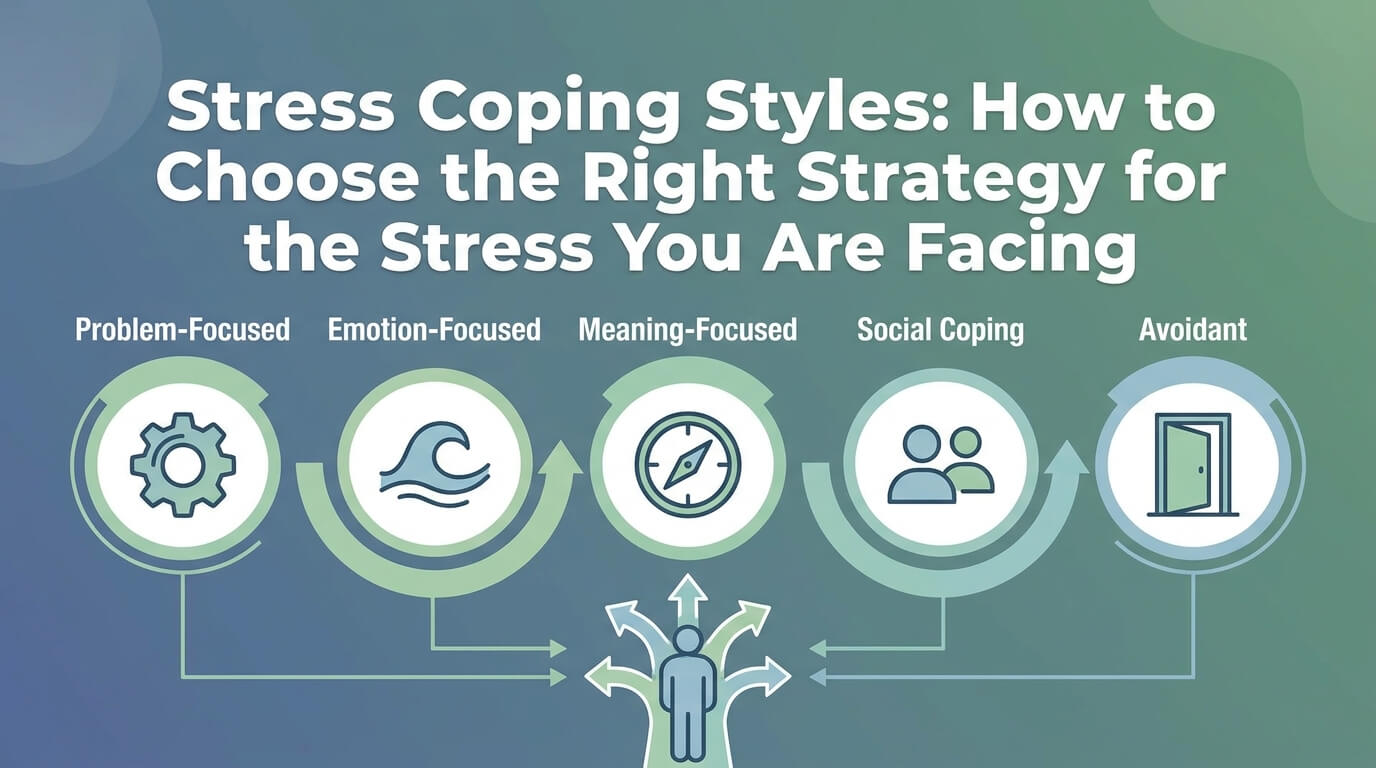
Stress coping styles are the patterns people use to handle pressure, uncertainty, overload, conflict, loss, or change. Some people immediately make a plan. Some calm their body first. Some talk it through with someone they trust. Some look for meaning. Some avoid the problem because they feel too tired, threatened, or overwhelmed to face it.
The useful question is not, “Which coping style is the best?” A better question is, “What kind of stressor am I facing, and what does this moment actually need?” The same strategy that helps in one situation can backfire in another. Planning can help when a problem is changeable, but it can become exhausting when the situation is outside your control. Rest can help when your body is depleted, but it may not help if the demand itself keeps growing.
This guide explains the major coping styles in practical language, shows how to match them to different stressors, and helps you notice when a coping habit has turned into avoidance, over-control, or isolation. It is educational, not a diagnosis or a replacement for professional care.
Quick Answer

The main idea behind coping styles
Stress coping styles are the ways you try to manage a stressful situation or your reaction to it. A coping strategy is an action or thought process used to meet a stressful situation or change your reaction to it. Common styles include problem-focused, emotion-focused, meaning-focused, social, and avoidant coping.
Coping styles make more sense when you first understand stress psychology, because different stress states call for different responses.
Why no coping style works for every stressor
No coping style is universally healthy or unhealthy. A strategy becomes helpful when it matches the stressor, your capacity, and the real level of control you have. If you can change the situation, action may help. If you cannot change it yet, calming, support, acceptance, or meaning may come first. If you are outside your capacity, your body may need settling before decision-making works well.
What Stress Coping Styles Mean
Coping as response to demand
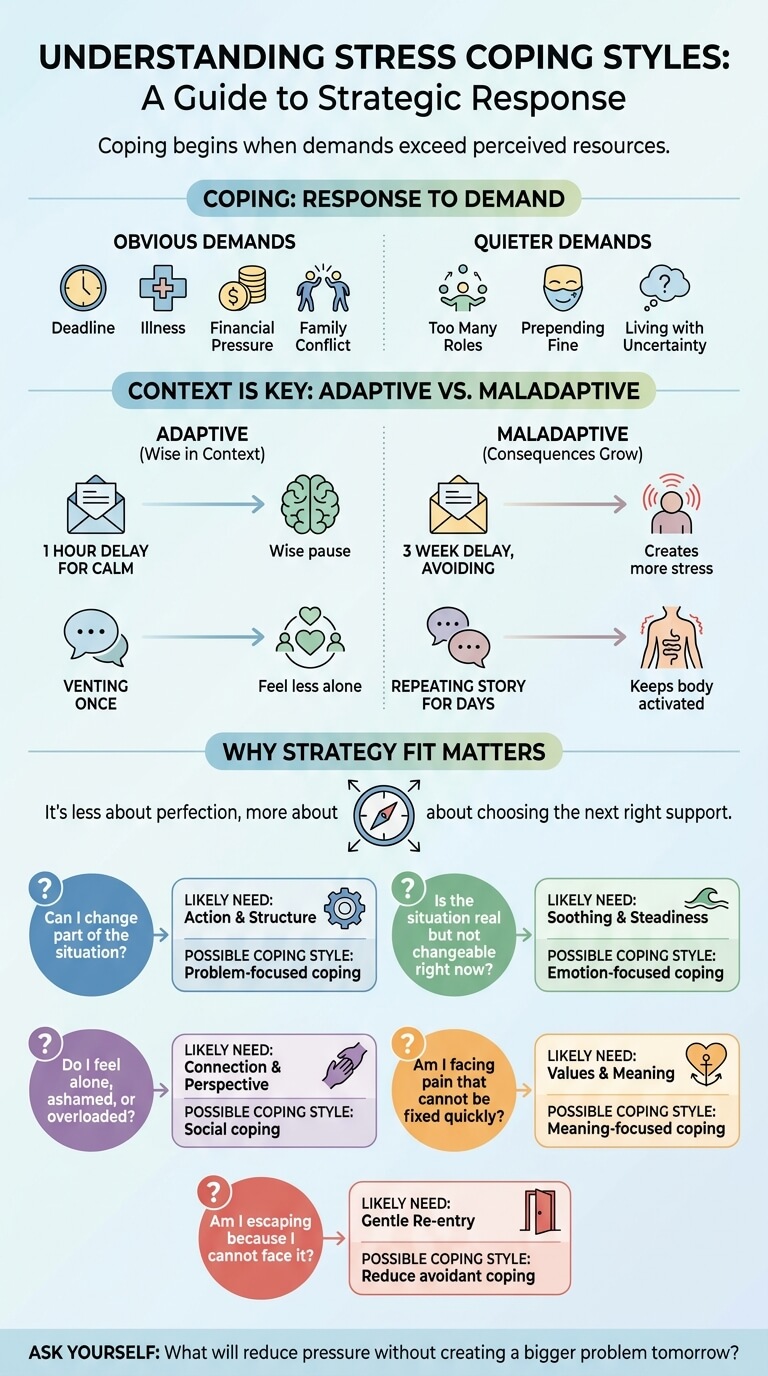
Coping begins when something asks more of you than you feel ready to handle. The demand may be obvious, such as a deadline, illness, financial pressure, family conflict, or a major decision. It may also be quieter, such as carrying too many roles, pretending you are fine, or living with uncertainty for too long.
Adaptive vs maladaptive depends on context
People often divide coping into “good” and “bad” categories, but real life is more flexible. Avoiding a difficult email for one hour so you can calm down may be wise. Avoiding it for three weeks while consequences grow may create more stress. Venting to a friend once may help you feel less alone. Repeating the same story for days without deciding what you need may keep your body activated.
Why strategy fit matters more than perfection
Useful coping is less about finding a perfect technique and more about choosing the next right kind of support. The key is fit. Ask: Is the stressor changeable? Is my body calm enough to think clearly? Do I need action, rest, connection, acceptance, or protection? What will reduce pressure without creating a bigger problem tomorrow?
| Question | Likely need | Possible coping style |
|---|---|---|
| Can I change part of the situation? | Action and structure | Problem-focused coping |
| Is the situation real but not changeable right now? | Soothing and steadiness | Emotion-focused coping |
| Do I feel alone, ashamed, or overloaded? | Connection and perspective | Social coping |
| Am I facing pain that cannot be fixed quickly? | Values and meaning | Meaning-focused coping |
| Am I escaping because I cannot face it? | Gentle re-entry | Reduce avoidant coping |
Problem-Focused Coping

When changing the situation is possible
Problem-focused coping means trying to change the stressor itself. The APA Dictionary describes problem-focused coping as directly confronting a stressor to decrease or eliminate it. This style tends to fit situations where you have some real control, even if that control is limited.
Use problem-focused coping when stress comes from unclear expectations, missing information, an overloaded schedule, an unresolved decision, a boundary that needs to be stated, or a practical obstacle that can be reduced. It is about acting where action is available.
Examples: planning, asking, prioritizing, removing friction
Problem-focused coping may look like making a list, breaking a large task into steps, asking for a deadline clarification, rescheduling a commitment, setting a boundary, preparing for a conversation, arranging childcare, organizing documents, or removing one source of friction from your day.
Planning can be especially useful for the Sunday scaries, when anticipatory stress builds before the week starts.
A simple version is the “next solvable step” method:
- Name the stressor in one sentence.
- Circle the part you can influence within the next 24 hours.
- Choose one action that reduces confusion, pressure, or delay.
- Stop after the first useful step instead of trying to fix the whole situation in one sitting.
When problem-solving becomes over-control
Problem-solving becomes stressful when it turns into endless fixing, researching, checking, arguing, or planning around things you cannot actually control. You may notice this when you keep rewriting the same message, making backup plans for unlikely outcomes, or trying to manage another person’s reaction before they have even responded.
If the same pressure keeps returning, chronic stress may need more than another productivity tactic.
A helpful check is: “Am I solving a problem, or am I trying to make uncertainty disappear?” If the answer is uncertainty, problem-focused coping may need to pause. You may need body calming, acceptance, or support before more planning helps.
Emotion-Focused Coping
When the situation cannot be changed immediately
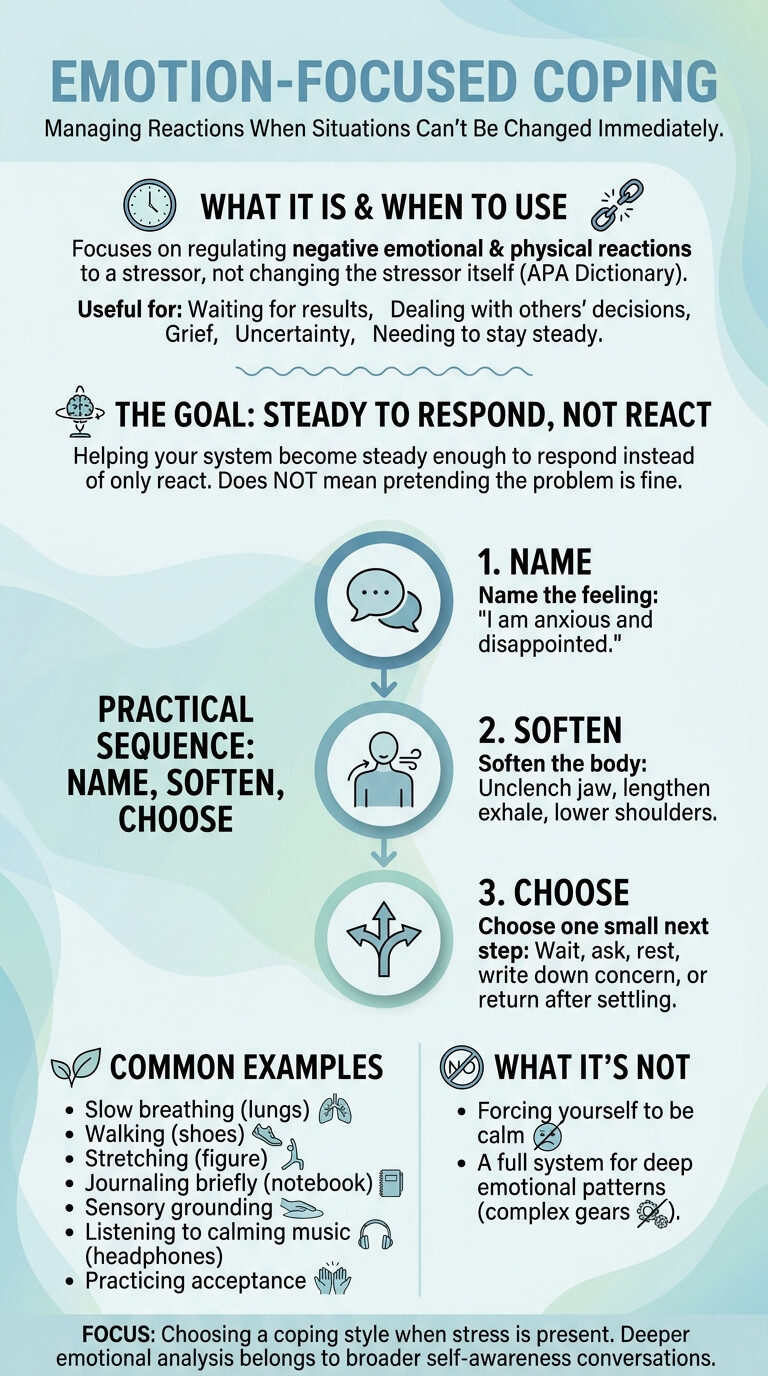
Emotion-focused coping helps you manage the emotional and physical reaction to stress when the situation cannot be changed right away. The APA Dictionary describes emotion-focused coping as focusing on regulating negative emotional reactions to a stressor rather than directly changing the stressor itself.
This style is useful when you are waiting for results, dealing with someone else’s decision, living through grief, facing uncertainty, or needing to stay steady before a difficult conversation. It does not mean pretending the problem is fine. It means helping your system become steady enough to respond instead of only react.
Examples: soothing, naming feelings, grounding, acceptance
Emotion-focused coping can include slow breathing, walking, stretching, naming what you feel, journaling briefly, grounding through the senses, listening to calming music, taking a shower, practicing acceptance, or reminding yourself that a feeling can be real without being the whole story.
A practical sequence is “name, soften, choose.” Name the feeling: “I am anxious and disappointed.” Soften the body: unclench your jaw, lengthen your exhale, lower your shoulders. Choose one small next step: wait, ask, rest, write down the concern, or return to the issue after your body settles.
How calming emotions differs from solving every feeling
Emotion-focused coping is not the same as forcing yourself to be calm. It is also not a full system for understanding every emotional pattern in your life. In this article, the focus is narrower: how to choose a coping style when stress is present. If you need a deeper look at emotions, impulses, triggers, or repeated reactions, that belongs to a broader emotional self-awareness conversation.
Meaning-Focused Coping
Reframing without denying pain
Meaning-focused coping helps you relate to a stressful situation through values, perspective, purpose, or interpretation. It can be useful when you cannot erase the stressor but still need to live with dignity, choice, or direction inside it. A review available through NCBI Bookshelf discusses meaning-focused coping as one broad way people manage the meaning of stressful events.
Healthy reframing does not deny pain. It does not say, “Everything happens for a reason,” when someone is grieving, trapped, or exhausted. A better version might be, “This is hard, and I still want to act according to my values,” or “I did not choose this situation, but I can choose the kind of person I want to be while I handle it.”
Values, perspective, and purpose
Meaning-focused coping often asks values-based questions. What matters most in this situation? What kind of response would I respect later? What is the smallest action that protects my dignity, health, family, learning, or future? What can I stop treating as a personal failure?
For example, a caregiver under stress may not be able to remove the whole burden. Meaning-focused coping might help them remember why care matters while also recognizing that love does not remove the need for rest, help, and practical limits. A student who fails an exam may use meaning to shift from shame to learning: “This result is painful, but it gives me information about how I need to study differently.”
When meaning-making becomes bypassing
Meaning-making becomes harmful when it skips reality. If you use perspective to avoid anger, grief, boundaries, or needed action, it may turn into bypassing. Phrases like “others have it worse,” “I should be grateful,” or “this will make me stronger” can silence real pain if they are used too quickly.
Meaning works best after the situation has been named honestly. A steady reframe keeps two truths together: “This hurts,” and “I can still choose my next step.” If a meaning-based statement makes you feel smaller, ashamed, or pressured to tolerate mistreatment, slow down and return to what is actually happening.
Social Coping and Co-Regulation
Asking for support
Social coping means using safe connection to help carry stress. This can include asking for advice, asking for help, telling the truth to someone who cares, being around steady people, or letting another person help you organize what feels too big alone. Mayo Clinic notes that social connection can help relieve stress because supportive contact can offer perspective, distraction, and help with life’s ups and downs in its stress relief guidance.
Asking for support does not have to be dramatic. You might say, “I do not need you to fix this. Can I talk it through for ten minutes?” Or, “I need help deciding what matters first.” Or, “Can you sit with me while I send this message?” Support is often most useful when the request is clear.
Being witnessed without being fixed
Sometimes stress feels worse because you are carrying it in isolation. Being witnessed means someone can hear you without rushing to judge, correct, compare, or solve. This is especially helpful when the stressor involves shame, grief, uncertainty, or a decision that is not simple.
A useful script is: “Can you listen first, then ask me if I want advice?” If you are supporting someone else, try: “Do you want comfort, problem-solving, or company right now?” That question can prevent accidental dismissal. Many people feel less overwhelmed once the support matches the need.
Choosing safe people
Not every person is safe for every stressor. A safe person does not use your vulnerability against you, mock your feelings, pressure you into a decision, gossip about your situation, or make your stress about them. They may not always say the perfect thing, but they leave you feeling more grounded, not more trapped.
If a person has a pattern of intimidation, humiliation, threats, retaliation, stalking, or control, coping advice should not focus on communicating better with them. In that kind of situation, privacy, support, and safety planning matter more than trying to explain yourself perfectly.
Avoidant Coping
Short-term relief vs long-term cost
Avoidant coping is any pattern that helps you get away from stress without actually facing, processing, or reducing it. It can look like procrastination, denial, numbing, excessive scrolling, overworking, sleeping to escape, avoiding messages, minimizing the problem, or pretending you are fine.
Avoidance is not always a character flaw. Sometimes it begins because your system is overloaded. The problem is cost. If avoidance gives you a short break and then lets you return with more capacity, it may be a pause. If it keeps the stressor growing, damages trust, increases shame, or narrows your life, it is becoming the main coping style.
Helpful pause vs harmful avoidance
| Pause | Avoidance |
|---|---|
| You name that you need time. | You disappear without a return plan. |
| You come back when calmer. | You keep delaying until pressure grows. |
| You use the break to settle. | You use the break to numb or deny. |
| You protect your capacity. | You protect yourself from all discomfort. |
| The problem becomes easier to face. | The problem becomes harder to face. |
Signs avoidance is becoming the main strategy
Avoidance may be taking over if you repeatedly miss deadlines, hide problems, delay medical or financial tasks, stop responding to people you care about, rely on substances to get through stress, or feel trapped by tasks that started small. Another sign is relief followed by dread. You escape for a while, then return to a larger version of the same stress.
The first step is not shame. It is a smaller doorway back into contact. Open the document for five minutes. Send a short “I need more time” message. Ask someone to sit with you. Make the appointment. Face one piece, not the whole mountain.
How to Match Coping Style to the Stressor

Is the stressor controllable?
Start with controllability. If you can change the situation, use some problem-focused coping. If you cannot change it right now, use emotion-focused, meaning-focused, or social coping first. A study on coping flexibility in daily stressors describes the idea of strategy-situation fit, including the view that problem-focused coping often fits higher-control situations while emotion-focused coping can fit lower-control situations, as discussed in research available through PubMed Central.
The window of tolerance can help explain why a strategy that works when you are calm may fail when you are highly activated or shut down.
Control is rarely all or nothing. You may not control a diagnosis, but you may control the next appointment, the questions you ask, or who knows what you are dealing with. You may not control a boss’s personality, but you may control documentation, boundaries, workload clarification, or whether you seek advice.
Is your body inside your window of tolerance?
Before choosing a strategy, check whether your body is able to use it. If you are panicked, frozen, furious, numb, or exhausted, a logical plan may not land. Your first coping step may be physical: breathe slowly, drink water, step outside, move your body, reduce stimulation, or contact a steady person.
Ask: “Can I think clearly enough to decide?” If not, do not force complex problem-solving. Settle first. Then choose. This is not avoidance if you return to the issue with a clear next step.
Do you need action, recovery, support, or acceptance first?
Use this simple decision map:
| If the main need is… | Try first… | Avoid making it worse by… |
|---|---|---|
| Unclear task | Ask, clarify, make a plan | Replaying the worry without action |
| Body overload | Ground, rest, lower stimulation | Forcing a big decision while flooded |
| Isolation | Talk to a safe person | Pretending independence means silence |
| Loss or disappointment | Name grief, seek comfort, allow time | Trying to optimize pain away |
| Ongoing unfair demand | Reduce load, set limits, seek help | Only soothing yourself while nothing changes |
Common Coping Mistakes

Trying to think your way out of body activation
When your body is highly activated, more analysis may create more stress. You may read, search, compare, rehearse, and still feel worse. That does not mean you are failing. It may mean the first task is not interpretation. It is settling your nervous system enough for thought to become useful again.
Coping skills can help with stress, but burnout vs stress matters when the solution requires workload changes, role clarity, recovery, or environmental support.
Try a physical reset before another mental loop: lengthen the exhale, feel your feet, unclench your hands, look around the room, or walk for a few minutes. Once the body is slightly steadier, one practical thought may help more than twenty panicked ones.
Resting without reducing demand
Rest matters, but rest alone may not solve stress if the same demand returns unchanged. If every weekend is spent recovering from an impossible week, the issue may not be your inability to relax. The issue may be that your life has too few recovery spaces and too many repeated demands.
This is where coping needs action. You may need to renegotiate workload, reduce commitments, ask for help, change routines, protect sleep, or stop treating every request as equally urgent. Rest fills the tank, but demand reduction stops the leak.
Problem-solving what needs grieving
Some stressors cannot be fixed quickly because they involve loss, disappointment, change, or limits. Trying to solve grief can make you feel broken for still hurting. If a relationship ends, a plan changes, or a hope collapses, coping may need space for sadness before strategy.
A helpful phrase is: “This may not be a problem to solve yet. It may be a loss to feel.” After the feeling has room, action may become clearer. You may still need decisions, but you do not have to skip the human part to look productive.
Using productivity to avoid support
Some people cope by becoming extremely capable. They organize, fix, perform, and handle everything alone. This can look impressive while still being lonely. If productivity keeps you from asking for support, it may become another form of avoidance.
Choosing a Coping Step After Fight, Flight, Freeze, Fawn, or Burnout
Why state comes before strategy
Different stress states need different entry points. If you are in fight mode, your first step may be lowering intensity before speaking. If you are in flight mode, it may be slowing down before making ten plans. If you are frozen, it may be tiny movement or one simple cue. If you are fawning, it may be pausing before agreeing. The coping style should meet the state you are actually in.
This is why a strategy that works for a calm person may not work when you are overwhelmed. A detailed action plan may help after you settle. Before that, it may feel like pressure. A supportive conversation may help if the person is safe. If they are not safe, privacy and outside support may matter more.
Why burnout may require environmental change
Burnout is not usually solved by one relaxation technique. If stress comes from repeated overload, lack of control, unfairness, value conflict, or work that drains care and energy over time, coping skills may need to be paired with changes in the environment. That could mean workload changes, role clarity, time off, medical or mental health support, or a serious review of what is sustainable.
Stress coping is still useful, but it should not become a way to tolerate an impossible system forever. If you keep needing more coping because the same demand keeps exceeding your capacity, the demand deserves attention too.
When to Get Support
Coping no longer helps functioning
Consider extra support if stress is affecting sleep, eating, concentration, work, school, parenting, relationships, or basic daily tasks for more than a short period. If stress or anxiety symptoms do not go away, interfere with daily life, or feel unmanageable, it is worth reaching for extra support.
Support can include a trusted person, a primary care clinician, a therapist, a counselor, an employee assistance program, a community service, or a crisis line when safety is involved. Seeking help does not mean your coping is weak. It may mean the stress is bigger than one person should carry alone.
Avoidance, substance use, or isolation escalates
If avoidance is growing, take it seriously. Warning signs include using alcohol, drugs, food, gambling, shopping, sex, scrolling, or sleep mainly to escape distress; withdrawing from people who care about you; or feeling unable to face normal responsibilities. These patterns can begin as relief and become another stressor.
A first step may be telling one safe person: “I am not coping well, and I need help getting back to the next step.” If you feel at risk of harming yourself or someone else, seek urgent support in your local area immediately.
Fear, coercion, or unsafe conditions limit choices
If stress is connected to threats, intimidation, coercion, stalking, humiliation, retaliation, or fear of someone’s reaction, do not treat it as a simple coping problem. Communication tips may be unsafe if the other person uses honesty against you. The National Domestic Violence Hotline offers safety planning information for people living with an abusive partner.
In unsafe dynamics, the priority is not to become calmer so you can tolerate more harm. The priority is support, privacy, safety, and careful planning with people or services that understand risk.
FAQ About Stress Coping Styles
What is the healthiest coping style?
The healthiest coping style is usually the one that fits the situation. Problem-focused coping can be helpful when a stressor can be changed. Emotion-focused coping can help when you need steadiness before action or when the situation is not changeable right now. Social coping helps when stress becomes too heavy to carry alone. Meaning-focused coping helps when you need values and perspective without denying pain.
Is avoidance always bad?
No. A short pause can be protective when you are overwhelmed, especially if you name it and return. Avoidance becomes a problem when it repeatedly delays necessary action, increases consequences, damages trust, narrows your life, or becomes your main way of handling discomfort. The difference is whether the pause helps you come back or helps you disappear.
What if I cannot change the stressor?
If you cannot change the stressor, shift the question from control to support. You may need to calm your body, ask for help, protect energy, grieve what is real, find meaning, or make a plan for what you can influence around the stressor. Acceptance does not mean approval. It means seeing reality clearly enough to choose the next workable step.
Why do coping skills stop working when I am overwhelmed?
Coping skills often stop working when your body is outside its usable capacity. In that state, advice can feel like pressure and planning can feel impossible. Start smaller. Lower stimulation, breathe, move, drink water, contact a safe person, or reduce the decision to one tiny step. Once your system is steadier, cognitive strategies may work better.
How do I know whether I need support or action?
You may need action if the stressor is clear and changeable. You may need support if you feel alone, ashamed, unsafe, confused, stuck in avoidance, or unable to function. Many situations need both. A good starting question is: “Would this feel easier if I had one safe person beside me while I take the next step?”
Key Takeaways
- Stress coping styles are not fixed identities. Most people use different styles in different situations.
- Problem-focused coping fits stressors you can influence, while emotion-focused coping helps when your reaction needs steadiness first.
- Meaning-focused coping can support values and perspective, but it should not deny pain or excuse harmful conditions.
- Social coping is not weakness. Safe support can reduce isolation and make action easier.
- Avoidance is not always bad, but it becomes costly when it keeps growing the problem you are trying not to face.
- The best first step is usually the one that matches control, body capacity, support needs, and safety.
Final Thoughts
Stress coping works best when it is flexible. Instead of judging yourself for how you reacted, pause and ask what your stress actually needs next. If the problem is changeable, take one concrete step. If your body is overloaded, settle first. If you are isolated, reach toward a safe person. If the situation cannot be fixed quickly, make room for grief, meaning, and support.
The goal is not to become a perfect coper. The goal is to stop using one strategy for every kind of stress. When your coping style fits the moment, you have a better chance of protecting your energy, facing reality, and choosing the next step with more steadiness.

Michael Reed is the Founder and Lead Writer at Psychology Exposed. He writes about human behavior, relationships, emotional patterns, self-awareness, and practical psychology topics using research-informed, easy-to-understand content.
Read More About Michael Reed: https://psychologyexposed.com/michael-reed/