
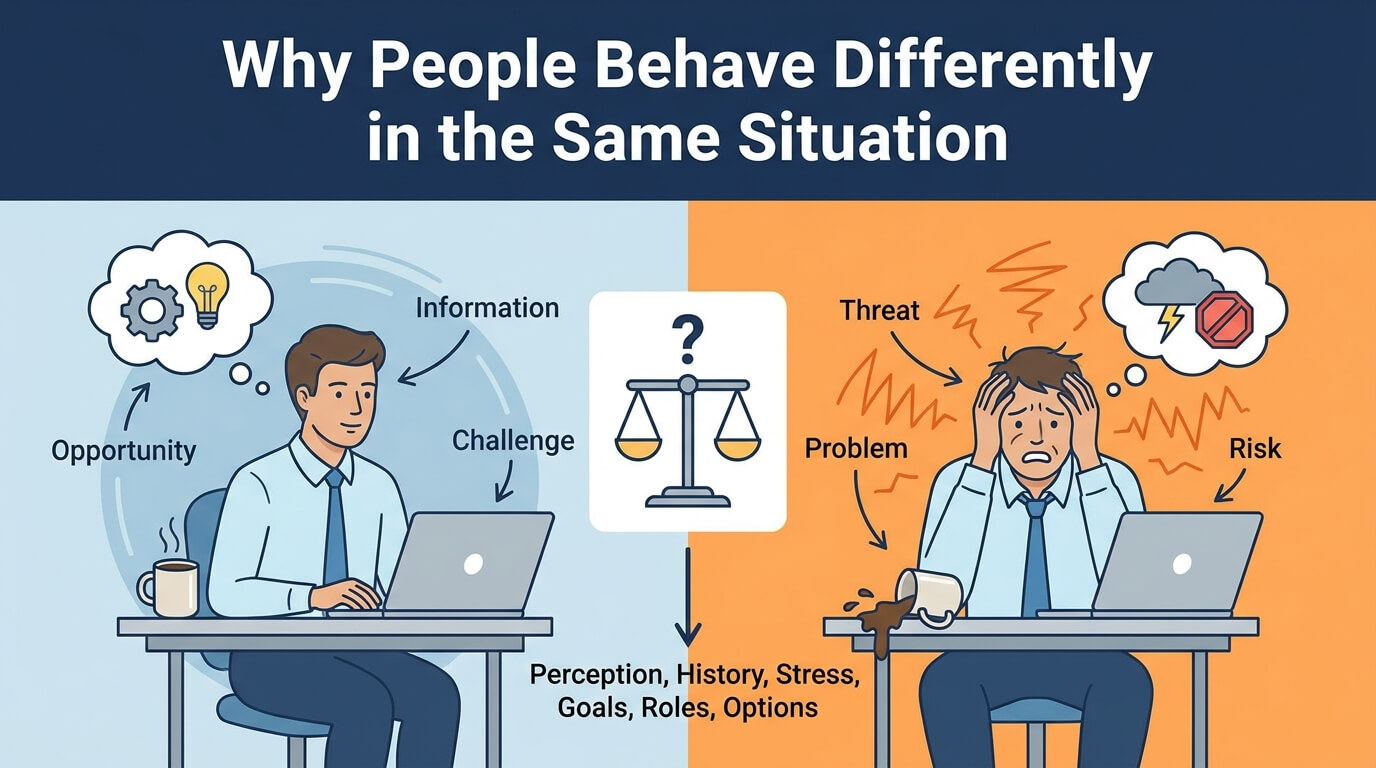
Two people can sit in the same meeting, hear the same comment, face the same delay, or walk into the same tense room and react in completely different ways. One person stays calm. Another gets defensive. One speaks up. Another goes quiet. One sees a chance to help. Another sees a risk. From the outside, it may look as if one person is simply stronger, kinder, more dramatic, or more difficult. In reality, the same situation is not always the same psychological experience.
Behavior is shaped by what a person notices, what they think the moment means, what their body is doing under stress, what they have learned before, what role they are in, what they want to protect, and what options seem available. A reaction is not only a personality trait showing itself. It is often the result of several forces meeting at once.
This article explains why people behave differently in the same situation without turning every reaction into a diagnosis or a fixed label. The focus is everyday behavior: conflict, pressure, choices, social settings, criticism, opportunity, uncertainty, and stress. If someone’s reaction involves panic that feels unmanageable, self-harm risk, violence, threats, coercion, or fear for safety, practical communication tips are not enough. Support from a qualified professional or emergency resource may be needed.
Quick Answer
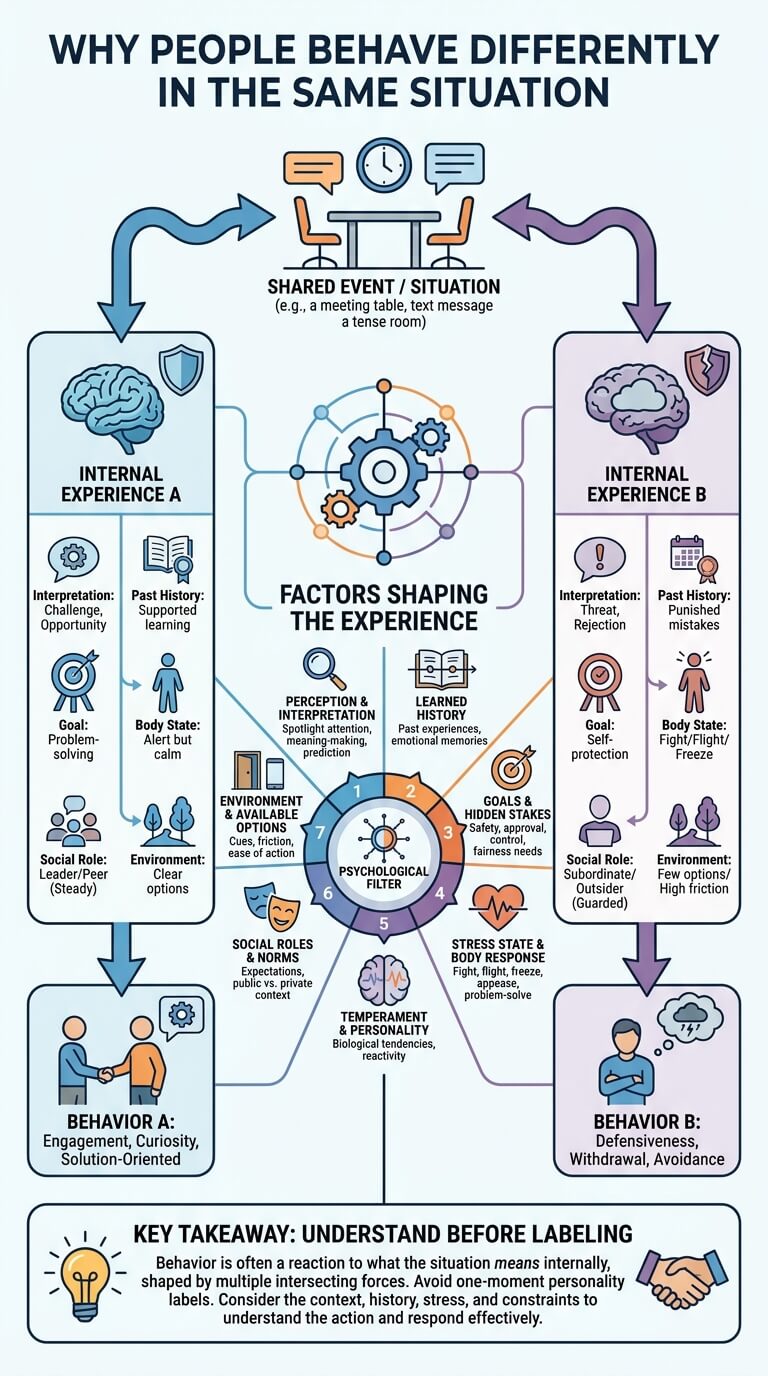
People behave differently in the same situation because they are not experiencing it in the same way. Their perception, past learning, temperament, stress level, goals, social role, sense of safety, and available choices all shape the response. One person may read the moment as a threat, while another reads it as a challenge, a chance to connect, or something not worth reacting to.
The Same Situation Is Not the Same Experience
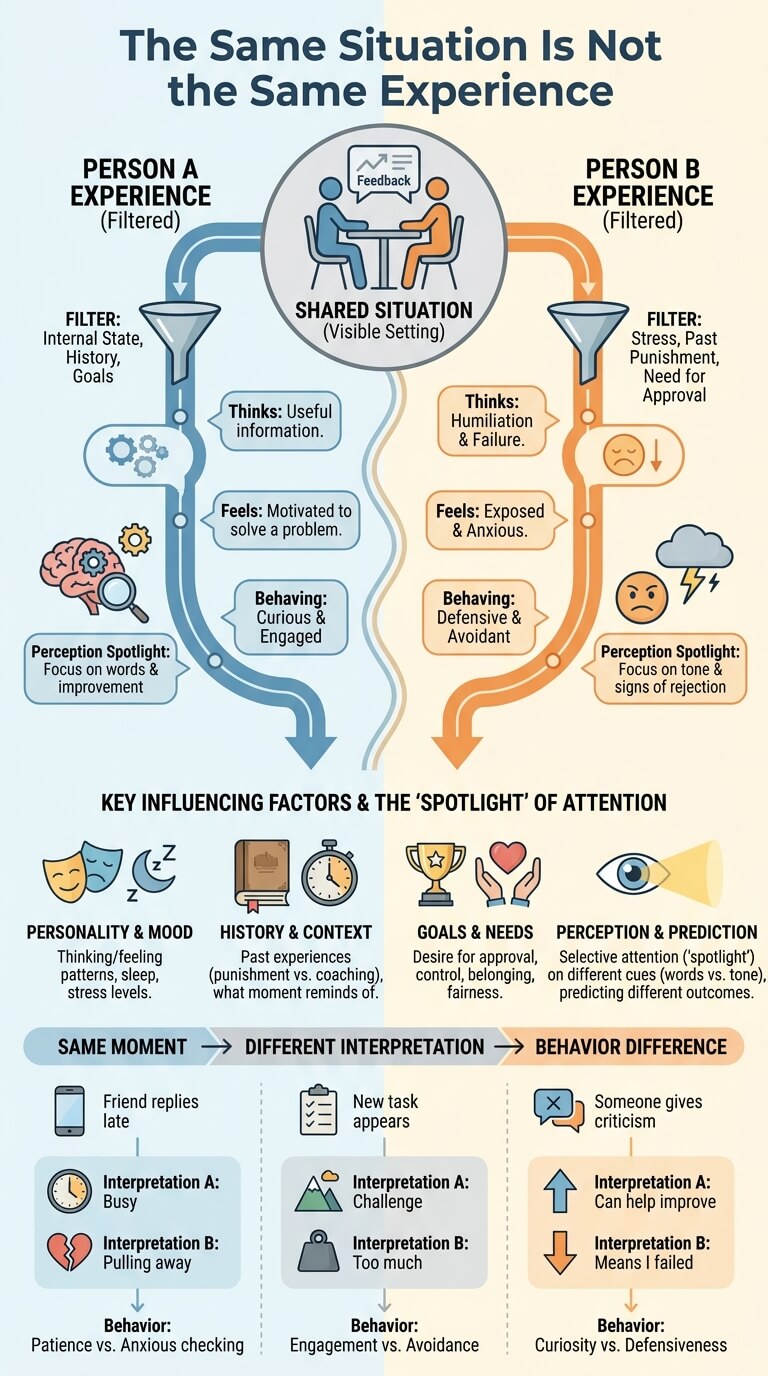
A situation is the visible setting. An experience is what the situation becomes inside a person’s mind and body. The setting may be shared. The experience is filtered. That is why two coworkers can receive the same feedback and have different reactions. One hears useful information. Another hears humiliation. One sees a problem to solve. Another feels exposed. Different reactions are a key part of human behavior psychology.
Psychology often studies behavior by looking at both the person and the situation. The American Psychological Association describes personality as involving individual differences in patterns of thinking, feeling, and behaving. Those differences matter, but they do not act alone. The same person may react differently depending on sleep, stress, audience, stakes, mood, power dynamics, and what the moment reminds them of.
People notice, interpret, and predict different things
Before people act, they select information from the moment. Nobody notices everything. One person hears the exact words. Another notices tone. Another watches facial expressions. Another thinks about what might happen next. Attention works like a spotlight, and different spotlights create different realities.
For example, imagine a manager says, “Can we talk after the meeting?” One employee may think, “There is a task to clarify.” Another may think, “I am in trouble.” A third may think, “This is my chance to ask for support.” The sentence is the same. The prediction is different. Behavior follows the prediction.
| Same moment | One possible interpretation | Another possible interpretation | Likely behavior difference |
|---|---|---|---|
| A friend replies late | They are busy | They are pulling away | Patience vs anxious checking |
| A group gets quiet | People are thinking | People are judging me | Reflection vs self-protection |
| A new task appears | This is a challenge | This is too much | Engagement vs avoidance |
| Someone gives criticism | This can help me improve | This means I failed | Curiosity vs defensiveness |
Context is filtered through history, goals, and state
People bring their history into the room even when they do not talk about it. A person who has often been punished for mistakes may react to feedback differently from someone who has mostly experienced feedback as coaching. A person who is exhausted may react more sharply than they would after rest. A person trying to prove themselves may see the same comment differently from someone who feels secure.
Goals also change the experience. If someone wants approval, they may scan for signs of rejection. If someone wants control, they may resist uncertainty. If someone wants belonging, they may agree too quickly. If someone wants fairness, they may react strongly to small signs of unequal treatment. The situation does not act on a blank mind. It meets a person with needs, expectations, memories, and body signals already active.
Different Interpretations Create Different Reactions

Behavior often begins with meaning. The mind asks, sometimes very quickly, “What is happening here?” and “What does this mean for me?” The answer may not be spoken. It may appear as a feeling, body tension, impulse, or action. People can react before they have fully named the interpretation driving them. For the broader process, how the human mind works explains perception, memory, emotion, and motivation.
Threat, opportunity, rejection, fairness, or control
The same event can be sorted into different meaning categories. A change at work may be a threat to one person and an opportunity to another. A partner’s quietness may feel like rejection to one person and simple fatigue to another. A rule may feel like fairness to one person and control to another.
Here is a simple way to understand it: people often react less to the event itself and more to the question the event seems to raise.
| If the moment seems to ask… | The person may feel… | The behavior may look like… |
|---|---|---|
| Am I safe? | Fear, alertness, tension | Withdrawing, arguing, freezing, checking |
| Am I respected? | Anger, shame, defensiveness | Correcting, pushing back, going silent |
| Do I belong? | Anxiety, eagerness, insecurity | People-pleasing, joking, overexplaining |
| Can I influence this? | Confidence or helplessness | Taking action or giving up early |
| Is this fair? | Irritation, moral concern | Speaking up, refusing, confronting |
How thoughts influence behavior in the moment
Thoughts do not have to be long or logical to shape behavior. A fast thought like “They are blaming me,” “I cannot handle this,” “This is my chance,” or “No one will help” can change posture, tone, timing, and choices. Often, the person only notices the reaction: the raised voice, the silence, the quick yes, the urge to leave.
The useful question is not only “What happened?” It is also “What did this person think was happening?” That does not mean every interpretation is accurate. It means behavior is easier to understand when you look at the meaning that made the action feel necessary.
Temperament, Personality, and Learned History

Some people are generally more cautious. Some are more sensation-seeking. Some recover quickly after stress. Some need more time. Some are socially bold in public and private in emotional conversations. These differences are real, but they should not be used as quick labels that explain everything. Individual differences overlap with nature vs nurture psychology.
Personality gives a tendency, not a full script. Learned history gives another layer. A naturally cautious person who grew up with steady support may handle risk differently from a cautious person who was mocked for mistakes. A bold person may step forward in a crisis but avoid emotional vulnerability. A sensitive person may notice subtle emotional shifts that others miss, but that sensitivity can feel tiring in tense spaces.
Why some people are more reactive, cautious, bold, or sensitive
Temperament refers to early appearing patterns in emotional and behavioral response, such as activity level, emotional reactivity, and adaptability. The APA Dictionary of Psychology defines temperament in terms of biologically influenced individual differences in emotional and behavioral tendencies. In plain language, people do not all start from the same baseline.
A more reactive person may feel emotional signals quickly and strongly. A more cautious person may look for what could go wrong before acting. A bolder person may move before all details are clear. A more sensitive person may pick up tension that others overlook. None of these reactions is automatically good or bad. Their value depends on the situation and what the person does next.
Why personality is only one part of the answer
It is tempting to explain different behavior by saying, “That is just their personality.” Sometimes this is partly true. But personality is not the whole explanation. A calm person can become reactive under enough pressure. A confident person can hesitate in an unfamiliar role. A quiet person can speak strongly when a value is threatened. A generous person can become guarded after repeated disappointment.
A more accurate view combines person and context: What tendencies does the person bring? What does the moment ask of them? What has this situation meant for them before? What are the consequences of each possible action? This prevents one-moment personality labels, such as “dramatic,” “cold,” “weak,” or “selfish,” from replacing understanding.
Stress State and Body Response

Stress can make people look more different than they usually are. Under pressure, the body prepares for protection, speed, energy, or shutdown. This can narrow attention, increase emotional intensity, and reduce the space between impulse and action.
The APA explains how stress affects the body, including activation of systems involved in the fight-or-flight response. This helps explain why behavior during stress may not look like a person’s calm, reflective self. It may be a protective state taking over.
Fight, flight, freeze, appease, or problem-solving
People do not all protect themselves in the same way. One person may argue. Another leaves. Another freezes and says nothing. Another tries to smooth the situation by pleasing others. Another becomes highly practical and starts solving the problem. These responses can come from body state, learning history, perceived power, and what has worked before.
| Stress response | What it can look like | What it may be trying to do |
|---|---|---|
| Fight | Arguing, challenging, raising intensity | Regain control or stop a perceived threat |
| Flight | Leaving, avoiding, changing the subject | Create distance from overwhelm |
| Freeze | Going blank, silence, difficulty responding | Pause action when options feel unsafe or unclear |
| Appease | Agreeing quickly, over-apologizing, pleasing | Reduce conflict or keep connection |
| Problem-solving | Organizing, planning, giving instructions | Restore order and reduce uncertainty |
These reactions are not diagnoses. They are descriptions of possible protective directions. A person may use different responses in different settings.
Why stress can narrow choices
When stress rises, people may lose access to options they could see when calm. A person who planned to speak carefully may snap. A person who wanted to ask for help may shut down. A person who usually listens may interrupt. The body is prioritizing quick protection, not perfect reasoning.
A PubMed Central article on subjective stress response notes that acute stress can include both physical signs, such as a racing pulse, and a subjective mental state. This matters because two people may be in the same external situation while their internal stress levels are not the same at all.
Social Roles and Group Norms
People do not behave only as individuals. They behave as employees, leaders, parents, guests, friends, strangers, students, customers, siblings, partners, and members of groups. Each role carries expectations about what is allowed, rewarded, punished, respected, or embarrassing. Roles and norms are where social psychology becomes especially useful.
Why people act differently as leader, guest, parent, employee, friend, or stranger
A person who speaks freely with close friends may stay careful at work. A parent may become more protective in public than they are alone. A new employee may avoid questions that a senior employee would ask easily. A guest may hide discomfort to avoid seeming rude. A leader may sound more certain than they feel because the role expects steadiness.
The role changes the cost of behavior. Speaking up as a friend may risk a small disagreement. Speaking up as a junior employee may risk reputation, opportunity, or income. This is why judging behavior without role context can be misleading.
Public behavior vs private behavior
People often behave differently when they are being watched. Public settings can increase self-consciousness, performance, pride, politeness, fear of judgment, or pressure to match the group. Private settings can make people more honest, relaxed, affectionate, irritable, playful, or withdrawn, depending on what feels safe.
The APA Dictionary of Psychology defines social role as a socially defined behavior pattern expected of a person in a particular setting or group. That definition helps explain why the same person may not look “inconsistent” as much as role-responsive. They are adjusting to what the setting seems to require.
Environment, Cues, and Available Options
Behavior is easier to understand when you look at what the environment invites. A room can invite focus or distraction. A phone can invite checking. A messy process can invite delay. A calm tone can invite honesty. A harsh tone can invite defensiveness. People respond not only to what they want, but to what the setting makes easy, visible, risky, or difficult. A reaction may depend on how environment shapes behavior.
How physical and digital context changes behavior
A person may be patient in person and harsher by text because digital communication removes facial expression, timing, and softening cues. Someone may eat differently when food is visible on the counter than when it is stored away. A person may work differently in a quiet room than in a noisy shared space. Someone may make bolder comments online than they would face to face.
None of this means environment controls people completely. It means environment changes the effort required for each action. When a behavior is easy, visible, and rewarded, it is more likely. When it is hidden, awkward, delayed, or punished, it is less likely.
Why options and friction matter
Two people may behave differently because they do not have the same options. One person can leave an argument safely. Another cannot. One person can say no without major consequences. Another depends on the person asking. One person has time, money, support, and privacy. Another is exhausted and under pressure.
Friction matters too. If the healthy choice requires planning, energy, transport, money, and social confidence, while the unhelpful choice is one tap away, behavior will often follow the path of least resistance. Understanding this prevents a shallow explanation like “They just did not care.” Sometimes the person cared but had fewer usable options in the moment.
Different Goals and Hidden Stakes
People often enter the same situation with different goals. One person wants accuracy. Another wants harmony. One wants speed. Another wants respect. One wants connection. Another wants control. These goals may not be obvious, but they can drive behavior strongly.
Safety, approval, achievement, belonging, control, and relief
A person seeking safety may avoid risk. A person seeking approval may agree quickly. A person seeking achievement may push through stress. A person seeking belonging may copy the group. A person seeking control may resist sudden changes. A person seeking relief may choose the fastest exit from discomfort.
These hidden stakes can turn a simple situation into something personal. A small correction may feel like a threat to competence. A delayed reply may feel like a threat to connection. A new opportunity may feel like a test of worth. A group decision may feel like a loss of control.
Why motives can conflict
People rarely have only one motive. A person may want honesty and approval. They may want closeness and independence. They may want progress and comfort. They may want fairness and peace. When motives conflict, behavior may look confusing because the person is pulled in more than one direction.
For example, someone may say yes to help a friend because belonging matters, then feel resentful because rest also mattered. Someone may avoid a promotion because achievement matters, but safety matters more in that season. Someone may speak sharply because fairness matters, then regret the damage to connection. Different behavior often reflects different priorities becoming louder under pressure.
How to Understand Different Reactions Without Overjudging
Understanding why people behave differently does not mean excusing every action. Harmful behavior still has consequences. But understanding helps you respond more accurately. It lets you separate a person’s reaction from a permanent label and ask better questions about what shaped the moment.
Ask what the situation meant to that person
A useful first question is: “What did this seem to mean to them?” The answer may be wrong, incomplete, or emotionally loaded, but it often explains the behavior better than the event alone. You can ask this about yourself too: “What did I think was at stake?”
- Did this feel like criticism, rejection, danger, pressure, unfairness, or opportunity?
- Did the person feel watched, trapped, rushed, responsible, ignored, or replaceable?
- Was the reaction stronger because of past experiences, current stress, or a repeated pattern?
- What did the person seem to protect: pride, safety, belonging, control, rest, or hope?
Look at context, pattern, and consequences
One reaction does not tell the whole story. Look at whether the behavior is unusual or repeated. Look at what came before it. Look at what happens after it. A quiet response may be thoughtful in one person, overwhelmed in another, and unsafe silence in a different context. A loud response may be confidence, panic, anger, or a learned way to be heard.
Context, pattern, and consequences help you avoid two mistakes: dismissing a meaningful reaction as “just personality,” and turning one moment into a permanent judgment.
Avoid one-moment personality labels
Labels are tempting because they simplify. “She is dramatic.” “He is cold.” “They are weak.” “I am just bad under pressure.” These labels may feel clear, but they often stop curiosity too early. A better description is more specific: “She became louder when she felt dismissed,” “He went quiet when the conversation moved fast,” or “I hesitated when I thought I might be judged.”
Specific descriptions make change more possible. A person cannot do much with “I am impossible.” They can work with “I shut down when I feel cornered and need a way to ask for a pause.”
What This Helps Explain Next
Once you understand why reactions differ, several other behavior questions become easier to study. You can look at what people bring into a moment, what the situation activates, and what keeps a response going.
Nature and nurture
Some differences come from temperament, biology, and inherited tendencies. Others come from family, culture, learning, opportunity, stress, and social experience. Most real behavior reflects both. Asking whether someone’s reaction is “nature or nurture” is often less useful than asking how their tendencies and experiences interact in this specific moment.
Social influence
Groups change behavior through norms, approval, status, modeling, pressure, and belonging. A person may act bravely with supportive people and cautiously with judgmental people. They may become more helpful when helping is normal, or more silent when silence is rewarded. Social influence does not erase individual choice, but it changes the emotional cost of that choice.
Environment and behavior
Settings make some actions easier than others. The same person may be focused in one room and scattered in another, patient in one conversation and defensive in another, generous in one group and guarded in another. Understanding environment helps you design better conditions instead of relying only on willpower or blame.
FAQ About Different Behavior in the Same Situation
Why do I stay calm while someone else panics?
You may read the situation as manageable while the other person reads it as threatening, overwhelming, or urgent. Differences in stress level, past experience, confidence, sleep, support, and perceived control can all matter. Staying calm does not automatically mean you care more or are stronger. Panicking does not automatically mean someone is weak. It may mean their body is reacting to danger, uncertainty, or overload more intensely in that moment.
Can two people remember the same event differently?
Yes. Memory is influenced by attention, emotion, expectation, stress, meaning, and what a person focused on during the event. Two people may honestly remember different details because they noticed different parts of the same moment. This does not mean every memory is equally accurate. It means disagreement about memory is not always deliberate lying. Details, timing, and outside evidence can help when accuracy matters.
Does different behavior mean different personality?
Sometimes personality plays a role, but it is not the only explanation. Different behavior may also come from stress, role expectations, social pressure, learned history, current goals, power differences, fatigue, or available options. A better question is: “Is this behavior consistent across many situations, or did this setting bring out a specific response?”
Why do I act differently around different people?
Different people make different parts of you feel safe, judged, respected, needed, controlled, accepted, or dismissed. You may be playful with one friend, careful with a supervisor, guarded with a critical relative, and open with someone who listens well. This does not necessarily mean you are fake. It may mean your behavior is adapting to the emotional rules of each relationship.
When should different reactions be taken more seriously?
Take reactions more seriously when they involve threats, violence, coercion, stalking, humiliation, panic that disrupts daily life, self-harm thoughts, or feeling unsafe. Also pay attention when a reaction repeatedly damages relationships, work, health, or decision-making. In those cases, understanding the reaction is helpful, but support, boundaries, medical care, or safety planning may be more important than trying to analyze the situation alone.
Key Takeaways
- The same situation can become different experiences because people notice, interpret, and predict different things.
- Personality matters, but stress state, history, goals, roles, environment, and available options also shape behavior.
- People often react to what the situation seems to mean, such as threat, rejection, opportunity, unfairness, or loss of control.
- Stress can narrow choices and make fight, flight, freeze, appease, or problem-solving responses more likely.
- Understanding behavior does not mean excusing harm. It means asking better questions before using permanent labels.
- When reactions involve danger, panic, coercion, self-harm risk, or repeated harm, practical insight should be paired with appropriate support.
Final Thoughts
People behave differently in the same situation because the visible event is only part of the story. Each person brings a different body state, history, role, interpretation, goal, and set of options. A reaction that looks confusing from the outside may make sense once you understand what the moment seemed to mean from the inside.
The next time someone reacts differently than you expected, try slowing down before labeling them. Ask what they may have noticed, feared, protected, wanted, or misunderstood. Do the same for yourself. This does not remove accountability, but it makes understanding more accurate and change more possible.

Michael Reed is the Founder and Lead Writer at Psychology Exposed. He writes about human behavior, relationships, emotional patterns, self-awareness, and practical psychology topics using research-informed, easy-to-understand content.
Read More About Michael Reed: https://psychologyexposed.com/michael-reed/